
What Is Predictive Maintenance? A Practical Guide


Predictive maintenance is a strategy that uses sensor data and analytics to predict when equipment will fail, so maintenance is performed just before failure rather than on a fixed schedule or after a breakdown. The core goal is to reduce unplanned downtime: instead of reacting when unexpected equipment failures stop a machine or replacing parts on a calendar regardless of their condition, a predictive maintenance program detects the early warning signs of developing failures and schedules intervention at the optimal moment.
Key Takeaways
- What it is: a condition-based maintenance strategy that uses real-time sensor data and analytics to predict equipment failure before it occurs.
- How it differs: preventive maintenance replaces parts on a fixed schedule (whether or not they need it); reactive maintenance waits for breakdowns; predictive maintenance acts when data indicates failure is approaching.
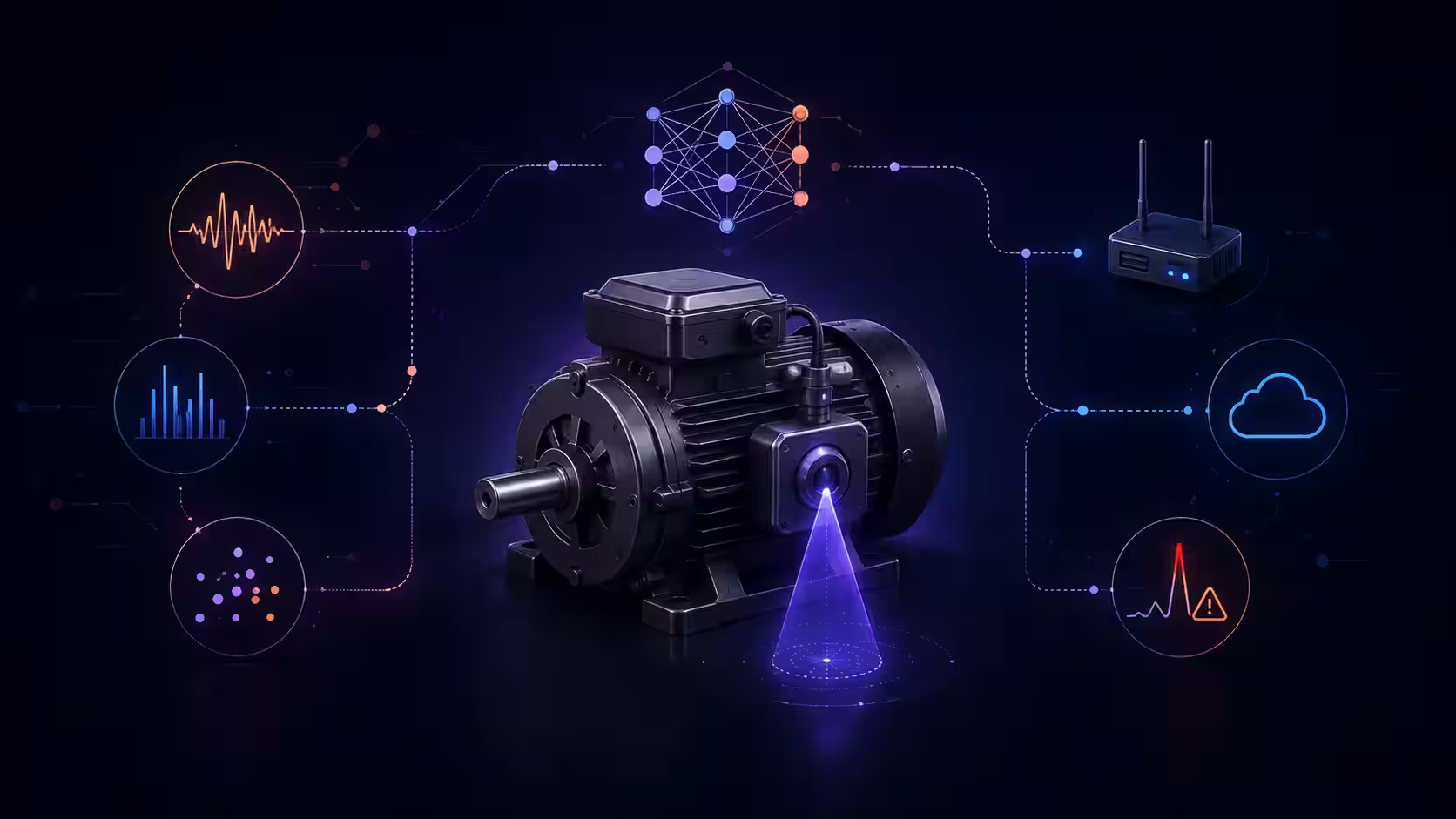
- How it works: IoT sensors collect real-time data from equipment, machine learning models analyze the data to identify failure patterns and predict remaining useful life, and alerts trigger scheduled maintenance before the failure occurs.
- The benefits: 18 to 25% reduction in maintenance costs, 30 to 50% reduction in unplanned downtime, and extended equipment lifespan, with documented ROI of 10:1 to 30:1 within 12 to 18 months of implementation (McKinsey, 2020/2023).
- How to get started: select one high-criticality asset class as a pilot, instrument with sensors, run the analytics, validate the model against real failure events, then scale.
What Predictive Maintenance Means
Predictive maintenance uses real-time data to assess equipment health and condition, identifying early signs of wear and failure before they cause a breakdown. It is a form of condition monitoring: rather than assuming all equipment of a given type will wear at the same rate and replacing parts on a calendar, a predictive program monitors the actual physical condition of each specific piece of equipment and determines when maintenance is needed based on what the sensors are observing. Predictive maintenance relies on the continuous availability of high-quality sensor data: a program that monitors a compressor only when someone remembers to check the dashboard is not a predictive program, it is a manual inspection with a digital interface.
The core components are:
Sensors installed on or near the equipment to measure physical parameters that indicate equipment health: vibration, temperature, pressure, current draw, acoustic emissions, oil particle count, and others depending on the equipment type and failure modes of interest.
Data pipelines that collect, transmit, and store the sensor data in a format that analytics systems can access in real time and historically. Transmitting sensor data reliably from field devices to the analytics layer requires attention to connectivity, buffering, and data quality validation at each stage of the pipeline. Without reliable, complete data pipelines, sensor data is collected but not actionable. These three components together enable predictive maintenance: without sensors, there is no signal; without a reliable pipeline, sensor data never reaches the model; without analytics, data accumulates without generating predictions.
Analytics and machine learning that identify patterns in sensor data, correlate those patterns with known failure events, and generate predictions about when a specific piece of equipment is likely to fail or requires maintenance intervention.
Together these components track equipment health continuously, generating a real-time picture of each asset's condition that was previously unavailable between inspection intervals.
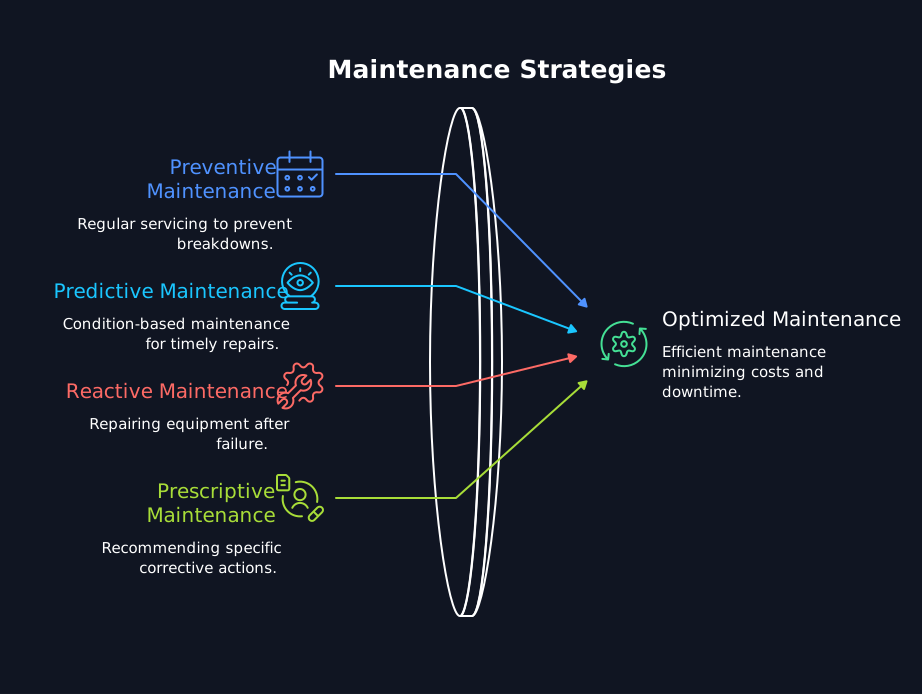
Predictive vs Preventive vs Reactive Maintenance
Comparison table
| Strategy | When maintenance happens | Data reliance | Cost and risk profile |
|---|---|---|---|
| Reactive (corrective) | After failure | No data required before the failure | Low planning cost, high breakdown cost, and unplanned production loss |
| Preventive | On a fixed schedule based on time or usage | Historical failure-rate data used to set maintenance schedules | Predictable cost, some unnecessary replacements, and planned downtime |
| Predictive | When sensor data indicates that failure is approaching | Real-time condition-monitoring data | Higher setup cost, lower ongoing maintenance cost, and minimal unplanned downtime |
| Prescriptive | When the system recommends or automatically executes a specific action | AI models integrating multiple data sources | Highest capability and implementation complexity; recommends specific actions to prevent failures |
Preventive maintenance aims to eliminate unexpected breakdowns by performing servicing at fixed intervals regardless of actual equipment condition: replace the bearing every 6,000 hours whether or not it shows any sign of wear. Predictive maintenance replaces fixed maintenance schedules with condition-driven intervals that reflect the actual state of each asset rather than a generic fleet average, eliminating unnecessary replacements and the planned production interruptions that may not have been needed.
Reactive maintenance (corrective maintenance) waits until equipment breaks: the simplest maintenance strategy, requiring no planning or instrumentation, but the most expensive when failure causes unplanned production downtime, emergency repair labor, and potentially secondary equipment damage. Maintenance tasks performed reactively are more expensive than the same tasks performed on a planned schedule, because emergency labor rates, expedited parts procurement, and secondary damage all compound the base repair cost.
Predictive maintenance focuses on the specific condition of each individual asset rather than the statistical average behavior of a population, which is why two identical motors in the same application can have different maintenance intervals under a predictive program. The result is that maintenance happens when it is actually needed: not so early that components are replaced with usable life remaining, and not so late that a failure causes an unplanned production halt.
Prescriptive maintenance goes one step further, recommending specific corrective actions to prevent failures and, in some implementations, automatically triggering those actions without human decision steps in the loop.
For a full technical comparison, see predictive maintenance vs preventive maintenance.
How Predictive Maintenance Works
A well-designed predictive maintenance strategy converts raw sensor data into scheduled maintenance actions through a defined predictive maintenance process. Understanding that process end-to-end, from sensor to alert to work order, is what separates programs that deliver measured results from those that generate dashboards nobody acts on. The four stages are:
1. Data collection. IoT sensors installed on the monitored equipment collect real-time sensor data continuously: a vibration sensor on a motor bearing might report 100 times per second; a temperature sensor on a heat exchanger might report every second; an oil particle counter on a gearbox might sample every few minutes. The data pipeline (edge gateway, historian, and analytics platform) moves this data from the sensor to the analytics system with the appropriate latency for the use case. See industrial DataOps for the data pipeline design.
2. Pattern detection and failure prediction. AI models analyzing data in real time alongside historical records identify the patterns that precede failures. A machine learning model trained on vibration data from a population of similar motors learns to recognize the frequency shift that indicates a bearing entering the early stage of fatigue failure: a change too subtle for a human to detect in a noisy plant environment, but statistically significant across thousands of sensor readings. Machine learning improves prediction accuracy over time as the model sees more failure events and refines its understanding of the specific asset population it is monitoring. AI-driven predictive maintenance, which applies deep learning and neural network models to complex multi-sensor datasets, has extended the detectable lead time for certain failure modes beyond what classical signal analysis approaches can achieve.
3. Alert generation. When the model identifies a pattern that indicates an equipment failure is approaching, it generates a structured alert: the asset, the predicted failure mode, the estimated time window to failure, and the recommended maintenance action. This alert is routed to the maintenance team through whatever work order management system they use, triggering a scheduled maintenance event.
4. Scheduled repair. The maintenance team plans the repair during the next available maintenance window, before the predicted failure occurs. Maintenance is performed on a planned schedule, at a planned time, with the right parts and labor already arranged.
For the detailed IoT implementation, see IoT predictive maintenance. For the machine learning techniques, see predictive maintenance machine learning.
Predicting Equipment Failure
Predictive maintenance identifies potential equipment failures before they cause production stoppages by monitoring the physical signatures that failure modes produce as they develop. Predictive analytics models detect anomalies in sensor data that fall outside the statistical envelope of normal equipment behavior, flagging them for human or automated review before they progress to a failure event. The goal is to detect early warning signs when the developing failure is still weeks or months away, not days, so maintenance can be scheduled without disrupting production. Avoiding a system failure is categorically different from managing a predictable maintenance event: the first causes an uncontrolled production stop; the second is a scheduled activity with planned parts, labor, and duration. Different equipment types and failure modes produce different detectable signals:
Vibration is the primary indicator for rotating machinery (motors, pumps, compressors, fans, gearboxes). Bearing defects, imbalance, misalignment, and looseness all produce characteristic vibration frequency components that change as the defect progresses. A bearing in the early stage of outer-race defect produces a specific frequency pattern at the bearing defect frequency (a function of bearing geometry and rotational speed); as the defect grows, the amplitude increases and sidebands appear around the defect frequency, all detectable through spectral analysis before the bearing reaches failure.
Temperature indicates problems including overloading, lubrication failure, cooling system degradation, and electrical insulation breakdown. A motor winding temperature that has increased 10°C from its historical baseline without a corresponding increase in ambient temperature or load indicates a developing problem.
Current draw (motor current signature analysis) detects rotor bar defects, eccentricity, and load anomalies without requiring physical access to the motor, since the current is measured at the electrical panel rather than at the motor itself.
Acoustic emission and ultrasound detect early-stage bearing and gear defects, compressed air leaks, and partial electrical discharge, often detecting problems earlier than vibration analysis.
Process parameters (pressure, flow, efficiency) detect degradation in process equipment: a heat exchanger that requires a higher differential pressure to achieve the same thermal duty is fouling; a pump whose efficiency has dropped below its performance curve is wearing internally.
Remaining-useful-life (RUL) estimation converts these early-warning signals into a time forecast: not just "this bearing has a developing defect" but "this bearing is predicted to reach a failure condition in 14 to 21 days at current operating conditions," giving the maintenance team a specific planning window. For the technical details, see remaining useful life estimation.
Benefits of Predictive Maintenance
Benefits table
| Benefit | Typical improvement | Notes |
|---|---|---|
| Maintenance cost reduction | 18–25% compared with preventive maintenance; up to 40% compared with reactive maintenance | McKinsey, 2020; multiple industry analyses |
| Unplanned downtime reduction | 30–50% | McKinsey, 2020; Deloitte research |
| Equipment lifespan extension | 20–40% | Artesis, 2026 |
| ROI | 10:1 to 30:1 within 12–18 months | Leading organizations; McKinsey, 2023 |
| Downtime cost avoidance | $260,000 per hour of downtime prevented | Industry average; McKinsey, 2023 |
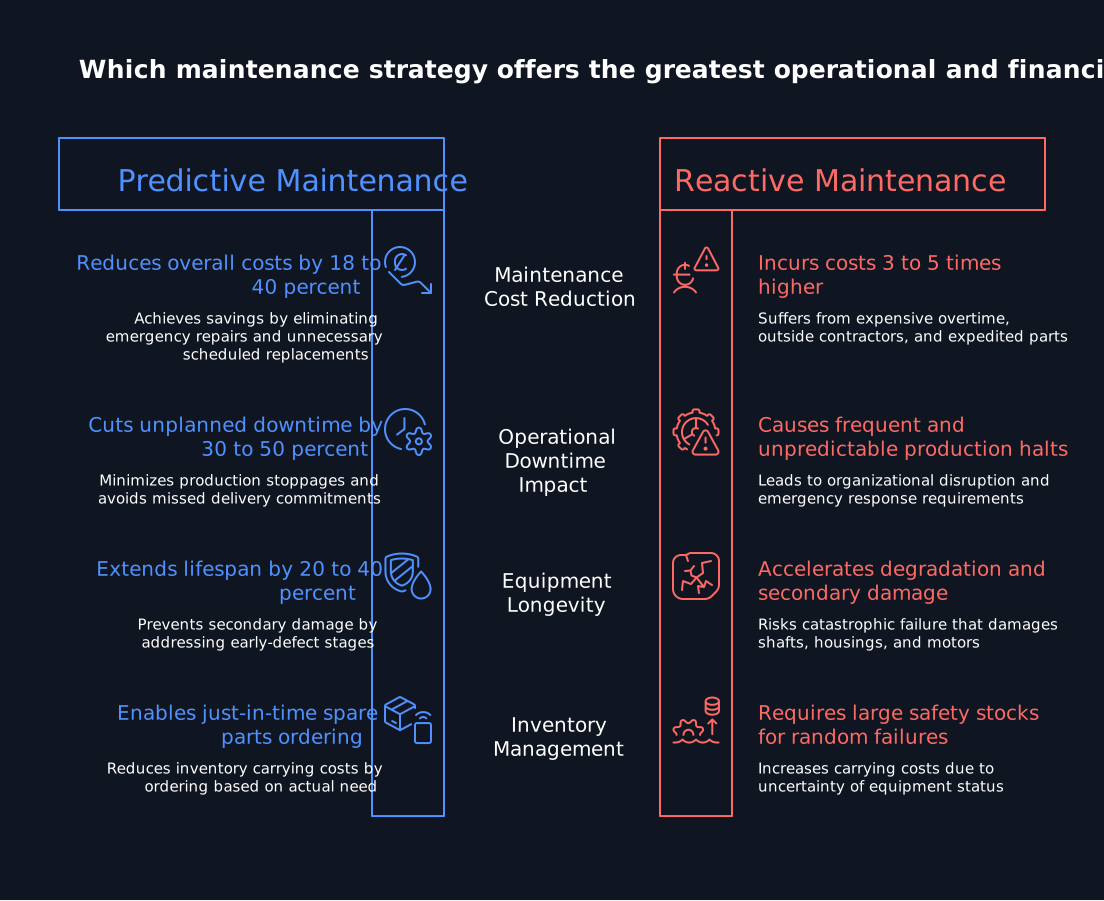
Reduced unplanned downtime. Minimizing downtime is the primary measurable outcome that justifies predictive maintenance investment. Predictive maintenance can cut unplanned downtime by 30 to 50%, which for a plant where a single hour of downtime costs $260,000 (industry average, McKinsey, 2023) represents substantial direct economic value per avoided failure event. Unplanned outages also carry indirect costs: missed customer delivery commitments, expedited logistics, re-scheduling of downstream production, and the organizational disruption of an emergency response. Customer satisfaction improves when predictive maintenance eliminates the unplanned production stoppages that cause missed delivery commitments and order expediting costs.
Lower maintenance costs. The most compelling argument for predictive maintenance investment is the cost of the alternative: costly downtime from unexpected failures, costly emergency repairs, and the downstream cost of missed deliveries and production rescheduling. Predictive maintenance reduces overall maintenance costs by 18 to 25% compared to traditional preventive approaches, and up to 40% compared to fully reactive strategies (McKinsey, 2020). The reduction comes from fewer emergency repairs (which typically run at 3 to 5 times the cost of planned maintenance labor due to overtime, outside contractors, and expedited parts), eliminating unnecessary scheduled replacements, and concentrating maintenance resources on assets that actually need attention. Enabling maintenance teams to plan their work rather than react to whatever fails next also improves workforce productivity and morale.
Extended equipment lifespan. Predictive maintenance extends equipment lifespan by 20 to 40% (Artesis, 2026) by preventing the secondary damage that failures cause: a bearing that reaches seizure damages the shaft, the housing, and sometimes the motor winding; a bearing removed at the early-defect stage replaces only the bearing.
Improved asset reliability. Asset performance improves when equipment runs within its operating envelope rather than cycling through progressive degradation to sudden failure. Quality and energy efficiency improve as well: a pump operating at design efficiency consumes less energy and produces less heat than one with worn internal clearances; a motor with properly lubricated bearings runs cooler and produces less vibration than one with degraded lubrication.
Worker safety. Predictive maintenance programs that eliminate unplanned failures also eliminate the safety exposures associated with emergency equipment access: a planned bearing replacement performed at a scheduled maintenance window, with equipment properly isolated, is safer than an emergency repair performed on a machine that has just failed catastrophically.
Inventory optimization. Just-in-time spare parts ordering becomes possible when maintenance events are predictable: rather than holding large safety stocks of every spare part against the possibility of a random failure, the maintenance team orders parts when the predictive system indicates they will be needed, reducing inventory carrying cost. Optimizing maintenance schedules around actual equipment condition, rather than generic manufacturer recommendations, reduces both the frequency of unnecessary interventions and the waste of consumable parts removed with serviceable life remaining. Resource allocation improves when maintenance planners know in advance which assets need attention and when: fewer technicians tied up in emergency response means more capacity for planned improvement work.
Maintenance Costs and ROI
The direct cost components of a predictive maintenance program include: sensor hardware and installation, data connectivity and pipeline infrastructure, the analytics platform and model development, and the integration of alerts into the maintenance management workflow. The infrastructure investments that support predictive maintenance are one-time capital costs that then generate ongoing operational savings.
Implementing predictive maintenance on a narrow pilot scope, selected through a risk-based maintenance lens reduces the upfront capital risk while generating the performance data needed to build the business case for broader deployment. Implementation costs for a single-line pilot typically range from $50,000 to $200,000 depending on asset count, sensor type, and analytics complexity.
Against that investment, the return comes from: avoided emergency repair labor (which typically runs at 3 to 5 times the cost of planned maintenance labor due to overtime, outside contractors, and expedited parts); avoided unplanned downtime (at the $260,000 per hour industry average, a single avoided failure event can exceed the entire pilot cost); reduced preventive maintenance spend (parts replaced on schedule but not yet worn); and extended equipment lifespan (deferred capital replacement expenditure).
Wondering what a pilot would cost for your equipment? Our predictive maintenance consulting team scopes predictive maintenance deployments around your existing assets and data - no rip-and-replace required.
Leading organizations report 10:1 to 30:1 ROI ratios within 12 to 18 months of implementation (McKinsey, 2023). Conservative estimates for well-implemented programs on high-criticality assets project payback within 12 to 18 months. Results depend on the current maintenance baseline (organizations running purely reactive maintenance see larger gains than those with a mature preventive maintenance program), asset criticality, failure frequency, and implementation quality.
For the full business case and ROI calculation framework, see predictive maintenance in manufacturing.
Data, Sensors, and Analytics
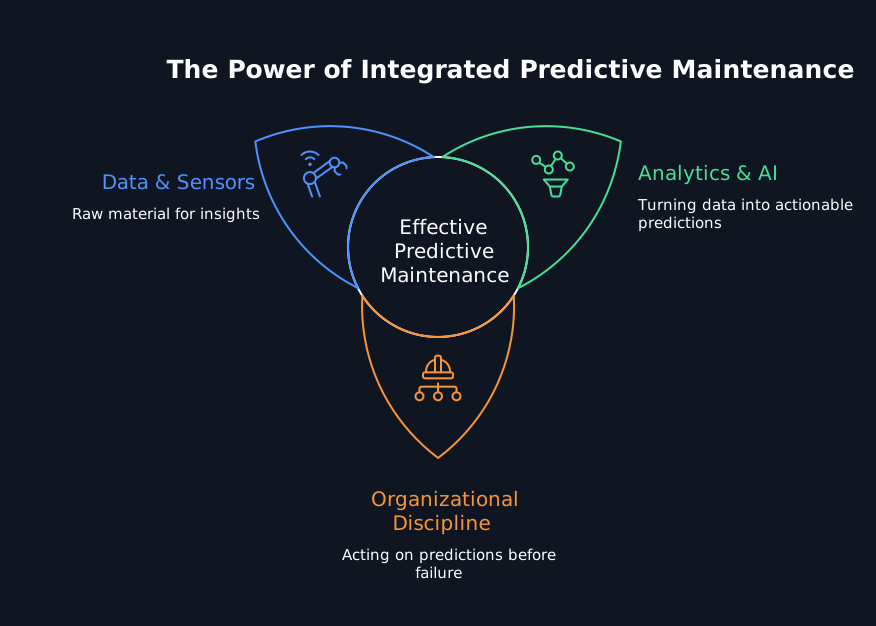
Effective predictive maintenance depends on the quality and completeness of maintenance data and sensor coverage, which is where our predictive maintenance services usually start. Equipment data from sensors, process historians, and maintenance records is the raw material of every predictive maintenance model. Operational data from SCADA historians, process control systems, and maintenance records complements sensor readings by providing the production context that improves model accuracy. Predictive maintenance technologies have matured significantly over the past decade: sensors that once required specialist installation are now self-powered wireless devices; predictive maintenance platforms range from open-source time-series and ML toolkits that require a data science team to configure, to fully managed predictive maintenance solutions with pre-built models for common rotating equipment failure modes. Predictive maintenance systems that integrate sensor data, analytics, and work-order management into a single workflow reduce the manual coordination overhead that maintenance teams currently spend resolving. The primary sensor data sources are:
Vibration sensors (accelerometers) on rotating machinery: the highest-value sensor type for the most common failure modes in manufacturing (bearing, gear, imbalance, misalignment). Industrial accelerometers are available in wired and wireless configurations; the appropriate choice depends on cable access, the required sampling rate, and the failure mode being monitored.
Temperature sensors on motors, electrical panels, process equipment, and bearing housings: relatively low cost and broadly applicable, measuring one of the most universal indicators of equipment stress.
Current sensors at motor control centers: non-intrusive (measuring at the electrical panel rather than at the motor), applicable to any motor-driven asset without physical access to the motor itself.
Process sensors (pressure, flow, level, quality) that already exist in SCADA systems: leveraging existing OT data for predictive analytics is often the fastest path to initial predictive value, before any new sensor investment.
Data analysis is essential for effective predictive maintenance: raw sensor data is not interpretable by maintenance staff directly, and the failure signals of interest are often small deviations from normal behavior that are invisible to unassisted human observation. Predictive maintenance requires not just sensors and analytics but the organizational discipline to act on the alerts the system generates: a maintenance program that generates accurate predictions but whose teams do not schedule the recommended repairs before failures occur has not delivered its value.
Predictive maintenance uses AI and IoT for real-time monitoring to make these deviations detectable and actionable, and that pairing is the foundation of wider IoT and predictive maintenance strategies. Machine learning models trained on historical data from the specific asset population being monitored substantially outperform rule-based threshold alarms for complex failure modes where the warning signal is a pattern across multiple parameters rather than a single value crossing a threshold.
For the data pipeline and contextualization infrastructure, see industrial DataOps.
Industry Use Cases
Predictive maintenance examples span nearly every industry where equipment failure has operational consequences, but the highest-value applications share a common profile: rotating equipment, high failure cost, and repeatable failure modes.
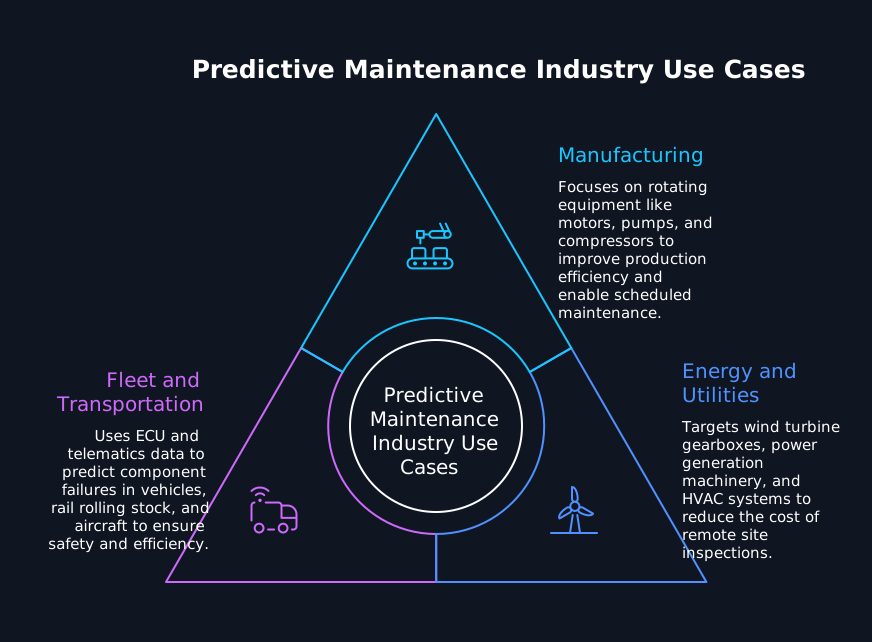
Manufacturing. Rotating equipment (motors, pumps, compressors, fans, conveyor drives) is the primary predictive maintenance target in manufacturing. Equipment maintenance for these asset types is the highest-ROI starting point for most programs because failure consequences are high and failure modes are repeatable. Predictive maintenance improves production efficiency by enabling scheduled maintenance during off-hours: a planned bearing replacement at a weekend shutdown avoids a mid-week production halt that disrupts the schedule for the rest of the week. Vision-based quality inspection integrated with process data is an adjacent use case, detecting product defects correlated with equipment condition changes.
Energy and utilities. Wind turbine gearboxes and main bearings, rotating machinery in power generation, transformer health monitoring, and HVAC systems in large facilities are high-value predictive maintenance targets in the energy sector. Monitor rotating equipment in these applications often means assets that are geographically distributed and physically difficult to access, making the cost of a site visit for an inspection far higher than in a factory environment and the value of remote condition monitoring correspondingly higher. For oil and gas applications, see oil and gas predictive maintenance use cases.
Fleet and transportation. Vehicle fleet predictive maintenance uses diagnostic data from vehicle ECUs, combined with sensor data from telematics devices, to predict component failures (brake wear, powertrain components, tires) before they cause a service disruption. The same logic applies to rail rolling stock and aircraft maintenance programs, where predictive maintenance is a safety imperative as well as an operational efficiency driver.
For the full manufacturing-specific business case, see predictive maintenance in manufacturing.
Manufacturing is where most programs start, because the cost of an hour of stopped production is the easiest number to defend in a business case. The full seven-step rollout for that setting, from pilot asset selection to plant-wide scaling, is covered in predictive maintenance in manufacturing.
Read also:
- Predictive Maintenance vs Preventive Maintenance: Which Is Right?
- How to Implement Predictive Maintenance: A Step-by-Step Guide
- Predictive Maintenance with Machine Learning: Models, Training, and Deployment
How to Get Started
The path to a working predictive maintenance program follows five steps, but the most important principle is to start narrow: one asset class, one plant, one high-value use case, with pre-defined KPIs before the pilot begins.
If you'd rather skip the trial-and-error phase, our predictive maintenance services cover the full path - from sensor selection and condition monitoring to models integrated with your CMMS.
1. Define goals and select initial assets. Choose the critical assets with the highest failure consequence and frequency as the pilot target: the asset where an unplanned failure causes the most production loss, safety risk, or repair cost. Define the specific KPIs that will be used to evaluate the pilot (reduction in unplanned downtime events, reduction in emergency repair labor hours) before instrumentation begins.
2. Install IoT sensors. Select the sensor types appropriate for the target failure modes (vibration for rotating machinery, temperature for electrical and thermal assets) and install with the connectivity required to reach the data pipeline (wired or wireless depending on the plant environment and the required data rate).
3. Use data analytics to identify patterns and predict equipment failures. Connect sensor data to an analytics platform, train initial models on available historical data (maintenance records correlated with historical sensor data where it exists), and validate model output against known past failure events before deploying in a predictive role. A range of predictive maintenance solutions exists at different price and complexity points, from cloud-hosted platforms that accept raw sensor data through a standard API to full-stack systems that bundle sensors, edge compute, and analytics in a pre-integrated package.
4. Create clear alert-response processes. A predictive maintenance alert that reaches a maintenance manager's screen but triggers no defined response produces no value. Define in advance who receives each alert, what the response procedure is, and how the work order is generated and tracked through to completion. Integrating predictive alerts into existing maintenance processes, rather than creating a parallel workflow, is the practical step most implementations underestimate. Predictive maintenance tasks should be tracked through the same work-order system as all other maintenance activities, so the maintenance team has a single view of all planned work regardless of whether it was triggered by a schedule or a predictive alert.
5. Monitor KPIs and iterate. Track the pre-defined KPIs from the pilot launch, measure model prediction accuracy against actual failure events (did the predicted failures occur? were there failures the model missed?), and improve the models based on accumulated evidence, establishing a continuous improvement cycle that compounds the program's accuracy and value over time. After the pilot validates the approach and quantifies the value, scale to additional asset classes and sites.
For the full implementation step-by-step, see how to implement predictive maintenance. For the operational playbook, see predictive maintenance best practices. If the rollout needs an outside partner, the best predictive maintenance companies differ widely in sensor, software and integration scope.
The fastest way to prove predictive maintenance is a single asset class, instrumented properly and validated against real failure events. We scope and run that first pilot with you.
Start with one high-criticality asset class
InTechHouse case study: Predictive maintenance for rotating equipment
InTechHouse built and operated a predictive maintenance program for a manufacturer with recurring compressor failures that were causing unplanned production stoppages averaging 8 hours per event. The program targeted the three most failure-prone compressor groups on the site, instrumenting each with tri-axial vibration sensors on each bearing location and temperature sensors on motor windings and bearing housings.
Data pipelines ran from the sensors through edge gateways to a cloud analytics platform, with the edge layer applying initial quality validation and the cloud platform running spectral analysis and ML-based anomaly scoring. The models were trained on 18 months of historical vibration data correlated with the maintenance history records for each compressor, identifying the vibration signatures that preceded the 14 bearing failures documented in that period.
In the first year of operation, the program correctly predicted 11 of 12 bearing failures an average of 12 days in advance, enabling planned replacements that avoided the associated production stoppages. The single unpredicted failure occurred on a compressor that was added to the program mid-year with insufficient historical data for model training. Annual maintenance cost savings on the three compressor groups, including avoided emergency labor, expedited parts, and production downtime, exceeded the full program implementation cost within 9 months of go-live.
We have built condition monitoring and failure prediction for rotating equipment, from sensor selection to model validation and alert handling. Ask us what the same approach would cost on your fleet.
Review our rotating equipment PdM work
Let's talk about your next move
Not sure where to start? We work with companies at every stage, from early ideas to enterprise-level builds. A 30-minute call can save you months of guesswork.
FAQ
1. What is predictive maintenance?
Predictive maintenance is a condition-based maintenance strategy that uses sensor data and analytics to predict when equipment will fail, enabling maintenance to be performed just before failure rather than on a fixed schedule or after a breakdown. It uses real-time monitoring of equipment health indicators (vibration, temperature, current, pressure) and machine learning models to identify developing failure patterns and generate maintenance alerts with sufficient lead time to schedule a planned intervention.
2. How does predictive maintenance work?
IoT sensors installed on monitored equipment collect real-time sensor data continuously; a data pipeline transmits that data to an analytics platform; machine learning models trained on historical sensor data and failure event records analyze the incoming data to detect patterns that precede failures; and when the model identifies a failure signature, it generates an alert with the asset, predicted failure mode, and estimated time to failure, triggering a scheduled maintenance work order.
3. What is the difference between predictive and preventive maintenance?
Preventive and predictive maintenance both aim to avoid reactive breakdowns, but they differ fundamentally in how they decide when to act. Preventive maintenance (also written as preventative maintenance) performs maintenance at fixed intervals (every 6,000 operating hours, every six months) regardless of the actual condition of the equipment, replacing components that may have significant remaining useful life or potentially missing failures that develop between scheduled intervals. Predictive maintenance monitors actual equipment condition in real time and performs maintenance when sensor data indicates failure is approaching, neither too early (wasting serviceable components) nor too late (allowing an unplanned failure).
4. What are the benefits of predictive maintenance?
The primary quantified benefits are: 18 to 25% reduction in overall maintenance costs (up to 40% versus reactive strategies), 30 to 50% reduction in unplanned downtime, 20 to 40% extension of equipment lifespan, and documented ROI of 10:1 to 30:1 within 12 to 18 months for well-implemented programs (McKinsey, 2020/2023). Secondary benefits include improved worker safety (planned maintenance is safer than emergency repairs), inventory optimization through just-in-time parts ordering, and energy and quality improvements from equipment operating within its design envelope.
5. How do you start with predictive maintenance?
Select one high-criticality, high-failure-frequency asset class as a pilot target. Define the KPIs that will measure success before instrumentation begins. Install IoT sensors appropriate for the target failure modes. Connect sensor data to an analytics platform and validate initial models against historical failure records. Define the alert-response process for when the model predicts an impending failure. Monitor the pilot KPIs for at least one failure cycle before scaling to additional assets or sites. The most common mistake is starting too broadly: a single asset class, measured rigorously, produces more learning and more credible results than a wide deployment with shallow instrumentation and undefined success criteria.
Damian Ledziński, PhD Eng.
Damian Ledziński, PhD Eng., is an Applied Artificial Intelligence Expert and an Assistant Professor at Bydgoszcz University of Science and Technology. He has over 15 years of academic, research, software-engineering, and technology-development experience.
His work focuses on applying artificial intelligence, machine learning, deep neural networks, and data science to complex real-world systems. His principal research and engineering interests include autonomous unmanned aerial vehicles, drone navigation and swarm intelligence, biomedical engineering, medical signal and image analysis, predictive modeling, industrial IoT, and intelligent water-management systems.
Damian has contributed to multidisciplinary R&D initiatives including AI-assisted medical diagnostics, a Polish ventilator prototype, autonomous indoor drone systems for warehouse inventory, AI-supported water-consumption analysis, virtual medical assistants, and intelligent systems combining embedded devices with machine-learning models.
He is the author or co-author of more than 30 scientific publications. His work has appeared in international scientific publications covering artificial intelligence, biomedical engineering, signal analysis, autonomous systems, environmental monitoring, and data-driven infrastructure.
Damian is a co-creator of academic programs in Engineering in Medicine, AI in Medicine, and Data Science at Bydgoszcz University of Science and Technology. He combines scientific research with hands-on implementation, translating experimental AI methods into deployable technology. He writes about applied AI, machine learning, predictive analytics, autonomous UAV systems, AI in medicine, biomedical signal processing, industrial IoT, and intelligent models in real-world systems.
Damian Ledziński's academic profiles:
https://orcid.org/0000-0003-0796-4390
https://wtie.pbs.edu.pl/pl/pracownik/damian-ledzinski
https://www.researchgate.net/profile/Damian-Ledzinski
https://scholar.google.pl/citations?user=AlQpPB0AAAAJ&hl=pl
https://ludzie.nauka.gov.pl/ln/profiles/DN6pHXU6KZm/publications/f83a8833-6060-4fae-8628-3dbf57661394
Let's talk about your next project
From first prototype to production, our engineers can help you scope it, build it and get it certified.





Discuss your product with our R&D team
This initial conversation is focused on understanding your product, technical challenges, and constraints.
No sales pitch - just a practical discussion with experienced engineers.
Share a few details about your product and context. We’ll review the information and suggest the most appropriate next step.