


.svg)
Hardware Testing & Certification Services
We provide hardware testing and prototyping services focused on reducing certification risk in regulated and mission-critical products. Testing is integrated with development to generate structured validation evidence, enabling predictable qualification outcomes and avoiding late-stage redesign.


Measured impact on validation and certification
Our electronic testing services and validation workflows reduce certification risk, shorten qualification timelines and improve production readiness.
How we prepare hardware for qualification and production
Testing is integrated into development from the start. EMC, environmental and functional validation are used early to identify issues before certification and avoid redesign.
Testing integrated with engineering
- EMC, environmental and functional validation performed during development
- Close collaboration between design and test teams
- Early detection of risks related to compliance and real-world conditions
Designed for qualification and NPI
- Pre-compliance testing aligned with certification requirements
- Test strategies support DFT, production validation and repeatability
- Prototypes built and validated with production and deployment in mind
.avif)
What defines a qualification-ready hardware system
A prototype needs to be validated against real operating constraints and prepared for certification before entering formal testing.

Environmental testing electronics, including thermal, vibration and operational stress testing, verifies system behaviour under actual deployment conditions rather than ideal lab scenarios.

EMC testing for electronics is performed early as part of structured validation. This reduces the risk of failure during formal certification and improves first-pass success rates.

Hardware is validated with DFM and DFT considerations, ensuring repeatable production, test coverage and readiness for deployment. Validation results are used as part of the qualification and production process.
Our In-House Test Lab
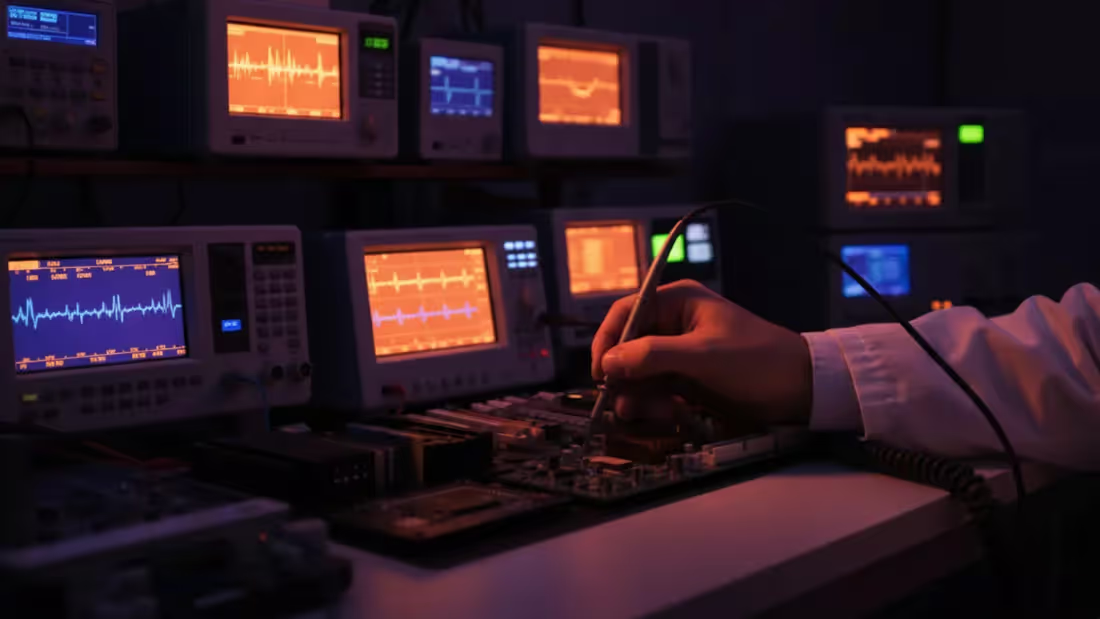
Our in-house R&D test lab is equipped with a walk-in climate chamber, spectrum and logic analysers, high-bandwidth mixed-domain oscilloscopes, signal generators and thermal vision cameras. This lab operates under our status as a Certified Research & Development Centre (Decision No. 7/CBR/16), which sets formal requirements for how our R&D testing and validation processes are run. We run EMC pre-compliance and environmental testing on-site, then coordinate full qualification with accredited laboratories, covering CE (EMC, LVD, RED), FCC and MIL-STD requirements. The result is a complete report set your team can use as the basis for the declaration of conformity.
From Prototype to Small Series
We assemble and validate small production series in-house. Electronics assembly is carried out in an ESD-protected (EPA) environment per IPC requirements, followed by wiring, enclosure integration, and functional testing of every unit before it ships.
This is where a validated prototype becomes a batch you can deploy, ideal for pilot runs, field-trial batches, and limited editions before committing to full-scale manufacturing.
Use Cases

We support validation and qualification of aerospace hardware through environmental testing, EMC pre-compliance, and certification preparation. Our approach minimizes redesign risk and accelerates certification cycles. Each activity is aligned with applicable aerospace standards to ensure compliance, traceability, and reliable performance in mission-critical applications.



We prepare hardware systems for certification in subsea and offshore environments, where compliance and reliability are critical. Our validation process ensures readiness for deployment in regulated conditions. Each system is verified against applicable industry standards to ensure safety, durability, and consistent performance in demanding operational environments.


We perform EMC validation and compliance preparation for electronic systems, aligned with FCC, CE, and relevant industrial standards. It includes pre-compliance testing, design optimization, and risk mitigation to streamline the certification process. Each solution meets regulatory requirements maintaining performance and integration with the system architecture.

We support the transition from prototype to production through structured validation workflows, DFT/DFM preparation, and reliability testing. We guarantee design robustness, manufacturability, and repeatability across production volumes. Each stage is optimized to reduce risk, improve yield, and enable efficient scaling.

We support the modernization of industrial electronics where aging components, long product lifecycles, and harsh operating conditions create reliability challenges. Our approach considers component availability, compatibility with legacy hardware, embedded software behavior, and validation requirements during redesign. Each upgrade is developed to preserve established functionality while supporting continued maintenance and dependable operation.
Industries We Serve
Our engineering capabilities are deployed across regulated, mission-critical and industrial sectors.

Subsea electronics, downhole systems and harsh-environment hardware for offshore and onshore operations.

End-to-end electronics engineering for launch vehicles, UAV payloads and defence platforms.

Custom gas detection systems, environmental monitoring hardware and personal safety electronics - engineered from sensor to software.

Validation and qualification support for laboratory and diagnostic hardware in regulated environments.

End-to-end hardware engineering for industrial automation, IoT devices and manufacturing control systems.
FAQs
If you have additional questions or would like to discuss your requirements, feel free to get in touch with our team.
Hardware testing is what confirms that a product does what it is designed to do, under the conditions it will actually face. InTechHouse provides comprehensive hardware testing services covering every stage from early design validation through to final certification support, ensuring that products meet their requirements to the highest standards.
The scope of hardware testing services includes:
Test planning – before any testing begins, a structured plan defines what needs to be verified, against which standards, and in what sequence. Good test planning prevents gaps in coverage and makes the certification process predictable.
Functional testing – hardware components and assembled boards are verified against the design specification to confirm that the product behaves as intended under normal operating conditions.
Performance and reliability testing – products are tested beyond baseline functionality to confirm they perform consistently over time and under the load conditions they will encounter in use.
Environmental testing – temperature cycling, humidity, vibration, and mechanical stress testing establish how the product holds up under the physical conditions of its target environment. The full scope is covered in our environmental testing for electronics and embedded devices service.
Pre-compliance testing – covering electromagnetic compatibility and other regulatory requirements, pre-compliance testing identifies issues before formal submission, reducing the risk of failure and the cost of re-testing.
Certification support – InTechHouse works with clients through the formal certification process, preparing documentation, coordinating with test houses, and addressing any findings that arise.
Comprehensive hardware testing at each of these stages is what gives both the engineering team and the client confidence that the product is ready, and that the certification outcome will reflect the quality of the design.
Pre-compliance testing is hardware testing carried out before a product is submitted to a formal certification laboratory. Its purpose is to identify electromagnetic compatibility issues, signal integrity problems, and other compliance risks while there is still time to address them in the design, rather than after a formal test failure.
Formal certification lab time is expensive, and a failure at that stage means rescheduling, design changes, and re-testing. For most companies, a single failed submission costs more in time and fees than a thorough pre-compliance testing programme would have. More significantly, it delays market entry at the point when the product is closest to launch.
Pre-compliance testing gives the engineering team a clear picture of where the product stands against the relevant standards before that submission happens. Issues that would cause a failure are found on the bench, where they can be investigated properly and resolved without the pressure of a booked lab slot. The product that reaches formal certification has already been verified to a level that makes a compliant outcome the expected result rather than an uncertain one.
For clients, this translates directly into confidence. Knowing that the hardware has been tested against the applicable standards using the expertise of an experienced electronics engineering team, and that identified risks have been addressed, removes one of the most unpredictable variables from the product launch timeline.
Pre-compliance testing is also where InTechHouse expertise in electromagnetic compatibility and signal behaviour is most practically applied. The knowledge of what formal test houses look for, and how designs typically fail, is what makes pre-compliance testing genuinely useful rather than a box-ticking exercise.
The certifications required for an electronic product depend on where it will be sold and what it does, but there are several standards that apply across a wide range of hardware testing situations.
CE marking is required for products sold in the European Union. It covers electromagnetic compatibility, electrical safety, and in some cases radio equipment, and demonstrates that the product meets EU regulatory requirements. CE marking is not a single test but a set of directives that apply depending on the product category, each with its own hardware testing requirements and supporting documentation.
FCC authorisation is the equivalent requirement for the US market. Products that generate or use radio frequency energy need to demonstrate compliance with FCC regulations, either through certification, declaration of conformity, or verification depending on the device type. Hardware components that include wireless functionality typically require FCC testing as a baseline before the finished product can be sold.
UL certification covers safety standards widely recognised in North America. While not always a legal requirement, UL compliance is expected in many markets and procurement processes, particularly for products going into commercial or industrial environments.
Testing for each of these certifications is carried out through accredited laboratories that are recognised by the relevant regulatory bodies. InTechHouse works with accredited labs to ensure that hardware testing is conducted under the correct conditions and against the applicable standards, and delivers the supporting test reports that clients need to demonstrate compliant products to distributors, retailers, and regulatory authorities.
Having the test reports in order from the start of the certification process avoids delays at the point of market entry, where documentation gaps are both common and costly.
Lab conditions and real operating conditions are rarely the same thing. Hardware testing that only verifies function at room temperature on a stable bench tells you relatively little about how a product will behave once it is in the field. Testing under real and extreme conditions is what reveals the margins between nominal performance and actual failure.
Thermal testing establishes whether the cooling approach is adequate for the application. Ambient and component temperatures are monitored under load to confirm that heat is being managed within the limits set by the design. This goes beyond checking that the product does not overheat at maximum load. It maps how temperatures behave across the operating range, identifying components that run hotter than expected and conditions where thermal margins are tighter than the design assumed.
Durability and reliability testing takes the product beyond its normal operating envelope to understand where the limits are. Extreme temperatures, humidity, vibration, and mechanical stress are applied systematically to determine how the hardware holds up over time and what the realistic service life of the product is. This kind of testing is what separates a product with a known, defensible reliability specification from one where lifespan is essentially an estimate.
Endurance cycling powers the system on and off repeatedly over extended periods to measure failure rates and identify weaknesses in components, connections, or firmware behaviour that only appear after sustained use. This is particularly relevant for products where startup and shutdown place stress on hardware components that steady-state operation does not.
Signal verification across the expected frequencies and operating range confirms that system performance is consistent under the conditions the product will actually encounter, not just at the centre of the frequency range under ideal conditions.
Hardware testing sounds straightforward in principle: build the product, test it, confirm it works. In practice, the process surfaces challenges that require both technical depth and careful planning to manage without derailing the project schedule.
Reproducing real-world conditions in a controlled test environment is harder than it appears. A product that passes every bench test can still behave unexpectedly once it is installed in its actual operating environment, because the combination of temperature variation, electromagnetic noise, mechanical stress, and load conditions in the field is difficult to replicate exactly. Good test design addresses this by thinking through the range of conditions the hardware will actually encounter, not just the conditions that are easiest to test for. The construction of the test setup itself determines how much confidence the results actually provide.
Troubleshooting failures during hardware testing requires a systematic approach. When a product fails a test, the immediate question is whether the failure reflects a fundamental design issue, a manufacturing variation, or a problem specific to the test setup. Getting to the root cause quickly, rather than changing multiple variables at once, is what makes troubleshooting efficient and ensures that fixes actually resolve the underlying problem rather than masking it.
Meeting certification standards without delaying the project is the challenge that has the most direct business impact. Test schedules slip when failures are found late, when documentation is incomplete, or when the scope of required testing was not fully understood at the planning stage. A well-structured hardware testing programme, with pre-compliance work done early and test plans agreed before hardware is built, is what keeps certification on a timeline that the rest of the project can rely on.
The broader point is that hardware testing is only as useful as the thinking that goes into designing it. Tests that are poorly specified produce results that are hard to interpret, which makes it difficult to determine whether the product behaves as expected and where the real fixes need to be applied.
Certification is the stage where the quality of the engineering process either pays off or creates problems. For clients going through formal certification for the first time, and for those who have been through it before and want it to go more smoothly, InTechHouse provides structured support across every part of the process.
Preparation begins well before any accredited lab is involved. Documentation covering the product's technical construction, component specifications, test configurations, and design rationale is compiled in the format that certification bodies and test houses expect. Incomplete or inconsistent documentation is one of the most common sources of delay in the certification process, and addressing it early is one of the most straightforward efficiency gains available.
Pre-compliance testing is run against the applicable standards before formal submission. This is where the expertise built up across previous hardware testing programmes is most directly applied. Knowing what formal test houses look for, how they set up their test environments, and where designs of a particular type tend to have difficulty, allows the engineering team to find and resolve issues on the bench rather than at the lab. The practices developed through repeated certification work are what make this stage reliable rather than optimistic.
Test reports are produced to document every stage of the testing programme, including pre-compliance findings, the actions taken in response, and the final results. These reports serve the certification submission and give clients a complete record of what was tested, under what conditions, and what the outcome was.
Guidance through the accredited lab process covers selecting the right test house for the applicable standards, preparing the product and documentation for submission, and working through any findings that arise. For customers unfamiliar with the process, this removes the uncertainty that makes certification feel like a risk rather than a defined set of steps with a predictable outcome.
Rigorous testing across multiple dimensions is what gives a hardware product a reliable, defensible specification rather than a best-guess one. InTechHouse provides rigorous testing using the right tools for each type of assessment, covering functionality, performance, thermal behaviour, and mechanical integrity.
Functional testing verifies that the hardware does what it is designed to do. Also referred to as black box testing, this approach assesses each subassembly against a defined test procedure without assumptions about the internal construction. Mini-tests are run at the assembly stage as well, catching faults early in the build process where they are least expensive to address. The interaction between hardware and software is included in functional testing where the product's functionality depends on both working together correctly.
Performance and stress testing pushes hardware components to their maximum workload to identify bottlenecks and establish the margins between normal operation and failure. Running the system at the limits of its specification reveals how it behaves under sustained load, where thermal, electrical, and signal integrity factors interact and where system performance begins to degrade. This is the testing that determines what the product can reliably sustain, not just what it can do briefly under ideal conditions.
Thermal testing monitors component and ambient temperatures under operating conditions to confirm that heat is managed within design limits across the expected operating range. The tools used provide accurate temperature mapping that identifies hotspots and assesses whether the cooling approach is adequate for the application.
Mechanical strength testing evaluates how the hardware holds up against physical forces, including vibration, shock, and mechanical stress. Resistance to these forces is assessed systematically to confirm that the construction of the product meets the durability requirements of its target environment.
A hardware test plan is a document that defines the test cases corresponding to each hardware requirement. Its purpose is to make testing repeatable, structured, and complete, so that every aspect of the product's intended behaviour is verified and nothing is left to the judgment of whoever happens to be running the tests on a given day.
A well-constructed test plan covers what is being tested, how it is being tested, what tools are required, what the pass and fail criteria are, and in what sequence the tests should be run. This gives the engineering team a clear framework and gives clients confidence that the product's ability to meet its requirements has been systematically assessed rather than informally checked.
For products with multiple subassemblies or a mix of hardware and software functionality, the test plan also defines which tests apply to which parts of the system and how results from individual tests combine to confirm overall user-facing behaviour. Without this structure, gaps in coverage are easy to miss and difficult to detect until a problem surfaces in the field.
Failure during hardware testing is not the end of the process. It is information. When a product does not perform as expected, failure analysis is carried out to diagnose the root cause before any fixes are applied.
Failure analysis looks at what failed, under what conditions, and why. This might point to a design issue, a component that behaves differently under stress than it does at nominal conditions, a materials problem, or a manufacturing variation. Getting to the actual cause matters because fixes applied without a clear diagnosis tend to address symptoms rather than underlying problems, which means the same failure can reappear in a different form.
The findings from failure analysis feed directly back into the design. Changes are made, validated, and retested, and the outcome is a product with better reliability than the one that failed. This cycle, test, analyse, improve, retest, is what turns hardware testing into a genuine engineering tool rather than a pass or fail checkpoint at the end of the project.
Discuss your product with our R&D team
This initial conversation is focused on understanding your product, technical challenges, and constraints.
No sales pitch - just a practical discussion with experienced engineers.


Share a few details about your product and context. We’ll review the information and suggest the most appropriate next step.