


Embedded Firmware & Software Development Services
We provide embedded firmware development services and embedded software development services for industrial systems where deterministic behaviour, hardware integration and long-term reliability are critical.


Engineering Impact in Embedded Systems
We deliver embedded systems development that improves system stability, resource efficiency and long-term maintainability in industrial environments.
Embedded Systems Delivered for Production Environments
We deliver embedded systems engineering aligned with hardware constraints, certification requirements and long-term system operation in industrial environments.
System definition and technical validation
- Precise definition of system behavior, interfaces and constraints
- Validation of embedded hardware–software integration at early stages
- Verification of communication between system components under real conditions
Engineering quality and production readiness
- Firmware and system design aligned with regulatory and industry requirements
- System-level testing focused on reliability, determinism and fault handling
- Readiness for manufacturing, deployment and long-term maintenance
.avif)
Embedded Systems Built for Real Operational Conditions
We engineer embedded software services with focus on runtime behaviour, timing control and reliable interaction between firmware and hardware components.

Embedded software developed with direct understanding of hardware behavior, timing constraints and low-level system interactions allows predictable execution and stable system operation.

Structured approach to firmware development services, including stabilization, refactoring and controlled evolution of production systems supports long-term maintainability and safe system updates.

Firmware designed for seamless embedded system integration with industrial infrastructure, communication protocols and external control systems maintains compatibility with existing environments and workflows.
Low-Level & Bare-Metal Expertise
We work at every layer of the embedded stack: bare-metal firmware that talks directly to hardware, Board Support Packages (BSP) for RTOS and custom PCBs, and embedded Linux applications. Our engineers write device drivers, interrupt handlers, bootloaders, and hardware abstraction layers in C and C++, with Python for tooling and test automation.
Use Cases

We design and develop embedded systems for UAV platforms, integrating sensors, communication modules, and control logic for real-time operation. Our solutions are engineered for mission-critical environments, ensuring reliable performance, low latency, and seamless system integration. Each design supports stable operation under dynamic conditions while maintaining data integrity and operational efficiency.



We design and develop firmware for industrial equipment, enabling reliable communication, data acquisition, and system control under real operating conditions. We focus on robustness, real-time performance, and seamless integration with hardware and higher-level systems. Each implementation provides stability, scalability, and long-term maintainability in demanding industrial environments. We als optimize for resource efficiency and compliance with industry protocols.


We design and develop firmware for subsea systems focusing on predictable real-time operation, fault tolerance, and robust communication in harsh underwater environments. Each implementation allows consistent performance under pressure, limited accessibility, and long-term deployment conditions. We also support integration with monitoring and diagnostic systems to enable remote operation and maintenance.


We design and implement advanced embedded software for imaging systems, including real-time processing, camera control, and data integration. Our solutions are optimized for high performance, low latency, and seamless interaction with hardware components. Each implementation ensures stable operation, high data throughput, and reliable system behavior. We also support integration with higher-level systems and data pipelines for end-to-end functionality.
We modernize firmware and embedded software for industrial equipment affected by component obsolescence and aging hardware architectures. Our work includes microcontroller migration, FPGA-based logic redesign, and adaptation of communication interfaces while preserving compatibility with existing systems. Each upgrade supports reliable operation, long-term maintainability, and controlled system evolution in demanding industrial environments.
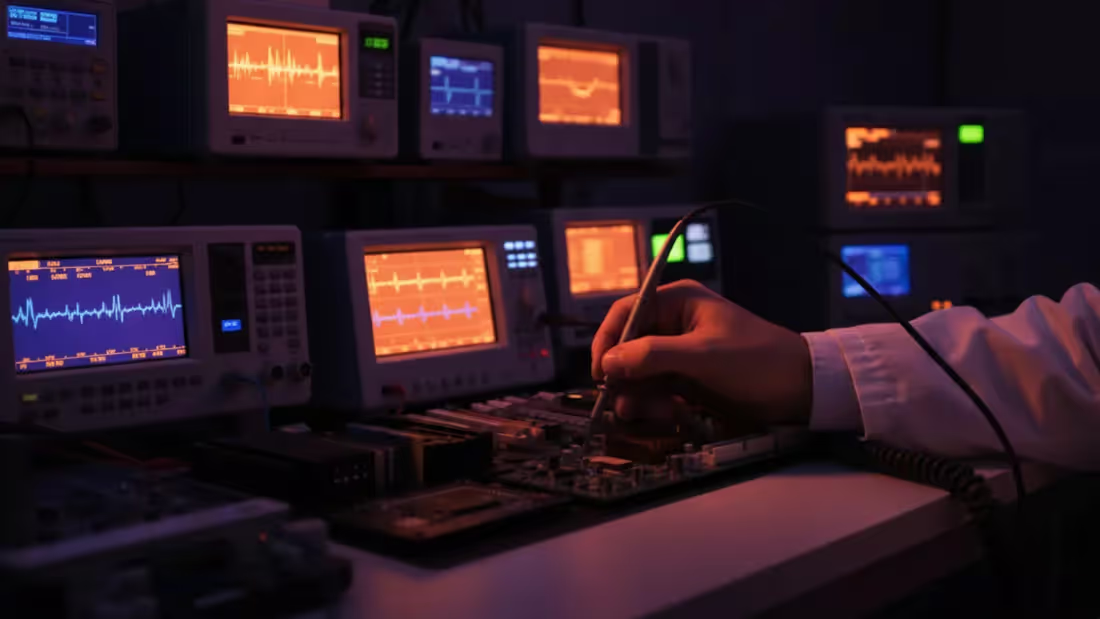
We develop and integrate software for industrial control and monitoring systems that require reliable communication between field devices and operational interfaces. Our approach addresses controller integration, communication protocols, remote operation, and fault handling under real operating conditions. Each solution is engineered to support dependable control, consistent monitoring, and long-term operational stability.


We develop embedded software and programmable logic for aerospace electronics where processing performance, compact hardware, and reliable system behavior are critical. Our engineering work covers FPGA-based architectures, embedded control, hardware-software integration, and efficient use of available computing resources. Each solution is designed to meet demanding operational requirements while supporting future system evolution.

Industries We Serve
Our engineering capabilities are deployed across regulated, mission-critical and industrial sectors.

Subsea electronics, downhole systems and harsh-environment hardware for offshore and onshore operations.

Mission-critical embedded systems and real-time firmware for UAV platforms and defence electronics.

Real-time embedded firmware for gas detection, environmental sensing and worker alert systems.

Embedded systems and real-time firmware for industrial automation,
machine control and IoT data acquisition.
FAQs
If you have additional questions or would like to discuss your requirements, feel free to get in touch with our team.
Embedded firmware development services cover the full path from technical requirements to production-ready firmware running on the target hardware. The scope spans every layer of the firmware stack, from the lowest-level code that initialises the hardware through to the application logic that implements the product's functionality.
Requirements definition establishes the functional, performance, and interface requirements that the firmware must satisfy. This is the foundation that every subsequent development decision is measured against, and the stage where ambiguities in what the firmware needs to do are resolved before they become defects in code that has already been written.
Board support packages are the first firmware layer developed for a new hardware platform. A BSP initialises the processor, configures clocks and memory, and establishes the low-level environment that all subsequent firmware depends on. Getting the BSP right is what makes the rest of the firmware development predictable, because it provides a stable, validated foundation rather than a platform with unresolved hardware bring-up issues sitting underneath the application code.
Driver development provides the software interfaces through which the application firmware communicates with hardware peripherals. Each peripheral on the board, whether a communication interface, a sensor, a display, or an actuator, requires a driver that abstracts the hardware details into a reliable, well-defined API. Custom firmware at this layer is written to the specific characteristics of the hardware rather than to a generic specification.
Application firmware implements the product's functionality on top of the BSP and driver layers. This is where the behaviour that the product exists to deliver is coded, tested, and validated against the requirements defined at the start of the project.
Integration and testing validate the complete firmware stack on the target hardware, confirming that all layers work together correctly and that the firmware meets its requirements under real operating conditions.
Ongoing maintenance covers the updates, optimisations, and adaptations that connected devices require over their operational lifetime, ensuring that production-ready firmware remains reliable as the product evolves.
The most fundamental difference between embedded software development and standard software development is the relationship between the code and the hardware it runs on.
Standard software runs on general-purpose computers with effectively unlimited memory by embedded standards, operating systems that abstract the hardware entirely, and the ability to be updated instantly across all users when a bug is found. The developer rarely thinks about the physical hardware because the hardware is designed to be invisible to the software running on it.
Embedded firmware runs on a specific device, often with kilobytes rather than gigabytes of available memory, no operating system abstraction layer, and direct hardware operation at the register level. Low-level code that configures a peripheral, manages an interrupt, or controls a communication interface is written with explicit knowledge of the hardware it targets. Memory constraints are not a performance concern to be optimised later but a hard boundary that the firmware must fit within from the first line of code. Every allocation, every buffer, and every data structure has a cost that the developer accounts for rather than leaving to a runtime environment to manage.
Device operation in an embedded context is also deterministic in a way that standard software is not required to be. The firmware knows exactly what hardware it is running on, controls that hardware directly, and is responsible for behaviour that a general-purpose operating system would otherwise manage.
Firmware updates are less frequent than updates for application software, and in many embedded devices they are operationally significant events rather than background processes. Updating firmware on a deployed embedded device may require physical access, specialist tools, or a carefully managed over-the-air process with rollback capability. The consequence of shipping a bug in firmware is therefore higher than the consequence of shipping a bug in software that can be patched silently overnight, which is what makes upfront rigour in embedded firmware development not just good practice but an economic necessity.
Firmware stabilization and refactoring become necessary at recognisable points in a product's lifecycle, and addressing them at the right time is significantly less costly than continuing to build on an unstable or poorly structured foundation.
Recurring bugs are the clearest signal. When the same categories of fault keep appearing in different parts of the codebase, or when fixing one issue consistently introduces another, the problem is rarely the individual bugs. It is the structure of the existing firmware that makes those bugs easy to introduce and hard to find. Patching symptoms in code that has underlying structural problems produces a codebase that becomes progressively harder to maintain with each release, and that carries increasing risk of a fault reaching the field.
Hard-to-maintain existing code is a slower signal but an equally important one. When making a small change requires understanding a large portion of the codebase, when there are no clear boundaries between firmware components, or when the knowledge of how the code works exists only in the heads of the original developers, the cost of every future change is higher than it needs to be. Refactoring existing code to establish clear interfaces, remove duplication, and make the structure of the firmware legible to the whole team pays back through every subsequent development cycle.
A move to new hardware is the third common trigger. Porting existing firmware to a new processor or platform exposes the assumptions the code makes about the underlying hardware, many of which will be implicit rather than documented. This is the point at which separating hardware-specific code from application logic, if that separation does not already exist, produces firmware that is genuinely portable rather than a port that carries the assumptions of the original platform into the new one.
In each of these situations, stabilizing and refactoring existing firmware before adding new features is the decision that protects the reliability of what already works while creating the conditions for new development to proceed without inheriting the problems of the code it builds on. The goal is firmware that can be optimised, extended, and maintained with confidence rather than approached with caution.
Firmware development sits at the intersection of software engineering and hardware engineering, and the challenges it presents are distinct from those in either discipline alone. Navigating them requires technical expertise that spans both domains and an understanding of how decisions in one area affect outcomes in the other.
Tight memory constraints are the starting condition of embedded firmware development. The embedded systems landscape covers devices with memory measured in kilobytes alongside those with megabytes available, but in both cases the boundary is fixed and cannot be expanded at runtime. Every data structure, every buffer, every library dependency, and every feature added to the firmware has a memory cost that must be accounted for against a hard limit. Code that manages memory carelessly in a constrained environment produces failures that are difficult to reproduce and diagnose, because memory exhaustion and corruption manifest differently depending on what happens to be in memory at the time.
Processing delays arise when the firmware asks more of the processor than it can deliver within the required time window. In real-time applications, a processing delay is not a performance issue but a functional failure. Identifying where delays originate, whether in interrupt handling, in peripheral communication, or in computation that takes longer than the timing budget allows, requires both the right tooling and the technical expertise to interpret what the measurements reveal.
Real-time timing requirements mean that correctness has a temporal dimension that standard software testing does not address. The firmware must not only produce the right output but produce it within the time the application requires, under all operating conditions, including the worst-case combinations of system load and external events that are difficult to reproduce in a test environment.
Hardware dependencies make firmware inherently specific to its target platform. Changes to the hardware, whether a component revision, a PCB layout change, or a move to a new processor, can affect firmware behaviour in ways that are not visible until the code runs on the new hardware. Managing these dependencies through clean hardware abstraction reduces the risk, but does not eliminate the need for validation on every hardware revision.
Security is the challenge that the embedded systems landscape has been slowest to address and where the consequences of failure are most significant. Firmware vulnerabilities expose the devices they run on to attacks that can affect not just the device itself but the networks and systems it connects to. Security cannot be an afterthought added at the end of firmware development. Authentication, secure boot, encrypted communication, and protection against common attack vectors need to be designed into the firmware architecture from the start, because retrofitting security into existing firmware is both difficult and incomplete.
Firmware porting is the process of adapting existing firmware to run correctly on a new hardware platform, whether that means a different processor family, a revised PCB, or an entirely new custom hardware design. The goal is firmware that behaves on the new platform as it did on the original, with all the same functionality validated against the same requirements.
The starting point is understanding what in the existing firmware is hardware-specific and what is not. Well-structured firmware separates hardware-dependent code, drivers, peripheral initialisation, and memory map definitions, from the application logic that sits above it. Where this separation exists, porting is primarily a matter of replacing the hardware-specific layer. Where the codebase has hardware assumptions distributed throughout the application code, porting requires more extensive changes and carries higher risk of introducing regressions.
Board support package adaptation is the core of the porting work. The BSP for the new platform initialises the processor, configures clocks, sets up memory regions, and establishes the low-level environment the rest of the firmware depends on. A BSP written for one processor family does not transfer to another: register layouts, startup sequences, interrupt controllers, and memory map conventions differ between architectures and between devices within the same family.
Driver development or adaptation follows. Peripherals on the new hardware may be different devices, mapped to different addresses, or accessed through different interfaces than those on the original platform. Each driver needs to be rewritten or adapted for the new hardware, then validated against the behaviour the application firmware expects from it.
Toolchain reconfiguration adapts the cross compiler, linker scripts, and build system for the new target. Different processor architectures require different compilers, and the same compiler family may need different flags, libraries, and optimisation settings for a new device. Programming languages used in the original firmware remain the same, but the toolchain configuration that produces binary firmware for the target changes completely.
Revalidation confirms that the ported firmware meets the original requirements on the new hardware. For bare metal firmware, this covers timing behaviour, interrupt response, and peripheral operation. For RTOS-based firmware, scheduling behaviour and inter-task timing need to be verified on the new platform, because the overhead characteristics of the RTOS on a different processor may differ from those on the original target.
The requirements that industrial and regulated sectors place on firmware development go beyond technical capability. A firmware development company working in these environments needs to demonstrate reliability in its processes as well as its code, compliance experience across the relevant standards, and a track record in the specific domains where the consequences of firmware failure are most significant.
Reliability in this context means more than firmware that works under normal conditions. It means firmware that has been developed to a standard where its behaviour under edge cases, error conditions, and long-term operation is known and validated rather than assumed. Industrial systems run continuously, often for years without intervention, in environments where a firmware fault cannot be resolved with a remote update. The development process, including requirements traceability, structured testing, and documented validation, is what gives confidence that the firmware will perform as required across the full operational life of the product.
Compliance experience is what makes the difference between a firmware development company that can write code for a regulated product and one that can take that product through certification. Medical devices require firmware developed under quality management systems and validated to standards that govern how requirements are defined, how code is reviewed, and how testing is documented. Consumer electronics, smart home devices, and connected products carry their own compliance requirements around security, wireless protocols, and safety that affect firmware architecture decisions from the start of a project.
The breadth of sectors InTechHouse has worked across, from real-time patient monitoring in medical devices to robotic automation systems and consumer electronics, reflects the range of firmware challenges the team has navigated in production environments. Each sector brings distinct requirements: the deterministic timing demands of robotic automation systems differ from the security requirements of smart home devices, which differ again from the validation obligations of medical device firmware.
Long term support is the commitment that regulated and industrial products require from a firmware development company beyond the initial delivery. Products with long operational lives need a partner who will maintain, adapt, and support the firmware as hardware revisions, regulatory updates, and new requirements emerge over time. InTechHouse is built for exactly this kind of engagement, where the relationship with the client extends across the product lifecycle rather than ending at the point of first delivery.
The firmware development process follows a defined sequence that moves from requirements through to production-ready firmware, with each stage building on the validated outputs of the previous one. The timeline for that journey depends on the complexity of the product, the number of hardware interfaces involved, and the regulatory or compliance requirements that apply. Simple firmware for a single-function device can be completed in weeks. Firmware for a complex embedded product with multiple communication protocols, real-time requirements, and certification obligations can take a year or more.
Requirements definition is where the firmware development process begins. Functional requirements describe what the firmware must do. Performance requirements set the timing, throughput, and resource budgets it must operate within. Interface requirements define how the firmware communicates with the hardware peripherals, external systems, and other software components it connects to. Clear, complete requirements at this stage are what allow development to proceed without the costly changes that ambiguous or missing requirements produce later.
Architecture design translates requirements into a structure for the firmware. This covers the partitioning of functionality, the selection of operating system or bare-metal approach, the definition of interfaces between firmware components, and the mapping of software to hardware resources. Where the product requires them, advanced technologies in processor architecture, wireless connectivity, and security influence architecture decisions from the start.
Developing firmware covers the implementation phase, where code is written, reviewed, and unit-tested against the architecture and requirements. Building firmware for the target hardware using a cross compiler produces the binary that will run on the device, and the development environment is configured to match the specific toolchain requirements of the target platform.
Integration brings the firmware together with the hardware and any external systems, validating that all components function correctly as a complete system on the actual target hardware rather than in simulation. This is where the assumptions each discipline made about the others are tested against reality.
Testing validates the integrated firmware against the full requirements set, covering functional correctness, timing behaviour, and performance under the operating conditions the product will encounter in the field. The output is production-ready firmware that has been verified against its requirements and is ready to be released to manufacturing. Knowing how to create firmware that reaches this standard reliably, across a range of product types and complexity levels, is what the development process is designed to ensure.
The firmware development process follows a defined sequence that moves from requirements through to production-ready firmware, with each stage building on the validated outputs of the previous one. The timeline for that journey depends on the complexity of the product, the number of hardware interfaces involved, and the regulatory or compliance requirements that apply. Simple firmware for a single-function device can be completed in weeks. Firmware for a complex embedded product with multiple communication protocols, real-time requirements, and certification obligations can take a year or more.
Requirements definition is where the firmware development process begins. Functional requirements describe what the firmware must do. Performance requirements set the timing, throughput, and resource budgets it must operate within. Interface requirements define how the firmware communicates with the hardware peripherals, external systems, and other software components it connects to. Clear, complete requirements at this stage are what allow development to proceed without the costly changes that ambiguous or missing requirements produce later.
Architecture design translates requirements into a structure for the firmware. This covers the partitioning of functionality, the selection of operating system or bare-metal approach, the definition of interfaces between firmware components, and the mapping of software to hardware resources. Advanced technologies in processor architecture, wireless connectivity, and security may influence architecture decisions where the product requires them.
Developing firmware covers the implementation phase, where code is written, reviewed, and unit-tested against the architecture and requirements. Build firmware for the target hardware using a cross compiler produces the binary that will run on the device, and the development environment is configured to match the specific toolchain requirements of the target platform.
Integration brings the firmware together with the hardware and any external systems, validating that all components function correctly as a complete system on the actual target hardware rather than in simulation.
Testing validates the integrated firmware against the full requirements set, covering functional correctness, timing behaviour, and performance under the operating conditions the product will encounter in the field. The output of this stage is production-ready firmware that has been verified against its requirements and is ready to be released to manufacturing.
Firmware testing is not a single activity but a layered programme that builds confidence in the firmware's behaviour progressively, from individual components through to the complete system operating under real-world conditions.
Unit testing verifies individual firmware components in isolation, confirming that each function, driver, or module produces the correct output for a defined set of inputs. Testing at this level catches logic errors early, when they are confined to a small amount of code and straightforward to diagnose and fix. Where unit tests can run on the host development machine rather than on target hardware, they can be executed quickly and repeatedly as part of the development workflow.
Integration testing brings firmware components together and verifies that they interact correctly. This is where the interfaces between drivers, middleware, and application code are tested under conditions that approach real operation, and where assumptions that each component made about the behaviour of the others are validated. Integration testing on actual hardware is essential because the timing relationships and electrical behaviour of real peripherals differ from simulation in ways that affect how firmware components interact.
Stress testing validates firmware reliability under sustained load and at the boundaries of the operating envelope. Running the system at maximum throughput, minimum and maximum operating temperatures, and under the combinations of concurrent activity that production use will produce reveals weaknesses that nominal condition testing misses. Cloud connectivity and computer vision pipelines, where they are part of the system, are included in stress testing to confirm that firmware behaviour remains correct under sustained data transfer and processing load.
Pre-compliance testing is run before formal certification submission to identify electromagnetic compatibility issues, timing violations, and other compliance risks while there is still time to address them in the firmware rather than after a formal test failure.
Compliance testing against the applicable standards is the final validation stage, confirming that the firmware and the product it runs on meet the regulatory requirements of the target market. Running tests on actual hardware throughout this programme, rather than relying on simulation, is what ensures that the results reflect the behaviour of the product that will be manufactured and deployed.
Discuss your product with our expert
This initial conversation is focused on understanding your product, technical challenges, and constraints.
No sales pitch - just a practical discussion with experienced engineers.


Share a few details about your product and context. We’ll review the information and suggest the most appropriate next step.