
Payloads for Unmanned Aerial Vehicle (UAV)
Polish Armaments Group: holding of 30+ state defense companies
Polish Armaments Group is a government-established holding uniting over 30 state-owned defense companies in Poland. The group is responsible for a wide range of strategic initiatives, including advanced technology development for military and environmental applications.
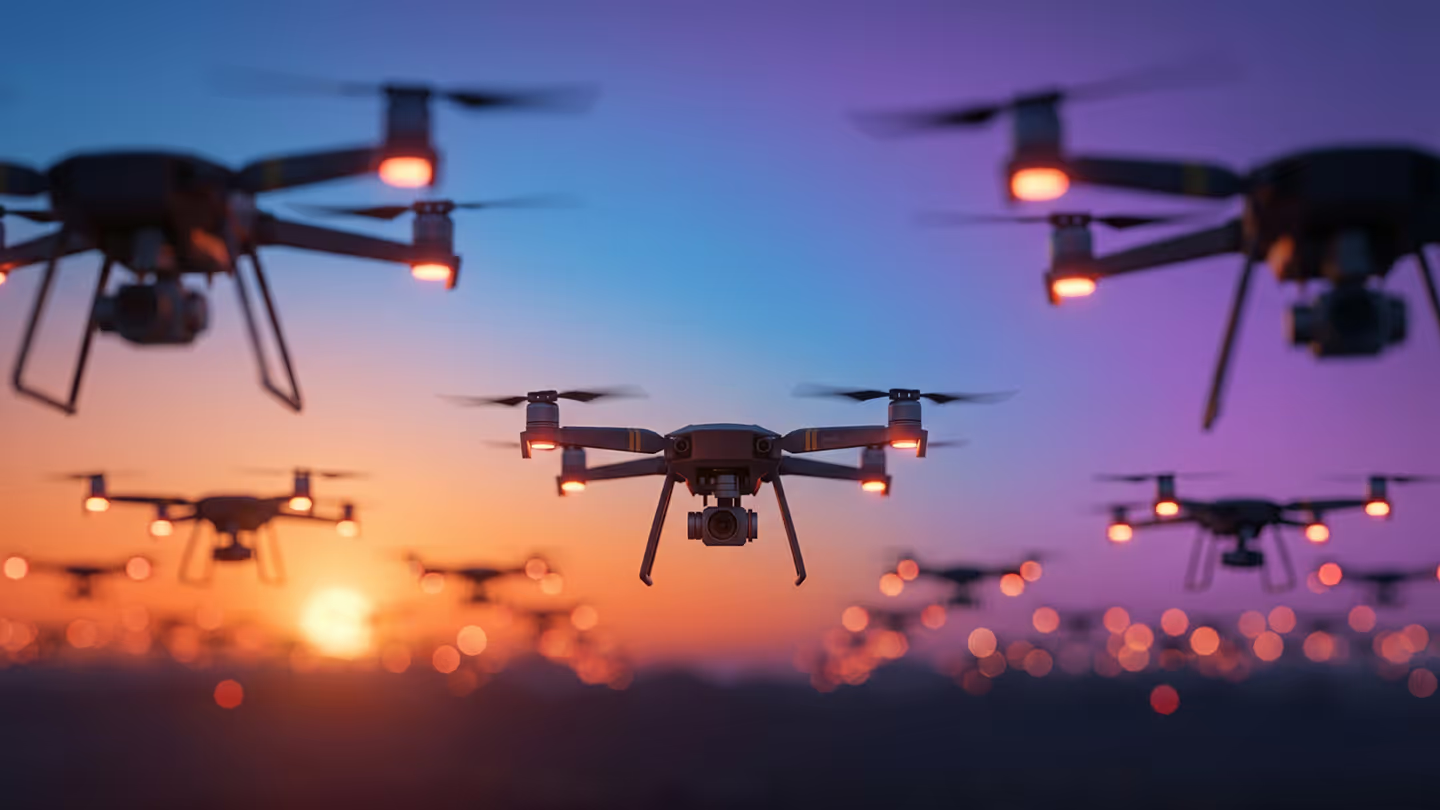
One UAV platform for monitoring and inspection missions
The client required an unmanned aerial platform capable of supporting a wide range of applications, including environmental monitoring and infrastructure inspection. The project called for aerospace and UAV engineering expertise to integrate multiple sensing technologies, onboard processing, and communication capabilities within a flexible platform.
The complexity of the project came from the need to combine multiple sensing technologies, mission types, and operational requirements into a single, flexible system.
At the same time, the platform needed to operate reliably in diverse conditions, supporting both real-time observation and data collection across different scenarios.
Requirements for a modular multi-mission UAV platform
To meet operational requirements, the system needed to:
- support multiple mission types within a unified platform
- integrate various sensors and data collection systems
- enable real-time observation and data transmission
- operate in hard-to-reach and hazardous environments
- maintain high reliability under demanding field conditions
The goal was to create a modular platform that could adapt to different use cases without requiring separate systems.
UAV family: patrol, environmental research, and sampling platforms
A family of UAV platforms was developed, each tailored to specific mission requirements while sharing a common architectural foundation.
These platforms include:
- Patrol systems equipped with electro-optical and infrared sensors
- Environmental research platforms for air pollution analysis and chemical contamination detection
- Sampling platforms for collecting material for further laboratory analysis
- NDVI imaging systems for assessing vegetation health
- Exploratory systems combining signal repeaters and compact observation units for confined spaces
- Photogrammetric platforms designed for mapping and navigation in complex environments
The modular design allows the system to be configured for different applications while maintaining consistency across hardware and software components.
The project illustrates how sensor integration, PCB architecture, and embedded software influence the flexibility and reliability of UAV platforms. Our guide to embedded hardware design discusses these engineering considerations in more detail.
The system combines advanced hardware, embedded software, and communication technologies:
- 6-layer PCB designs for high-performance electronics
- C and C++ for firmware and embedded software
- Python for higher-level processing
- Linux-based systems for onboard computing
- Qt (C++ and QML) for application development
- Communication protocols: ISM, GPS, USB, Ethernet over ISM, SBUS, HDMI, CAN, LVDS
How UAV payloads collect and transmit data in real time
Each UAV platform integrates specialized sensors, onboard processing, and communication systems to collect and transmit data in real time. Depending on the mission, it can monitor environmental conditions, detect pollutants, capture imagery, or collect physical samples.
Communication systems ensure stable data transmission, while onboard software manages flight operations, sensor integration, and data processing.
The modular architecture allows components to be adapted or extended based on mission requirements.
Data collection in hard-to-reach and hazardous areas
The platform enables advanced environmental monitoring and data collection in areas that are difficult or unsafe to access. By combining multiple capabilities into a single system, it reduces the need for separate tools and simplifies operational workflows. Real-time data access improves situational awareness and supports faster decision-making in the field.
Results: multiple mission types on one UAV platform
The system delivered improvements across key areas:
- Expanded mission capabilities, supporting multiple use cases within one platform
- Improved data collection and analysis, enabling better environmental insights
- Reduced operational complexity, through modular system design
- Enhanced field efficiency, in hard-to-reach or hazardous environments
- Support for environmental protection efforts, through advanced monitoring capabilities
Frequently asked questions
Can one UAV platform handle patrol, environmental research, and sampling missions?
Yes, a modular UAV architecture lets platforms share a common hardware and software foundation while being configured per mission. In this project, InTechHouse developed a UAV family for Polish Armaments Group including patrol systems with electro-optical and infrared sensors, air pollution and chemical contamination research platforms, sampling platforms, NDVI imaging systems, and photogrammetric mapping platforms.
Which communication protocols do multi-mission UAV payloads use?
The UAV payloads in this project use ISM, GPS, USB, Ethernet over ISM, SBUS, HDMI, CAN, and LVDS. Communication systems ensure stable data transmission, while onboard software manages flight operations, sensor integration, and data processing. In this project, InTechHouse combined these protocols with Qt (C++ and QML) applications and Python for higher-level processing on Linux-based onboard computers for Polish Armaments Group.
Can UAV payloads collect physical samples for laboratory analysis in hazardous areas?
Yes, a dedicated UAV sampling platform can collect material for further laboratory analysis. These UAV platforms are designed to operate in hard-to-reach and hazardous environments that are difficult or unsafe to access. In this project, InTechHouse built sampling platforms alongside environmental research UAVs that detect pollutants for Polish Armaments Group, reducing the need for separate tools in field operations.
We’ll review your goals, technical constraints, and opportunities to design a solution that fits your organization.
Planning an electronics, embedded, or FPGA project? Our engineers can help with hardware design, firmware, and testing - from first prototype to production.
Related Services
Other related case studies


Feasibility Study for Interprocessor Communication in Underwater Navigation System







Discuss your product with our R&D team
This initial conversation is focused on understanding your product, technical challenges, and constraints.
No sales pitch - just a practical discussion with experienced engineers.
Share a few details about your product and context. We’ll review the information and suggest the most appropriate next step.