
Enhancing Pest Monitoring with Digital Simulations

Optical systems provider automating warehouse monitoring
A provider of advanced optical systems developing automated monitoring solutions for industrial environments such as warehouses. Their products focus on detecting and analyzing environmental conditions using camera-based technologies.
Why real-world training images limited insect detection
Traditional pest monitoring relied heavily on manual inspections, which were time-consuming, inconsistent, and prone to human error.
As the client moved toward automation, they needed a system capable of detecting and classifying insects accurately under varying real-world conditions.
The key obstacle was data. Training such a system typically requires large volumes of labeled real-world images, which are difficult and expensive to collect, especially for specific environments and rare scenarios. Without sufficient high-quality data, system performance and reliability would be limited.
Requirements for synthetic training data for pest detection
To build an effective system, the solution needed to:
- provide large volumes of high-quality training data
- simulate real-world environments and camera conditions
- support detection of multiple insect types
- account for varying lighting and environmental scenarios
- reduce reliance on costly and time-consuming data collection
The goal was to create a scalable and efficient way to train detection models without relying on physical data acquisition.
Synthetic data pipeline simulating warehouse environments
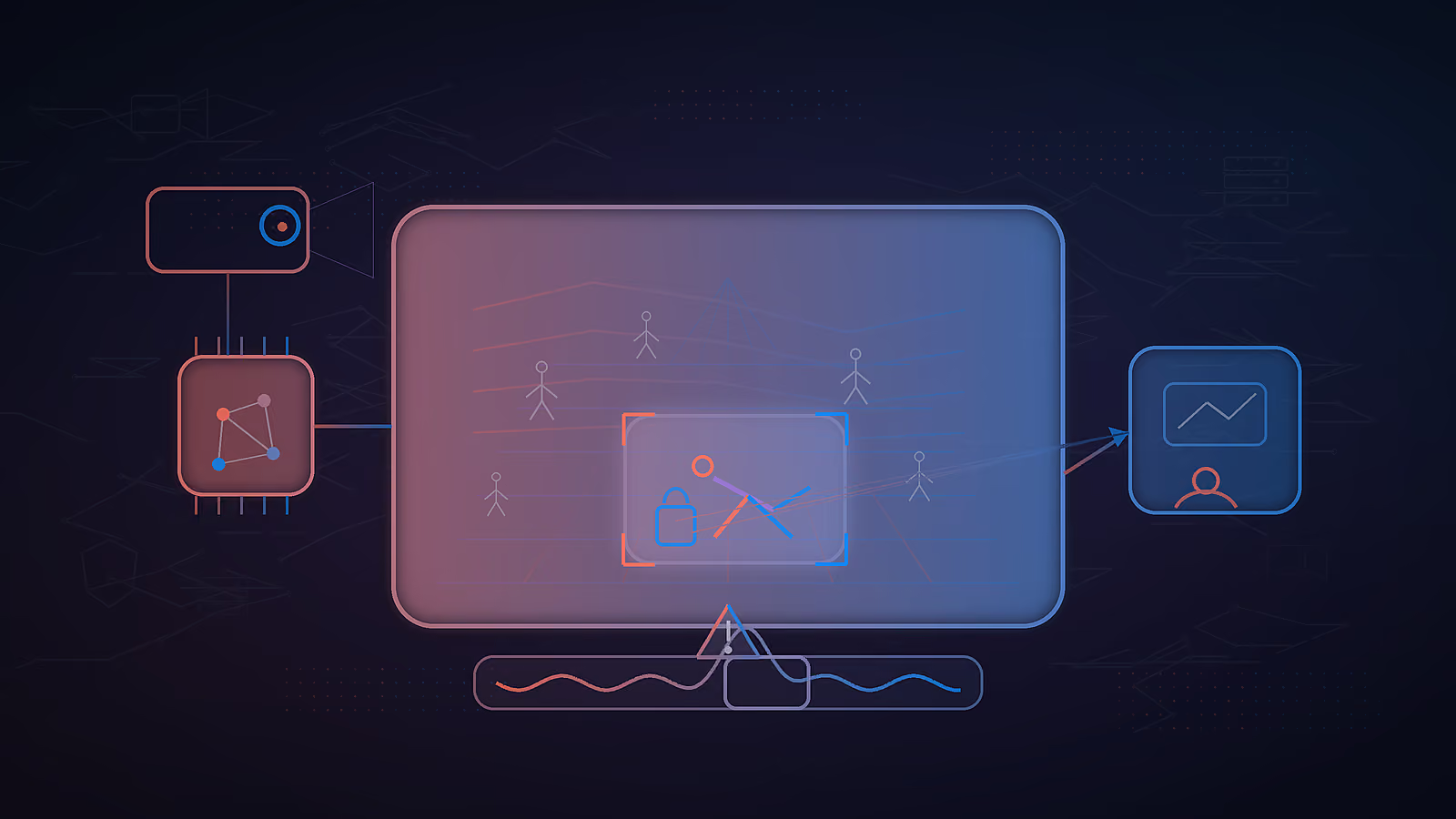
A synthetic data generation pipeline was developed to simulate realistic warehouse environments and produce training datasets for the pest detection system. Instead of collecting real-world images, the system uses digitally recreated environments to generate data that closely reflects actual operating conditions.
The approach combines 3D modeling, environmental simulation, and camera replication to ensure that the generated data reflects expected operating conditions. The resulting datasets support the development of automated detection systems, an application related to IoT and data monitoring solutions, where reliable information is essential for monitoring and analysis.
Automated pest detection illustrates how visual monitoring technologies can support operations in industrial environments. Similar monitoring principles are used in industrial IoT applications, where connected sensors and data processing systems provide information about equipment and environmental conditions.
Technology stack:
- Autodesk 3ds Max for 3D modeling
- V-Ray and Unreal Engine for rendering and simulation
- Substance Painter for texture creation
- Adobe Photoshop for data refinement
How 3D models and camera replication generate training data
A detailed digital model of the physical environment is created, including equipment layout and spatial configuration. Camera positioning and parameters are replicated to match real deployment conditions, ensuring consistency between simulated and real-world data.
Lighting and environmental variations are introduced to reflect different operating scenarios, allowing the system to learn how to detect insects under diverse conditions. The simulated scenes are then rendered into datasets used to train detection models, enabling accurate recognition and classification.
Key capabilities:
- Synthetic data generation for AI model training
- Realistic 3D environment reconstruction
- Accurate camera simulation and positioning
- Simulation of varying lighting and environmental conditions
- Scalable data pipeline for continuous model improvement
Less manual data collection and faster model training
The introduction of synthetic data significantly reduced the need for manual data collection, accelerating the development of the detection system. The client was able to train and test models more efficiently, improving system performance without the delays associated with real-world data acquisition.
At the same time, the automated monitoring system reduced reliance on manual inspections, enabling more consistent and reliable pest detection in industrial environments.
Results: lower data collection costs and faster development
The solution delivered measurable improvements across key areas:
- Reduced data collection costs, by eliminating the need for real-world datasets
- Faster development cycles, through scalable data generation
- Improved detection accuracy, with diverse and controlled training data
- Reduced manual workload, through automated monitoring
- Increased operational efficiency, in warehouse environments
- Scalable foundation, for future monitoring solutions
The synthetic data pipeline provides a reusable foundation for expanding into other automated detection systems. As new use cases emerge, the same approach can be applied to train models in different environments, supporting further product development and innovation.
Frequently asked questions
Can synthetic images replace real-world photos for training an insect detection model in warehouses?
Yes. Synthetic data generated from digitally recreated environments can replace costly real-world image collection when the simulation reflects actual operating conditions. In this project, InTechHouse generated training datasets from simulated warehouse scenes instead of collecting real images, which reduced data collection costs, shortened development cycles and improved detection accuracy through diverse and controlled training data.
How do you keep simulated warehouse camera data consistent with the real pest detection deployment?
By replicating camera positioning and parameters to match real deployment conditions. In this project, InTechHouse first created a detailed digital model of the warehouse, including equipment layout and spatial configuration, then introduced lighting and environmental variations and rendered scenes with V-Ray and Unreal Engine, using Substance Painter for textures and Adobe Photoshop for data refinement.
Can the same synthetic data pipeline be reused for other automated detection systems?
Yes. The synthetic data pipeline is a reusable foundation, so the same approach of 3D environment reconstruction, camera simulation and rendering can train models for different environments. In this project, InTechHouse built the pipeline for warehouse pest detection, and the client can apply it to new automated detection use cases as they emerge.
We’ll review your goals, technical constraints, and opportunities to design a solution that fits your organization.
Planning a computer vision or edge AI system? Our team can help with models, hardware selection, and deployment close to the data source.
Related Services
Other related case studies
Streamlining AI Filter Development and Improving Team Collaboration




Discuss your product with our R&D team
This initial conversation is focused on understanding your product, technical challenges, and constraints.
No sales pitch - just a practical discussion with experienced engineers.
Share a few details about your product and context. We’ll review the information and suggest the most appropriate next step.