
Production AI for a Regulated Hospital, With Full Data Sovereignty

University hospital with 32 departments under GDPR Article 9
A university clinical hospital in Poland, one of the largest in its region, with 32 clinical departments, operates under GDPR and Polish national data protection law (UODO). Patient and operational data are classified as special category data under GDPR Article 9 - which means processing outside the hospital's own infrastructure is not an option without extensive legal and organizational safeguards that the client chose to avoid entirely.
At the same time, the hospital generates years of structured historical data: medical records, medication usage, stock levels, bed occupancy, that remained largely unused for decision support.
This is a pattern we see across regulated organizations, from hospitals to pharmaceutical and industrial environments. Valuable operational data exists, but compliance constraints limit cloud-based AI options, and internal teams lack the infrastructure to run AI in production on their own terms. Similar challenges arise in Industrial AI projects, where secure integration, data governance, and operational reliability are equally critical.
In practice, data sovereignty in this context means one thing: every byte of patient and operational data - at rest, in transit, and during processing - stays on servers physically located inside the hospital, owned and operated by the hospital's own IT team. No cloud, no external APIs, no third-party data processors.
Why patient data could not leave the hospital
The organization needed production-grade AI, not a pilot, inside its own walls.
The requirements were unambiguous:
- all data processing and model training had to run entirely on-premise, in the client's server room
- clinical and operational staff needed AI support in daily workflows: preparing structured medical documentation, selecting materials for medication administration, and ordering medications and supplies
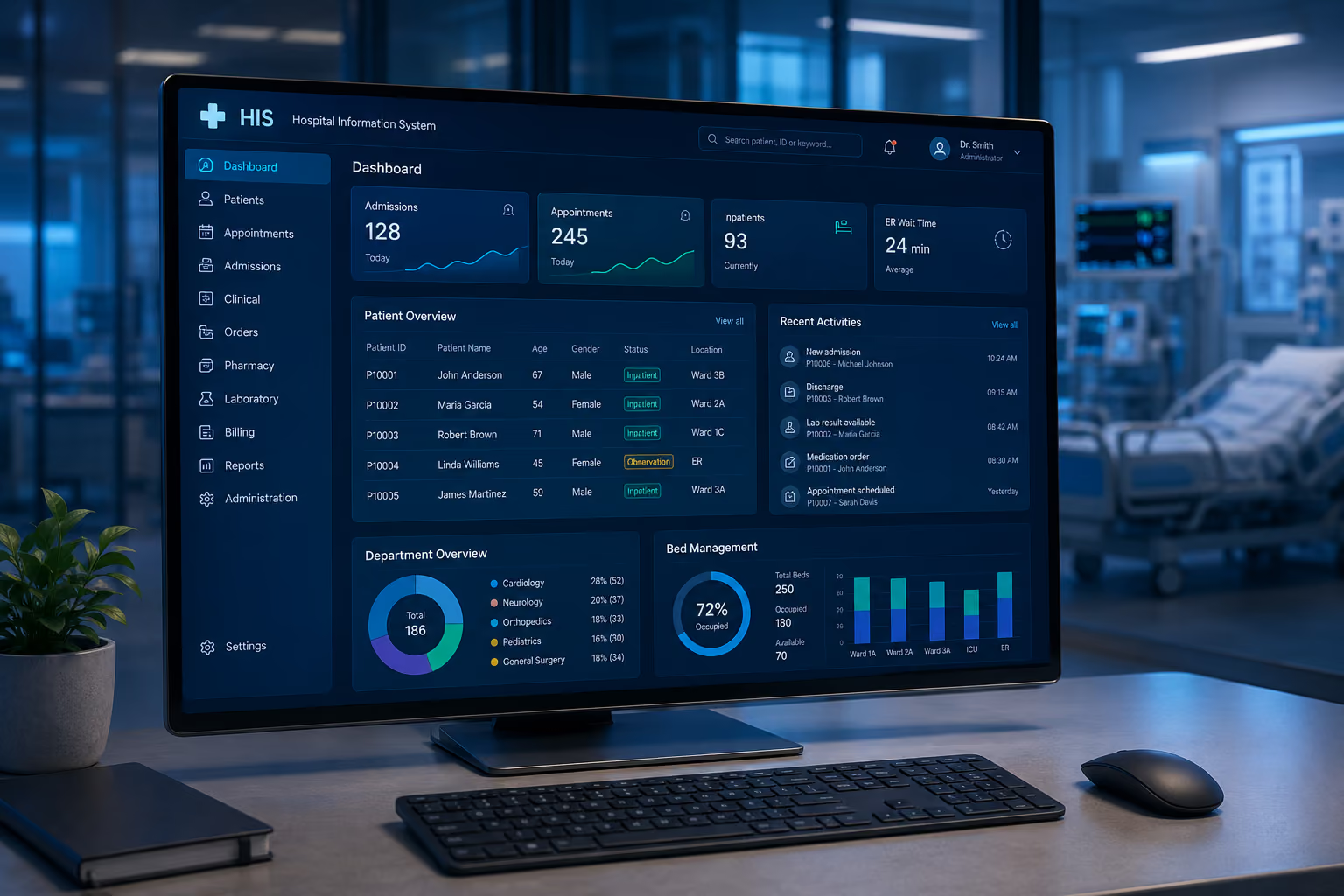
- the solution had to integrate with the hospital's mission-critical information system (HIS)
- production operation could not depend on the availability of an LLM, external services, or any generative process running in real time
- after handover, the client's own IT team had to be able to maintain and extend the system independently, with no vendor lock-in
Most AI initiatives in regulated environments fail at exactly these points. They remain proof-of-concepts, they quietly route data through external APIs, or they create permanent dependency on the vendor.
Three AI modules: documentation, recommendations, forecasting
We delivered a complete on-premise AI platform covering three functional modules on shared infrastructure.
1. AI-assisted medical documentation. The platform analyzed the hospital's historical medical records and generated structured documentation templates, covering care plans, medical orders, referrals, discharge recommendations, and final coding (ICD-10 / ICD-9 - International Classification of Diseases), for the most frequent diagnoses and procedures in each of the 32 clinical departments. The contracted scope covered a minimum of 256 department-specific documentation schemas.
2. AI-based recommendations for medication administration. Based on historical usage data, the system recommends the disposable materials and equipment needed for administering specific medications, adjusted to local practices of each department. Recommendation quality is verified against a contractual threshold of precision@k ≥ 0.70, validated against expert-reviewed test sets.
3. Demand forecasting for medications and supplies. Forecasting models run once a day and deliver seasonality-aware order proposals to pharmacy and logistics before a fixed morning cut-off, replacing manual estimates. The same approach applies to other life sciences and pharma organizations and regulated industries, and similar models support predictive maintenance in industrial environments.
The architecture principle that made it production-grade: the LLM is used exclusively in the content-preparation layer. All generated outputs are validated, versioned, and published to a local reference database, and it is this database, not the model, that production systems query. Live operation has zero dependency on model availability.
The platform is built on:
- on-premise GPU server infrastructure for local LLM inference
- a local LLM, so no data leaves the client's infrastructure at any stage
- MLOps tooling for training, validation, versioning, monitoring, and rollback
- a governed content lifecycle: every AI-generated artifact moves through draft, validation, approved, published, and retired states, with full metadata and audit trail
- JSON-based data pipelines with encrypted transfer and a dedicated intermediate database
- HIS integration via API and database interfaces
Daily decision support for physicians, nurses, and pharmacy
The platform turns years of dormant historical data into a structured foundation for daily decision support, while keeping every byte of sensitive data inside the hospital's own infrastructure. Physicians gain access to pre-structured documentation templates matched to the diagnostic and treatment process. Nurses gain material recommendations consistent with local department practice. Pharmacy and logistics gain daily, seasonality-aware order proposals in place of manual estimates.
Because the production path is decoupled from the generative layer, the system was built to deliver this support with the stability and predictability required of mission-critical hospital infrastructure, ready for the client's team to bring into daily clinical and logistics workflows.
Capabilities behind an on-premise LLM deployment
To meet these constraints, the solution required capabilities that rarely exist in one team:
- designing and delivering the full on-premise infrastructure: an AI server with GPU acceleration, deployed and configured in the client's server room
- standing up a complete local environment for LLM inference, with MLOps tooling for the full model lifecycle
- building secure data pipelines and integrating operational data through Industrial Data Platforms expertise: encrypted transfer, JSON-based exchange, and a dedicated intermediate database
- integrating with a mission-critical hospital system (HIS) without disrupting its operation
- engineering an architecture that keeps generative AI out of the production-critical path
- structuring the entire delivery around knowledge transfer, so the client's engineers can operate and extend the platform independently
Keeping the LLM out of the production path
Historical and current data from the hospital's systems flow through secure pipelines into the local AI environment. Models are trained on this data, entirely within the client's infrastructure.
Generated outputs (documentation schemas, material recommendations, demand forecasts) are validated against quality thresholds, versioned, and published to a local reference database. The hospital's HIS reads from this database in production, a deliberate separation of the generative layer from the operational layer.
Every schema and recommendation carries full metadata: identifier, scope of application, linked diagnoses and procedures, version, status, and publication dates. The client's team can modify dictionaries, classification rules, and mappings, and generate new content for additional diagnoses, medications, and products, without involving the vendor.
Forecasting models run in a daily cycle, delivering order proposals before a fixed cut-off time each morning.
Unlike general-purpose AI tools for data analysts, this solution was designed for tightly controlled production workflows, with local data processing, validated model outputs, and integration into the hospital's existing information systems.
Results: precision@k 0.80 against a 0.70 requirement
The delivery demonstrates a capability that most organizations in regulated environments are still searching for:
- Full data sovereignty. AI training and inference with zero data leaving the client's infrastructure.
- Production deployment, not a pilot. Contractual quality gates (precision@k ≥ 0.70), end-to-end testing, and formal acceptance testing before handover.
- No runtime dependency on generative AI. Offline-first architecture built for environments where downtime is not an option.
- Governed AI content lifecycle. Versioning, validation states, and audit trail designed for regulated settings.
- No vendor lock-in. Complete documentation, source code, and knowledge transfer enabling the client's team to independently extend the system with new diagnoses, medications, and forecasting models.
- Compliance-first model selection. Both the LLM and the supporting models were selected against EU AI Act alignment and provenance from trusted vendors. The platform runs on Gemma, Google's open model family.
- Measured results at handover:
- Documentation module: 320 schemas generated across all 32 departments for the top 10 most frequent diagnoses per department, each with the full 14-section structure, PII protection built into the generation pipeline, and version control on every generation cycle.
- Recommendation module: precision@k of 0.80 achieved against a contractual requirement of 0.70 (0.85 on the validation sample, 0.94 micro-averaged), covering 100 medications across 32 departments and 1,456 recommendation packages. Across the full quality distribution, the median score reached 0.875, with 469 of 693 samples at or above the 0.70 threshold.
- Forecasting module: MASE below 1 at every level of the hierarchy, outperforming a naive seasonal baseline, with hospital-wide WAPE (Weighted Absolute Percentage Error) in the 15 to 17 percent range.
The deployment addresses regulatory requirements at two levels. Under GDPR, all personal data processing occurs within the hospital's own infrastructure - no data is transferred to third-party processors or outside the EU. The AI-generated content lifecycle includes audit trails, version control, and human validation before any output reaches production, which aligns with the EU AI Act's requirements for human oversight and traceability in high-risk applications. Model selection prioritized open-weight models from vendors with transparent training data provenance, reducing the risk of opaque or non-compliant model origins.
For organizations in pharma, life sciences, and other regulated industries facing the same constraint (our data cannot leave the building), this deployment is proof that production-grade, locally hosted AI is achievable today.
Frequently asked questions
Can a hospital run a large language model entirely on-premise under GDPR?
Yes, a hospital can run LLM training and inference on local GPU servers so no patient data leaves its infrastructure. Under GDPR, all personal data processing then occurs inside the hospital, with no transfer to third-party processors or outside the EU. In this project, InTechHouse deployed Gemma, Google's open model family, on an AI server with GPU acceleration in the client's server room.
How can hospital AI avoid depending on LLM availability in production?
By keeping the LLM in the content-preparation layer only. Generated documentation schemas, recommendations, and forecasts are validated, versioned, and published to a local reference database, and the hospital's information system (HIS) queries that database, not the model. In this project, InTechHouse built a governed content lifecycle with draft, validation, approved, published, and retired states, so live operation has zero dependency on model availability.
How was medication recommendation quality validated in the hospital AI platform?
Against a contractual threshold of precision@k of at least 0.70, using expert-reviewed test sets. The hospital recommendation module achieved precision@k of 0.80, with 0.85 on the validation sample and 0.94 micro-averaged. In this project, InTechHouse covered 100 medications across 32 departments and 1,456 recommendation packages, and the median score reached 0.875, with 469 of 693 samples at or above the 0.70 threshold.
We’ll review your goals, technical constraints, and opportunities to design a solution that fits your organization.
Planning an AI system for a regulated environment? Our team can help design on-premise architectures that keep sensitive data inside your infrastructure.
Related Services
Other related case studies





![Gear icon with "AI" center connected to circuit nodes, headline: "Generative AI on the Edge Devices [Efficiency]…](https://cdn.prod.website-files.com/69faf71c11cabfbbbd65ecc4/69faf71c11cabfbbbd65f77f_69f1d83ac003acd7d961acd6_generative-ai-on-the-edge-devices-efficiency-without-the-clo_thumb.avif)

Discuss your product with our R&D team
This initial conversation is focused on understanding your product, technical challenges, and constraints.
No sales pitch - just a practical discussion with experienced engineers.
Share a few details about your product and context. We’ll review the information and suggest the most appropriate next step.