.avif)
Explainable AI, or XAI, is the set of techniques that make an AI system's decisions understandable to a human, surfacing not just what the model decided but why. The angle this page takes is narrower and more practical than most XAI overviews: explanations an operator can read and act on in real time, in systems where a wrong or unexplained decision has safety consequences, not explanations a data scientist reviews offline weeks later. Safety-critical here means a domain where AI decisions feed automatic braking, threat alerts, or other actions where a missed or unexplained failure has physical consequences, and the stakeholders for this page are safety and systems engineers, frontline operators, regulators and auditors, and the ML teams who have to make all of the above trust the system.
Key Takeaways
AI systems are taking on increasingly consequential roles in safety-critical domains: collision avoidance on rail and automotive platforms, threat detection in public CCTV, diagnostic support in medical devices, fault detection in industrial control systems. In each of these contexts, the AI model is not making a recommendation a human reviews at leisure; it is feeding a decision with a real-world consequence on a tight timescale. On those timescales, inference often has to happen on the device itself, which is why industrial edge AI systems keep the model beside the sensor rather than in the cloud.
The AI models that appear in certification contexts are overwhelmingly deep learning models: convolutional neural networks for vision, recurrent or transformer architectures for sequential or temporal data. These models achieve strong performance, often state of the art, precisely because they learn complex, high-dimensional representations directly from data rather than relying on hand-engineered features. That same property is what makes them opaque: a trained model with millions of parameters does not expose a simple, human-readable rule for why it classified a specific input the way it did, in the way a decision tree or a linear model does.
High-stakes environments require understanding AI decision-making for reasons that go beyond intellectual curiosity. An operator who does not understand why a system flagged a threat cannot judge whether to trust that flag. A safety engineer who cannot trace a model's decision back to specific input features cannot build a credible safety case for certification. An auditor reviewing an incident cannot determine whether a system behaved correctly without some account of what the model actually responded to. Model opacity undermines trust in AI decision-making processes specifically because trust in any system, human or automated, depends on some degree of legibility: the ability to ask "why" and get an answer that holds up to scrutiny.
The ML lifecycle stages relevant here, train, validate, deploy, and monitor, map onto operational systems in a way that makes explainability a thread running through the entire pipeline, not a single deliverable produced once. A model is trained on historical data; validated against held-out test sets and, increasingly, against explainability metrics covered later in this guide; deployed into a live system where its decisions have consequences; and monitored continuously, where explanation drift (the model's reasoning patterns shifting over time, even if its accuracy holds) is itself a signal worth tracking.
The foundational distinction in this field, and the one that determines almost every other design decision, is between an interpretable model and post-hoc explainability applied to a black-box model.
Interpretable models are transparent by construction: decision trees, linear models, and rule-based systems expose their decision logic directly, in a form a human can read and verify without any additional translation layer. A decision tree's path from root to leaf is, by definition, the explanation for its output. A linear model's coefficients directly indicate how each input feature contributes to the final prediction. The trade-off, covered in more detail below, is that this transparency typically comes at the cost of representational capacity: interpretable models generally cannot match the accuracy of deep learning models on complex, high-dimensional tasks like image-based object detection.
Post-hoc explainability is what is required when the underlying model is a black box, most commonly a deep neural network, whose internal representations are not directly human-readable. Post-hoc methods (covered in the next section) probe a trained black-box model after the fact, generating an explanation for a specific prediction without requiring the underlying model itself to be interpretable.
A data scientist debugging a model in a notebook wants a detailed, technically rich explanation: a full SHAP value breakdown, a saliency map overlay, a feature-importance ranking across dozens of variables. An operator watching a control room dashboard during a live shift needs something else entirely: a short, immediately actionable statement, "braking triggered: pedestrian detected, 18 meters, confidence 0.94," delivered in under a second, not a research artifact requiring interpretation of its own. Designing for the operator-facing case, the actual subject of this guide, is a distinct engineering problem from designing for the data-scientist-facing case, and conflating the two is a common reason XAI implementations fail to deliver real operational value despite technically working.
The accuracy-versus-transparency trade-off is real but not absolute: post-hoc methods have substantially narrowed the gap, letting teams retain a high-accuracy deep learning model while still producing a credible, human-readable account of its decisions. The trade-off that remains is computational and engineering cost, covered in depth in the Edge and Real-Time Constraints section below, which is where this guide's differentiating angle lives.
Where task accuracy requirements can be met by an inherently interpretable model (decision trees, rule-based systems, or simpler linear models for lower-complexity classification tasks), choosing that interpretable model from the start avoids the need for post-hoc explanation machinery entirely. Where the task genuinely requires deep learning's representational capacity (vision-based object detection is the canonical example for this guide's audience), post-hoc explainability is the practical path, and the question shifts to which post-hoc method, covered next.
XAI provides transparency into how algorithms decide, identifying the most important input features behind a given output, bridging model performance and human interpretability, building trust in the resulting system, and helping identify biases that would otherwise remain hidden inside an opaque model's behavior.
Interpretable models build transparency directly into their structure. Post-hoc explainability works differently: it adds an explanation layer on top of a black-box model after the fact.
The model types differ accordingly. Interpretable approaches typically mean decision trees, linear models, or rule-based systems. Post-hoc explainability gets applied to deep neural networks and ensemble models, the architectures too complex to interpret directly.
On accuracy, interpretable models often hit a lower ceiling on complex, high-dimensional tasks. Post-hoc methods don't have this problem since they explain a model that already matches the underlying black-box accuracy.
Cost is another dividing line. An interpretable model's explanation comes free, the model itself is the explanation. Post-hoc methods require additional compute for every explanation they generate.
Faithfulness works differently too. Interpretable models offer an exact guarantee by construction. Post-hoc explanations are approximate, and how approximate depends entirely on the method used.
That leaves a clear best-fit split. Interpretable models suit lower-complexity tasks and regulatory contexts that demand exact traceability. Post-hoc explainability fits high-accuracy vision and sequence models, where interpretability has to be added after the fact because the underlying model can't be simplified without losing performance.
A practical inventory of the explanation methods a team building operator-facing XAI should evaluate, grouped by category.
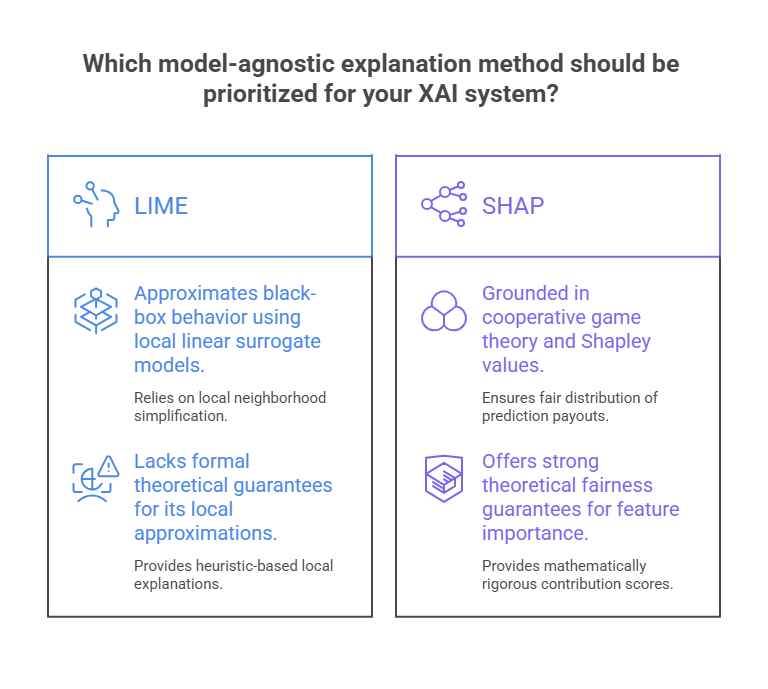
LIME (Local Interpretable Model-Agnostic Explanations) approximates a black-box model's behavior in the local neighborhood of a specific prediction with a simpler, interpretable surrogate model (typically linear), producing a local explanation for that one prediction without requiring any knowledge of the underlying model's internals. SHAP (SHapley Additive exPlanations) is grounded in game theory and Shapley values, a concept from cooperative game theory that fairly distributes a total "payout" (here, the model's prediction) among the contributing "players" (here, the input features), producing feature importance values that have a strong theoretical fairness guarantee that LIME's local linear approximation does not.
Integrated Gradients computes feature importance by integrating the gradient of the model's output with respect to its input along a path from a baseline (often a black or blank image, for vision models) to the actual input, producing an attribution map that satisfies certain desirable mathematical properties (completeness, in particular) that simpler gradient-based methods lack. DeepLIFT (Deep Learning Important FeaTures) similarly assigns each input feature a contribution score relative to a reference activation, propagating that score backward through the network's layers, and is the method this guide returns to repeatedly given the strong evaluation results covered in the next section. Saliency maps, the simplest and computationally cheapest of this group, visualize the gradient of the output with respect to the input directly, highlighting which pixels most influence a vision model's prediction, useful as a fast, low-cost first-pass explanation even where it lacks the theoretical guarantees of the more sophisticated methods.
Counterfactual explanations answer a different, often more operator-intuitive question than feature attribution: not "which features mattered" but "what would have needed to be different for the model to have decided otherwise," a framing that maps naturally onto an operator's instinct to ask "would it have braked if the person had been two meters further away." Rule-extraction approaches attempt to distill a trained black-box model's behavior into a compact set of human-readable rules, trading some fidelity to the original model for a more directly interpretable output format.
A surrogate model, a simpler, inherently interpretable model trained to approximate a black-box model's behavior in a specific region of the input space, is the conceptual mechanism underlying LIME and related local-explanation methods, and can also be deployed independently as a lighter-weight, faster explanation path, relevant to the real-time constraints covered later in this guide.
An explanation method that produces wildly different attributions for two nearly identical inputs is not trustworthy, regardless of how plausible any single explanation looks in isolation. Robustness, the stability of an explanation under small input perturbations, is a property that must be explicitly tested, not assumed, and is one of the four evaluation criteria covered in detail in the next section.
XAI algorithms like LIME and SHAP are used for model interpretability across both general machine learning and deep learning contexts, and the choice among the broader family of methods covered above should be driven by the specific evaluation criteria detailed next, not by which method happens to be most popular or most familiar.
This section presents cited research findings, not InTechHouse claims, as the evidence base for choosing among XAI methods in a safety-critical context.
A rigorous comparative evaluation of four XAI methods, LIME, SHAP, Integrated Gradients, and DeepLIFT, applied to an LSTM model prioritizing real-world network intrusion detection system (NIDS) alerts from a Security Operations Center dataset, assessed explanation quality using a four-metric framework: faithfulness, complexity, robustness, and reliability (Alam and Altiparmak, 2025; published at arXiv 2506.07882 and SCITEPRESS). This is directly relevant to operator-alert systems generally, since NIDS alert classification is structurally the same problem this guide addresses for collision-avoidance and CCTV alerts: a deep learning model making a high-stakes prioritization decision that a human operator needs to trust and act on quickly.
Faithfulness measures the correlation between an explanation's attributed feature importances and the model's actual sensitivity to those features, the degree to which the explanation genuinely reflects what the model is doing rather than just looking plausible. Complexity measures the conciseness of an explanation (calculated via the entropy of the feature attribution distribution), since a sprawling, diffuse explanation citing dozens of marginally-relevant features is less operationally useful than a concise one citing the few that actually matter. Robustness measures explanation stability under input perturbations, as introduced in the previous section. Reliability is assessed through metrics including Relevance Mass Accuracy and Relevance Rank Accuracy, which evaluate whether an explanation's highlighted regions or features genuinely align with what domain experts (in this study, SOC analysts) independently identify as important.
DeepLIFT achieved the highest faithfulness mean and standard deviation correlation values of 0.7559 plus or minus 0.2681 for test data points across the study, the strongest faithfulness result among the four methods evaluated (Alam and Altiparmak, 2025). DeepLIFT also achieved high monotonicity at 78% (mean), meaning its attributed feature importances changed in the expected direction as the corresponding input features were progressively emphasized, a further check on whether the explanation method is capturing genuine model behavior rather than an artifact.
Among the methods assessed by the low-complexity metric, Integrated Gradients achieved the lowest complexity (approximately 2.174 plus or minus 0.413), closely followed by DeepLIFT (approximately 2.264 plus or minus 0.330), with both notably more concise than LIME and SHAP in this specific study's evaluation.
Reliability metrics, Relevance Mass Accuracy and Relevance Rank Accuracy, showed meaningful overlap between the features each explainer highlighted and the features SOC analysts independently flagged as significant, a finding that supports the broader claim that XAI methods, evaluated rigorously, can produce explanations that genuinely track domain-expert judgment rather than diverging from it. Taken together across all four metrics, DeepLIFT consistently outperformed the other XAI methods evaluated, providing explanations with high faithfulness, low complexity, robust performance, and strong reliability (Alam and Altiparmak, 2025), the specific, cited basis for this guide's repeated attention to DeepLIFT as a strong default candidate for operator-alert explanation in deep-learning-based safety systems.
The methodology here, evaluating explanation quality against a structured, multi-metric framework on a real-world dataset rather than relying on a single intuitive metric or anecdotal plausibility, is the standard this guide recommends any team building safety-critical XAI hold their own evaluation to, covered as an actionable practice in the next section.
.png)
An alert nobody can explain within a second will not be trusted by the operator or accepted by the auditor. We design the explanation layer into the HMI and the evidence trail together.
Build operator alerts your safety team can defend
Building on the evaluation framework above, this section covers how those metrics translate into ongoing operational practice and audit evidence.
Faithfulness (covered in detail above) is the core fidelity metric: an explanation is only as useful as its genuine correspondence to what the model is actually doing. Adopting a standard faithfulness metric, measured consistently across model versions and explanation methods, gives a team a comparable basis for evaluating whether a new model version or a new explanation method represents a genuine improvement, rather than relying on subjective plausibility judgments.
Beyond robustness to ordinary input perturbation (covered above), safety-critical systems should specifically test explanation robustness against inputs deliberately crafted to be adversarial, whether through malicious intent or simply through the kind of edge-case input distribution a real deployment will eventually encounter, since an explanation that breaks down precisely on the hardest, most important cases provides a false sense of security that is arguably worse than no explanation at all.
Every metric covered in this guide, faithfulness scores, complexity measurements, robustness test results, reliability comparisons against domain-expert judgment, should be recorded and versioned alongside the model artifact it was measured against, forming the documentary evidence base that a regulatory audit or safety-case review will eventually require, covered in full in the Regulatory Compliance section later in this guide.
Faithfulness measures the correlation between an explanation and the model's actual sensitivity to its inputs. Operationally, it confirms the explanation reflects real model behavior instead of a plausible-sounding fiction that happens to look convincing.
Complexity measures how concise an explanation is, calculated through the entropy of the attribution itself. This matters because it determines whether an operator can actually act on the explanation quickly, or whether they're stuck parsing a dense attribution map that takes longer to interpret than the original decision took to make.
Robustness measures how stable an explanation stays when the input is slightly perturbed. This confirms the explanation isn't an unstable artifact tied to one specific input, a system that gives a wildly different explanation for a nearly identical frame isn't one an operator can trust.
Reliability measures how well an explanation aligns with independent judgment from a domain expert. This validates that the explanation tracks what actually matters to a human reviewer, not just what the model's attribution method happened to highlight.
This is the engineering reality that most XAI content skips entirely, treating explainability as a research output rather than a production system component with its own pipeline, monitoring, and versioning requirements.
Rather than generating an explanation report once, manually, before a model ships, explainability evaluation (the faithfulness, complexity, robustness, and reliability metrics from the previous sections) should be a checkpoint integrated directly into the standard ML training and validation pipeline, run automatically on every candidate model version alongside standard accuracy validation, not as a separate, manual, easily-skipped step.
Every model release should generate an explainability report as a standard build artifact, summarizing the metrics above, comparing them against the previous deployed version, and flagging any regression, integrated into the same release process covered in our companion guide on MLOps for deployed edge devices.
A model's accuracy can hold steady in production while its underlying reasoning pattern shifts, the model arriving at the same correct conclusions through an increasingly different (and potentially less trustworthy) feature-attribution pattern as the input data distribution evolves. Monitoring explanation drift, tracking the stability of feature-attribution patterns over time in production, not just accuracy, is the explainability-specific extension of the broader drift-monitoring discipline covered in our edge MLOps guide.
Every deployed model version's explanation behavior (which method is used, what its measured faithfulness and complexity scores were at validation time) should be versioned and traceable in the same model registry that tracks the model weights themselves, since an explanation generated by one model version is not necessarily valid evidence for the behavior of a subsequent version, and conflating the two in an audit trail is a credibility risk for any safety case built on that evidence.
Explainability has to be designed into the system architecture, not added as an afterthought, for it to genuinely support a credible safety case.
Separating the core inference model from the explanation-generation component as distinct, independently versioned and testable modules (connected by a defined interface, model output and intermediate representations in, structured explanation out) lets a team evolve, swap, or upgrade the explanation method without disturbing the validated, certified inference model itself, a meaningful practical advantage in any system operating under a certification regime where re-certifying the core model is costly.
A safety case is the structured argument, supported by evidence, that a system is acceptably safe for its intended operational context. XAI provides a clear, auditable trail for compliance with safety standards by supplying exactly the kind of evidence a safety case requires: not just "the model achieves 98% accuracy on a test set" but "here is what the model was responding to in this specific class of decision, and here is the evidence that this attribution is faithful and reliable." This is qualitatively different, and more defensible, evidence than an aggregate accuracy figure alone.
A mature safety architecture traces a clear path from a stated safety requirement (the system must detect a forward obstacle and initiate braking within a defined time and distance budget) through the specific model behavior that satisfies it, to the explanation evidence that demonstrates the model is satisfying that requirement for the right reasons, not by an accident of correlation in the training data. This traceability chain, requirement to model behavior to explanation evidence, is the structural backbone any regulatory submission or independent safety audit will ultimately scrutinize.
This is the wedge that makes this page un-clonable by a generic XAI content piece, and the part of the title's promise ("operator alerts in safety-critical systems") that most XAI overviews never actually engage with.
You cannot run an expensive explanation method, full SHAP with its combinatorial feature-coalition sampling, for instance, on every frame of a real-time vision system running onboard a vehicle. SHAP's theoretical rigor comes at real computational cost, often orders of magnitude more expensive per inference than the underlying model's forward pass itself, which is simply incompatible with real-time computer vision on embedded hardware processing 30 frames per second within a fixed power and thermal budget.
The practical resolution is not "always explain everything" but "explain the decisions that matter, when they matter." Most frames in a real-time vision stream produce no actionable output at all (no obstacle detected, no threat flagged); generating a full explanation for every one of those non-events is pure waste. Explaining only the decisions that matter, the moment of a braking alert, the moment a threat is flagged, concentrates the explanation compute budget exactly where it has operational value, and reduces the average per-frame explanation cost by orders of magnitude relative to an always-on approach.
Where a model's architecture and deployment configuration are fixed (the common case for a production safety system, as covered in our hardware guide), some explanation-relevant computation can be precomputed or cached rather than recalculated from scratch on every triggering event, analogous to the precomputed-remap-map approach covered in our fisheye dewarping guide for a different but structurally similar real-time edge constraint. On-demand computation, generating the explanation only at the moment a decision actually requires one, is the right default for genuinely event-triggered explanations like a braking alert, where the rare-event nature of the trigger means there is no meaningful precomputation to do in advance.
A safety-critical alert has its own hard latency budget (the time from detection to braking action, covered in our collision avoidance guide), and the explanation generation cannot meaningfully eat into that budget; an explanation delivered after the braking action has already had to occur regardless is still valuable for the operator's subsequent understanding and trust, but it cannot be allowed to delay the safety action itself. The practical architecture decouples these: the safety-critical decision and action proceed on their own tight timeline, while the explanation is generated in parallel or immediately after, on a separately budgeted (and more generous) timeline, reaching the operator within a second or two rather than the tens-of-milliseconds budget the underlying detection and braking decision itself must meet. The detections that trigger these alerts often rely on human pose estimation, whose own inference time has to fit inside that same tens-of-milliseconds budget.
Saliency maps and Integrated Gradients (the latter shown to achieve the lowest complexity in the evaluation covered earlier in this guide) are generally far cheaper computationally than full SHAP, making them better-suited starting points for an edge-deployed explanation pipeline where compute budget is genuinely scarce. DeepLIFT, given its strong faithfulness and reliability results in the cited research, is a reasonable middle-ground choice, generally more expensive than a raw saliency map but substantially cheaper than SHAP's combinatorial sampling.
This entire section ties directly to on-device inference: explaining only the decisions that matter, on hardware that is already running the core inference model in real time, is the practical realization of operator-facing XAI for the actual deployments this guide is written for. See what is edge AI for the foundational architecture and edge AI hardware for in-vehicle systems for the compute budget reality this explanation strategy has to fit within. Room for those attribution methods usually comes from quantizing models for edge devices, which frees compute and memory on hardware already busy with inference.
This is core to the title's promise, and deserves a full section in its own right: an explanation that never reaches an operator in a usable form has delivered no operational value, regardless of how rigorous the underlying metrics are.
The explanation needs to be embedded directly into the operator's existing workflow and interface, not delivered as a separate artifact the operator has to seek out. For a collision-avoidance braking alert, that means the explanation (object type, distance, confidence) appears on the same display, at the same moment, as the alert itself, not in a separate log file an operator would need to consult after the fact.
The explanation format that works for this audience is short, structured, and immediately actionable: a sentence or a small set of labeled values, not a visualization requiring interpretation or a technical attribution score an operator has no training to read. "Braking: pedestrian detected, 18m, high confidence" tells an operator everything they need to make an immediate judgment call; a raw SHAP value array does not.
Even a well-designed, simple explanation format requires some operator training to use effectively: what does a lower confidence score mean for how much to trust the alert, what does it mean if the explanation cites an unusual or unexpected feature, and what is the correct escalation procedure when an explanation looks anomalous. This training is a real, ongoing operational investment, not a one-time onboarding step, particularly as model versions and their typical explanation patterns evolve over time.
When an alert turns out to be a false positive, or worse, when an incident occurs that the system should have caught and did not, the explanation data attached to that event is a primary investigative asset: what was the model responding to, did the explanation correctly reflect the actual scene content, and does the pattern suggest a systematic gap rather than an isolated failure. Incident procedures should explicitly incorporate this explanation evidence as a standard part of the review process, not treat it as optional supplementary material.
XAI prevents operators from blindly trusting or dismissing AI outputs, building informed confidence rather than either uncritical reliance or reflexive skepticism, both of which are real and well-documented failure modes for any automated alert system over time. This enables genuine human and AI collaboration, where the operator's judgment and the system's detection capability complement each other, and fosters informed human decision-making generally. The practical, measurable payoff connects directly to false-positive reduction: a good explanation lets an operator triage alerts faster, distinguishing at a glance between a credible threat requiring immediate action and a marginal, likely-false detection that can be deprioritized, which is the difference between an alert system operators actually use effectively over a full shift and one that gets ignored or disabled out of alert fatigue.
A map of the applicable standards landscape, with appropriate caution around any claim of legal requirement, which should always be independently verified before publication or use in a compliance argument.
IEC 61508 is the foundational, sector-agnostic functional safety standard underlying most domain-specific derivatives. ISO 26262 applies the functional safety framework specifically to automotive systems, with explicit Automotive Safety Integrity Level (ASIL) requirements that scale with the severity and likelihood of potential harm. EN 5012x (the CENELEC framework, EN 50126, 50128, and 50129) applies the equivalent framework to rail systems, the standard most directly relevant to the transit deployments this content cluster focuses on.
The EU AI Act establishes specific obligations for AI systems classified as high-risk, a category that is likely to include many safety-critical applications covered throughout this guide (transit safety systems, certain categories of biometric and surveillance systems, among others), with requirements touching on transparency, human oversight, and documentation that connect directly to the explainability practices covered throughout this guide. Specific applicability, exact compliance obligations, and implementation timelines under the EU AI Act are evolving and jurisdiction- and application-specific; any claim that a specific XAI practice is legally required under the Act, or under any other named regulation, should be verified with qualified legal counsel before being relied upon, rather than taken from this or any general guide.
Standardizing the documentation format for explainability evidence, the metrics, evaluation methodology, and traceability chain covered throughout this guide, into a consistent template that can be efficiently assembled for each model version and each regulatory submission, substantially reduces the effort and risk of inconsistency in what is otherwise a recurring, high-stakes documentation burden.
Beyond internal validation, scheduling periodic independent audits, by a third party with no stake in the model's reported performance, of both the model's explainability claims and the evidence supporting them, is increasingly an expectation of mature safety-critical AI governance, not just a best practice.
Every decision about which explanation method was chosen, what evaluation criteria it was measured against, and what the results were, should be documented and retained as part of the system's permanent audit trail, available for review long after the original engineering team that made those decisions may have moved on to other projects.
Safety-critical decisions must be auditable by law or regulation in an increasing number of jurisdictions and sectors, and XAI is vital for regulatory compliance specifically because it is the mechanism that makes an otherwise opaque deep learning decision auditable at all. High-stakes environments require functional safety standards as a baseline, and XAI is crucial in automotive and healthcare, the two sectors where this regulatory pressure has historically been most mature and most directly applicable to AI-based systems, with rail following a closely related trajectory under its own CENELEC framework.
Leading with the deployment most directly relevant to this content cluster: a tram or light-rail collision-avoidance system where an automatic-braking decision is surfaced to the operator with a reason, not just a binary alert. This is the case study detailed in full below, and it illustrates the core thesis of this entire guide: the explanation is not a regulatory nicety bolted onto the safety system, it is operationally necessary for the operator to maintain appropriate trust and respond correctly to the system over a full service life.
In this class of system the alert rarely comes from a single sensor, which makes the explanation harder: the driver needs to know whether the camera, the LiDAR, or the radar drove the decision. The architecture behind that, including how detections are aligned and combined on-vehicle, is described in our guide to camera, LiDAR and radar fusion.
Driver-assistance and partial-automation systems increasingly use a combination of inherently interpretable components (rule-based logic for certain safety-critical decision boundaries) and post-hoc-explained deep learning components (for perception tasks like object detection), reflecting the broader pattern covered throughout this guide of matching the explainability approach to the specific sub-task rather than applying a single method uniformly across an entire system.
Aviation has among the most mature functional safety and certification traditions of any industry, and AI-based systems entering this domain face correspondingly rigorous explainability and traceability requirements, often requiring a level of evidence and formal verification beyond what is currently standard in automotive or rail, a useful reference point for how stringent this discipline can become as a sector's safety culture and regulatory maturity increase.
AI-assisted diagnostic and monitoring devices face explainability requirements driven both by formal regulatory pathways (device certification processes that increasingly expect some account of model decision-making) and by the practical reality that a clinician will not act on a diagnostic recommendation they cannot understand or evaluate against their own expertise, directly paralleling the operator-trust dynamic covered throughout this guide.
AI-based fault detection and predictive maintenance in industrial control systems generally operates under lower formal certification burden than automotive, rail, or medical applications, but the same underlying lesson applies: an operator who does not understand why a system flagged a potential fault is less likely to act on that flag promptly, eroding the practical value of the detection system regardless of its underlying accuracy. Explanations therefore count as a functional requirement in production-grade industrial AI, on par with detection accuracy, because an alert nobody trusts never turns into a maintenance action.
XAI is crucial for safety and compliance in sectors like automotive and healthcare, and the transit and industrial-safety contexts this guide is written for sit squarely within the same underlying logic, even where the specific regulatory framework differs in maturity or formal structure.
InTechHouse case study: Explainable collision-avoidance alerts for public transport safety
InTechHouse made the automatic-braking decision explainable in real time for a collision-avoidance system, surfacing "why the system braked" to the onboard operator at the moment of the alert, not as a separate post-hoc review artifact.
The explanation surfaced the detected object class, its estimated distance and closing rate, and the model's confidence score, delivered to the operator's display within the same time window as the braking alert itself, structured as a short, immediately readable statement rather than a technical attribution visualization requiring interpretation.
This built operator trust measurably over the deployment period: operators who could see what the system had detected and why were less likely to dismiss or override genuine alerts as nuisance triggers, and the explainability data attached to each event gave the operations team a concrete, evidence-based basis for tuning the system's alert thresholds rather than relying on anecdotal operator feedback alone.
Read also:
Before reaching for a black-box deep learning model and a post-hoc explanation layer, confirm whether an inherently interpretable model can meet the task's accuracy requirements; where it can, the engineering and audit simplicity it provides is substantial.
Where deep learning is genuinely required, select a post-hoc method (DeepLIFT, Integrated Gradients, SHAP, or LIME, per the evaluation guidance covered throughout this guide) matched to the specific accuracy, compute-budget, and faithfulness requirements of the deployment.
Run the reliability evaluation covered in the Evaluating Model Explainability section, comparing the model's attributed feature importances against independent domain-expert judgment, not as a one-time validation step but as a recurring practice across model versions.
Every explanation generated in production should be logged alongside the corresponding model decision, forming the data foundation for the incident-investigation, drift-monitoring, and audit-trail practices covered throughout this guide.
Robustness testing should specifically cover the kind of distribution shift a deployment will genuinely encounter over its service life, seasonal lighting changes, new object types entering a scene, sensor degradation, not just synthetic perturbation tests in a lab environment.
A new model version, or even a change to the explanation method itself, requires revisiting the safety case and its supporting evidence, not assuming the previous version's explainability evidence remains valid by default.
XAI allows engineers to identify and correct errors in AI models before failures occur, since a faithful explanation frequently surfaces a model relying on a spurious or unintended correlation in its training data well before that flaw manifests as an actual failure in deployment. Increased transparency allows developers to pinpoint model failures and risks earlier in the development cycle, when they are far cheaper and lower-risk to address than after a system has shipped.
SHAP (the reference implementation of the Shapley-value approach covered earlier) and LIME (the reference implementation of the local surrogate-model approach) are the two most widely adopted general-purpose explainability libraries. Captum, developed for the PyTorch ecosystem, provides a comprehensive implementation of deep-learning-specific attribution methods including Integrated Gradients and DeepLIFT, directly relevant to the methods this guide has emphasized. Alibi provides a broader toolkit spanning explanation, monitoring, and outlier detection, useful for teams wanting a more integrated production-monitoring story alongside explanation generation. InterpretML provides both interpretable-model training and post-hoc explanation tooling within a single, unified library.
Beyond simply selecting a library, evaluate each candidate tool's actual performance against the faithfulness, complexity, robustness, and reliability framework covered earlier in this guide, on representative data from the actual deployment domain, rather than assuming a popular library's default configuration is automatically well-suited to a specific safety-critical use case.
Building an initial explanation pipeline using a model-agnostic library (SHAP or LIME) before committing to a more deeply integrated, model-specific approach (Captum's DeepLIFT implementation, for instance) is a reasonable de-risking strategy for a team's first production XAI deployment, letting the team validate the operational workflow and operator-facing format before optimizing for the lowest-latency, most tightly integrated explanation path.
Every library and method covered above should be benchmarked directly on the target deployment's representative hardware and data, following the same measurement discipline covered throughout this content cluster's guidance on edge deployment, not assumed from generic published benchmarks that may not reflect the specific model architecture or input characteristics of a given deployment.
SAFEXPLAIN (Safe and Explainable Critical Embedded Systems based on AI) is a Horizon Europe-funded research project, coordinated by the Barcelona Supercomputing Center, that integrates and embeds XAI directly into the safety lifecycle for critical autonomous AI-based systems, with case studies spanning automotive, space, and, directly relevant to this guide's primary domain, railway applications (SAFEXPLAIN project, BSC-CNS, concluded 2025). The project's core innovation, an AI-Functional Safety Management lifecycle positively assessed by certification experts from TUV Rheinland, adapts traditional safety engineering principles specifically to the realities of deep learning, providing both a conceptual framework and an open software platform relevant to any team building toward functional safety certification for an AI-based railway or automotive system.
XAI helps reduce false positives in network intrusion detection by giving analysts a faster, more reliable basis for triaging alerts, and DeepLIFT outperformed other methods in alert-classification reliability in the rigorous, cited evaluation covered in detail earlier in this guide (Alam and Altiparmak, 2025), evidence this guide treats as directly transferable to the structurally similar operator-alert problem in collision-avoidance and CCTV threat-detection systems.
Explainability tools help detect security vulnerabilities as a secondary but genuinely useful benefit beyond their primary safety and trust function, since a model relying on an unintended or adversarially exploitable feature correlation is frequently surfaced by the same attribution analysis that supports operator-facing explanation.
Despite the substantial progress covered throughout this guide, fundamental questions remain open: how to formally guarantee faithfulness rather than only measure it empirically on a specific dataset, how to extend rigorous evaluation frameworks like the one covered earlier in this guide to genuinely novel, out-of-distribution inputs rather than just the test distribution a model was validated against, and how to scale human-subject validation (covered as a best practice above) cost-effectively across the full range of model versions and operational scenarios a real fleet deployment encounters over its service life.
XAI integration lacks systematic approaches in safety-critical domains currently, with evaluation methodology varying meaningfully across research groups and application domains, a fragmentation that makes cross-study comparison difficult and slows the maturation of shared standards that regulators and certification bodies could reference directly, the gap that initiatives like SAFEXPLAIN are explicitly working to address.
Given the domain-specificity of explainability evaluation (a method that performs well for NIDS alert classification, as covered in this guide's central cited research, will not automatically transfer its measured performance to a vision-based collision-avoidance task without independent validation), targeted pilot studies in each specific safety-critical domain remain necessary before broad claims of method superiority can be made with confidence.
As frameworks like SAFEXPLAIN mature and regulatory frameworks like the EU AI Act's high-risk regime take fuller effect, the practical expectation for any team building safety-critical AI is that explainability evidence will move from a competitive differentiator (the position this guide largely treats it as today) to a baseline certification requirement over a multi-year horizon, making early investment in the practices covered throughout this guide a meaningful hedge against future compliance cost, not just a current best practice.
High false positive rates challenge NIDS alert prioritization specifically, and the same alert-fatigue dynamic, covered in the Human Factors section above, challenges every operator-facing safety alert system this guide addresses, which is precisely why the research gaps in this section matter operationally, not just academically: closing them directly improves the practical trustworthiness and usability of the systems this guide's audience is building and deploying today.
A practical first explainability sprint does not need to cover everything in this guide at once. Pick one model already in production or near deployment. Pick the four metrics covered in the Evaluating Model Explainability section (faithfulness, complexity, robustness, reliability) and measure them against at least one candidate explanation method. Validate the results with one domain expert, an operator, a safety engineer, or both, comparing the explanation's highlighted factors against their independent judgment. Write one safety-case fragment, a single page connecting a specific safety requirement to the model behavior that satisfies it and the explanation evidence supporting that claim.
Assign clear owners: someone on the ML team responsible for the technical evaluation and metric measurement, someone on the safety or regulatory side responsible for translating that evidence into the safety-case and compliance documentation this guide has covered, and a target timeline for the pilot.
To discuss scoping explainable safety-AI for a deployed or planned system, including how to select and evaluate an explanation method for your specific real-time and edge constraints, talk to the InTechHouse team. For the broader safety context this guide connects to, see our industrial safety practice.
Our teams ship detection and vision models with the evidence package that functional safety review actually asks for. Ask how we handle explainability from model output to operator screen.
See how we deliver auditable edge AI for safety-critical systems
Not sure where to start? We work with companies at every stage, from early ideas to enterprise-level builds. A 30-minute call can save you months of guesswork.
Explainable AI (XAI) is the set of techniques that make an AI system's decision-making transparent and understandable to a human, identifying which input features or patterns drove a specific output rather than leaving the model as an opaque black box. For safety-critical systems specifically, XAI provides the evidence base that lets operators, engineers, and auditors trust, validate, and act on AI-driven decisions in real time.
Safety-critical systems need explainability because a decision an operator, auditor, or safety engineer cannot understand is a decision they cannot validate, trust, or improve. High-stakes environments require understanding AI decision-making to support operator trust during live operation, regulatory and certification compliance under functional safety standards, and post-incident investigation when something does go wrong, none of which is achievable with an unexplained black-box output alone.
Operator-facing explanation requires a short, structured, immediately actionable format delivered at the moment of the decision, not a technical artifact requiring separate interpretation: a concise statement identifying the detected object or condition, relevant context like distance or confidence, and the resulting action, integrated directly into the operator's existing display and workflow. This is a distinct design problem from data-scientist-facing explanation, which can tolerate more technical detail and a longer review timeline.
Yes, but it requires deliberately selecting lightweight explanation methods and applying them selectively rather than attempting full explanation of every inference. Computationally expensive methods like full SHAP are generally incompatible with real-time, frame-by-frame explanation on embedded hardware; the practical approach explains only the decisions that matter (a triggered alert, not every routine frame), using faster methods like Integrated Gradients or DeepLIFT, with the explanation generated on a separately budgeted timeline from the safety-critical action itself.
Functional safety standards (IEC 61508 and its automotive, rail, and other sector-specific derivatives) and the EU AI Act's high-risk regime both create requirements that explainability evidence directly supports, including transparency, human oversight, and documentation obligations relevant to many safety-critical AI applications. Specific legal requirements vary by jurisdiction, sector, and the precise classification of a given system, and are evolving; any specific compliance claim, including under the EU AI Act, should be verified with qualified legal counsel rather than assumed from general guidance.
Tomasz Andrysiak, DSc, PhD, is an Expert and a Professor at Bydgoszcz University of Science and Technology. He has more than 30 years of academic, research, R&D, and technology-implementation experience in artificial intelligence, computational intelligence, signal processing, anomaly detection, cybersecurity, and complex information systems.
His research focuses on machine-learning and computational-intelligence methods for analyzing signals, time series, network traffic, industrial data, and multimodal datasets. He specializes in anomaly and failure detection, predictive modeling, intelligent monitoring, critical-infrastructure security, smart metering, biomedical signal analysis, and the practical deployment of AI in industrial and public-sector systems.
Tomasz is the author or co-author of more than 75 scientific publications, including papers published in internationally recognized journals and conference proceedings indexed by Web of Science and Scopus. His research has covered network anomaly detection, cybersecurity of critical infrastructure, ECG signal analysis, machine learning, smart water networks, telecommunications, and intelligent industrial systems.
He has led and contributed to national and European R&D programs focused on cyber situational awareness, critical-infrastructure resilience, autonomous systems, Big Data, intelligent water management, blockchain-based transaction platforms, and industrial AI. He leads industrial-doctorate projects involving AI-based CMDB automation and machine-learning methods for knowledge discovery in Big Data.
Tomasz is an IEEE Senior Member and has served as an elected member of the Commission of Informatics and Automation of the Polish Academy of Sciences, Poznań Branch. He has participated in scientific committees and journal boards, supervised doctoral research, reviewed publications for international journals, and co-authored patents and patent applications related to signal detection and LoRa-based ECG monitoring. He writes about industrial AI, machine learning, anomaly detection, predictive analytics, cybersecurity, signal processing, time-series analysis, and intelligent infrastructure.
Tomasz Andrysiak's academic profiles:
https://orcid.org/0000-0001-8138-6619
https://ludzie.nauka.gov.pl/ln/profiles/fHOpojQ2lIF
https://link.springer.com/chapter/10.1007/978-3-642-32384-3_28
https://www.researchgate.net/profile/Tomasz-Andrysiak
https://scholar.google.com/citations?user=RHW7zx4AAAAJ&hl=pl
https://dblp.org/pid/41/6793.html
https://radon.nauka.gov.pl/dane/profil/6FFA1E51186802ECFFB49644209B5BE0EBD68C55
https://pbs.edu.pl/pl/pracownik/tomasz-andrysiak
https://www.youtube.com/watch?v=6e1GTqT5czM
From first prototype to production, our engineers can help you scope it, build it and get it certified.
This initial conversation is focused on understanding your product, technical challenges, and constraints.
No sales pitch - just a practical discussion with experienced engineers.
Share a few details about your product and context. We’ll review the information and suggest the most appropriate next step.