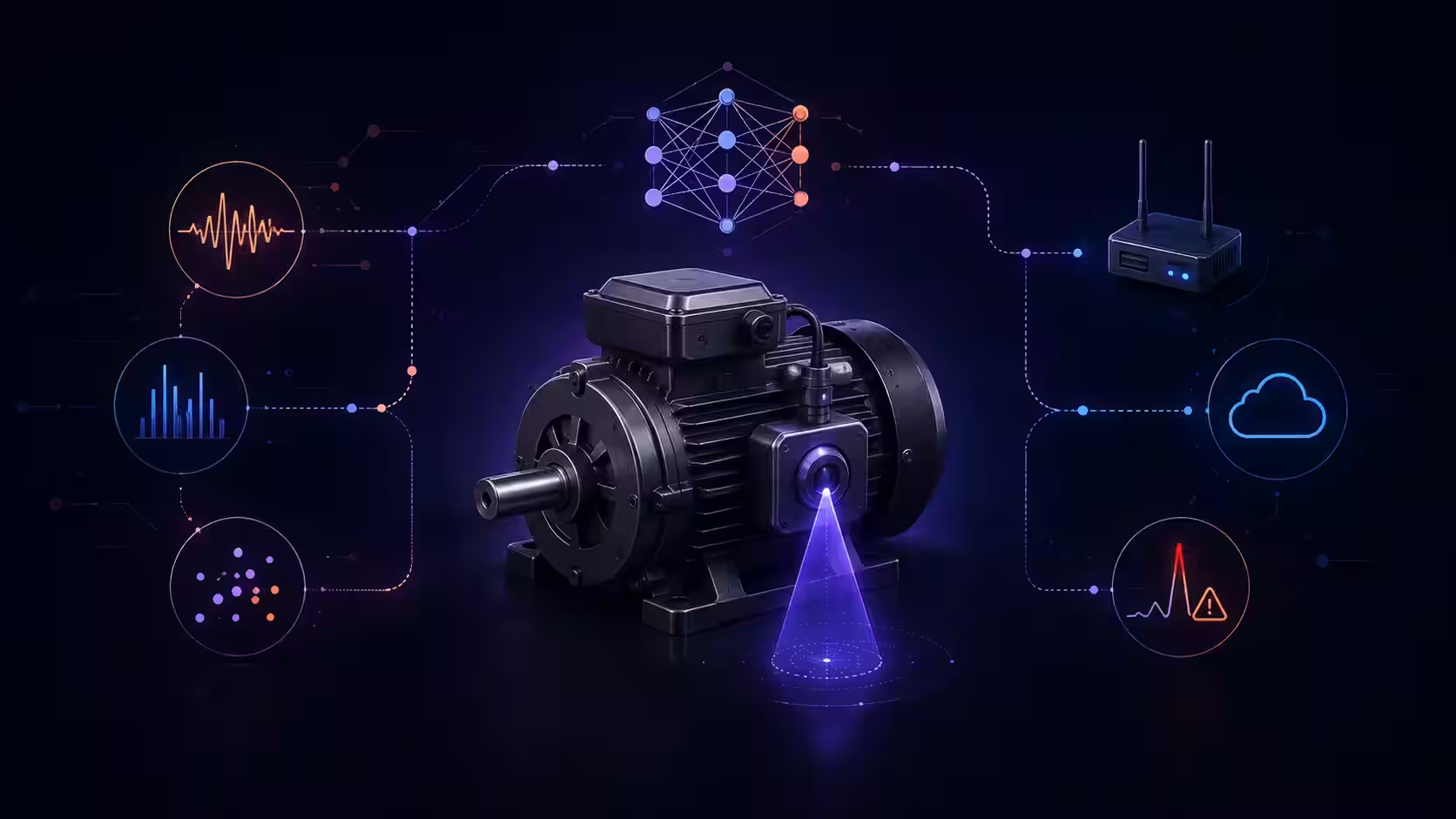
.avif)

Video anomaly detection is the process of monitoring video to flag events that deviate from learned normal behavior, without requiring the system to have seen the specific anomaly during training. The focus of this guide is rare safety events: fights, falls, weapons, trespassing, unattended objects. These are hard precisely because there is almost no data to train on. A camera covering a busy transit platform may capture a genuine safety incident once in tens of thousands of hours of footage. Building a system that catches that one event without drowning operators in false alarms is the core engineering problem this guide addresses.
Key Takeaways
Video anomaly detection monitors live video to compare it against learned normal-behavior models, flagging segments that deviate significantly from what the system has learned to expect in a given scene. Anomalous events of interest in safety and security contexts include fighting, stealing, and accidents, along with the broader category of abnormal behavior: trespassing, loitering in restricted areas, falls, and equipment malfunction in industrial settings. These abnormal events share a common property: each is rare enough that no fixed training set will ever contain examples of every variant a deployed system might encounter. Everything else observed in the scene is classified as a normal event by default. Because these events are rare and time-critical, the models often run on embedded AI hardware beside the camera, so an alert does not wait on a round trip to the cloud.
The defining characteristic of this task, and what separates it from standard object detection, is that the system is not trained to recognize a fixed list of anomaly classes. Video anomaly detection automates surveillance monitoring tasks by learning a model of what normal activity looks like in a specific scene, then flagging video segments where the observed activity falls outside that learned normal distribution. This is fundamentally a different machine learning problem than training a classifier to recognize "fighting" as a category, because most production deployments will encounter anomaly types that were never represented in training data. Identifying patterns that deviate from the learned norm, rather than matching against known anomaly signatures, is what makes the approach generalize to unseen event types.
The rare-event challenge and the abnormal-behavior challenge compound each other. A rare-event problem is hard because there are too few examples to learn from directly. An abnormal-behavior problem is hard because "abnormal" is not a fixed category: what counts as anomalous in a station concourse at midday is different from what counts as anomalous at 2 AM, and the boundary between unusual-but-benign and unusual-and-dangerous activity is genuinely ambiguous in many cases. Effective video anomaly detection systems must address both challenges simultaneously, which is why the field has converged on normality modeling rather than direct anomaly classification as the dominant approach, covered in detail below.
Detecting anomalies reliably across many camera scenes at once, rather than just one well-tuned camera, is the practical bar most deployments are actually measured against.
Rare event detection techniques identify rare events that are low-frequency but high-impact: events that happen infrequently but where missing one carries a disproportionate cost relative to its rarity. This framing matters because it changes the optimization target. A system optimized purely for accuracy across all video frames will trivially achieve high accuracy by predicting "normal" for everything, since normal frames vastly outnumber anomalous ones. The actual goal is high recall on the rare positive class without an unmanageable false positive rate, which is a fundamentally different optimization problem.
Rare event detection under severe class imbalance is formally an NP-hard problem in the general case (rare event prediction literature). The practical implication: there is no algorithm that solves this problem optimally and efficiently for all data distributions. Every practical system makes trade-offs, and understanding those trade-offs is more useful than searching for a single "correct" architecture.
Imbalanced datasets lead to biased outcomes: a model trained on a dataset where 99.9% of examples are normal will, absent corrective techniques, learn to predict "normal" almost always, because that strategy minimizes training loss even though it fails at the actual task. Limited labeled data complicates training further: even when an organization has captured genuine anomalous events, labeling them accurately (determining exact start and end times, confirming the event category, distinguishing it from look-alike normal behavior) is labor-intensive and requires domain expertise. High dimensionality and temporal properties add another layer of complexity specific to video: unlike a single image or a tabular record, a video anomaly unfolds across both space (where in the frame) and time (over how many frames), multiplying the search space the model must reason about.
A comprehensive survey reviewing rare event prediction across 73 datasets from multiple industries and modalities found that imbalance and limited labeled data are pervasive problems across domains, not specific to video (Shyalika et al., arXiv 2309.11356, 2024). This cross-domain consistency is the reason the field has converged on a particular strategic response: rather than trying to teach a model what every possible anomaly looks like, systems typically rely on learning normal sample distributions and flag departures from that learned normal, which sidesteps the need for comprehensive positive-class training data.
Machine learning techniques applied to this problem (statistical models, one-class SVMs, Gaussian Mixture Models for normality) predate deep learning models but remain relevant for scenarios with very limited compute or training data. Deep learning models (autoencoders, GANs, and more recently transformer-based architectures) dominate current research and most production systems because they learn richer, more discriminative representations of normal video directly from raw pixels, at the cost of requiring more training data and compute than classical statistical approaches. Across published deep learning methods, the choice between reconstruction-based and discriminative training remains the primary architectural fork. Dimensionality reduction techniques such as principal component analysis are sometimes used as a lightweight preprocessing step to compress high-dimensional video features before classical statistical anomaly models, reducing compute cost on constrained hardware.
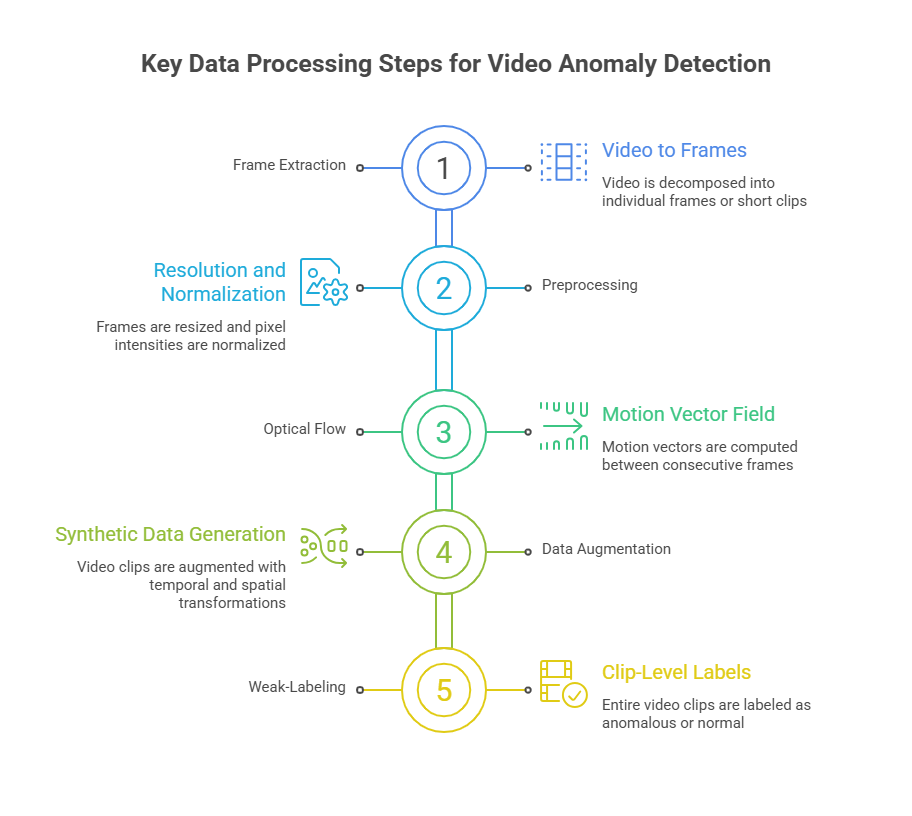
Data processing is the first stage of any video anomaly detection pipeline, performing several steps that materially affect downstream performance.
Video is decomposed into individual frames or short clips, resized to a target resolution matched to the model architecture, and pixel intensities are normalized to a standard range. The frame extraction rate is a design decision: extracting every frame preserves maximum temporal detail but increases compute cost and storage; extracting every Nth frame reduces cost but risks missing brief anomalous events. The input image resolution at this stage directly bounds how much detail later stages can recover.
Optical flow estimates the motion vector field between consecutive frames, capturing how pixels move from one frame to the next. This is a critical input for anomaly detection because many anomalies are defined by motion patterns rather than static appearance: a person running where everyone else is walking, a vehicle moving against traffic flow, a crowd suddenly dispersing. Computing and visualizing optical flow maps (commonly using methods like Farnebäck or, more recently, learned optical flow networks like RAFT) provides the model with explicit motion features alongside the raw RGB appearance information, which is especially valuable for the temporal dimension of the anomaly detection problem, extracting the relevant features that distinguish ordinary motion from the patterns a flagged event would produce. Classical preprocessing techniques like edge detection can supplement learned optical flow in resource-constrained pipelines where a full deep optical flow network is too costly to run.
Data augmentation enhances model sensitivity to rare events by artificially expanding the limited positive examples available. Techniques specific to video anomaly detection include temporal augmentation (varying clip speed, reversing clip order for certain augmentation strategies), spatial augmentation (cropping, flipping), and synthetic anomaly injection (compositing anomalous motion patterns into otherwise normal footage to generate additional positive training examples). Modern approaches combine spatial and temporal analysis rather than treating video as an unordered sequence of independent images, because the temporal structure itself carries much of the signal that distinguishes normal from anomalous behavior. Applying these augmentations consistently throughout the training phase is what gives the model robustness to the variation it will see in deployment.
Given that frame-level labeling of rare events is impractical at scale, most production pipelines establish weak-label procedures: a human reviewer labels an entire video clip as containing or not containing an anomaly, without precisely marking the start and end frame. This weak labeling approach is the foundation for the Multiple Instance Learning techniques covered later in this guide, and it is the practical compromise that makes large-scale rare-event dataset construction feasible.
Public benchmark datasets are the standard reference point for evaluating video anomaly detection approaches, and understanding their scale and composition is useful context for any team scoping a custom deployment.
UCSD Ped1/Ped2 is one of the oldest benchmarks in this space: 70 videos of pedestrian scenes, shot from a single fixed camera angle, with anomalies limited to things like bicycles, vehicles, and skateboards showing up where only foot traffic is expected. Real deployments rarely match that tidy fixed view, and footage from fisheye cameras often needs wide-angle lens distortion correction before models trained on such benchmarks perform well.
ShanghaiTech scales that up considerably. It covers 437 videos and roughly 317,000 training frames across 13 different campus scenes, so the anomaly types vary more too, again mostly bikers and vehicles appearing in pedestrian zones, but across a much wider range of camera setups than UCSD.
UCF-Crime is built for a different purpose entirely. It's 1,900 untrimmed videos, over 13 million frames, 128 hours of footage, drawn from real surveillance conditions rather than staged campus scenes. The anomaly categories reflect that: abuse, arrest, arson, assault, accidents, burglary, explosions, fighting, robbery, shooting, stealing, shoplifting, and vandalism. It's the closest thing to a real-world crime benchmark in this list.
XD-Violence is currently the largest public dataset for video anomaly detection, at 4,754 untrimmed videos and over 217 hours of footage. It focuses on six violence-related categories and, notably, includes audio alongside video, which most benchmarks in this space skip entirely.
CUHK Avenue is smaller and more contained: 37 videos of campus scenes, used as a single-scene benchmark. The anomalies here are specific behaviors rather than object categories, things like running, movement in the wrong direction, or throwing objects.
UCF-Crime contains 1,900 untrimmed videos covering 13 real-world anomaly categories, sourced from real surveillance footage with significant variation in lighting, resolution, and camera angle, which makes it considerably more challenging and more representative of real deployment conditions than single-scene datasets (Sultani et al.; UCF-Crime project page). ShanghaiTech contains approximately 317,000 training frames captured from 13 different scenes across a university campus, providing the multi-scene diversity needed to evaluate whether a model's learned normality generalizes across environments rather than overfitting to a single camera's background.
A comprehensive survey of rare event prediction across 73 datasets from multiple industries found that a substantial share of naturally occurring rare-event datasets fall into the extremely-rare category, where positive examples represent a vanishingly small fraction of total data (Shyalika et al., 2024). This rarity distribution is consistent with what teams encounter when building custom datasets from a real deployment's camera footage: genuine safety incidents are rare occurrences by the nature of safety systems working as intended. This rarity distribution reflects how infrequently unusual events and unusual patterns actually appear in normal operational footage.
Synthetic data is increasingly used to supplement scarce positive samples. Synthetic anomaly generation (compositing or simulating anomalous events into normal footage) can expand the effective volume of positive training examples without requiring the genuinely rare real-world event to occur and be captured on camera. This is particularly valuable for safety-critical categories (weapons, falls, specific violent actions) where waiting for sufficient real positive examples is neither practical nor ethically desirable.
When building a custom rare-event dataset from operational camera footage, annotation work should follow data minimization principles: annotators should see only the footage segments necessary for labeling, retention of raw footage used for training should be time-limited, and any personally identifiable information should be handled according to applicable regulations (GDPR and equivalent frameworks) given that this is sensitive video data of real people.
A 2D convolutional neural network processes each frame independently, treating the video as a sequence of images; temporal information must be incorporated separately (through an RNN layer, optical flow input, or frame-stacking). A 3D CNN processes video clips as a single 3D volume, with convolutions operating across both spatial dimensions and the temporal dimension simultaneously, learning spatiotemporal features directly. 3D CNNs (C3D, I3D, and successors) are widely used for video anomaly detection because they capture motion patterns natively rather than requiring a separate temporal modeling stage, at the cost of higher compute requirements than 2D approaches. That extra compute directly trades against detection speed on constrained edge hardware.
Many production video anomaly detection pipelines integrate an object detection stage as a preprocessing step, often with small object detection with SAHI, detecting and tracking the people and objects in the scene before anomaly scoring is applied. This hybrid approach lets the anomaly detection layer reason about object-level behavior (this person is moving unusually fast relative to the crowd) rather than only raw pixel-level reconstruction error, often improving both accuracy and the explainability of resulting alerts.
Fusing optical-flow channels with RGB inputs gives the network access to both appearance information (what objects are present) and motion information (how they are moving) in a single representation, which has been shown to enhance detection accuracy over RGB-only or flow-only approaches across most published benchmarks.
Autoencoders learn from normal footage and detect anomalies through reconstruction error: the network is trained to compress and then reconstruct normal video, and at inference time, segments that reconstruct poorly (because the model has never learned to represent that pattern) are flagged as anomalous. This is the dominant unsupervised approach because it requires no labeled anomalies at all during training, only a representative sample of normal footage from the deployment environment. Some classical pipelines pair this with foreground detection (background subtraction) to isolate moving regions before reconstruction scoring is applied, reducing false triggers from static scene elements.
GANs (Generative Adversarial Networks) detect anomalies as discrepancies from learned distributions, using a generator-discriminator framework where the discriminator's confidence (or the generator's reconstruction quality) serves as the anomaly signal. This is closely related to the autoencoder approach but with a more sophisticated training dynamic.
GMMs (Gaussian Mixture Models) model movement likelihood by fitting a probability distribution to observed normal motion patterns, flagging low-probability observations as anomalous. Markov models flag rare action sequences probabilistically by modeling the likelihood of observed state transitions, useful for detecting anomalies defined by an unusual sequence of otherwise-normal individual actions (entering a restricted area, then loitering, then approaching a secured asset).
Transformer-based architectures, increasingly applied to video anomaly detection, use self-attention to model long-range temporal dependencies across an entire clip rather than the limited receptive field of convolutional approaches. This is particularly valuable for anomalies that unfold gradually over many seconds, where a convolutional model's fixed temporal window may miss the slow-building pattern. The trade-off is compute cost and the larger volume of training data transformer architectures typically require to train effectively.
Autoencoder-based reconstruction models train on normal footage only, which means no labeled anomalies are needed to get started. The strength is obvious: you skip the labeling bottleneck entirely. The limitation is just as real. If an anomaly happens to reconstruct well through the network, the model won't flag it, and there's no reliable way to predict which anomalies will slip through until you've already deployed the thing.
GAN-based approaches also train on normal footage only, and they model the underlying data distribution more thoroughly than a plain autoencoder does. That extra modeling power comes at a cost. GANs are notorious for training instability, and getting one to converge on surveillance footage without a lot of manual tuning is a real time sink.
GMM and other probabilistic methods stick with the same normal-footage-only training setup, but trade model complexity for something lighter and more interpretable. That interpretability matters when you need to explain to a client why a system flagged something. The tradeoff shows up in complex scenes: these models don't have the capacity to handle scenarios with a lot of visual variation or clutter.
3D CNN classifiers move into different territory. They need weak or full labels to train, which means someone has to annotate at least some anomalous footage before the model is useful. What you get in exchange is strong spatiotemporal feature extraction, the model actually learns how motion unfolds over time, not just static appearance. The cost is straightforward: more labeled data, more upfront engineering time.
Transformer-based approaches also require weak or full labels, and they're built to model long-range dependencies across a video sequence, catching patterns that span far more frames than a CNN's receptive field typically covers. That capability doesn't come cheap. These models demand serious compute and a large training dataset, which puts them out of reach for a lot of production deployments unless the budget and infrastructure are already in place.
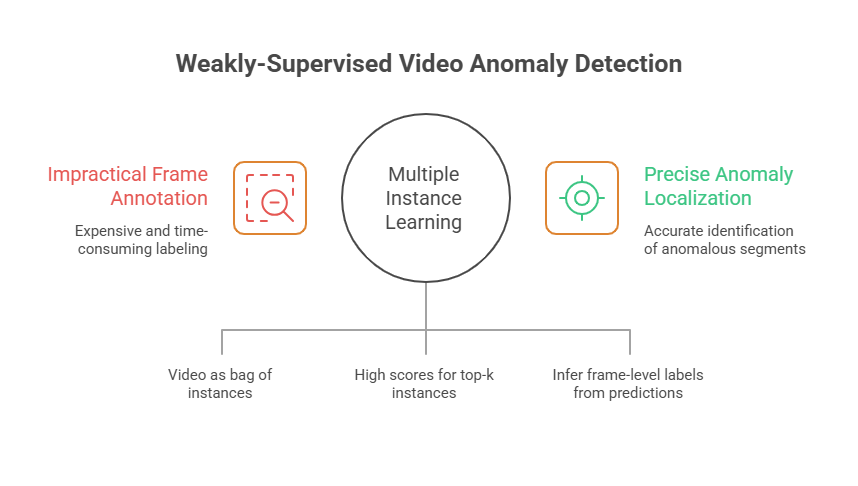
Given that frame-level annotation of rare events is impractical at scale, Multiple Instance Learning (MIL) has become the standard framework for training video anomaly detection models with realistically obtainable labels.
The MIL bag-instance concept. In the MIL framing, each video is treated as a "bag" containing many "instances" (individual frames or short clips). A bag is labeled positive if it contains at least one anomalous instance, and negative if all instances are normal, but which specific instances are anomalous within a positive bag is not known. This matches exactly what is practically obtainable: a human reviewer can confidently say "this surveillance video contains a fight" without precisely marking every frame boundary. This is what weakly supervised learning in this domain practically requires: label availability at the video level, not the frame level.
Top-k ranking loss. A common MIL training objective: for a positive bag, the model should assign high anomaly scores to at least the top-k highest-scoring instances; for a negative bag, all instances should receive low anomaly scores. Implementing and visualizing a top-k ranking loss during training (plotting which segments of a positive video the model is assigning high scores to) is a useful diagnostic for verifying the model is learning to localize the actual anomalous segment rather than producing uniformly elevated scores across the entire positive video.
Pseudo-label generation. Once a MIL model achieves reasonable performance, its high-confidence predictions on the training set can be used to generate pseudo labels: frame-level labels inferred from the model's own confident predictions, which can then be used to fine-tune the model with a more precise training signal than the original weak bag-level labels. This bootstrapping approach incrementally improves localization precision without requiring additional human annotation effort.
Weakly-supervised vs. one-class vs. unsupervised. Weakly-supervised learning uses both normal and anomalous videos, with anomalous videos labeled only at the bag (video) level as described above. One-class classification trains only on normal videos, learning a boundary or distribution that represents normality and treating anything outside that boundary as anomalous at inference time, without ever seeing labeled anomalous examples during the training phase. Unsupervised methods learn normal behavior patterns from data without any labels at all, relying entirely on the assumption that anomalies will appear as low-probability or high-reconstruction-error events relative to the learned normal distribution. The choice among these three paradigms depends primarily on what labeled data is realistically available: weakly-supervised approaches generally outperform fully unsupervised ones when even modest weak labeling effort is feasible, which is the common case for an organization with historical incident records to draw from.
Most video anomaly pilots fail on false alarms, not on detection. We tune normality models and thresholds so operators keep trusting the alerts across every camera in the site.
Talk to our edge vision team about false alarm rates
Anomaly-scoring methods vary by architecture but generally fall into reconstruction error (how poorly does the model reconstruct this segment), probability density (how unlikely is this segment under the learned normal distribution), or a learned discriminative score (from a MIL-trained ranking model).
Beyond the primary task loss (reconstruction loss for autoencoders, ranking loss for MIL), a temporal-smoothness regularizer is commonly added to discourage the anomaly score from fluctuating wildly between adjacent frames, since genuine anomalous events typically unfold continuously over multiple frames rather than appearing and disappearing instantaneously. This regularization improves the practical usability of the output score by producing a cleaner, more interpretable signal for downstream thresholding.
Standard deep learning training practices apply: Adam or AdamW optimizers are the common default, batch size is typically constrained by GPU memory given the relatively large input size of video clips (often necessitating gradient accumulation), and a learning rate schedule with warmup and decay improves training stability, particularly important given the noisy gradient signal that comes from weak, bag-level supervision.
Recurrent neural networks (LSTMs, GRUs) model temporal features to understand human actions by processing the sequence of per-frame features and maintaining a hidden state that captures the evolving context of an action over time. While increasingly supplemented or replaced by attention-based temporal modeling in recent architectures, RNN-based temporal modeling remains a practical and computationally lighter option for resource-constrained deployments.
Deep learning techniques are effective for detecting abnormal behaviors precisely because they can learn the relevant spatial and temporal features directly from raw video, without requiring hand-engineered features specific to each anomaly type, which is essential given that a production system must generalize to anomaly types not explicitly represented in its training data. A model's performance on held-out test data, evaluated with the metrics covered in the next section, is the practical measure of whether this generalization has actually been achieved.
Frame-level AUC is the standard metric in published video anomaly detection research: for each frame, the model's anomaly score is compared against the ground truth label (anomalous or not), and the area under the ROC curve summarizes how well the score separates the two classes across all possible thresholds. Receiver operating characteristic (ROC) curves plot true positive rate against false positive rate across thresholds, and ROC-AUC is the most commonly reported single-number summary in this literature.
Event-level evaluation complements frame-level metrics by assessing whether the system correctly identified the existence and approximate temporal boundaries of an anomalous event, rather than scoring every individual frame. This matters because a system that detects most of an anomaly's frames but misses the first few seconds may still be operationally useful (the alert still fires), even though its frame-level recall is imperfect.
Given the severe class imbalance inherent to rare-event problems, standard accuracy is not a useful metric (a trivial always-predict-normal model achieves high accuracy). G-Mean (the geometric mean of sensitivity and specificity) combines both error types into a single balanced metric that does not reward a model for ignoring the minority class. Matthews correlation coefficient (MCC) is particularly well-suited to imbalanced datasets because it accounts for all four confusion matrix categories and produces a more reliable signal than accuracy or even F1 in highly skewed distributions.
For a deployed safety system, the time from event occurrence to alert delivery is operationally critical. A reasonable target for most video anomaly detection deployments is detection within a few seconds of the event's onset, which constrains both the model's computational cost and the clip-length window the model evaluates at each inference step. Early detection of the event's onset, rather than waiting for full confirmation, is what determines whether the alert arrives in time to matter operationally.
For edge deployment, the model's inference performance must be validated and energy-profiled on the actual target hardware, not a development workstation. A reconstruction-based or transformer-based model that performs well on a GPU benchmark may require quantization, pruning, or architecture simplification to meet the latency and power budget of an embedded edge AI compute unit. Anomaly detection can run on-device so footage need not leave the site, which is a meaningful privacy and bandwidth advantage; see edge AI vs cloud AI for the full architectural comparison.
A model tuned purely to maximize detection accuracy or AUC without regard to operational false-alarm rate is not deployable. False-alarm reduction procedures include threshold calibration against operational data (not just benchmark test sets), temporal smoothing to suppress single-frame spikes, and scene-specific normality modeling (a model trained per-camera or per-scene-type generally produces fewer false alarms than a single generic model applied across heterogeneous environments).
A video anomaly detection model that achieves excellent benchmark metrics is not yet a usable safety system. The gap between the two is the operator workflow: how an alert reaches a human, how that human decides whether to act, and whether the system remains trusted after the first week of operation.
VAD systems output start and end times of detected anomalies, packaged with a confidence score and (ideally) a representative clip or thumbnail. This structured output, rather than a continuous score stream, is what integrates into a control room dashboard or alert management system: an operator sees a discrete, reviewable event, not an undifferentiated firehose of scores.
A system running continuously across dozens or hundreds of cameras will generate false alarms at some rate above zero, regardless of model quality. If that rate is too high, operators stop trusting and stop reviewing alerts within days, a well-documented failure mode in deployed video surveillance systems generally. The false-alarm rate that is operationally tolerable depends on the staffing model: a control room with dedicated reviewers can absorb more false alarms than a system designed to alert a single roaming security officer directly. Designing the false-alarm budget around the actual operational context, rather than optimizing a benchmark metric in isolation, is what separates a system that gets used from one that gets disabled.
This is where explainability becomes operationally essential rather than a nice-to-have. VAD requires sophisticated AI to understand scene context, and an operator reviewing a flagged clip needs to understand quickly why the system flagged it: was it the motion pattern, the object class, the location within the frame, the time of day relative to normal activity at that hour? An alert with no explanation forces the operator to re-derive the reasoning from scratch by watching the clip, which is slow and which erodes confidence in the system over repeated ambiguous cases. See explainable AI for safety alerts for the broader explainability framework this connects to.
ROI masking ignores irrelevant parts of a scene, letting an operator or system administrator exclude regions that generate persistent nuisance triggers (a tree branch moving in the wind at the edge of frame, a flickering light reflection) from anomaly scoring entirely, rather than relying on the model to learn to ignore them implicitly. This is a simple, high-leverage tool for reducing false-alarm rate in practice that is often underused relative to its operational value.
This workflow connects directly to two adjacent applications. CCTV threat detection systems use a similar alert-and-review pipeline structure; see edge AI CCTV threat detection. And action recognition, which classifies specific known behaviors rather than flagging generic deviations from normal, is a complementary technique often combined with anomaly detection in production pipelines; see human pose estimation and action recognition for behavior detection.
Read also:
VAD is applied in public safety contexts to detect suspicious activities in transit stations, public squares, and other high-footfall environments where a small security staff cannot continuously monitor every camera feed. The detection accuracy achieved on benchmark datasets like UCF-Crime (published frame-level AUC scores in the 80–98% range across different methods and dataset variants) gives a useful sense of the state of the art, though real-world deployment performance depends heavily on how closely the deployment environment matches the training distribution.
Crowding is one of the normal-state signals an anomaly model has to reason against, and it is usually measured by a separate counting stage. Stations and vehicles typically run passenger counting and crowd density estimation alongside the anomaly detector, so a surge in density is treated as context rather than as an alarm.
Traffic systems use VAD to identify accidents and violations: a vehicle stopped in a travel lane, a collision, a pedestrian entering a roadway outside a crosswalk. These events share the rare-event characteristic with surveillance anomalies (genuine accidents are, fortunately, uncommon relative to total traffic volume) but often have more structured normal patterns (vehicles generally follow lane geometry and traffic signal timing) that can be exploited for more targeted normality modeling than the more open-ended scene understanding required for general surveillance.
VAD can detect early signs of equipment malfunctions in industrial settings: unusual vibration patterns visible in high-speed camera footage of rotating machinery, smoke or fluid leaks, abnormal movement in a process line that precedes a quality failure or safety incident. This application often benefits from a more controlled and stable normal baseline than open public spaces, since an industrial environment's normal operating conditions are typically more consistent and repeatable than a public transit platform's, which can improve model performance for a given amount of training data. That more stable baseline makes camera-based detection a practical starting point for industrial AI, and it can be combined with vibration or temperature data from the same machinery.
Published research generally shows the highest reported AUC scores on single-scene, fixed-background benchmarks like UCSD Ped2 and CUHK Avenue (often exceeding 95%), with performance declining somewhat on the more diverse, multi-scene, real-world conditions represented by UCF-Crime (typically in the 80% range for frame-level AUC across published methods). This gap is instructive for any team scoping a real deployment: a model's reported benchmark performance should be discounted relative to the diversity and difficulty of the actual target environment, and a custom dataset built from representative deployment footage will almost always outperform a generically pretrained model applied without domain-specific fine-tuning.
InTechHouse case study: Rare safety event detection in transit conditions for public transport safety
InTechHouse built a rare safety event detection capability for a public transport operator's onboard and platform CCTV system, developed for a public transport manufacturer, targeting events for which almost no positive training examples existed at project start: serious passenger incidents that the operator's historical footage archive captured only a handful of times across years of operation.
Given the near-total absence of positive examples for the highest-severity event categories, the team modeled normality directly from the much larger pool of routine operational footage rather than attempting to train a classifier on the rare incident category itself. The system flagged segments where observed motion and behavior patterns deviated meaningfully from the learned normal baseline for each specific camera and time-of-day context, rather than searching for a fixed set of predefined anomaly signatures.
Keeping false alarms manageable for control room operators required scene-specific calibration: a single global anomaly threshold produced an unacceptable alert volume across the full camera estate, while per-camera, time-of-day-aware thresholding brought the false-alarm rate down to a level operators could sustain reviewing across a full shift without alert fatigue setting in. The resulting system gave operators a meaningfully earlier signal for developing incidents than the previous fully manual monitoring approach, without requiring labeled training examples of the specific incident types it needed to catch.
Video anomaly detection for rare safety events remains an active research area precisely because the core difficulty (almost no positive training data, by definition) cannot be fully solved by better architectures alone. Three open problems define the current frontier.
Current MIL approaches make effective use of video-level labels, but localization precision (exactly which frames within a flagged video are anomalous) remains imperfect. Future research into more sample-efficient weak supervision techniques, including approaches that incorporate limited frame-level labels alongside the larger pool of video-level labels, is an active direction with direct practical payoff for operator-facing alert quality.
Motion is central to many safety-relevant anomalies, and continued improvement in learned optical flow estimation, along with better architectural integration of motion and appearance features, is likely to keep improving detection accuracy, particularly for the subtle, gradually-developing anomalies that current frame-level approaches sometimes miss.
The field's progress has tracked dataset availability closely: the jump from single-scene benchmarks like UCSD Ped2 to large-scale, multi-scene, real-world datasets like UCF-Crime and XD-Violence drove substantial methodological advances. Continued growth in dataset scale and diversity, including datasets that better represent transit, industrial, and other non-generic-surveillance contexts, remains a meaningful lever for future improvement, and is part of why a custom, deployment-specific dataset typically outperforms generic pretrained approaches in practice.
Machine learning and deep learning techniques are increasingly central to modern VAD systems, and that trend shows no sign of reversing. The practical takeaway for an organization evaluating this technology: a system tailored to a specific deployment's normal behavior, with a false-alarm management workflow designed around real operator capacity, will outperform a generic, off-the-shelf anomaly detector in every dimension that matters for actual safety outcomes.
To discuss building a rare safety event detection system for your specific environment, including how to approach normality modeling when positive examples are scarce or unavailable, talk to the InTechHouse team.
Our engineers size the backbone, the accelerator and the streaming pipeline together, so detection runs on site at frame rate instead of queueing in the cloud.
See how we run anomaly detection on embedded hardware
Not sure where to start? We work with companies at every stage, from early ideas to enterprise-level builds. A 30-minute call can save you months of guesswork.
Video anomaly detection is the use of computer vision to monitor live or recorded video and flag segments showing significant deviations from learned normal behavior in a given scene, without requiring the system to have been explicitly trained on every possible type of anomaly it might encounter. It is the standard approach for safety and security applications where the events of interest (fights, falls, weapons, equipment malfunctions) are too rare and varied to address with a conventional fixed-category classifier.
The dominant strategy is to model normal behavior rather than the rare event itself, since there is rarely enough labeled positive data to train a direct classifier for the target event. Techniques include reconstruction-based approaches (autoencoders that learn to reconstruct normal footage and flag high reconstruction error), distribution-based approaches (modeling the statistical likelihood of observed patterns), and weakly-supervised approaches (Multiple Instance Learning) that make practical use of video-level labels when at least some labeled examples are available.
Rare safety events are, by definition, infrequent, which means standard supervised learning (which requires many labeled examples per class) is not directly applicable. Imbalanced datasets bias models toward the majority (normal) class, limited labeled data complicates accurate model training and evaluation, and the high dimensionality and temporal structure of video adds further complexity relative to simpler tabular rare-event problems. These compounding factors are why the field has converged on learning normal-behavior models rather than training direct anomaly classifiers.
Yes, with appropriate model optimization for the target hardware. Running inference on-device means footage need not leave the site, which is a significant privacy and bandwidth advantage for surveillance applications processing video of identifiable people. Achieving real-time performance on embedded edge AI hardware typically requires quantization, pruning, or selecting a lighter-weight architecture than what achieves the best benchmark scores on unconstrained GPU hardware, with the optimization validated through direct energy and latency profiling on the actual deployment hardware.
Effective false-alarm reduction combines several techniques: temporal smoothing to suppress single-frame score spikes that do not represent a sustained event, scene-specific or per-camera normality modeling rather than a single generic model applied across heterogeneous environments, threshold calibration against real operational data rather than benchmark test sets alone, and region-of-interest masking to exclude scene areas that generate persistent nuisance triggers. Designing the false-alarm budget around actual operator review capacity, rather than optimizing a benchmark metric in isolation, is what determines whether a deployed system remains trusted and actively used over time.
Tomasz Andrysiak, DSc, PhD, is an Expert and a Professor at Bydgoszcz University of Science and Technology. He has more than 30 years of academic, research, R&D, and technology-implementation experience in artificial intelligence, computational intelligence, signal processing, anomaly detection, cybersecurity, and complex information systems.
His research focuses on machine-learning and computational-intelligence methods for analyzing signals, time series, network traffic, industrial data, and multimodal datasets. He specializes in anomaly and failure detection, predictive modeling, intelligent monitoring, critical-infrastructure security, smart metering, biomedical signal analysis, and the practical deployment of AI in industrial and public-sector systems.
Tomasz is the author or co-author of more than 75 scientific publications, including papers published in internationally recognized journals and conference proceedings indexed by Web of Science and Scopus. His research has covered network anomaly detection, cybersecurity of critical infrastructure, ECG signal analysis, machine learning, smart water networks, telecommunications, and intelligent industrial systems.
He has led and contributed to national and European R&D programs focused on cyber situational awareness, critical-infrastructure resilience, autonomous systems, Big Data, intelligent water management, blockchain-based transaction platforms, and industrial AI. He leads industrial-doctorate projects involving AI-based CMDB automation and machine-learning methods for knowledge discovery in Big Data.
Tomasz is an IEEE Senior Member and has served as an elected member of the Commission of Informatics and Automation of the Polish Academy of Sciences, Poznań Branch. He has participated in scientific committees and journal boards, supervised doctoral research, reviewed publications for international journals, and co-authored patents and patent applications related to signal detection and LoRa-based ECG monitoring. He writes about industrial AI, machine learning, anomaly detection, predictive analytics, cybersecurity, signal processing, time-series analysis, and intelligent infrastructure.
Tomasz Andrysiak's academic profiles:
https://orcid.org/0000-0001-8138-6619
https://ludzie.nauka.gov.pl/ln/profiles/fHOpojQ2lIF
https://link.springer.com/chapter/10.1007/978-3-642-32384-3_28
https://www.researchgate.net/profile/Tomasz-Andrysiak
https://scholar.google.com/citations?user=RHW7zx4AAAAJ&hl=pl
https://dblp.org/pid/41/6793.html
https://radon.nauka.gov.pl/dane/profil/6FFA1E51186802ECFFB49644209B5BE0EBD68C55
https://pbs.edu.pl/pl/pracownik/tomasz-andrysiak
https://www.youtube.com/watch?v=6e1GTqT5czM
From first prototype to production, our engineers can help you scope it, build it and get it certified.
This initial conversation is focused on understanding your product, technical challenges, and constraints.
No sales pitch - just a practical discussion with experienced engineers.
Share a few details about your product and context. We’ll review the information and suggest the most appropriate next step.