.avif)
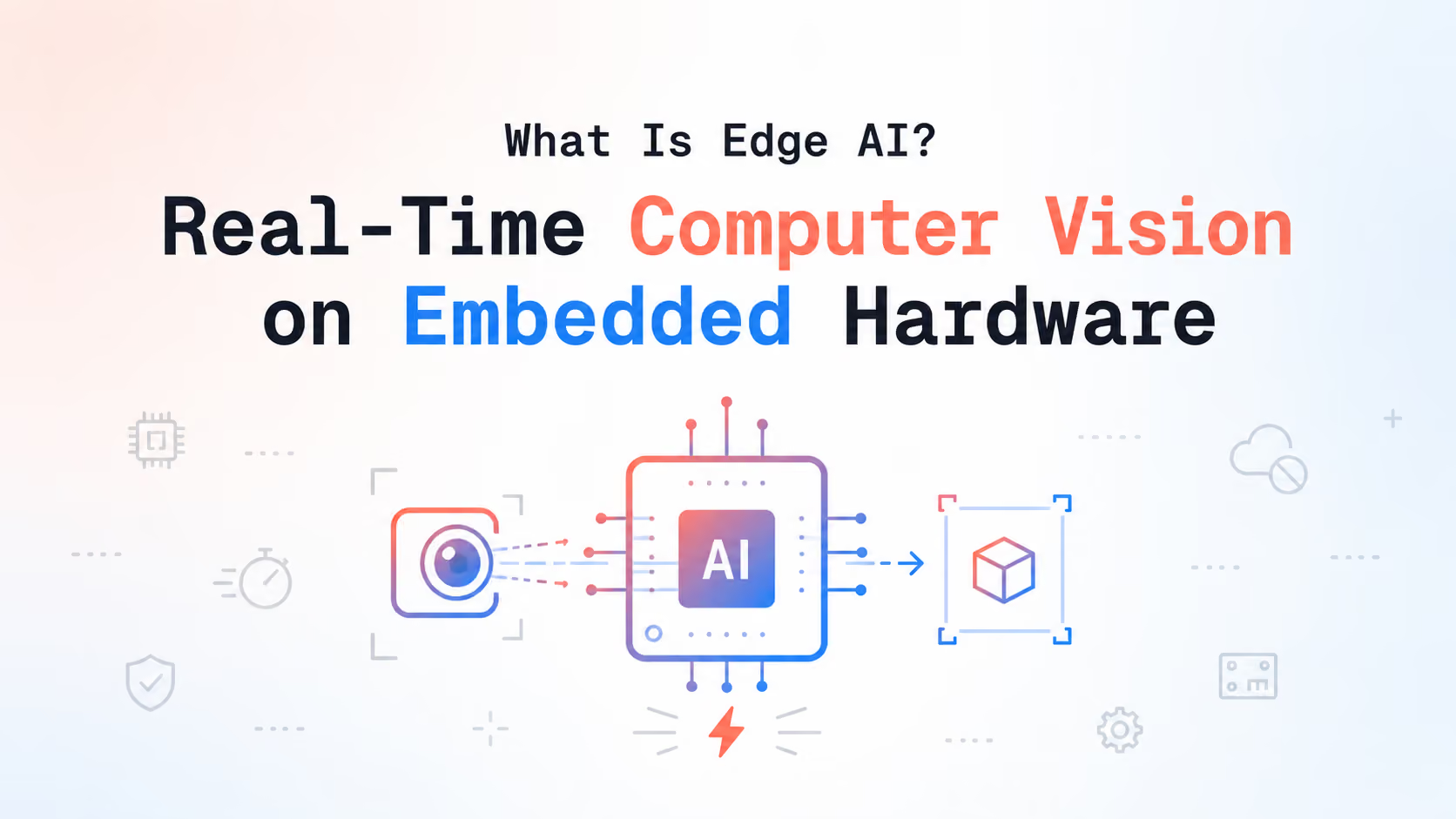
Edge AI is the execution of artificial intelligence inference directly on a local device, with no data sent to a remote server. When a camera on a tram detects an obstacle and triggers a brake signal in under 50 milliseconds, that is edge AI at work, usually with camera, LiDAR and radar fusion behind the detection. This article focuses on the specific intersection of edge artificial intelligence and real-time computer vision: what it is, why the hardware matters more than most people realize, and where it is already saving lives.
Key Takeaways
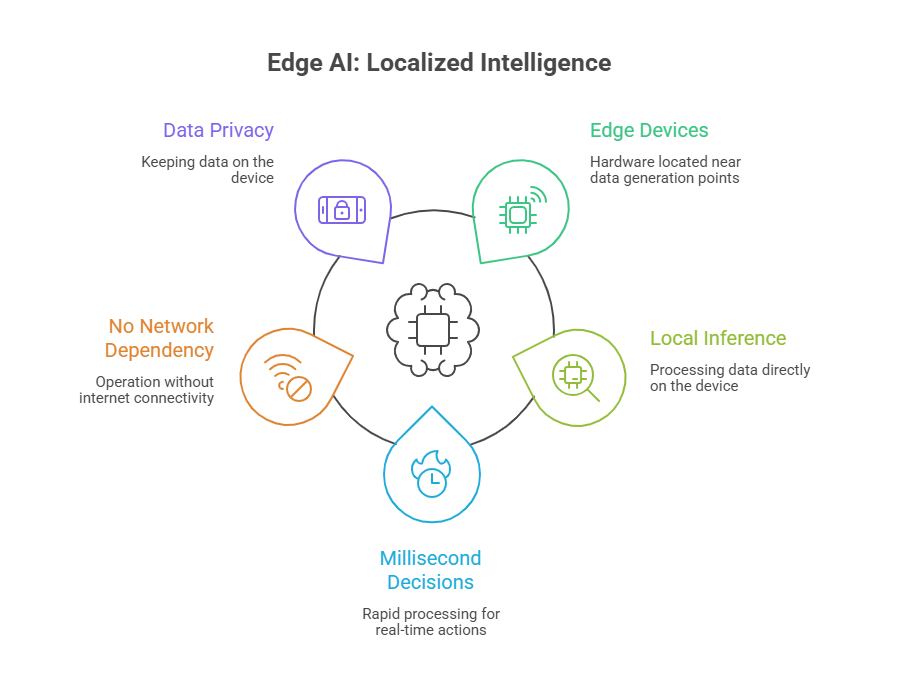
Edge artificial intelligence is the practice of running trained AI models on edge devices (embedded hardware located at or near the point where data is generated), so that inference happens locally rather than in a centralized cloud. The result: decisions in milliseconds, no network dependency, and data that never leaves the device.
Artificial intelligence is the broader discipline of building systems that perform tasks normally requiring human intelligence: recognizing objects, detecting anomalies, analyzing data, and predicting outcomes. These systems are built on machine learning, the subset of AI in which models learn patterns from data rather than following hand-written rules. Deep learning, a further subset, uses layered neural networks to process raw inputs like images or sensor streams with human-competitive accuracy.
The typical AI lifecycle has three stages: train, deploy, and infer. Training happens on large datasets, usually in the cloud, and requires significant compute. Deployment packages the trained model for a target runtime. Inference, the moment the model processes a new input and returns a prediction, is where edge AI lives. Edge AI moves that inference stage off the cloud and onto the device itself, cutting the round trip entirely.
Cloud AI relies on a centralized data center for inference, needing constant cloud connectivity to function; edge AI runs inference on the device where data originates. Cloud computing provides the infrastructure (servers, storage, networking) on which models are trained and cloud inference is served. Even in fully edge-deployed systems, cloud computing still handles model training, retraining, and monitoring.
The practical gap shows up in latency. Edge AI provides deterministic response times of 10–100 milliseconds independent of network conditions, while cloud AI introduces variable latency of 50–500+ milliseconds depending on network quality. For a collaborative robot that needs to detect a human hand in 20–50 milliseconds and halt, even an average cloud latency of 100 milliseconds becomes problematic when worst-case latency reaches 300–500 milliseconds.
Latency comparison at a glance
On-device inference using an NPU or GPU delivers deterministic latency of 10–100 milliseconds. Cloud inference, which involves both network transmission and server processing, introduces variable latency of 50–500+ milliseconds depending on network conditions. Comparing edge computing to cloud-based 5G solutions, edge processing is 2 to 10 times faster.
Privacy and bandwidth are the other dividers. Cloud AI requires constant internet connectivity and transmits raw sensor data (often video) across external networks. Edge AI keeps sensitive data on the device instead of having to send data to external networks, which means reduced bandwidth usage and lower exposure overall.
For a full technical comparison, see our deep-dive on edge AI vs cloud AI.
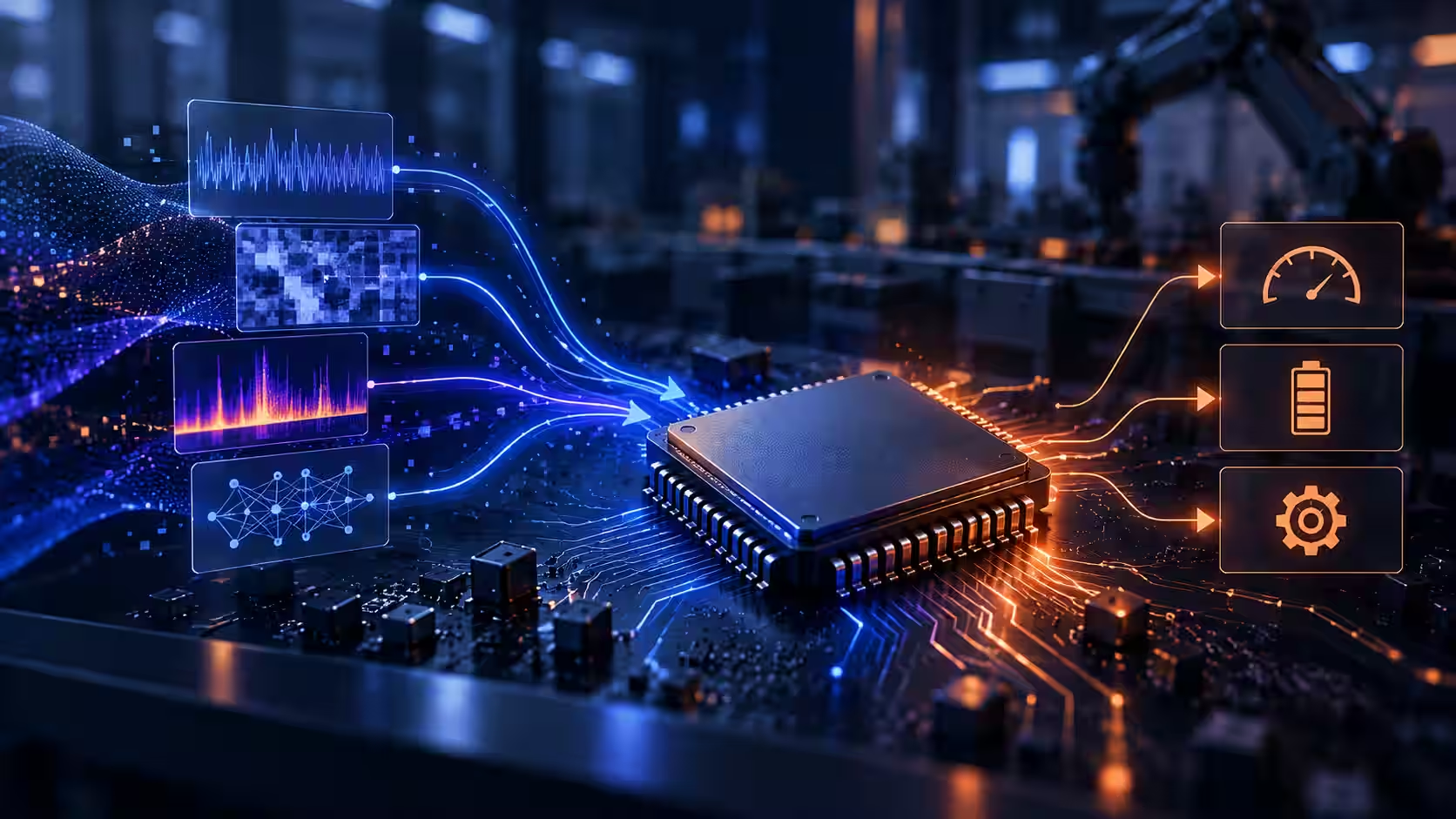
An edge AI system has four core layers working together: sensors or cameras collect data from the environment; accelerator hardware (NPU, GPU, or FPGA) runs the computation; a lightweight runtime (ONNX Runtime, TensorRT, OpenVINO) manages model execution; and an optimized model produces predictions. The model is trained in the cloud on large labeled datasets, then compressed and deployed to the edge device for on-device inference.
Compression is not optional. It is the work. Edge AI requires efficient AI models due to strict limitations in memory, computation, and energy. Two primary techniques make models deployable on constrained hardware. Quantization reduces the numerical precision of model weights (for example, converting 32-bit floats to 8-bit integers), shrinking model size and speeding up inference with minimal accuracy loss. Pruning removes connections in the neural network that contribute little to output quality. Applied together, these techniques can reduce a model to a fraction of its original size while retaining most of its accuracy. That is the difference between a model that runs at 60 frames per second on a 5W embedded board and one that does not run at all.
Learn more about these techniques in our guide on model quantization for edge deployment.
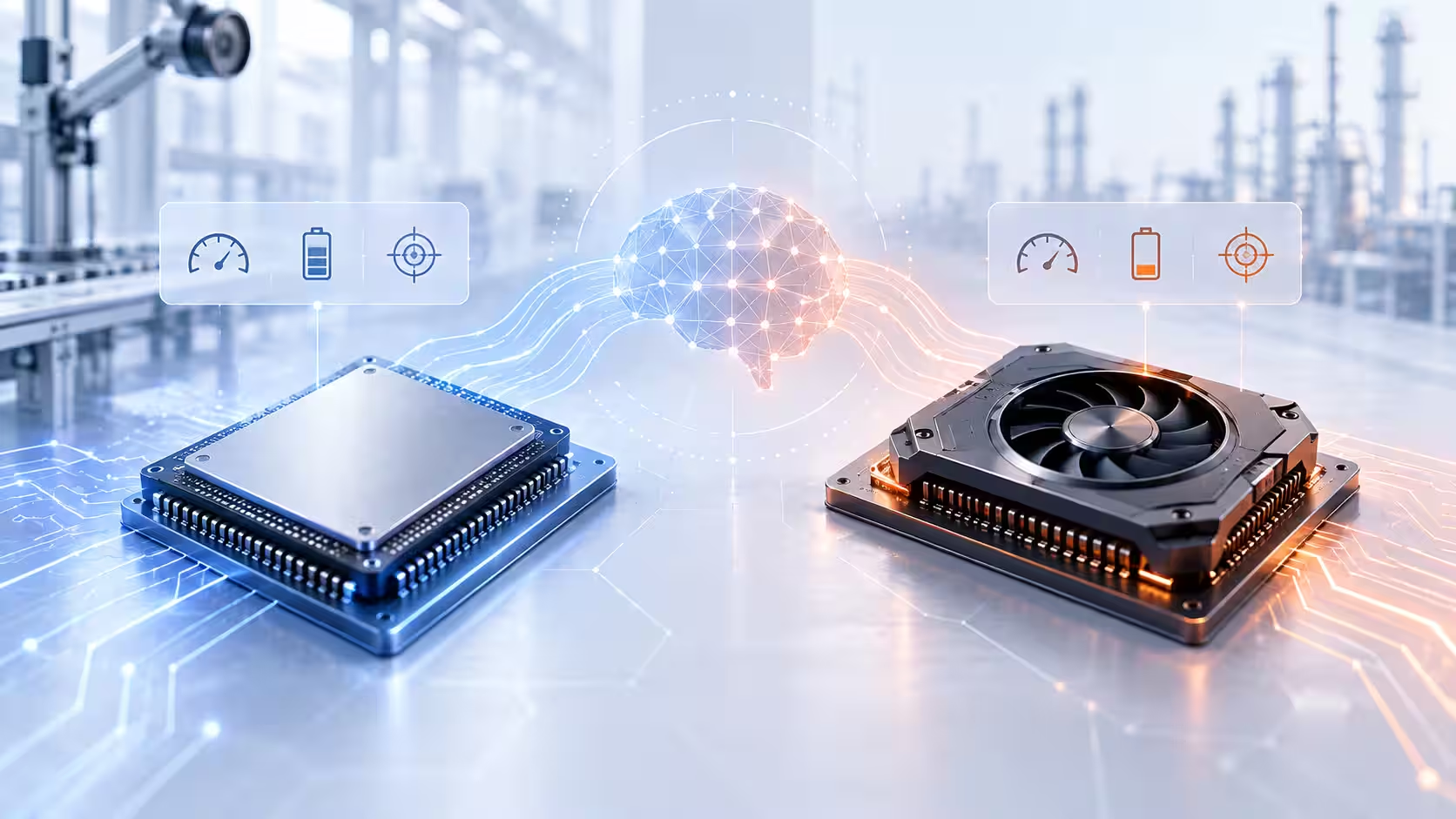
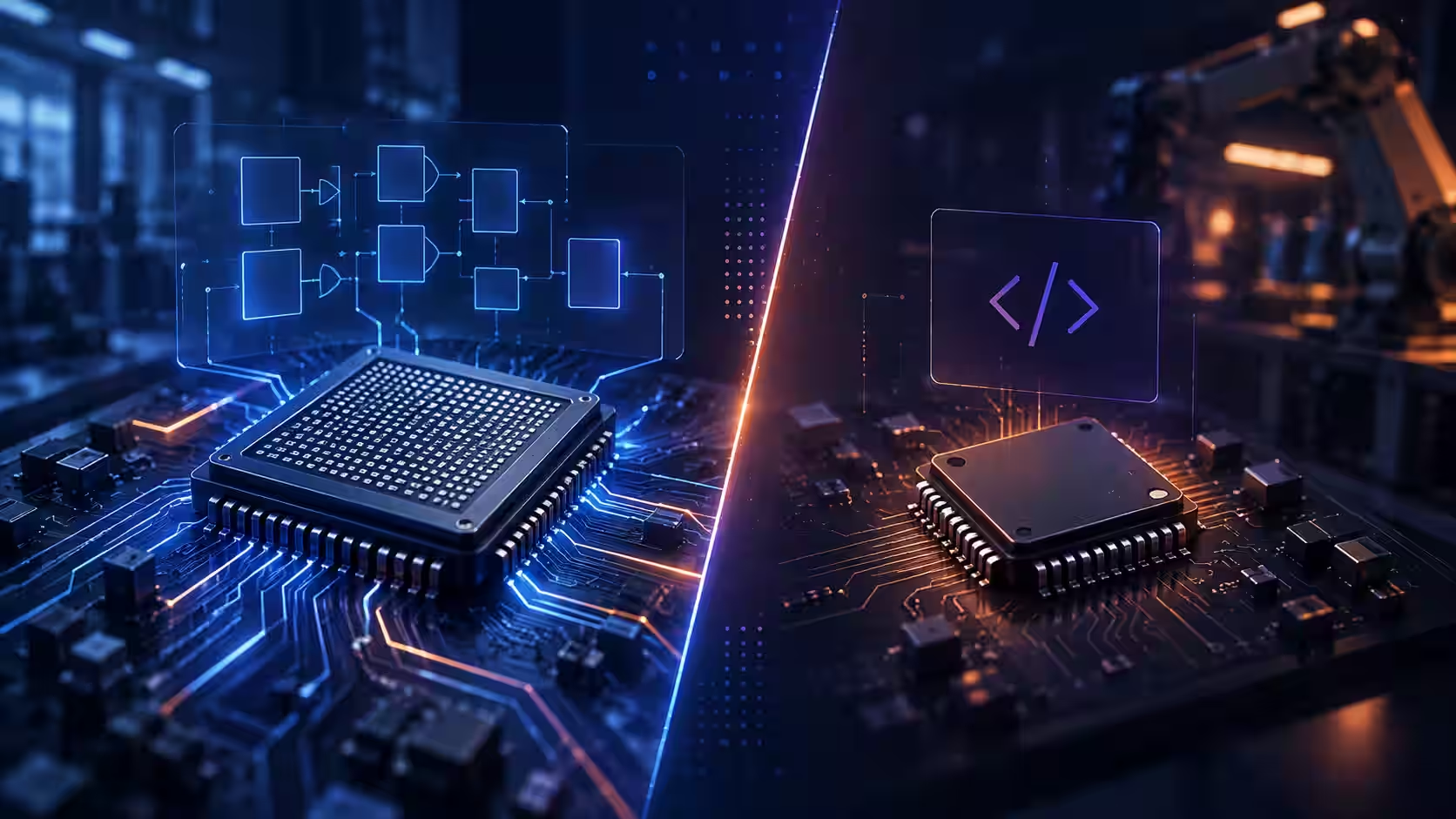
This is where edge AI projects succeed or stall. The accelerator choice (NPU for sustained matrix math, GPU for flexible parallel compute, FPGA for reconfigurable low-latency pipelines) sets a hard ceiling on model complexity and throughput, because the processing power and compute power available on embedded hardware is orders of magnitude below that of a data center GPU. Runtimes like NVIDIA TensorRT or Intel OpenVINO exploit hardware-specific instruction sets; a model that achieves 30 ms inference on the right accelerator may take 300 ms on a general-purpose CPU.
Four constraints govern every real deployment: power budget (a camera running on vehicle power cannot draw 100 W); thermal envelope (sustained inference in an enclosed enclosure will throttle a chip without active cooling); memory (many embedded platforms have 4–8 GB of RAM, sometimes less); and MTBF/reliability (in-vehicle or trackside hardware must operate continuously for years, not months). These constraints are not engineering details. They are the design brief. A model that achieves 95% mAP in a lab but requires 12 W and 6 GB of memory exceeds the computational power available on most transit hardware and is not deployable. Getting this right is the difference between a proof of concept and a system that goes into service.
For a detailed treatment of hardware selection for in-vehicle deployments, see edge AI hardware for in-vehicle systems.
Accuracy on a workstation says nothing about behaviour on a fanless device at 60 degrees. We size models against real power, thermal and memory limits before you commit to hardware.
Get a vision model that runs inside your power budget
.png)
Reduced latency. Edge AI processes data locally on the device, eliminating the network round trip. For computer vision, this means object detection and classification happen in real time, within the same frame cycle, enabling reactions that are physically impossible over a cloud connection, as the full edge AI vs cloud AI comparison shows.
Enhanced data privacy. Sensitive data stays on the device and is never transmitted to external networks. Video feeds of passengers, patients, or shop floors do not leave the premises. This is not just a feature preference; in many regulated industries (healthcare, transit, retail) it is a compliance requirement.
Lower bandwidth usage. Only inference results (a bounding box, a threat score, a maintenance flag) are transmitted, not continuous video streams. In deployments with hundreds of smart cameras, this difference is the gap between a feasible network architecture and an unworkable one.
Improved operational resilience. Edge AI keeps working without a network connection. In tunnels, remote sites, or after a connectivity failure, the system continues operating. For safety-critical applications, this is non-negotiable. That requirement should also shape vendor selection, since choosing an edge AI development company for safety-critical work means verifying offline behaviour, not just accuracy.
Edge AI has moved well past the proof-of-concept stage across healthcare, manufacturing, smart homes, retail, and transportation. Edge AI is enabling instant intelligence for autonomous vehicles, predictive healthcare, precision agriculture, and smart manufacturing. The sections below cover each domain, with a focus on the safety-vision applications that define InTechHouse's core work.
Wearable health monitors run continuous inference on ECG, SpO₂, and motion data locally, detecting arrhythmias or falls without uploading raw biometrics. Medical imaging devices use on-device deep learning models for real-time inference on X-ray and ultrasound data, supporting clinicians in point-of-care settings. Remote patient monitoring systems process sensitive physiological data on local devices, avoiding cloud transmission of identifiable health information. That is a compliance requirement under HIPAA and GDPR. Edge AI in healthcare wearables enables real-time monitoring without cloud latency, which matters acutely when seconds determine an intervention outcome.
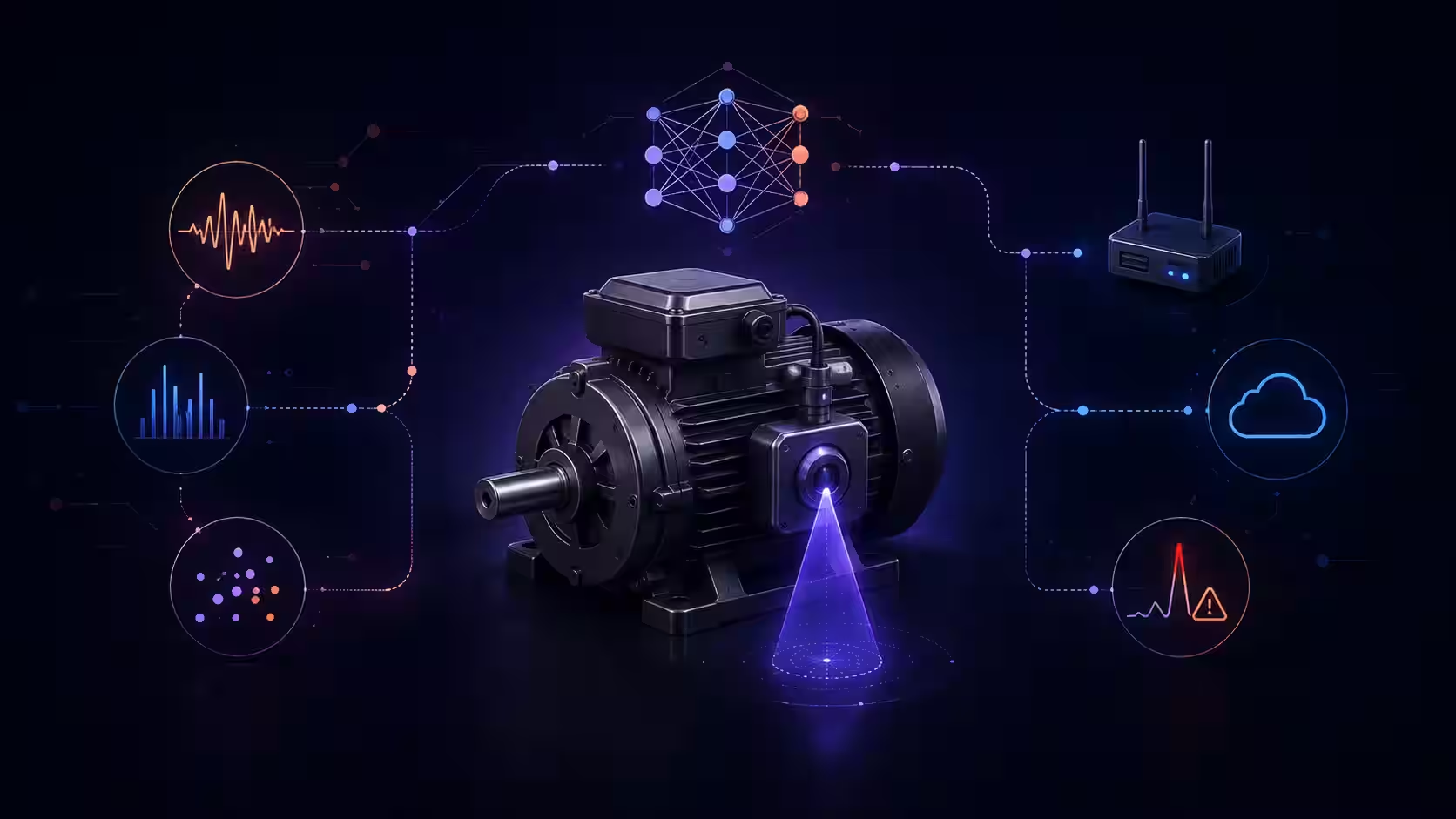
Automated optical inspection cameras run defect-detection models at line speed (hundreds of parts per minute) with inference times well under the mechanical cycle. Smart cameras with embedded NPUs process images locally for surface defect classification, dimensional measurement, and assembly verification. Predictive maintenance systems analyze vibration and acoustic sensor data on edge gateways, detecting early failure signatures before a breakdown occurs. Edge AI is enabling real-world deployments in smart manufacturing that reduce scrap rates, cut unplanned downtime, and keep sensitive production data off external networks.
Voice assistants and other smart home appliances running local speech-recognition models respond without a cloud call, improving both latency and privacy. Smart security cameras use on-device models to distinguish a person at the door from a passing car, sending an alert only when warranted rather than streaming continuous video to a cloud server for analysis. Local processing keeps audio and video data within the home network.
Smart shelf systems use computer vision running on AI-driven embedded systems to detect out-of-stock conditions and track inventory without manual scanning. Edge AI supports smart retail applications by analyzing customer behaviors (dwell time, queue length, conversion zones) quickly, with inference on local hardware. Autonomous vehicles and self-driving cars rely on edge AI for real-time perception (object detection, lane tracking, and obstacle avoidance at 100+ frames per second), collecting data from dozens of sensors simultaneously; any cloud dependency would be a safety failure. Smart traffic management systems process feeds from roadside cameras locally, adjusting signal timing based on real-time vehicle counts without transmitting raw video.
Transit is where edge AI's constraints become safety constraints. Collision avoidance systems on trams and light rail must detect obstacles and initiate braking within a fixed physical window. There is no time for a cloud round trip when the closing speed is 40 km/h. CCTV-based threat and behavior detection running onboard must process video locally because transmitting live feeds for cloud inference is neither low-latency enough nor acceptable under passenger privacy regulations. Latency and privacy are not features here; they are hard safety and legal requirements. Onboard threat detection of this kind, covering aggression, weapons and abandoned objects, is a core use case for edge AI CCTV analytics.
InTechHouse builds systems that operate precisely within these constraints. See our work on computer vision for rail and public transport.
An onboard alert is only useful if the driver or the control room operator can act on it within seconds. That is why safety vision deployments pair the detection model with explainable AI for operator alerts, so every warning arrives with the evidence that triggered it.
Distributed AI splits a workload across multiple connected nodes, each contributing compute toward a shared inference or training task. Unlike traditional AI, which centralizes processing in one location, both edge AI and distributed AI move compute closer to the data. Edge AI, by contrast, runs the full inference pipeline on a single local device. The rule of thumb: choose distributed AI when the model is too large for any single device, or when the task requires aggregating inputs across many physical locations simultaneously. Choose edge AI when the priority is deterministic low-latency inference at a specific point: a camera, a vehicle, a wearable.
The practical architecture for most production deployments is hybrid: infer at the edge, train and monitor in the cloud. Edge devices handle real-time inference; the cloud handles the computationally expensive work of retraining on accumulated data, running performance monitoring, and pushing updated model versions back to the fleet.
Federated learning is the privacy-preserving variant of this pattern.
Federated learning has expanded beyond mobile devices to power industrial edge AI and intelligent hardware in healthcare, finance, manufacturing, and autonomous vehicles. Rather than sending raw data to the cloud for retraining, each edge device trains on its local data and sends only model weight updates. The raw data never leaves the device. This approach is particularly well suited to healthcare and transit applications where patient or passenger data cannot be centralized.
Data-sync strategy matters too. Edge devices should buffer inference results and metadata locally, syncing to the cloud in batches during off-peak windows, rather than attempting continuous streaming.
For practical guidance on managing deployed edge models over time, see our piece on MLOps for deployed edge devices.
Deploying edge AI successfully comes down to four steps:
1. Select hardware matched to the workload. Identify the inference latency requirement, the power envelope, and the operating environment before choosing an accelerator. A Hailo-8 NPU is a different choice than an NVIDIA Jetson Orin, and neither is universally correct.
2. Optimize the model for the target device. Quantize to INT8, prune low-weight connections, and validate accuracy on representative data after optimization. A model that passes cloud benchmarks but has not been tested on the target hardware is not production-ready.
3. Build a monitoring and update strategy before deployment. Model drift is inevitable. The real world changes. Instrument inference metrics (latency, confidence scores, error rates) and define the retraining trigger. Plan OTA (over-the-air) update delivery from day one. See our edge MLOps guide for tooling options.
4. Apply security by design. Encrypt model weights at rest and in transit. Use secure boot to prevent firmware tampering. Treat physical access to the device as a threat vector. Embedded hardware in public spaces (transit vehicles, retail environments) is accessible to adversaries in ways that data center hardware is not.
Read also:
Technical challenges. Limited processing power, compute, and memory force hard trade-offs between model accuracy and inference speed. Model drift occurs as real-world conditions diverge from training data distributions. A defect detector trained in summer lighting may degrade in winter. Device fragmentation across hardware generations complicates deployment pipelines. Maintaining accuracy after aggressive quantization requires careful validation.
Security challenges. Physical access is a realistic threat: an embedded device on a vehicle or at a retail site can be removed, cloned, or tampered with. The attack surface is larger than for cloud deployments. Each edge device is an endpoint. On-device model theft is a specific risk; proprietary computer vision models represent significant IP investment and must be protected with encryption and access control. Firmware must be updatable without requiring physical access, but the update channel itself must be authenticated to prevent malicious pushes.
Mitigations. Encrypt model weights. Use signed firmware with secure boot chains. Authenticate all cloud-to-edge communications with certificate-based mutual TLS. Monitor inference performance continuously for signs of drift or tampering.
Forward-looking trends. The edge AI hardware market is projected to reach USD 58.90 billion by 2030, up from USD 26.14 billion in 2025. Two forces will shape that growth: 5G connectivity, which expands the bandwidth available for hybrid edge-cloud data sync without requiring always-on low-latency connections; and a new generation of energy-efficient chips that deliver NPU-class inference at sub-1W power draws, opening embedded AI to battery-powered and automotive-grade applications that are not currently feasible.
Choose edge AI when your workload is latency-sensitive, privacy-constrained, bandwidth-limited, or operating in environments where network connectivity is unreliable. If the decision needs to happen in under 100 milliseconds, if the data cannot leave the device, or if the system must keep working when the network goes down, the architecture is edge.
If you are scoping an edge AI vision system or need to map a deployment from hardware selection through MLOps to production, InTechHouse can help. Talk to our team about requirements, hardware fit, and a practical implementation roadmap.
Our teams have shipped real time detection systems on vehicles where a late decision is a safety event. Ask us to walk through the pipeline, from camera to brake signal.
See how we built onboard transit safety vision
Not sure where to start? We work with companies at every stage, from early ideas to enterprise-level builds. A 30-minute call can save you months of guesswork.
Edge AI is AI inference that runs directly on a local device (a camera, vehicle computer, wearable, or industrial sensor) without sending data to a remote cloud server. It enables real-time decisions in milliseconds, keeps sensitive data on-device, and operates without a network connection.
A model is trained on large datasets in the cloud, then optimized (quantized, pruned) for constrained hardware and deployed to an edge device. When new sensor data arrives (a video frame, a vibration reading, a health metric) the device uses its onboard processing power to run inference locally and produces a result without any external call.
Edge AI performs inference on the device where data is collected; cloud AI sends data to a centralized data center for processing. Edge AI delivers lower, more predictable latency (10–100 ms) and keeps data private. Cloud AI offers greater compute power and scalability for complex models and batch workloads.
The answer depends on the workload. A neural processing unit (NPU) like the Hailo-8 or Google Edge TPU suits high-throughput vision at low power. An NVIDIA Jetson module suits complex multi-camera systems where a richer software ecosystem matters. FPGAs suit applications requiring custom low-latency signal processing alongside inference. All deployments require attention to power budget, thermal design, memory, and long-term hardware availability.
Collision avoidance systems on trams and light rail run object detection on embedded hardware, triggering braking within the vehicle's physical stopping window. Onboard CCTV systems use edge AI to detect threatening behaviors or unauthorized access without transmitting passenger video to a cloud server. Industrial collaborative robots detect human presence within safety zones and halt in under 50 milliseconds, a response time that is impossible over a cloud connection.
Tomasz Andrysiak, DSc, PhD, is an Expert and a Professor at Bydgoszcz University of Science and Technology. He has more than 30 years of academic, research, R&D, and technology-implementation experience in artificial intelligence, computational intelligence, signal processing, anomaly detection, cybersecurity, and complex information systems.
His research focuses on machine-learning and computational-intelligence methods for analyzing signals, time series, network traffic, industrial data, and multimodal datasets. He specializes in anomaly and failure detection, predictive modeling, intelligent monitoring, critical-infrastructure security, smart metering, biomedical signal analysis, and the practical deployment of AI in industrial and public-sector systems.
Tomasz is the author or co-author of more than 75 scientific publications, including papers published in internationally recognized journals and conference proceedings indexed by Web of Science and Scopus. His research has covered network anomaly detection, cybersecurity of critical infrastructure, ECG signal analysis, machine learning, smart water networks, telecommunications, and intelligent industrial systems.
He has led and contributed to national and European R&D programs focused on cyber situational awareness, critical-infrastructure resilience, autonomous systems, Big Data, intelligent water management, blockchain-based transaction platforms, and industrial AI. He leads industrial-doctorate projects involving AI-based CMDB automation and machine-learning methods for knowledge discovery in Big Data.
Tomasz is an IEEE Senior Member and has served as an elected member of the Commission of Informatics and Automation of the Polish Academy of Sciences, Poznań Branch. He has participated in scientific committees and journal boards, supervised doctoral research, reviewed publications for international journals, and co-authored patents and patent applications related to signal detection and LoRa-based ECG monitoring. He writes about industrial AI, machine learning, anomaly detection, predictive analytics, cybersecurity, signal processing, time-series analysis, and intelligent infrastructure.
Tomasz Andrysiak's academic profiles:
https://orcid.org/0000-0001-8138-6619
https://ludzie.nauka.gov.pl/ln/profiles/fHOpojQ2lIF
https://link.springer.com/chapter/10.1007/978-3-642-32384-3_28
https://www.researchgate.net/profile/Tomasz-Andrysiak
https://scholar.google.com/citations?user=RHW7zx4AAAAJ&hl=pl
https://dblp.org/pid/41/6793.html
https://radon.nauka.gov.pl/dane/profil/6FFA1E51186802ECFFB49644209B5BE0EBD68C55
https://pbs.edu.pl/pl/pracownik/tomasz-andrysiak
https://www.youtube.com/watch?v=6e1GTqT5czM
From first prototype to production, our engineers can help you scope it, build it and get it certified.
This initial conversation is focused on understanding your product, technical challenges, and constraints.
No sales pitch - just a practical discussion with experienced engineers.
Share a few details about your product and context. We’ll review the information and suggest the most appropriate next step.