Edge MLOps is the practice of managing the full machine learning lifecycle, training, deployment, monitoring, and retraining, for models running on devices already in the field, where you cannot simply redeploy a container in the cloud and call it done. The real problem this guide addresses: keeping a model accurate on hardware that is physically distributed across vehicles, cameras, and industrial sites, often with intermittent connectivity, no on-site engineer, and a model whose accuracy is silently drifting against a world that keeps changing after the device shipped.
Key Takeaways
Edge MLOps extends model lifecycle management to edge devices: the same discipline that governs how a model moves from training to production in the cloud, applied to hardware that is physically distributed, frequently disconnected, and far harder to reach for a manual fix than a server in a data center.
The business drivers for edge AI deployments (low latency, data privacy, offline operation) are well established and covered elsewhere in this content cluster. What those drivers create, once a system actually ships, is a new and underappreciated obligation: someone has to keep every deployed model accurate, secure, and current for years after the initial deployment, across potentially hundreds or thousands of physical units that cannot be SSH'd into casually.
Edge MLOps is built on three principles: version control, automation, and governance. Version control means every model artifact, every configuration, and every device's current state is tracked and reversible, not assumed. Automation means the update, monitoring, and retraining pipeline runs without requiring a human to manually touch each device, because that does not scale past a handful of units. Governance means there is accountability and compliance built into the pipeline, not bolted on afterward, for questions like which model version is running on which device, who approved it, and whether it still meets applicable data-privacy regulations.
Managing software on distributed edge devices is more complex than on centralized systems for reasons that compound: edge devices vary in hardware capability across a fleet (different Jetson SKUs, different NPU generations), connectivity is often intermittent or metered rather than constant and free, physical access for a manual fix may require a multi-hour trip rather than a few seconds of cloud console access, and the cost of an update going wrong is materially higher when "wrong" means a vehicle's safety system, not a web service that can be rolled back in seconds.
The hardest question a buyer asks before signing a contract for an edge AI system is rarely about the initial detection accuracy. It is "what happens to the model after deployment?" A vendor who has not built edge MLOps into the product from the start does not have a real answer to that question, only a promise to figure it out later. This guide is, among other things, the answer InTechHouse gives to that question.
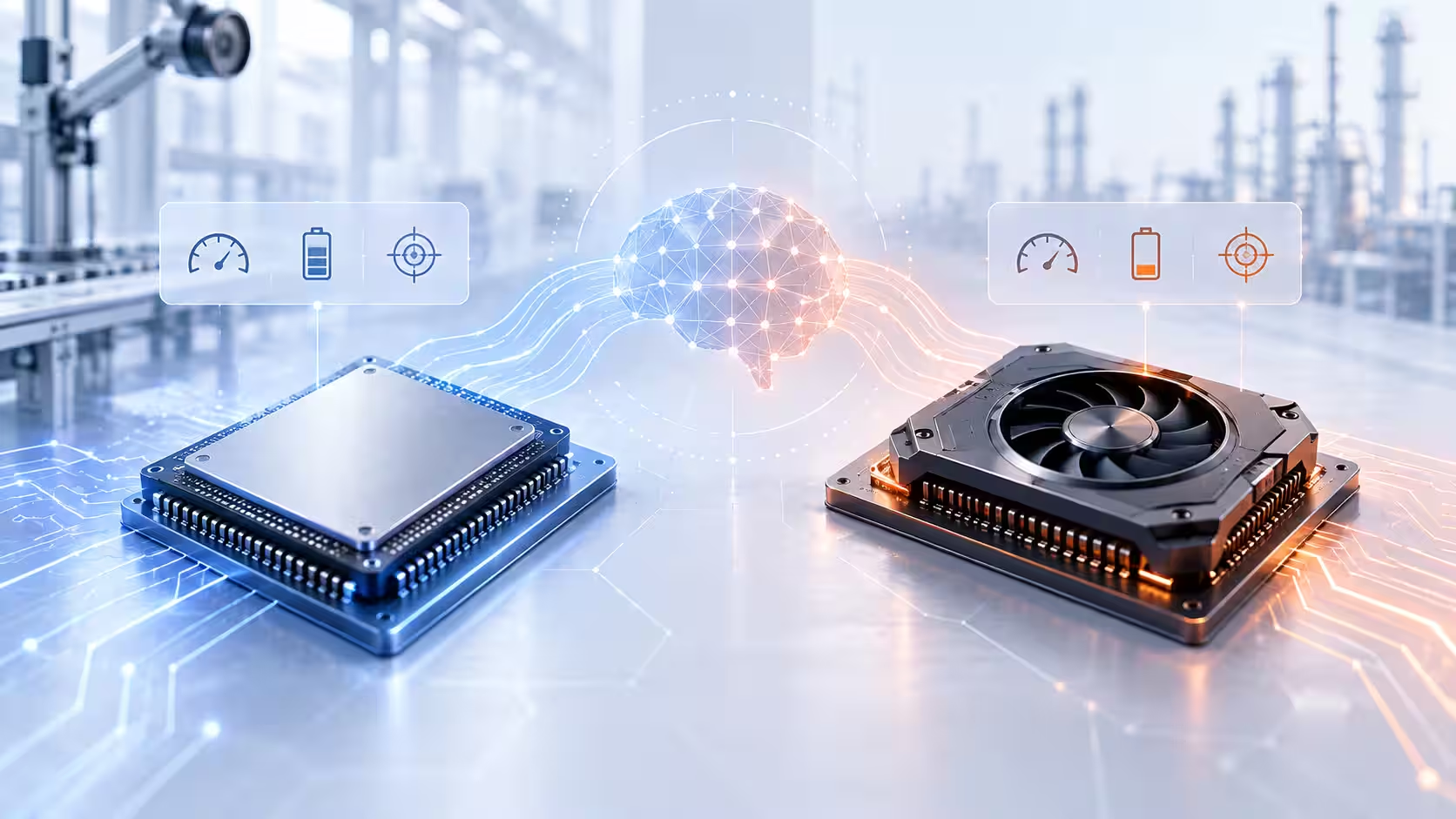
Edge devices span an enormous range, from microcontrollers running a few kilobytes of model weights to the in-vehicle compute units described in edge AI hardware for in-vehicle systems, running multi-camera, multi-model real-time pipelines, and the right MLOps approach has to flex across that range rather than assuming a single hardware profile.
At the low end, microcontroller-class hardware (Arm Cortex-M series) runs tiny, heavily quantized models for simple classification tasks, with kilobytes of RAM and no dedicated AI accelerator. At the mid-range, NPU modules (Hailo-8 and similar) and embedded GPU platforms (NVIDIA Jetson Orin family) run real-time computer vision detection and classification at several to hundreds of TOPS. At the high end, in-vehicle compute units combine this compute with the ruggedization, redundancy, and integration requirements of a safety-critical automotive or rail deployment, the hardware reality covered in depth in our guide to edge AI hardware for in-vehicle systems.
The ML lifecycle stages, in the edge context, run: data collection (gathering representative data from the deployment environment, covered in the next section), model training (typically in the cloud, where compute is abundant), model optimization (quantization and pruning to fit the target hardware, see model quantization for edge deployment), deployment (getting the optimized model onto the physical device), monitoring (tracking how the deployed model performs in the field), and retraining (closing the loop when monitoring reveals the model needs to improve). Edge MLOps is specifically the set of practices that make the deployment, monitoring, and retraining stages work reliably at fleet scale on physically distributed hardware.
Edge devices often have limited processing power and memory relative to a training server, which means model quantization for edge deployment and pruning are required for performance on edge devices in the overwhelming majority of real deployments, not as an optional optimization step but as a precondition for the model running at all within the target latency and power budget. The model architecture and target hardware have to be co-selected from the start of a project, not chosen independently and reconciled later.
A defining edge AI property: edge devices can operate intelligently even when disconnected from the internet, since inference happens locally on the device, not via a cloud API call. This is a genuine architectural advantage for the core inference function, but it creates the central tension this entire guide addresses: a device that does not need connectivity to infer still needs connectivity, eventually, to update, and designing for that asymmetry (always-on inference, intermittent connectivity for everything else) is the core engineering problem edge MLOps solves.
In our reality at InTechHouse, this plays out concretely in onboard vehicle compute (a tram or bus running a collision-avoidance or CCTV model, with connectivity available primarily at depot or over Wi-Fi at specific points on a route) and industrial sensors (a factory-floor inspection camera with a wired but potentially restricted network connection). Both share the same underlying requirement: the model has to keep working, accurately, between the relatively rare windows when it can actually be updated.
The data that flows back from deployed edge devices is both the raw material for improving the model and, handled carelessly, a meaningful privacy and bandwidth liability.
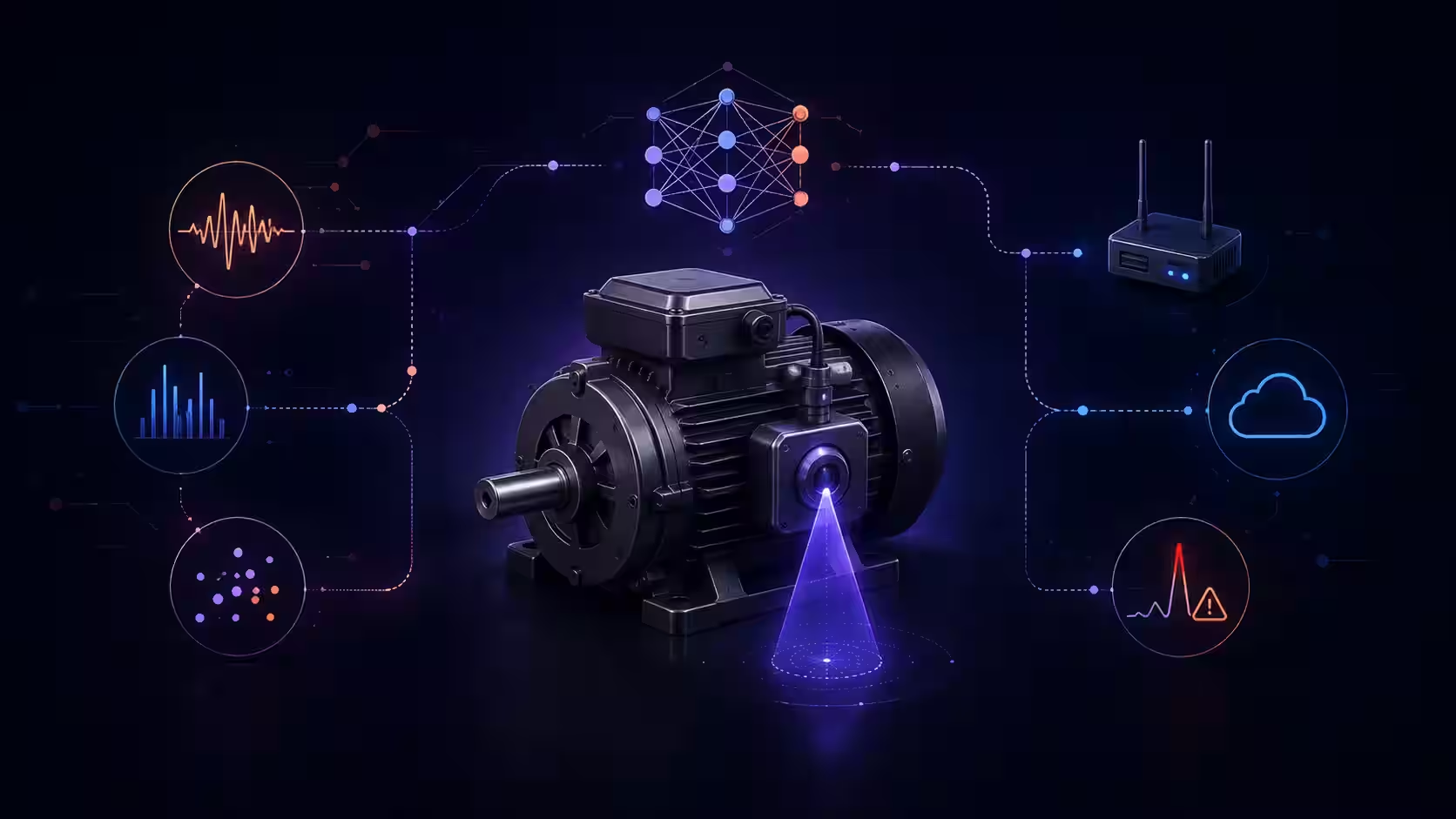
Inference logs (structured records of every detection or classification event, including confidence scores and timestamps), flagged event clips (short video or sensor segments around a specific detected event, retained for review or retraining), and periodic telemetry (latency, resource utilization, and health metrics from the device itself) are the three primary categories of data a deployed edge device generates and potentially needs to transmit. People counting at the edge illustrates the split well, since its inference logs already hold the counts and raw video rarely needs to leave the device.
Not everything a device observes needs to leave the device. Defining explicit filtering rules, transmit only flagged events above a confidence threshold, transmit only a sampled fraction of routine inference logs rather than every single one, discard raw sensor data immediately after inference unless a specific retention trigger fires, keeps the volume of data leaving the device manageable and limits what could be exposed if a transmission channel were ever compromised.
Where data does need to leave the device, encrypted transport (TLS at minimum) and authenticated endpoints (the device proves its identity to the receiving back-end, and vice versa) are baseline requirements, not optional hardening, particularly for any data that could plausibly be linked to an identifiable individual.
Filter and infer on-device so raw video or sensitive data need not leave the vehicle: this is the architectural decision that does the most work for privacy compliance, and it is a decision, not a default. A system designed from the start to keep raw sensor data local and transmit only structured, minimized outputs has a fundamentally smaller privacy footprint than one that streams raw data and tries to add filtering controls afterward.
Data drift can affect model performance in edge computing environments as the real-world distribution of inputs (lighting conditions, seasonal changes, new object types entering a scene, changes in the physical environment around a fixed camera) diverges from what the model was trained on, a phenomenon covered in depth in the Monitoring section below. Data quality matters at every stage of this pipeline: a retraining dataset assembled from poorly filtered, mislabeled, or unrepresentative field data will produce a worse model than the one it is meant to replace, regardless of how sophisticated the retraining pipeline around it is.
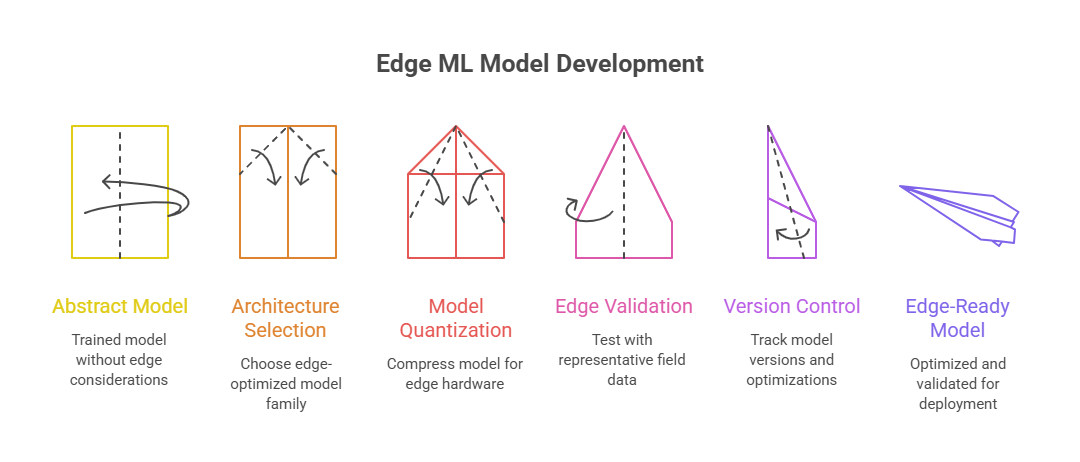
A model destined for edge deployment has to be built and validated with that destination in mind from the start, not adapted after the fact.
Architecture selection should account for the target hardware's specific strengths from the outset (a model family with mature INT8 quantization support and efficient operator coverage on the target NPU's compiler, for instance), rather than selecting the most accurate architecture in the abstract and discovering compatibility problems during deployment.
Model compression techniques are required for performance on edge devices in nearly every real deployment, converting a model trained at full precision into a quantized, often pruned version that fits the target hardware's compute and memory budget. See model quantization for edge deployment for the detailed mechanics of this step, which sits between model training and the deployment process this guide focuses on.
A model validated only against a held-out slice of its original training data has not been validated against deployment reality. Validation should use data genuinely representative of the field conditions the model will encounter, including the specific camera angles, lighting variation, and edge cases of the actual deployment environment, not just the broader benchmark distribution the model may have originally been trained on.
Version control allows tracking and rolling back model versions, which requires more discipline at the edge than in a typical cloud ML pipeline: every deployed model version needs to be traceable not just to its training run and dataset, but to the specific optimization pipeline (quantization configuration, pruning schedule) that produced the exact binary artifact running on a given device, since two models built from the same training checkpoint but different optimization settings can behave meaningfully differently in production. A clear versioning scheme, and a registry that records which version is deployed to which device, is the foundation that every other capability in this guide (rollback, staged rollout, drift correlation) depends on.
Getting a validated model from the registry onto physical devices, safely and at scale, is its own discipline distinct from training and validation.\
Once devices ship, someone has to keep every model accurate and signed. We build the delta based OTA pipeline, staged rollout and automatic rollback so a bad model never reaches the whole fleet.
Set up OTA model updates and rollback for your fleet
Rather than imperatively scripting "push this model to these specific devices," a declarative approach specifies the desired end state (devices matching certain criteria should be running model version X) and lets an orchestration system reconcile actual device state toward that desired state continuously, retrying and recovering automatically as devices come online, go offline, or fail an update attempt.
Devices in a fleet are rarely identical: different hardware revisions, different camera configurations, different deployment sites with different regulatory or operational requirements. Labeling devices by these attributes (hardware generation, site, vehicle type, regulatory jurisdiction) lets a deployment policy target precisely the right subset of the fleet for a given model version, rather than requiring a single model to fit every device or a fully manual, error-prone device-by-device deployment process.
Pushing updates to edge devices requires specialized orchestration frameworks specifically because a naive simultaneous fleet-wide push is the single highest-risk deployment pattern available: if a new model has an undiscovered regression, a simultaneous push propagates that regression to the entire fleet before anyone notices. The standard mitigation, the fleet framing this guide returns to repeatedly, is a staged rollout across a tram or vehicle fleet: deploy to a small canary subset first (a single vehicle, or a handful), monitor key performance indicators for an appropriate observation window, then progressively expand to larger subsets of the fleet only as confidence in the new version builds, with automatic rollback if a model regresses at any stage.
A staged rollout is only as good as the automated trigger that halts it. Defining explicit rollback conditions in advance (a detection rate dropping below a threshold, a latency spike beyond an acceptable bound, a crash or error rate exceeding a defined ceiling) and wiring those conditions to an automatic rollback action, reverting affected devices to the previous known-good model version without waiting for a human to notice and intervene, is what makes staged rollout a genuine safety mechanism rather than just a slower version of the same risk.
Automation is the second of the three founding principles of edge MLOps, and it is what makes the practices described throughout this guide viable at any meaningful fleet scale.
Automation streamlines data collection and model training and deployment by removing manual handoffs between stages: a retraining trigger (covered in the Drift section below) should be able to kick off a training run, validation, optimization, and staged deployment without requiring a human to manually execute each step in sequence, while still preserving appropriate human review gates at the points where they add genuine value (approving a model for production deployment, for instance, rather than automating that decision away entirely).
A central, authoritative record of every trained model version, its training data lineage, its validation results, its optimization configuration, and its current deployment status across the fleet. Automated processes reduce human intervention in edge MLOps specifically by giving automation a reliable source of truth to operate against; without a registry, automation has nothing trustworthy to automate against and tends to accumulate inconsistency over time.
Integrated pipelines support model export, deployment, and monitoring as a single connected system rather than three separate, manually bridged tools, so that a monitoring alert (covered in detail later in this guide) can trigger a retraining pipeline directly, and a successful retraining run can flow automatically into a new staged deployment, closing the loop described throughout this guide without requiring manual data hand-offs between each stage.
CI/CD for edge AI inherits the core ideas from standard software CI/CD, automated building, testing, and deployment triggered by a defined change, but requires specific adaptations for the edge environment's unique constraints.
Every change to a model (a retraining run, an updated quantization configuration, a pruning schedule adjustment) should trigger an automated build pipeline that produces a versioned, validated artifact: running the standard accuracy and performance validation suite, confirming the model meets the latency and resource budget for its target hardware class, before that artifact is eligible for deployment consideration at all.
Once a model artifact passes CI validation, a continuous delivery pipeline manages its progression toward production: through the staged rollout process described in the previous section, with automated promotion criteria at each stage (a canary deployment that meets its KPI thresholds after the observation window automatically becomes eligible for the next rollout stage, rather than requiring a fully manual sign-off at every single stage).
This is the edge-specific twist that distinguishes edge CD from standard cloud CD: a device that is offline when a new deployment is pushed cannot simply receive it immediately the way a cloud server behind a load balancer would. The deployment system needs to queue the intended update for that device and apply it automatically the next time the device establishes connectivity, rather than treating offline devices as deployment failures requiring manual intervention.
Given the hardware diversity across a typical edge fleet (different accelerator generations, different camera configurations), CI should include explicit compatibility validation against each distinct hardware profile present in the fleet, not just a single reference configuration, to catch hardware-specific regressions before they reach production devices of that type.
Automated updates can be pushed to thousands of edge devices once this CI/CD discipline is in place, the scale at which manual, ad-hoc update processes become genuinely impossible to sustain reliably.
A deeper look at the declarative deployment pattern introduced earlier, because it is the architectural foundation that makes fleet-scale edge deployment manageable rather than a constant manual scramble.
Separating application and deployment specifications
The application specification defines what a deployment is, the model artifact, its configuration, the runtime environment it requires, independent of where it runs. The deployment specification defines where and under what conditions that application should run, which devices, which rollout stage, which approval gates. Keeping these concerns separate means a single application specification can be targeted at many different deployment specifications (a canary subset, a full fleet, a specific site) without duplicating the underlying application definition.
Logical labels for deployment targeting
Rather than referencing individual devices by ID (which does not scale and is brittle to fleet changes), deployment specifications target logical labels (hardware generation, site, rollout-stage, region) that devices are tagged with, letting the deployment system resolve "deploy to all canary-stage Jetson Orin devices in the Warsaw depot" into the correct concrete device list automatically and keep that resolution current as devices are added, removed, or relabeled.
Continuous convergence to the desired state
Rather than a one-time push-and-forget deployment action, a declarative system continuously compares each device's actual running state against its declared desired state and takes corrective action whenever they diverge, whether that divergence came from a failed update, a device that was offline during the original push, or a device that was manually tampered with. This continuous reconciliation is what keeps a large, distributed fleet converged on its intended state without requiring constant manual auditing.
A deployed model is not a finished artifact. It is a system that needs ongoing observation, and the edge environment adds a specific privacy and bandwidth twist to how that observation has to work.
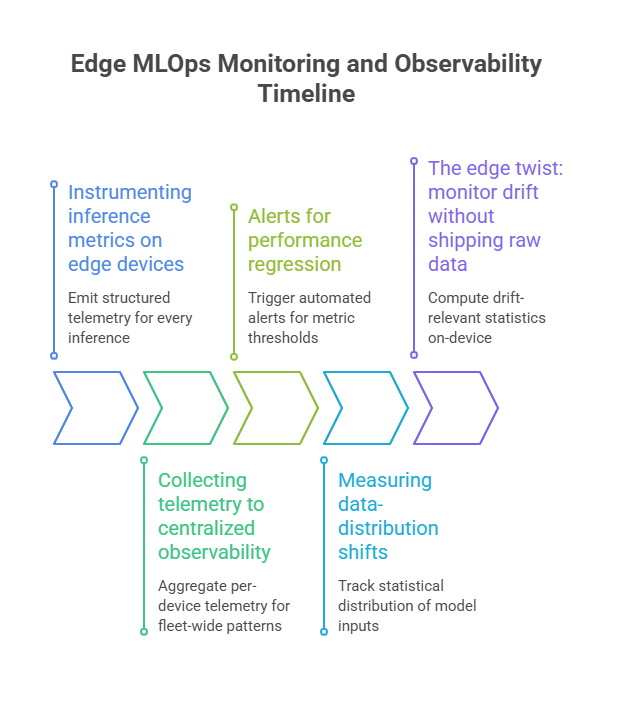
Instrumenting inference metrics on edge devices
Every deployed model should emit structured telemetry for every inference (or a representative sample, for high-frequency inference workloads): latency, confidence score, and, where available, any downstream feedback signal indicating whether the inference was correct.
Collecting telemetry to centralized observability
That per-device telemetry needs to flow to a centralized system where patterns across the fleet, not just within a single device, become visible: real-time monitoring tracks model accuracy, latency, and drift, aggregated across the fleet so a systemic issue affecting many devices simultaneously (a software bug, a seasonal lighting shift affecting an entire geographic region) is distinguishable from an isolated single-device hardware fault.
Alerts for performance regression
Monitoring tools help detect model bias and other flaws post-deployment specifically because automated alerting, triggered when a tracked metric crosses a defined threshold, surfaces a developing problem to a human or an automated remediation pipeline long before it would otherwise be noticed through, for example, a customer complaint or a missed safety event.
Measuring data-distribution shifts
Beyond accuracy and latency, tracking the statistical distribution of the model's inputs over time (the range of object sizes detected, the distribution of confidence scores, the time-of-day and lighting profile of incoming frames) can surface an emerging data drift problem before it has degraded accuracy enough to show up directly in accuracy metrics, since input distribution shift is frequently the leading indicator of an accuracy problem that has not yet fully manifested.
The edge twist: monitor drift without shipping raw data to the cloud
A naive approach to drift monitoring streams representative raw samples (images, sensor readings) to a central server for analysis. The edge-appropriate approach computes drift-relevant statistics on-device (feature distributions, confidence histograms, detection-rate summaries) and transmits only those compact, aggregated statistics, respecting both the bandwidth constraints and the privacy posture this guide has emphasized throughout. Comprehensive monitoring fosters greater accuracy and improved user experience precisely because it catches problems early, and doing that monitoring without exporting sensitive footage is what keeps the privacy benefit of edge inference intact through the monitoring stage, not just the inference stage.
Drift detection only has value if it connects to an actual response pipeline. This section covers that connection explicitly.
Defining drift-detection thresholds
Model drift occurs when accuracy decreases over time, but accuracy itself is frequently not directly observable in production (no one is manually verifying every inference against ground truth). Proxy thresholds, defined in advance and validated against historical data where possible, on metrics that are observable in production (confidence score distribution shift, detection rate change, latency creep) serve as the practical trigger mechanism for catching this otherwise-invisible decay.
Automating data collection upon drift detection
When a drift threshold fires, rather than relying on whatever data happened to already be collected, an automated response can specifically increase the sampling rate or trigger targeted collection of examples from the affected device or device class, accelerating the accumulation of exactly the data needed to diagnose and address the drift.
Triggering retraining pipelines on drift detection
Real-time monitoring triggers automatic model retraining when performance degrades past the defined threshold, kicking off the automated training pipeline described in the ML Lifecycle Automation section above without requiring a human to first notice the problem and then manually initiate a response, closing the gap between detection and remediation.
Deploying updated models via controlled rollout
A retrained model that addresses a detected drift problem should go through the same staged rollout and validation process as any other model update, not be rushed to full-fleet deployment simply because it addresses an urgent problem, since an unvalidated rushed deployment carries its own regression risk that a staged rollout is specifically designed to catch.
Retraining is triggered when model performance degrades, and the entire point of the automated pipeline this section describes is closing that loop, drift detected, data collected, model retrained, validated, and redeployed, automatically and quickly enough that degraded model performance does not persist for an extended, unaddressed period in production.
The mechanical and security details of getting a new model onto a device, once a deployment decision has been made, deserve their own dedicated treatment given how much can go wrong at this specific step.
Every update package (model weights, firmware, configuration) should be cryptographically signed by a trusted authority before distribution, and the receiving device should verify that signature before installing anything, preventing a compromised distribution channel or man-in-the-middle attacker from pushing unauthorized code to deployed devices.
Delta updates, transmitting only the difference between the currently installed version and the new version rather than the full artifact, deliver substantial bandwidth savings that compound at fleet scale: one published case study measured a 60.51% reduction in bandwidth consumption from switching to delta updates on a fleet of edge gateway devices (Canonical/Mender case study, Dell Edge 3000-series, 2026). For fleets operating over metered cellular or satellite connectivity, the kind common in transit and remote industrial deployments, this is not a marginal optimization; it is frequently the difference between an update strategy that is financially sustainable at fleet scale and one that is not. Update costs like these should shape industrial AI solutions from the start, because a model that cannot be refreshed cheaply over metered links gradually loses accuracy in the field.
Beyond the initial signature verification, the device should validate that the downloaded update is complete and uncorrupted (checksum verification) and, ideally, run a brief smoke test of the new model in a sandboxed or shadow mode before fully cutting over to it, catching a corrupted or incompatible update before it affects live inference rather than after.
Models on edge devices are vulnerable to tampering and intellectual property theft in a way that cloud-hosted models simply are not, because the device, and therefore the deployed model artifact, is physically accessible to anyone with access to the vehicle or site. Updating models on IoT devices often requires firmware reloading in addition to the model artifact itself, which widens the security surface that needs to be protected: signed boot chains, encrypted storage for model weights, and tamper-detection mechanisms are all part of a complete edge update security posture, not optional hardening reserved for the most sensitive deployments.
Automated updates can be pushed to thousands of edge devices reliably once signing, delta updates, and validation are all in place together, and the resulting reducing downtime that a well-engineered OTA pipeline delivers (versus the alternative of physical, manual device visits for every update) is frequently one of the most direct, quantifiable returns on the edge MLOps investment this guide describes.
InTechHouse case study: Operating and updating a deployed safety system for public transport
InTechHouse operates the model update and monitoring pipeline for an onboard safety system developed for a public transport manufacturer, covering both the collision-avoidance and CCTV behavior-detection functions running on the deployed vehicle fleet.
Updates reach the fleet through a staged rollout process synchronized to the vehicles' actual connectivity windows, primarily at depot or over Wi-Fi at specific points along the route, with each update validated on a small subset of the fleet before wider deployment. Automatic rollback is wired to defined performance thresholds, so a regression in detection rate or an unexpected latency increase reverts the affected vehicles to their previous known-good model version without requiring a person to first notice the problem.
Drift is monitored using on-device computed statistics, confidence distributions, detection rates, and latency, transmitted to a central monitoring system without exporting the underlying sensitive footage itself, preserving the same privacy posture that motivated running inference onboard in the first place. The system has operated continuously across its service schedule, with model updates delivered and validated through this pipeline without requiring physical access to individual vehicles for routine maintenance.
Beyond reactive drift response, a mature edge MLOps practice treats model improvement as an ongoing, proactive process, not solely a response to detected problems.
Rather than collecting field data uniformly, an active or targeted sampling strategy prioritizes collection of the cases most likely to improve the model: low-confidence inferences, cases where the model's prediction conflicts with a downstream signal, or examples from underrepresented conditions in the current training set, getting more retraining value per unit of collected and transmitted data than uniform random sampling would.
Even absent a detected drift trigger, a regular cadence (quarterly is a common default for many deployments, though the right interval depends on how quickly the deployment environment actually changes) of retraining on accumulated field data helps a model stay current with gradual environmental shifts that may not individually cross any single drift-detection threshold but compound meaningfully over a longer period.
Every retrained model candidate goes through the same validation rigor as an original model before being considered for deployment: accuracy on a representative held-out set, performance benchmarking on the actual target hardware, and explicit comparison against the currently deployed model's performance, not just an absolute accuracy threshold, since the goal is genuine improvement, not just an acceptable score in isolation.
A validated retrained model enters the same CI/CD pipeline described earlier in this guide, the same staged rollout, the same monitoring, the same rollback safety net, treating "improved model from continuous retraining" and "new model version" as the same kind of event the deployment system already knows how to handle safely, rather than as a special case requiring a separate process.
This entire cycle, more data collected from the field, new model trained, retrained model validated, and pushed through the standard ml workflow back to the fleet, is what distinguishes a genuinely maintained edge AI system from one that was deployed once and left to slowly drift out of accuracy without anyone noticing until it fails visibly.
The third founding principle of edge MLOps, governance, covers the accountability, compliance, and oversight obligations that become more complex, not less, once a model is deployed across many physical devices.
Governance ensures compliance with data-privacy laws like GDPR and HIPAA by making data minimization, retention limits, and access controls explicit, enforced policies within the pipeline (covered earlier in the Data Collection section), rather than informal practices that depend on individual engineers remembering to apply them correctly on every device.
Particularly for any model whose outputs affect how people are treated (a CCTV threat-detection system, for instance), periodic auditing of model decisions across relevant subgroups, both at initial deployment and after any retraining cycle, catches fairness regressions that a pure accuracy metric would not surface, a concern this guide's companion piece on model quantization also raises in the context of optimization-induced accuracy shifts.
An audit needs more than an accuracy number per site: it needs a record of why a given model output was produced. Systems that raise alerts to a human should log the same evidence the operator sees, which is the practical case for explainable AI for operator alerts inside the MLOps loop.
Production environments at the edge need the same access-control discipline as a cloud production environment: who can push an update, who can access raw device logs or footage, who can modify a deployment policy, all explicitly defined, logged, and limited to the minimum necessary role, since a device physically accessible in the field is a meaningfully different threat model than a server behind a corporate firewall.
Models on edge devices are vulnerable to tampering and IP theft, a security concern that intersects directly with governance: protecting a deployed model's weights from extraction or unauthorized modification is both a security control and, in many contexts, a compliance obligation tied to protecting the underlying training data or proprietary methodology the model represents. Edge deployments must comply with data-privacy regulations applicable to their specific jurisdiction and data type; specific regulatory requirements vary meaningfully by jurisdiction and by the nature of the data processed, and current applicable requirements should be verified directly with legal counsel before finalizing a governance framework for any specific deployment, rather than assumed from general guidance like this guide.
A practical question for any team building out edge MLOps capability: build from scratch, adopt an existing platform, or some combination of both, and how does any of it fit with the cloud MLOps tooling a team likely already has.
Several platforms (AWS IoT Greengrass, Azure IoT Edge, and a range of open-source and specialized industrial IoT orchestration tools) provide varying degrees of the declarative deployment, staged rollout, and fleet-management capability described throughout this guide out of the box, trading some customization flexibility for substantially faster time to a working capability than building the equivalent infrastructure from scratch.
Monitoring tools vary in how well they support the edge-specific requirements covered in this guide, particularly the on-device statistic computation needed to avoid shipping raw sensitive data for monitoring purposes; evaluating a candidate tool specifically against that requirement, not just its general-purpose monitoring capability, is essential before committing to a platform.
Edge MLOps should extend a team's existing MLOps, not replace it: the model training, experiment tracking, and initial validation stages typically still happen in the same cloud-based MLOps infrastructure a team already uses for non-edge ML work, with the edge-specific tooling covered in this guide picking up specifically at the optimization, deployment, and field-monitoring stages that a cloud-only MLOps stack was never designed to handle. Architecting for this extension, rather than a wholesale rip-and-replace of existing tooling, is both faster to implement and lower-risk for a team with established cloud ML practices already in place.
As a fleet grows from a handful of pilot devices to a production rollout across hundreds or thousands of units, the device-management platform underlying the entire pipeline (handling provisioning, identity, connectivity, and the deployment mechanics this guide has covered) needs to be selected with that eventual scale in mind from early in the project, since migrating an established fleet to a different underlying platform later is a substantially harder undertaking than choosing well at the start.
Read also:
Before committing to a fleet-wide architecture, validate the full deployment, monitoring, and update cycle, not just the model itself, on a small number of devices genuinely representative of the production hardware and connectivity environment, surfacing integration problems early when they are cheap to fix.
Define the specific, measurable performance indicators (inference latency, detection accuracy on representative held-out data, update success rate, time-to-rollback when a regression is detected) that the pilot, and later the production fleet, will be evaluated against, before deployment begins, not retroactively after a problem has already occurred.
Treat the pilot phase as explicitly intended to surface process gaps (an under-specified rollback condition, a monitoring blind spot, an update mechanism that does not handle a specific connectivity pattern well), and refine the process based on what the pilot actually reveals, rather than treating the initially designed process as fixed and the pilot as a pure validation exercise.
When a deployed model regresses, a connectivity gap prevents an expected update, or an update itself fails on a subset of devices, the operations team needs a documented, rehearsed response procedure, not an improvised one under the pressure of a live incident, particularly for any deployment where the model's outputs feed a safety-relevant decision.
Extending the staged-rollout discipline already established at the model-version level to the level of entire deployment sites or fleet segments: validate the full system at a single site or vehicle subset before expanding to additional sites, applying the lessons learned at each stage rather than attempting a simultaneous full-scale rollout.
Edge MLOps is an essential practice for any organization operating ML models at the edge beyond a small pilot scale, not an optional layer of polish; operations teams that treat it as essential from the start of a project consistently spend less time firefighting reducing downtime problems later than teams that treat deployment as the finish line and discover the operational burden only after the fact.
Updatability is the answer to "what happens after deployment," the buyer question this guide opened with. A deployed model that cannot be safely, securely, and efficiently updated, monitored, and improved over its service life is not a finished product; it is a liability that accumulates risk every month it goes unmaintained, whether that risk shows up as gradually degrading accuracy, an unpatched security vulnerability, or a compliance gap that widens as regulations evolve faster than an unmaintained system can adapt to them.
To discuss edge MLOps for a deployed or planned fleet, including how to architect the version control, automation, and governance foundation this guide has covered for your specific hardware and connectivity environment, talk to the InTechHouse team. For guidance on selecting a development partner with this operational capability built in from the start, see choosing an edge AI development partner.
Drift monitoring, versioning per device and a documented retraining loop are what separate a demo from a system you can run for five years. See how we operate deployed models for industrial clients.
Ask what happens to your model after deployment
Not sure where to start? We work with companies at every stage, from early ideas to enterprise-level builds. A 30-minute call can save you months of guesswork.
Edge MLOps is the practice of managing the machine learning lifecycle, training, deployment, monitoring, and retraining, for models running on edge devices already deployed in the field, extending standard MLOps practices to handle the distributed, often intermittently connected, and physically inaccessible nature of edge hardware. It covers version control of model artifacts, automated and staged deployment to a device fleet, ongoing performance and drift monitoring, and the governance controls needed for compliance and security.
The standard approach uses an over-the-air (OTA) update pipeline: a new model version is validated, signed, and pushed through a staged rollout, deployed first to a small canary subset of the fleet, monitored against defined performance thresholds, then progressively expanded to the full fleet only as confidence builds, with automatic rollback to the previous version if the new model underperforms at any stage. Delta updates, transmitting only the changed portion of the model rather than the full artifact, are commonly used to minimize bandwidth consumption, particularly for fleets operating over metered cellular or satellite connectivity.
An OTA model update packages the new model artifact (and, where needed, supporting firmware), cryptographically signs it to prevent tampering, and transmits it to deployed devices, ideally as a delta update containing only the changes from the currently installed version to minimize bandwidth. The receiving device validates the update's signature and integrity before installation, applies it, and ideally runs a brief validation check before fully activating the new version, with the deployment system tracking rollout status across the fleet and triggering automatic rollback if defined performance thresholds are not met after activation.
Edge drift monitoring tracks proxy metrics observable in production, confidence score distributions, detection rate changes, latency trends, and input data distribution shifts, computed on-device and transmitted as compact aggregated statistics rather than raw sensitive data, preserving the privacy and bandwidth benefits of edge inference through the monitoring stage as well. When a drift threshold is crossed, the monitoring system can automatically trigger increased data collection and a retraining pipeline, closing the loop between detection and remediation without requiring a human to first notice the problem.
Ongoing maintenance combines four practices covered throughout this guide: continuous monitoring of inference performance and data drift to detect degradation early; a secure, staged OTA update pipeline to deploy fixes and improvements safely; scheduled and drift-triggered retraining using data collected from the actual field deployment to keep the model current with real-world conditions; and governance controls (access management, compliance auditing, security hardening against tampering) to keep the deployed system accountable and compliant over its full service life, not just at the moment of initial deployment.
Damian Ledziński, PhD Eng., is an Applied Artificial Intelligence Expert and an Assistant Professor at Bydgoszcz University of Science and Technology. He has over 15 years of academic, research, software-engineering, and technology-development experience.
His work focuses on applying artificial intelligence, machine learning, deep neural networks, and data science to complex real-world systems. His principal research and engineering interests include autonomous unmanned aerial vehicles, drone navigation and swarm intelligence, biomedical engineering, medical signal and image analysis, predictive modeling, industrial IoT, and intelligent water-management systems.
Damian has contributed to multidisciplinary R&D initiatives including AI-assisted medical diagnostics, a Polish ventilator prototype, autonomous indoor drone systems for warehouse inventory, AI-supported water-consumption analysis, virtual medical assistants, and intelligent systems combining embedded devices with machine-learning models.
He is the author or co-author of more than 30 scientific publications. His work has appeared in international scientific publications covering artificial intelligence, biomedical engineering, signal analysis, autonomous systems, environmental monitoring, and data-driven infrastructure.
Damian is a co-creator of academic programs in Engineering in Medicine, AI in Medicine, and Data Science at Bydgoszcz University of Science and Technology. He combines scientific research with hands-on implementation, translating experimental AI methods into deployable technology. He writes about applied AI, machine learning, predictive analytics, autonomous UAV systems, AI in medicine, biomedical signal processing, industrial IoT, and intelligent models in real-world systems.
Damian Ledziński's academic profiles:
https://orcid.org/0000-0003-0796-4390
https://wtie.pbs.edu.pl/pl/pracownik/damian-ledzinski
https://www.researchgate.net/profile/Damian-Ledzinski
https://scholar.google.pl/citations?user=AlQpPB0AAAAJ&hl=pl
https://ludzie.nauka.gov.pl/ln/profiles/DN6pHXU6KZm/publications/f83a8833-6060-4fae-8628-3dbf57661394
From first prototype to production, our engineers can help you scope it, build it and get it certified.
This initial conversation is focused on understanding your product, technical challenges, and constraints.
No sales pitch - just a practical discussion with experienced engineers.
Share a few details about your product and context. We’ll review the information and suggest the most appropriate next step.