Choosing an edge AI development company for a safety-critical system is mostly about whether the vendor can deliver hardware and software together and prove it. A software-only shop can build a model that passes a benchmark; that is not the same as a system that runs on a constrained compute unit inside a vehicle, survives three years of field operation, and gets updated over-the-air when the model drifts. This guide is for technical buyers and procurement teams putting AI into vehicles, industrial equipment, or safety-critical environments, where a wrong or late decision has physical consequences.
Most edge AI vendors stop at the model and leave you to solve power, thermals and field updates. Run our team through the same scorecard and see how a hardware plus software supplier answers.
Put our edge AI team through your scorecard
An edge AI development company builds AI systems that run inference on edge devices rather than in a cloud data center. The practical scope covers custom algorithm development for resource-constrained environments, model compression to make those algorithms fit the target hardware, and integration of the resulting system into the physical device and its operating context.
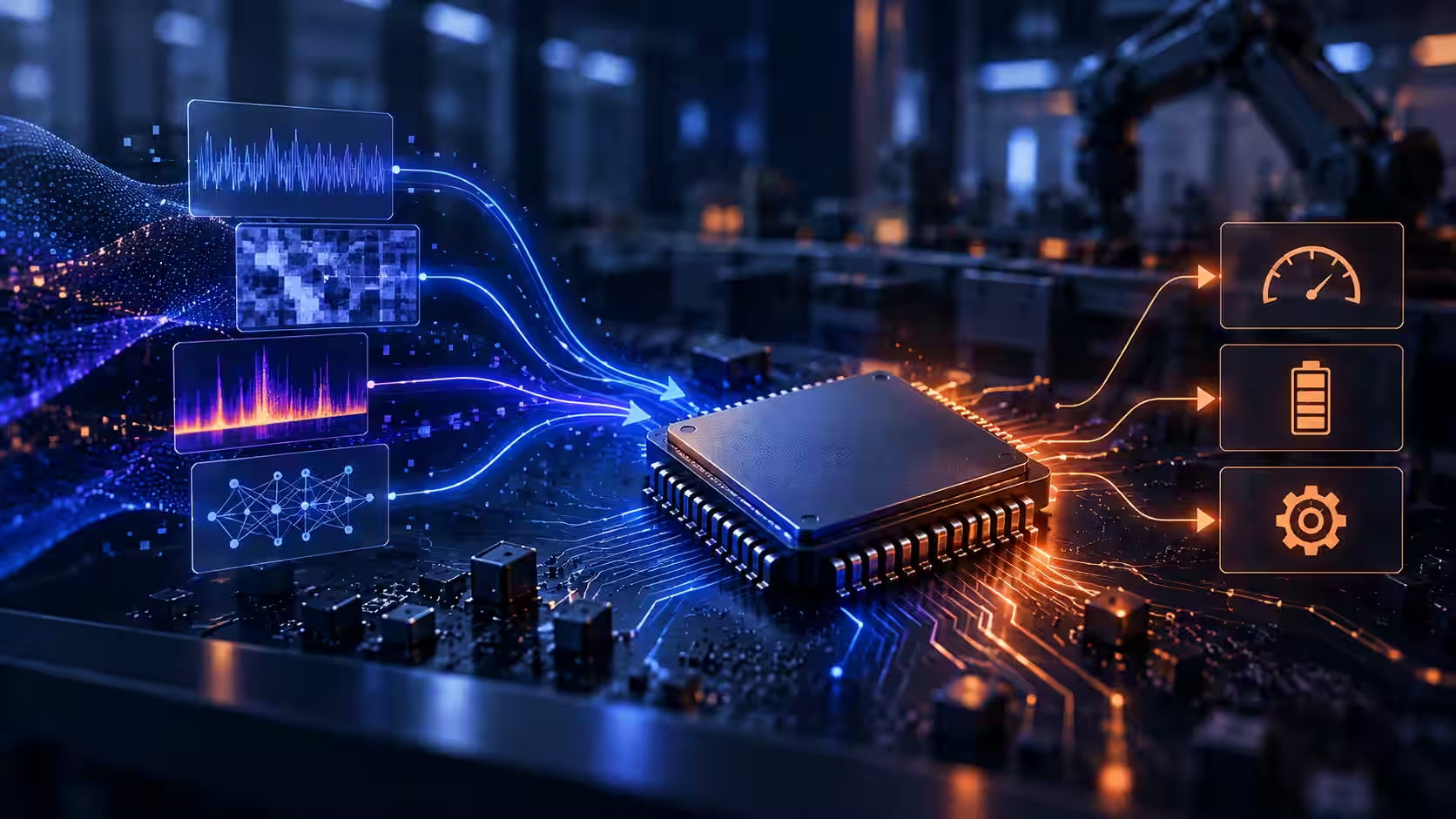
Edge AI technologies bring AI capabilities directly to devices where data is generated. That means deploying machine learning models on hardware with limited compute, memory, and power. The models themselves require a different engineering approach than cloud-based AI: deploying edge AI involves quantization (reducing numerical precision of model weights to shrink size and improve inference speed), pruning (removing low-importance connections from a neural network), and knowledge distillation (training a smaller model to replicate the behavior of a larger one). These model optimization techniques reduce a model trained on a cloud GPU cluster to something that runs at 30 FPS on a 5W embedded chip. See model quantization for edge deployment for the technical mechanics.
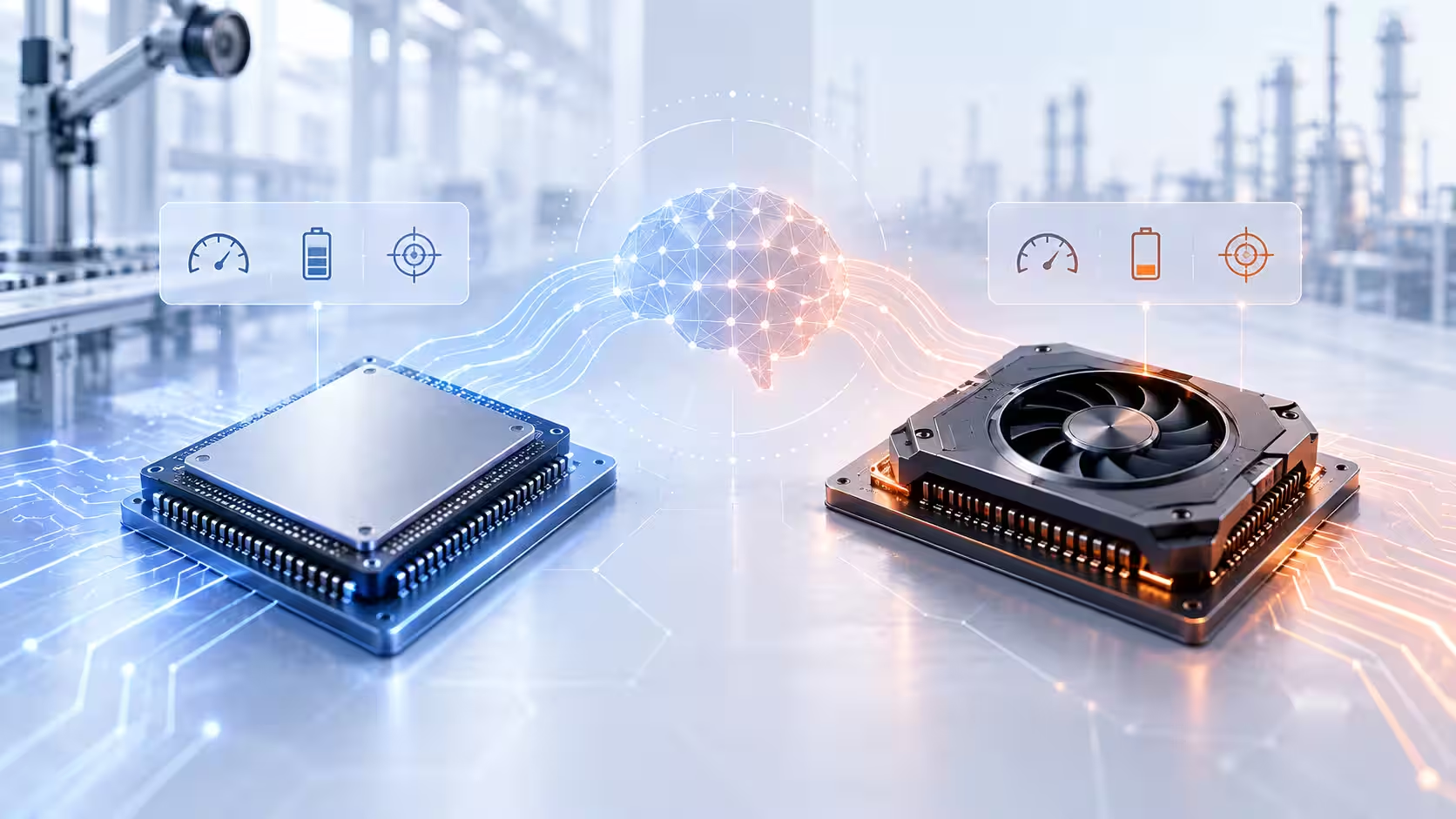
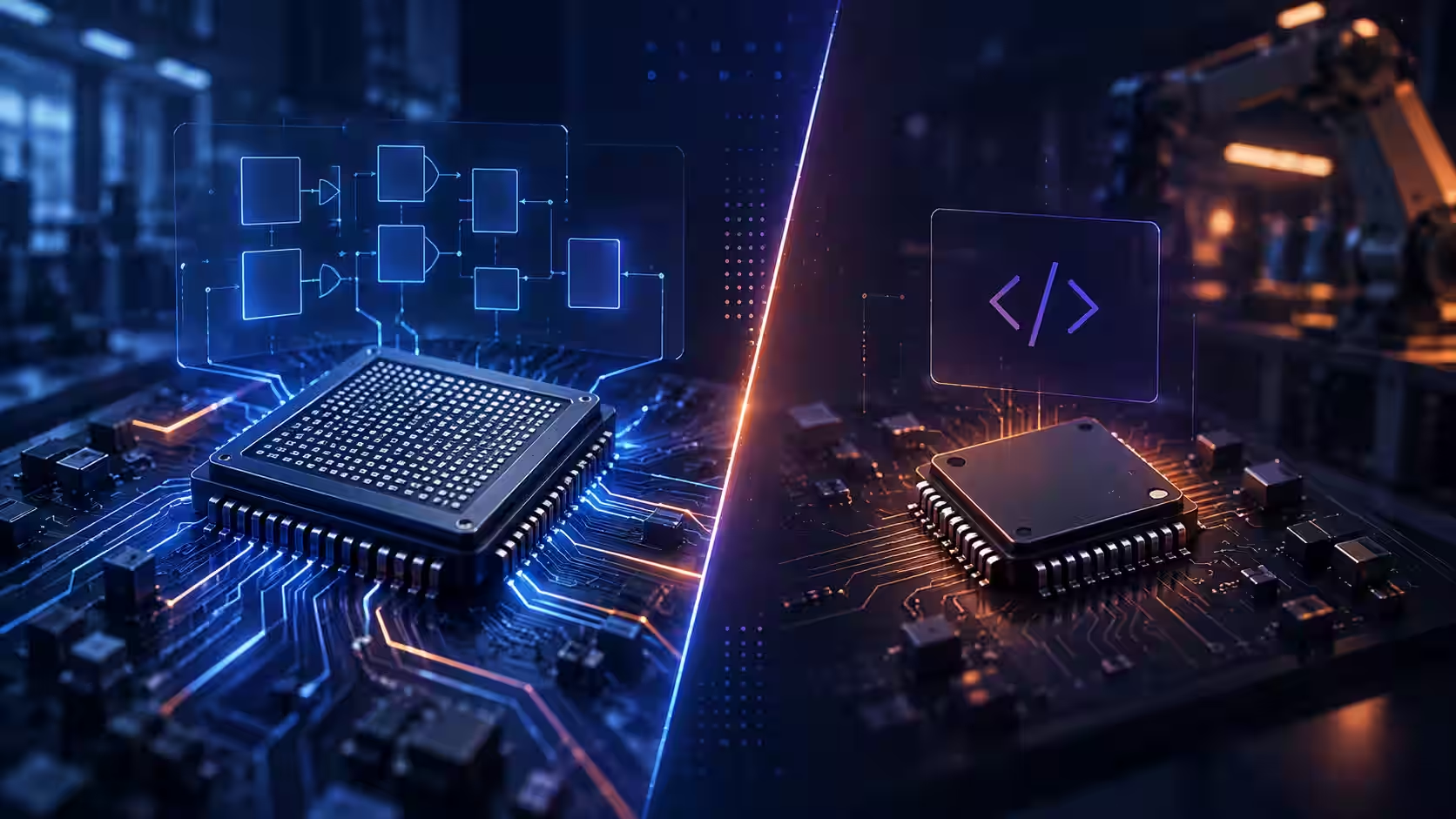
The critical distinction for buyers evaluating a safety-critical AI vendor: software-only vendors versus full-stack vendors. A software-only vendor delivers optimized AI models and, possibly, the runtime software to execute them. A full-stack vendor also specifies, sources, or designs the hardware the model runs on: the compute module, the power supply architecture, the thermal management, the connectors, and the integration into the host vehicle or machine. For a safety-critical deployment, that hardware layer is not optional.
In a safety-critical system, a wrong or late decision has consequences that a software bug report cannot fix. A collision avoidance system that misses a pedestrian, a medical device that misclassifies a vital sign, or an industrial robot that fails to detect a human in its workspace. These are not UX problems. That changes the bar on every dimension of vendor evaluation.
The system must work consistently across the full range of operating conditions (temperature, vibration, lighting, network state) for the full intended service life. Edge AI allows mission-critical operations to run without internet dependency, but that autonomy requires the hardware and software to be specified and validated together for the deployment environment, not generically.
A safety decision that arrives 500 ms late is not a safety decision. The inference pipeline must be designed for the latency budget required by the application (typically 10–100 ms for onboard safety systems) and validated against that budget in the actual deployment hardware, not in a simulation.
Many safety-critical deployments involve sensitive data: patient health information, passenger video, proprietary industrial processes. Edge AI keeps sensitive data on the device rather than transmitting it over a network, but only if the architecture is designed that way from the start, not retrofitted.
Edge AI systems require ongoing monitoring and updates after deployment. Model drift is real: the world changes, the data distribution shifts, and a model that performed well at launch degrades over time without a retraining and update cycle. A vendor who delivers a system and disappears is not a safety-critical partner.
When a safety system takes an automatic action, the operator or regulator needs to understand why. That is an engineering requirement, not a nice-to-have.
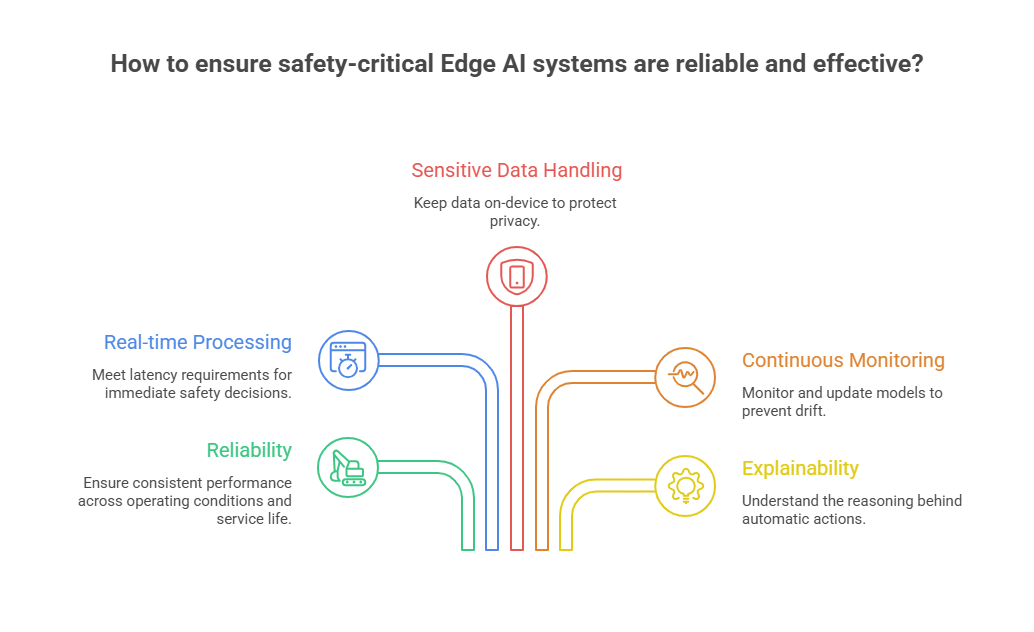
The sections below cover each evaluation criterion in priority order. Use them as the structure for your vendor assessment. The scorecard in a later section translates these into a weighted scoring framework you can apply consistently across vendors.
This is the decisive criterion and the most commonly missing capability in the market. Most companies that describe themselves as "edge AI companies" are software-only. They build and optimize AI models; they do not specify or integrate hardware. For a demo or a proof of concept, that may be sufficient. For a deployable safety system, it is not.
The hardware layer of a safety-critical edge AI system covers: selecting or designing the AI compute unit (NPU, GPU, or FPGA) appropriate to the inference workload; specifying the power consumption budget and validating that the system operates within it across the full thermal range; managing thermal dissipation so that the compute unit does not throttle under sustained load; selecting edge devices and connectors rated for the operating environment (vibration, temperature, ingress protection); and integrating into the existing infrastructure of the host vehicle or machine (power supply voltage, communications bus, mechanical envelope).
Specialized hardware is necessary to run AI models on edge devices at the throughput and latency required for real-time safety functions. AI algorithms that perform correctly on a cloud GPU may be completely unusable on a 5W embedded board without hardware-aware model design from the outset. Edge AI requires hardware expertise for optimizing models in constrained environments: the model architecture, quantization strategy, and runtime selection are all influenced by the target chip.
Ask any candidate vendor directly: do you design or specify the compute hardware, or do you only deliver software? Can you show a delivered system where you owned both the model and the hardware integration? See edge AI hardware for in-vehicle systems for the technical depth on what hardware selection actually involves.
A vendor who has built a prototype is not the same as a vendor who has shipped a production system. The prototype proved a concept. A production system proved that the concept works in the real environment, under real operating conditions, maintained over time. For safety-critical work, demand the latter.
Good delivery proof for edge AI work looks like: a named system in a comparable environment (transit, industrial, medical) that is currently in service; measured performance outcomes (detection rate, latency, false positive rate) from the deployed environment, not from a benchmark dataset; evidence that the system handled the deployment challenges specific to that environment (vibration, temperature, connectivity loss); and a maintenance record showing that the vendor continued to support the system after go-live.
Vendors with real edge AI work to show understand that seamless integration with the host system is one of the hardest parts of the project, not a minor detail. Real time analytics from a deployed system are evidence of this. Ask for reference customers you can contact, not just case study PDFs.
A safety-critical edge device is both a data processor and a physical endpoint. Its security posture must address both.
Data security on the device covers: encryption of sensitive data at rest (model weights, inference logs, any buffered video or sensor data); encrypted communications for all data transmission to back-end systems; and secure boot to prevent unauthorized firmware from running on the device.
OTA update security covers: signed firmware and model artifacts authenticated by the update server before installation; a rollback mechanism for failed updates; and audit logging of all update events.
Data privacy for edge AI deployments benefits from the architecture: processing locally reduces the risk surface by keeping sensitive data on the device rather than transmitting it across a network. No raw footage or patient data needs to cross an external network if inference and alerting happen on-device. Edge AI enhances security by keeping sensitive data on devices, which directly addresses GDPR data minimization requirements and reduces the risk of data breaches at the transmission layer.
Regulatory compliance requirements vary by industry and jurisdiction. Medical device software has specific frameworks (IEC 62304, FDA guidance on AI/ML-based software as a medical device). Safety-critical rail systems operate within EN 50128/50129. Industrial safety systems may need IEC 61508. Ask vendors to map their development process to the applicable framework for your industry, and verify any specific standard claims with your compliance team before finalizing requirements.
A safety-critical AI system is not a fixed artifact. It is a living system that requires ongoing investment to remain accurate and reliable.
Model drift is the most common post-deployment failure mode that organizations underestimate before their first deployment and overestimate in planning budget. The real-world data distribution changes over time: seasonal lighting shifts, new vehicle types appear on roads, patient populations change. A model trained on last year's data will degrade this year without retraining on new examples collected from the deployment environment.
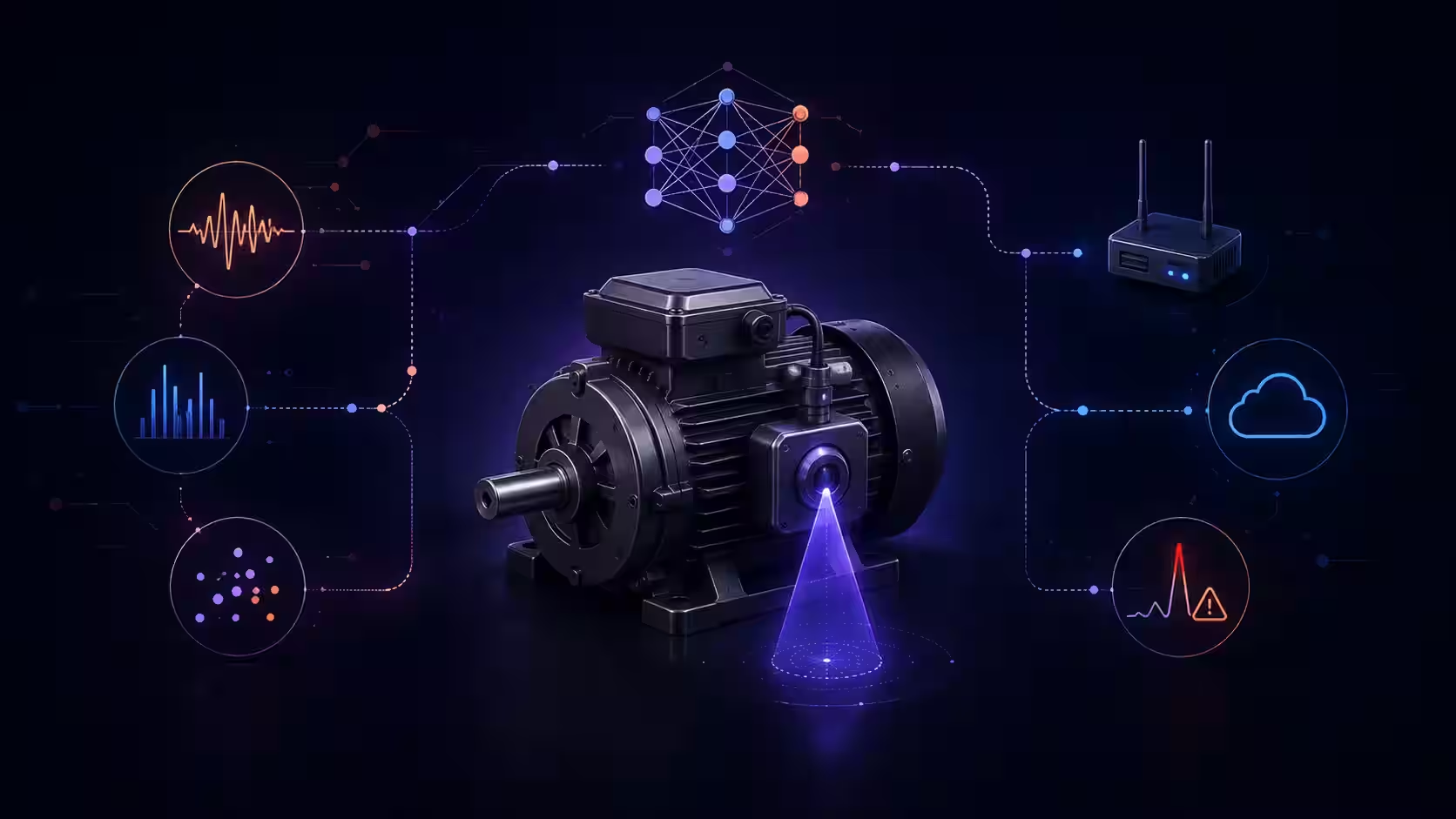
Edge AI systems require ongoing monitoring and updates. The maintenance architecture that supports this includes: telemetry from the edge device reporting inference metrics (latency, confidence score distributions, detection rates) to a back-end monitoring system; anomaly detection on those metrics to flag performance degradation before it becomes a safety issue; a retraining pipeline that uses production data to improve the model; and an OTA update mechanism that delivers new model versions to deployed devices without requiring physical access.
Model updates must be validated before deployment to the full fleet. A new model version that improves accuracy on one threat type while degrading on another is worse than the status quo. Ask vendors whether they have a managed MLOps service for their deployed systems, or whether model maintenance falls to your internal team after handover. Real time data processing from deployed devices feeds this cycle. See edge MLOps for deployed devices for the technical stack.
For safety-critical AI systems, explainability is a regulatory and operational requirement. When an automatic braking system fires, the driver, the operator, and (potentially) the regulator need to understand why. A black-box model that cannot explain its decision is not a safety-critical system; it is a liability.
AI systems for safety-critical applications should support structured alert outputs: event type, confidence score, detected object class, and the inputs that drove the decision. This is distinct from traditional AI outputs that return a single classification without supporting evidence. Potential risks from unexplainable decisions include regulatory rejection of the system, loss of operator trust leading to system deactivation, and inability to diagnose and fix systematic errors.
Safety documentation requirements cover: hazard analysis and risk assessment (HARA) for the system; failure mode effects and diagnostic analysis (FMEDA); a functional safety case that demonstrates the system meets the required SIL; and validation test evidence from representative real-world conditions. Ask vendors whether they produce this documentation as part of standard delivery, or whether it requires a separate engagement. See explainable AI for safety alerts.
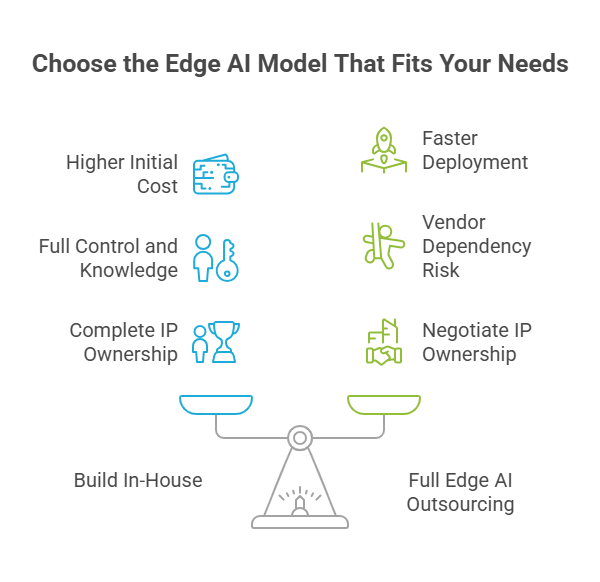
Three options exist for any organization considering edge AI for a safety-critical application. Each has a different cost, risk, and time-to-deployment profile. Build in-house makes sense when your organization already has embedded systems engineers, ML engineers with edge deployment experience, and access to the hardware integration expertise that industrial edge AI and intelligent hardware projects require in your specific operating environment. The full cost of building in-house includes not just engineering salaries but also the time to develop institutional knowledge of edge frameworks, hardware selection, and the MLOps infrastructure for post-deployment management. For most organizations outside the largest OEMs, this path takes longer and costs more than it appears at the outset.
Full edge AI outsourcing makes sense when you need to move quickly, lack embedded or hardware expertise internally, and have a well-defined requirement that a specialist vendor can execute against. The risk is vendor dependency: if the outsourced vendor owns the model weights, the runtime, and the deployment tooling, changing vendors later is expensive. Negotiate for IP ownership of trained models and documentation of the deployment architecture as part of the initial engagement.
Co-development is the model that works best for organizations with some internal capability but not the full stack. Your team owns the domain knowledge and the system-level requirements; the vendor brings the edge AI engineering depth. The result is a system your team understands and can maintain, built faster than a full in-house effort. Edge AI lowers operational costs associated with data transmission relative to cloud-based alternatives, which is one input to the build-vs-outsource math: the ongoing cost savings from reduced bandwidth can be weighed against the capital cost of the edge system to determine the breakeven point.
Existing infrastructure should inform the choice. An organization with an established DevOps practice and some ML capability may be closer to the co-development model than they expect. An organization with no embedded systems experience should outsource the hardware integration layer even if they plan to own the model development.
Prototype-only portfolios. If every case study is a proof of concept or pilot, the vendor has not solved the hard problems of production deployment: certification, vibration tolerance, OTA updates, model drift management.
No hardware capability. A vendor who cannot answer "what compute unit does this run on and what is the power draw?" does not have the hardware depth required for a safety-critical system.
Vague reliability claims. "Our system achieves 99% accuracy" without specifying the test dataset, the operating conditions, or the false positive rate is not a reliability claim. It is a marketing statement.
No maintenance story. A vendor who has not thought about what happens after deployment is not a long-term partner. Safety-critical edge AI systems have service lives of five to ten years; the model cannot be static for that duration.
Unnecessary complexity. A vendor who proposes a multi-cloud, multi-model architecture for a single-vehicle detection problem may be optimizing for billing, not for your deployment. Edge AI solutions for safety-critical contexts should be as simple as the application allows.
Use this framework to score two to four vendors consistently. Weight the criteria by the importance to your specific application; the weights below are indicative for a safety-critical onboard system.
Hardware and embedded capability carries the heaviest weight in the evaluation, at 25 percent. This criterion checks whether a vendor actually owns hardware integration work rather than shipping software and leaving the embedded engineering to someone else.
Delivery proof in a comparable environment counts for 20 percent. This is where a vendor's track record gets tested against reality: shipped systems, measurable outcomes, and reference customers who will actually take a call.
Security, compliance, and data privacy make up 15 percent of the score. Encryption practices, secure OTA update mechanisms, and alignment with the relevant regulatory framework all fall under this heading.
Maintenance, monitoring, and model updates also account for 15 percent. This covers a vendor's MLOps capability, their retraining pipeline, and how they handle OTA delivery once a system is live.
Explainability and safety documentation take 10 percent. Reviewers look at how alerts are structured and whether FMEDA and safety case documentation actually hold up.
Domain knowledge specific to the buyer's industry, whether that's transit, industrial, medical, or automotive, is worth another 10 percent.
Commercial and engagement model rounds out the scorecard at 5 percent, covering IP ownership terms and what support actually looks like after go-live.
Together, these seven criteria add up to a full 100 percent weighting.
Scoring guidance: 5 = strong evidence (reference customers, documentation reviewed); 3 = credible claims but limited evidence; 1 = no evidence or red flag present. Appropriate hardware capability should be scored by asking the vendor to describe a specific deployment, not by accepting a general capability claim.
For decision making between vendors with similar weighted scores, the tiebreaker should be the reference customer conversation. A vendor whose customers will not speak to you on the record has a proof problem regardless of their scorecard total.
Most edge AI outsourcing engagements move through three stages. Understanding what each stage should deliver helps buyers avoid paying for a pilot that never becomes a product.
A time-boxed engagement (typically 6–12 weeks) that answers whether the approach is technically feasible on representative hardware, with representative data, in a representative environment. The deliverable is a working system running on the target edge device with measured performance against defined metrics. A pilot that runs only on a development laptop is not a pilot; it is a demo.
The full engineering engagement that takes the validated approach from pilot to a deployable, certified system. This stage covers hardware finalization, model optimization for the production compute unit, safety documentation, integration testing with the host system, and field validation. For safety-critical systems, this stage typically takes 6–24 months depending on the certification requirements and the complexity of the operating environment. Business needs at this stage include seamless integration with existing infrastructure and a clear handover plan for the operational team.
Enterprise deployment and support
The ongoing relationship after go-live covering model maintenance, OTA update delivery, fleet monitoring, and retraining cycles. This stage should be scoped and priced before the production development contract is signed, not negotiated after the system is deployed when the buyer has no leverage. Edge AI solutions in production require active maintenance to accelerate innovation and maintain performance over time.
The global edge computing market is projected to reach USD 61.14 billion by 2028, growing at a CAGR of 38.4% (Grand View Research, 2021). That growth is being driven by industrial IoT, connected vehicles, and safety-critical applications that cannot tolerate cloud latency or connectivity loss. The vendor landscape is expanding with it, which means more choice but also more vendors whose edge AI credentials are thinner than their marketing suggests.
Read also:
A camera and sensor array on a production line detects early failure signatures in rotating machinery and flags maintenance before a breakdown. The benefits of edge AI in this context are concrete: predictive maintenance eliminates the unplanned downtime that costs manufacturers an estimated $50 billion annually (Siemens, 2023). The system runs on an edge server in the plant, processing real time analytics from multiple sensor streams simultaneously, with model updates delivered OTA during planned maintenance windows.
Medical devices running edge AI process physiological sensor data locally, detecting arrhythmias or critical vital sign changes without transmitting raw patient data to a cloud server. Healthcare uses edge AI for real-time patient monitoring in wearables and bedside devices, where HIPAA and GDPR compliance requires that sensitive health data stays on-device. The latency improvement over cloud-based analysis is clinically significant: a local inference in 20 ms versus a cloud round-trip of 200 ms makes a measurable difference in early-warning alert delivery for time-sensitive clinical events. The same latency and privacy arithmetic applies to camera systems, where edge AI vs cloud AI comparisons also weigh the bandwidth cost of streaming raw video.
InTechHouse case study: Full-stack safety-critical delivery for public transport
InTechHouse developed and deployed an onboard AI system for a public transport manufacturer. The engagement covered the full stack: sensor selection and placement, compute hardware specification and integration into the vehicle's power and communications architecture, model development and optimization for the target embedded platform, and validation across the full operating environment including tunnels, adverse weather, and the full seasonal temperature range.
The system ran inference entirely onboard at the latency required for the collision avoidance application, with no cloud dependency. After deployment, InTechHouse maintained the model update and monitoring pipeline, delivering OTA updates when retraining on new operational data improved performance. The system has operated continuously across the vehicle's service schedule without requiring physical access for model management.
This engagement demonstrates the criteria described in this guide: hardware and software owned by the same team, a shipped system with measurable outcomes in a production environment, and a post-deployment maintenance relationship that keeps the system accurate over its service life.
We build inference systems that run on constrained compute inside vehicles and industrial equipment, and we stay on them after go-live. Ask for the delivery evidence before you shortlist anyone.
Review our shipped edge AI systems
Not sure where to start? We work with companies at every stage, from early ideas to enterprise-level builds. A 30-minute call can save you months of guesswork.
An edge AI development company builds AI systems that run inference on edge devices rather than in a cloud data center, and the top edge AI development providers differ mainly in which layer of that stack they own. The scope typically includes model development, optimization for constrained hardware (quantization, pruning), and integration with the target device or system. Full-stack vendors also cover hardware selection and embedded integration; software-only vendors deliver optimized models and runtimes but expect the buyer to handle hardware.
Start by separating vendors who have shipped production systems in comparable environments from those who have only built prototypes or demos. Then evaluate hardware capability (can they specify and integrate the compute unit?), security and compliance posture, post-deployment maintenance offering, and explainability of the AI system's decisions. Use the scorecard in this guide to compare vendors consistently rather than relying on sales presentations alone.
A safety-critical AI vendor must demonstrate: production systems in comparable safety contexts (not just lab proofs); hardware capability or a named hardware partner they work with; a maintenance and model update process that addresses model drift over the system's service life; safety documentation (FMEDA, safety case, SIL evidence) appropriate to the applicable standard for your industry; and explainable alert outputs that operators and regulators can interpret. Vague reliability claims and prototype-only portfolios are disqualifying for safety-critical work.
Build in-house only if you already have embedded systems engineering, ML engineering with edge deployment experience, and the MLOps infrastructure to maintain models in production. Co-develop with a specialist vendor if you have domain knowledge and some technical capability but not the full hardware-plus-software stack. Fully outsource edge AI if you need to move quickly or have no embedded experience. In all cases, negotiate for IP ownership of trained models and documentation of the deployment architecture.
The ten most important: (1) Show me a shipped production system in a comparable context. (2) Who owns hardware integration? (3) What is your model drift and retraining process? (4) How do you deliver and validate OTA model updates? (5) What safety documentation is standard delivery? (6) How does the system explain its decisions? (7) What data leaves the device? (8) What are your data security controls on-device? (9) What functional safety standard have you worked to? (10) What does post-deployment maintenance cost and include?
Damian Ledziński, PhD Eng., is an Applied Artificial Intelligence Expert and an Assistant Professor at Bydgoszcz University of Science and Technology. He has over 15 years of academic, research, software-engineering, and technology-development experience.
His work focuses on applying artificial intelligence, machine learning, deep neural networks, and data science to complex real-world systems. His principal research and engineering interests include autonomous unmanned aerial vehicles, drone navigation and swarm intelligence, biomedical engineering, medical signal and image analysis, predictive modeling, industrial IoT, and intelligent water-management systems.
Damian has contributed to multidisciplinary R&D initiatives including AI-assisted medical diagnostics, a Polish ventilator prototype, autonomous indoor drone systems for warehouse inventory, AI-supported water-consumption analysis, virtual medical assistants, and intelligent systems combining embedded devices with machine-learning models.
He is the author or co-author of more than 30 scientific publications. His work has appeared in international scientific publications covering artificial intelligence, biomedical engineering, signal analysis, autonomous systems, environmental monitoring, and data-driven infrastructure.
Damian is a co-creator of academic programs in Engineering in Medicine, AI in Medicine, and Data Science at Bydgoszcz University of Science and Technology. He combines scientific research with hands-on implementation, translating experimental AI methods into deployable technology. He writes about applied AI, machine learning, predictive analytics, autonomous UAV systems, AI in medicine, biomedical signal processing, industrial IoT, and intelligent models in real-world systems.
Damian Ledziński's academic profiles:
https://orcid.org/0000-0003-0796-4390
https://wtie.pbs.edu.pl/pl/pracownik/damian-ledzinski
https://www.researchgate.net/profile/Damian-Ledzinski
https://scholar.google.pl/citations?user=AlQpPB0AAAAJ&hl=pl
https://ludzie.nauka.gov.pl/ln/profiles/DN6pHXU6KZm/publications/f83a8833-6060-4fae-8628-3dbf57661394
From first prototype to production, our engineers can help you scope it, build it and get it certified.
This initial conversation is focused on understanding your product, technical challenges, and constraints.
No sales pitch - just a practical discussion with experienced engineers.
Share a few details about your product and context. We’ll review the information and suggest the most appropriate next step.