


Industrial AI Solutions
We design and deploy AI-powered systems for industrial settings where downtime creates real financial loss, operational risk, or safety exposure. Our solutions are not experiments or proof-of-concept projects.


Industrial AI built for real operational environments
Our goal is not to deliver an AI tool in isolation. Our goal is a stable, production-grade AI platform that supports business operations and operational decision making in high-responsibility industrial environments. These systems predict equipment failures, enable predictive maintenance, analyze sensor data continuously, and integrate directly with enterprise systems such as CMMS and ERP.
A practical approach to Industrial AI Solutions
Optimizing industrial processes with AI requires more than a trained model. It requires aligning industrial data sources, operational constraints, and deployment architecture with how a plant or asset network actually runs, so the system produces deeper insights instead of noise.
Data and operational context
- We analyze sensor data, industrial IoT telemetry, system logs, process parameters, failure and maintenance history, and environmental data to build a complete operational picture of industrial processes.
- Operational data from OT systems is structured and connected to enterprise systems, so anomaly detection and predicting equipment failures reflect how machines actually behave, not a simplified dataset.
- We address noise, inconsistent formats, and data gaps between locations, since high quality data is what determines whether a model performs well once it moves into production.
Production deployment and lifecycle
- Predictive insights integrate directly with CMMS and ERP systems, so alerts and recommendations reach maintenance and operations teams inside the enterprise systems they already use.
- Systems are architected for the industrial edge, where latency, bandwidth, or data sovereignty requirements demand local processing, with cloud infrastructure handling aggregation and scaling.
- Production-grade MLOps practices, including monitoring, drift detection, and retraining, keep machine learning models accurate and governed well beyond the initial deployment.
.avif)
Where Industrial AI creates measurable value
Industrial AI initiatives tend to concentrate around a small set of high-impact use cases: predictive maintenance, quality control, and process optimization.

Analyzing sensor and historical data lets a system flag early signs of wear before a breakdown happens, shifting maintenance teams from reactive repair to planned intervention. Suncor, a Calgary-based energy company operating more than 20,000 assets across 14 sites, achieved $37 million CAD in savings using predictive analytics since implementing the approach in 2017 (AVEVA, 2017 onward).

High-speed computer vision systems inspect products on the assembly line with greater accuracy than human inspection, catching defects that are easy to miss at production speed. This is one of the clearest entry points for industrial automation on a production line, since it reduces waste and rework without slowing throughput.

Process optimization adjusts operational parameters dynamically to maximize throughput, and the same approach extends to energy management. AI can forecast energy demand and optimize equipment operation, reducing waste and enhancing productivity across manufacturing operations. AI optimizes energy use in manufacturing processes, and industrial AI reduces waste from industrial processes more broadly, an outcome documented across multiple deployments.
Use Cases
We built a complete on-premise AI platform for a large university clinical hospital across 32 clinical departments, covering AI-assisted documentation, medication administration recommendations, and demand forecasting for medications and supplies. Every stage of training and inference runs entirely on the client's own infrastructure, with zero dependency on external cloud services and no vendor lock-in at handover.
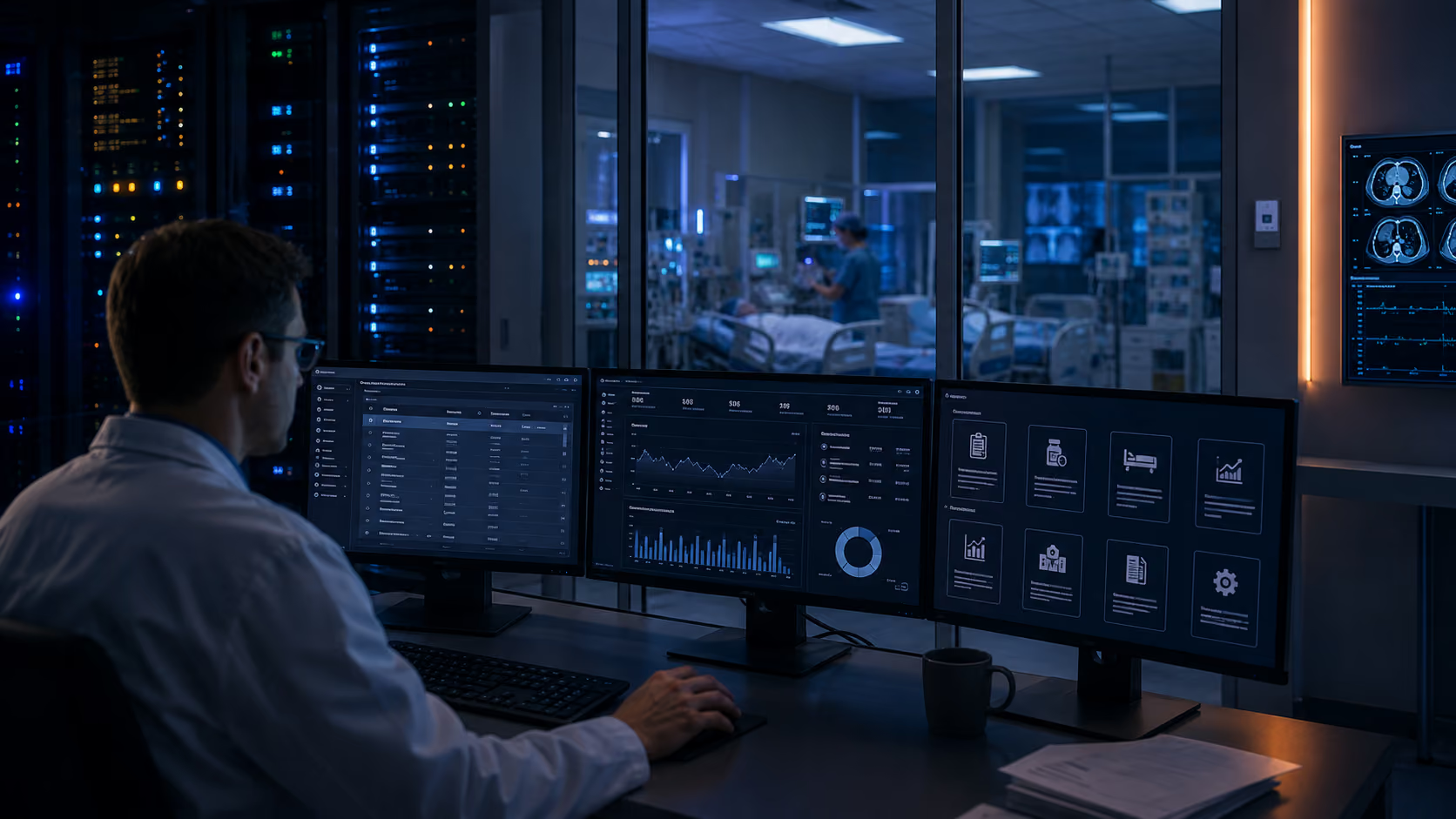


We developed a combined hardware and software platform that analyzes sensor data from water meter overlays to detect leaks, bursts, blockages, and irregular usage. The system moved detection time from many hours or a full day down to 15 to 30 minutes, enabling a shift from reactive to predictive, data-driven operations.

Predictive Analytics and Anomaly Detection in Water Utility Management

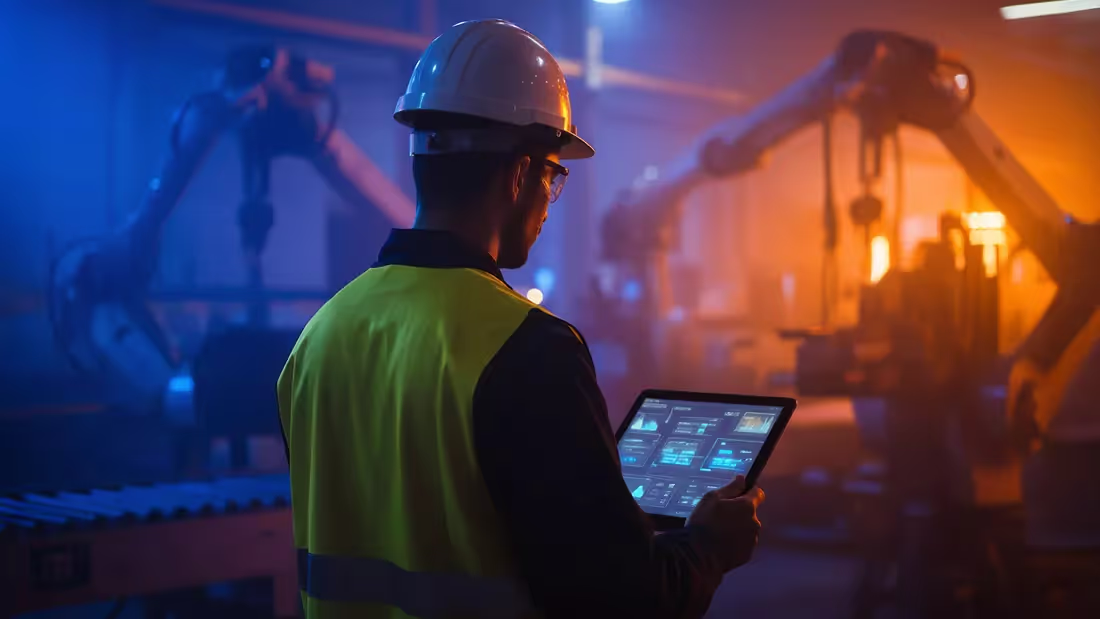
We standardized how a computer vision company builds and deploys AI filters for manufacturing, logistics, and agriculture clients, introducing a consistent technology stack, structured sprint planning, and integrated QA. The result was faster delivery timelines and a scalable framework for parallel AI development across teams.
Streamlining AI Filter Development and Improving Team Collaboration


We design and implement monitoring platforms that track consumption of multiple industrial utilities, including electricity, gas, heat, compressed air, and water across production facilities and infrastructure sites. Real-time analysis of consumption patterns enables early detection of anomalies, irregular usage, and efficiency losses, helping prevent equipment failures and avoid unnecessary operational costs.

We develop synthetic training datasets for computer vision systems when real-world image collection is expensive, limited, or difficult to scale. Our approach combines realistic 3D environments, camera simulation, and controlled lighting conditions to prepare datasets for automated object detection and classification. This supports AI model development, reduces dependence on manual data acquisition, and enables testing across varied operating conditions.

Industries We Serve
Our Industrial AI capabilities are deployed across regulated, mission-critical, and asset-heavy sectors of the industrial sector.

Predictive maintenance and anomaly detection for upstream, offshore, and extraction infrastructure.

Industrial AI for multi-site production environments, covering quality control, computer vision, and process optimization across production lines.

AI systems for diagnostic devices and medical infrastructure, built for regulated, high-responsibility environments with full data sovereignty.
FAQs
If you have additional questions or would like to discuss your requirements, feel free to get in touch with our team.
Industrial AI refers to the application of artificial intelligence and machine learning models to industrial processes, using real-time data and historical data from sensors and enterprise systems to optimize production processes, support quality control, and enable predictive maintenance. As a form of industrial artificial intelligence, it typically integrates advanced machine learning, computer vision, and IoT data analytics into a single operational layer, rather than treating each as a separate tool. Industrial AI predicts equipment failures to minimize unplanned downtime, which is why it has become one of the most measurable applications of artificial intelligence technologies on the plant floor. The results are documented across multiple deployments: Nestlé cut product waste by 10% using AI analytics to standardize powder quality at its Waverly, Iowa plant, and ISU Chemicals predicted reactor yield with 99.7% accuracy using AI modeling built on six years of reactor data (AVEVA, industry case data). These outcomes reflect what industrial AI looks like once it moves past a proof-of-concept and into daily plant operations.
Industrial AI needs to operate reliably inside complex, high-responsibility environments without destabilizing operations or generating false alarms that disrupt maintenance teams. Our approach is built around three principles, with deep domain expertise at the center of all three.We understand the physical behavior of industrial equipment, including sensors, embedded systems, and operational constraints. This deep domain expertise lets us extract better signal from noisy industrial data, build more realistic models, and reduce false alarms compared to generic AI tools working from datasets alone. Modern factories increasingly leverage AI to optimize machine health and real-time process controls, and that only works reliably when the underlying models reflect real equipment behavior rather than a simplified simulation of it.Our systems include full MLOps lifecycle management, covering model monitoring, drift detection, and retraining, so system performance holds up well beyond the first deployment. We design complete systems, not isolated models: data, pipeline, model, integration, monitoring, and lifecycle management are treated as one continuous chain, which is what keeps operational efficiency gains from eroding a few months after go-live.Industrial AI systems are architected to work with CMMS, ERP, SCADA, and PLC data sources, using industrial protocols such as MQTT and OPC-UA, and are designed to scale across multiple sites without rebuilding the system for each new location. This architecture is also what makes proper asset performance management possible at scale, since the same models and dashboards can be extended to new equipment classes and sites without a ground-up rebuild. This is what separates an AI platform that supports autonomous operations from one that stays stuck at pilot scale.
Adopting Industrial AI means implementing a production-grade system that combines data engineering, machine learning, integration, and lifecycle management to support real operational decisions. A standalone AI tool only performs prediction; without integration, monitoring, and governance around it, a model on its own typically fails once it reaches live industrial operations. It is also a different problem than adopting generative AI: a generative AI tool is built to produce content or draft text, while an industrial AI platform is grounded in operational data and machine learning models built for prediction, classification, and control. Industrial AI is generally aimed at augmenting human intelligence and engineering judgment, automating repetitive tasks such as manual data logging or visual inspection, rather than replacing the operator's decision-making role entirely. That distinction matters most in high-responsibility environments, where AI-driven automation needs to support a technician's decision, not obscure how the recommendation was reached.
An industrial AI platform analyzes sensor data, IoT telemetry, system logs, process parameters, failure and maintenance history, environmental data, and operational data from OT systems. Combining these sources gives deeper insights into equipment behavior than any single data source can provide on its own. Depending on the use case, the platform can also analyze data from adjacent functions, such as inventory levels and logistics data across supply chains, to connect equipment condition with broader planning decisions. Data quality across all of these sources, not model choice, is usually the biggest factor in whether an industrial AI platform performs well once it moves into production.
Yes, when the system is architected for it from the start. Many industrial AI initiatives fail to scale because of weak data foundations, poor integration, or missing monitoring. Production-grade Industrial AI is designed around multi-site deployment, consistent data handling, and centralized governance from the beginning, which is also what separates a genuine digital transformation program from a series of disconnected pilots that never reach the rest of the organization.
AI-driven solutions connect directly to CMMS and ERP systems, so predictions, alerts, and recommendations appear inside the enterprise systems maintenance and operations teams already use, rather than in a separate dashboard. AI can aggregate siloed operational data into unified dashboards for decision making, pulling information that would otherwise sit in disconnected spreadsheets or single-purpose tools into one operational view. The goal when we integrate AI into existing industrial systems is always the same: improve operational efficiency without asking teams to change how they already work, which is a core requirement of any credible enterprise AI deployment.
Computer vision gives industrial automation systems the ability to inspect products, monitor worker safety, and detect anomalies on the production line visually, often with greater accuracy and consistency than manual inspection. It is widely used for quality control on production lines and increasingly for monitoring conditions across warehouse operations. Because it automates repetitive tasks that previously required a person to visually check every unit or every frame of footage, computer vision is one of the fastest-adopted AI technologies in the manufacturing industry, particularly in manufacturing environments running at high throughput where manual inspection cannot keep pace.
A digital twin is a virtual model that simulates a real-world physical asset or system, letting engineers anticipate the impact of production or process changes before implementing them. Digital twins optimize performance using real-time data and analytics, continuously updating the virtual model as conditions on the physical asset change, rather than relying on a static simulation built once and never revisited. Digital twins are becoming a core component of smart manufacturing, supporting performance optimization across production lines without disrupting live operations. The engineering side benefits as well: AP Consultoria e Projetos accelerated pipe-support analysis speed by 90% using AI-assisted design and simulation tools (AVEVA, industry case data), showing how the same simulate-before-you-build principle behind digital twins also speeds up plant design and engineering review work.
Industrial AI systems can run at the edge, processing sensor data locally before sending summarized results to the cloud. This reduces latency and bandwidth demand and supports autonomous operations where connectivity is limited or data sovereignty requirements apply. Edge deployment is also what allows autonomous systems, such as automated inspection stations or self-adjusting process controls, to keep operating even during a temporary loss of connection to central infrastructure.
Industrial AI is used across oil and gas, manufacturing, energy and utilities, healthcare infrastructure, aerospace, heavy industry, and industrial infrastructure. It is widely regarded as a core technology of the fourth industrial revolution, alongside industrial IoT, automation, and advanced analytics, and is increasingly described as a driver of the next industrial revolution in how factories and plants operate. Across the manufacturing industry specifically, adoption tends to follow a similar pattern: predictive maintenance and quality control first, then broader digital transformation initiatives that extend AI technologies into planning, supply chains, and enterprise-wide asset performance management.
Look for a provider with genuine industrial systems experience and deep domain expertise, not just AI or data science skills, since physical equipment understanding directly affects model quality. Production-grade MLOps, proven integration with existing enterprise systems, edge deployment capability, and experience in regulated industrial environments are the practical signals worth checking. It is also worth asking how the provider approaches data quality and governance, since even strong artificial intelligence technologies underperform when they are built on inconsistent or poorly validated operational data.
Discuss your product with our R&D team
This initial conversation is focused on understanding your product, technical challenges, and constraints.
No sales pitch - just a practical discussion with experienced engineers.



Share a few details about your product and context. We’ll review the information and suggest the most appropriate next step.