
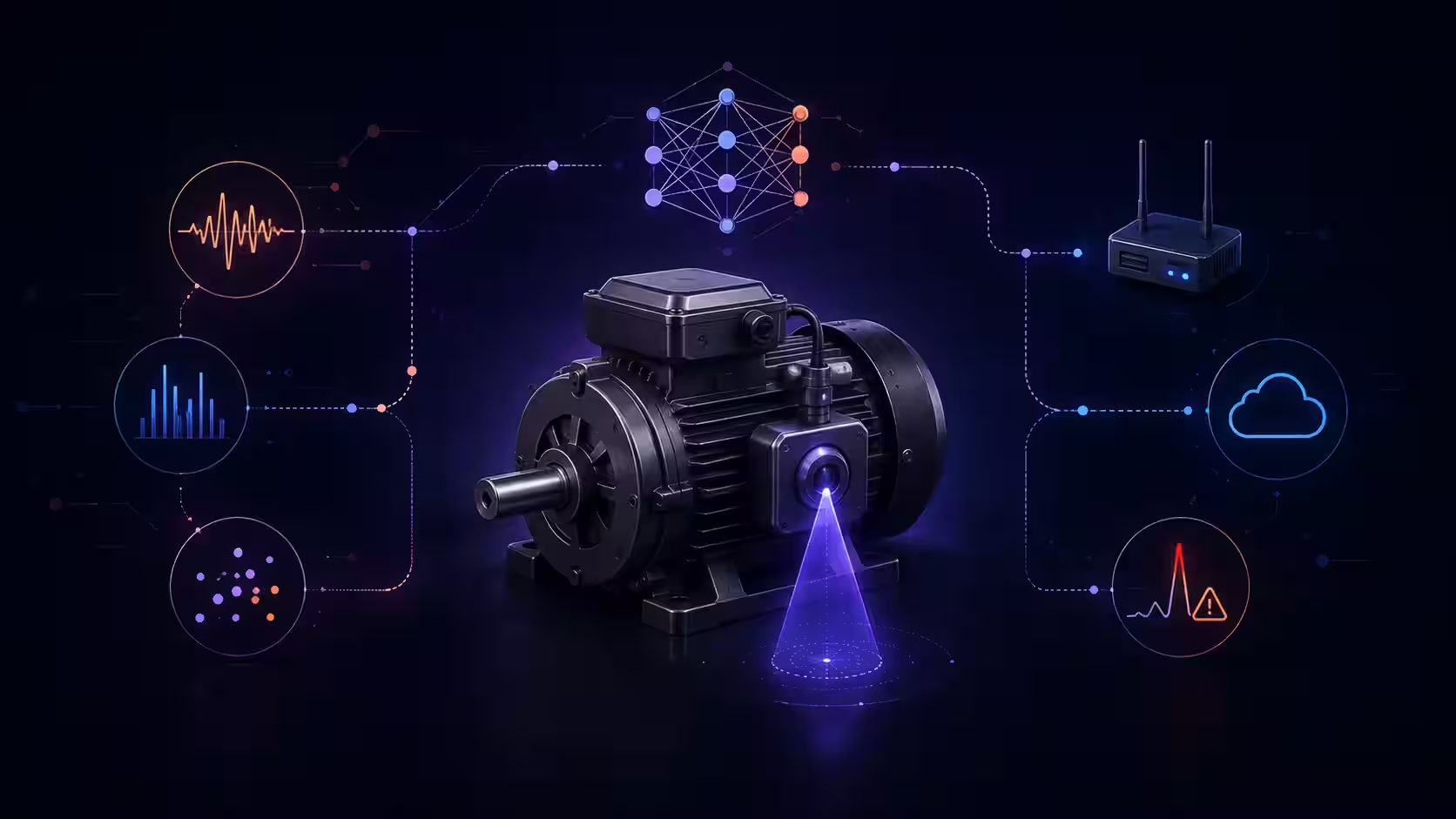
Predictive maintenance machine learning trains models on sensor and historical data to predict equipment failures before they happen, replacing fixed schedules and reactive repairs with condition-based, data-driven servicing. Done well, it shortens unplanned downtime, cuts maintenance spend, and extends the working life of critical assets, but the payoff depends entirely on the model layer: what data feeds it, which model family fits the failure mode, and how it gets deployed into a maintenance team's actual workflow. This guide focuses on that model layer specifically, covering how predictive maintenance machine learning models are built, trained, validated, and put into production.
Reactive maintenance, sometimes called corrective maintenance, repairs equipment after it fails. Preventive maintenance performs scheduled maintenance regardless of condition, which avoids some failures but often leads to unnecessary repairs on parts that still had useful life left. Predictive maintenance predicts failures before they occur by reading the equipment's actual condition, so repairs happen only when the data indicates they are needed. The lower costs associated with predictive maintenance come from that shift: condition-based servicing replaces fixed schedules, cutting both emergency repairs and premature part replacement. For the fuller comparison across all three maintenance strategies, including implementation guidance, see our guide to predictive maintenance in manufacturing.
Model quality is capped by data quality, full stop. No model architecture compensates for sensor data that is inconsistent, incomplete, or poorly sampled.
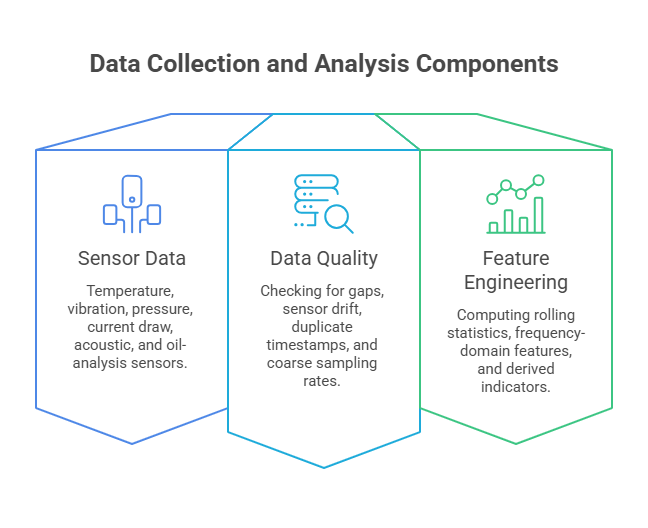
Effective predictive maintenance programs collect data from a defined set of sensor types: temperature, vibration, and pressure sensors form the core, often supplemented by current draw, acoustic, and oil-analysis sensors depending on the asset. That data collection needs to combine real time sensor data with historical data, since real-time readings tell the model what is happening now, and historical data gives it the failure examples and normal-operation baselines it needs to learn from.
Before any data reaches a model, it needs a data-quality pass: checking for gaps in the time series, sensor drift, duplicate or misaligned timestamps, and sampling rates that are too coarse to catch fast-developing faults. Poor data quality leads to unreliable models regardless of the algorithm chosen, and it is far cheaper to fix at the source than to compensate for downstream.
Once the raw data is clean, feature engineering turns it into something a model can learn from. For time-series sensor data, this typically means computing rolling statistics (mean, standard deviation, rate of change), frequency-domain features from vibration signals, and derived indicators like cumulative operating hours since the last service. The features chosen should map back to known failure physics wherever possible, since a feature grounded in how the equipment actually fails tends to generalize better than one selected purely because it improved a training-set score.
For a deeper look at building the data foundation this depends on, see our guide to industrial DataOps.
On most plant floors the binding constraint is not the model but the machine. Assets installed fifteen or twenty years ago expose no usable signal at all, so closing that gap means retrofitting legacy machinery with brownfield IoT, adding external vibration, current, and temperature sensors instead of replacing equipment that still runs fine. Budget for that layer before you budget for data science.
This is the core of predictive maintenance machine learning, and it deserves the most attention of any section here, since the model family chosen shapes everything downstream: what data you need, how you validate it, and what kind of alert it can generate.
| Model Type | What It Does | Typical Use Case |
|---|---|---|
| Supervised Classification | Learns to distinguish healthy operation from specific failure modes using labeled historical examples | Predicting a known failure type, such as bearing wear, when enough labeled failure history exists |
| Unsupervised Anomaly Detection | Flags subtle deviations from normal operating conditions without needing labeled failure data | New assets or failure modes with little or no labeled failure history |
| Regression for Remaining Useful Life | Estimates the time remaining before a component is likely to fail | Scheduling replacement of wear parts like bearings, belts, or filters before they fail |
| Reinforcement Learning for Scheduling | Learns an optimal maintenance scheduling policy by balancing failure risk against maintenance cost over time | Optimizing maintenance windows across a large fleet of similar assets |
Machine learning models analyze IoT data to predict failures by learning the patterns that precede a breakdown, whichever model family is doing the analysis. Anomaly detection algorithms flag subtle deviations that a fixed threshold alarm would miss entirely, and pattern recognition techniques identify the more complex, multi-signal wear signs that a human reviewing a single sensor chart would not catch. Machine learning reduces false alarms over time as models see more examples of normal operating variation versus genuine developing faults, which matters because a maintenance team that gets flooded with false positives stops trusting the alerts.
Remaining useful life prediction deserves its own mention, since it answers a different question than classification does. Rather than asking "is this failing," it estimates how much operating time is left before a specific component needs attention, which is what actually drives a maintenance schedule. For a deeper technical treatment of RUL estimation methods, see our guide to remaining useful life estimation.
Predictive maintenance models need extensive datasets, and how that data gets split for training and testing matters as much as how much of it there is. A random train-test split, the default in most general machine learning workflows, is the wrong choice here: it lets the model train on data from after the point it is later tested on, which leaks information and produces evaluation metrics that look better than the model will actually perform in production. The split needs to respect temporal order, training on an earlier window and validating on a later one, so the evaluation reflects what the model will actually face: predicting failures it has not seen yet.
Cross-validation for time-series data follows the same logic, using rolling or expanding windows rather than the random k-fold splits used elsewhere in machine learning. Each fold trains on data up to a point in time and validates on the period immediately following it, then the window advances.
Evaluation metrics differ by model type. For remaining useful life models, which are regression problems, mean absolute error and root mean squared error on the predicted time-to-failure are standard. For failure classification, precision and recall matter more than raw accuracy, because failure events are rare relative to normal operation, and a model can score well on accuracy while missing nearly every actual failure. Precision-recall curves and the resulting trade-off, more false alarms versus more missed failures, should be set deliberately based on the cost of each type of error for the specific asset, not left at a default threshold.
Feature reduction techniques such as principal component analysis and other statistical analysis methods help when sensor counts are high relative to the number of failure examples available, reducing the risk that machine learning algorithms fit noise rather than the signal that separates normal operating conditions from developing faults. These dimensionality-reduction techniques matter across every model family described above, since predictive models trained on too many correlated features tend to overfit regardless of which specific machine learning techniques generated them. Machine learning improves prediction accuracy over time as new data accumulates, but that improvement only holds if the retraining pipeline keeps feeding the model current, correctly labeled examples.
In one power-generation case study, an AI-based predictive maintenance system was able to predict 100% of the failures it monitored within a window of three to seventeen hours ahead of occurrence (SPD Technology). That window is specific to the assets and sensors in that deployment, and lead time varies significantly by asset type and failure mode, so it should be read as an illustration of what is achievable rather than a general benchmark.
Training a model is the easy half; keeping it accurate against sensor drift and changing operating conditions is where most in-house programs stall. Our predictive maintenance services include the retraining pipelines and model monitoring that carry deployments past the pilot stage.
Class imbalance, censored histories and leaking validation splits break more PdM models than the choice of algorithm. Our team builds and validates models against your real sensor history.
Get a model that survives contact with your data
Implementing predictive maintenance machine learning requires a structured approach to data collection before a single model gets trained. In practice, the rollout follows a consistent sequence.
Start with a pilot on critical assets rather than a plant-wide deployment, since a smaller scope makes it easier to validate model performance against real outcomes before scaling. Choose the platform architecture next: whether models run at the edge, close to the equipment, or centrally in the cloud, depends on latency requirements and existing infrastructure, and on whether existing data already covers the assets in the pilot or new sensors need to be added first. Edge computing suits assets where a fast local response matters and network connectivity cannot be guaranteed, while cloud deployment suits fleets where centralized retraining, shared data processing, and cross-asset pattern detection matter more than millisecond response time. Finally, plan CMMS integration from the start rather than as an afterthought, since a model that generates accurate predictions nobody acts on delivers no value at all.
For the full program roadmap, including tool selection and organizational rollout, see our guide to step-by-step predictive maintenance implementation. For the sensor and IoT layer that feeds these models, see our guide to IoT predictive maintenance. Before any of this, stakeholders outside engineering may need a plain account of what predictive maintenance is and what it can realistically deliver.
Predictive maintenance machine learning is a cross-functional effort between data science and reliability engineering, not a project either team can run alone. Data scientists handle model selection, feature engineering, training, and validation, but they depend on maintenance teams and reliability engineers to supply the failure-mode knowledge that separates a truly useful feature from a statistically convenient one.
The handoff typically runs in both directions. Data scientists pass processed data analysis and model outputs to engineers, who translate a probability score or an anomaly flag into an actual maintenance action. Maintenance teams, in turn, feed back which alerts turned out to be real failures and which were false positives, closing the loop that keeps the model accurate. Data-driven decision-making depends on integrating sensor data and historical logs into dashboards that both groups can read, not just the data science team.
Enabling maintenance teams to work with this data does not require turning technicians into data scientists. It requires clear dashboards, plain-language failure explanations attached to each alert, and a documented escalation path so a model's output turns into a work order rather than a number nobody acts on.
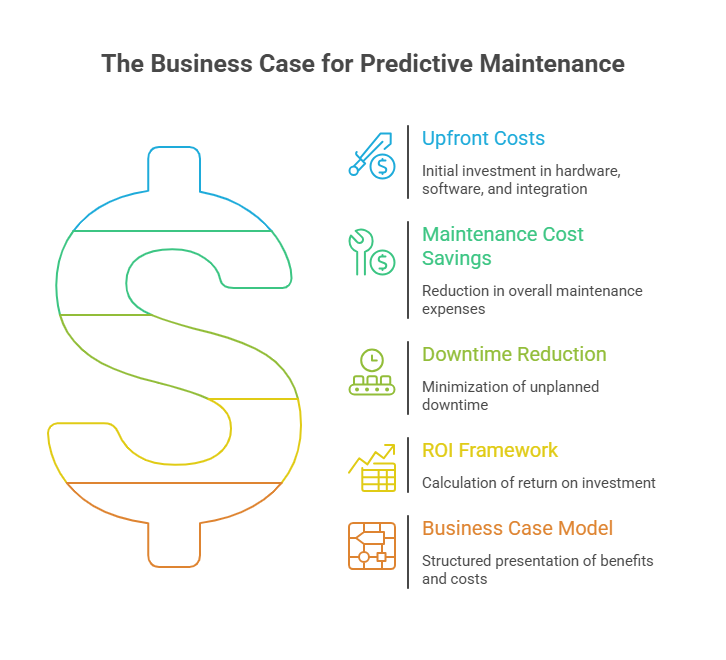
The business case for predictive maintenance machine learning rests on comparing upfront costs against avoided downtime and reduced maintenance spend, and it is worth being precise about ranges rather than quoting a single number, since reported figures vary by source and by how mature the program is.
On the cost side, expect upfront investment in sensor hardware where it does not already exist, software or platform licensing, and integration engineering to connect the model's output to a CMMS. On the savings side, predictive maintenance reduces overall maintenance costs by 18% to 31% compared to traditional approaches (IBM), and separate McKinsey research puts predictive maintenance AI cost reductions in the 10% to 40% range, with the wide spread reflecting differences in asset type and program maturity. Downtime reduction estimates cluster similarly: Deloitte and McKinsey research both put unplanned downtime reductions in the 35% to 50% range for mature programs, and a separate DOE-cited estimate puts breakdown elimination as high as 70% to 75% for a properly implemented program, though that figure describes breakdowns avoided rather than total downtime reduced, and the two metrics should not be conflated in a business case.
Unplanned downtime itself is expensive enough that even modest reductions matter: unplanned downtime costs manufacturers an average of roughly $25,000 per hour (MaintainX, 2024 State of Industrial Maintenance), with the figure climbing well past that for larger or more complex operations. Multiplying your own facility's downtime-hour cost against even a conservative reduction estimate usually produces a stronger business case than any headline percentage.
Treat every one of these ranges as a starting point for your own calculation, not a promise. For the full ROI framework and business case model, see our predictive maintenance in manufacturing guide.
Predictive maintenance extends equipment lifespan by catching wear early enough to intervene before it accelerates into other components, and by preventing the premature part replacement that scheduled maintenance sometimes causes. Estimates on the size of that effect vary by source, but extended equipment lifespan in the 20% to 40% range appears consistently across vendor and analyst research, driven by intervening at the point a component actually needs attention rather than on a fixed calendar.
Asset performance improves through the same mechanism in a different form: continuous monitoring catches equipment degradation while it is still gradual, which keeps machinery running closer to its designed performance envelope instead of drifting out of tolerance between scheduled inspections. Asset reliability, measured through metrics like mean time between failures, tends to improve in step with this closer monitoring, since the model is effectively watching the asset's condition every hour instead of once a quarter.
The oil and gas industry runs some of the highest-value critical assets anywhere in industry, from compressors and pumps to pressure vessels and pipeline monitoring equipment, and the cost of an unplanned failure extends beyond lost production into safety and regulatory exposure. Predictive maintenance machine learning in this sector focuses heavily on rotating equipment health and pressure-system integrity, where vibration and pressure sensor data feed models tuned to catch the specific failure modes that matter most for equipment health in hazardous environments. Regulatory reporting requirements also shape how these programs get built, since model outputs and maintenance actions often need to be auditable, not just accurate. For the full treatment of oil and gas use cases, see our dedicated guide to predictive maintenance in oil and gas.
Read also:
Retraining and governance keep the model honest over time, which is the part of a predictive maintenance program that gets neglected most often once the initial deployment is live.
Establish data-governance practices from day one: who owns sensor data quality, how long historical data is retained, and who can access model outputs. Prioritize critical assets by risk rather than by ease of instrumentation, since the highest-value monitoring targets are usually the assets whose failure would be most disruptive, not the ones with the most convenient sensor access. Build a feedback loop for model retraining so that new failure examples and confirmed false positives flow back into the training data on a regular cadence, since models improve with new data only if that data actually reaches them. Finally, document maintenance response procedures for each alert type, so continuous monitoring produces consistent action rather than depending on whichever technician happens to see the alert first. Together, these proactive measures turn a one-time model deployment into an actual maintenance practice, and consistent maintenance practices are what separate a pilot that gets abandoned after six months from one that keeps delivering value for years.
Building predictive maintenance machine learning models in-house typically draws on standard ML frameworks and libraries for the modeling work itself, paired with a time-series database and a feature-engineering pipeline to prepare sensor data before it reaches the model.
Buying versus building shows up as a choice between two vendor approaches. CMMS platforms with predictive features layered on top prioritize maintenance-management workflow, with modeling capability added around the edges. Predictive maintenance as a service (PMaaS) vendors flip that priority, leading with the modeling and analytics and treating work-order integration as a secondary feature. Predictive analytics platforms in either category exist to turn raw sensor data into actionable insight, but how much of that translation work a team has to do itself varies significantly between the two approaches.
Team roles typically split three ways: data scientists who build and validate models, reliability or maintenance engineers who supply failure-mode expertise and interpret outputs, and a data or platform engineer who owns the pipeline connecting sensors to models to the CMMS. Smaller organizations often combine these roles or lean on an advanced predictive maintenance solutions partner for the parts they cannot staff internally, particularly the data engineering work that AI based predictive maintenance depends on but that in-house maintenance teams rarely have the bandwidth to build themselves.
Tooling decisions usually collapse into build, buy, or a hybrid of the two, and the right answer shifts with fleet size and the maturity of the CMMS you already run. A side-by-side of the main platforms, including sensor coverage, integration effort, and the point at which each product stops being economic, is available in predictive maintenance tools compared. Choose the stack after a pilot has proven the failure modes are predictable, not before.
A worked predictive maintenance example makes the model-building process concrete, and shows what ai driven predictive maintenance actually looks like at the level of a single asset rather than a slide deck. Consider a centrifugal pump instrumented with vibration, temperature, and pressure sensors, sampling at one-minute intervals. Scaling the pump approach from one asset to a fleet raises the data quality and process questions covered by predictive maintenance best practices.
The dataset combines eighteen months of historical sensor data with maintenance logs identifying four confirmed bearing-failure events and two seal-failure events. Given the small number of confirmed failures, an unsupervised anomaly-detection model is the practical starting point: it establishes a baseline of normal operating conditions from the majority of the historical data, then flags deviations without needing dozens of labeled failure examples that this pump simply has not generated yet.
Feature engineering focuses on vibration frequency bands associated with bearing wear, rate-of-change in pressure differential across the pump, and a rolling average of motor temperature. The model is validated on the six known failure events using a temporal split, checking whether the anomaly score rose meaningfully in the days before each confirmed failure rather than only at the moment of failure itself. In this example, the model flagged three of the four bearing failures with a detectable rise in anomaly score roughly one to two weeks in advance, and one bearing failure was missed because a sensor gap during that period left the model without enough real time data to detect early warning signs.
Deployment runs the model on a daily batch job against the previous day's sensor data rather than in real time, since a pump failure develops over days, not seconds, and daily scoring is sufficient lead time while keeping the deployment simple. Anomaly scores above a defined threshold generate a work order in the CMMS automatically, tagged with the specific feature that triggered the alert so the technician knows what to check first. Ongoing monitoring tracks false-positive and false-negative rates against actual maintenance outcomes, feeding back into a quarterly retraining cycle as more confirmed failure examples accumulate and the model's remaining useful life estimates get more precise.
A client operating a fleet of critical rotating equipment needed to move beyond fixed-interval inspections after several unplanned failures caused costly production stops. InTechHouse trained an unsupervised anomaly-detection model on eighteen months of vibration and temperature sensor data, validated it against the client's own historical failure log using a temporal train-test split to avoid inflating accuracy with future data, and tuned the alert threshold jointly with the maintenance team to balance missed failures against alert fatigue. The model was deployed on a scheduled batch pipeline that scored incoming sensor data daily and pushed flagged assets directly into the client's existing CMMS as prioritized work orders. Within the first several months of operation, the client recorded a measurable reduction in unplanned downtime on the monitored assets, without requiring the client to replace its existing CMMS or sensor infrastructure.
Start with one asset, prove the model against its historical failure record, and only scale once the deployment has demonstrated it catches real failures without flooding the maintenance team with false alarms. The predictive models that work are rarely the most sophisticated ones available; they are the ones trained on clean data, validated rigorously, and deployed into a workflow the maintenance team actually trusts. That combination, more than algorithm choice, is what turns predictive maintenance solutions into a maintenance strategy that can lower maintenance costs and reduce maintenance costs on the assets that matter most. Talk to InTechHouse about building predictive maintenance machine learning models for your assets, or explore our industrial data platforms and OT/IT integration services if the data foundation, not the model itself, is holding your program back.
We handle the edge versus cloud decision, the CMMS integration and the retraining cadence that keeps a model useful a year after launch. Ask how we run the production side.
Talk to us about deployment and retraining
Not sure where to start? We work with companies at every stage, from early ideas to enterprise-level builds. A 30-minute call can save you months of guesswork.
Machine learning enables predictive maintenance by analyzing sensor and historical data to learn the patterns that precede equipment failure, then flagging deviations from normal operation before a breakdown occurs. Instead of following a fixed maintenance calendar, the model estimates equipment condition continuously and triggers a maintenance action only when the data indicates it is actually needed.
The main model families are supervised classification for known failure types, unsupervised anomaly detection for new or under-documented failure modes, regression models for estimating remaining useful life, and reinforcement learning for optimizing maintenance scheduling across a fleet. Most programs start with unsupervised anomaly detection when labeled failure history is limited, then add supervised models as more confirmed failure examples accumulate.
It depends on the model type. Unsupervised anomaly-detection models can work with a few months of normal operating data and no labeled failures at all, while supervised classification models predicting a specific failure type generally need dozens of confirmed failure examples to train reliably. Most programs start with unsupervised models and shift toward supervised approaches as failure history builds up.
Lead time varies significantly by asset type, failure mode, and sensor coverage, so there is no universal answer. In one documented power-generation case study, a model predicted equipment failures within a three-to-seventeen-hour window ahead of occurrence, while slower-developing failure modes like bearing wear can sometimes be flagged one to two weeks in advance when vibration trends are tracked continuously.
Deployment typically means choosing between edge and cloud architecture based on latency needs, connecting the model's output to a CMMS so alerts become work orders automatically, and setting a retraining cadence so the model stays accurate as new failure and false-positive data accumulates. Batch scoring, running the model on a daily or hourly schedule rather than continuously, is often sufficient for asset types where failures develop over days rather than seconds.
Damian Ledziński, PhD Eng., is an Applied Artificial Intelligence Expert and an Assistant Professor at Bydgoszcz University of Science and Technology. He has over 15 years of academic, research, software-engineering, and technology-development experience.
His work focuses on applying artificial intelligence, machine learning, deep neural networks, and data science to complex real-world systems. His principal research and engineering interests include autonomous unmanned aerial vehicles, drone navigation and swarm intelligence, biomedical engineering, medical signal and image analysis, predictive modeling, industrial IoT, and intelligent water-management systems.
Damian has contributed to multidisciplinary R&D initiatives including AI-assisted medical diagnostics, a Polish ventilator prototype, autonomous indoor drone systems for warehouse inventory, AI-supported water-consumption analysis, virtual medical assistants, and intelligent systems combining embedded devices with machine-learning models.
He is the author or co-author of more than 30 scientific publications. His work has appeared in international scientific publications covering artificial intelligence, biomedical engineering, signal analysis, autonomous systems, environmental monitoring, and data-driven infrastructure.
Damian is a co-creator of academic programs in Engineering in Medicine, AI in Medicine, and Data Science at Bydgoszcz University of Science and Technology. He combines scientific research with hands-on implementation, translating experimental AI methods into deployable technology. He writes about applied AI, machine learning, predictive analytics, autonomous UAV systems, AI in medicine, biomedical signal processing, industrial IoT, and intelligent models in real-world systems.
Damian Ledziński's academic profiles:
https://wtie.pbs.edu.pl/pl/pracownik/damian-ledzinski
https://www.researchgate.net/profile/Damian-Ledzinski
https://scholar.google.pl/citations?user=AlQpPB0AAAAJ&hl=pl
https://ludzie.nauka.gov.pl/ln/profiles/DN6pHXU6KZm/publications/f83a8833-6060-4fae-8628-3dbf57661394
This initial conversation is focused on understanding your product, technical challenges, and constraints.
No sales pitch - just a practical discussion with experienced engineers.
Share a few details about your product and context. We’ll review the information and suggest the most appropriate next step.