Implementing predictive maintenance means replacing reactive repairs and fixed-schedule servicing with condition-based maintenance, where sensor data and machine learning models tell you when an asset actually needs attention. The predictive maintenance process runs in a phased sequence: identify critical assets, collect data and set baselines, build and validate models, run a pilot, then scale across the plant. Most organizations move through this sequence over several months, starting with a small pilot on a handful of high-value assets before expanding. Implementing a predictive maintenance program successfully comes down to one factor above all others: data quality, closely followed by choosing the right pilot asset.
Implementation is a phased program, not a one-time install. Before writing a single line of code or mounting a sensor, define what the program needs to achieve: fewer unplanned stoppages, lower maintenance spend, longer asset life, or some combination of the three. Map your asset inventory so you know what you are working with, and set aside an initial project budget that covers sensors, integration work, and a data science resource for the pilot phase.Most predictive maintenance pilots stall because the wrong asset was picked or the sensor data was never clean enough to model. We run asset criticality analysis and data readiness assessment before any modelling starts.
Choose the right pilot asset with our engineers
Predictive maintenance replaces reactive repairs with condition-based servicing, and it sits alongside other maintenance strategies rather than eliminating them outright; some low-criticality equipment will still run on a preventive schedule. This shift does not happen overnight, and a phased approach is recommended precisely because it lets maintenance teams and data teams learn from a contained pilot before committing to a plant-wide rollout. Successful predictive maintenance programs combine two things that rarely sit in the same department: maintenance expertise (the people who know why a bearing fails) and operational data that reflects true asset performance (the systems that can show it failing in advance).
Start where a failure hurts most. Identifying critical assets is the step that determines your return on investment more than any modeling choice that comes later, so it deserves real analysis rather than a guess.
Analyze production impact per asset: which machines, if they stop, halt a line versus which have redundancy or slack capacity. Rank assets by failure cost, combining downtime cost, repair cost, and safety risk. The 80/20 rule applies well here: a small share of your equipment typically accounts for most of your unplanned downtime and maintenance spend, so prioritize that subset first. Consult machine operators and maintenance technicians directly. They know the equipment failures that show up in maintenance history and the ones that never quite get logged, and their input often reveals asset reliability issues that a spreadsheet review misses.
Choosing the right asset is critical for ROI. A pilot asset that fails rarely, or one where sensors are hard to install, will not generate enough data to prove the model works.
Data quality ensures effective predictive maintenance, and this step is where that quality is either built in or lost. Start with the maintenance data you already have: extract maintenance logs from the computerized maintenance management system, export sensor archives and PLC logs, and validate timestamps and units across all of it. Mismatched time zones or inconsistent units are a common, avoidable reason predictive models underperform.
Once the historical data is validated, install condition monitoring sensors on the pilot assets, configure the data-sampling frequency to match how quickly the failure mode develops, and define healthy operating baselines for each asset. Establishing what normal operation looks like is necessary to detect anomalies later; without a baseline, a model has nothing to compare current readings against. Historical failure-data analysis also establishes the thresholds that convert raw sensor data and real time data into actionable alerts. For a closer look at building the data pipeline behind this step, see InTechHouse's guide to industrial DataOps.
Six months of clean baseline data is the step most teams underestimate - and the one that determines everything downstream. Our predictive maintenance services begin with a data readiness assessment, so you know whether your sensor and CMMS history can support reliable models before you commit to a pilot.
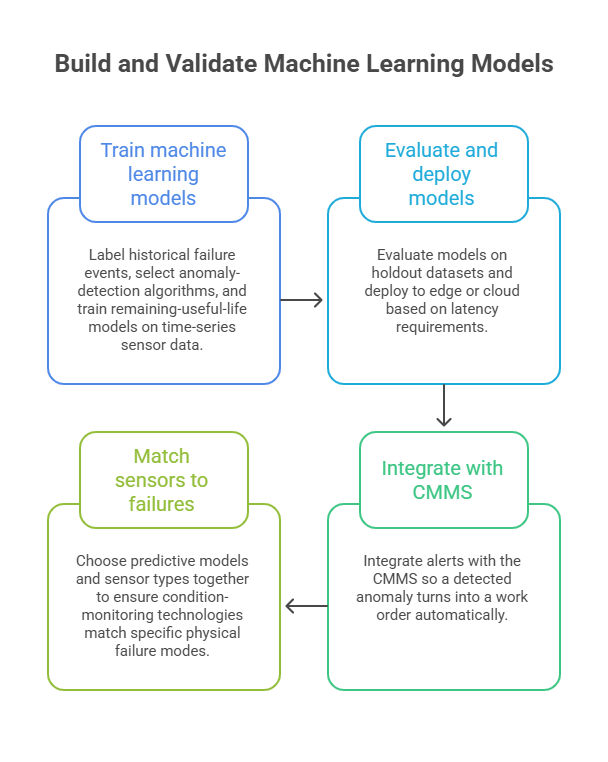
With clean historical data in hand, label historical failure events, select anomaly-detection machine learning algorithms suited to the failure modes you are targeting, and train remaining-useful-life models on time-series data drawn from real time sensor data streams. AI analyzes historical data to forecast failures by learning the patterns that preceded past breakdowns, and machine learning improves accuracy over time as more labeled events feed back into the model.
Evaluate the models on holdout datasets the model has never seen, deploy to edge or cloud depending on latency requirements, and integrate alerts with the CMMS so a detected anomaly turns into a work order automatically. Condition-monitoring technologies should match specific physical failure modes: a vibration sensor will not catch a lubrication problem, and a thermal camera will not catch a bearing imbalance. Choosing predictive models and sensor types together, rather than bolting one onto the other, is what separates programs that detect anomalies reliably from ones that generate noise. InTechHouse covers this in more depth in its guides to predictive maintenance with machine learning and remaining useful life estimation.
Before the pilot goes live, perform a failure mode and effects analysis (FMEA) for each prioritized asset, and document the common failure modes and their triggers. This step turns raw predictions into practical maintenance tasks: create targeted maintenance tasks based on what the models are predicting, update spare-parts inventory management to reflect the failure modes you now expect, and adjust preventive schedules using prediction outputs instead of fixed calendar intervals.
Done well, predictive maintenance extends equipment lifespan and improves equipment reliability by preventing unexpected failures rather than by servicing equipment more often. These proactive measures, targeted tasks, adjusted schedules, updated inventory, are what convert a working model into an operational improvement. The FMEA output also becomes the reference document maintenance teams use months later, when someone asks why a particular threshold was set where it was. Once failure modes are documented, the natural next question is how much life a degrading asset actually has left. That is what remaining useful life estimation adds on top of anomaly detection, turning a warning signal into a maintenance date your planners can schedule against.
The pilot proves the model against reality before you trust it. Run it on the selected high-value assets, monitor false positives and missed detections closely, refine thresholds as real operating data comes in, and retrain models on a regular cadence rather than treating the first version as final.
Automated alerts should inform engineering teams when a monitored metric falls into a warning zone, well before it reaches a failure threshold. Integrating predictive alerts with maintenance ticketing systems is necessary for the alerts to actually change maintenance workflows; an alert nobody acts on is not worth much more than no alert at all. Track key performance indicators throughout the pilot so you have a clear, defensible answer to "did this work" before asking for budget to scale.
Once the pilot has proven itself on its initial critical assets, expand sensor coverage incrementally rather than all at once. Standardize the data architecture so new asset classes plug into the same pipeline instead of each requiring custom integration work, publish APIs so other systems (ERP, MES, existing systems already in use on the plant floor) can consume predictive maintenance systems output, and roll out standardized alert handling so every site follows the same escalation logic.
A centralized platform is needed at this stage to aggregate real-time operational data and equipment data across sites; without one, each plant tends to reinvent its own version of the pilot, and the maintenance schedules never converge into a single, comparable dataset. InTechHouse's overview of industrial IoT architecture walks through what that centralized layer typically looks like.
Read also:
The program fails without an owner and trained crews. Secure executive sponsorship early, since predictive maintenance touches operations, IT, and finance budgets, and it needs someone with authority across all three. Assign an owner for asset reliability who is accountable for the program's outcomes, not just its rollout, and allocate a recurring analytics budget rather than a one-time capital line, since models need retraining and sensors need maintenance of their own.
Train maintenance crews on the new workflows before go-live, not after. Training personnel on sensor diagnostics is essential for effectiveness: a technician who does not trust or understand an alert will often ignore it, no matter how accurate the underlying model is. Getting resource allocation right here, meaning enough technical expertise on staff or on contract to keep the models current, is what separates programs that optimize resource allocation over time from ones that stall after the initial pilot.
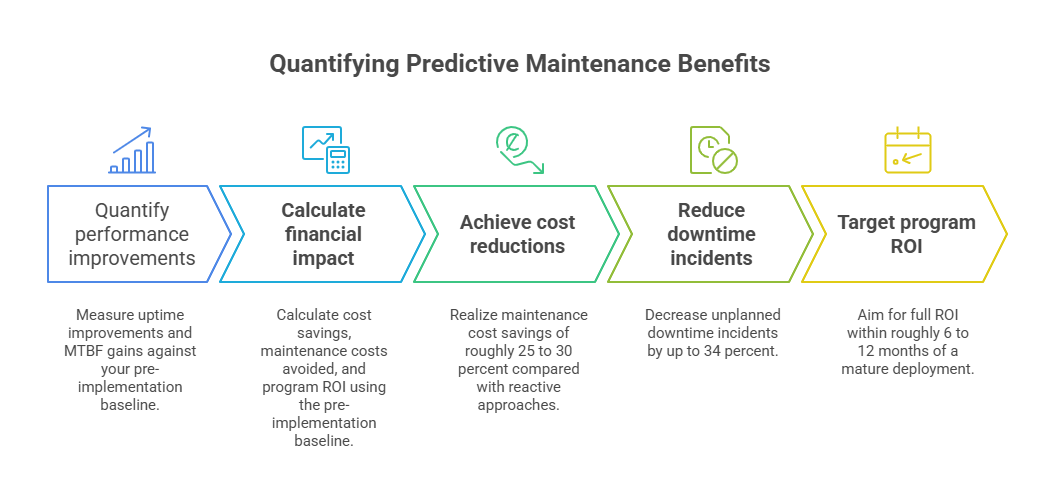
Quantify uptime improvements and MTBF (mean time between failures) gains against your pre-implementation baseline, and calculate cost savings, maintenance costs avoided, and program ROI using the same baseline. The benefits of predictive maintenance are well documented, though the exact figures vary by industry and by how mature the program is.
The U.S. Department of Energy has reported maintenance cost reductions of roughly 25 to 30 percent from well-run predictive maintenance programs compared with reactive approaches (DOE, 2019). MaintainX's 2024 customer data shows a similar range, with organizations reporting maintenance cost savings of about 25 to 30 percent and up to 34 percent fewer unplanned downtime incidents (MaintainX, 2024). Beyond direct cost savings, IoT predictive maintenance minimizes unplanned downtime, extends equipment lifespan, and enhances workplace safety by catching degrading conditions before they become failure events. Many organizations set an internal target of full ROI within roughly 6 to 12 months of a mature deployment, though this depends heavily on the criticality and failure cost of the assets included (MaintainX, 2024).
Choose sensors matched to failure modes rather than defaulting to whatever is easiest to install. Set data-retention rules early, since model retraining depends on having enough historical depth, and verify sensor-calibration schedules regularly; a drifting sensor produces a drifting baseline, and a drifting baseline produces false alerts.
The four condition-monitoring techniques that cover most industrial failure modes, and give the clearest picture of overall equipment health, are: vibration analysis, which detects mechanical failures such as imbalance, misalignment, and bearing wear, and is the standard way to monitor rotating equipment; oil analysis, which monitors lubricant condition and picks up contamination or wear metal before a mechanical failure follows; thermography, which identifies overheating components in electrical and mechanical systems alike; and acoustic analysis, which detects anomalies by sound, often catching issues like air or steam leaks that other methods miss.
Predictive maintenance models are not a "set it and forget it" system. Implement a feedback loop for model retraining, review KPIs monthly rather than quarterly so drift gets caught early, and conduct root-cause analysis after every failure the model missed, not just the ones it caught, so the team can identify patterns it wasn't yet trained to see.
Governance decisions matter here too: decide the data-ownership model between IT, OT, and maintenance teams, choose edge versus cloud deployment based on latency and connectivity constraints, and document security and access controls before scaling, not after. Continuous improvement involves refining sensor placements as you learn where the highest-value data actually comes from, and adjusting thresholds as equipment ages and operating conditions shift. InTechHouse's guide to edge MLOps covers the operational side of keeping models current once they are running in production.
InTechHouse case study: predictive maintenance rollout for a public transport manufacturer
InTechHouse worked with a public transport manufacturer to design a predictive maintenance program for fleet-critical subsystems. Critical assets were selected jointly with the manufacturer's maintenance team, based on failure cost and passenger safety impact, and historical maintenance logs were combined with new condition-monitoring sensor data to establish operating baselines. The team built anomaly-detection and remaining-useful-life models trained on that combined dataset, then validated them through a pilot on a subset of the fleet before wider rollout. The pilot's alerts were integrated directly into the manufacturer's maintenance ticketing workflow, and the program was scaled to additional fleet subsystems after the pilot demonstrated a measurable reduction in unplanned maintenance events, within the operator's required reliability tolerance.
Plan to iterate on the pilot for about three months before making a scale decision. That window is usually enough to see the model's alerts tested against real operating conditions and to refine thresholds based on actual false positives and missed detections. Once the pilot has proven ROI on its initial assets, expand to the next asset tier rather than jumping straight to plant-wide coverage, and institutionalize the continuous improvement process described above so the program keeps working after the initial excitement fades.
Ready to turn this plan into a working predictive maintenance program? Talk to InTechHouse about implementing predictive maintenance, or explore how InTechHouse's industrial data platforms and OT/IT integration services support the data layer this kind of program depends on.
We have taken predictive maintenance programmes from three assets to full production lines, including integration with CMMS and ERP. See how the rollout is structured and measured.
See how we scale PdM from pilot to plant
Not sure where to start? We work with companies at every stage, from early ideas to enterprise-level builds. A 30-minute call can save you months of guesswork.
You start by identifying critical assets based on failure cost and production impact, then collecting historical maintenance and sensor data to establish operating baselines. Only after that data foundation is in place should you begin building and validating models, which then get tested through a contained pilot before any wider rollout.
A typical pilot runs for about three months once data collection and model training are complete, though the full process, including asset selection, data collection, and baseline-setting beforehand, usually spans several months total. Full-scale rollout across a plant or fleet takes longer and depends on how many asset classes are involved.
Most predictive maintenance programs start with at least six months of historical data covering both normal operation and any past failure events. More history generally improves model reliability, particularly for failure modes that develop slowly or occur infrequently.
Start with a small set of 3 to 5 critical assets chosen by failure cost and production impact rather than ease of implementation. The 80/20 rule is a useful guide here, since a relatively small share of equipment usually accounts for most unplanned downtime and maintenance spend.
Predictive maintenance integrates with a computerized maintenance management system by routing model-generated alerts directly into the CMMS as work orders, so a detected anomaly triggers the same maintenance workflow a technician would otherwise create manually. This integration is what turns a predictive model from a monitoring dashboard into an operational maintenance tool.
Damian Ledziński, PhD Eng., is an Applied Artificial Intelligence Expert and an Assistant Professor at Bydgoszcz University of Science and Technology. He has over 15 years of academic, research, software-engineering, and technology-development experience.
His work focuses on applying artificial intelligence, machine learning, deep neural networks, and data science to complex real-world systems. His principal research and engineering interests include autonomous unmanned aerial vehicles, drone navigation and swarm intelligence, biomedical engineering, medical signal and image analysis, predictive modeling, industrial IoT, and intelligent water-management systems.
Damian has contributed to multidisciplinary R&D initiatives including AI-assisted medical diagnostics, a Polish ventilator prototype, autonomous indoor drone systems for warehouse inventory, AI-supported water-consumption analysis, virtual medical assistants, and intelligent systems combining embedded devices with machine-learning models.
He is the author or co-author of more than 30 scientific publications. His work has appeared in international scientific publications covering artificial intelligence, biomedical engineering, signal analysis, autonomous systems, environmental monitoring, and data-driven infrastructure.
Damian is a co-creator of academic programs in Engineering in Medicine, AI in Medicine, and Data Science at Bydgoszcz University of Science and Technology. He combines scientific research with hands-on implementation, translating experimental AI methods into deployable technology. He writes about applied AI, machine learning, predictive analytics, autonomous UAV systems, AI in medicine, biomedical signal processing, industrial IoT, and intelligent models in real-world systems.
Damian Ledziński's academic profiles:
https://wtie.pbs.edu.pl/pl/pracownik/damian-ledzinski
https://www.researchgate.net/profile/Damian-Ledzinski
https://scholar.google.pl/citations?user=AlQpPB0AAAAJ&hl=pl
https://ludzie.nauka.gov.pl/ln/profiles/DN6pHXU6KZm/publications/f83a8833-6060-4fae-8628-3dbf57661394
This initial conversation is focused on understanding your product, technical challenges, and constraints.
No sales pitch - just a practical discussion with experienced engineers.
Share a few details about your product and context. We’ll review the information and suggest the most appropriate next step.