
Predictive Maintenance vs Preventive Maintenance: Which Is Right?
.avif)
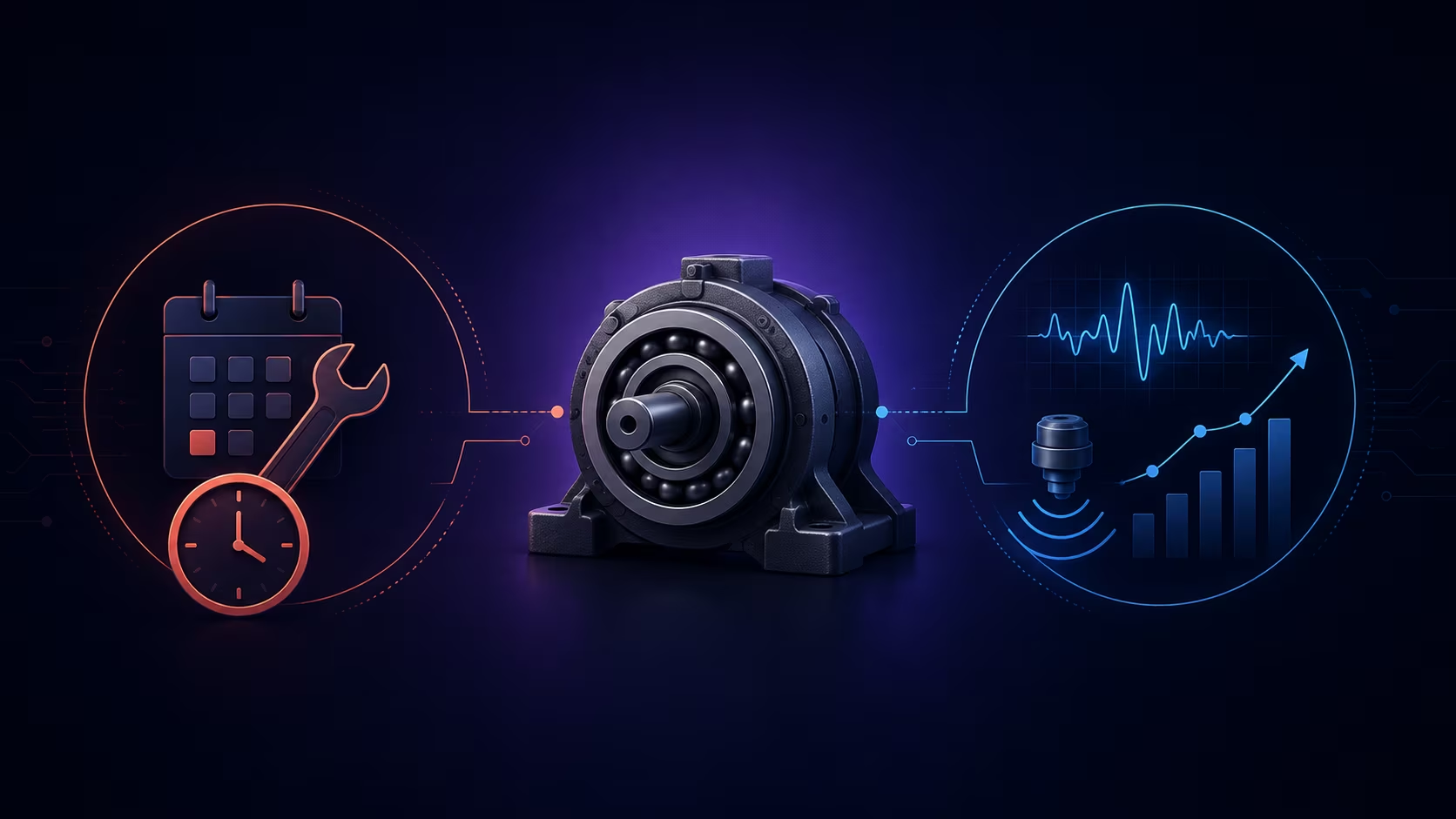
Preventive maintenance services equipment on a fixed schedule. Predictive maintenance services it based on real condition data. That single difference, time versus condition, decides almost everything else: predictive usually wins on cost and uptime for critical, high-value assets, while preventive stays simpler and cheaper to run for predictable, low-risk ones. Most operations end up combining the two rather than picking a single winner.
Plant managers benefit most from preventive vs predictive maintenance decisions when assets are numerous, low-cost, and fail in predictable ways (HVAC units, standard motors, conveyor rollers), those are the ones best left on routine maintenance. Reliability engineers lean on predictive maintenance when a single failure is expensive, dangerous, or hard to reach, think turbines, rail bogies, or offshore equipment. The trigger is what separates them: preventive fires on a calendar or usage counter, predictive fires when sensor data crosses a threshold that signals real wear.
Key Takeaways
- Trigger is the core difference. Preventive maintenance follows fixed intervals; predictive maintenance uses real-time data from sensors to decide when service is actually needed.
- Cost profile differs by horizon. Preventive maintenance typically cuts costs by 12 to 18 percent over reactive maintenance (U.S. Department of Energy, FEMP), while predictive maintenance can reduce maintenance costs by 18 to 25 percent and cut unplanned downtime by as much as 50 percent (McKinsey & Company, 2020).
- Predictive needs more setup. Sensors, analytics, and skilled staff raise the entry cost and stretch implementation to 12 to 18 months before most teams see full payback.
- Preventive wastes some material. Fixed-interval servicing often replaces parts that still have useful life left, a cost predictive maintenance avoids by servicing only when data shows real need.
- A hybrid strategy is the strongest default. Layer predictive on your most critical assets, keep preventive for predictable, low-risk equipment, and let the rest run to failure.
How Predictive Maintenance Works
Predictive maintenance uses sensor data, data analysis, and analytics to estimate when an asset will actually need service, rather than assuming it needs service on a fixed date. Predictive maintenance relies on three layers working together: sensors that capture vibration, temperature, or pressure data, analytics that turn that data into a health score, and a CMMS that turns the health score into alerts and work orders, which is how predictive maintenance work gets triggered.
Three strengths stand out. First, it targets work precisely, technicians act on components that actually show wear instead of servicing everything on schedule. Second, it protects uptime by catching equipment failures before they cause stoppage. Third, it replaces intuition with data-driven decisions, so maintenance budgets go toward assets that need them.
Predictive maintenance uses real-time data from IoT sensors, which makes it the natural fit for high-cost or safety-critical assets where a single failure carries a large financial or safety cost. It also helps extend asset life and equipment life, since parts stay in service until data shows genuine degradation rather than being swapped on a fixed date. That same characteristic makes it well suited to assets in remote or hard-to-reach locations, where sending a technician for a routine check is expensive and continuous condition monitoring cuts unnecessary site visits.
The answer is usually a split, not a winner. We rank your assets by failure cost and data availability, then tell you which ones justify sensors and which stay on a calendar.
Decide which assets deserve predictive coverage
How Preventive Maintenance Works
Preventive maintenance refers to servicing equipment at fixed, scheduled intervals, based on calendar time, run hours, or equipment usage, regardless of the asset's actual condition at that moment. Typical triggers include monthly calendar checks, a set number of operating hours, or regular intervals defined directly in the manufacturer's service manual.
Three strengths make it durable as a default strategy. It is simple to plan and budget for, since the schedule is fixed well in advance. It produces predictable maintenance windows that operations teams can build production schedules around. And it requires minimal setup, no sensors, no analytics platform, just a preventive maintenance program built around scheduled tasks.
Preventive maintenance is scheduled at fixed intervals and has been used in some form since the late 1950s, when the aviation industry began formalizing fixed-interval overhauls in response to reliability concerns raised by U.S. regulators (Reliability Academy, 2025). It significantly reduces the likelihood of catastrophic failures on equipment with well-understood wear patterns, and it remains highly effective for assets with predictable failure curves, where common preventive maintenance tasks on bearings, filters, and belts are easy to standardize. Its main drawback is over-maintenance: because service happens on a schedule rather than a condition trigger, some interventions replace parts that still have plenty of useful life left, even though this scheduled approach can still improve asset lifespan when wear patterns are stable.
Side-by-Side: Key Differences
The table below lays out the key differences that matter most when choosing between the two.
| Dimension | Preventive Maintenance | Predictive Maintenance |
|---|---|---|
| Trigger | Fixed schedule (calendar, hours, OEM interval) | Real-time condition data crossing a threshold |
| Required Technology | Checklist, basic CMMS | Sensors, analytics platform, CMMS integration |
| Setup Complexity | Low, deployable in weeks | High, typically 12 to 18 months to full deployment |
| Maintenance Costs | Reduces costs 12 to 18 percent vs. reactive (DOE FEMP) | Reduces costs 18 to 25 percent vs. reactive (McKinsey, 2020) |
| Labor and Material Costs | Higher parts waste from early replacement | Lower waste, parts changed only when data warrants it |
| Asset Reliability | Strong for predictable failure patterns | Strong for complex, high-variability failure modes |
The one-line takeaway: preventive maintenance follows a fixed schedule regardless of condition, while predictive maintenance uses real-time data to determine actual maintenance needs, and that extra precision comes at the price of a higher initial investment.
Maintenance Costs and ROI
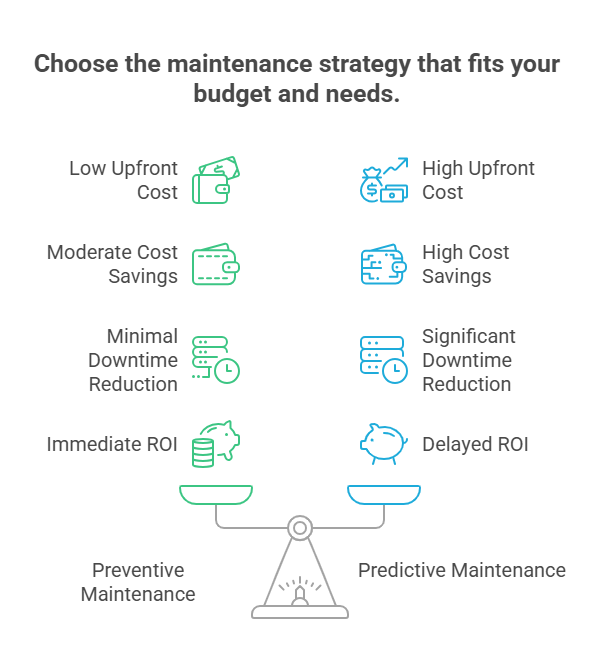
Preventive maintenance can reduce maintenance costs by 12 to 18 percent compared with reactive, run-to-failure approaches (U.S. Department of Energy, Federal Energy Management Program). It requires almost no upfront capital, a checklist and a CMMS license cover most of the cost, so payback starts almost immediately, and one of the core preventive maintenance benefits is avoiding costly repairs through planned service.
Predictive maintenance carries a steeper upfront cost: sensor hardware, an analytics platform, and integration work typically push the initial investment into a 12 to 24 month implementation timeline before an operation sees full value. In exchange, predictive maintenance can achieve 25 to 30 percent cost savings over reactive maintenance and reduce downtime by 20 to 40 percent, with fewer emergency repairs and lower failure risk; some industry studies cite reductions as high as 35 to 50 percent depending on asset type and sensor coverage (McKinsey & Company, 2020; U.S. Department of Energy O&M Best Practices). The spread between studies reflects differences in asset criticality and how mature the sensor deployment is, not a flaw in the underlying strategy.
The market trajectory backs the direction of investment: the global predictive maintenance market is projected to reach 70.73 billion dollars by 2032, up from roughly 13.65 billion dollars in 2025 (Fortune Business Insights, 2024).
Verdict: predictive wins on lifecycle cost for critical assets, where downtime or failure cost outweighs the sensor investment, delivering lower maintenance costs over asset life. Preventive stays the more cost effective, lower-setup choice everywhere else.
Implementation Effort and Management
Predictive maintenance is complex and technology-intensive. It requires skilled personnel who can interpret sensor data, tune alert thresholds, and translate a health score into an actual work order, with many teams now also building machine learning capability for more advanced predictive programs. That skills gap is closing fast: 65 percent of maintenance teams plan to incorporate AI into their maintenance management by the end of 2026 (MaintainX, State of Industrial Maintenance, 2026), which signals how quickly the technical expertise bar is expected to normalize.
Preventive maintenance management, by contrast, needs almost no specialized technical expertise. A technician who can read a checklist and log a service date can run the program, because it relies on maintenance practices based on schedules rather than condition signals. That is precisely why most maintenance teams still lean on preventive maintenance as the default and add predictive coverage only where the payoff clearly justifies the added implementation effort, the sequencing our roadmap for predictive maintenance in manufacturing recommends.
Verdict: preventive wins for ease of setup, predictive wins for long-run efficiency once the right maintenance strategy and skill set are in place. For a step-by-step rollout plan, see how to implement predictive maintenance.
Read also:
- What Is Predictive Maintenance? A Practical Guide
- Essential Guide to Building Preventive Maintenance
- Understanding Risk Based Maintenance: A Practical Approach for Success
Labor and Material Costs
Preventive maintenance may replace parts still in good condition, a direct form of unnecessary maintenance that shows up as wasted spare parts spend and technician hours spent on work that did not need to happen yet. Predictive maintenance services only when sensor data shows a genuine need, which keeps spare parts inventory leaner and frees labor hours for work that actually prevents failure rather than work performed on autopilot.
Verdict: predictive wins on labor and material efficiency, provided the sensor and analytics investment is already in place. Where it is not, the fixed, predictable labor and material costs of preventive maintenance are easier to plan around.
Condition Monitoring: Where Predictive Adds Value
Predictive maintenance relies on sensors and advanced analytics using operational data to build an ongoing picture of asset health rather than a single snapshot taken at a scheduled visit. The most common condition-monitoring methods include vibration analysis for rotating equipment, oil analysis for gearboxes and hydraulics, infrared thermography for electrical panels and motors, and acoustic monitoring for leaks and bearing wear. Predictive maintenance focuses on turning these streams into forward-looking maintenance decisions for strategic assets with high downtime impact.
Each method feeds continuous data into the same core loop: capture a signal, compare it against a healthy baseline, and flag deviation before it becomes unplanned downtime. Verdict: condition monitoring is where predictive maintenance earns its reliability advantage, since it catches degradation patterns a fixed inspection schedule would miss and helps reduce machine downtime.
Condition-Based vs Predictive: Clarify the Terms
Condition-based maintenance triggers a service action the moment a monitored value crosses a defined threshold, a temperature spike, a vibration reading past a set limit, an oil analysis result outside spec. It reacts to the present state of the asset.
Predictive maintenance goes a step further. It uses that same condition-based monitoring stream, plus historical data and analytics, to forecast when a failure is likely to occur, not just detect that a threshold has already been crossed. In practice, a condition based system might alert on today's vibration reading; a predictive system uses the trend in that data to estimate asset health weeks in advance. Condition based maintenance and predictive maintenance overlap heavily in the sensors they use, but use "condition-based" when describing a reactive threshold, and "predictive" when describing a forecast built from real time data and trend analysis over time.
The Hybrid Answer: Combine Both
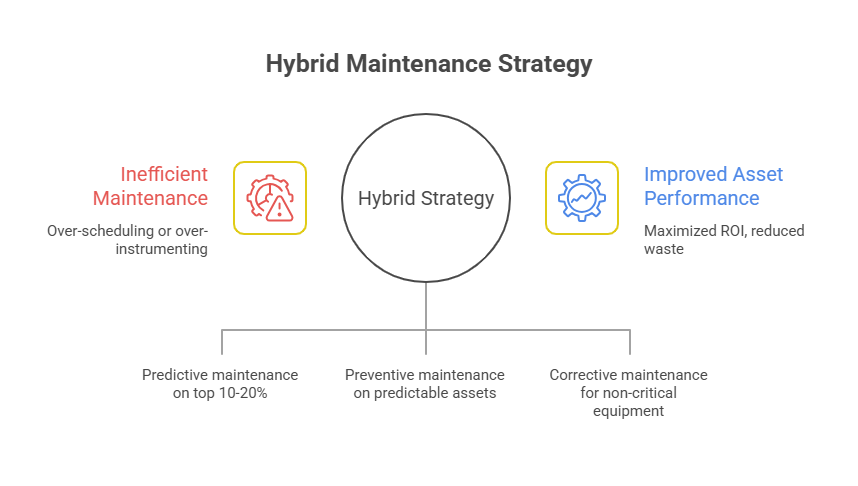
Neither strategy on its own is the honest recommendation for most operations, a hybrid maintenance strategy that combines preventive and predictive coverage is. The practical approach layers the two by asset criticality, and it tends to improve overall asset performance faster than either strategy run alone: predictive maintenance on the top 10 to 20 percent of assets by criticality (the equipment where failure is expensive, dangerous, or hard to reach), preventive maintenance on predictable, low-risk assets, and corrective maintenance for the small tail of non-critical equipment.
A hybrid strategy is the clearest way to combine preventive and predictive approaches because it is a maintenance strategy based on asset criticality and consequence of failure: sensor investment on the assets that justify it, and simple scheduled servicing everywhere else. This allocation maximizes ROI for critical assets without forcing a costly sensor rollout across an entire fleet. Most organizations benefit from a hybrid strategy for exactly this reason, it avoids both the waste of over-scheduling low-risk equipment and the expense of over-instrumenting equipment that does not need it.
Rolling this out well takes some change management: start with a pilot and perform maintenance with predictive tools first on the assets with the clearest downtime cost, prove the ROI case with real numbers, then expand the proactive maintenance strategy fleet by fleet rather than all at once. A staged rollout also gives the maintenance team time to build the technical expertise predictive maintenance requires before it becomes mission-critical.
This tiered approach is exactly how we deploy predictive maintenance solutions - predictive on the critical 10–20% of assets, preventive everywhere else, with one monitoring layer across both.
Decision Checklist: Which Fits Your Operation
Four criteria decide the right maintenance strategy for a given asset: how critical it is to production, its failure risk, how expensive an hour of downtime is, how much budget is available for sensors and analytics, and how much in-house staffing exists to interpret condition data.
- Small operations, limited staff: default to preventive maintenance across the fleet, and consider predictive only on the one or two assets where failure would be catastrophic; lower-risk assets like HVAC systems often stay on preventive schedules.
- Mid-size operations with a handful of critical lines: run a hybrid model, predictive on bottleneck equipment, preventive everywhere else.
- Large operations with high downtime costs: invest in predictive maintenance broadly, since asset availability gains compound across many production lines and downtime costs scale with scale.
Across every size, the strongest all-around pick is a hybrid strategy weighted by asset criticality. It is decisive without being wasteful, and it scales as the operation and its maintenance strategy mature by choosing the right maintenance strategy based on those criteria.
If your checklist points toward predictive for even a handful of critical assets, our predictive maintenance services cover the full rollout - sensor selection, failure prediction models, and CMMS integration - scoped to start with your highest-risk equipment first.
InTechHouse case study: predictive maintenance for a mixed public transport fleet
A public transport manufacturer needed a maintenance program that could scale across a mixed fleet without instrumenting every vehicle from day one. InTechHouse worked with the operator to tier the fleet by criticality, mapping which subsystems (traction motors, braking components, door mechanisms) carried the highest failure cost and safety impact. Sensor-based predictive maintenance was rolled out on those high-criticality subsystems first, feeding real-time data into a condition-monitoring dashboard, while lower-risk components stayed on a preventive, fixed-interval schedule. The result was a measurable reduction in unplanned service interruptions on the instrumented subsystems, delivered within the operator's required maintenance tolerance and without a fleet-wide sensor rollout.
Once the split between the two strategies is settled, the work shifts to execution: asset ranking, sensor selection, alert thresholds and the governance that stops false alarms from eroding trust. Those steps are collected in our summary of predictive maintenance best practices.
We have layered predictive monitoring on top of existing preventive schedules without disrupting the maintenance plan already in place. Ask us how the transition is sequenced.
Build the hybrid strategy with our reliability team
Let's talk about your next move
Not sure where to start? We work with companies at every stage, from early ideas to enterprise-level builds. A 30-minute call can save you months of guesswork.
FAQ
1. What is the difference between predictive and preventive maintenance?
The difference between preventive and predictive maintenance comes down to the trigger: preventive maintenance, also commonly written as preventative maintenance, services equipment on a fixed schedule regardless of condition, while predictive maintenance uses real-time sensor data to service equipment only when it actually shows signs of wear.
2. Is predictive maintenance better than preventive?
Predictive maintenance is not universally better, it is better for critical, high-cost, or hard-to-reach assets where downtime is expensive, while preventive maintenance remains more cost-effective and easier to manage for standard, low-risk equipment.
3. Can you use predictive and preventive maintenance together?
Yes, and most mature maintenance operations do exactly that through a hybrid maintenance strategy: predictive maintenance on the most critical assets, preventive maintenance on predictable, lower-risk equipment, with many teams using predictive maintenance strategies on critical assets and preventive schedules on the rest.
4. How long does it take to switch to predictive maintenance?
A full predictive maintenance rollout typically takes 12 to 18 months from sensor deployment to measurable ROI, though a pilot on a small number of critical assets can show results faster.
5. How much does predictive maintenance cost versus preventive?
Preventive maintenance needs little upfront investment beyond a checklist and CMMS, cutting maintenance costs by roughly 12 to 18 percent versus reactive approaches, while predictive maintenance requires a larger upfront investment in sensors and analytics but can cut maintenance costs by 18 to 25 percent or more once fully deployed.
Tomasz Andrysiak, DSc, PhD
Tomasz Andrysiak, DSc, PhD, is an Expert and a Professor at Bydgoszcz University of Science and Technology. He has more than 30 years of academic, research, R&D, and technology-implementation experience in artificial intelligence, computational intelligence, signal processing, anomaly detection, cybersecurity, and complex information systems.
His research focuses on machine-learning and computational-intelligence methods for analyzing signals, time series, network traffic, industrial data, and multimodal datasets. He specializes in anomaly and failure detection, predictive modeling, intelligent monitoring, critical-infrastructure security, smart metering, biomedical signal analysis, and the practical deployment of AI in industrial and public-sector systems.
Tomasz is the author or co-author of more than 75 scientific publications, including papers published in internationally recognized journals and conference proceedings indexed by Web of Science and Scopus. His research has covered network anomaly detection, cybersecurity of critical infrastructure, ECG signal analysis, machine learning, smart water networks, telecommunications, and intelligent industrial systems.
He has led and contributed to national and European R&D programs focused on cyber situational awareness, critical-infrastructure resilience, autonomous systems, Big Data, intelligent water management, blockchain-based transaction platforms, and industrial AI. He leads industrial-doctorate projects involving AI-based CMDB automation and machine-learning methods for knowledge discovery in Big Data.
Tomasz is an IEEE Senior Member and has served as an elected member of the Commission of Informatics and Automation of the Polish Academy of Sciences, Poznań Branch. He has participated in scientific committees and journal boards, supervised doctoral research, reviewed publications for international journals, and co-authored patents and patent applications related to signal detection and LoRa-based ECG monitoring. He writes about industrial AI, machine learning, anomaly detection, predictive analytics, cybersecurity, signal processing, time-series analysis, and intelligent infrastructure.
Tomasz Andrysiak's academic profiles:
https://orcid.org/0000-0001-8138-6619
https://ludzie.nauka.gov.pl/ln/profiles/fHOpojQ2lIF
https://link.springer.com/chapter/10.1007/978-3-642-32384-3_28
https://www.researchgate.net/profile/Tomasz-Andrysiak
https://scholar.google.com/citations?user=RHW7zx4AAAAJ&hl=pl
https://dblp.org/pid/41/6793.html
https://radon.nauka.gov.pl/dane/profil/6FFA1E51186802ECFFB49644209B5BE0EBD68C55
https://pbs.edu.pl/pl/pracownik/tomasz-andrysiak
https://www.youtube.com/watch?v=6e1GTqT5czM
Let's talk about your next project
From first prototype to production, our engineers can help you scope it, build it and get it certified.






Discuss your product with our R&D team
This initial conversation is focused on understanding your product, technical challenges, and constraints.
No sales pitch - just a practical discussion with experienced engineers.
Share a few details about your product and context. We’ll review the information and suggest the most appropriate next step.