Predictive maintenance in oil and gas uses sensor data and machine learning to predict equipment failures before they happen, across drilling, pipelines, refineries, and rotating equipment, cutting unplanned downtime and improving safety. This guide covers oil and gas predictive maintenance use cases across each of those operation types, then walks through how to actually implement a program rather than just listing what is theoretically possible.
In a capital-intensive, safety-critical industry, predicting failures protects both production and people, which is why predictive maintenance has become standard practice across much of the oil and gas sector faster than in many other industries.
Predictive maintenance reduces unplanned downtime significantly and can save operators millions in lost production, since unplanned downtime in the oil and gas industry costs hundreds of thousands of dollars per hour on average, a figure that can exceed tens of millions of dollars per year for a single major outage (IBM). Beyond the direct cost of downtime, predictive maintenance extends the life of critical assets that are expensive and slow to replace, drilling rigs, compressor trains, and refinery equipment routinely represent capital investments in the tens or hundreds of millions of dollars. It also enhances safety by predicting hazardous conditions before they escalate, catching the kind of equipment degradation, a corroding pipeline, an overheating compressor bearing, that can turn into a safety incident rather than just a maintenance one.
Priority assets for monitoring tend to cluster around rotating equipment and pressure-containing systems, since those are where both operational efficiency losses and safety consequences concentrate. Top regulatory and safety drivers include occupational health and safety requirements, environmental protection obligations tied to leak prevention, and the operational pressure to avoid the cost savings lost to unplanned outages in the first place.
Mapping common failure modes by operation type clarifies where predictive maintenance delivers the most value first. Starting with the highest-value failure modes is itself one of the predictive maintenance best practices that hold across industries.
| Operation Type | Common Failure Modes | Highest-Value Monitoring Targets |
|---|---|---|
| Drilling | Drill bit wear, top drive failure, mud pump wear | Torque, vibration, and mud-system sensors |
| Pipeline Transport | Corrosion, leaks, pressure anomalies | Pressure sensors and pipeline integrity monitoring |
| Refining | Heat exchanger fouling, turbine and generator vibration | Thermal and vibration sensors on critical rotating equipment |
| Pumps and Compressors | Bearing wear, cavitation, valve degradation | Vibration and acoustic sensors |
| Storage and Facilities | Tank pressure loss, leak development | Continuous pressure and acoustic monitoring |
Across oil and gas operations, data from SCADA systems and IoT sensors gets combined to assess equipment health, and predictive analytics helps target the highest-risk use cases within that broader picture rather than trying to monitor everything with equal intensity from day one. Early fault detection is what separates the highest-ROI use cases from the rest: critical rotating equipment has the highest ROI from predictive maintenance industry-wide, largely because rotating assets fail in ways vibration analysis catches early and reliably, and because their failure modes are well understood enough that models trained on them tend to perform well quickly.
Drilling rigs monitor torque and vibration to predict failures of drill bits and top drives, catching the gradual wear patterns that precede a costly downhole failure. Sensor placement on rotary systems and mud systems needs to capture both the mechanical stress on the drill string and the condition of the mud circulation system that keeps the whole operation running, since a mud-system failure can be just as disruptive as a mechanical one.
Predictive maintenance prevents costly non-productive rig time, which on an offshore or high-day-rate rig can represent one of the largest controllable cost categories in the entire drilling operation. Drill corrosion detection prevents expensive repairs by catching material degradation before it compromises structural integrity, and given that drilling rigs cost millions and require effective lifespan management, even modest improvements in early detection translate into meaningful capital preservation over a rig's operating life. A remaining-useful-life model trained on torque and vibration sensor data works well here, since drill bit wear tends to follow a fairly predictable degradation curve that machine learning can learn from historical drilling runs.
Pipelines span hundreds of miles and require monitoring for integrity and environmental safety, which makes them one of the more logistically demanding predictive maintenance use cases in the industry simply because of the distances involved.
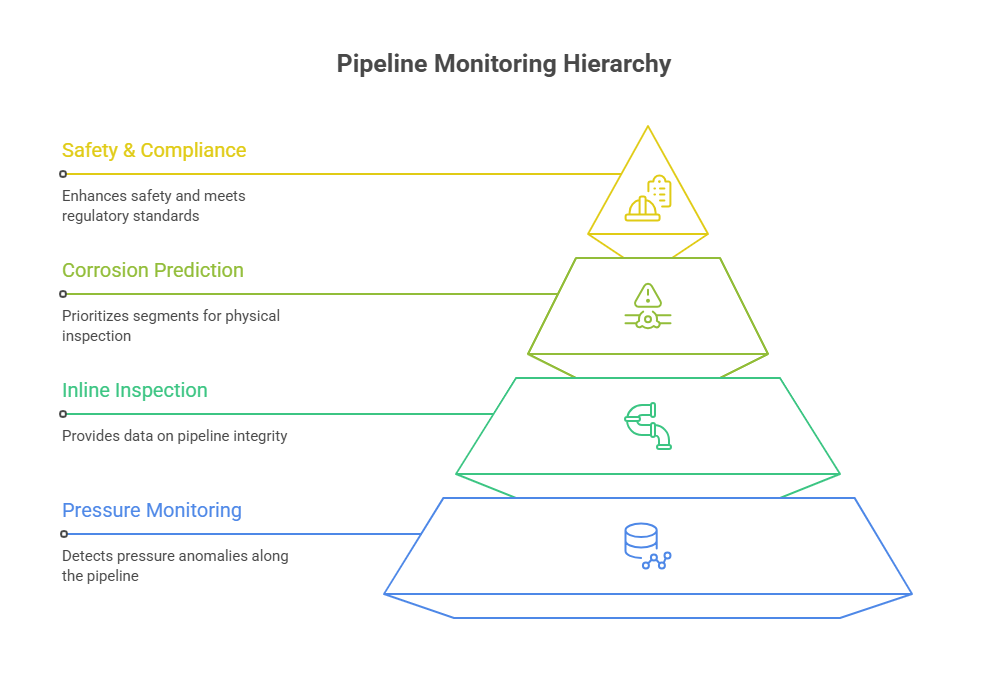
A leak-detection sensor strategy typically combines pressure monitoring along the pipeline's length with periodic or continuous inline inspection data, watching for the pressure-anomaly patterns that indicate a developing leak before it becomes a visible one. Defining clear pressure-anomaly alert criteria matters here specifically, since crude oil pipelines operate across varying elevation and flow conditions that can produce pressure readings that look anomalous but are actually normal for that specific segment. Corrosion prediction models, trained on historical inspection data alongside real time data on flow rate, pressure, and known pipe age and material, help prioritize which segments need physical inspection first rather than treating the entire pipeline uniformly.
Pipeline monitoring prevents costly repairs and improves safety at the same time, and it is one of the clearer cases in the industry where predictive maintenance directly supports regulatory compliance rather than being a separate operational initiative.
Refineries concentrate some of the industry's highest-value rotating and thermal equipment in a single facility, which makes asset-performance monitoring here particularly high-stakes.
Heat exchangers are monitored for fouling to schedule cleaning before efficiency drops, since fouling develops gradually and a remaining-useful-life model can predict the point at which cleaning becomes more economical than continuing to run a degraded exchanger. Monitoring turbine and generator vibration ensures operational efficiency across the power and process systems that keep a refinery running, and identifying which rotating assets to prioritize for this kind of monitoring should follow the same criticality-ranking logic used across the rest of the facility. Advanced analytics can predict equipment failures before they occur across this equipment mix, but the specific thresholds for early-failure alerts need to be set per asset class, since a heat exchanger's normal operating drift looks nothing like a turbine's.
Vibration analysis is the most common method for pump condition monitoring, and for good reason: bearing wear, misalignment, and cavitation all produce distinctive vibration signatures that a well-tuned model catches reliably, often showing early signs of an asset failure weeks before it would otherwise become apparent.
Acoustic monitoring adds a complementary layer, particularly for cavitation detection in pumps, since cavitation produces a characteristic sound signature before it shows up clearly in vibration data. Acoustic sensors also track internal valve performance in compressor stations to prevent pressure drops, catching valve degradation before it affects downstream process pressure. For electrical submersible pumps specifically, monitoring extends to motor current, pressure, and temperature together, since these pumps operate downhole where physical inspection is impractical and sensor data is often the only window into actual condition. Wireless vibration and temperature sensors monitor downhole and surface motor conditions in these applications, feeding data back to the surface without requiring a hardwired connection through the wellbore.
Setting a vibration baseline for compressor bearings early in a monitoring program, and scheduling automated inspection triggers from anomalies against that baseline, is what turns raw sensor data on this equipment into an actual early-warning system rather than a data feed nobody reviews.
Storage tanks use continuous monitoring for pressure and acoustic changes to prevent leaks, extending the same sensing logic used on pipelines and compressors to static storage assets. Tank pressure monitoring helps avoid production interruptions that would otherwise occur if a developing leak or structural issue went undetected until a scheduled inspection caught it.
Facility-level monitoring at storage sites and gas plants benefits from the same proactive measures as the rest of the operation: defined alert thresholds, clear escalation paths, and a maintenance team that trusts the sensor data enough to act on it before a minor pressure deviation becomes one of the safety incidents that regulatory bodies and insurers scrutinize most closely. Minimizing downtime at storage facilities also has a knock-on effect across the broader supply chain, since a tank taken offline unexpectedly can disrupt scheduling well beyond the facility itself.
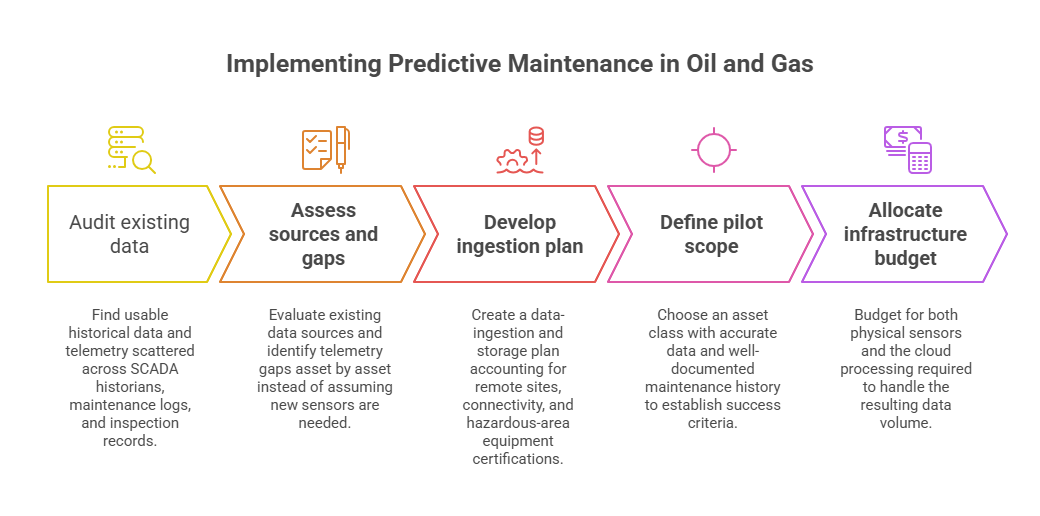
Start by finding out what data you already have, since most operators are sitting on more usable historical data and telemetry than they initially realize, scattered across SCADA historians, maintenance logs, and inspection records that were never consolidated for this purpose.
Assess existing data sources and identify telemetry gaps asset by asset, rather than assuming every facility needs new sensors installed before a step-by-step predictive maintenance implementation can begin. Develop a data-ingestion and storage plan that accounts for the specific challenges of oil and gas environments: remote sites with limited connectivity, hazardous-area equipment certifications for any new sensor hardware, and the sheer geographic spread of assets like pipelines. Define pilot scope and success criteria before deployment starts, choosing an asset class where accurate data already exists and maintenance history is well documented, since a pilot built on incomplete data undermines confidence in the entire program regardless of how good the eventual model turns out to be. Allocate budget for both sensors and the cloud processing that will handle the resulting data volume, since underestimating the data infrastructure side of the budget is one of the most common reasons pilots stall midway through. For the data architecture this depends on, see our guide to industrial DataOps, and for the OT/IT integration work connecting new sensors to existing systems, see our guide to OT/IT integration.
Inventorying existing telemetry sources comes before specifying any new sensors, since data from SCADA and IoT sensors are combined to assess equipment health, and a surprising amount of that data may already exist in a historian nobody has connected to a modeling pipeline.
For gaps that new sensors need to fill, temperature, vibration, and pressure remain the three core sensor types across nearly every use case described above, with advanced sensors, acoustic, current, and specialized corrosion sensors, layered in for specific failure modes. Accurate data matters more here than sensor count: a smaller set of well-placed, well-calibrated condition monitoring sensors on a critical asset beats a larger set of poorly maintained sensors spread thin across less important equipment.
Condition monitoring often runs at the edge near the asset, particularly for remote oil and gas sites where a round trip to a distant cloud region is impractical or where connectivity cannot be guaranteed at all times. An edge-to-cloud data pipeline typically processes raw sensor data locally, filtering and pre-aggregating it before forwarding a manageable stream to the cloud for deeper analysis and long-term storage.
Choosing an AI framework for model deployment depends heavily on where inference needs to happen: lightweight models suited to edge hardware for time-sensitive alerts, and more computationally intensive models running centrally for tasks like fleet-wide pattern detection across many similar assets. Artificial intelligence and advanced analytics only create value once predictions are integrated with maintenance workflows, which means the architecture decision has to account for how an alert reaches a technician, not just how accurately a model performs in testing. Real time data flowing through this pipeline needs the same security and access controls as any other operational system, particularly given how much of oil and gas infrastructure qualifies as critical infrastructure under regional regulation. For the fuller architecture pattern, see our guide to industrial IoT architecture, and for how models get deployed and maintained once live, see our guide to edge MLOps.
Predictive maintenance software in this space needs to handle both the edge and cloud sides of that architecture coherently, rather than treating them as separate products bolted together after the fact.
Prove the model against known past failures before you trust it, which means running a pilot on a single asset class where implementing predictive maintenance can be validated against a documented failure history rather than tested blind.
Validate models against historical failures specifically, checking whether the anomaly score or predicted remaining useful life would have flagged each known past failure with enough lead time to have made a difference. Document pilot metrics carefully for the scale decision: asset performance improvements, false-positive rates, and the operational excellence gains the maintenance team actually experienced day to day, not just the technical accuracy figures a data science team would report internally. A pilot that performs well on paper but that the maintenance team does not trust in practice is not ready to scale, regardless of its validation metrics.
Compressor trains, mud pumps and refinery turbines are where downtime and safety risk concentrate. We scope a pilot on one asset class, prove the model against your failure history, then scale it across the site.
Start with the rotating equipment that is costing you most
Supervised approaches classify known failure types using labeled historical examples, which works well for the well-documented failure modes common across drilling, pumps, and compressors. Unsupervised approaches detect anomalies without labeled failure data, which suits newer assets or less common failure modes where enough labeled history has not yet accumulated.
Feature engineering for vibration signals typically extracts frequency-domain features that correspond to specific mechanical faults, bearing defect frequencies, misalignment harmonics, rather than relying on raw time-domain vibration amplitude alone. Machine learning algorithms correlate trends in operational data to predict asset life, and artificial intelligence layered on top of that correlation work increasingly extends into remaining-useful-life estimation for the specific components, drill bits, heat exchangers, compressor bearings, that degrade gradually rather than failing suddenly. A model-retraining cadence tied to confirmed failures and false positives keeps predictive analytics current as equipment ages and operating conditions shift, and accurate predictions depend on that retraining discipline holding over the life of the program, not just during the initial pilot when everyone is paying close attention.
The modeling choices behind these use cases repeat across industries: supervised classifiers where labeled failure history exists, anomaly detection where it does not, and regression models where the goal is a time-to-failure estimate. Our guide to predictive maintenance with machine learning walks through model selection, training data requirements, and production deployment for each of those cases.
Predictive maintenance can save companies millions by avoiding unexpected repairs, particularly in an industry where a single unplanned outage on critical rotating equipment can cost more than an entire year of a monitoring program.
Cost savings compound across several categories: avoided emergency repair premiums, reduced non-productive time on high-day-rate assets like drilling rigs, and the extended lifespan of critical assets that predictive maintenance makes possible by catching wear before it forces early replacement. Predictive maintenance also optimizes maintenance schedules to reduce operational costs more broadly, shifting spend away from unnecessary preventive servicing and toward the specific assets that actually need attention. Overall Equipment Efficiency (OEE) is a vital KPI for tracking whether these gains are materializing in practice, since it captures availability, performance, and quality in a single metric that connects directly to the asset-performance improvements a predictive maintenance program is meant to deliver. Attribute every cost-savings claim in your own business case to your facility's specific downtime and repair-cost figures rather than relying solely on industry-wide averages, since oil and gas asset costs vary enormously by facility type and region.
Bad data breaks predictive maintenance, so data quality and sensor upkeep are non-negotiable, especially in an industry where sensors often operate in harsh environments that accelerate drift and physical damage.
Accurate data risks compound in remote or hazardous-area installations where routine sensor maintenance and calibration are harder to schedule than in a typical manufacturing plant. Plan sensor maintenance and calibration into the program from the start, treating it as an ongoing operational cost rather than a one-time setup task. Develop a contingency for false positives specifically, since an alert-fatigue problem on safety-critical equipment carries more consequence in oil and gas than in most other industries: a team that starts ignoring alerts because too many turned out to be false will eventually miss a real one. A proactive approach to both data quality and false-positive management, reviewed on a regular cadence rather than only when a problem surfaces, keeps equipment failures from slipping through a program that looks healthy on paper.
Defining leading indicators for equipment failure gives a program something concrete to track before a failure happens, rather than only measuring success after the fact.
| KPI | What It Tracks | Typical Monitoring Cadence |
|---|---|---|
| Mean Time Between Failures (MTBF) | Average operating time between unplanned failures | Monthly |
| Vibration Threshold Breaches | Frequency of readings exceeding the defined baseline | Continuous, reviewed weekly |
| Temperature and Pressure Excursions | Deviations from normal operating range | Continuous, reviewed weekly |
| False-Positive Rate | Share of alerts that did not correspond to a real developing failure | Monthly |
Setting thresholds for vibration, temperature, and pressure specific to each asset class, rather than applying one generic threshold facility-wide, is what makes these leading indicators useful. Tracking mean time between failures monthly gives a program a clear trend line to report, and monitoring equipment health this consistently is what prevents minor issues from escalating into the kind of unplanned outage a predictive maintenance program exists to avoid, supporting broader operational excellence across the facility.
Predictive maintenance helps avoid costly fines and penalties by catching the kind of equipment degradation that regulators specifically look for during inspections, before it becomes a documented violation. Non-compliance can lead to hefty fines and reputational damage in an industry where regulatory scrutiny is already high, which makes the compliance case for predictive maintenance almost as strong as the cost-savings case on its own.
Two management-system standards, among the safety standards most relevant to this industry, deserve specific mention here. ISO 45001 covers occupational health and safety management systems, providing a framework for identifying and controlling the kinds of workplace hazards that a failing piece of rotating equipment can create. ISO 14001 covers environmental management systems, relevant to the leak-prevention and emissions-control side of predictive maintenance, particularly for pipeline and storage-tank monitoring. Neither standard mandates predictive maintenance specifically, but both reward the kind of proactive hazard identification and continual improvement that a well-run predictive maintenance program naturally produces, which is why compliance teams increasingly treat these programs as supporting evidence for certification and audit readiness rather than a separate initiative entirely. Ensure safety and safe operations stay the primary framing internally even when the regulatory angle is what secures budget, since a program built around checking a compliance box tends to underperform one built around actually enhancing safety.
Read also:
A 12-month implementation roadmap for scaling predictive maintenance across an oil and gas operation typically moves through four phases: the first quarter for pilot validation and data-infrastructure buildout, the second for expanding to the next tier of critical assets, the third for refining models and alert thresholds based on real operational feedback, and the fourth for formalizing governance and planning the following year's expansion.
Assign a cross-functional implementation team spanning maintenance, IT or OT, data science, and safety or compliance, since a program that lives entirely within one department tends to stall when it needs resources or sign-off from outside that team. Schedule training for operations staff early and repeat it as the program scales, since technicians who joined after the initial rollout need the same grounding in interpreting alerts that the pilot team received. Establish model governance and continuous improvement as a standing process rather than a one-time milestone: defined retraining cadences, a clear owner for data quality, and regular reviews of false-positive rates keep the program credible years into its life, not just during the first pilot.
Maintenance teams that follow this path consistently report that operational excellence gains from predictive maintenance compound over time, as each new asset class added to the program benefits from lessons learned on the ones before it, and as predictive maintenance solutions mature from a single pilot into standard practice across the operation. Talk to InTechHouse about building an oil and gas predictive maintenance program for your assets, or explore our industrial data platforms and OT/IT integration services for the data foundation this roadmap depends on.
InTechHouse delivered a predictive maintenance program for a client's fleet of critical rotating equipment, pumps and compressors serving a continuous industrial process, where unplanned failures had previously caused costly production stops. The approach combined vibration and temperature sensor data with a remaining-useful-life model trained on the client's own historical failure and maintenance-log data, validated against confirmed past bearing and seal failures before going live. The resulting predictions were integrated directly into the client's maintenance workflow, generating prioritized work orders ahead of predicted failure windows rather than waiting for a fixed inspection interval. The program delivered a measurable reduction in unplanned downtime on the monitored assets; while this particular deployment was not in the oil and gas sector, the sensor strategy, model approach, and integration pattern are directly transferable to oil and gas rotating equipment such as pumps, compressors, and turbines, where the same failure modes and monitoring techniques apply.
We have instrumented and modelled safety-critical assets under real regulatory pressure, with KPIs and audit trails built in from the start. Ask us for the case study and the metrics behind it.
See our predictive maintenance work on critical rotating equipment
Not sure where to start? We work with companies at every stage, from early ideas to enterprise-level builds. A 30-minute call can save you months of guesswork.
The main use cases span drilling rigs (drill bit and top drive wear), pipelines (corrosion and leak detection), refineries (heat exchanger fouling and turbine vibration), pumps and compressors (bearing wear and cavitation), and storage facilities (tank pressure and leak monitoring). Each use case relies on a different mix of sensors, but all follow the same underlying pattern of continuous condition monitoring feeding predictive models.
Critical rotating equipment, pumps, compressors, and turbines, consistently gives the highest ROI from predictive maintenance in oil and gas. These assets fail in ways vibration analysis catches early and reliably, and their well-understood failure modes mean predictive models tend to perform well relatively quickly once deployed.0
The core sensors are vibration, temperature, and pressure, supplemented with acoustic sensors for cavitation and valve monitoring and specialized sensors for applications like electrical submersible pump motor current. This sensor data typically gets combined with existing SCADA data and historical maintenance records to build a complete picture of equipment health, the same connected data layer our guide to IoT predictive maintenance describes end to end.
Predictive maintenance reduces unplanned downtime significantly, and given that unplanned downtime in the oil and gas industry can cost hundreds of thousands of dollars per hour, even a partial reduction represents a substantial savings. The exact reduction achievable depends heavily on asset type, current maintenance maturity, and how well the pilot's models were validated against historical failures before scaling.
Start by assessing what data and telemetry you already have across SCADA systems, historians, and maintenance logs, since most operators have more usable data than they initially realize. From there, define a pilot on a single, well-documented asset class, validate the model against known past failures, and only scale to additional assets once that pilot has demonstrated results the maintenance team trusts.
Damian Ledziński, PhD Eng., is an Applied Artificial Intelligence Expert and an Assistant Professor at Bydgoszcz University of Science and Technology. He has over 15 years of academic, research, software-engineering, and technology-development experience.
His work focuses on applying artificial intelligence, machine learning, deep neural networks, and data science to complex real-world systems. His principal research and engineering interests include autonomous unmanned aerial vehicles, drone navigation and swarm intelligence, biomedical engineering, medical signal and image analysis, predictive modeling, industrial IoT, and intelligent water-management systems.
Damian has contributed to multidisciplinary R&D initiatives including AI-assisted medical diagnostics, a Polish ventilator prototype, autonomous indoor drone systems for warehouse inventory, AI-supported water-consumption analysis, virtual medical assistants, and intelligent systems combining embedded devices with machine-learning models.
He is the author or co-author of more than 30 scientific publications. His work has appeared in international scientific publications covering artificial intelligence, biomedical engineering, signal analysis, autonomous systems, environmental monitoring, and data-driven infrastructure.
Damian is a co-creator of academic programs in Engineering in Medicine, AI in Medicine, and Data Science at Bydgoszcz University of Science and Technology. He combines scientific research with hands-on implementation, translating experimental AI methods into deployable technology. He writes about applied AI, machine learning, predictive analytics, autonomous UAV systems, AI in medicine, biomedical signal processing, industrial IoT, and intelligent models in real-world systems.
Damian Ledziński's academic profiles:
https://wtie.pbs.edu.pl/pl/pracownik/damian-ledzinski
https://www.researchgate.net/profile/Damian-Ledzinski
https://scholar.google.pl/citations?user=AlQpPB0AAAAJ&hl=pl
https://ludzie.nauka.gov.pl/ln/profiles/DN6pHXU6KZm/publications/f83a8833-6060-4fae-8628-3dbf57661394
This initial conversation is focused on understanding your product, technical challenges, and constraints.
No sales pitch - just a practical discussion with experienced engineers.
Share a few details about your product and context. We’ll review the information and suggest the most appropriate next step.