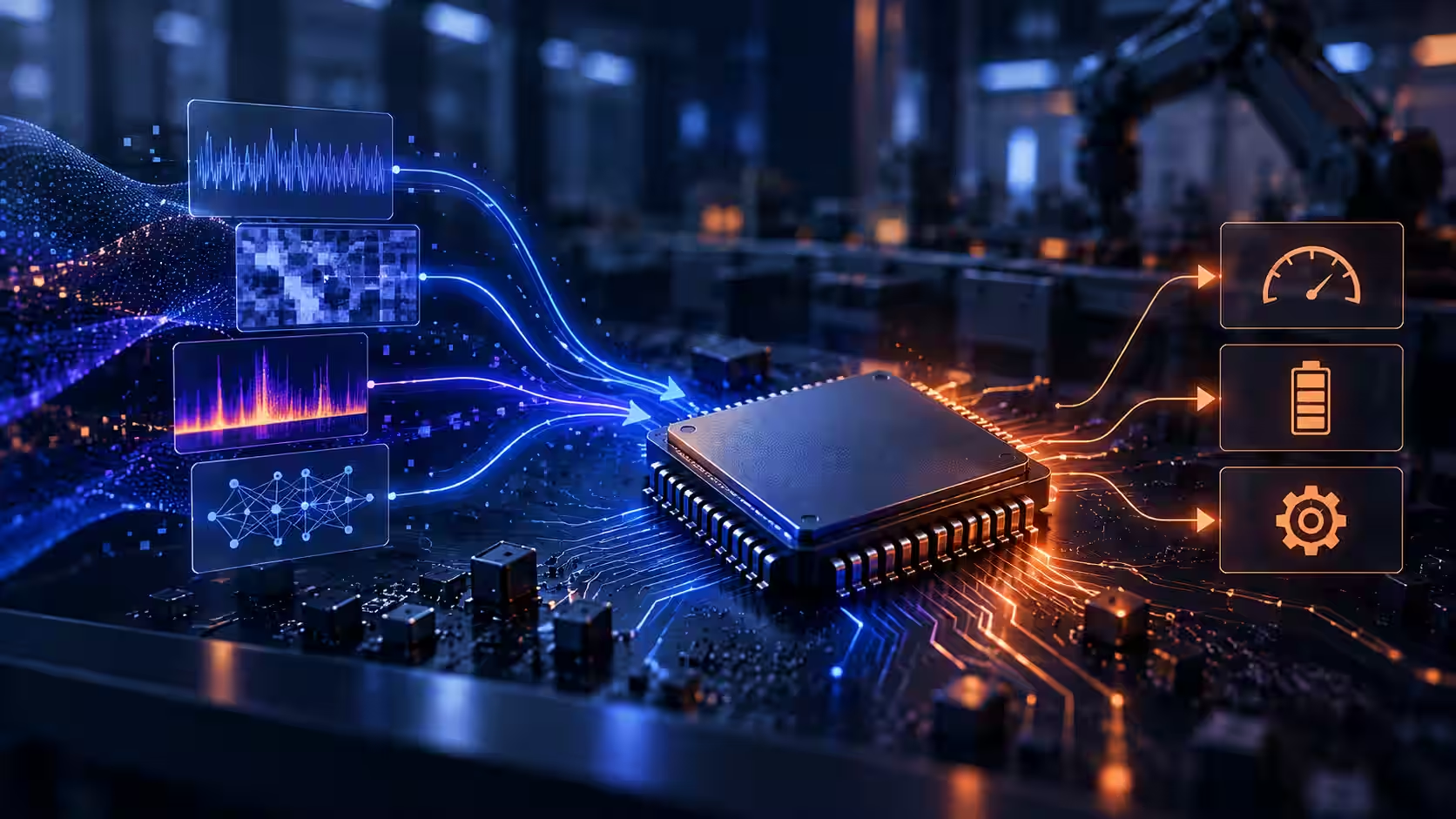
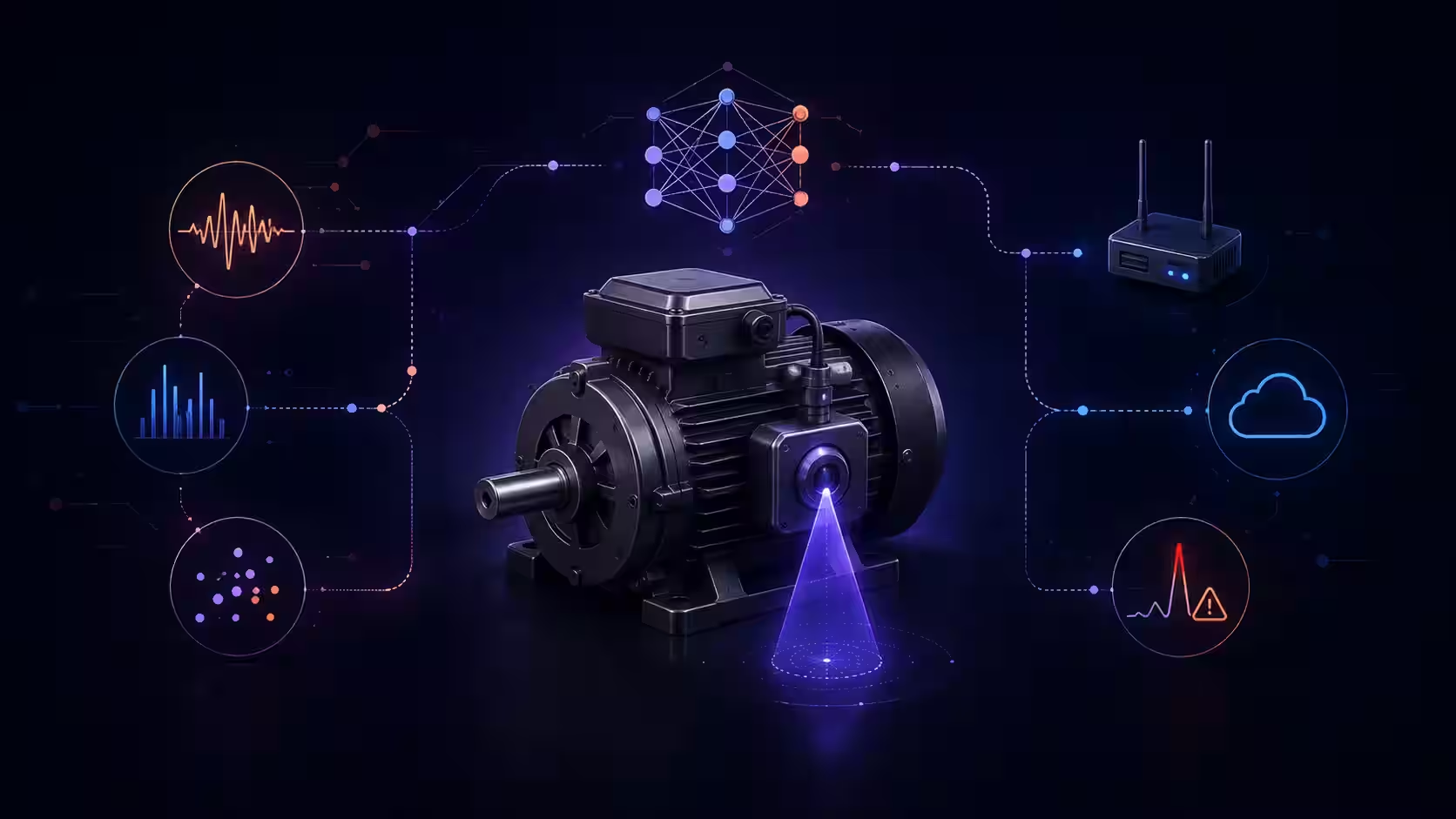
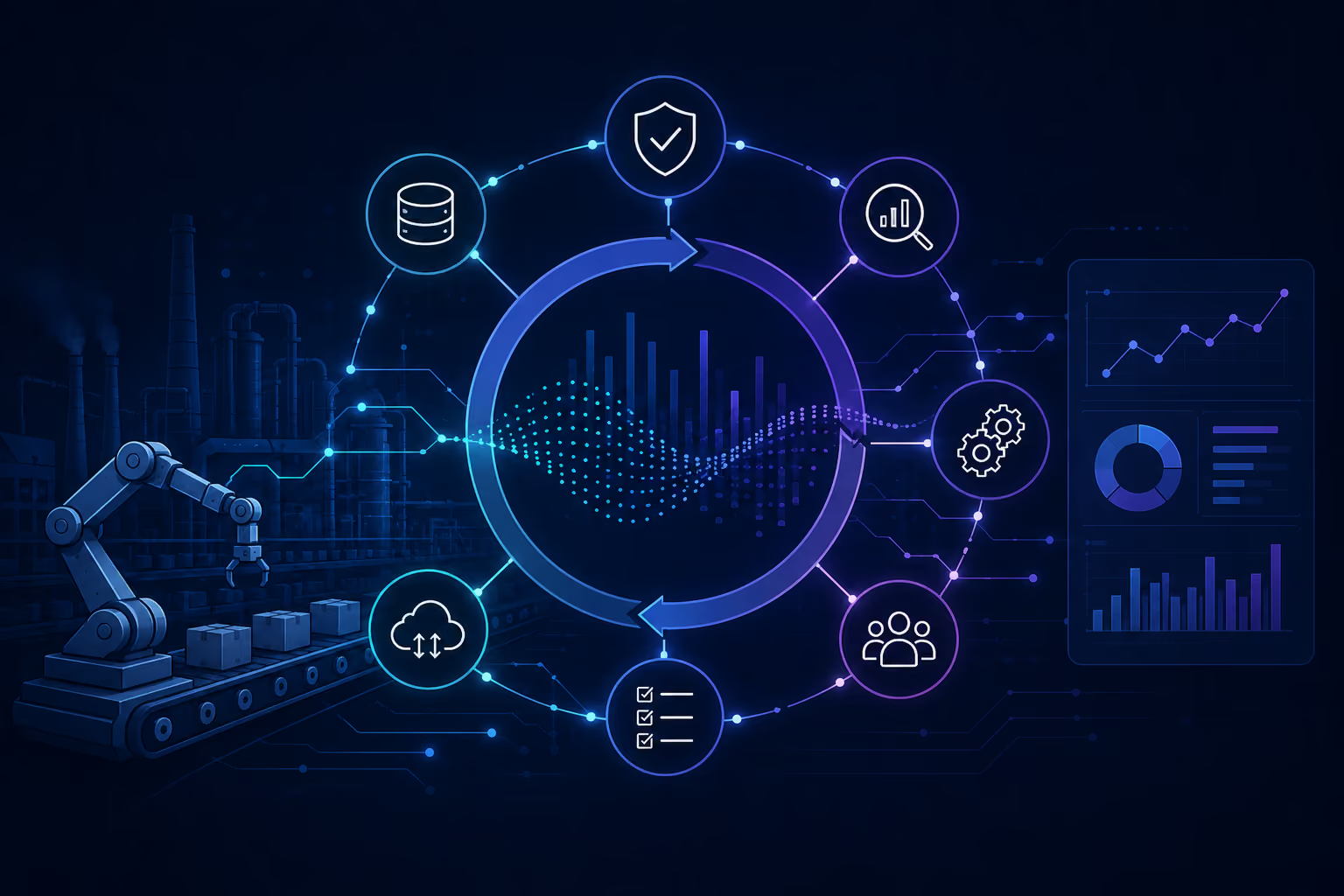
OT/IT integration is the connecting of operational technology (the systems that control physical industrial processes) with information technology (the systems that manage data and business), so that data flows from the plant floor to the enterprise and back. It is the technical foundation of digital transformation and Industry 4.0: without it, a factory can produce things but cannot use what it knows about how it produces them to improve operations, predict failures, or respond to demand in real time. This guide covers what OT/IT integration is, how the architecture is structured, what benefits it delivers, and what challenges operators need to manage to make it work safely.
Key Takeaways
Operational technology is the hardware and software that monitors and controls physical processes and industrial equipment: the programmable logic controllers (PLCs) that run a production line, the SCADA (supervisory control and data acquisition) systems that supervise a water treatment plant, the industrial control systems that manage a chemical process or energy distribution network, the BMS that controls a building's HVAC. OT environments span manufacturing, utilities, oil and gas, transportation, and building automation, anywhere a computer system directly actuates or monitors a physical outcome.
OT's primary function is controlling industrial processes safely and continuously, and its primary design priority is uptime and safety, not data management or user experience. An OT system that loses connectivity to a sensor or a controller for 200 milliseconds is in a categorically different situation from an IT system that drops a web request for 200 milliseconds. One stops a production line or, in a worst case, causes a physical incident; the other retries.
For the full technical comparison between OT and IT systems, see OT vs IT.
Information technology is the hardware and software that processes, stores, and communicates data: servers, enterprise resource planning (ERP) systems, manufacturing execution systems (MES), cloud platforms, business intelligence tools, and the network infrastructure connecting them. IT systems manage data, enable digital systems, and support the business functions of procurement, logistics, finance, and customer service.
IT focuses on data processing and data management, and is designed for flexibility: IT systems are updated frequently, patched regularly, and expected to evolve rapidly with business needs. IT networks emphasize high bandwidth and general-purpose connectivity over the deterministic, low-latency delivery characteristics that OT control loops require.
Summary comparison
| Dimension | OT | IT |
|---|---|---|
| Primary function | Physical process control | Data processing and management |
| Uptime priority | Continuous availability, often 24/7/365 | High, but planned maintenance is acceptable |
| Update cadence | Rarely; legacy systems can run decades unpatched | Frequent; security patches expected within days to weeks |
| Network requirement | Deterministic delivery for control loops | High bandwidth, flexible routing |
| Security model | Air-gapped or isolated historically; safety-first | Perimeter-and-endpoint defense, confidentiality-first |
| Device lifetime | 15 to 30+ years | 3 to 7 years typically |
| Protocols | Modbus, DNP3, PROFIBUS, EtherNet/IP, OPC-UA | TCP/IP, HTTP, TLS, standard internet protocols |
OT prioritizes safety and real-time efficiency while IT focuses on data management. OT networks require deterministic delivery for control loops while IT networks emphasize high bandwidth. Legacy OT systems can last decades without updates, which is their operational strength and their security liability simultaneously.
For the full technical comparison, see OT vs IT.
OT/IT convergence is the process of connecting these previously separate technology stacks so that data and, more carefully, control signals can flow between them. The goal is visibility and analytics reach into physical operations that were previously dark from a data perspective. The Industrial Internet of Things drives IT/OT convergence by connecting physical devices and assets (sensors, actuators, controllers, and field instruments) to IP networks, giving OT systems the addressability and data-transmission capability that convergence requires.
Convergence enables real-time data sharing between the plant floor and the enterprise: a machine's current throughput is visible in the ERP system without a manual data-entry step; a quality defect detected by a vision system triggers a purchasing alert automatically; energy consumption data feeds a sustainability report in real time rather than monthly.
It integrates data analytics with operational processes: historical sensor data feeds machine-learning models that predict which compressor will fail next week; real-time process data feeds dashboards that let an operations manager see every line's OEE from a single view; alarm data feeds root-cause analysis tools that reduce mean time to repair. These insights transform industrial operations from reactive to predictive.
The data exchange that makes all of this possible flows across integration points that need careful design. Real-time OT traffic flows (sensor readings, control commands, alarm states) must not be exposed to the same network paths as general enterprise IT traffic, and every point where data crosses the OT/IT boundary is a point that needs gated access, monitored and logged.
For deeper coverage of IIoT architecture, see industrial IoT architecture.
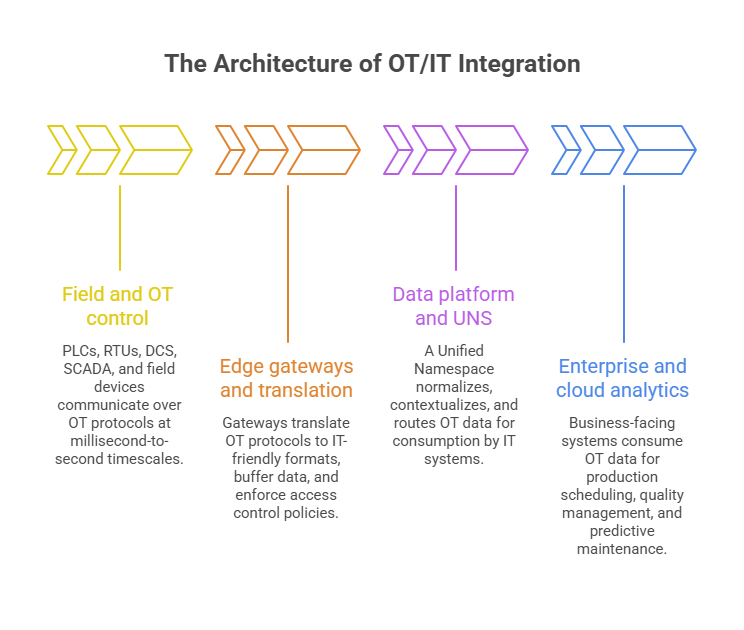
This is the technical heart of the integration problem. The architecture that makes OT/IT integration work is layered, with each layer performing a specific function and the boundaries between layers serving as the control points for security and data governance.
PLCs, RTUs, DCS, SCADA, and the field devices they monitor and control. These systems communicate over OT protocols (Modbus, PROFIBUS, DNP3, EtherNet/IP) and operate at the millisecond-to-second timescales that physical process control requires. This layer is where uptime and safety are paramount, and where no IT-sourced traffic should arrive unless it has passed through controlled gateways above it.
The edge gateway is the critical boundary component: it translates between OT protocols and IT-friendly formats (typically OPC-UA or MQTT as the northbound standard, so the OPC UA vs MQTT decision shapes the whole data layer), buffers data locally for the intermittent connectivity or store-and-forward patterns that many industrial environments require, and enforces the access control policy that separates Layer 1 from everything above it. The gateway does not allow arbitrary IT traffic to reach Layer 1; it exposes only the specific data points that have been explicitly configured for northbound publication. For protocol selection, see OPC-UA vs MQTT.
Above the edge gateway sits a data platform that normalizes, contextualizes, and routes OT data for consumption by IT systems. The Unified Namespace (UNS) pattern is the modern standard for this layer: a single, hierarchically organized message broker (typically MQTT-based) that publishes data from every OT source in a consistent, discoverable format, eliminating the point-to-point integration spaghetti that characterized earlier integration approaches. This layer is where data from multiple OT systems is combined, time-aligned, and made available to analytics, MES, ERP, and cloud platforms through a single, governed interface.
At the top of the stack sit the business-facing systems: MES, ERP, BI platforms, and cloud analytics services that consume OT data for production scheduling, quality management, energy monitoring, supply chain optimization, and predictive maintenance, and the SCADA vs MES vs ERP boundaries decide which of those systems owns which of those functions. Cloud services provide the compute scale for historical analytics and ML model training that on-premise infrastructure cannot cost-effectively deliver.
Edge computing plays a dual role in this architecture: at Layer 2, edge compute supports the gateway function, real-time protocol translation, and local buffering; at Layer 3, edge compute supports near-real-time analytics use cases that cannot tolerate the round-trip latency of cloud processing, such as in-line quality control or real-time OEE calculation.
For deeper coverage, see industrial IoT architecture, Industry 4.0 data architecture, and industrial DataOps. Organisations planning to hand this layer to an external partner can compare the top industrial IoT development companies by integration experience.
Most plants stall because PLC and SCADA data never reaches the enterprise in a usable shape. We audit your asset landscape, protocols and network zones, then design the integration layer that fits them.
Map your OT/IT integration architecture
When OT data flows to enterprise dashboards in real time, a production manager can see every line's status, throughput, and alarm state from a single view rather than walking the floor or waiting for a shift report. IT/OT convergence enhances operational efficiency through real-time analytics applied to operational data that was previously siloed on the plant floor.
Organizations achieve cost reduction via predictive maintenance: machine-learning models trained on historical sensor data identify the early signatures of bearing wear, pump cavitation, or electrical fault before the failure occurs, enabling a planned maintenance intervention rather than an unplanned breakdown. The capital and labor cost of replacing a bearing during a scheduled shutdown is a fraction of the cost of a breakdown-induced production stoppage.
Convergence reduces unplanned downtime not only through predictive maintenance but through faster incident response: when an alarm fires, a converged system can automatically open a work order in the CMMS, notify the right maintenance technician, and surface the relevant historical data before the technician reaches the equipment. What previously took 30 minutes of manual coordination can happen in under a minute.
When production data, quality data, energy data, and inventory data are integrated in a single platform rather than siloed in separate OT and IT systems, the decisions a plant manager or operations director makes are based on a complete, current picture rather than a partial, stale one. Convergence improves decision-making accuracy by eliminating the data gaps and reconciliation errors that manual data transfer between OT and IT systems inevitably introduces.
Regulatory compliance is aided through the visibility that integrated systems provide: energy consumption records, quality audit trails, environmental monitoring data, and safety event logs are all available in a unified system, reducing the manual effort and error risk of compliance reporting.
Convergence fosters innovation through comprehensive data insights by making it possible to ask and answer questions that were previously impossible: which process parameters predict finished-product quality? Which shift patterns correlate with higher defect rates? Which maintenance interventions have the best energy-efficiency outcomes? These questions require the kind of cross-domain data integration that OT/IT convergence delivers.
Organizations that have reached mature OT/IT integration typically measure: OEE (Overall Equipment Effectiveness) improvement of 5 to 15% within 12 months of integration, mean time to detect (MTTD) for process anomalies falling from hours to minutes, energy intensity per unit of output reducing by 5 to 10% through real-time energy optimization, and unplanned downtime reducing by 20 to 40% through predictive maintenance programs.
OT/IT integration expands the attack surface, and the threat environment reflects this reality in the available data.
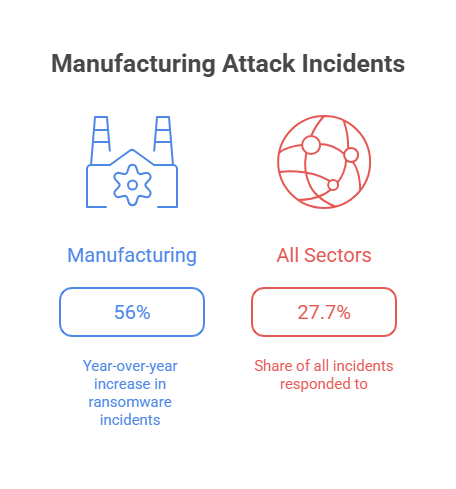
Manufacturing became the most attacked industry for the fifth consecutive year in 2025, accounting for 27.7% of all incidents responded to across every sector (IBM X-Force Threat Intelligence Index, 2026). Dragos tracked 119 ransomware groups hitting roughly 3,300 industrial organizations in 2025, with attack volume rising 64% year over year (Dragos OT Cybersecurity Year in Review, 2025). Manufacturing ransomware incidents surged 56% year over year to 1,466 incidents in 2025, accounting for roughly half of all global ransomware (Check Point Research, 2026). The manufacturing sector experienced an average of 11 days of downtime per incident, with 74% of attacks resulting in data encryption (Armis, 2025). Manufacturing environments are uniquely exposed because production continuity and cybersecurity have historically been managed by separate teams with different priorities. Most damaging for convergence risk: 75% of OT attacks begin as IT breaches (Zero Networks, 2025), meaning the IT side of a converged environment is the entry point that reaches OT.
See also:
OPC UA vs MQTT: Industrial Protocol Comparison
SCADA vs MES vs ERP: What's the Difference?
Industry 4.0 Data Architecture Patterns: From Field to Enterprise
Integration exposes OT systems to increased cyber threats by connecting systems that were historically air-gapped to networks accessible from the broader enterprise and, in many cases, from the internet. OT systems often lack built-in security features and can run for decades unpatched: the same operational stability that makes a 20-year-old PLC reliable also means it is running firmware that predates modern security practices, cannot support modern authentication, and cannot be patched without a production interruption the plant cannot afford to schedule. Industrial machinery designed in the 1990s or early 2000s simply was not built with network security in mind.
Legacy systems are a security gap that is not solved by policy alone. A controller that cannot support encrypted communications, strong authentication, or firmware updates cannot be secured to modern standards regardless of what policy surrounds it. The correct technical mitigation for a legacy device that cannot be patched is network segmentation: isolate it behind a gateway that enforces the controls the device itself cannot, so that its legacy vulnerability does not become an attack path into the broader environment. The same gateway pattern underpins brownfield IoT retrofitting, where sensors and edge nodes are added to machines that were never designed for connectivity.
Interoperability issues arise from specialized protocols: OT environments use dozens of vendor-specific and industry-standard protocols (Modbus, EtherNet/IP, PROFIBUS, BACnet, DNP3) that IT networks and applications do not natively understand. Different communication protocols complicate integration by requiring translation at the gateway layer, increasing the engineering effort and the potential for misconfiguration that opens a security gap.
Cultural barriers and skill gaps between IT and OT teams hinder convergence efforts consistently and predictably. An OT engineer's top priority is keeping a process running safely and continuously; a security change that requires a maintenance window or introduces latency into a control loop is not a welcome suggestion. An IT security team that treats an OT network like an enterprise IT network will make changes that create exactly those problems, eroding trust between the teams and slowing the integration. Bridging this gap requires organizational structure and training, covered in the Organizational Change section below, not just technical standards.
Network segmentation, dividing the OT network into zones with controlled, monitored gateways between them and between OT and IT, is the foundational mitigation for every security risk listed above. A compromised IT system cannot reach a PLC or SCADA server directly if there is no direct network path between them. Segmentation does not eliminate the risk of OT attack, but it constrains lateral movement and gives defenders time to detect and respond before a breach reaches critical control systems.
The answer-first guidance: pilot narrow, translate at the edge, gate every cross-domain link.
Do not attempt to integrate all OT systems at once. Select one production line, one asset class, or one specific data use case (predictive maintenance for a single pump station, for instance) as the pilot. Define the success criteria before implementation, not during. Plan a rollback procedure: what does restoring the pre-integration state look like, and how long does it take, before you run the pilot.
Do not route raw OT protocol traffic onto IT networks. Use an edge gateway to translate OT protocols to an IT-compatible format (OPC-UA or MQTT over TLS) at the boundary, so that what crosses the OT/IT line is a structured, authenticated data stream, not raw Modbus or PROFIBUS traffic that IT network devices do not understand and cannot inspect.
Every point where data flows from OT to IT (and especially any point where a signal might flow from IT back toward OT) is a boundary that needs documented access control, authentication, logging, and monitoring. Least-privilege access means OT systems expose only the specific data points explicitly required for the integration use case, and IT systems can only read (or, in controlled cases, write) those specific points, nothing else.
Before purchasing integration software, edge gateways, or data platforms, verify that the candidate solutions support the specific OT protocols present in your environment. Do not assume; require a proof-of-concept demonstration on your actual equipment. Integration failures caused by undiscovered protocol incompatibilities are expensive and schedule-damaging to discover after purchase.
Remote access to OT systems, often required for vendor support, remote monitoring, or multi-site operations, should be implemented through a purpose-built industrial remote access solution with strong authentication, session recording, and time-limited access grants, not through general-purpose VPN connectivity that grants broader access than the specific maintenance task requires.
ISA/IEC 62443 is the foundational industrial cybersecurity standard, defining security levels, zones, conduits, and security lifecycle requirements for industrial automation and control systems. It provides the framework for designing the segmentation architecture described above, specifying which security controls apply to which zones based on their function and the consequence of compromise.
Network segmentation frameworks for OT zones. The Purdue Model (ISA-95) provides the conceptual layer model that most OT network segmentation architectures follow, distinguishing field, control, supervisory, operations, and enterprise layers and specifying what traffic should and should not cross each boundary. Modern implementations often extend or adapt the Purdue Model to account for cloud connectivity and IIoT architectures that the original model predates, but the core principle (controlled boundaries between layers) remains directly applicable. The cloud-connected IIoT layers that strain the original Purdue Model are the same ones behind how IIoT transforms industry on the shop floor.
Asset-inventory standards for visibility. You cannot secure what you cannot see. An OT asset inventory, covering every device connected to OT networks with its hardware identity, firmware version, communication protocol, and network address, is a prerequisite for any meaningful security program and for any integration architecture that needs to account for every device that might become an integration point or a lateral-movement path. IEC 62443 and the NIST Cybersecurity Framework both include asset management as a foundational control.
Verify current versions of all referenced standards with the issuing bodies before relying on specific version numbers in a compliance context, as standards are periodically updated.
Technology is not the binding constraint in most OT/IT integration projects. People and process are.
Joint governance is crucial for successful integration: a governance team that includes OT engineers, IT architects, plant operations management, and security professionals, with a shared mandate and joint ownership of the integration outcome, addresses the organizational fragmentation that derails most convergence programs. Without joint governance, OT teams block IT-initiated changes on safety grounds, IT teams push security policies that OT teams cannot implement without production impact, and neither side moves forward.
OT engineers need enough understanding of IT security concepts (network segmentation, authentication, encrypted communications) to engage productively with security recommendations. IT teams need enough understanding of OT operational reality (deterministic timing, the impossibility of patching during production, the 20-year asset lifetime) to design security controls that are actually implementable. Cross-training improves collaboration by giving each discipline a working vocabulary for the other's constraints, which makes the conversations about trade-offs productive rather than defensive.
Define explicitly, and in writing, what success looks like for both OT and IT in the integrated environment. An SLA that covers uptime, security incident response time, integration data latency, and change-management procedures (how will security patches be handled for OT systems, with what notice and what rollback procedures) creates a shared reference point for resolving the inevitable conflicts between operational and security priorities that any convergence program will encounter.
Cultural barriers can hinder efforts consistently even when technology is working correctly. Naming and addressing this reality explicitly, treating it as a project management challenge with the same rigor as a technical challenge, is one of the most consistent differentiators between OT/IT integration programs that succeed and those that stall.
Phase 1: Discovery (weeks 1 to 6). Map every OT asset, industrial network segment, and protocol in the target environment. Document what connects to what, what protocols are in use, what firmware versions are running, and what the current network topology looks like. This discovery output is the baseline for everything that follows: the risk assessment, the architecture design, and the integration pilot.
Phase 2: Risk assessment (weeks 4 to 10, overlapping with discovery). For each priority system identified in discovery, assess the consequence of compromise (what happens to production safety and uptime if this system is reached by an attacker) and the current exposure (what network paths currently exist to this system, what authentication protects them). Prioritize mitigation by a combination of consequence and exposure: the highest-consequence, most-exposed systems are the first to address regardless of where they fall in the integration roadmap.
Phase 3: Pilot deployment (weeks 8 to 20). Select one narrow integration use case. Design and implement the edge gateway, protocol translation, and data platform components. Connect the pilot use case to the enterprise consumer (a dashboard, an analytics tool, a predictive maintenance application). Measure against pre-defined success criteria. Execute the rollback procedure at least once in a non-production test to confirm it works before the pilot goes live.
Phase 4: Scaling and continuous improvement. Extend the integration to additional use cases and systems based on the lessons of the pilot, not on the original plan (which the pilot will have revised). Establish a regular cadence for reviewing integration health: security, data quality, and operational performance metrics reviewed monthly, architecture reviewed annually, and the integration scope expanded incrementally as each previous phase delivers confirmed value.
InTechHouse case study: OT/IT integration for an industrial safety deployment
InTechHouse implemented an OT/IT integration for an industrial operator that needed real-time production and safety data to flow to an enterprise analytics platform without exposing the OT control network to IT-side security risks or introducing latency into the control loop.
The architecture used edge gateways deployed at the OT/IT boundary to handle protocol translation from the site's mix of Modbus and EtherNet/IP devices to OPC-UA northbound, with data flowing through a Unified Namespace that normalized data from multiple production lines into a single, consistently structured stream for enterprise consumption.
OT availability was preserved throughout: the gateway architecture was designed so that failure of the IT-side data path (network outage, analytics platform maintenance) had no impact on OT-side operation, and the reverse flow from IT toward OT was gated with explicit, minimal access control permitting only the specific read operations required for monitoring. The resulting integration delivered real-time OEE visibility to the operations management team and the sensor data foundation for a predictive maintenance program.
We deliver narrow first integrations: one line, one protocol gateway, documented rollback. It proves the data path and the security model before you commit to a plant-wide rollout.
Run a scoped OT/IT pilot with rollback
OT/IT integration is not a single project with a completion date. It is an ongoing capability that compounds in value as more OT data flows to enterprise systems and as the analytics and operational programs that consume that data mature. The organizations that have made the most progress have done so by starting narrow, proving value quickly, and building organizational confidence and technical competence iteratively rather than attempting a comprehensive transformation all at once.
Immediate next steps: commission a discovery and asset-inventory effort for your priority OT environment; run a risk assessment to identify which systems are most exposed and most consequential; then design and execute a narrow pilot with explicitly pre-defined success metrics and a documented rollback procedure. Measure against those metrics at 30, 60, and 90 days post-deployment before expanding scope.
To discuss an OT/IT integration, including architecture design, security assessment, and pilot scoping, talk to the InTechHouse team.
Not sure where to start? We work with companies at every stage, from early ideas to enterprise-level builds. A 30-minute call can save you months of guesswork.
What is OT/IT integration?
OT/IT integration is the connecting of operational technology (the hardware and software that controls physical processes, such as PLCs, SCADA, and industrial controllers) with information technology (the systems that handle data processing and business functions, such as ERP, cloud platforms, and analytics tools), so that production data flows from the plant floor to the enterprise in real time. It is the technical foundation of Industry 4.0 digital transformation and the enabler of capabilities like predictive maintenance, real-time OEE monitoring, and data-driven process optimization.
What is the difference between OT and IT?
OT (operational technology) encompasses the physical systems and controls that monitor industrial processes, prioritizes uptime and safety above all else, uses specialized deterministic protocols, and typically runs legacy systems with lifetimes of 15 to 30 years, which is where the OT vs IT in industrial systems split begins. IT (information technology) manages data and business functions, prioritizes flexibility and rapid evolution, uses standard internet protocols, and operates on hardware and software refresh cycles of 3 to 7 years. OT design decisions are made for reliability and safety; IT design decisions are made for functionality and efficiency.
Why is OT/IT convergence important for Industry 4.0?
Industry 4.0 requires that production systems be not just physically automated but digitally intelligent: able to optimize themselves using real-time data, predict failures before they occur, and respond to demand signals from the supply chain dynamically. None of these capabilities is possible when OT and IT systems are isolated from each other. OT/IT convergence creates the data flows that Industry 4.0 use cases depend on, connecting the physical process to the digital systems that can analyze and act on what that process is doing.
What are the security challenges of OT/IT integration?
The primary challenges are an expanded attack surface (IT breaches can now reach OT systems that were previously air-gapped), legacy OT devices that cannot be patched or secured to modern standards, protocol incompatibilities between OT and IT that complicate secure integration design, and the cultural gap between OT teams (who prioritize uptime) and IT security teams (who prioritize patching and policy). In 2025, 75% of OT attacks began as IT breaches (Zero Networks), and manufacturing accounted for 27.7% of all industry cyber incidents (IBM X-Force, 2026), the most of any sector for the fifth consecutive year.
How do you start an OT/IT integration project?
Start with discovery: map every OT asset, network, and protocol before designing anything. Follow with a risk assessment to identify which systems are most exposed and most consequential. Then pilot narrow: pick one integration use case, implement it with edge gateways for protocol translation and explicit access control at every OT/IT boundary, measure against pre-defined success criteria, and confirm the rollback procedure works before expanding scope. Every OT/IT boundary point needs documented access control, authentication, and monitoring before any data flows across it.
Jacek Suty is Head of Solution Architecture at InTechHouse, with more than 30 years of experience in system architecture, enterprise IT, infrastructure, information security, and complex digital transformation programs.
He specializes in designing enterprise and solution architectures, translating business and regulatory requirements into scalable technology platforms, and coordinating delivery across software, infrastructure, data, and security teams. His work covers enterprise architecture based on TOGAF, system modeling using UML and BPMN, cloud and on-premise infrastructure, CI/CD processes, data platforms, cybersecurity, and IT governance.
Jacek has contributed to large-scale technology programs for public institutions, finance, energy, education, healthcare, utilities, and digital archives. His project experience includes nationwide public digital infrastructure, distributed document-management and archiving systems, data-exploration platforms using machine learning and predictive analytics, and transaction systems combining blockchain, metadata standards, and computational intelligence.
He holds PRINCE2 Practitioner, Management of Risk, Scrum Master, ITIL Foundation, and ISO/IEC 27001 Lead Auditor qualifications. Jacek is currently pursuing a doctoral degree at Bydgoszcz University of Science and Technology, combining academic research with extensive experience in real-world architecture and technology delivery.
He writes about enterprise architecture, system design, digital transformation, data platforms, cloud infrastructure, cybersecurity, technology governance, and the practical application of AI in complex information systems.
Jacek Suty's academic and professional profiles:
https://pbs.edu.pl/pl/doktorant/uczelniania-rada-samorzadu-doktorantow
https://www.isep.pw.edu.pl/isep/zs/Aktualnosci/Kalendarium-wydarzen2/Seminarium-zakladowe-9.03.2021-Jacek-Suty
https://aionehealth.pl/wp-content/uploads/2026/04/Raport-2026-final.pdf
This initial conversation is focused on understanding your product, technical challenges, and constraints.
No sales pitch - just a practical discussion with experienced engineers.
Share a few details about your product and context. We’ll review the information and suggest the most appropriate next step.