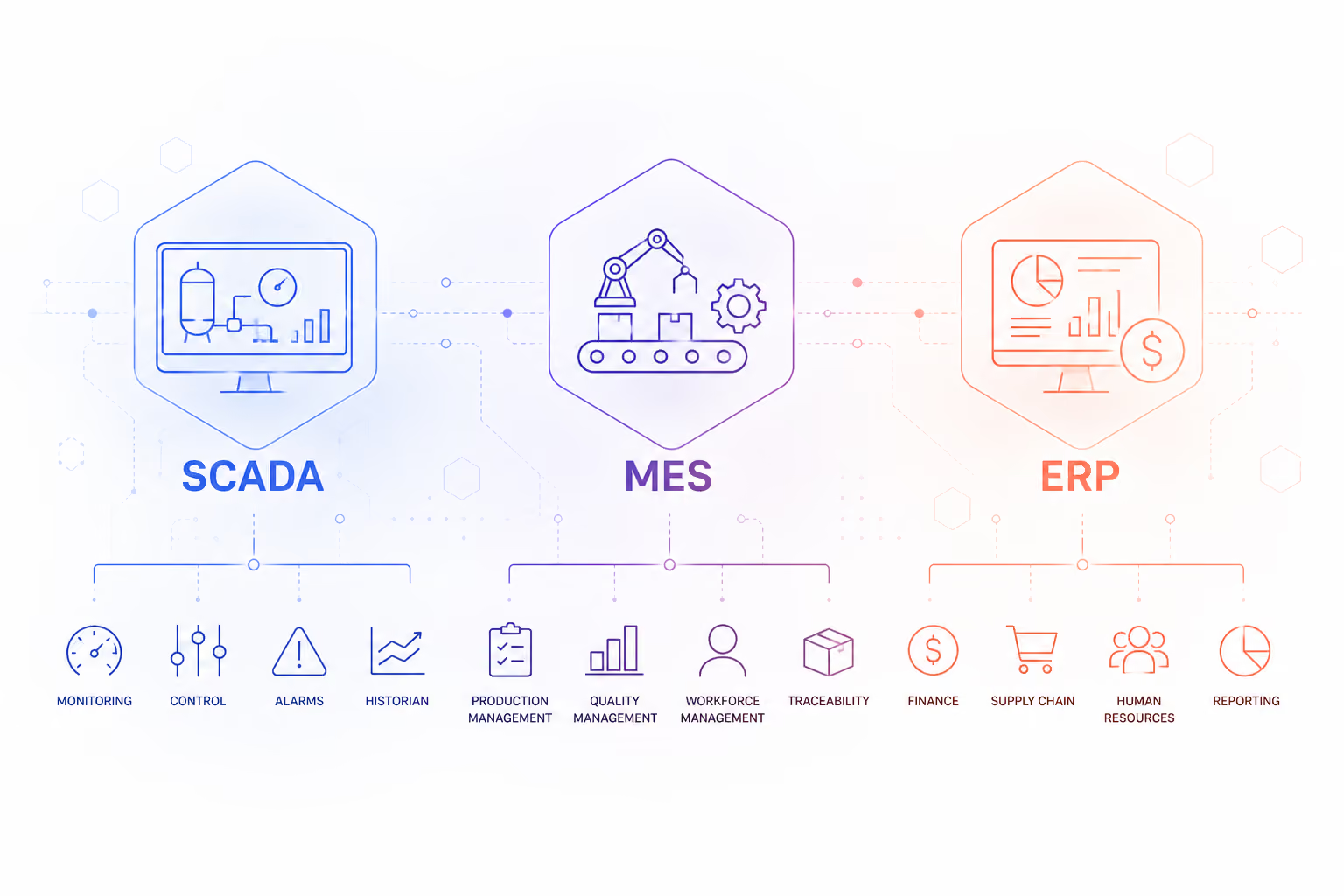
SCADA, MES, and ERP are three different layers of the same manufacturing stack: SCADA controls equipment in real time, MES executes and tracks production on the shop floor, and ERP plans the business. Most manufacturers do not choose one; they integrate all three. The single biggest deciding difference is time horizon and scope: SCADA operates in milliseconds, MES in shifts and orders, and ERP in days and planning cycles. Plant operators benefit most from SCADA. Production managers benefit most from MES. Business planners benefit most from ERP.
Key Takeaways
The ISA-95 automation pyramid provides the standard framework for understanding where SCADA, MES, and ERP each belong and why they are complementary layers rather than competing systems. Because the layers are complementary, the practical challenge is moving data between them, and an industrial DataOps platform is one way to connect SCADA signals with MES and ERP context.
At the bottom of the pyramid are field and control systems: PLCs (programmable logic controllers), sensors, actuators, and the low-level control logic that directly drives industrial equipment, the operational technology half of the split analysed in OT vs IT in industrial systems. Above that sits SCADA (supervisory control and data acquisition), which provides supervisory control and real-time visibility across the entire plant or facility. SCADA collects, displays, and historizes the data flowing up from field devices, and sends operator commands down to them.
Above SCADA sits MES (manufacturing execution system), which manages manufacturing operations at the shop-floor level: scheduling production orders, dispatching work to operators and machines, enforcing process rules, tracking materials and quality, and providing production performance metrics. MES bridges the gap between the equipment world (SCADA and below) and the business world (ERP and above).
At the top sits ERP (enterprise resource planning), the enterprise-planning layer that manages orders, inventory, finance, procurement, and supply chain. ERP sets the "what and when" at the business level, including master production schedules that flow down to MES for execution.
These are complementary layers. Higher level systems (ERP, MES) depend on the real-time data and control capability of lower level systems (SCADA, control) to operate with accurate, current information. Lower level systems depend on higher level systems for the business context that gives their data meaning. For the full architecture that connects these layers, see OT/IT integration architecture.
Three-way snapshot
| Dimension | SCADA | MES | ERP |
|---|---|---|---|
| Primary function | Real-time equipment monitoring and control | Shop-floor production execution and tracking | Enterprise planning and business processes |
| Time horizon | Milliseconds to seconds | Minutes, shifts, orders | Days, weeks, planning cycles |
| Primary users | Plant operators, maintenance technicians | Production managers, quality teams, shift supervisors | Planners, finance, supply chain, executive |
| Data type | Sensor readings, alarm states, control commands | Production orders, work instructions, quality records | Financial records, inventory, customer orders |
| Typical integrations | PLCs, sensors, historians | SCADA (downward), ERP (upward) | MES (downward), CRM, finance systems |
| Scope | A plant, a site, or a process area | A factory or production line | An enterprise or multiple sites |
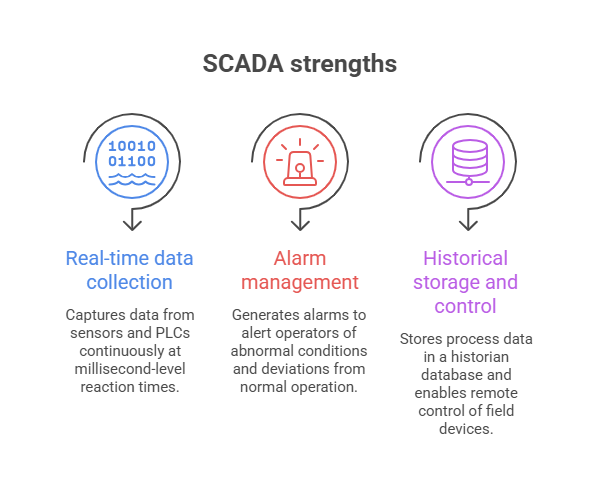
SCADA (supervisory control and data acquisition) is the software and hardware system that monitors and controls industrial equipment in real time. Three core SCADA strengths for manufacturing and process operations:
1. Continuous real-time data collection from field devices. SCADA captures data from sensors and PLCs continuously, aggregating readings from hundreds or thousands of field devices into a unified operational view. This real-time data acquisition happens at millisecond-level reaction times, far faster than any human operator or business system could track manually. The data is displayed visually in operator interfaces (HMIs) that give plant operators an immediate picture of current equipment status.
2. Alarm management. SCADA systems generate alarms to alert operators of abnormal conditions: a temperature exceeding a safety setpoint, a flow rate falling outside its normal range, a machine stopping unexpectedly. This alarm management is a primary safety function: it ensures that deviations from normal operation are surfaced to a human within the time needed to intervene effectively.
3. Historical data storage and remote control. SCADA stores historical process data in a historian database, creating a record of equipment behavior over time that supports root-cause analysis, regulatory reporting, and process optimization. It allows remote control of field devices from a centralized operator console, enabling a plant manager to monitor and respond to events across an entire facility from a single location.
SCADA focuses on real-time monitoring and control of the physical process. Its primary users are plant operators and maintenance technicians who need immediate operational awareness and the ability to act on it.
A manufacturing execution system (MES) is the software that manages and optimizes the entire production process at the shop-floor level, bridging the business orders from ERP and the equipment-level control from SCADA. Three core MES strengths for production management:
MES software translates business orders from ERP into shop-floor work: dispatching work orders to specific machines, operators, and production cells; managing production workflows; tracking production progress against schedules and targets; and dynamically adjusting dispatch priorities as conditions change. MES provides the contextual information required to execute business processes on the shop floor, turning "produce 500 units of product X by end of shift" into step-by-step operator instructions on a specific line with specific materials.
MES enforces process rules that ensure product quality and regulatory compliance. It enables standardized workflows and automated decision rules: a process step cannot be completed out of order, a component cannot be used unless it has passed incoming quality inspection, a product cannot ship without a completed quality record. This capability supports batch traceability throughout production, a requirement in industries like pharmaceuticals, food, and aerospace where regulatory standards mandate that every unit of output can be traced back to every input material, process step, and operator involved in its production.
MES provides real-time metrics like OEE (Overall Equipment Effectiveness), production yield, downtime analysis, and scrap rates, giving production managers the data they need to make informed decisions during a shift rather than waiting for an end-of-day report. This real-time visibility into production performance is what enables continuous improvement on the shop floor.
Enterprise resource planning (ERP) is the business-planning layer of the manufacturing stack, managing the enterprise-wide processes that determine what gets made, when, in what quantity, and at what cost. Where SCADA controls the equipment and MES executes the production, ERP sets the context for both.
ERP manages orders (from customers and to suppliers), inventory (materials on hand, in transit, and in production), finance (cost accounting, profitability, working capital), procurement, and supply chain. Production planning in ERP produces the master production schedule that flows down to MES: "by the end of this week, we need 1,200 units of product A, 450 units of product B, and 800 units of product C." MES turns that schedule into detailed shop-floor execution. SCADA controls the equipment that does the work.
Typical ERP users are business planners, finance teams, supply chain managers, and executives, not plant operators or production managers, though the data flowing up from MES and SCADA (actual production quantities, material consumption, quality outcomes) feeds the ERP data that those business users work with. Higher level systems like ERP depend on the accuracy and timeliness of that operational data to make good planning decisions.
ERP is the top of the automation pyramid, setting the business context that gives shop-floor activity meaning. Without ERP context, an MES knows what it is producing but not why; a SCADA system knows what the equipment is doing but not whether it is producing the right thing at the right time. ERP connects manufacturing operations to business strategy, digital transformation goals, and customer commitments.
Detailed comparison
| Factor | SCADA | MES | ERP |
|---|---|---|---|
| Time horizon | Milliseconds to minutes | Minutes to shifts | Days to planning cycles |
| Scope | Equipment, process area, or site | Production line, factory, or site | Enterprise or multi-site |
| Primary data | Sensor values, alarm states, commands | Orders, work instructions, quality records, genealogy | Customer orders, inventory, financials, forecasts |
| Key output | Real-time process view, historian, alarms | OEE, traceability records, schedule adherence | Master production schedule, cost reports, demand plans |
| Integration upward | To MES (production context) and historian | To ERP (actual production data) | To external systems (CRM, EDI, financial) |
| Integration downward | To PLCs, sensors, field devices | To SCADA (equipment data), operator terminals | To MES (production schedule) |
| Decision-making horizon | Immediate (is this alarm real, should I intervene) | Short-term (is this order on track, where is the bottleneck) | Medium to long-term (what should we produce, what do we order) |
One-line takeaway. SCADA provides immediate insight into equipment performance while MES optimizes the whole production process; ERP connects both to business reality. The two systems that most manufacturers confuse, SCADA and MES, are actually solving different problems at different timescales.
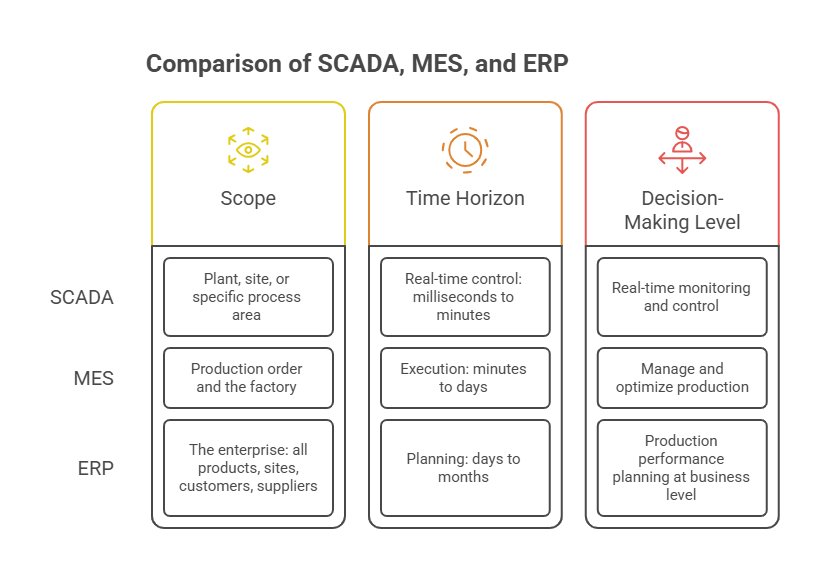
Scope. SCADA's scope is typically a plant, a site, or a specific process area: the refinery, the production building, the water treatment plant. Its view is the physical equipment and the process it runs. MES scope is the production order and the factory: what is being produced, by whom, on which equipment, with which materials, against what schedule. ERP scope is the enterprise: all products, all sites, all customers, all suppliers.
Time horizon. SCADA operates on real-time control timescales: milliseconds to seconds for control loops, seconds to minutes for operator response. MES operates on execution timescales: minutes for work order dispatch, hours for shift performance, days for order completion tracking. ERP operates on planning timescales: days for short-term scheduling, weeks and months for supply and demand planning.
Decision-making level. SCADA focuses on real-time monitoring and control: the operator decides whether to acknowledge an alarm, adjust a setpoint, or restart a machine. MES manages and optimizes production: the production manager decides whether to expedite an order, reassign a machine, or escalate a quality issue. ERP supports production performance planning at the business level: the planner decides what to produce, what to order, and what to promise customers.
These three dimensions, scope, time horizon, and decision-making level, explain why SCADA and MES are the most commonly confused pair in this stack. Both involve the plant floor, both deal with real-time data, and both affect operators. The distinction is that SCADA controls equipment, while MES manages production. SCADA answers "what is the equipment doing right now?" MES answers "is production on track to meet the schedule?"
Comparison of SCADA, MES, and ERP
See also:
What Is OT/IT Integration? Architecture, Benefits, Challenges
OT vs IT: Key Differences in Industrial Systems
OPC UA vs MQTT: Industrial Protocol Comparison
SCADA handles real-time data collection: it captures data from sensors and PLCs continuously, stores it in a historian, and displays it in operator interfaces designed for immediate awareness and reaction. Control and data acquisition is SCADA's core function. The data SCADA produces is high-frequency, high-volume process data: temperature readings every second, flow rates every 100 milliseconds, alarm transitions as they happen.
MES turns that data into production actions. It retrieves contextual information to execute business processes: knowing that a temperature reading is 187°C is SCADA's job; knowing that 187°C is within the acceptable range for this product's production step, that this batch is order 4872 for customer A, and that the step must complete within the next 45 minutes to meet the committed delivery date is MES's job. MES contextualizes and acts on the process data that SCADA collects.
Winner for immediate real-time monitoring: SCADA. No other system provides the millisecond-level process visibility and control that SCADA is designed for.
Winner for production execution and management: MES. SCADA does not know what an order is, what a schedule is, or what a quality specification requires. MES does.
SCADA's HMI (human-machine interface) and alarm management capabilities are its most visible features for plant operators. The HMI presents real-time process data visually, typically as schematic diagrams of the process with live values overlaid, so an operator can immediately see the status of every instrument and every controllable device. SCADA systems generate alarms for abnormal conditions: a configurable alarm limit on any process variable that fires when the value exceeds a high or low threshold, with alarm priority levels, acknowledgment requirements, and alarm history logging that supports post-incident analysis.
MES operator interfaces serve a different purpose: they deliver work instructions, quality checklists, and production status information to operators on the shop floor. An MES operator screen might show "current work order: 4872, step 3 of 7, target completion: 14:30, materials required: lot A1234-B" rather than a process schematic with live instrument values. The operator uses the MES interface to record what they have done, confirm quality checks, and report exceptions; they use the SCADA interface to monitor and control the equipment that executes those steps.
A common trade-off in SCADA/MES integration is the operator's attention: if both systems have separate interfaces on separate terminals, operators spend cognitive overhead switching between process monitoring (SCADA) and production execution (MES). The best integrated implementations present both sets of information in a unified operator experience, either through MES interfaces that embed live SCADA tags or through SCADA HMIs that display MES context alongside process values.
MES is the clear winner for scheduling, traceability, and manufacturing efficiency improvement at the production level. SCADA provides no native scheduling or traceability capability; it records process data, but it does not associate that data with production orders, materials, or quality specifications unless explicitly integrated with a system that does.
MES supports traceability throughout production: it records which material lots went into which production order, which operator performed which step, which machine produced which unit, and which quality checks were performed and passed. This genealogy record is what industries like pharmaceuticals, food and beverage, and medical devices require for compliance with quality and regulatory standards. Without MES traceability, a product recall requires manual correlation of paper records; with MES traceability, the affected lot can be identified in minutes.
MES directly improves manufacturing efficiency by giving production managers the real-time metrics they need to identify and address bottlenecks during a shift: OEE by machine and by line, yield rates, downtime categories, and schedule adherence. These metrics optimize production in a way that SCADA's process data alone cannot support, because SCADA does not know what "on schedule" means without the production order context that MES provides.
For highly regulated industries, MES is not optional: traceability and quality enforcement are compliance requirements, not nice-to-haves, and SCADA cannot fulfill them.
The real value in the SCADA-MES-ERP stack is not choosing one system but connecting all three so that data flows from equipment through the shop floor to the business, and planning decisions flow back the other way. This integrated data architecture is the foundation of modern manufacturing and Industry 4.0. Those connections tend to follow a small set of Industry 4.0 data architecture patterns, each with different trade-offs in latency, coupling and governance.
Integrating SCADA and MES improves production planning and decision-making because MES gets real-time equipment data from SCADA rather than relying on manual operator reporting. Integrating MES and ERP improves production planning by giving ERP actual production data (actual quantities produced, actual material consumed, actual quality outcomes) rather than planned assumptions. The full three-layer integration enhances operational visibility across the enterprise, reduces waste and improves quality control by closing the loop between planning and execution, supports faster decisions by eliminating the data lag that manual reporting introduces, and streamlines operations by reducing manual data entry and the errors it produces.
Required integration components:
Common pitfalls: integrating SCADA and MES without agreeing on tag naming conventions, units of measure, and data-type mappings before integration begins results in a data-cleaning project after the fact. Integrating MES and ERP without defining who owns the production schedule (ERP sets it, MES may adjust within the shift) leads to conflicting records. Letting manufacturers adapt quickly to production changes requires that the integration handles not just the normal flow but also exceptions: order changes, machine breakdowns, quality holds.
Most plants do not need a new system, they need the three they already own to exchange data without a nightly CSV export. We design and build that integration layer.
Connect your SCADA, MES and ERP layers properly
When legacy protocols exist on the plant floor (Modbus, PROFIBUS, OPC-DA from an older SCADA system), middleware handles the translation without requiring changes to the source systems. A middleware layer, an OPC-UA or MQTT-based data broker, a historian API, or a dedicated integration platform, normalizes data from multiple sources into a consistent format before it reaches MES or ERP.
Before writing an integration, map tag names and data types systematically. A temperature value in SCADA tagged as Line1.HeatEx.TempIn needs to map to a specific process variable ID in MES and a routing step in ERP. This mapping is the most error-prone part of any SCADA integration and must be version-controlled and reviewed by both the OT team (who owns SCADA tags) and the MES team (who owns process variable definitions).
For high-volume, real-time data flows between systems that need to be decoupled (SCADA producing data at 10 Hz, MES consuming it at event-driven intervals), a scalable enterprise message bus or data streaming layer handles the buffering, routing, and retry logic that point-to-point API calls cannot sustain reliably at production volumes. For the data-layer architecture, see industrial DataOps.
Existing systems in a brownfield integration rarely speak the same protocols or use the same data models. Budget for protocol-specific connectors, transformation logic, and data-quality validation as explicit integration deliverables, not as assumptions.
The middleware layer is only as good as the protocol underneath it, and most industrial estates end up running two: one for machine semantics, one for lightweight distribution. Our comparison of OPC UA vs MQTT explains which of them should feed the historian and which should feed MES and ERP consumers.
Raw sensor data from SCADA has limited value on its own. The process data becomes useful when it is centralized, time-stamped, and enriched with production context. A historian database (OSIsoft PI, Ignition Historian, InductiveAutomation, or similar) centralizes raw process data tags from SCADA in a time-series format optimized for retrieval, with retention policies that satisfy regulatory requirements (often one to seven years for batch records in regulated industries, with some requiring permanent retention for safety-critical data).
MES retrieves contextual information to execute business processes and contextualizes that raw data: attaching a temperature reading to the specific production order, product, batch, and process step it belongs to. A temperature of 187°C at 14:23:07 on 2025-11-03 becomes "acceptable temperature during mixing step of batch 2025-1103-04 of product XYZ for order 4872" only when the historian timestamp and the MES production record are correlated.
Live data contextualization, linking real-time SCADA values to the currently active MES production context, is the integration value that eliminates the need for operators to manually record process parameters. When integration is working correctly, the MES production record is automatically populated with the actual process values from SCADA rather than relying on operator memory or manual data entry after the fact.
Decisive-factors table
| Factor | SCADA wins | MES wins | ERP wins |
|---|---|---|---|
| Primary requirement | Real-time equipment control, alarm management, process visibility | Production scheduling, traceability, quality enforcement, OEE metrics | Business planning, order management, financial integration |
| Time horizon | Milliseconds to minutes | Minutes to shifts | Days to planning cycles |
| Regulatory requirement | Process safety monitoring | Batch traceability, quality records, GMP compliance | Financial reporting, supply chain compliance |
| Users | Plant operators, maintenance | Production managers, quality teams | Planners, finance, executive |
| Total cost of ownership | Lower for a single site | Moderate; scales with production complexity | Higher; covers entire enterprise |
| Implementation timeline | Weeks to months for a single site | Months for a production line | Months |
One-line rationale per factor. MES improves overall operational efficiency at the production level by providing real-time performance metrics that connect equipment behavior to business outcomes; SCADA enables the equipment visibility that feeds those metrics; ERP provides the business context that gives production efficiency its meaning and business value.
For production plants in regulated industries (pharma, food, aerospace), MES is often non-negotiable regardless of TCO, because the traceability and quality-enforcement requirements it fulfills cannot be achieved by any combination of SCADA and manual processes.
SCADA-first when immediate equipment control, alarm management, and real-time process visibility are the primary requirement: a utility operating a water or power distribution network where operators need immediate situational awareness and control, or a continuous process plant (refinery, chemical facility) where process stability and safety are the dominant concern. Add MES when production tracking and quality records become regulatory or operational requirements, and add ERP when business planning and financial integration are needed. Each added layer widens the data available for analysis, which is where many of the industrial IoT benefits in efficiency and maintenance start to appear.
MES-first when scheduling, traceability, and quality enforcement are the dominant requirements from day one: a pharmaceutical manufacturer, a food producer, or a medical device manufacturer where batch traceability and GMP compliance are non-negotiable from the first production run. MES can operate with manual data entry or simple SCADA data feeds initially and be enriched with tighter SCADA integration over time. Connect to ERP when the business-planning integration becomes a bottleneck for growth.
Combined SCADA plus MES plus ERP for digital transformation programs where the goal is full operational visibility from equipment to the business: modern manufacturing organizations pursuing Industry 4.0, minimizing downtime through predictive maintenance programs that require equipment data in the business context, or manufacturers competing on delivery performance and quality who need to close the loop between planning, execution, and actuals across the entire stack.
The answer-first guidance: pilot narrow, prove KPIs, then scale.
Phase 1: Pilot on one production line (weeks 1 to 12). Select a single production line for the first SCADA-MES integration. Define measurable KPIs tied to manufacturing efficiency before the pilot begins: OEE improvement target, reduction in manual data entry time, reduction in time-to-traceability for a quality event. Validate data flow from SCADA tags to MES production records in a test environment before going live. Run the pilot for a full production cycle (at least one month) and measure against the pre-defined KPIs.
Phase 2: ERP integration and expansion (months 4 to 12). Add the MES-to-ERP integration for production actuals (completed quantities, material consumption, quality outcomes). Plan training and change management for operators and production managers whose workflows change when manual data entry is replaced by system-to-system integration. Significant improvements at the pilot line validate the approach and build organizational confidence before expansion.
Phase 3: Scale to additional lines and sites (months 9 onwards). Iterative rollout to additional production lines and sites, applying lessons from the pilot. Each new rollout benefits from the master data mappings, integration patterns, and change management playbooks established in the pilot, reducing the time and cost of each subsequent deployment.
Before any SCADA-MES-ERP integration goes live:
Seamless data flow across all three layers requires that each of these items is completed and validated before go-live, not treated as post-launch cleanup. Validating each item is simpler when the team knows which of the IIoT architecture layers it touches, from field devices up to enterprise applications.
We delivered the manufacturing plant integration described at the end of this article, including middleware, historian contextualisation and the migration sequence. Ask for the detail.
See how we integrate SCADA, MES and ERP data
InTechHouse case study: SCADA-MES-ERP integration on a manufacturing plant
InTechHouse connected all three layers of the automation stack for a manufacturing operator who needed production data to flow automatically from shop-floor equipment to business planning, eliminating the manual reporting that was causing three-hour lags between production events and ERP inventory updates.
The integration used an OPC-UA-to-MQTT bridge from the plant's SCADA historian to an MES integration layer, where raw process data was contextualized against active production orders and enriched with material lot and quality step information before being written to the MES production record. Completed production orders were then passed automatically to ERP at shift end, updating actual inventory consumption and production quantities without manual data entry.
The outcome was a reduction in production reporting lag from three hours to under five minutes, a traceability record that could be pulled for any production order within seconds rather than hours of manual file correlation, and OEE data available to production managers during the shift rather than in a next-day report.
Not sure where to start? We work with companies at every stage, from early ideas to enterprise-level builds. A 30-minute call can save you months of guesswork.
Can SCADA, MES, and ERP run together?
Yes, and in most mature manufacturing organizations they do. SCADA, MES, and ERP are designed as complementary layers: SCADA provides the equipment data that MES contextualizes against production orders, and MES provides the actual production data that ERP needs for accurate business planning. The integration between layers requires defined data flows, master data alignment, and protocol translation, but the three systems are specifically designed to work together in the ISA-95 automation pyramid architecture.
What is the difference between SCADA and MES?
SCADA monitors and controls industrial equipment in real time, collecting data from sensors and PLCs with millisecond reaction times and providing operators with alarms and process visibility. MES manages and optimizes production at the shop-floor level, executing work orders, enforcing quality rules, tracking materials and traceability, and providing OEE metrics. SCADA answers "what is the equipment doing right now?" MES answers "is production on track to meet the schedule and quality requirements?"
Where does ERP fit with MES and SCADA?
ERP sits at the top of the automation pyramid, above both MES and SCADA. It handles enterprise-level planning: customer orders, master production scheduling, inventory management, procurement, and financial accounting. ERP sets the "what and when" that MES executes on the shop floor; MES reports actual production outcomes back to ERP; SCADA controls the equipment that executes the MES plan. Without MES in the middle, the integration between ERP planning and SCADA equipment reality is a manual gap that operators fill with clipboards and spreadsheets.
How long does a SCADA-MES integration take?
A focused SCADA-MES integration on a single production line typically takes 3 to 6 months from project kickoff to live production, including requirements definition, tag mapping, development, testing, and parallel operation validation. The largest time consumers are master data alignment (agreeing on tag names, engineering units, and MES variable identifiers), integration testing under realistic production conditions, and operator training and change management. Adding ERP integration extends this timeline by 1 to 3 months for the MES-to-ERP data flow and production order handoff. A multi-line, multi-site program can take 12 to 24 months with a phased rollout approach.
Who should own the integration project internally?
A cross-functional team with representatives from OT operations (who own SCADA and the plant-floor systems), IT (who own MES and ERP infrastructure), and production management (who define the business requirements for what data needs to flow where and why) is the right governance structure. Neither OT operations nor IT alone has the full picture. OT knows what data is available and what operational constraints apply; IT knows the integration tooling, security requirements, and enterprise system architecture; production management defines the business value that justifies the investment and sets the performance requirements the integration must meet.
Jacek Suty is Head of Solution Architecture at InTechHouse, with more than 30 years of experience in system architecture, enterprise IT, infrastructure, information security, and complex digital transformation programs.
He specializes in designing enterprise and solution architectures, translating business and regulatory requirements into scalable technology platforms, and coordinating delivery across software, infrastructure, data, and security teams. His work covers enterprise architecture based on TOGAF, system modeling using UML and BPMN, cloud and on-premise infrastructure, CI/CD processes, data platforms, cybersecurity, and IT governance.
Jacek has contributed to large-scale technology programs for public institutions, finance, energy, education, healthcare, utilities, and digital archives. His project experience includes nationwide public digital infrastructure, distributed document-management and archiving systems, data-exploration platforms using machine learning and predictive analytics, and transaction systems combining blockchain, metadata standards, and computational intelligence.
He holds PRINCE2 Practitioner, Management of Risk, Scrum Master, ITIL Foundation, and ISO/IEC 27001 Lead Auditor qualifications. Jacek is currently pursuing a doctoral degree at Bydgoszcz University of Science and Technology, combining academic research with extensive experience in real-world architecture and technology delivery.
He writes about enterprise architecture, system design, digital transformation, data platforms, cloud infrastructure, cybersecurity, technology governance, and the practical application of AI in complex information systems.
Jacek Suty's academic and professional profiles:
https://pbs.edu.pl/pl/doktorant/uczelniania-rada-samorzadu-doktorantow
https://www.isep.pw.edu.pl/isep/zs/Aktualnosci/Kalendarium-wydarzen2/Seminarium-zakladowe-9.03.2021-Jacek-Suty
https://aionehealth.pl/wp-content/uploads/2026/04/Raport-2026-final.pdf
This initial conversation is focused on understanding your product, technical challenges, and constraints.
No sales pitch - just a practical discussion with experienced engineers.
Share a few details about your product and context. We’ll review the information and suggest the most appropriate next step.