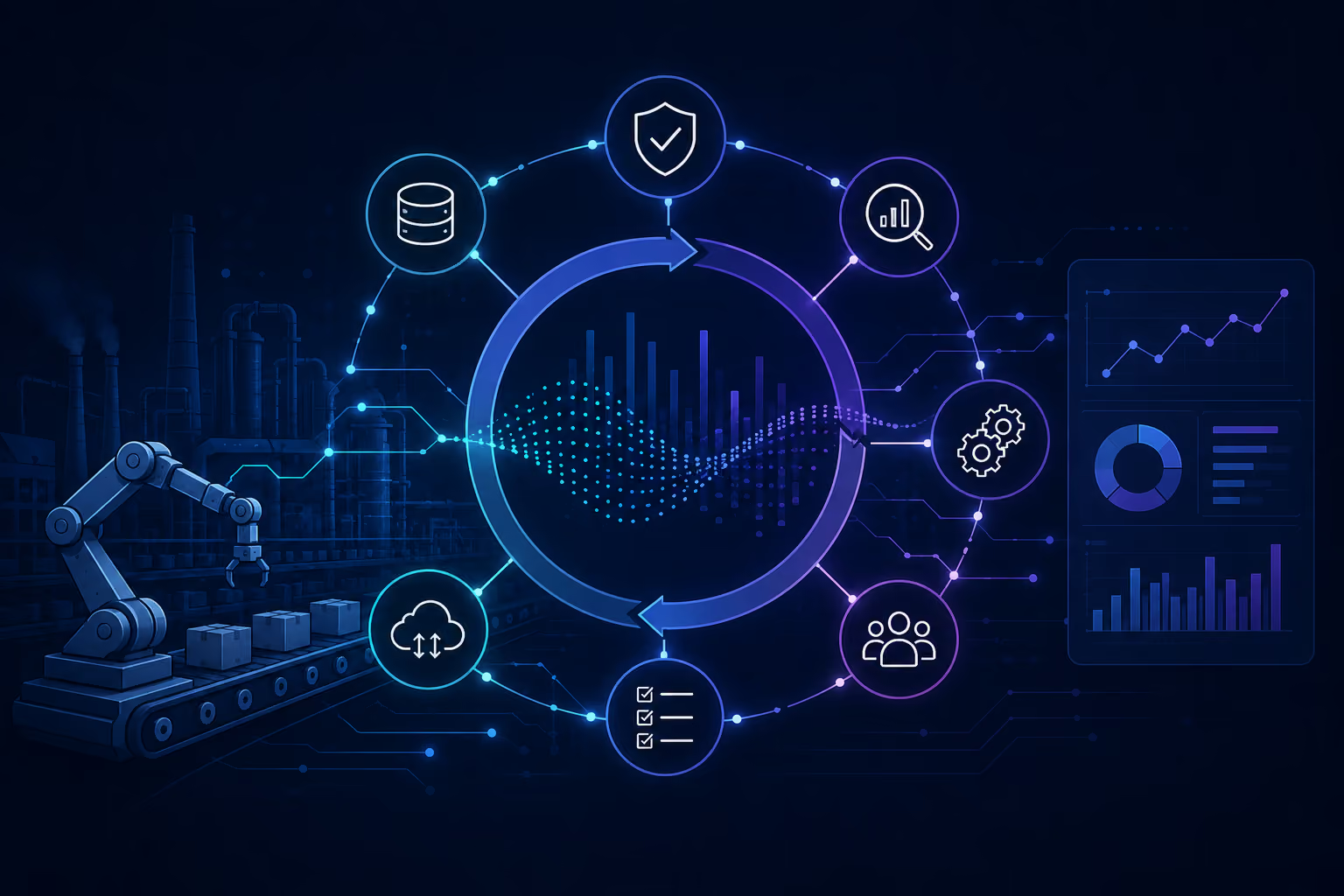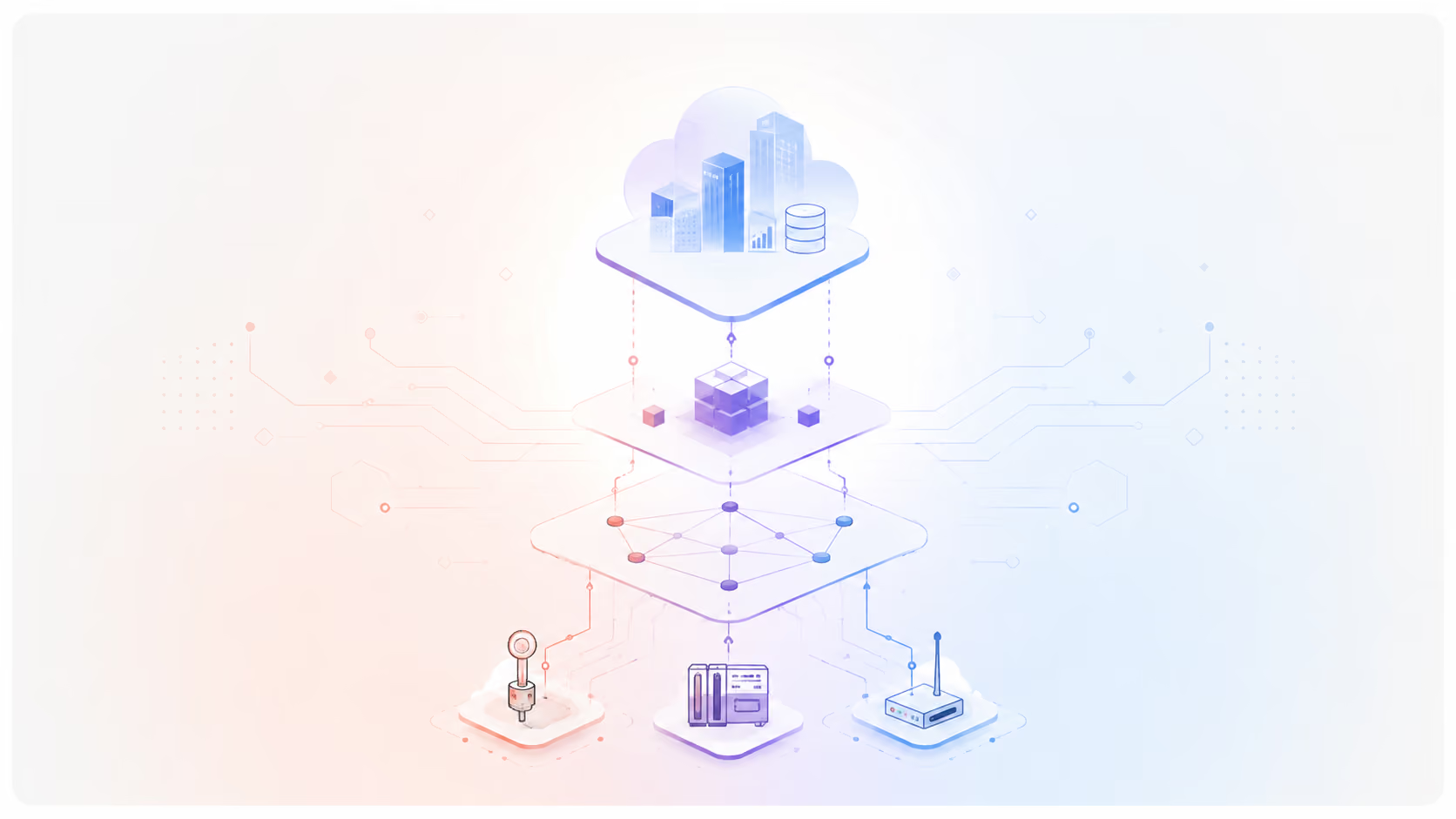
An Industry 4.0 data architecture is a layered, interconnected design that connects physical manufacturing assets to digital systems and moves data from the field to the enterprise for real-time decisions. The architecture spans from a vibration sensor on a conveyor motor to a predictive maintenance alert on a maintenance manager's phone, with edge compute, data platforms, digital twins, and analytics in between. This page is a pattern catalog for that architecture plus a practical guide to deploying it, especially in the brownfield plants where most manufacturers actually operate.
Key Takeaways
The industrial revolution introduced mechanization; the second introduced electricity and mass production; the third introduced computers and automation. Industry 4.0 is the fourth: the integration of cyber-physical systems, Industrial Internet of Things, and digital intelligence into the manufacturing process itself.
The outcome is the smart factory: a manufacturing environment where machines communicate, data flows continuously from the shop floor to enterprise systems, and closed-loop automation makes decisions in real time without waiting for human observation or end-of-shift reporting. Industry 4.0 architecture follows a layered, interconnected approach that connects physical manufacturing assets with digital systems, enabling the smart factory to use data the way the previous three revolutions used steam, electricity, and computing: as the fundamental enabling resource.
Digital transformation of an existing manufacturing industry is not a greenfield design problem. It is a retrofit problem. The starting point for most manufacturers is a plant full of equipment of varying ages, speaking incompatible protocols, managed by teams with deeply different mental models about what data is and what it is for.
Three principles determine whether an Industry 4.0 data architecture succeeds or becomes a collection of disconnected pilots that never scale.
Enhanced interoperability lets disparate systems communicate: an OT controller from Siemens, a quality system from a point-solution vendor, an ERP from SAP, and a cloud analytics platform from a hyperscaler all need to exchange data without custom point-to-point integrations written for each pair. This requires a unified OT/IT integration architecture with standard protocols and data models at the integration layer, not bilateral agreements between each pair of systems. An architecture that succeeds on interoperability makes adding a new data consumer as simple as subscribing to a topic; one that fails on interoperability makes every new integration a unique project.
A temperature reading of 187 is meaningless without the unit (Celsius or Fahrenheit), the context (which sensor, which asset, which process step), and the interpretation (within normal range, approaching limit, or already over threshold). Mandating semantic data models at the architecture level means every data point carries this context explicitly, not just for human readers but for the analytics systems and digital twins that consume it.
Data governance ensures policies for data quality, security, and compliance are consistently applied: who can read which data, who can write to which systems, how long data is retained, and what quality checks run before data reaches analytics. Without governance, an architecture produces a data swamp: high volume, low trust, no agreed-upon definitions. Industry 4.0 incorporates advanced technologies like AI and machine learning, and both require high-quality, governed data to produce reliable outputs.
Industry 4.0 data architecture manages massive volumes of data from interconnected machines and enables automated decision-making and continuous optimization. The architecture that makes this tractable is layered: each layer has a defined function, a defined set of components, and defined interfaces to the layers above and below.
Data moves from field sensors up through OT and a data platform to analytics and back down for closed-loop control. The upward flow carries raw sensor data, alarm events, and production records to be contextualized, analyzed, and stored. The downward flow carries setpoints, control parameters, and decisions from analytics back to the systems that execute them.
Layered architecture table
| Layer | Function | Key components | Data flow |
|---|---|---|---|
| Field and edge | Connect sensors and PLCs; process telemetry at the edge | Sensors, actuators, PLCs, edge gateways, edge compute | Raw sensor data upward; control commands downward |
| OT and control | Provide supervisory control and integrate HMI, SCADA, and MES systems | SCADA, DCS, HMI, OPC UA interfaces, historians | Aggregated OT data upward; setpoints and parameters downward |
| Data platform | Ingest, store, and provide access to industrial data | MQTT broker or UNS, time-series database, data lake, stream processor | Structured and contextualized data upward; governed data APIs for consumption |
| Analytics and digital twin | Generate insights, run models, and support decision-making | Digital twins, ML models, BI dashboards, predictive maintenance applications | Actionable intelligence upward to business systems; closed-loop control downward |
| Enterprise | Support business planning and execution | ERP, MES, supply chain systems, customer-facing applications | Business outcomes upward; demand signals and schedules downward |
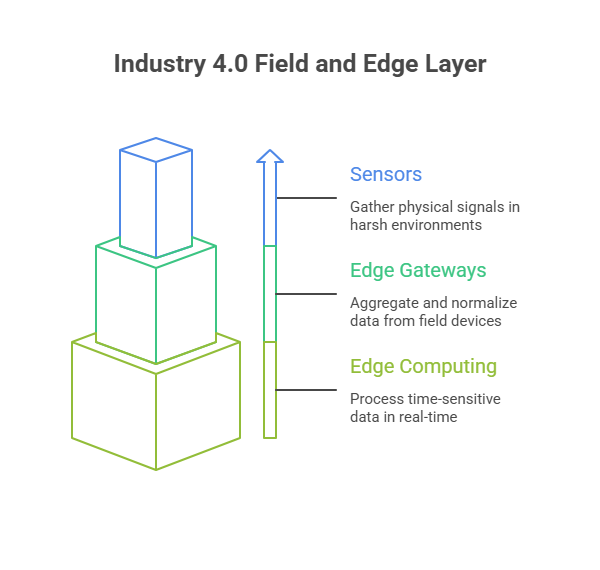
The field and edge layer is where Industry 4.0 physically starts: at the equipment. Industrial IoT connects assets to the network at this layer, adding digital connectivity to equipment that was previously data-dark or that communicated only to the local PLC with no path to higher-level systems.
Sensors gather the physical signals: temperature, pressure, vibration, flow, current, position, and dozens of other measurable variables depending on the equipment and process. Sensors at the field layer operate in harsh environments (high temperature, electrical noise, vibration, chemicals) and use industrial communication standards that IT engineers rarely encounter: 4-20mA analog signals, IO-Link, HART, Modbus RTU over RS-485.
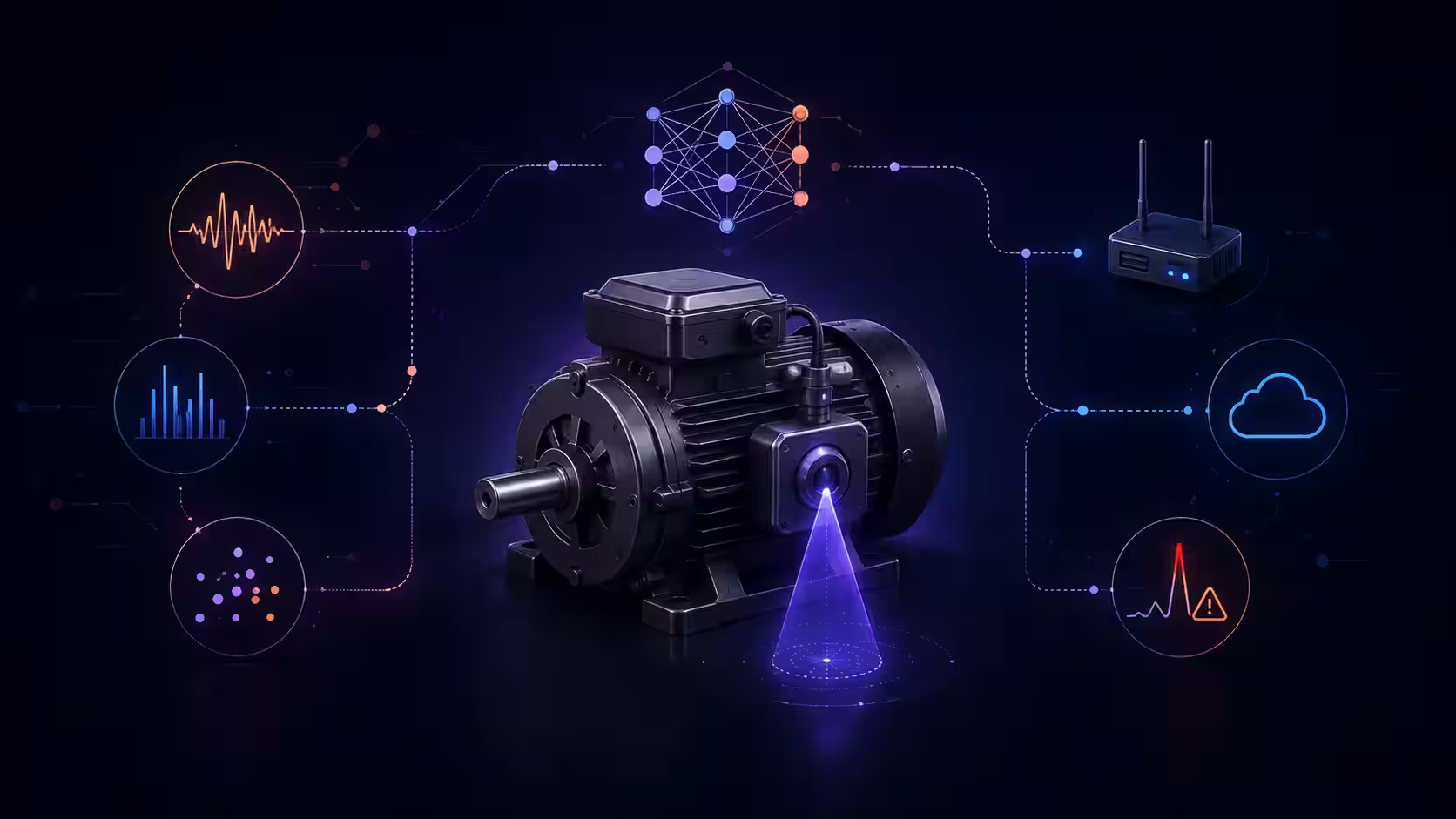
Edge gateways aggregate data from multiple field devices, filter noise and out-of-range values, and normalize signal formats from the heterogeneous field-layer protocols into a consistent format that the OT and data platform layers can consume. Edge computing supports real-time data processing in manufacturing at this layer: a gateway that runs local anomaly detection can flag a developing fault condition within milliseconds, before the raw data has traveled to any upstream system.
Edge computing at this layer handles time-sensitive workloads that cannot tolerate round-trip latency to a cloud platform: closed-loop quality control, safety system monitoring, and real-time OEE calculation per machine. Data that is not time-sensitive (trend data, historical records, model retraining sets) can be sent upstream on a slower path without compromising operational performance. The detailed edge design, from gateways to protocol normalization, follows the Industrial IoT architecture layers and components.
The OT layer is where PLCs, HMIs, SCADA, and DCS systems live. These systems are the operational core of the plant: they execute the control logic that makes equipment run safely and in specification, and they have been doing so for decades. The Industry 4.0 challenge at this layer is adding digital data integration without disrupting operational stability.
OPC UA integration is the standard approach for connecting modern OT systems to the data platform. OPC UA provides a platform-independent interface that most modern PLCs and SCADA systems support natively, exposing a typed, structured data model that the data platform can consume without schema negotiation. High-speed streaming and low-latency processing are crucial at this layer: an OPC UA subscription to a machine's cycle-count signal must deliver updates fast enough to calculate accurate OEE in real time, not on a polling cycle that misses events.
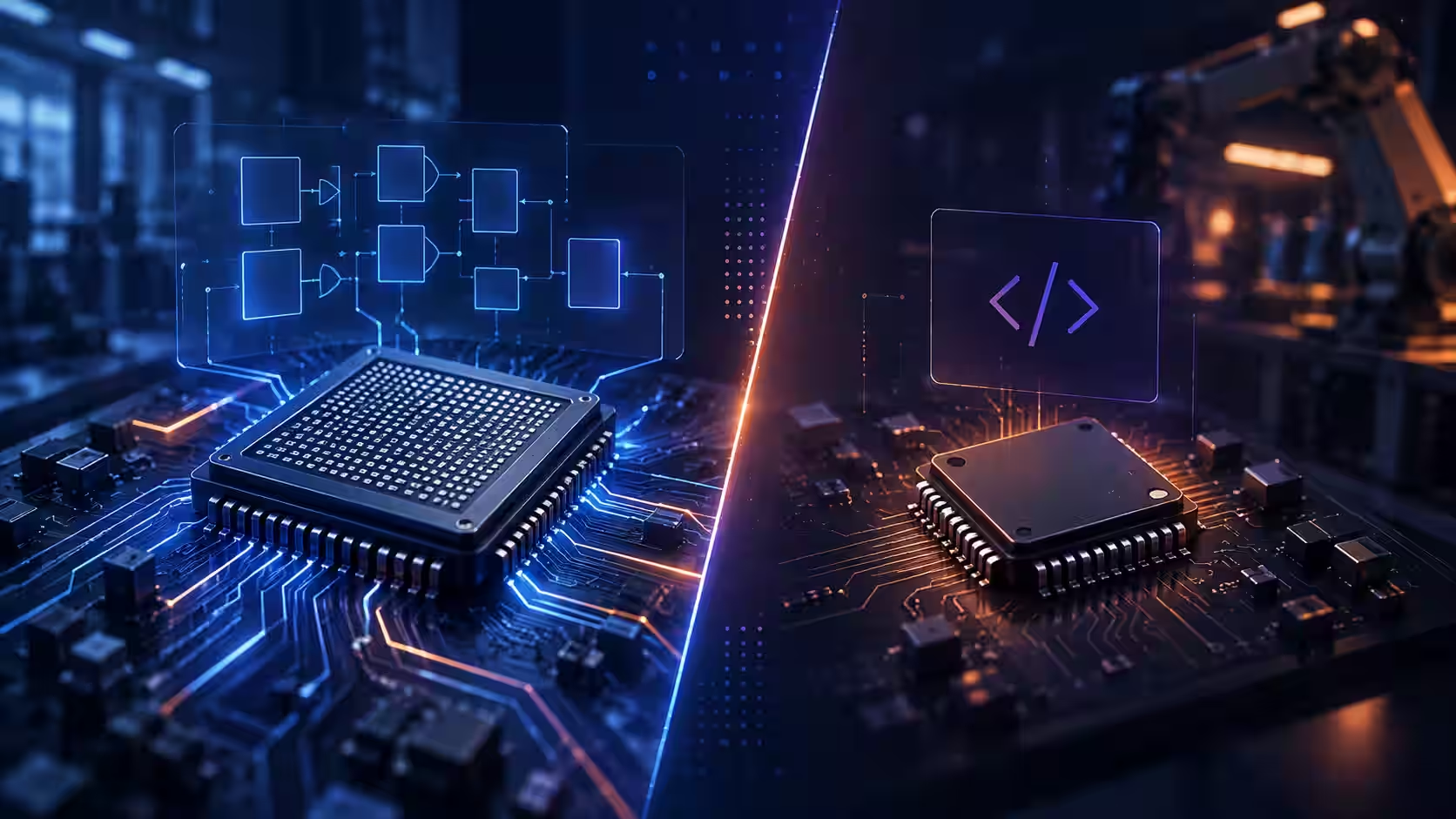
Legacy equipment bridging is the hard part. Assembly lines and machines installed before OPC UA existed, before Ethernet was standard on industrial controllers, and sometimes before digital communication of any kind was a design consideration. These machines require gateways that add IP connectivity to legacy serial or fieldbus protocols, translating Modbus RTU, PROFIBUS, or vendor-proprietary protocols to OPC UA or MQTT. This is where brownfield integration earns its difficulty: the diversity of legacy protocols, the absence of documentation for older equipment, and the operational risk of adding any interface to a running production system make legacy bridging the most labor-intensive part of an Industry 4.0 data architecture program.
For the protocol selection and translation patterns at this layer, see OPC UA vs MQTT.
The data platform layer is where raw industrial data from the OT layer becomes governed, contextualized, queryable information. Real-time streaming is a key feature of Industry 4.0 architecture at this layer: sensor events and OT data arrive continuously, and the platform must ingest, process, and make that data available to analytics without buffering delays that defeat the purpose of real-time monitoring.
A Unified Namespace (UNS) built on an MQTT broker is the standard pattern for the data distribution function at this layer: all OT and IT systems publish and subscribe to a single, consistently structured broker, eliminating point-to-point integrations. A unified data architecture supports cross-system interoperability through this single integration point: adding a new analytics consumer requires a new subscription, not a new integration project.
High-frequency sensor data (readings at 100ms intervals from a vibration sensor) requires a time-series database optimized for ingestion rate and time-range queries, not a general-purpose relational database. Contextual data (which production order is running on which machine, what quality specification applies to this batch, what operator is responsible for this production cell) requires a relational or document database that can be joined with time-series data for contextualized analytics.
A data lake stores the raw operational data in its original format, before any transformation or aggregation, enabling retrospective analysis with new models or questions that were not anticipated when the data was first collected. Industrial data platforms enable predictive maintenance models by providing this historical record of raw machine behavior that ML training requires.
For the data architecture and governance patterns, see industrial DataOps.
This layer converts governed, structured industrial data into actionable intelligence that operators, engineers, and business leaders can act on.
A digital twin is a virtual replica of a physical asset (a machine, a production line, a factory) that is continuously synchronized with real-time data from the physical asset. Digital twins help increase productivity and improve workflows by enabling simulation: a plant engineer can run a what-if scenario on the digital twin (what happens if I increase line speed by 5%? what if I change the maintenance interval on this compressor?) without affecting the physical asset. Digital twins are used to simulate production processes for training, optimization, and capacity planning. They require continuous quality data for real-time synchronization: a twin that loses synchronization with its physical counterpart due to data quality issues or connectivity loss becomes unreliable for both monitoring and simulation.
Machine learning enables predictive maintenance strategies at this layer by correlating historical sensor patterns with known failure events, then predicting when developing conditions are following the same trajectory. An ML model trained on vibration data from 200 similar compressors can predict with quantifiable confidence when a specific compressor needs maintenance, based on current vibration signatures, enabling a planned intervention weeks before the compressor would fail. Digital twins can minimize downtime and improve capacity utilization by making these predictions actionable, converting an unplanned emergency repair into a scheduled maintenance event that does not disrupt production.
Big data analytics enables anomaly detection in production cycles by identifying deviations from the statistical distribution of normal production behavior, surfacing quality problems, process drifts, and equipment degradations that rule-based alarm systems miss. The decision-making output from this layer, a dashboard alert, a work order, a schedule adjustment, or a setpoint change back down to the OT layer for closed-loop control, is what converts data into operational value.
Most Industry 4.0 programmes lose time between the OT layer and the data platform, where context and asset hierarchy disappear. We design that layer so digital twins and analytics stay synchronised.
Design the layer where your data actually fragments
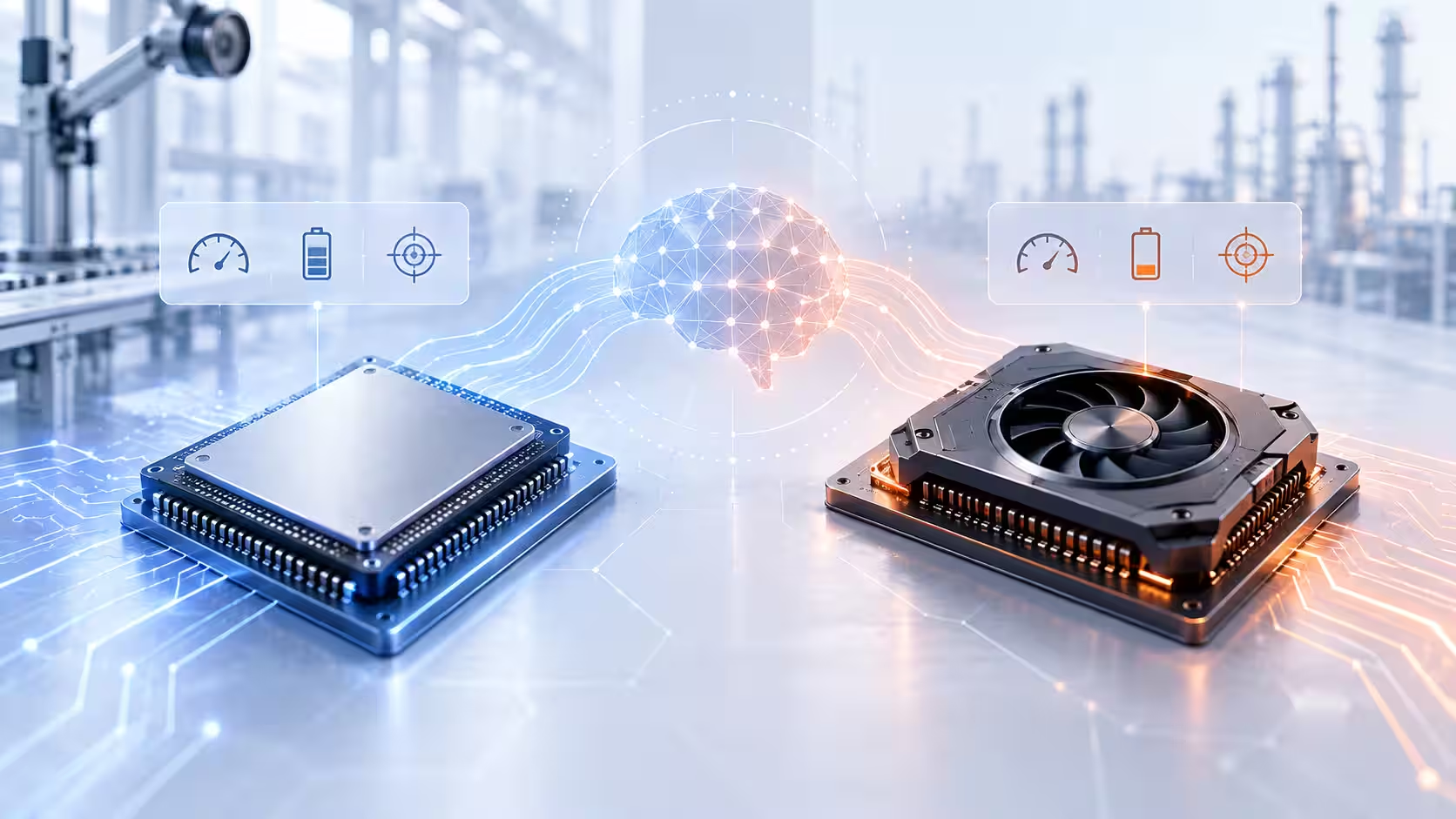
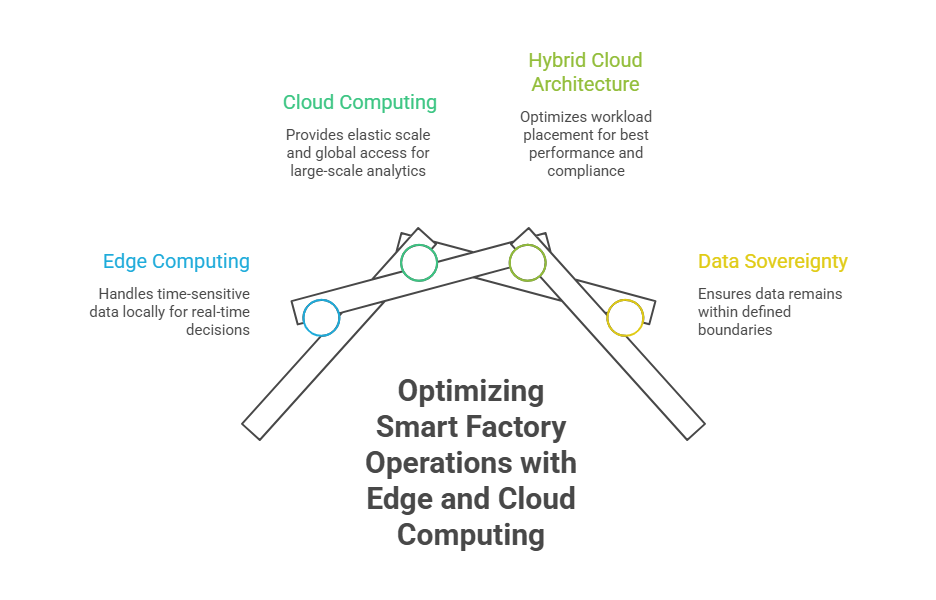
The edge-cloud division of labor is a design decision, not an ideology. Both are needed; the question is which workloads belong where.
Edge computing handles time-sensitive data that cannot tolerate round-trip latency to the cloud: closed-loop quality control (a vision inspection system that must accept or reject a part within the mechanical cycle time of the production line), real-time safety monitoring (a vibration anomaly that must trigger an alert within seconds, not minutes), and local analytics that continue functioning during connectivity interruptions. Latency can lead to lost yield and excess scrap in precision manufacturing; a quality decision that arrives after the non-conforming part has already left the production cell is not a quality decision in any operational sense.
Cloud computing is essential for Industry 4.0 workloads that require elastic scale: ML model training on large historical datasets, analytics across many sites, long-term data storage at volumes that on-premise hardware cannot economically accommodate. Cloud enables real-time data processing and integration of engineering and production data at the enterprise scale. For small manufacturers, cloud reduces startup costs for smart manufacturing programs by eliminating the need for on-premise server infrastructure for workloads that do not require local placement.
Hybrid cloud architecture optimizes workloads by placing them where they are best served: edge for latency-sensitive and offline-resilient workloads, cloud for elastic scale and global access, on-premise for workloads with data-sovereignty requirements or security constraints that prohibit cloud transmission. A hybrid multicloud infrastructure optimizes workloads by matching each compute requirement to the most appropriate environment rather than forcing all workloads into a single topology. Data sovereignty zones, where regulation or business policy requires certain data to remain within defined geographic or network boundaries, must be defined explicitly in the architecture and enforced through network controls, not assumed from cloud-provider commitments alone.
Edge-cloud data flows are governed at the data layer, where Industrial DataOps best practices set the quality gates, contracts, and buffering rules.
See also:
Industrial DataOps: Best Practices for the Factory Floor
What Is OT/IT Integration? Architecture, Benefits, Challenges
Brownfield IoT: Retrofitting Legacy Industrial Machinery for Predictive Maintenance
Choosing the right storage type for each data category is one of the most consequential early architecture decisions in an Industry 4.0 program, because changing storage architecture after data pipelines are built is expensive.
Time-series databases (OSIsoft PI, InfluxDB, TimescaleDB, and cloud-native options like Azure Time Series Insights) are optimized for the write-intensive, time-range-query workload of industrial telemetry: ingesting thousands of tag updates per second and retrieving a week of a specific sensor's readings in milliseconds. Time-series are the right store for raw sensor telemetry and aggregated production metrics.
Data lakes store raw big data in its original format, without schema enforcement, enabling retrospective analysis with questions and models that were not defined when the data was collected. Data integration eliminates silos for real-time visibility by bringing data from all sources into a single queryable layer where cross-system analysis is possible without manual data extraction. Data lakes serve the exploratory and training workloads that data scientists and ML engineers use; they are not designed for low-latency operational queries.
Data warehouses (structured, schema-enforced, query-optimized) serve the business analytics layer: production reports, KPI dashboards, compliance reporting, and supply chain analytics that require consistent, historically reconciled data rather than raw operational streams. Big data analytics can optimize supply chain management through this layer by giving supply chain planners access to actual production throughput, inventory consumption, and quality yield data in real time.
Cloud storage as a tiered strategy: high-frequency raw data in hot storage for 30 to 90 days, then tiered to warm or cold storage as query frequency decreases. Most industrial organizations retain aggregated production data for years; raw telemetry for shorter periods. Define retention policies based on both regulatory requirements and analytical value, not on default storage platform settings.
A digital twin implementation requires three things that are often underestimated: high-quality real-time data, a clear definition of what the twin is used for, and ongoing maintenance as the physical asset changes.
A digital twin begins with an asset inventory: every component of the physical asset that needs to be represented in the virtual model must be identified, along with the sensor or data source that provides its current state. For a production line with hundreds of components, this mapping is a weeks-long project, not an afternoon exercise.
Define twin synchronization frequency based on the twin's purpose: a twin used for real-time monitoring needs data updates at operational cadence (seconds to minutes); a twin used for weekly capacity planning simulations can synchronize once per shift. Over-synchronizing consumes bandwidth and compute; under-synchronizing makes the twin stale for its intended use case.
Digital twins are used to simulate production processes beyond current operation. A twin that has been validated against real production data can be used to test proposed changes (increasing line speed, changing a maintenance interval, introducing a new material) in simulation before implementing them on the physical asset, reducing the risk of production trials for process changes. Requiring continuous quality data for real-time synchronization is not just a data quality requirement; it is an operational discipline that the maintenance and operations teams must own alongside the data architecture team.
Without governance, a well-designed Industry 4.0 data architecture produces a data swamp rather than a data asset. The governance framework must be established before the architecture scales, not after.
Establish data stewardship for each data domain (production data, quality data, energy data, maintenance data): a named person or team responsible for data quality, schema changes, and access control decisions for that domain. Without named ownership, data quality issues go unresolved and schema inconsistencies accumulate. Data governance ensures data quality, security, and compliance by making these responsibilities explicit rather than assumed.
Define who can read which data, who can write to which systems, and who can modify schemas or access control policies. In a converged OT/IT environment, the principle of least privilege applies as strictly as in any enterprise security context: a quality inspector who needs to read quality records does not need access to production setpoints; an OT operator who needs to control a machine does not need access to financial data. Architectural sprawl increases cyber risk in manufacturing by creating integration points that lack consistent access control.
OT and IT have different security priorities (OT: availability and safety; IT: confidentiality and integrity) that must be reconciled in an integrated architecture. Security policies for cross-domain data flows must account for both: data crossing the OT/IT boundary must not introduce latency into control loops, and access controls must be enforced without creating workarounds that OT teams use to avoid operational impacts.
An Industry 4.0 data architecture that is designed in isolation from the enterprise architecture will eventually create conflicts with enterprise standards for data formats, security protocols, and integration patterns. Aligning early with enterprise systems and IT architecture prevents the costly architectural reconciliation that becomes necessary when a production-scale industrial data platform is discovered to be incompatible with the enterprise's cloud strategy or data governance framework.
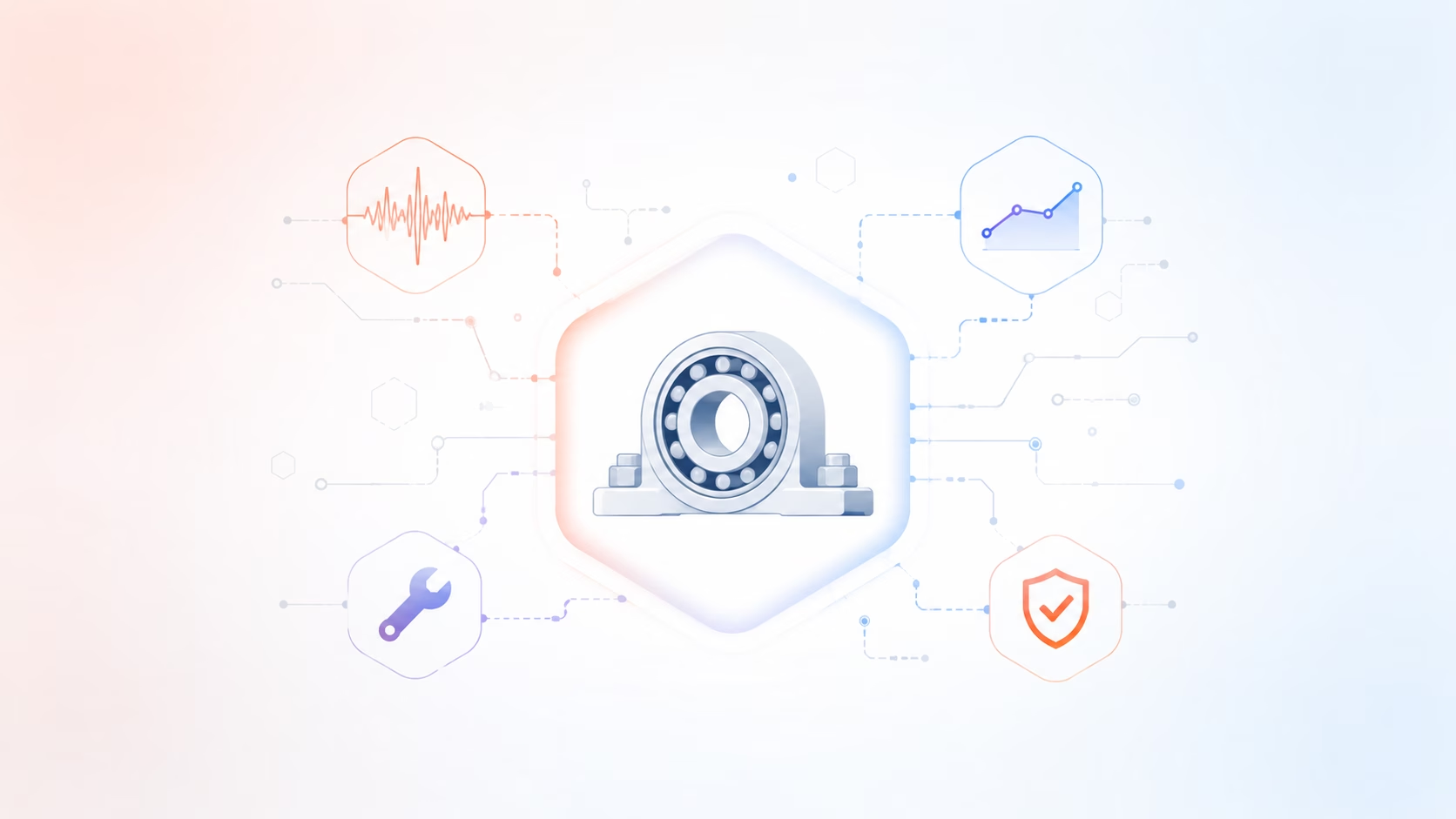
Predictive maintenance minimizes equipment downtime using real-time data and can increase efficiency significantly. Published figures from early-adopter manufacturers show predictive maintenance programs reducing unplanned downtime by 25 to 50% on targeted asset classes, with maintenance cost reductions of 10 to 25% as time-based servicing is replaced by condition-based servicing. The business case is direct: the cost of a planned bearing replacement is a fraction of the cost of an emergency repair with associated downstream downtime.
Smart factories can improve defect detection by approximately 50% compared to manual visual inspection, by deploying machine vision systems with AI-based defect classification at production line speed (McKinsey Global Institute, cited in industry analyses). AI vision inspects every unit rather than relying on sampling, catches defect types that are difficult for human inspectors to detect consistently, and generates a 100% inspected quality record that supports traceability requirements.
Real-time analytics from the production floor feed supply chain decisions with actual data rather than planned assumptions: actual production rates, actual material consumption, actual quality yields. Manufacturing operations connected to supply chain systems through an Industry 4.0 data architecture can respond to demand changes, material shortages, and production disruptions in hours rather than days.
Industry 4.0 data architecture enables mass customization by making it economically feasible to run short production runs with rapid changeover, with the data intelligence to execute them correctly: the right production parameters, the right materials, the right quality checks for each product variant, driven by data rather than operator memory or paper-based work instructions.
Most manufacturers are brownfield. 70% of manufacturers still rely on manual data collection processes (Manufacturing Leadership Council, cited in multiple industry analyses). 74% of manufacturing and engineering companies rely on legacy systems and spreadsheets (Intoware, 2022). Engineers in brownfield environments spend 30 to 70% of their time looking for information, gathering it from different systems, or manually copying it into spreadsheets (Forbes/Wilson, 2019). Data fragmentation hinders real-time visibility by creating information silos that cannot be queried across systems, and this condition describes the starting point for most real Industry 4.0 programs.
This is where an integrator earns its fee: not in designing the target architecture (which follows known patterns), but in navigating the brownfield reality of heterogeneous legacy equipment, incomplete asset documentation, and organizational resistance to change.
Phase 1: Asset inventory and mapping (weeks 1 to 6). Conduct a systematic inventory of every production asset in scope: manufacturer, model, vintage, communication interface, available data signals, and current connectivity. This inventory is the foundation for everything else. Prioritize integrations by business value: which asset classes have the highest unplanned downtime, the largest quality risk, or the most significant energy cost. These are the integration priorities, regardless of how easy or difficult they are to connect.
Phase 2: Edge gateway deployment and protocol normalization (weeks 4 to 16). Deploy edge gateways for each identified legacy protocol, validating connectivity one asset class at a time. Execute phased deployments per production cell to limit the operational risk of each integration step: a gateway deployment that causes a production interruption on one cell is recoverable; one that affects multiple cells simultaneously is not. Pacing the rollout cell by cell delays some returns, but it protects the uptime that most industrial IoT benefits ultimately depend on.
Phase 3: Data platform and UNS establishment (weeks 8 to 24). Establish the Unified Namespace with a governed topic taxonomy before connecting data consumers. Validate end-to-end data flows from field device to the data platform for each integrated asset class. Define and enforce schema standards at this stage, before consumer applications have been built against inconsistent schemas.
Phase 4: Analytics, digital twins, and business integration (months 6 to 24+). Connect analytics applications, digital twin synchronization, and business system integrations to the established data platform. Validate results against the pre-defined KPIs and adjust the roadmap based on what the data is actually showing. The phased deployment approach enables learning at each stage rather than discovering all integration issues simultaneously at a single go-live.
InTechHouse case study: Industry 4.0 data architecture on a brownfield plant
InTechHouse designed and implemented an Industry 4.0 data architecture for a manufacturing operator whose plant included equipment from three different decades, speaking four different communication protocols, with no unified data layer and a production reporting process that required engineers to spend hours each shift manually compiling data from disconnected systems.
The implementation began with a full asset inventory, followed by edge gateway deployment that translated from legacy Modbus and PROFIBUS installations to OPC UA northbound, alongside native OPC UA connections to the plant's newer equipment. A Unified Namespace was established on an MQTT broker using a topic taxonomy aligned to the plant's line-machine-measurement hierarchy, and a time-series historian was connected as the first data consumer, replacing the manual data-collection process with automated, real-time data capture.
The outcome was a production data platform that gave the operations management team real-time OEE visibility across all production lines simultaneously for the first time, and a historical dataset that enabled the first predictive maintenance pilot on the plant's highest-unplanned-downtime asset class within six months of the data platform going live.
High-quality, governed data is crucial for effective AI in industry. An AI model trained on bad data produces bad predictions; an AI model deployed without monitoring for drift eventually produces wrong predictions. Both failures are worse than no AI, because they mislead decision-makers.
Define, before connecting any analytics application to the data platform, the data quality criteria that data must meet to be used for operational decisions: acceptable time-lag from sensor event to platform availability, required measurement precision, completeness requirements (what percentage of expected readings must be present for a time window to be considered complete), and the validation process for data that arrives outside expected parameters.
Validate predictive analytics models against ground truth before deploying them to production: a predictive maintenance model must be tested against held-out historical failure events to demonstrate that it would have predicted those failures, not just that it achieves a high validation accuracy score. Ground-truth validation is the difference between a model that works in production and one that worked in the training environment.
Monitor and report model drift at defined intervals: seasonal changes in ambient temperature affect baseline vibration signatures; changes in production mix affect energy consumption patterns; equipment wear changes the normal operating envelope. Valuable data for a model trained last year may produce unreliable predictions this year if the data distribution has shifted. Establish a retraining trigger and cadence before deployment, not after the first observed drift.
An Industry 4.0 data architecture is a production system with SLAs. Instrument it accordingly.
Define the end-to-end latency SLA for each critical data flow: sensor event to dashboard update, production event to ERP record, anomaly detection model to maintenance alert. Instrument each stage of each pipeline with latency and throughput metrics. Alert when a pipeline falls outside its SLA before a user reports that their dashboard is stale.
Create dashboards that surface data quality anomalies (missing data from a sensor, values outside expected ranges, timestamp gaps) as operational alerts, not post-hoc audit findings. Data quality issues that are caught at the ingestion layer are corrected before they corrupt downstream analytics; issues discovered in the analytics layer require retroactive data reconciliation that is expensive and may be impossible for real-time operational records.
Implement lineage tracking for every dataset in the platform: what source it came from, what transformations it passed through, and which analytics applications and reports consume it. Inconsistent KPIs create strategic blind spots across many plants when the same metric (OEE, for instance) is calculated differently from different data sources at different sites, and lineage tracking is what makes it possible to identify and resolve those inconsistencies systematically rather than through endless manual investigation.
We build these architectures in plants that still run equipment with no digital signal at all, using gateways rather than rip-and-replace. Ask for the pattern set we start from.
See our brownfield data platform work
An Industry 4.0 data architecture program starts with an architecture review, not a technology purchase. The review should involve OT and IT teams together, map the existing asset estate and data landscape, identify the highest-value use cases and their data requirements, and produce a roadmap that is honest about the brownfield reality most plants face. The starting point is almost never a greenfield design; it is a phased integration plan that connects legacy assets, establishes a data platform, and builds toward digital twins and advanced analytics incrementally.
The governance and architecture workshop is the first productive step for most organizations: a structured session with OT operations, IT architecture, production management, and executive representation to align on the target state, the priority use cases, and the governance model before any technology is selected or deployed. Architecture decisions made before that alignment produce rework; decisions made after it produce results.
This is the next frontier in industrial competitiveness: the manufacturers who have connected their production data, built the analytics layer, and can act on real-time insight from their factories will outperform those who are still manually collecting data from disconnected systems.
To discuss designing an Industry 4.0 data architecture for your industrial operations, talk to the InTechHouse team.
Not sure where to start? We work with companies at every stage, from early ideas to enterprise-level builds. A 30-minute call can save you months of guesswork.
What is an Industry 4.0 data architecture?
An Industry 4.0 data architecture is a layered, interconnected design that connects physical manufacturing assets (sensors, PLCs, machines) to digital systems (data platforms, analytics, enterprise applications) and moves operational data from the field to the enterprise for real-time decisions. It is the technical implementation of smart manufacturing, enabling continuous data flow from every connected asset through a governed data platform to the analytics and business applications that convert that data into operational and competitive advantage.
What are the layers of an Industry 4.0 architecture?
The five standard layers are: field and edge (sensors, PLCs, and edge gateways), OT and control (SCADA, DCS, and HMI systems), data platform (Unified Namespace, time-series database, data lake), analytics and digital twin (ML models, digital twins, BI dashboards), and enterprise (ERP, MES, and supply chain systems). Data moves upward from sensors to analytics and business insight; decisions and setpoints move back downward for closed-loop control and execution.
What is a digital twin in manufacturing?
A digital twin is a virtual replica of a physical asset (a machine, a production line, a factory) that is continuously synchronized with real-time data from the physical asset. Digital twins are used to simulate production processes, enabling what-if analysis and optimization in the virtual model without risk to the physical asset. Effective digital twins require high-quality, continuous data for real-time synchronization; a twin that loses synchronization with its physical counterpart becomes unreliable for monitoring or simulation.
How do you modernize a brownfield factory's data architecture?
In four phases: first, conduct an asset inventory and protocol discovery to understand what equipment exists and how it communicates. Second, deploy edge gateways to translate from legacy protocols (Modbus, PROFIBUS, proprietary formats) to modern standards (OPC UA, MQTT) at the plant boundary. Third, establish a Unified Namespace with a governed topic taxonomy before connecting data consumers. Fourth, onboard analytics applications, digital twins, and business system integrations to the validated data platform, validating each integration before expanding scope.
Edge or cloud for smart factory data?
Both, in their appropriate roles. Edge computing handles time-sensitive workloads that require local processing at low latency: closed-loop quality control, real-time safety monitoring, and analytics that must continue functioning during connectivity loss. Cloud computing handles elastic-scale workloads: ML model training on large historical datasets, multi-site analytics, and long-term storage at volumes that on-premise infrastructure cannot economically provide. A hybrid cloud architecture optimizes workloads by placing each at the tier where its requirements (latency, scale, data-sovereignty) are best met.
Jacek Suty is Head of Solution Architecture at InTechHouse, with more than 30 years of experience in system architecture, enterprise IT, infrastructure, information security, and complex digital transformation programs.
He specializes in designing enterprise and solution architectures, translating business and regulatory requirements into scalable technology platforms, and coordinating delivery across software, infrastructure, data, and security teams. His work covers enterprise architecture based on TOGAF, system modeling using UML and BPMN, cloud and on-premise infrastructure, CI/CD processes, data platforms, cybersecurity, and IT governance.
Jacek has contributed to large-scale technology programs for public institutions, finance, energy, education, healthcare, utilities, and digital archives. His project experience includes nationwide public digital infrastructure, distributed document-management and archiving systems, data-exploration platforms using machine learning and predictive analytics, and transaction systems combining blockchain, metadata standards, and computational intelligence.
He holds PRINCE2 Practitioner, Management of Risk, Scrum Master, ITIL Foundation, and ISO/IEC 27001 Lead Auditor qualifications. Jacek is currently pursuing a doctoral degree at Bydgoszcz University of Science and Technology, combining academic research with extensive experience in real-world architecture and technology delivery.
He writes about enterprise architecture, system design, digital transformation, data platforms, cloud infrastructure, cybersecurity, technology governance, and the practical application of AI in complex information systems.
Jacek Suty's academic and professional profiles:
https://pbs.edu.pl/pl/doktorant/uczelniania-rada-samorzadu-doktorantow
https://www.isep.pw.edu.pl/isep/zs/Aktualnosci/Kalendarium-wydarzen2/Seminarium-zakladowe-9.03.2021-Jacek-Suty
https://aionehealth.pl/wp-content/uploads/2026/04/Raport-2026-final.pdf
This initial conversation is focused on understanding your product, technical challenges, and constraints.
No sales pitch - just a practical discussion with experienced engineers.
Share a few details about your product and context. We’ll review the information and suggest the most appropriate next step.