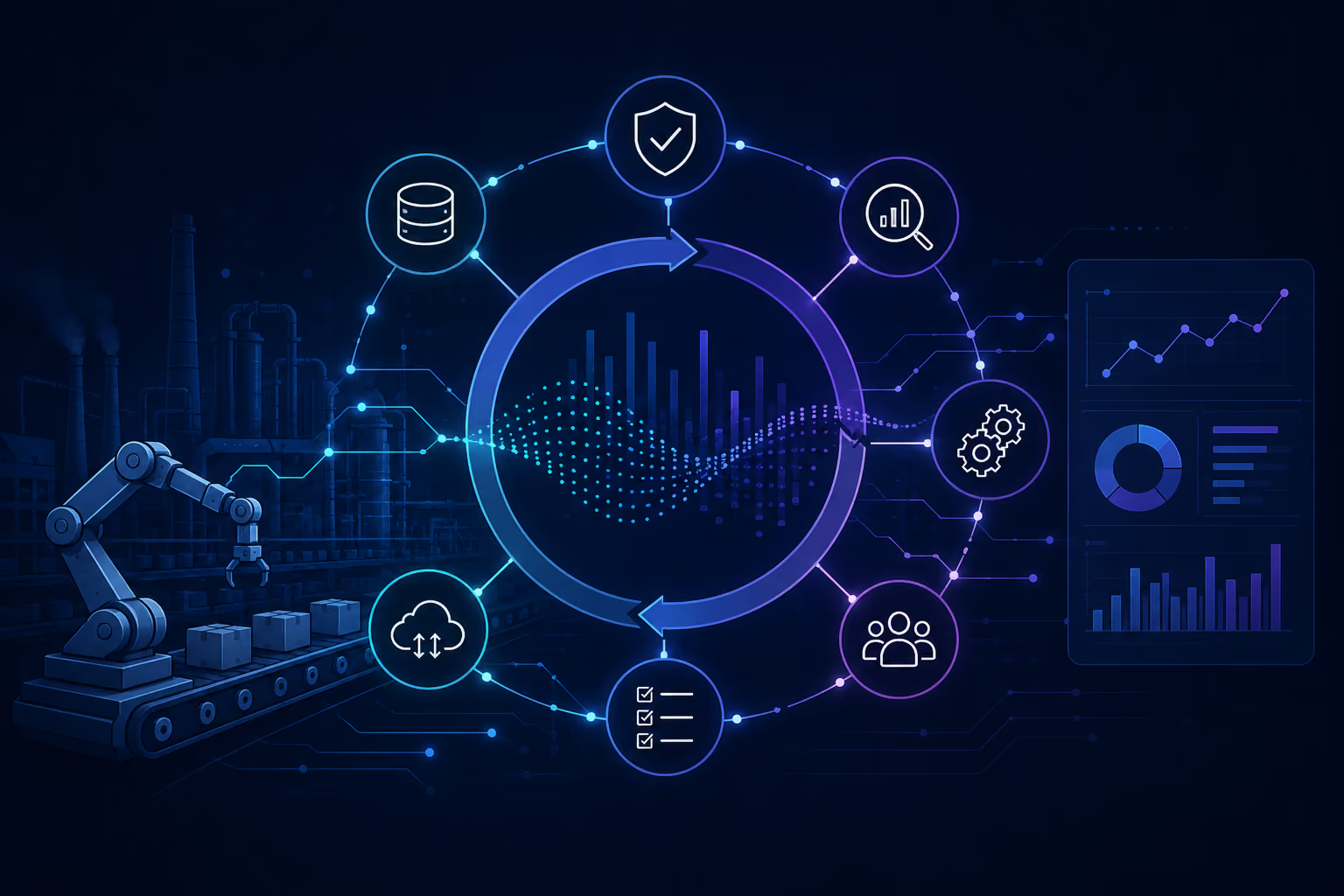
An Industrial IoT (IIoT) architecture is a hierarchical, edge-to-cloud design that connects industrial machinery to networks and moves data through defined layers, perception, network, processing, and application, so operations get real-time insight from equipment that previously generated no digital data at all, which is how IIoT transforms industry in day-to-day operations. In a real plant, that hierarchy spans from a temperature sensor on a reactor vessel to a predictive maintenance dashboard on an operations manager's screen, with gateways, brokers, platforms, and analytics in between. This page maps those layers and components, covers the protocols and integration points between them, and describes what makes legacy OT integration the hard part that most reference architectures understate.
Key Takeaways
An IIoT architecture delivers three outcomes that separate data-driven manufacturing from traditional manufacturing: real-time insight into what equipment and processes are doing right now, the historical data foundation for AI-powered prediction and optimization, and the integration layer that connects operational data to business systems for actual decision support.
IIoT enhances operational efficiency through real-time data analysis and automation: instead of an operator discovering a compressor is degrading at the next scheduled inspection, a properly instrumented IIoT architecture detects the vibration signature of bearing wear weeks in advance and generates a maintenance work order automatically. It provides unprecedented visibility into operations at a level of granularity and freshness that manual reporting and periodic inspections cannot match.
Key stakeholders for an IIoT architecture program include: OT operations (who own the equipment and understand the process requirements), IT architecture (who own the infrastructure and integration standards), production and maintenance management (who define the use cases and business value), and executive sponsorship (who fund the program and govern the cross-functional change). Success metrics span both operational (unplanned downtime reduction, OEE improvement, maintenance cost reduction) and technical (data latency from sensor to dashboard, coverage of connected assets, data quality and uptime of the IIoT infrastructure itself).
The Industrial Internet of Things is the network of industrial devices, sensors, controllers, and systems that are connected to each other and to enterprise networks, enabling the continuous collection, transmission, and analysis of operational data from physical equipment. IIoT architecture is the structured design that governs how those connected devices communicate, where data is processed, and how operational data reaches the applications and people who need it.
IIoT architecture typically follows a hierarchical structure, with foundational technology at the field level (sensors and PLCs), intermediate layers for connectivity and edge processing, and higher layers for platform-scale analytics and business integration. IIoT uses industrial communication protocols for reliable, low-latency data transmission, distinct from general-purpose internet protocols in their determinism and reliability requirements for control applications.
The relationship to operational technology is direct: IIoT architecture is the technology layer that connects OT systems (SCADA, PLCs, sensors) to IT systems (cloud platforms, analytics, enterprise applications). It is the practical implementation of OT/IT convergence. Connected devices at the network edge are the starting point: without those devices generating and transmitting data, no higher layer of the architecture has anything to work with. For the broader OT/IT integration context, see OT/IT integration.
The Industrial Internet Reference Architecture (IIRA), published by the Industrial Internet Consortium, provides a framework for developing IIoT systems that addresses the needs of multiple stakeholders across business, usage, functional, and implementation viewpoints. When shortlisting IIoT development companies, asking how they map a project onto the IIRA viewpoints quickly shows who works from a structured framework.
The IIRA guides IIoT system development by separating concerns across these viewpoints: the business viewpoint identifies the stakeholders and their objectives; the usage viewpoint describes the system's activities from the user's perspective; the functional viewpoint defines the functional components and their interactions; and the implementation viewpoint addresses the technology and standards required. For a manufacturing IIoT program, the functional and implementation viewpoints are the most immediately relevant, defining the layers and components this guide covers in detail.
Regulatory compliance requirements vary by industry and jurisdiction. IIoT systems that connect to critical infrastructure (energy, water, transportation) or that process personal data (worker health monitoring, visitor tracking) have specific regulatory obligations that must be addressed in the architecture design, particularly around data sovereignty, access control, and incident reporting. Verify applicable requirements with legal and compliance teams before finalizing the architecture.
This is the core of the architecture and the section that delivers on the title's promise. The layered model provides both a design structure and a troubleshooting framework: when something breaks, knowing which layer owns the problem determines who fixes it and how.
IIoT architecture layers table
| Layer | Function | Key components | Design constraints |
|---|---|---|---|
| Perception | Interact with the physical environment and machinery | Sensors (temperature, pressure, vibration, flow), actuators, PLCs, SCADA, meters | Real-time response, electrical noise immunity, industrial ratings |
| Network | Transport data from field devices to processing | Industrial networks, edge gateways, cellular/Wi-Fi/wired connectivity, protocol translation | Latency, determinism, reliability, security at the OT/IT boundary |
| Processing | Ingest and analyze raw data to generate useful information | Edge compute nodes, on-premise servers, cloud platforms, stream processors, historians | Bandwidth, storage cost, compute cost, data quality |
| Application | Let users act on analyzed data for operational tasks and business goals | Dashboards, SCADA, MES, ERP, predictive maintenance applications, mobile alerts |
Perception layer. The perception layer interacts with the physical environment and machinery. Sensors gather data like temperature, pressure, and vibration from equipment and processes; actuators execute commands from control systems; PLCs implement the control logic that makes automated processes function. This layer is entirely OT: it operates in real time, is engineered for the specific physical environment (hazardous areas, extreme temperatures, vibration), and uses industrial communication protocols optimized for control rather than data volume.
Network layer. The network layer transports data from the perception layer to the processing layer. Industrial equipment at this layer includes edge gateways that aggregate and translate raw data before sending it upward, converting legacy fieldbus protocols (Modbus, PROFIBUS, EtherNet/IP) to IP-based standards (OPC UA, MQTT) that the processing and application layers understand. The network layer is the OT/IT boundary: below it is deterministic, industrial networking; above it is IT-style networking with standard protocols and enterprise security.
Processing layer. The processing layer ingests and analyzes raw data to generate useful information. This layer spans from edge compute (processing data locally at the plant, with low latency and offline resilience) through on-premise servers (plant-level historians, MES integrations) to cloud platforms (enterprise analytics, ML model training, multi-site aggregation). The processing layer is where raw sensor readings become OEE metrics, anomaly scores, and maintenance predictions.
Application layer. The application layer lets users use analyzed data for operational tasks and business goals. Dashboards give plant operators and production managers real-time visibility. Predictive maintenance applications generate maintenance work orders before failures occur. MES and ERP systems consume production actuals that flow up from the processing layer. Mobile alerts reach field technicians instantly when a monitored asset requires attention.
The protocol estate in a real industrial plant is never a single protocol. It is a mix of legacy fieldbus protocols inherited from decades of capital investment, modern IP-based standards adopted for newer equipment, and proprietary vendor protocols for specific equipment types.
Protocol table
| Protocol | Layer | Primary use | Notes |
|---|---|---|---|
| Modbus TCP/RTU | Field to gateway | Legacy PLC and sensor communication | Ubiquitous in brownfield environments; no built-in security |
| PROFINET / PROFIBUS | Field | Siemens and European automation ecosystems | Common in European manufacturing plants |
| EtherNet/IP | Field | Rockwell and Allen-Bradley automation ecosystems | Common in North American manufacturing |
| OPC UA | Field to gateway, gateway to platform | Semantic machine-to-machine communication | Platform-independent interoperability standard; preferred in IIoT for structured data |
| MQTT | Gateway to platform, platform to application | Lightweight publish-subscribe transport | De facto IIoT messaging standard; handles packet loss and interruptions effectively |
| BACnet | Field | Building automation, including HVAC and lighting | Common in smart building and energy management IIoT systems |
| DNP3 | Field | Utility and energy sector SCADA | Common in water, power, and oil and gas systems |
OPC UA is the platform-independent interoperability standard for structured machine communication, providing typed information models and built-in security. MQTT is the de facto IIoT messaging standard for lightweight, scalable data distribution, designed for low-bandwidth, high-latency environments. For the detailed protocol comparison, see OPC UA vs MQTT.
Protocol translation strategy. IIoT connectivity must support diverse physical channels and protocols. The practical approach for a brownfield plant is to handle all protocol translation at the edge gateway layer, converting from whatever the field device speaks to a normalized format (typically OPC UA or Sparkplug B-formatted MQTT) at the plant boundary. This keeps the diversity of the field layer from propagating into the integration architecture above it.
The Unified Namespace. A Unified Namespace (UNS) is a single, consistently structured MQTT broker that all OT and IT systems in the enterprise publish and subscribe to. Rather than point-to-point integrations between every data producer and every data consumer, all systems connect to the same broker using a hierarchical topic structure aligned to the plant topology (for example site/line/machine/measurement). This eliminates integration spaghetti: adding a new consumer requires only a new subscription to the broker, not a new connection to each source. The UNS topic taxonomy should align to ISA-95 or site topology conventions to maintain discoverability and governance.
SCADA systems connect to the UNS both as publishers (making real-time process data available to enterprise consumers) and as subscribers (receiving setpoints or operational parameters from business systems where appropriate). Device connectivity to the UNS passes through edge gateways that handle the field-protocol translation described above.
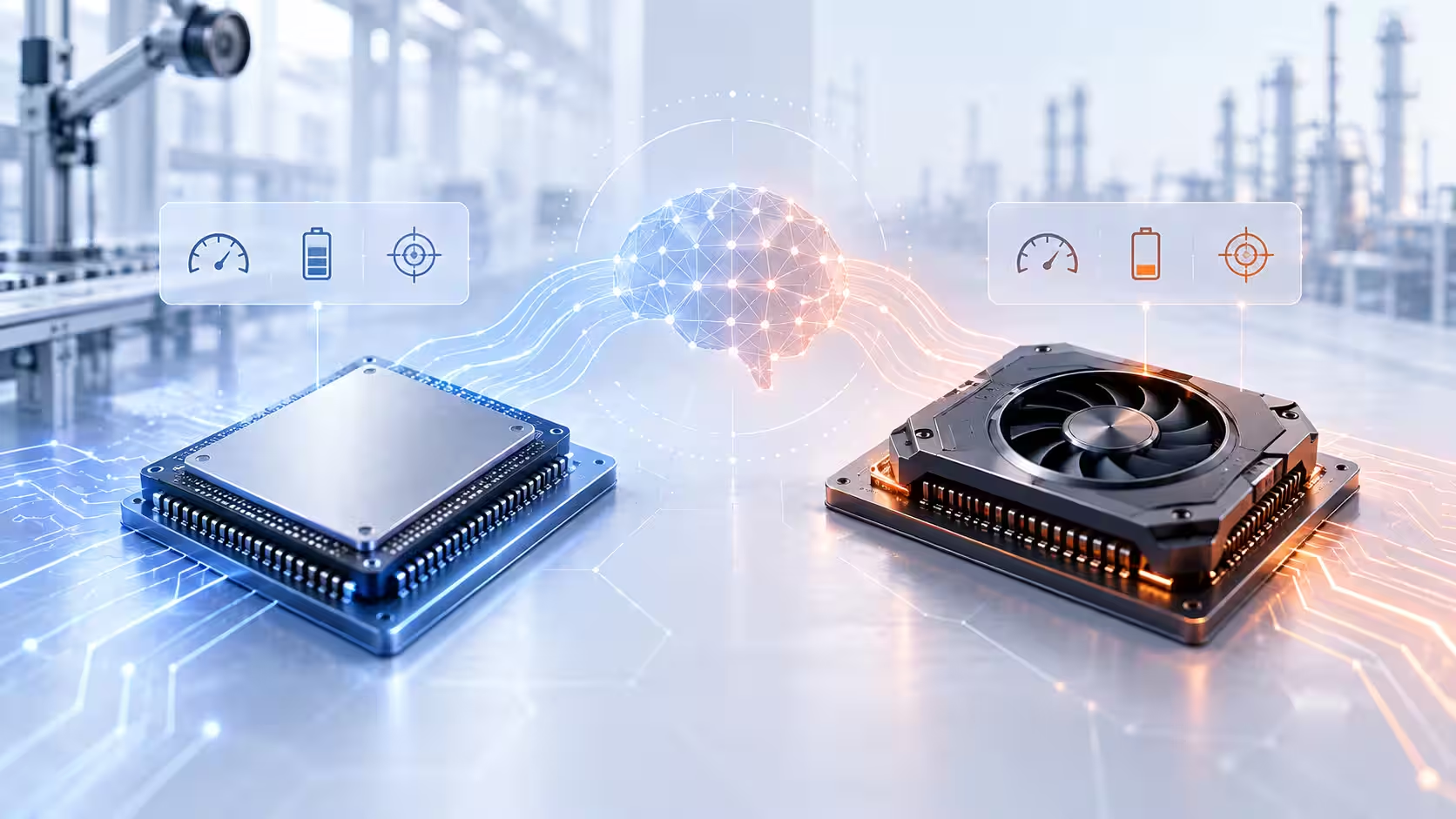
Edge computing processes data at the network edge, on hardware physically located at or near the plant, rather than sending all raw data to a central cloud or data center. For IIoT, edge computing is not optional for time-sensitive data: a predictive maintenance algorithm that needs to react within seconds to a vibration anomaly cannot afford the round-trip latency to a cloud inference endpoint.
Use cases that require edge computing:
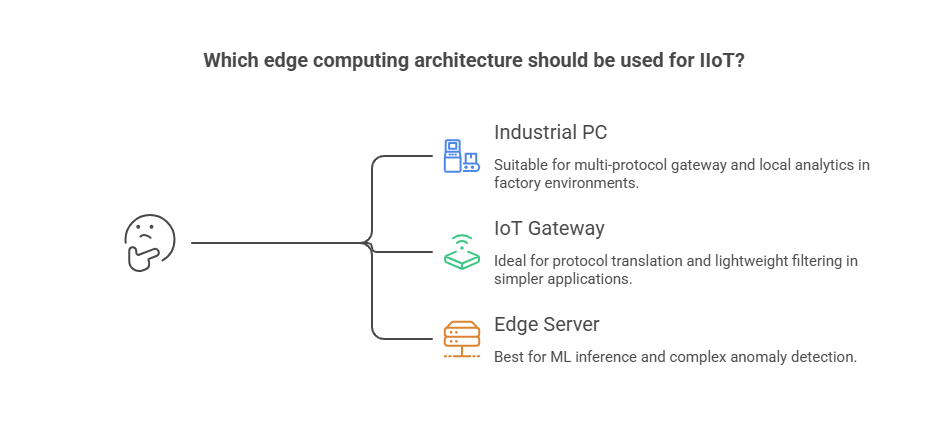
Edge hardware profiles. Edge hardware selection depends on the compute requirement and the physical environment. A ruggedized industrial PC (rated for temperature, vibration, and ingress protection) handles multi-protocol gateway and local analytics functions in a factory environment. A compact IoT gateway device handles protocol translation and lightweight filtering for simpler applications. A more capable edge server handles ML inference for complex anomaly detection or multi-camera vision applications.
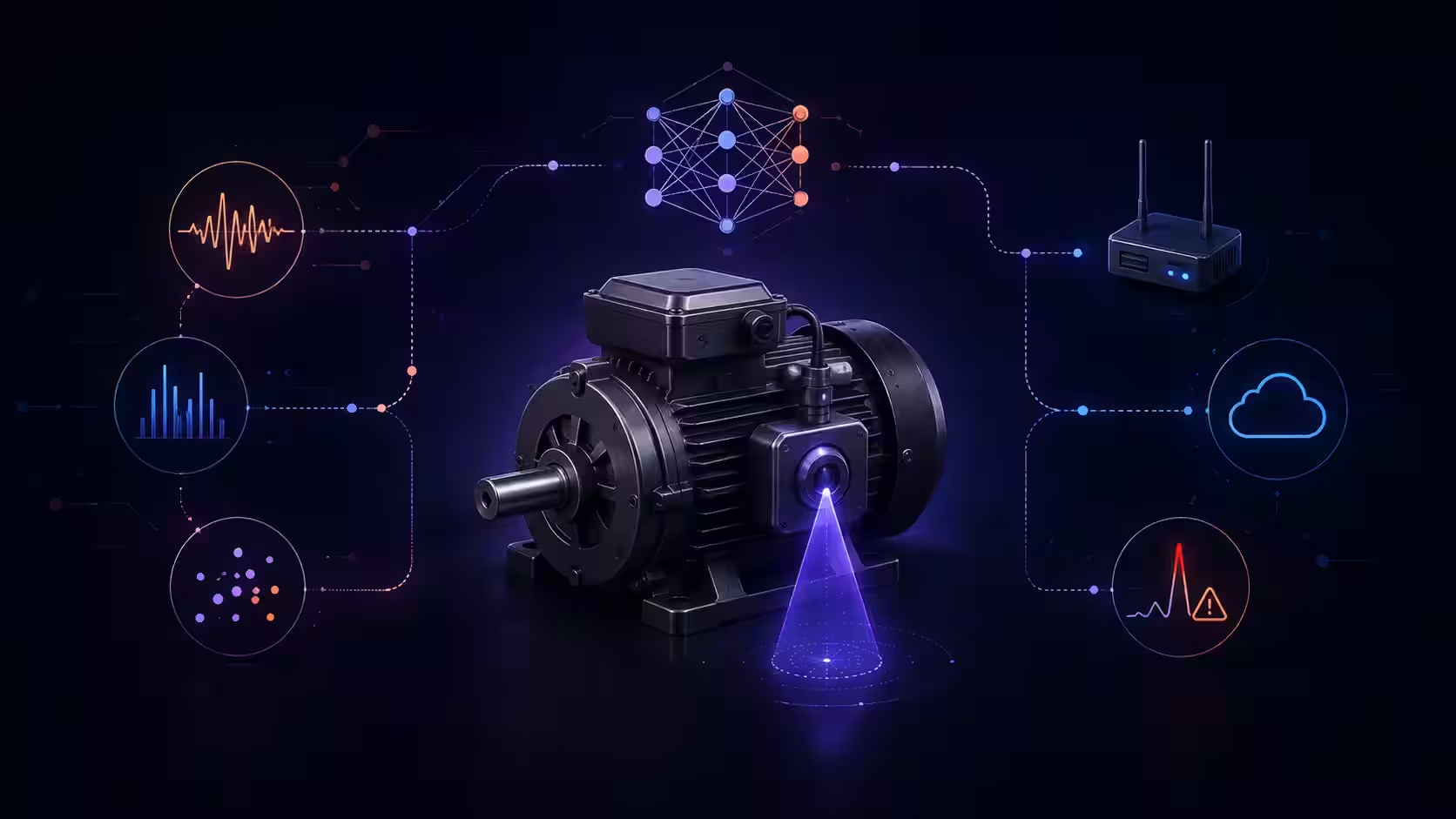
Edge computing supports predictive maintenance by processing data locally: vibration and temperature data from rotating equipment is processed at the edge, where a locally deployed model generates a health score and a time-to-failure estimate without the raw data ever leaving the plant. For the data-layer architecture that governs edge processing, see industrial DataOps.
See also:
What Is OT/IT Integration? Architecture, Benefits, Challenges
OPC UA vs MQTT: Industrial Protocol Comparison
SCADA vs MES vs ERP: What's the Difference?
Industrial organizations generate terabytes of operational data monthly across sensors, controllers, quality systems, and process historians. Managing this volume with consistent quality, appropriate governance, and useful structure is an architecture problem that most IIoT programs underestimate.
Raw operational data is high-volume and often noisy: sensor dropouts, out-of-range values, timestamp misalignments, and unit-of-measure inconsistencies are common in brownfield environments. Establishing schema-validation rules before data reaches the analytics layer prevents low-quality data from corrupting models and reports. Data formats vary widely across vendors and systems, and normalization must be explicit: a temperature reading in Celsius from one PLC and Fahrenheit from another must be reconciled at the gateway or stream processing layer, not left to each application to handle independently.
Time-sensitive data (process alarms, real-time OEE metrics) requires hot-path processing with sub-second latency. Historical process data for trend analysis and model training can be processed on a cold path with higher latency but lower cost. A tiered storage policy, retaining high-frequency raw data for 30 to 90 days and aggregated data for years, balances storage cost against regulatory requirements (some regulated industries require raw production data for 7+ years).
Every data stream needs lineage documentation: what source produces it, through what transformations it passes, and what downstream applications consume it. Without this lineage, debugging data quality issues is detective work, and the impact of a source-system change on downstream analytics is invisible until something breaks.
For the full industrial data architecture pattern, see industrial DataOps and Industry 4.0 data architecture.
An IIoT platform is the software layer that ingests, stores, processes, and exposes industrial data from edge devices to applications. Evaluating IIoT platforms against data-ownership criteria is essential before commitment: some cloud IIoT solutions store all operational data in the vendor's cloud, which may conflict with data-sovereignty requirements, IP-protection concerns, or simply with the economics of transmitting high-frequency sensor data to a remote cloud.
Cloud IIoT solutions (AWS IoT, Azure IoT Hub, Google Cloud IoT) leverage cloud computing for scalable data processing: near-unlimited storage, elastic compute for ML model training, and managed integrations to cloud analytics services. On-premise or hybrid options (Ignition by Inductive Automation, OSIsoft PI, custom deployments on industrial servers) keep data in the plant while providing platform capabilities. The right choice depends on connectivity cost, data-sovereignty requirements, latency needs, and the organization's cloud strategy.
Integrating IIoT with legacy systems presents interoperability challenges because legacy equipment often lacks native connectivity: older PLCs and sensors speak Modbus or PROFIBUS, have no REST API, and in some cases have no IP interface at all. These devices require gateways (protocol converters) that add IP connectivity to legacy serial or fieldbus protocols. Requiring native OPC UA connectors from a platform vendor is a reasonable integration criterion, since OPC UA is the dominant standard for structured machine communication in modern industrial environments.
Reference architectures assume connectivity your plant does not have. We design the gateway and protocol normalisation layer that brings legacy PLCs and unnetworked assets into the same namespace.
Connect the brownfield machines that generate no data
Define the APIs and event formats through which the IIoT platform exposes data to downstream applications (MES, ERP, dashboards, notification systems) before evaluating platforms. A platform that exposes data only through a proprietary API creates vendor lock-in at the integration layer. Standard event patterns (MQTT topics, REST APIs with OpenAPI specifications, webhook delivery) are more portable.
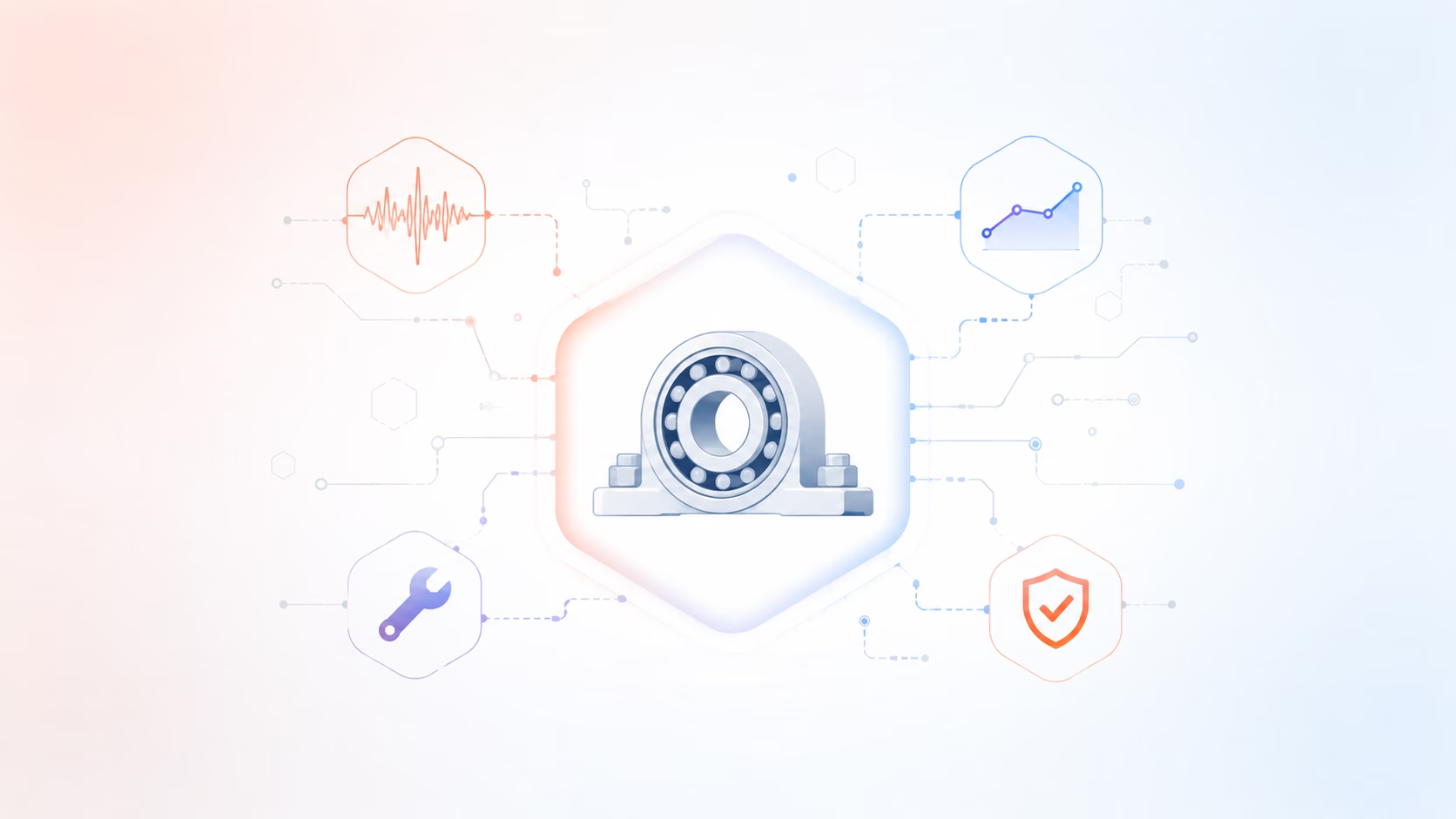
The highest-value, highest-adoption IIoT application. Predictive maintenance can reduce downtime and improve productivity by detecting equipment degradation early: vibration sensors on rotating machinery, temperature sensors on electrical panels, and acoustic sensors on compressors generate the signals that ML models correlate with specific failure modes. A bearing that will fail catastrophically in two weeks shows a specific vibration frequency signature weeks in advance; a motor that is overloading shows elevated temperature at the windings before it trips. The business case is direct: a planned bearing replacement at $2,000 versus an unplanned motor failure with downstream downtime at $40,000.
Real-time monitoring provides visibility into machine performance and production status at a granularity and freshness that manual reporting cannot match. Equipment performance dashboards that update in real time let a shift supervisor see OEE by line, by machine, and by product during the shift rather than reviewing yesterday's report. Asset data from every connected device is available for troubleshooting, trend analysis, and compliance reporting.
IIoT provides end-to-end visibility in supply chains by connecting production output data to logistics and inventory systems in real time: actual production quantities flow to ERP immediately rather than at shift end, enabling more responsive supply chain decisions. Track-and-trace applications use IIoT data (location, temperature, handling events) to provide end-to-end product visibility from raw material receipt to customer delivery.
Connected energy meters and smart power monitoring equipment provide granular energy consumption data by machine, by line, and by time of day, enabling energy optimization programs (shifting high-consumption operations to off-peak tariff periods, identifying machines that consume disproportionate energy per unit of output) that are impossible without the metering data IIoT provides.
AI and analytics in the processing layer help detect anomalies and optimize production schedules. The standard deployment pattern for industrial AI is: train models on historical operational data (captured by the IIoT historian), deploy inference to edge or cloud depending on latency requirements, and continuously monitor model performance for drift.
Define the anomaly-detection objective precisely before selecting a model approach: detecting a compressor cavitation event (millisecond-level, edge inference required) is a different problem from detecting a gradual increase in bearing temperature over weeks (batch inference on historical data is sufficient). Detection windows, the time between an anomaly appearing and the system generating an alert, must be within the window of opportunity to intervene before the anomaly becomes an incident.
Choose model-training data from validated sensor streams only. Data quality gates before the analytics consumption layer (covered in the Data Architecture section above) prevent corrupted sensor readings from degrading model performance. Machine learning identifies optimal operating conditions by training on historical process data where both the inputs (sensor readings) and the output (production quality, energy consumption, failure events) are known, and then predicting outcomes for current operating conditions.
Plan inference placement at edge or cloud per latency requirement. Time-sensitive data requiring inference within seconds must run at the edge, close to the sensor. Non-time-sensitive analytics (weekly energy optimization, batch quality prediction, model retraining) can run in the cloud where compute is elastic and cost-efficient. Create monitoring for model drift: a predictive maintenance model trained on summer operating conditions may degrade in winter when ambient temperatures affect baseline vibration signatures, and that drift must be detected and addressed through retraining before the model's predictions become unreliable.
Edge computing enhances operational efficiency in Industry 4.0 applications by enabling real-time AI inference at the plant floor, without the round-trip latency of cloud inference. A locally deployed anomaly detection model that flags an emerging fault condition in real time, triggering a maintenance alert before the fault causes a production stoppage, delivers business value that a cloud-only architecture cannot match for time-sensitive applications.
Cybersecurity risks increase when connecting OT to networks: equipment that was previously isolated from external access becomes reachable when it joins an IIoT architecture. IIoT devices increase the threat surface beyond what traditional OT security was designed to address. The security architecture must address both the new IIoT attack surface and the legacy OT security gaps that IIoT connectivity makes more consequential.
Segment networks into security zones for OT and IT, following the IEC 62443 zone-and-conduit model. OT devices sit in a protected OT zone with controlled, monitored ingress and egress. The IIoT gateway sits in a DMZ that can communicate to both OT and IT networks with explicit rules governing which data flows are permitted in each direction. Enterprise IT systems never have direct network access to OT devices; all communication passes through the gateway DMZ.
Robust zero-trust security is essential for protecting IIoT: every device, every user, and every application that accesses IIoT data must be authenticated and authorized before access is granted, regardless of whether the request originates inside or outside the perimeter. Zero-trust limits lateral movement: a compromised IT system cannot reach an OT controller directly if every access request must pass authentication and authorization checks at every layer.
Device hijacking is a common risk for IIoT devices that ship with default credentials, run unpatched firmware, or expose management interfaces to the network. Timely firmware upgrades are necessary to address disclosed vulnerabilities; a device management platform that tracks firmware versions across the entire connected fleet and alerts on outdated devices is a basic operational security requirement. Secure IIoT deployments require certificate-based device authentication, encrypted communications between devices and the gateway, and physical security for devices in accessible locations.
IIoT malfunctions can lead to production downtime and safety hazards. An IIoT system that sends an incorrect command to a field device, or that crashes in a way that disables monitoring for safety-critical equipment, has real physical consequences. Define incident-response playbooks for OT incidents that cover both the cybersecurity response (contain and remediate the security incident) and the operational response (ensure the physical process remains safe during the recovery period).
The answer-first guidance: start narrow, scale with governance. Pilot a specific high-value use case on a limited scope, prove measurable KPIs, then scale the architecture across additional use cases and sites.
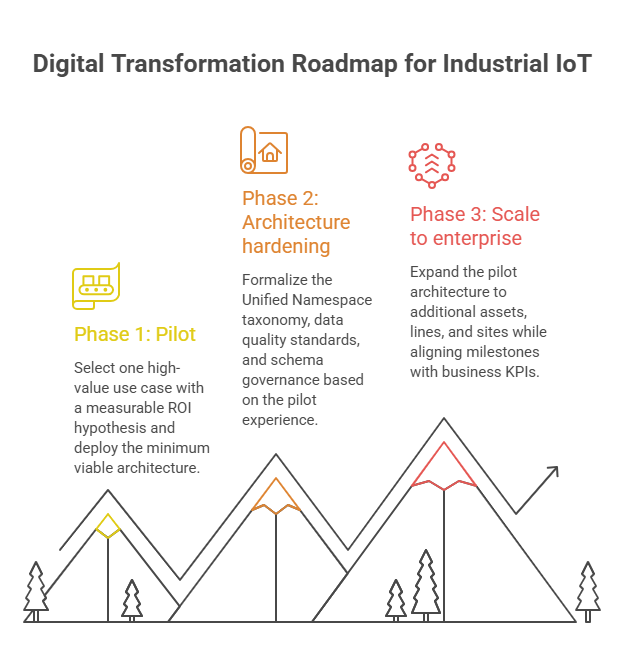
Phase 1: Pilot (months 1 to 4). Select one high-value use case with a measurable ROI hypothesis (predictive maintenance on the plant's highest-unplanned-downtime asset class, for instance). Deploy the minimum viable architecture: sensors or connectivity for the pilot assets, an edge gateway for protocol normalization, a minimal Unified Namespace configuration for the pilot data topics, and a simple analytics application or dashboard. Define KPIs before the pilot begins. IIoT deployments that skip the pilot-with-KPIs step frequently discover during full-scale rollout that the use case was less valuable than assumed.
Phase 2: Architecture hardening and governance (months 3 to 8). Formalize the Unified Namespace taxonomy, data quality standards, and schema governance based on the pilot experience. Establish the cross-functional governance structure (OT and IT joint ownership of the integration standards) that will govern the scaling phase. Define the security architecture, including network segmentation and zero-trust controls, before connecting additional assets.
Phase 3: Scale to enterprise (months 6 to 24+). Expand the pilot architecture to additional assets, lines, and sites, following the migration checklist below. Align milestones with business KPIs and ensure executive sponsorship remains active: IIoT enhances visibility into operations to identify inefficiencies, but acting on those inefficiencies requires operational change that only executive-sponsored governance can sustain at scale.
Scalability is a challenge for IIoT implementations because the connection count, message throughput, and data volume grow linearly with the number of connected assets, but the operational complexity (managing firmware versions, certificate renewals, schema changes, and integration updates across thousands of devices) grows faster than linearly without deliberate architecture choices.
Before selecting infrastructure, define the maximum connection count (how many IIoT devices will eventually be connected), message throughput (how many messages per second at peak), and end-to-end latency requirements for the highest-priority use cases. MQTT broker selection should account for the full projected connection count, not just the pilot scale.
Latency from sensor event to dashboard display is the sum of all processing steps in the pipeline: sensor polling interval, gateway processing time, network transport, broker delivery, stream processing, and dashboard rendering. Benchmark each stage independently and the end-to-end flow together on real hardware before declaring a latency target achievable.
Infrastructure-as-code for edge gateway configuration, MQTT broker provisioning, and cloud platform setup enables consistent, repeatable deployments across multiple sites without the configuration drift that manual deployment produces at scale. IIoT networks that are deployed manually at each site accumulate site-specific variations that make fleet-level management increasingly difficult over time.
Most real estates are brownfield: the vast majority of industrial equipment already in the field was installed before IIoT was a consideration and lacks native IIoT connectivity. Gateways and the Unified Namespace must come before consumers, not after.
Step 1: Device and protocol discovery. Before deploying any infrastructure, perform a discovery audit of every asset in the target scope. Document the make, model, firmware version, and native protocol of every PLC, sensor, meter, and controller. Identify which devices have IP interfaces and which require serial-to-IP or fieldbus-to-IP gateways. This inventory is the input to the protocol translation strategy.
Step 2: Edge gateway deployment for protocol normalization. Deploy edge gateways to translate from all identified field protocols to a normalized format at the plant boundary. Validate that every protocol in the discovered inventory has a gateway connector that works in the target environment. This is the hardest step in a brownfield IIoT deployment: protocol edge cases, firmware version incompatibilities, and device-specific quirks require time to resolve. Budget for this in the implementation plan.
Step 3: Establish the Unified Namespace. Deploy the MQTT broker and define the topic taxonomy before connecting data consumers. A UNS that is built incrementally as each consumer arrives produces an inconsistent topic structure that becomes harder to govern over time. Define the full taxonomy, aligned to the ISA-95 hierarchy or site topology, before the first data consumer subscribes.
Step 4: Onboard IIoT platform and validate end-to-end flows. Connect the IIoT platform to the Unified Namespace as a subscriber. Validate that data from each field device reaches the platform with correct values, timestamps, and metadata. Validate end-to-end latency. Only after this validation is complete should analytics applications, dashboards, and business-system integrations be connected to the platform.
Aligning IT and OT teams is a major challenge in IIoT deployments. OT teams own the field equipment and the process expertise; IT teams own the infrastructure and integration standards. Neither team alone can deliver a working IIoT architecture. The governance structure that makes both accountable, with shared success metrics spanning both OT availability and IT integration quality, is the organizational enabler that determines whether the technical implementation actually succeeds.
InTechHouse case study: Brownfield IIoT architecture on an industrial estate
InTechHouse designed and implemented an IIoT architecture for an industrial operator whose plant included a mix of modern EtherNet/IP equipment and legacy Modbus devices installed in the 1990s, with no existing IP connectivity to the older equipment and no unified data model across the site.
The implementation began with a protocol discovery audit that catalogued every device in scope, followed by edge gateway deployment to translate from Modbus RTU and EtherNet/IP to OPC UA northbound. A Unified Namespace was established on an MQTT broker before any analytics applications were connected, using a topic taxonomy aligned to the plant's line-and-machine topology. Only after the UNS was validated end-to-end were the predictive maintenance analytics and the OEE dashboard connected as subscribers.
The outcome was real-time production visibility across a previously data-dark estate, with predictive maintenance alerts on the plant's highest-unplanned-downtime asset class reducing emergency maintenance callouts within the first three months of operation.
The InTechHouse delivery pattern described above maps directly to the IIRA's functional viewpoint: perception layer (field sensors and PLCs connected via native protocols), network layer (edge gateways translating to OPC UA and MQTT), processing layer (Unified Namespace broker, historian, and analytics platform), and application layer (OEE dashboard, predictive maintenance, MES integration).
Industrial environments that have successfully scaled IIoT architectures consistently share two characteristics: a Unified Namespace established early (before data consumers proliferated and topic inconsistency became entrenched), and a cross-functional governance model that gives both OT and IT teams shared accountability for the integration outcome. The architectural pattern is replicable; the governance discipline is the harder part to transfer.
For stakeholder review, the three-way snapshot of SCADA, MES, and ERP in the broader manufacturing software stack, and how the IIoT architecture connects them, is covered in SCADA vs MES vs ERP.
From edge gateways and MQTT brokers to MES and ERP handoff, we deliver the whole path rather than one layer of it. Ask for our integration reference build.
See how we deliver OT/IT integration
An IIoT architecture program starts with an architecture review: a structured assessment of the existing OT asset estate, the protocol landscape, the current data flows, and the IoT data analytics use cases that have clear business value. That review, conducted jointly by OT and IT teams, produces the scope definition and the risk inventory that a 90-day implementation sprint can act on.
The 90-day sprint should deliver: a completed device and protocol discovery, a deployed and validated edge gateway for the pilot scope, a Unified Namespace with a defined and governed topic taxonomy, and at least one analytics application consuming live data from the UNS. The sprint output is a working, measured system, not a design document.
To discuss designing or integrating an IIoT architecture for your industrial estate, talk to the InTechHouse team.
Not sure where to start? We work with companies at every stage, from early ideas to enterprise-level builds. A 30-minute call can save you months of guesswork.
What is an Industrial IoT architecture?
An Industrial IoT architecture is a hierarchical, edge-to-cloud design that connects industrial machinery and sensors to networks and moves data through defined processing layers, perception, network, processing, and application, so that operational data flows from field devices to the business systems and analytics applications that need it, which is what industrial IoT development services build and maintain. It is the technical implementation of OT/IT convergence, connecting the physical equipment that OT systems control to the data platforms and enterprise applications that IT systems manage.
What are the layers of an IIoT architecture?
The four standard layers are: the perception layer (sensors, PLCs, and field devices that interact with the physical environment), the network layer (connectivity infrastructure, edge gateways, and protocol translation), the processing layer (edge compute, on-premise historians, and cloud platforms that ingest and analyze raw data), and the application layer (dashboards, predictive maintenance applications, MES, and ERP systems that consume processed data for operational and business decisions).
What protocols are used in IIoT (MQTT, OPC UA, Modbus)?
At the field level, legacy protocols like Modbus (TCP and RTU), PROFINET, PROFIBUS, and EtherNet/IP connect sensors and PLCs to controllers. At the gateway and platform level, OPC UA provides semantic, secure machine-to-machine communication with a typed information model, and MQTT provides lightweight publish-subscribe transport for scalable data distribution to the cloud and enterprise systems. Most IIoT architectures use OPC UA for structured machine communication inside OT zones and MQTT for the Unified Namespace distribution layer, with edge gateways translating between legacy field protocols and these modern standards.
What is a Unified Namespace in IIoT?
A Unified Namespace is a single, consistently structured MQTT broker that all OT and IT systems in an enterprise publish and subscribe to. Instead of point-to-point integrations between every data producer and every data consumer, all systems connect to the same broker using a hierarchical topic structure aligned to the plant topology. Adding a new data consumer requires only a new subscription to the broker, not a new connection to each source device. The UNS eliminates integration spaghetti and creates a governed, discoverable data fabric for the entire industrial estate, which is the core deliverable of industrial data platforms and OT/IT integration.
How do you connect legacy OT equipment to an IIoT architecture?
Through edge gateways that translate from legacy protocols (Modbus, PROFIBUS, EtherNet/IP, serial RS-232/485) to IP-based standards (OPC UA, MQTT) without requiring changes to the legacy device itself. Most legacy equipment cannot be directly connected to an IIoT platform and has no native IP interface; the gateway adds that connectivity while the legacy device continues operating unchanged. Selecting the right gateway requires knowing the exact protocol, firmware version, and hardware interface of each legacy device, which is why a protocol discovery audit is the mandatory first step of any brownfield IIoT implementation.
Jacek Suty is Head of Solution Architecture at InTechHouse, with more than 30 years of experience in system architecture, enterprise IT, infrastructure, information security, and complex digital transformation programs.
He specializes in designing enterprise and solution architectures, translating business and regulatory requirements into scalable technology platforms, and coordinating delivery across software, infrastructure, data, and security teams. His work covers enterprise architecture based on TOGAF, system modeling using UML and BPMN, cloud and on-premise infrastructure, CI/CD processes, data platforms, cybersecurity, and IT governance.
Jacek has contributed to large-scale technology programs for public institutions, finance, energy, education, healthcare, utilities, and digital archives. His project experience includes nationwide public digital infrastructure, distributed document-management and archiving systems, data-exploration platforms using machine learning and predictive analytics, and transaction systems combining blockchain, metadata standards, and computational intelligence.
He holds PRINCE2 Practitioner, Management of Risk, Scrum Master, ITIL Foundation, and ISO/IEC 27001 Lead Auditor qualifications. Jacek is currently pursuing a doctoral degree at Bydgoszcz University of Science and Technology, combining academic research with extensive experience in real-world architecture and technology delivery.
He writes about enterprise architecture, system design, digital transformation, data platforms, cloud infrastructure, cybersecurity, technology governance, and the practical application of AI in complex information systems.
Jacek Suty's academic and professional profiles:
https://pbs.edu.pl/pl/doktorant/uczelniania-rada-samorzadu-doktorantow
https://www.isep.pw.edu.pl/isep/zs/Aktualnosci/Kalendarium-wydarzen2/Seminarium-zakladowe-9.03.2021-Jacek-Suty
https://aionehealth.pl/wp-content/uploads/2026/04/Raport-2026-final.pdf
This initial conversation is focused on understanding your product, technical challenges, and constraints.
No sales pitch - just a practical discussion with experienced engineers.
Share a few details about your product and context. We’ll review the information and suggest the most appropriate next step.