


Ingress Protection (IP) Testing & Enclosure Sealing Design


Measured impact on enclosure protection
Enclosure sealing is decided at the design stage: groove geometry, gasket material, and glanding choices, long before a unit reaches a water jet or an immersion tank.
How we design and verify sealed enclosures
Two disciplines determine whether an enclosure passes: sealing decisions made at the design stage, and pre-compliance work that confirms them before formal testing.
Designing the seal
- Gasket groove geometry and compression ratio get set to hold seal force across manufacturing tolerance, not just on a best-case sample
- Gasket material and hardness get selected for the actual operating temperature range and chemical exposure
- Pressure-equalizing membranes get specified where a sealed enclosure needs to breathe without letting water or dust in
- Cable glands and connectors are treated as part of the seal, not bolted on as an afterthought
- Fastener torque gets specified and documented, since uneven torque is a common reason a sealed enclosure fails on day one
Verifying pre-compliance and managing certification
- Pre-compliance checks run on the seal design before tooling, catching a groove or gasket problem while it's still a CAD change
- Test samples use production-representative tooling and assembly, not hand-built prototypes
- We define the IP level and test sequence with the accredited lab and prepare the certification documentation
- Test results get reviewed against the original design intent, feeding any deviation into the next revision
.avif)
What defines a sealed, field-ready enclosure
A field-ready enclosure isn't one that simply passed a single IP test. It holds its seal under actual operating conditions, clears certification without late redesigns, and seals the same way on unit one thousand as it did on the qualification sample.

Seal performance gets verified against the enclosure's actual operating environment, not only the minimum conditions a declared IP level requires.

Sealing weaknesses surface and get corrected before formal IP testing, when a fix still costs a groove or gasket change instead of a failed test report.

Gasket, glanding, and torque specifications carry through to production, so every enclosure shipped seals the same way as the one that passed qualification.
In-house scope vs. accredited laboratory
IP qualification splits the same way vibration and shock work does: sealing design on one side, accredited testing on the other.
What InTechHouse does in-house
What an accredited laboratory does
How we design and verify sealed enclosures
An X means that digit was not tested or claimed, not that protection is absent. IP5X refers to solids protection; IPX4 refers to water protection.
IP67 and IP68 are not interchangeable. IP67 covers temporary immersion under defined conditions, while IP68 covers continuous immersion under manufacturer-defined conditions. IP69K (IPX9K under ISO 20653) is a separate test for close-range, high-pressure, high-temperature water jets, used for washdown and vehicle-cleaning environments.
First digit - solid objects and access
- IP0X - no protection
- IP1X - solid objects 50mm and larger
- IP2X - solid objects 12.5mm and larger, such as a finger
- IP3X - solid objects 2.5mm and larger, such as a tool
- IP4X - solid objects 1mm and larger, such as thin wire
- IP5X - dust protected: limited ingress permitted, not enough to interfere with operation
- IP6X - dust tight, verified in a dust chamber under negative pressure
Second digit - water
- IPX0 - no protection
- IPX1 - vertically falling drops
- IPX2 - dripping water, enclosure tilted up to 15 degrees
- IPX3 - spraying water up to 60 degrees from vertical
- IPX4 - splashing water from any direction
- IPX5 - low-pressure water jets
- IPX6 - powerful water jets
- IPX7 - temporary immersion, typically 1 meter for 30 minutes
- IPX8 - continuous immersion, depth and duration agreed between manufacturer and customer
- IPX9 / IPX9K - close-range, high-pressure, high-temperature water jets (washdown, steam cleaning)
Typical failure modes and the design fixes that prevent them
The same handful of failure modes account for most IP test failures. Each traces back to a specific design decision, and each has a fix that costs far less applied before testing than after it.
Symptom: the enclosure passes when new, then fails after thermal cycling. Mechanism: the gasket takes a permanent compression set, losing the spring-back needed to maintain seal force.
Fix: reselect gasket material and compression ratio for the actual temperature range, not just room temperature.
Symptom: ingress traces back to the cable entry point rather than the enclosure seam. Mechanism: the gland wasn't matched to the cable's actual outer diameter and jacket.
Fix: specify the gland to the cable's real diameter tolerance and treat the entry as part of the sealed boundary during design.
Symptom: the enclosure fails at one point on the seam rather than uniformly. Mechanism: inconsistent torque leaves the gasket compressed unevenly, opening a gap at the point of lowest clamping force.
Fix: specify torque values and sequence in the assembly documentation, and verify them in production, not just on the prototype.
Use Cases

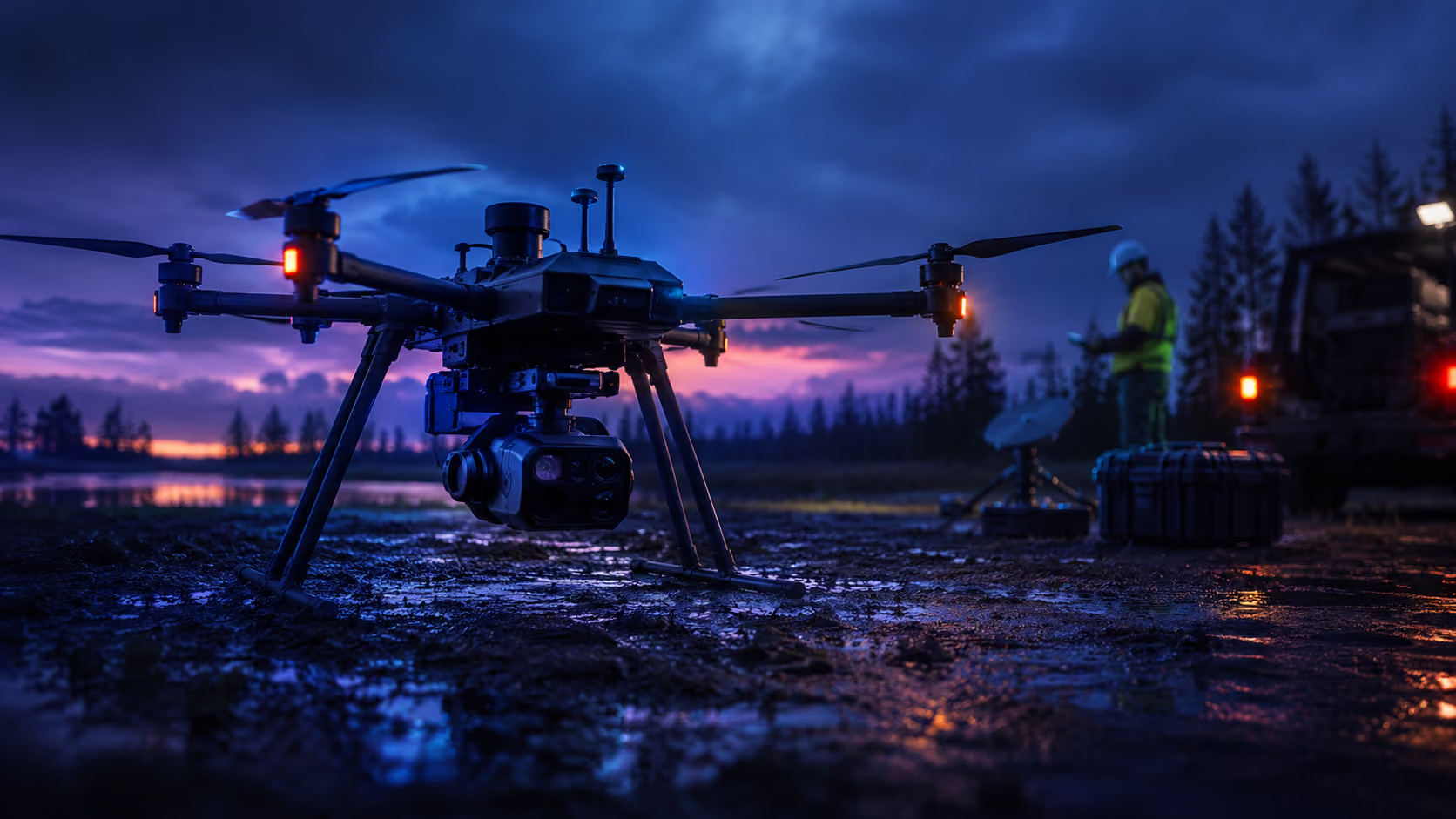
We design and develop embedded systems for UAV platforms, integrating sensors, communication modules, and control logic for real-time operation. Our solutions are engineered for mission-critical environments, ensuring reliable performance, low latency, and seamless system integration. Each design supports stable operation under dynamic conditions while maintaining data integrity and operational efficiency.


We design and develop firmware for industrial equipment, enabling reliable communication, data acquisition, and system control under real operating conditions. We focus on robustness, real-time performance, and seamless integration with hardware and higher-level systems. Each implementation provides stability, scalability, and long-term maintainability in demanding industrial environments. We als optimize for resource efficiency and compliance with industry protocols.

We design and develop firmware for subsea systems focusing on predictable real-time operation, fault tolerance, and robust communication in harsh underwater environments. Each implementation allows consistent performance under pressure, limited accessibility, and long-term deployment conditions. We also support integration with monitoring and diagnostic systems to enable remote operation and maintenance.


We design and implement advanced embedded software for imaging systems, including real-time processing, camera control, and data integration. Our solutions are optimized for high performance, low latency, and seamless interaction with hardware components. Each implementation ensures stable operation, high data throughput, and reliable system behavior. We also support integration with higher-level systems and data pipelines for end-to-end functionality.
Industries We Serve
Our engineering capabilities are deployed across regulated, mission-critical and industrial sectors.

Subsea electronics, downhole systems and harsh-environment hardware for offshore and onshore operations.

Mission-critical embedded systems and real-time firmware for UAV platforms and defence electronics.

Real-time embedded firmware for gas detection, environmental sensing and worker alert systems.

Embedded systems and real-time firmware for industrial automation,
machine control and IoT data acquisition.
Technologies we use
The reliability engineering disciplines applied on every HALT and HASS program, from prototype stress testing through the production screen it produces.
FAQs
If you have additional questions or would like to discuss your requirements, feel free to get in touch with our team.
Ingress protection testing measures how well an enclosure for electrical equipment resists intrusion by dust and other solid objects, protects against accidental contact with hazardous parts, and provides water ingress protection, under specific test conditions defined by a standard such as IEC 60529. Testing methods range from rain tests using vertically dripping water to dust chambers and water jets, using specialized equipment built for exactly that purpose. The result is a protection rating, or degree of protection, that states what protection the enclosure provided under that specific test, not a general claim of dust resistance or water resistance.
IEC 60529 is the international standard, sometimes referred to as International Protection, defining the IP code: a first digit for protection against solid objects and access to hazardous parts, and a second digit for protection against water, tested with equipment such as a dust chamber, oscillating tube, spray nozzle, water jets, or an immersion tank. A supplementary letter can add specific requirements on top of the two-digit code, and the standard sets out detailed testing requirements for each level.
In practice, no reputable manufacturer does. An IP rating is a testing claim against the specific requirements of a standard like IEC 60529, and without accredited test reports behind it, a declared rating has no standing if a customer or regulator challenges it. Pre-compliance testing can be done in-house, but the rating itself, and confirmation that no dust or moisture ingress caused harmful effects to the equipment, should be backed by accredited lab results.
In standard IP testing for IP67, the enclosure is verified dust tight first, then submerged, typically to 1 meter for 30 minutes, in an immersion tank, and inspected afterward for water ingress or moisture that would affect function or safety. It's a defined lab test, not a simulation of every real world condition an enclosure might see.
IP67 covers temporary immersion in liquids to a defined depth and duration. IP68 covers continuous immersion under conditions the manufacturer defines and agrees with the customer, so two IP68-rated enclosures can carry the same code while offering a very different level of protection in practice.
The X replaces a digit that wasn't tested or isn't being claimed. IPX4, for example, means only the water digit was tested; IP5X means only the solids digit was tested, and even then allows some dust ingress as long as it isn't in a sufficient quantity to interfere with operation. An X doesn't mean the enclosure has no protection in that category.
IP69K, or IPX9K under ISO 20653 for road vehicles, tests an enclosure against close-range, high-pressure, high-temperature water jets applied from different angles, simulating pressure washing and steam-cleaning conditions found in harsh environments and washdown facilities. It's built for equipment that has to survive repeated exposure to these environmental hazards, not just an occasional splash from powerful jets in a single direction.
Most failures trace back to gasket compression set, a cable gland mismatched to the actual cable diameter, a pressure-equalizing membrane sized wrong for the thermal range, or uneven fastener torque distorting the seal. Each is a design or assembly decision, not a defect in the enclosure material's dust resistance or water resistance. It's also worth noting that a rating under military standards, such as MIL-STD-810's rain and dust methods, or a NEMA rating, isn't automatically interchangeable with an IP code. Confirming an enclosure meets IEC 60529 requires testing to that standard specifically.
Discuss your product with our expert
This initial conversation is focused on understanding your product, technical challenges, and constraints.
No sales pitch - just a practical discussion with experienced engineers.


Share a few details about your product and context. We’ll review the information and suggest the most appropriate next step.