IoT development companies build the software, firmware, and connectivity layer that lets physical devices collect data, talk to each other, and act on it, either as a custom engineering partner or as a ready-made platform, which is why this shortlist overlaps with the top embedded software and firmware development companies. Industrial IoT, often shortened to IIoT, applies that same idea to factories, energy grids, and supply chains, where the goal is rarely a smart gadget and almost always operational efficiency: fewer unplanned shutdowns, lower maintenance costs, and machines that report their own health before they fail. A complete IoT implementation usually reaches beyond firmware and platforms, too, pulling in mobile app development for field technicians, web development for operations dashboards, and increasingly AI integration for the analytics layer sitting on top of it all.
Key takeaways:
The market data reflects how central this has become to industrial planning. Grand View Research projects the global industrial IoT market will reach USD 1,693.44 billion by 2030, growing at a CAGR of 23.3% from 2025 to 2030, driven by predictive maintenance, industrial automation, and supply chain management initiatives across manufacturing. Manufacturing remains the largest end-use segment, but energy, logistics, and even HVAC systems in commercial buildings are catching up fast as emerging technologies make sensor hardware cheaper and easier to deploy at scale.
Picking an IoT development company means deciding, first, whether you need a partner to build a custom IoT system from the ground up or a platform to build on top of. Below is a working list that covers both, starting with the full-cycle development partners and moving through the major industrial and cloud platforms you will likely end up integrating with them.
.png)
Industrial IoT projects rarely fail on hardware, they fail where devices have to talk to SCADA, PLC, MES and ERP. We design and build that connection layer so the data actually reaches the people who act on it.
Solve the integration layer, not just the sensors
| # | Company | Core focus | Best fit for |
|---|---|---|---|
| 1 | InTechHouse | Custom IoT hardware, firmware, and industrial data platforms built together | Regulated industries, brownfield retrofits, bespoke solutions |
| 2 | PTC (ThingWorx) | Industrial IoT application platform, Gartner-recognized leader | Enterprises building service and asset-optimization apps |
| 3 | Microsoft (Azure IoT Operations) | Cloud-to-edge IoT platform for hybrid, Kubernetes-based deployments | Organizations standardized on Azure and OT/IT convergence |
| 4 | AWS (IoT Core, Greengrass, SiteWise) | Hyperscaler IoT device management and industrial data collection | Large-scale, globally distributed device fleets |
| 5 | Siemens (Insights Hub, Industrial Edge) | Factory-floor IIoT tightly integrated with SIMATIC automation hardware | Manufacturers with existing Siemens OT infrastructure |
| 6 | Cumulocity | Independent, low-code industrial IoT platform | Fast time-to-market without building a platform from scratch |
| 7 | Bosch (IoT Suite) | Open-source-based device management and edge software | Automotive, smart home, and multi-protocol device fleets |
InTechHouse is a European engineering company that builds IoT systems the way industrial companies actually need them built: as custom hardware, firmware, and data infrastructure engineered together, not a generic platform with a sensor bolted on. As an EU-certified R&D partner, InTechHouse combines software development, system integration, and advanced data analytics under one roof, which matters most in industrial IoT projects, where the hardest part is rarely the sensor and almost always getting decades-old equipment to talk to a modern data platform.
That distinction shows up clearly in InTechHouse's brownfield IoT work: retrofitting legacy industrial machinery, often 10 to 20 years old with no built-in sensors or communication interfaces, with external sensors, edge gateways, and predictive maintenance capability, without replacing the machine or halting production. The company has also built IoT-based condition monitoring platforms that reduced incident response time from 24 hours to 15 to 30 minutes and helped industrial clients extend asset lifecycles by roughly 40% while cutting unplanned downtime in half.
InTechHouse's IoT and industrial IoT development services cover:
This is what "custom IoT solutions" is supposed to mean in practice: tailored solutions engineered around the actual hardware limitations and regulatory requirements of a specific site, not a one-size-fits-all IoT platform.
Pros: Combined hardware and software engineering under one team, deep experience in brownfield retrofits and regulated industries, EU-based delivery with a proven track record in oil and gas, manufacturing, and aerospace, and industrial data platform services that handle OT/IT integration end to end and help industrial companies streamline operations without disrupting production.
Best fit for: Companies that need a development team to build a custom IoT system, retrofit legacy equipment, or integrate IoT data into existing enterprise systems, rather than a generic off-the-shelf platform.
PTC's ThingWorx has been one of the most established names in industrial IoT software for over a decade, recognized by Gartner as a leader for execution ability in industrial IoT platforms. ThingWorx is a comprehensive IoT platform for industrial enterprises that connects systems, analyzes data, and enables remote management of devices through a secure, scalable architecture, paired with its companion product Kepware for industrial connectivity across a wide range of automation devices and protocols.
The platform's trajectory changed significantly in late 2025: PTC agreed to sell both ThingWorx and Kepware to private equity firm TPG in a deal worth up to $725 million, expected to close in the first half of 2026, so that PTC can concentrate on its core CAD, PLM, ALM, and SLM software. For buyers, the practical impact should be minimal in the near term, but it is worth knowing that ThingWorx is entering a new ownership structure just as this list goes to print.
Pros: Mature, enterprise-proven platform with a large partner ecosystem, low-code application builder (Mashup Builder) that speeds up custom app development, strong track record in service and asset-optimization use cases.
Trade-off: The pending TPG acquisition introduces some uncertainty around long-term product direction and support continuity, even if day-to-day operations are expected to continue unchanged through the transition.
Microsoft's approach to industrial IoT has consolidated around Azure IoT Operations, a Kubernetes-based platform built for what Microsoft calls Physical AI: systems that sense, reason, and act in real industrial environments rather than just analyzing data after the fact. Azure IoT Operations processes and normalizes data at the edge before sending it to the cloud, supporting open standards like MQTT and OPC UA specifically to remove the barriers between operational technology and IT systems that have historically made industrial IoT projects slow to scale.
Microsoft's April 2026 release added cloud-to-edge management actions, no-code dataflow graphs, and improved broker reliability for always-on production environments, with customers including Chevron and Husqvarna scaling the platform from single-site pilots to multi-site rollouts. For organizations already standardized on Azure, that native integration with Microsoft Fabric for real-time dashboards and Azure Arc for unified device management is often the deciding factor over a platform-agnostic alternative.
Pros: Deep integration with the broader Microsoft ecosystem, strong support for hybrid and disconnected operation, active investment in AI-powered predictive maintenance and edge vision AI use cases.
Trade-off: The Kubernetes-based architecture assumes a certain level of platform engineering maturity, which can be a heavier lift than a simpler managed platform for smaller industrial companies.
AWS approaches IoT from the scale-first angle: connecting and managing device fleets that number in the millions, using AWS IoT Core for device connectivity, AWS IoT Greengrass for edge intelligence, and AWS IoT SiteWise specifically for industrial data collection from equipment and production lines. It is a pay-as-you-go model built for organizations that want to automate tasks and analyze data using the rest of the AWS cloud services stack, from Lambda functions to SageMaker, without standing up separate infrastructure.
AWS's advantage is breadth: the same underlying platform supports everything from consumer IoT applications and smart home systems to complex industrial manufacturing dashboards, letting a development team reuse the same connectivity and device management patterns across very different product lines. That flexibility is a real advantage for software development companies building multiple IoT products on a shared cloud platform rather than committing to a single industrial-only stack.
Pros: Massive scale and global infrastructure footprint, deep integration with AWS's broader analytics and machine learning services, flexible enough to span consumer and industrial IoT projects on the same account.
Trade-off: Industrial-specific tooling like SiteWise is less purpose-built for OT protocols than platforms designed industrial-first, so heavier SCADA and PLC integration work often still falls to a systems integrator.
Siemens approaches IoT from the shop floor outward, which shows in how tightly its platforms integrate with the SIMATIC automation hardware many manufacturers already run. Siemens Industrial Edge, expanded significantly at Hannover Messe 2026, now includes an Industrial AI Suite that scales predictive maintenance and visual inspection models across multiple plants, running directly on production-floor hardware so that a lost internet connection does not stop the line.
The platform's Senseye Predictive Maintenance component analyzes vibration, temperature, and acoustic sensor data to flag equipment failures days in advance, a capability Siemens has deployed internally with measurable results: one flagship implementation reduced unplanned downtime by roughly 30% and increased asset utilization by around 15% across a manufacturing network monitoring more than 10,000 machines. Siemens has also added IEC 62443-4-2-certified security functions for critical infrastructure, including fully air-gapped operation for facilities that cannot risk network exposure.
Pros: Deep OT integration with existing SIMATIC and SCADA infrastructure, strong security certification for critical infrastructure and regulated industries, proven results at genuinely large manufacturing scale.
Trade-off: The ecosystem is built around Siemens' own automation hardware, so it is a stronger fit for existing Siemens shops than for a mixed-vendor factory floor.
Cumulocity took an unusual path to its current position: founded in 2012, acquired by Software AG, and then spun back out in January 2025 through a management buyout backed by Avedon, Schroders Capital, and Verso Capital, making it what the company now calls the leading independent IoT platform. Cumulocity is recognized as a Leader in the 2025 Gartner Magic Quadrant for Global Industrial IoT Platforms, built around a low-code, self-service model that aims to deliver roughly 80% of standard IoT functionality out of the box.
The platform's pitch to industrial companies is speed: connect a device and view its data within minutes, without writing code, then extend into custom microservices and applications as needs grow more specific. It is validated for 100 million connected devices and one million messages per second, and it runs as cloud, on-premises, edge, or hybrid, which matters for manufacturers that cannot send certain operational data off-site.
Pros: Fast time-to-value with genuine low-code tooling, hyperscaler-agnostic architecture that avoids cloud lock-in, strong self-service analytics for non-technical plant operators.
Trade-off: As an independent company post-buyout, Cumulocity has a smaller balance sheet than a Microsoft or Siemens, which is worth weighing for very long-term, multi-decade industrial deployments.
Bosch brings a hardware manufacturer's perspective to IoT software, which shows in the breadth of device types its platform was built to handle. Bosch IoT Suite currently connects more than 15 million devices, sensors, and machines, and much of its underlying technology, including Eclipse Ditto for digital twins and Eclipse hawkBit for software rollouts, is contributed to the Eclipse Foundation as open source, giving development teams a genuine option to avoid vendor lock-in.
Bosch Software Innovations, the team behind the platform, has delivered over 250 international IoT projects spanning agriculture, smart homes and buildings, retail, energy, and manufacturing, with more than 700 IoT specialists across Germany, Bulgaria, Singapore, China, and Japan. That mix of automotive-grade hardware expertise and open-source software architecture makes Bosch a natural fit for IoT app developers building products that need to work across a genuinely diverse mix of connected devices.
Pros: Strong multi-protocol and multi-device support, open-source foundation reduces lock-in risk, decades of hardware engineering credibility behind the software.
Trade-off: Reviewers consistently note a steep learning curve tied to the platform's breadth, and the extensive configuration options require real technical expertise to use well.
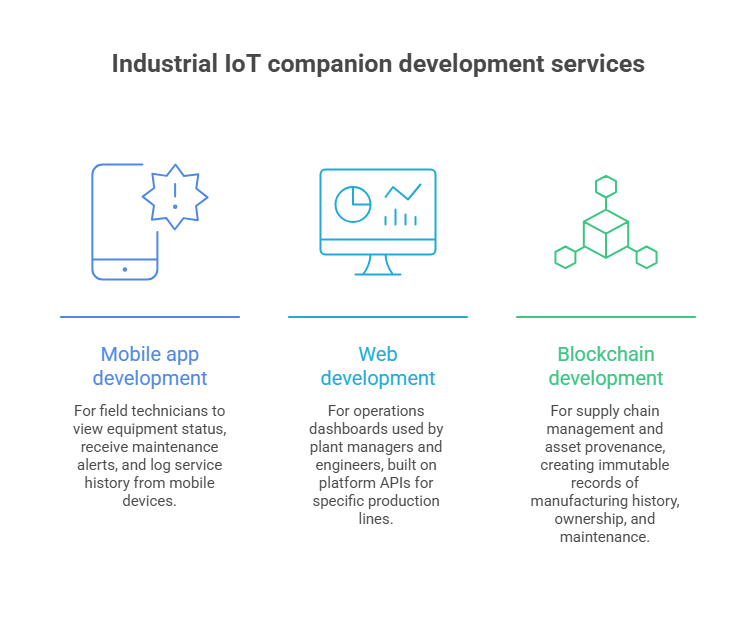
Picking an IoT platform or a firmware development team is rarely the end of the project. Most industrial IoT solutions also need a companion layer that the platform vendors above only partly cover:
A software development company that only touches the IoT platform layer will eventually hand a client off to a separate mobile app development or web development team anyway, which adds integration risk at exactly the point where the project needs the least friction. This is one more argument for evaluating a potential partner's full platform development capabilities, not just their IoT-specific credentials, before committing to a multi-year industrial deployment.
The analytics layer is also moving off the cloud and onto the machines themselves, where a model scores vibration or vision data in milliseconds. Vendors that specialize in that shift are covered separately in our list of top edge AI development providers.
Read also:
Every provider above solves a different piece of the IoT puzzle, and the right starting point depends on what you already have in place.
If you need a development team to build a custom IoT system or retrofit legacy equipment, especially in a regulated or brownfield industrial environment, a full-cycle partner like InTechHouse that owns hardware, firmware, and industrial data platforms and OT/IT integration together will get you further than a generic platform license.
If you need an application layer to build IoT-powered service and asset-management apps quickly, PTC's ThingWorx offers a mature, low-code environment with a large partner ecosystem, though it is worth watching how the TPG ownership transition unfolds.
If your organization is standardized on a hyperscaler, Microsoft Azure IoT Operations or AWS IoT Core will minimize the operational overhead of managing device fleets across your existing cloud environments.
If the deployment is a factory floor already running Siemens automation hardware, Siemens Insights Hub and Industrial Edge are purpose-built for that exact stack, with predictive maintenance already deeply integrated.
If speed to a working pilot matters more than deep customization, Cumulocity's low-code approach and Bosch's open-source foundation both shorten the path from device to dashboard.
A few questions worth asking any IoT development company before committing:
Most plants end up running two or three vendors side by side. Ask us how we fit custom firmware, gateways and OT/IT integration around the platform you already own.
See how we combine custom builds with industrial platforms
Not sure where to start? We work with companies at every stage, from early ideas to enterprise-level builds. A 30-minute call can save you months of guesswork.
IoT covers connected devices generally, including consumer products; industrial IoT (IIoT) applies the same concept specifically to industrial equipment, factories, and infrastructure. Consumer IoT applications, like smart home systems and wearables, prioritize convenience and typically tolerate occasional connectivity gaps. Industrial IoT devices are built to withstand harsh operating conditions, meet industrial standards, and operate in real time, because a missed reading from a factory sensor can mean a safety incident or a costly production stop, not just an inconvenience.
Cost depends heavily on the number of devices, the complexity of system integration, and whether custom hardware is required alongside the software. A small pilot connecting a handful of existing machines through off-the-shelf sensors costs far less than a brownfield retrofit across multiple industrial sites with custom PCB design and firmware development. Most IoT development companies scope projects individually after reviewing existing infrastructure, since integration work with legacy SCADA and PLC systems is usually the largest cost driver, not the sensors themselves.
Buy a platform if your use case is standard and speed to market matters most; build custom if your equipment, environment, or regulatory requirements do not fit an off-the-shelf platform's assumptions. Platforms like Cumulocity or ThingWorx get a standard use case running in weeks. Custom development becomes worth the investment when you are retrofitting decades-old equipment, operating in a highly regulated industry, or building a connected product that needs to be sold and supported as your own, not a third-party platform's brand.
IoT sensors continuously collect operational data, such as vibration, temperature, and acoustic signals, which machine learning models analyze to detect early signs of equipment failure before a breakdown occurs. This lets maintenance teams replace parts based on actual equipment condition rather than a fixed calendar schedule, which industry studies show can reduce unplanned downtime by 30 to 50% and lower maintenance costs by 10 to 40% compared to purely reactive or calendar-based maintenance.
Manufacturing remains the largest adopter of industrial IoT, followed by energy, logistics and supply chain management, and oil and gas. These industries share a common pattern: expensive equipment, real operational efficiency to gain from reduced downtime, and increasingly, regulatory pressure to demonstrate auditable, data-driven maintenance and safety practices.
Yes, through retrofitting rather than replacement, in most cases. IoT development companies commonly integrate legacy machinery using external sensors, edge gateways, and standard industrial protocols like OPC UA, MQTT, and Modbus, without requiring a full equipment replacement or halting production. This brownfield approach is usually far more cost-effective than a rip-and-replace strategy, particularly for machinery with 10 to 20 years of remaining mechanical life.
A simple pilot connecting existing equipment through an off-the-shelf platform can go live in a few weeks; a custom IIoT system that includes hardware development and deep enterprise system integration typically takes several months to a year. The timeline depends mostly on how much custom firmware development and legacy system integration the project requires, not on the IoT platform itself. Companies that optimize processes in phases, starting with a single production line before scaling site-wide, generally reach a stable, reliable deployment faster than teams that try to digitize an entire facility's manufacturing processes at once.
Damian Ledziński, PhD Eng., is an Applied Artificial Intelligence Expert and an Assistant Professor at Bydgoszcz University of Science and Technology. He has over 15 years of academic, research, software-engineering, and technology-development experience.
His work focuses on applying artificial intelligence, machine learning, deep neural networks, and data science to complex real-world systems. His principal research and engineering interests include autonomous unmanned aerial vehicles, drone navigation and swarm intelligence, biomedical engineering, medical signal and image analysis, predictive modeling, industrial IoT, and intelligent water-management systems.
Damian has contributed to multidisciplinary R&D initiatives including AI-assisted medical diagnostics, a Polish ventilator prototype, autonomous indoor drone systems for warehouse inventory, AI-supported water-consumption analysis, virtual medical assistants, and intelligent systems combining embedded devices with machine-learning models.
He is the author or co-author of more than 30 scientific publications. His work has appeared in international scientific publications covering artificial intelligence, biomedical engineering, signal analysis, autonomous systems, environmental monitoring, and data-driven infrastructure.
Damian is a co-creator of academic programs in Engineering in Medicine, AI in Medicine, and Data Science at Bydgoszcz University of Science and Technology. He combines scientific research with hands-on implementation, translating experimental AI methods into deployable technology. He writes about applied AI, machine learning, predictive analytics, autonomous UAV systems, AI in medicine, biomedical signal processing, industrial IoT, and intelligent models in real-world systems.
Damian Ledziński's academic profiles:
https://wtie.pbs.edu.pl/pl/pracownik/damian-ledzinski
https://www.researchgate.net/profile/Damian-Ledzinski
https://scholar.google.pl/citations?user=AlQpPB0AAAAJ&hl=pl
https://ludzie.nauka.gov.pl/ln/profiles/DN6pHXU6KZm/publications/f83a8833-6060-4fae-8628-3dbf57661394
This initial conversation is focused on understanding your product, technical challenges, and constraints.
No sales pitch - just a practical discussion with experienced engineers.
Share a few details about your product and context. We’ll review the information and suggest the most appropriate next step.