
Top Embedded Software & Firmware Development Companies 2026

Disclosure: This ranking is published by InTechHouse, which is included in the list. Companies were assessed on hardware and software integration, safety certification track record, platform and toolchain support, and experience taking products to mass production, based on publicly available information and company websites as of October 2026.
This ranking compares eight embedded software and firmware development companies, from a full-cycle engineering partner to silicon vendors, RTOS specialists and tooling companies, on certification track record, hardware integration and the projects each suits. Grand View Research puts the global embedded system market at USD 112.3 billion in 2024, on track for USD 169.1 billion by 2030 at a compound annual growth rate of 7.1%.
Top 8 embedded software and firmware development companies in 2026 (quick answer)
The best embedded software and firmware development companies in 2026, assessed on safety certification, hardware integration and production track record, are:
- InTechHouse: best for full-cycle firmware and hardware development in aerospace, medical and industrial projects.
- NXP Semiconductors: best for automotive and industrial products built on NXP silicon.
- Wind River: best for safety-critical aerospace and defence firmware on the VxWorks RTOS.
- QNX (BlackBerry): best for automotive digital cockpits, ADAS and software-defined vehicles.
- Green Hills Software: best for certified systems that need DO-178C, ISO 26262 or IEC 61508.
| # | Company | Type | Best for | Key products / services | Proof point |
|---|---|---|---|---|---|
| 1 | InTechHouse | Engineering services firm | Full-cycle firmware and hardware for regulated industries | Firmware, RTOS architectures, FPGA/SoC, PCB design, edge AI, production support | Fully qualified on-board computer for a space vehicle |
| 2 | NXP Semiconductors | Silicon vendor | Products built on NXP microcontrollers and SoCs | SDKs, middleware, MCUXpresso, CoreRide platform | Acquisition of TTTech Auto closed June 2025 |
| 3 | Wind River | RTOS vendor | Safety-critical aerospace and defence firmware | VxWorks RTOS | Selected by Leonardo in 2025 for a DO-178C DAL C system |
| 4 | QNX (BlackBerry) | Automotive OS vendor | Digital cockpits, ADAS and vehicle compute | QNX microkernel OS | Runs in 275 million+ vehicles (Counterpoint Research, December 2025) |
| 5 | Green Hills Software | RTOS vendor | Certified safety-critical systems | INTEGRITY RTOS | Used in DO-178C, ISO 26262 and IEC 61508 projects |
| 6 | Siemens EDA | Tooling vendor | Large teams co-designing hardware and embedded Linux | EDA tooling, embedded Linux and AUTOSAR toolchains | — |
| 7 | Texas Instruments | Silicon vendor | Low-power embedded devices at scale | Microcontrollers, processors, reference designs, board support packages | Agreed to acquire Silicon Labs in February 2026 (about $7.5 billion) |
| 8 | Vector Informatik | Automotive tooling vendor | AUTOSAR and functional safety software for automotive | MICROSAR, CANoe, CANape, VectorCAST | Supports ISO 26262 ASIL D; founded in Stuttgart in 1988 |
Top embedded software and firmware development companies in 2026: full overview
1. InTechHouse
InTechHouse is a European engineering company built around one idea: embedded software and hardware design should be handled by the same team, not handed off between disconnected vendors. Operating as part of the SoftBlue Group, a global company with hundreds of specialists across brands, InTechHouse works across electronics design, firmware, embedded Linux, RTOS-based architectures, and system integration for regulated and mission-critical industries.
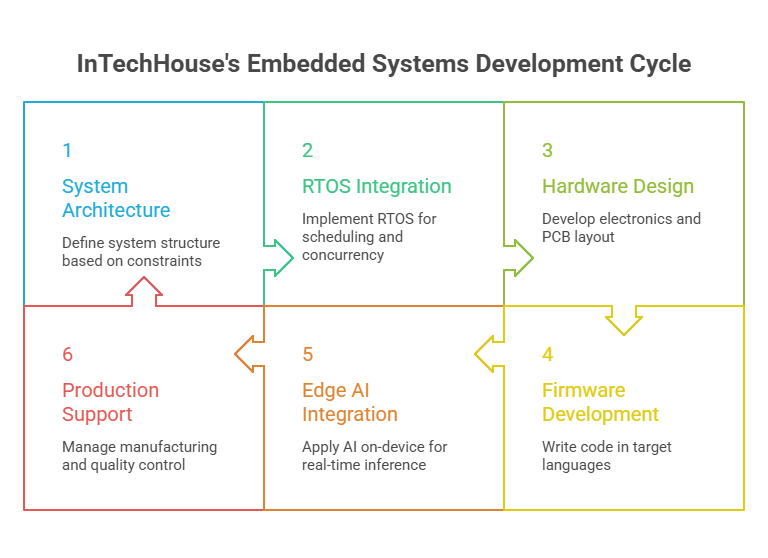
What sets InTechHouse apart from generic outsourcing shops, and what functions as its key differentiator in a crowded field, is the depth of its full lifecycle involvement. The team has delivered a fully qualified on-board computer for a space vehicle, covering software and hardware development, PCB routing, enclosure design, and environmental qualification for avionics use. That kind of project does not tolerate shortcuts, and it shows in how the company structures its work: system architecture defined by timing constraints and hardware capabilities, RTOS integration and driver development handled at the architecture level, and testing performed under real operating conditions rather than in a simulator alone.
InTechHouse's engineering scope covers:
- Embedded software and firmware development for real-time, safety-critical systems, written in the programming languages the target hardware actually demands, from C and C++ to Rust for newer safety-critical builds
- RTOS-based architectures with deterministic scheduling and controlled concurrency
- FPGA and SoC design for workloads where CPU-based approaches run into hardware limitations
- Electronics and PCB design, including analogue and digital simulation, power integrity analysis, and multilayer layout
- Firmware porting, board support packages, low-level software, and legacy firmware stabilization
- Edge AI systems that apply artificial intelligence directly on-device, with embedded software components built for deterministic, on-hardware inference rather than cloud round-trips
- Production support, from prototyping through IPC Class 2 and Class 3-compliant manufacturing and mass production
The company works with clients in aerospace, industrial automation, medical devices, and other regulated sectors where a single firmware bug can mean a failed certification or a recalled product. That focus on certification-ready engineering, rather than pure feature velocity, is what most differentiates InTechHouse from firmware development companies that treat embedded work as an extension of general application development.
Pros: Combined hardware and software engineering under one roof, extensive experience in certification-heavy industries (aerospace, medical, industrial), EU-based delivery with a proven track record on long-cycle, mission-critical projects, and embedded software consulting that starts at the architecture stage rather than after a design is already locked in.
Best for:
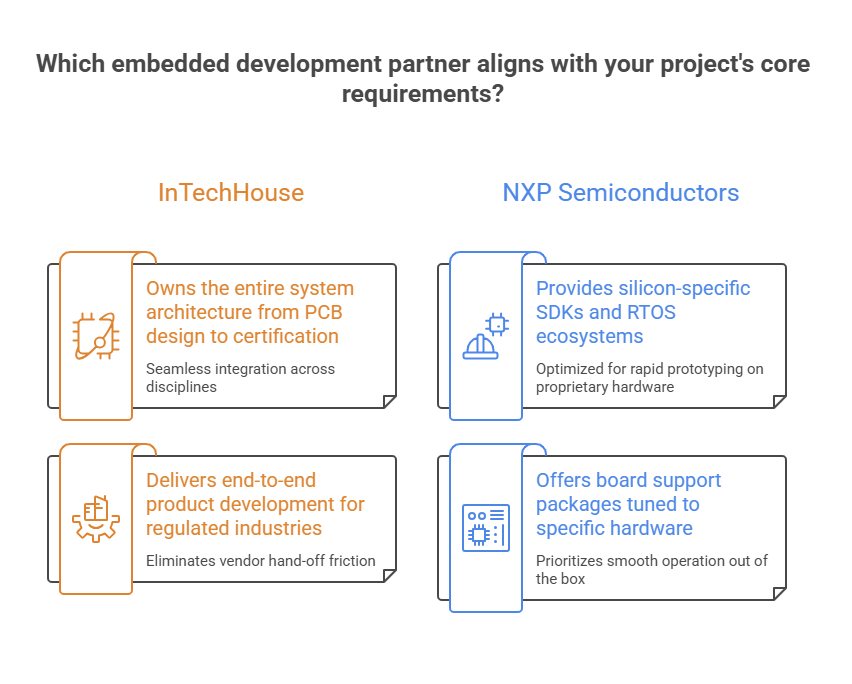
InTechHouse is best for companies that need one partner to own system architecture, firmware and hardware design together, particularly in regulated industries such as aerospace, medical devices and industrial automation.
2. NXP Semiconductors
NXP is not a services firm, but no list of embedded software development companies is complete without it, because so much embedded work happens on top of NXP silicon. The company describes itself as the worldwide leader in automotive processing and networking, and its embedded software stack, including SDKs, middleware, RTOS support, AUTOSAR integration, and the MCUXpresso toolchain, is built to pair tightly with its own microcontrollers and system-on-chip products.
NXP has been actively expanding beyond microcontrollers into full software platforms for software-defined vehicles. In January 2025 it agreed to acquire TTTech Auto, a company specializing in safety and security software for SDVs, to strengthen its CoreRide platform aimed at reducing complexity and shortening time to market for automakers. That acquisition closed in June 2025.
Pros: Tight hardware-software integration, strong long-term support commitments, broad footprint across automotive and industrial IoT.
Trade-off: Because the software is optimized around NXP's own hardware, teams working with mixed silicon vendors may find the ecosystem less flexible than a hardware-agnostic embedded development company.
Best for:
NXP Semiconductors is best for teams building automotive and industrial products on NXP microcontrollers and SoCs, using its SDKs and MCUXpresso toolchain.
3. Wind River
Wind River is one of the oldest names in real time operating systems, and its VxWorks RTOS remains a reference point for safety-critical embedded software in aerospace, defense, and industrial systems. VxWorks has flown on NASA missions, and it continues to win new design contracts in demanding environments: in 2025, Leonardo, a major aerospace and defense company, selected VxWorks to run a multicore radio frequency system that requires DO-178C DAL C certification.
VxWorks is built for backward compatibility, which matters enormously in aerospace and defense programs where hardware refresh cycles can span a decade. It also supports single-core and multicore configurations across multiple processor architectures, letting engineering teams standardize on one runtime environment even as the underlying hardware components change.
Pros: Decades of flight heritage, strong certification track record, mature toolchain for multicore and safety-critical deployments.
Trade-off: The certification overhead and licensing model make VxWorks a heavier commitment than short-lifecycle consumer electronics projects typically need.
Best for:
Wind River is best for safety-critical aerospace and defence firmware, where VxWorks offers DO-178C certification history and long backward compatibility.
4. QNX (BlackBerry)
QNX has become the default operating system for automotive digital cockpits and is expanding fast into broader vehicle compute. As of December 2025, Counterpoint Research confirmed that QNX software runs in more than 275 million vehicles worldwide, an increase of 100 million vehicles since 2020. Customers include BMW, Bosch, Continental, Honda, Hyundai, Mercedes-Benz, Toyota, Volkswagen, and Volvo, among others.
QNX's microkernel architecture is the technical reason it holds such a strong position in safety-critical automotive systems. Process isolation at the kernel level means a fault in one subsystem does not bring down the entire vehicle compute stack, which matters more than ever as automakers consolidate dozens of electronic control units into a handful of centralized, zonal processors.
Pros: Proven at massive automotive scale, strong fault isolation, expanding presence in ADAS and infotainment beyond just the instrument cluster.
Trade-off: Most heavily optimized for automotive; teams outside that vertical will find less out-of-the-box tooling than automotive-specific customers get.
Best for:
QNX (BlackBerry) is best for connected vehicle systems such as digital cockpits and ADAS, backed by its microkernel fault isolation.
5. Green Hills Software
Green Hills built its reputation on embedded software for systems where failure is not an inconvenience, it is a safety incident. Its INTEGRITY RTOS is designed around strict process isolation and deterministic execution, and it shows up disproportionately often in aerospace, defense, automotive, and industrial projects that require DO-178C, ISO 26262, or IEC 61508 certification.
Green Hills is a specialist choice rather than a generalist one. Teams that need a certifiable RTOS for a system where a crash could threaten human safety tend to end up evaluating Green Hills alongside Wind River, and the decision often comes down to specific certification history and toolchain compatibility with the target hardware.
Pros: Strong isolation guarantees, deep certification pedigree, extensive experience in the highest-stakes safety-critical markets.
Trade-off: The complexity and cost structure make it a poor fit for small teams or short-lifecycle consumer products.
Best for:
Green Hills Software is best for systems where a crash could threaten human safety, using the INTEGRITY RTOS for DO-178C, ISO 26262 or IEC 61508 certification.
6. Siemens EDA
Siemens EDA brings a different kind of value to the embedded systems landscape: it is less about a single RTOS and more about the tooling that surrounds embedded Linux, AUTOSAR, and hardware-software integration at industrial scale. As a division of a global company with deep technical expertise across electronics, it has the resources to maintain toolchains that span electronic design automation and embedded software development together, which matters for teams building complex, multi-board products where hardware design and firmware need seamless integration and need to be validated against each other early.
Pros: Deep integration between EDA tooling and embedded software workflows, strong industrial and automotive presence, backed by Siemens' broader engineering ecosystem.
Trade-off: The toolchain is built for large, well-resourced engineering organizations rather than lean product teams.
Best for:
Siemens EDA is best for large engineering organisations building multi-board products, where EDA tooling and embedded Linux or AUTOSAR software must be validated together.
7. Texas Instruments
Texas Instruments has long supplied the microcontrollers and processors underneath a huge share of embedded devices, and it continues to invest heavily in extending its embedded software and connectivity story. In February 2026, TI signed a definitive agreement to acquire Silicon Labs in an all-cash deal valued at $231.00 per share, representing a total enterprise value of approximately $7.5 billion, a move explicitly aimed at strengthening TI's embedded systems portfolio with Silicon Labs' wireless connectivity technology for connected products across industrial and automotive markets.
For embedded engineering teams, TI's value is less about a single flagship RTOS and more about breadth: microcontroller families, reference designs, low power management solutions, and an ecosystem of board support packages that shortens board bring-up time considerably.
Pros: Broad hardware portfolio, strong low-power microcontroller lineup, growing wireless connectivity story following the Silicon Labs acquisition.
Trade-off: As a component and platform supplier rather than a services company, TI does not offer hands-on embedded software development services for custom product builds.
Best for:
Texas Instruments is best for low-power embedded devices built on TI microcontrollers, using its reference designs and board support packages to shorten board bring-up.
8. Vector Informatik
Vector is the company most automotive engineers will recognize by name even if they have never worked with a car directly. Founded in Stuttgart in 1988, Vector is a core partner in the AUTOSAR consortium alongside BMW, Bosch, Mercedes-Benz, Toyota, and Volkswagen, and its CANoe and CANape tools are used across nearly every major automotive OEM and supplier for ECU simulation, diagnostics, and calibration.
Vector's MICROSAR embedded software stack is built to AUTOSAR Classic and Adaptive standards and supports safety-relevant applications up to ISO 26262 ASIL D. In January 2026, the company acquired RocqStat, a timing analysis technology, to strengthen worst-case execution time estimation for safety-critical embedded software, extending its VectorCAST test automation toolchain. Automotive suppliers are one segment, and American buyers outsourcing broader firmware work can compare vendors in the US embedded outsourcing guide.
Pros: Deep AUTOSAR expertise, tooling trusted across the entire automotive supply chain, strong functional safety pedigree.
Trade-off: The tooling is built around automotive networking protocols like CAN and FlexRay, so it is a less natural fit outside automotive and adjacent industries.
Best for:
Vector Informatik is best for automotive suppliers that need AUTOSAR software and testing tools, with MICROSAR supporting ISO 26262 ASIL D.
Which embedded software and firmware company fits your project?
The right embedded software and firmware company depends on what kind of problem you are solving.
- Regulated product that needs hardware and firmware from one team: InTechHouse
- Product built on NXP silicon: NXP Semiconductors
- Certified RTOS for aerospace or defence: Wind River
- Connected vehicle cockpit or ADAS: QNX (BlackBerry)
- Safety-critical system needing DO-178C, ISO 26262 or IEC 61508: Green Hills Software
- Multi-board product needing hardware-software co-design tooling: Siemens EDA
- Low-power device on TI microcontrollers: Texas Instruments
- Automotive AUTOSAR software and test automation: Vector Informatik
This list mixes one engineering services firm, InTechHouse, with seven silicon, RTOS and tooling vendors, so many embedded projects pair a services team with the vendor platforms it builds on.
InTechHouse ranks first because it covers firmware, RTOS architectures, FPGA and SoC design, PCB design and production support in one team, and has delivered a fully qualified on-board computer for a space vehicle.
The same questions apply when the scope extends to boards and enclosures, which is where a list of global hardware development companies becomes relevant.
A few technical questions are worth asking any embedded development company before you sign a contract, regardless of which one you pick:
- Do they have experience with bare metal firmware as well as full operating systems, or only one?
- How do they handle integration testing and test automation across hardware revisions?
- What is their approach to boot time optimization and power management on battery-powered or low-power devices?
- Can they demonstrate a track record of taking a product through mass production, not just a working prototype?
- Do they have experience with the specific regulatory framework your industry requires, whether that is IEC 61508, ISO 26262, DO-178C, or medical device standards like IEC 62304?
See how we deliver embedded firmware and software projects
Let's talk about your next move
Not sure where to start? We work with companies at every stage, from early ideas to enterprise-level builds. A 30-minute call can save you months of guesswork.
FAQ
What is the difference between embedded software and firmware?
Firmware usually refers to the low-level code that runs closest to the hardware, often stored in non-volatile memory and responsible for initializing peripherals and managing hardware components directly. Embedded software is the broader term, covering everything from bare metal firmware up through the operating system, middleware, and application logic that runs on the device. The programming languages involved vary by layer too: firmware is almost always C or C++ close to the hardware, while higher application layers increasingly use Rust, Python, or even embedded scripting languages. In practice, most engineering teams use the terms together because a single embedded product usually needs both layers working in sync.
How much does firmware development cost?
Cost depends heavily on system complexity, certification requirements, and whether the work includes hardware design alongside software. A simple sensor node with bare metal firmware costs far less than a safety-critical medical device requiring IEC 62304 documentation and full validation testing. Most embedded development companies scope projects individually rather than publishing flat rates, because board bring-up time, driver development, and testing frameworks vary so much between projects.
Should embedded software development be outsourced or built in-house?
It depends on how central embedded engineering is to the core product and how often the team needs this expertise. Companies building a single connected device often get better results outsourcing to a specialized embedded team with proven experience across multiple industries, since assembling and retaining in-house RTOS and driver expertise is expensive and slow. Companies where embedded systems are the permanent core of the business, such as industrial equipment manufacturers, more often build a permanent internal engineering team, sometimes supplemented by an external partner for peak workloads or specialized certification work.
What industries rely most on embedded software?
Automotive, industrial automation, medical devices, aerospace and defense, and consumer electronics are the biggest users of embedded software today, with automotive and industrial automation representing the largest and fastest-growing segments as vehicles and factories both shift toward more centralized, software-defined architectures.
Is embedded Linux replacing real time operating systems?
Not really, they serve different purposes. Embedded Linux is a strong choice when a device needs cloud connectivity, a rich user interface, or support for a wide range of hardware and mobile apps integration, since it comes with a mature driver ecosystem and networking stack. A real time operating system is still the better choice when the system needs deterministic, microsecond-level timing guarantees, which Linux's general-purpose scheduler cannot reliably provide. Many modern products actually run both: an RTOS on a safety-critical microcontroller and embedded Linux on an application processor, connected through a defined interface.
Damian Ledziński, PhD Eng.
Damian Ledziński, PhD Eng., is an Applied Artificial Intelligence Expert and an Assistant Professor at Bydgoszcz University of Science and Technology. He has over 15 years of academic, research, software-engineering, and technology-development experience.
His work focuses on applying artificial intelligence, machine learning, deep neural networks, and data science to complex real-world systems. His principal research and engineering interests include autonomous unmanned aerial vehicles, drone navigation and swarm intelligence, biomedical engineering, medical signal and image analysis, predictive modeling, industrial IoT, and intelligent water-management systems.
Damian has contributed to multidisciplinary R&D initiatives including AI-assisted medical diagnostics, a Polish ventilator prototype, autonomous indoor drone systems for warehouse inventory, AI-supported water-consumption analysis, virtual medical assistants, and intelligent systems combining embedded devices with machine-learning models.
He is the author or co-author of more than 30 scientific publications. His work has appeared in international scientific publications covering artificial intelligence, biomedical engineering, signal analysis, autonomous systems, environmental monitoring, and data-driven infrastructure.
Damian is a co-creator of academic programs in Engineering in Medicine, AI in Medicine, and Data Science at Bydgoszcz University of Science and Technology. He combines scientific research with hands-on implementation, translating experimental AI methods into deployable technology. He writes about applied AI, machine learning, predictive analytics, autonomous UAV systems, AI in medicine, biomedical signal processing, industrial IoT, and intelligent models in real-world systems.
Damian Ledziński's academic profiles:
https://orcid.org/0000-0003-0796-4390
https://wtie.pbs.edu.pl/pl/pracownik/damian-ledzinski
https://www.researchgate.net/profile/Damian-Ledzinski
https://scholar.google.pl/citations?user=AlQpPB0AAAAJ&hl=pl
https://ludzie.nauka.gov.pl/ln/profiles/DN6pHXU6KZm/publications/f83a8833-6060-4fae-8628-3dbf57661394
Let's talk about your next project
From first prototype to production, our engineers can help you scope it, build it and get it certified.
Discuss your product with our R&D team
This initial conversation is focused on understanding your product, technical challenges, and constraints.
No sales pitch - just a practical discussion with experienced engineers.
Share a few details about your product and context. We’ll review the information and suggest the most appropriate next step.