

Disclosure: This ranking is published by InTechHouse, which is included in the list. Companies were assessed on technological maturity (stability, safety, determinism), real-world deployments, scalability, outsourcing flexibility and system integration, and long-term support, based on publicly available information and company websites as of October 2026.
This guide compares 10 embedded software companies for US outsourcing in 2026, from certified RTOS and silicon vendors to project-based engineering firms, and complements our wider ranking of top embedded software and firmware development companies. According to a MarketsandMarkets report, the global embedded software market exceeded USD 18 billion in 2024 and is projected to grow at a CAGR of about 9% through 2030.
Top 10 embedded software companies in 2026 (quick answer)
The best embedded software companies in 2026, assessed on technological maturity, real-world deployments, scalability and outsourcing flexibility, are:
- InTechHouse: best for custom firmware, embedded Linux and RTOS work built alongside the hardware.
- Wind River: best for certified safety-critical systems in aerospace, defence and industry.
- Green Hills Software: best for systems where failure could put human life at risk.
- BlackBerry QNX: best for automotive infotainment, ADAS and digital cockpit software.
- Siemens EDA: best for enterprise Embedded Linux and AUTOSAR toolchains in large programmes.
| # | Company | Type | Best for | Key products / services | Proof point |
|---|---|---|---|---|---|
| 1 | InTechHouse | Engineering services firm (project-based) | Custom embedded software built alongside in-house hardware design | Embedded Linux, RTOS, firmware, BSP, device drivers, hardware-software co-design | — |
| 2 | Wind River | RTOS vendor | Certified safety-critical systems in aerospace, defence and industry | VxWorks RTOS | DO-178C and ISO 26262 certifications |
| 3 | Green Hills Software | RTOS vendor | Systems where failure risks human life or severe losses | INTEGRITY RTOS | ASIL-D and DO-178C certifications |
| 4 | BlackBerry QNX | RTOS vendor | Automotive infotainment, ADAS and digital cockpits | QNX Neutrino RTOS | Deployed in over 235 million vehicles (2024) |
| 5 | Siemens EDA | EDA and toolchain vendor | Embedded Linux and AUTOSAR in large automotive and aerospace programmes | Embedded Linux, AUTOSAR, toolchains | Used by over 70% of top automotive and aerospace OEMs (Siemens figure) |
| 6 | ARM | Processor architecture licensor | Products built on ARM-based processors | CMSIS, Trusted Firmware | World's most widely used processor architecture |
| 7 | NXP Semiconductors | Silicon vendor | Automotive and industrial products on NXP silicon | SDKs, middleware, RTOS, AUTOSAR, MCUXpresso | NXP processors in over 50% of vehicles (NXP figure) |
| 8 | Texas Instruments | Silicon vendor | Teams with in-house hardware engineers using TI microcontrollers | MCU+ SDK, Code Composer Studio, TinyEngine NPU | Over three decades of embedded development |
| 9 | Renesas Electronics | Silicon vendor | RA, RX and RZ microcontroller projects needing RTOS choice | e² studio, Flexible Software Package (FSP), Reality AI Tools | FSP supports FreeRTOS and ThreadX |
| 10 | Amazon Web Services (FreeRTOS) | Open-source RTOS maintainer | Fleets of connected devices using AWS cloud services | FreeRTOS, AWS IoT Core, AWS IoT Greengrass | MIT licence, more than 40 microcontroller architectures |
Looking to Optimise Your Embedded System Performance?
Our engineering team specialises in improving speed, stability, and security for embedded solutions across multiple industries, from automotive and aerospace to healthcare and industrial automation. Boost efficiency, reduce downtime, and ensure long-term reliability with proven expertise in hardware-software co design.
Criteria for selecting the top embedded software development companies
Our list includes organizations that have a real impact on the development of modern embedded systems. The key criterion was the technological maturity of embedded software, including stability, safety, determinism, and suitability for long lifecycle systems (industrial, automotive, aerospace, IoT).
Significant weight was also given to the scope of real-world deployments, especially in commercial products and safety-critical systems in the US market. Additionally, the scalability of solutions was evaluated, ranging from simple real time operating systems to complex embedded Linux platforms. In addition, the evaluation considered outsourcing flexibility, the ability to customize and achieve system integration with existing hardware, and long-term support from software teams with deep understanding of the underlying architecture.
The ranking reflects different embedded software delivery models, ranging from closed, certified platforms to project-based companies providing custom development. The goal was to create a practical reference point for technical decision-makers planning embedded software outsourcing in the US market in 2026.
The 10 embedded software companies, ranked
1. InTechHouse
InTechHouse is one of the best embedded software development companies specializing in embedded software development, embedded hardware design, and electronic systems, operating primarily in a project-based and service-oriented model. It focuses on custom-tailored embedded firmware and software development services, including embedded Linux, real time operating systems, and hardware software co design. Its embedded software is developed by hardware engineers with deep understanding of specific customer requirements and industrial use cases, spanning industrial automation, medical devices, and connected devices, rather than as a mass-market product.
Pros:
- high flexibility and the ability to deliver end-to-end solutions tailored to hardware design and project needs, drawing on proven experience across regulated industries,
- strong low-level competencies (firmware development, BSP, device drivers),
- direct collaboration with the engineering team, including software teams working closely with hardware engineers on system integration,
- no overhead from ready-made, closed platforms.
Cons:
- lack of a proprietary, mature embedded software product (software is project-dependent),
- lower scalability compared to large vendors,
- a limited ecosystem of tools and components,
- strong dependence of software quality on the specific project team.
Best for:
InTechHouse is best for companies that need custom embedded software built alongside the hardware, with firmware, BSP and device drivers handled by engineers who also design the boards.
If you want to know why companies are choosing Poland for their R&D and engineering needs, read our article about engineering software development in Poland.
2. Wind River
It's one of the most mature and influential embedded software vendors, especially in safety-critical systems where reliability and certification are essential. The company is best known for its VxWorks RTOS, widely used in aerospace, space, defense, and industrial applications.
Pros:
- very high safety and reliability standards,
- strong certifications (e.g., DO-178C, ISO 26262),
- proven, stable technology suitable for deterministic machine learning inference.
Cons:
- high licensing costs,
- a closed ecosystem,
- significant complexity, which makes it less attractive for small teams and short-lifecycle projects.
Best for:
Wind River is best for certified safety-critical systems in aerospace, defence and industry, where VxWorks and DO-178C or ISO 26262 certification matter more than licence cost.
3. Green Hills Software
Green Hills Software is a company specializing in embedded software for systems with the highest safety requirements, such as automotive, aerospace, defense, and industrial applications. Its flagship product is the INTEGRITY RTOS, designed with a strong focus on isolation, determinism, and certifiability. Green Hills is often chosen for projects where system failure could pose a direct risk to human life or result in severe financial losses.
Pros:
- the highest level of functional safety,
- extensive certifications (ASIL-D, DO-178C),
- a very rigorous system architecture.
Cons:
- high cost,
- niche positioning,
- a smaller ecosystem,
- a high entry barrier for teams without prior safety-critical experience.
Best for:
Green Hills Software is best for projects where system failure could put human life at risk, using the INTEGRITY RTOS with ASIL-D and DO-178C certifications.
4. BlackBerry QNX
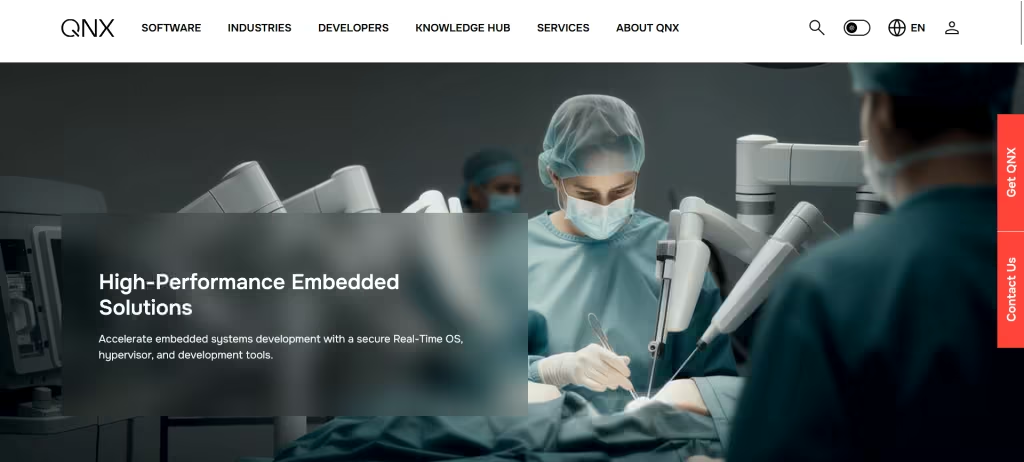
Company best known for the QNX Neutrino RTOS, which has become a cornerstone of modern automotive systems. As of 2024, QNX software is deployed in over 235 million vehicles worldwide, with strong penetration in infotainment, ADAS, and digital cockpit systems. The company has built a strong market position thanks to its microkernel architecture and long track record in safety-critical deployments.
Pros:
- microkernel architecture providing very high stability, strong process isolation, and fault tolerance,
- deterministic behavior with excellent real-time support,
- mature security mechanisms and extensive industry certifications,
- proven scalability.
Cons:
- high licensing and tooling costs compared to open-source solutions,
- closed ecosystem limiting flexibility and deep system customization,
- smaller availability of developers and community resources compared to Embedded Linux,
- strong focus on the automotive sector, reducing attractiveness in other embedded segments.
Best for:
BlackBerry QNX is best for automotive infotainment, ADAS and digital cockpit software, with QNX deployed in over 235 million vehicles as of 2024.
Most outsourcing disappointments start where firmware meets the board and nobody owns the seam. We run hardware and embedded software in one team, so driver bugs do not turn into vendor arguments.
Check whether your embedded vendor can own the hardware boundary
5. Siemens EDA
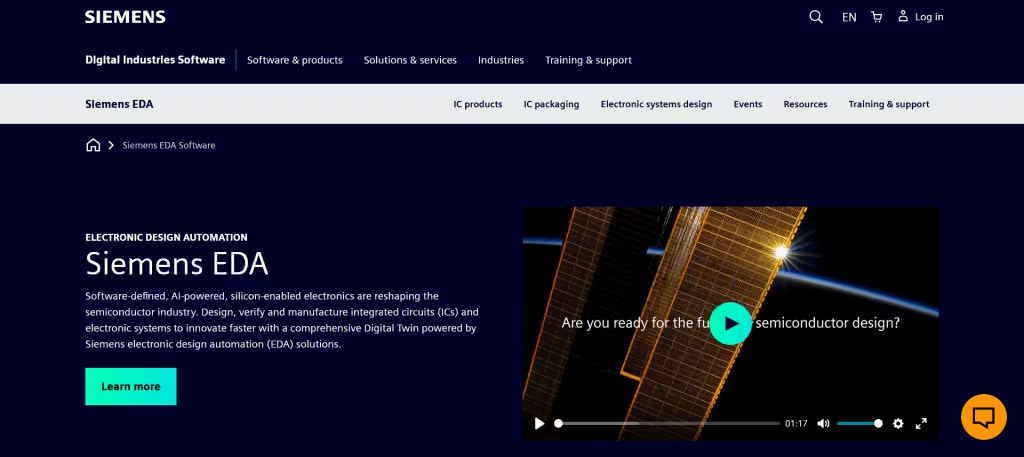
Siemens EDA is a Siemens division specializing in electronic design automation tools, including embedded software, formerly known as Mentor Graphics. The company provides solutions covering Embedded Linux, AUTOSAR, toolchains, and industrial-grade hardware–software integration. It has a strong presence in automotive, aerospace, and industrial sectors. Siemens reports that over 70% of the world’s top automotive and aerospace OEMs use its EDA and embedded toolchains in safety-critical programs.
Pros:
- very mature enterprise-class tools for Embedded Linux, AUTOSAR, and safety-critical systems,
- strong integration of software with hardware design (SoC, FPGA),
- good support for industry standards and certifications,
- stability and predictability in long-term projects.
Cons:
- high licensing costs, often out of reach for small teams and startups,
- high tool complexity and a steep learning curve,
- lower flexibility and slower iteration compared to open-source solutions,
- software designed primarily for large organizations.
Best for:
Siemens EDA is best for large automotive and aerospace programmes that need enterprise Embedded Linux and AUTOSAR toolchains, rather than for small teams or startups.
6. ARM
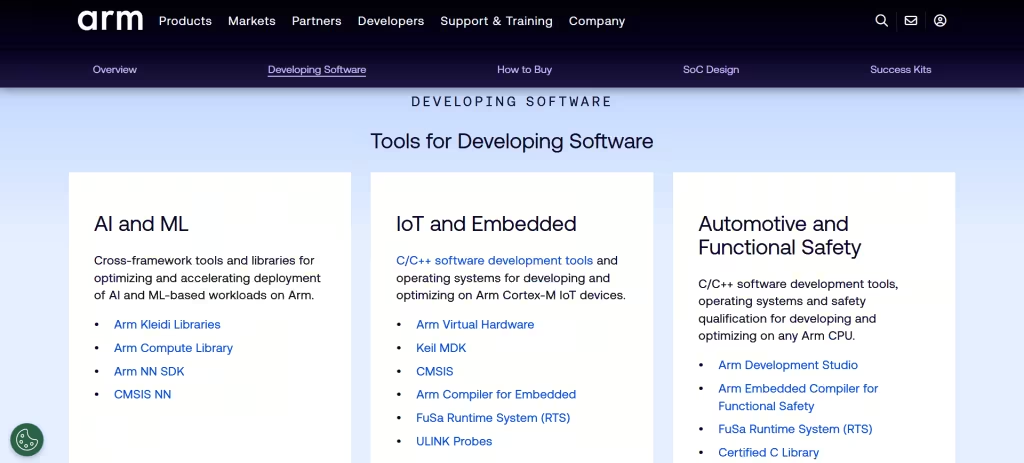
The company behind the world’s most widely used processor architecture, employed in embedded systems, IoT, mobile devices, servers, and virtually all modern consumer electronics. ARM does not manufacture its own chips. Instead, it licenses its architecture and provides key software components such as CMSIS and Trusted Firmware. Its solutions form the foundation of a large portion of modern embedded systems.
Pros:
- dominant market position,
- a vast ecosystem of hardware and tools,
- high energy efficiency,
- broad industry support.
Cons:
- the same architecture, but different SoC implementations lead to inconsistency in tools, bootloaders, and BSP support,
- limited predictability of the roadmap,
- higher cost and increased complexity in the high-end segment.
Best for:
ARM is best for teams building products on ARM-based processors, using CMSIS and Trusted Firmware as the base software layer.
7. NXP Semiconductors
NXP Semiconductors is a company providing comprehensive embedded solutions that combine hardware and software, with a strong presence in automotive, industrial, and IoT markets. NXP’s embedded software (SDKs, middleware, RTOS, AUTOSAR, MCUXpresso) is designed as a close complement to its own microcontrollers and SoCs, which simplifies system bring-up. According to NXP, over 50% of the world’s vehicles contain NXP processors, particularly in automotive networking and secure gateways. The company emphasizes long-term support and compliance with industry standards, often at the expense of flexibility.
Pros:
- strong hardware–software integration,
- comprehensive SDKs and tools,
- solid automotive and industrial support,
- long product lifecycles.
Cons:
- tight coupling of software to NXP-specific silicon,
- uneven quality of libraries and examples,
- slower pace of innovation,
- less flexibility compared to open-source solutions.
Best for:
NXP Semiconductors is best for automotive and industrial products built on NXP silicon, using MCUXpresso, SDKs and AUTOSAR support for faster bring-up.
8. Texas Instruments
Texas Instruments is a global semiconductor company whose embedded software ecosystem, including the MCU+ SDK and Code Composer Studio IDE, supports its broad microcontroller portfolio across industrial, automotive, and consumer electronics markets. TI has recently expanded into edge computing with its TinyEngine neural processing unit, embedded directly into new microcontroller families to run machine learning inference locally, reducing latency and power consumption. With over three decades of embedded development experience and an upstream-first approach to open-source contributions, TI provides comprehensive SDKs, drivers, and reference designs that accelerate hardware design work for engineering teams.
Pros:
- Extensive, well-documented SDKs and reference designs that reduce time spent building basic system software from scratch
- Growing edge AI capabilities built directly into microcontroller hardware, useful for connected devices with tight power budgets
- Strong long-term product lifecycles suited to industrial applications and automotive programs
- Active open-source community involvement and transparent GitHub-based development
Cons:
- Software tooling and SDKs are tightly coupled to TI silicon, limiting portability to other vendors
- Broad product portfolio can make it harder to identify the right SDK variant for a specific project
- Best suited to teams with in-house hardware engineers rather than software-only teams
- Less focused on safety-critical certification compared to vendors like Wind River or Green Hills
Best for:
Texas Instruments is best for teams with in-house hardware engineers using TI microcontrollers, including on-chip machine learning inference with the TinyEngine NPU.
9. Renesas Electronics
Renesas Electronics is a Japanese semiconductor company offering embedded software through its e² studio IDE and Flexible Software Package (FSP), which bundles production-ready drivers, middleware, and RTOS integrations for its RA, RX, and RZ microcontroller families. The FSP supports both FreeRTOS and the Eclipse Foundation's ThreadX (formerly Azure RTOS), giving engineering teams flexibility in choosing a real time operating system while relying on Renesas-maintained hardware abstraction layers. The company has also integrated its Reality AI Tools with e² studio to simplify development of edge AI and machine learning applications for endpoint devices.
Pros:
- Free, production-ready HAL drivers and middleware bundled directly with the IDE, reducing licensing overhead
- Flexible RTOS choice (FreeRTOS or ThreadX) rather than a locked-in proprietary operating system
- Strong support for cloud connectivity to AWS and Microsoft Azure out of the box
- Regular, well-documented software releases with clear migration guides between device families
Cons:
- FSP licensing includes full source code but is limited to Renesas hardware only
- Eclipse-based e² studio IDE can feel dated compared to newer, cloud-native development environments
- Fragmented software packages across different RZ and RA device families historically required separate learning curves, though recent consolidation is improving this
- Smaller global developer community compared to Embedded Linux or FreeRTOS on its own
Best for:
Renesas Electronics is best for RA, RX and RZ microcontroller projects that want a choice between FreeRTOS and ThreadX through the Flexible Software Package.
10. Amazon Web Services (FreeRTOS)
Amazon Web Services maintains FreeRTOS, an open-source real time operating system for microcontrollers that has become one of the most widely deployed embedded kernels in the industry. Distributed under the MIT license, FreeRTOS combines a lightweight real-time kernel with libraries for cloud connectivity, security, and over-the-air updates, allowing resource-constrained edge devices to connect securely to AWS IoT Core or process data locally through AWS IoT Greengrass. It supports more than 40 microcontroller architectures and is commonly used in industrial automation, connected consumer devices, and utility infrastructure such as smart meters.
Pros:
- Free and open source under the MIT license, with no licensing costs for the core kernel
- Broad hardware support across more than 40 architectures, avoiding vendor lock-in
- Mature cloud connectivity and over-the-air update libraries, well suited to fleets of connected devices
- Backed by a large community and a qualified partner device catalog that simplifies hardware selection
Cons:
- Lacks the built-in safety certifications (DO-178C, ISO 26262) that vendors like Wind River or Green Hills offer out of the box
- Deepest value is realized when paired with AWS cloud services, which can mean added complexity for teams not already using AWS
- As a kernel-plus-libraries project, it requires more integration work than a fully packaged commercial RTOS with vendor support
- Requires more manual security hardening decisions compared to closed, certified platforms designed for regulated industries
Best for:
Amazon Web Services (FreeRTOS) is best for fleets of connected devices on AWS, with an MIT-licensed kernel that supports more than 40 microcontroller architectures.
Read also:
- How Embedded Software Development Outsourcing Works - Guide for CTOs
- Choosing an Outsourcing Embedded Software Company
- 5 Best Embedded Software Development Companies in 2026
Which embedded software company fits your project?
The right embedded software company depends on whether you need a certified platform, a silicon vendor's software stack or an engineering team to build custom software for your hardware.
- Custom firmware, embedded Linux and RTOS work tied to your own hardware: InTechHouse
- Certified aerospace, defence or industrial systems: Wind River
- Systems where failure could put human life at risk: Green Hills Software
- Automotive infotainment, ADAS or digital cockpit software: BlackBerry QNX
- Enterprise Embedded Linux and AUTOSAR toolchains: Siemens EDA
- Products built on ARM processor architecture: ARM
- Automotive and industrial products on NXP silicon: NXP Semiconductors
- TI microcontroller projects with on-chip machine learning: Texas Instruments
- Renesas RA, RX or RZ microcontroller projects: Renesas Electronics
- Connected device fleets on AWS with no kernel licence cost: Amazon Web Services (FreeRTOS)
This list mixes product vendors (RTOS makers, a toolchain vendor, a processor architecture licensor and silicon makers) with one engineering services firm, InTechHouse, so most entries sell a platform your team builds on rather than outsourced development.
InTechHouse is ranked first because InTechHouse is the only company on this list that delivers custom embedded firmware and software development services as a project-based service, covering embedded Linux, RTOS, BSP and device drivers with hardware and software engineers working in one team.
If your project needs deep technical expertise across firmware, embedded Linux, and hardware design, reach out to InTechHouse to discuss your embedded software outsourcing needs.
Long lifecycle products need determinism, safety evidence and maintainable code, not a demo build. Ask us how we structure embedded delivery for US clients in medical, automotive and industrial programmes.
See how we deliver production-grade embedded software
Let's talk about your next move
Not sure where to start? We work with companies at every stage, from early ideas to enterprise-level builds. A 30-minute call can save you months of guesswork.
FAQ
1. What's the difference between an RTOS and Embedded Linux?
A real time operating system (RTOS) is designed for deterministic, time-critical tasks with a small memory footprint, making it well suited to microcontrollers. Embedded Linux offers a fuller operating system with networking, file systems, and a large software ecosystem, but with less predictable timing, making it better suited to more powerful processors running connected devices or systems requiring digital transformation features like data analytics and machine learning.
2. Why do safety-critical industries prefer certified embedded software platforms?
Industries like aerospace, automotive, and medical devices require software certified against standards such as DO-178C, ISO 26262, or IEC 62304. Certified platforms from vendors like Wind River or Green Hills Software come with the documentation and rigorous system architecture needed to pass regulatory audits, which significantly reduces the certification burden compared to building safety-critical software from scratch.
3. Is open-source embedded software like FreeRTOS suitable for commercial products?
Yes. FreeRTOS and similar open-source real time operating systems are widely used in commercial industrial automation, consumer electronics, and connected devices, and are distributed under permissive licenses like MIT. However, teams should budget extra engineering time for security hardening and, if needed, third-party certification, since open-source kernels don't come pre-certified for regulated industries the way commercial platforms do.
4. How does hardware choice affect embedded software outsourcing decisions?
Silicon vendors like NXP, Texas Instruments, and Renesas provide SDKs and drivers tightly coupled to their own hardware, which simplifies development but limits flexibility if you later need to switch chip vendors. Project-based embedded development companies, by contrast, can often work across multiple hardware platforms, offering more flexibility for products expected to evolve over multiple hardware generations.

Michał Kierul
Technology leader with over 20 years of experience in building and scaling engineering-driven organizations. Founder of InTechHouse and part of SoftBlue SA Group, a publicly listed, multi-brand technology company employing hundreds of specialists.
He focuses on delivering advanced solutions that combine hardware, embedded systems, and AI-driven software, supporting global clients in mission-critical sectors such as aerospace, defense, energy, healthcare, telecommunications, and industrial IoT.
His work centers on transforming complex technological challenges into scalable, production-ready systems. He has led projects from concept to deployment and driven the company’s international expansion, including the launch of a U.S. office in Dallas. He is also a graduate of Harvard Business School Executive Education, where he completed the Authentic Leader Development program.
Let's talk about your next project
From first prototype to production, our engineers can help you scope it, build it and get it certified.
Discuss your product with our R&D team
This initial conversation is focused on understanding your product, technical challenges, and constraints.
No sales pitch - just a practical discussion with experienced engineers.
Share a few details about your product and context. We’ll review the information and suggest the most appropriate next step.