.avif)

To ensure that machines, equipment, and commercial buildings in companies operate efficiently, it’s essential to avoid the „firefighting” approach – reacting only when something breaks down. This focus on building preventive maintenance is key to success.That’s the essence of what’s called reactive maintenance (RM) – fixing things after they’ve already failed. The problem is that this approach often leads to chaos: unplanned downtime, costly repairs, and less effective fixes for facility managers and their maintenance team.A smarter and more strategic way is to focus on prevention. That’s exactly what preventive maintenance plan is all about.
Ready to Replace Costly Chaos with Structured Efficiency?
We design custom Preventive Maintenance (PM) roadmaps that guarantee long-term asset reliability. Optimise operations, reduce downtime, and secure predictable results for your assets.
Explore Our Custom Strategy Service →
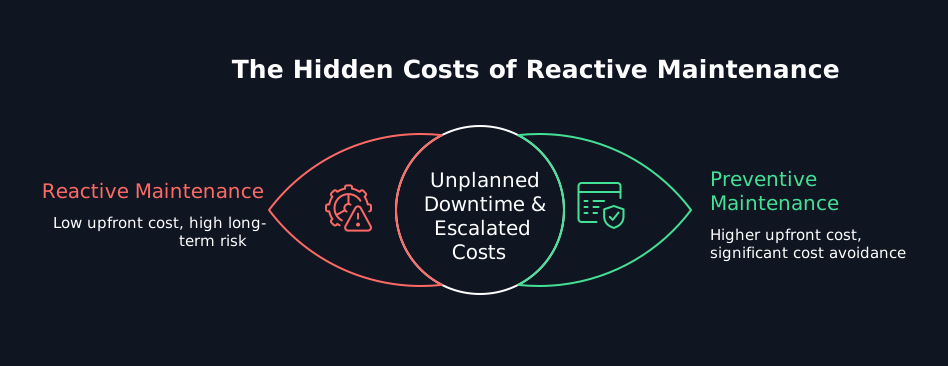
While reactive maintenance might appear to offer lower upfront costs because it postpones planning and scheduled intervention, this strategy results in substantial long-term financial and technical risks. The primary disadvantages of relying on RM (which often leads to expensive corrective maintenance) are unplanned downtime, increased repair costs, and a heightened risk of unforeseen operational disruptions.
When mission-critical equipment fails – be it an HVAC system or a control system – the resulting operational stop incurs maintenance costs far exceeding the immediate repair bill. This includes lost productivity, expedited shipping fees for emergency repairs and often, expensive overtime labour rates. Data unequivocally demonstrates the economic flaw in this approach.
By transitioning to systematic preventive maintenance programs (PM), organizations can achieve significant cost avoidance. According to the Federal Energy Management Program, companies save between 12% and 18% by choosing preventive maintenance over reactive maintenance, as every pound spent on preventive maintenance avoids five pounds in future costs.
This validates PM not as an overhead burden, but as a critical value driver based on the systematic risk mitigation logic of risk-based maintenance.
The fundamental objective of modern asset management is to embrace a proactive strategy. This preemptive methodology aims to prevent critical equipment failures before they manifest.
A great example is our work for a client in the oil and gas industry who needed to modernise an existing DC-DC converter module used in subsea power systems, which required specialist Multilayer PCB Design expertise. You can read more about it here.
By systematically conducting routine inspections, servicing, and condition monitoring, organizations realize the tangible preventive maintenance benefits: identifying potential issues in advance, allowing intervention before they escalate into costly failures. This improves equipment reliability.
The successful transition from reactive maintenance to proactive maintenance is more than a change in scheduling – it represents a deliberate shift in operational methodology.
RM forces premium spending on unscheduled labour and emergency procurement often leading to emergency repairs. Conversely, proactive maintenance systematically smooths out labour demand and enables planned, bulk purchasing of spare parts, transforming a system reliant on costly immediate action into one defined by scheduled efficiency.
Partner with InTechHouse for Proactive Maintenance
Partnering with InTechHouse offers a distinct advantage, leveraging over 21 years of market experience in facilities management and hardware design solutions to architect a scalable, data-driven preventive maintenance program tailored precisely to your organisational assets. Accelerate your transition to proactive maintenance.
The most important phase involves engineering the technical execution of the preventive maintenance program. To effectively manage this, the right preventive maintenance software is essential. What does that mean?
We sometimes modernise existing systems, and at other times we perform reverse engineering. One notable example is a successful project for a leading oil&gas client who needed a modernised power transformer for a Subsea Electronics Module (SEM). See more Mid Life Upgrade for Sem power transformer.
It’s worth remembering that a successful PM program must first determine the assets that require the most rigorous attention, especially those considered critical components.
This process begins with a comprehensive asset register and a criticality ranking, typically achieved through Failure Mode and Effects Analysis (FMEA). FMEA systematically identifies potential failure modes within a system, determining their effects, causes, and the criticality of the resulting damage to overall equipment performance.
The comprehensive asset register tracks every component, including its specifications, maintenance history, and estimated lifespan. This mapping is essential for determining which assets are low-priority (suitable for RM), which require rigid time-based maintenance tasks, and which demand advanced condition monitoring (Predictive Maintenance, PdM), a choice covered in predictive maintenance vs preventive maintenance.
The preventative maintenance strategy relies on tailored scheduling protocols, avoiding the one-size-fits-all approach. This is fundamental to effective maintenance operations.
Scheduling is generally categorized into three mechanisms, which are key types of preventive maintenance:
This entire digital workflow can be managed efficiently through our comprehensive Software Services.
This chart visually confirms the fundamental goal of proactive maintenance: to shift the intervention point from the expensive and disruptive „Failure Time” (Reactive Maintenance) to the precise „Threshold Time” (Condition-based Maintenance).
By leveraging real-time data, organizations ensure maintenance occurs only when absolutely necessary to prevent a breakdown, avoiding the premature intervention typical of Time-Based Maintenance (TBM) and the catastrophic costs of Reactive Maintenance (RM).
.svg)
Read also:
Operationalising a PM strategy requires converting physical conditions and service efficacy into quantifiable data. These Key Performance Indicators (KPIs) are essential not only for demonstrating ROI but also for driving the continuous improvement cycle mandated by ISO 55000, ensuring optimal performance.
It’s important to understand the duality of these metrics: MTBF measures intrinsic asset reliability, while MTTR measures organizational maintainability. Maximising both simultaneously requires a structured digital system that not only schedules PM (increasing MTBF) but also streamlines the repair process (reducing MTTR through efficient work order and spare parts management).
While time- and usage-based preventive maintenance provides strong baseline reliability, it remains fundamentally inexact, often leading to unnecessary intervention or undetected weaknesses. To achieve true operational excellence, organizations must transition to predictive maintenance (PdM) powered by Industrial IoT (IIoT) and advanced data analytics.
Preventive maintenance is scheduled far in advance, based on estimations of asset life. Predictive Maintenance, however, uses real-time condition monitoring to anticipate equipment failures, scheduling maintenance tasks precisely when and where they are required. The foundation of maintenance protocols shifts from rigid calendars to live asset condition data.
Fixed intervals still replace healthy parts and miss failing ones. We instrument the assets that matter, define the condition thresholds and prove the savings before you scale.
Move from calendar based schedules to condition based maintenance
PdM relies on a sophisticated Industrial IoT network architecture, leveraging specialized hardware and data processing capabilities. For effective building preventive maintenance, this is becoming the new standard.
InTechHouse’s R&D expertise in electronics and embedded systems is essential for architecting this infrastructure.The architecture comprises four critical stages:
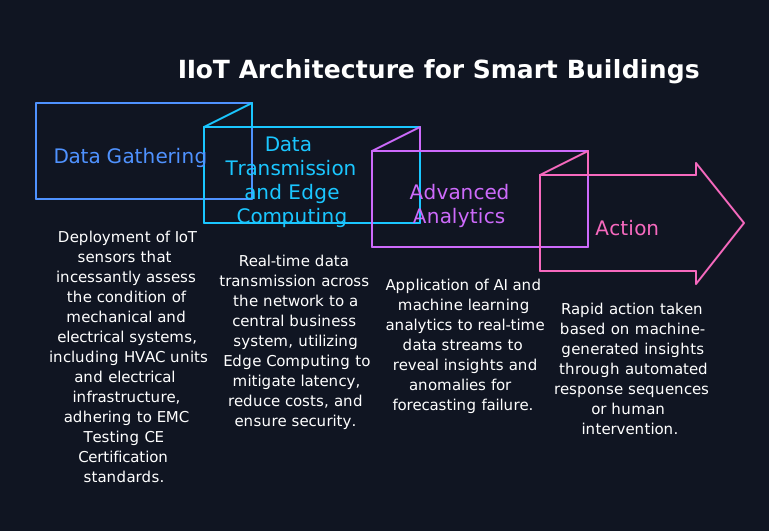
Our R&D team excels at architecting end-to-end IIoT and Predictive Analytics infrastructures, turning raw sensor data into actionable maintenance schedules. See how we optimise operations and prevent downtime with smart solutions.
See Our IIoT Predictive Maintenance Portfolio →
We start with one asset class, existing sensor data and a measurable KPI such as unplanned downtime hours. Ask what a first pilot on your equipment would involve.
See how a predictive maintenance pilot is scoped
Not sure where to start? We work with companies at every stage, from early ideas to enterprise-level builds. A 30-minute call can save you months of guesswork.
The choice between time-based, usage-based and condition-based maintenance depends on how the asset wears and what a failure costs. Assets with steady, predictable wear suit fixed calendar intervals. Assets whose wear tracks load, such as compressors or spindles, suit usage triggers like run hours or cycle counts. Condition-based checks pay off where degradation is measurable before failure (vibration, temperature, oil quality) and the consequence of a missed fault is high. Low-criticality, cheap-to-replace items can stay on run-to-failure.
FMEA (Failure Mode and Effects Analysis) ranks each failure mode by severity, likelihood of occurrence and likelihood of detection, often combined into a risk priority number. In maintenance planning, that ranking decides where inspection effort goes first. High-severity modes with poor detectability usually justify condition monitoring or shorter intervals, while low-risk modes may not need a scheduled task at all. The analysis only stays useful if it is revisited when failure history, operating conditions or the asset register change.
MTBF (mean time between failures) measures how long an asset runs before an unplanned breakdown, so it reflects reliability. It is calculated as total operating time divided by the number of failures in the period. MTTR (mean time to repair) measures how long it takes to restore the asset once it fails, so it reflects maintainability and the response process. Preventive tasks mainly raise MTBF; spare parts availability, diagnostics and work order discipline mainly lower MTTR. Tracking only one hides half the picture.
Preventive maintenance can be overdone when fixed intervals replace components that still have useful life or disturb equipment that was running well. Every intervention carries a risk of maintenance-induced faults, such as reassembly errors, contamination or misalignment, and it consumes planned downtime. Warning signs include parts routinely removed with little visible wear and failures clustering shortly after service. The fix is to review interval length against failure data and move measurable failure modes to condition-based triggers.
A CMMS (computerized maintenance management system) is the system of record that turns a preventive maintenance plan into scheduled work orders, tracks completion and stores asset history. It holds the asset register, task lists, intervals, spare parts and labor records, which makes KPIs like MTBF, MTTR and planned maintenance percentage measurable. When condition monitoring is added, sensor alerts are typically pushed into the CMMS through an API so they generate work orders instead of sitting in a separate dashboard.
Tomasz Andrysiak, DSc, PhD, is an Expert and a Professor at Bydgoszcz University of Science and Technology. He has more than 30 years of academic, research, R&D, and technology-implementation experience in artificial intelligence, computational intelligence, signal processing, anomaly detection, cybersecurity, and complex information systems.
His research focuses on machine-learning and computational-intelligence methods for analyzing signals, time series, network traffic, industrial data, and multimodal datasets. He specializes in anomaly and failure detection, predictive modeling, intelligent monitoring, critical-infrastructure security, smart metering, biomedical signal analysis, and the practical deployment of AI in industrial and public-sector systems.
Tomasz is the author or co-author of more than 75 scientific publications, including papers published in internationally recognized journals and conference proceedings indexed by Web of Science and Scopus. His research has covered network anomaly detection, cybersecurity of critical infrastructure, ECG signal analysis, machine learning, smart water networks, telecommunications, and intelligent industrial systems.
He has led and contributed to national and European R&D programs focused on cyber situational awareness, critical-infrastructure resilience, autonomous systems, Big Data, intelligent water management, blockchain-based transaction platforms, and industrial AI. He leads industrial-doctorate projects involving AI-based CMDB automation and machine-learning methods for knowledge discovery in Big Data.
Tomasz is an IEEE Senior Member and has served as an elected member of the Commission of Informatics and Automation of the Polish Academy of Sciences, Poznań Branch. He has participated in scientific committees and journal boards, supervised doctoral research, reviewed publications for international journals, and co-authored patents and patent applications related to signal detection and LoRa-based ECG monitoring. He writes about industrial AI, machine learning, anomaly detection, predictive analytics, cybersecurity, signal processing, time-series analysis, and intelligent infrastructure.
Tomasz Andrysiak's academic profiles:
https://orcid.org/0000-0001-8138-6619
https://ludzie.nauka.gov.pl/ln/profiles/fHOpojQ2lIF
https://link.springer.com/chapter/10.1007/978-3-642-32384-3_28
https://www.researchgate.net/profile/Tomasz-Andrysiak
https://scholar.google.com/citations?user=RHW7zx4AAAAJ&hl=pl
https://dblp.org/pid/41/6793.html
https://radon.nauka.gov.pl/dane/profil/6FFA1E51186802ECFFB49644209B5BE0EBD68C55
https://pbs.edu.pl/pl/pracownik/tomasz-andrysiak
https://www.youtube.com/watch?v=6e1GTqT5czM
From first prototype to production, our engineers can help you scope it, build it and get it certified.
This initial conversation is focused on understanding your product, technical challenges, and constraints.
No sales pitch - just a practical discussion with experienced engineers.
Share a few details about your product and context. We’ll review the information and suggest the most appropriate next step.