
Top Edge AI Companies / Edge AI Development Providers 2026

Disclosure: This ranking is published by InTechHouse, which is included in the list. Companies were assessed on the part of the edge AI stack they cover, support for custom hardware, power efficiency and fit with existing cloud or industrial ecosystems, based on publicly available information and company websites as of October 2026.
Edge AI runs AI models directly on a local device, sensor or gateway, and Grand View Research values the global edge AI market at USD 24.9 billion in 2025, projected to reach USD 118.7 billion by 2033. This ranking compares eight edge AI companies and development providers for 2026 on stack coverage, power efficiency and ecosystem fit, separating full-cycle development partners from chip vendors, cloud platforms and industrial ecosystems, for uses from factory inspection to edge AI hardware for in-vehicle vision.
Key takeaways:
- The global edge AI market is valued at USD 24.9 billion in 2025 and is projected to reach USD 118.7 billion by 2033 (Grand View Research).
- InTechHouse, NVIDIA, Qualcomm, Intel, Hailo, ADLINK, AWS, and Siemens each cover a different piece of the edge AI stack: full-cycle hardware and AI development, general-purpose compute, low-power silicon, software frameworks, or industrial infrastructure.
- Most real-world edge AI deployments combine two or three of these providers rather than relying on a single vendor.
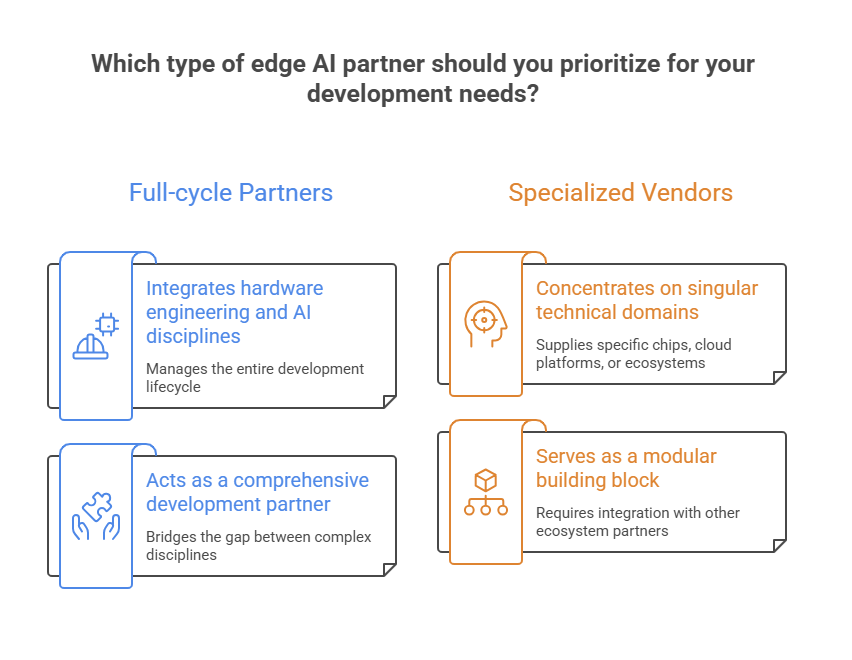
- The right choice depends on three factors: whether you need custom hardware, how tight your power budget is, and whether you are already standardized on a specific cloud or industrial ecosystem. If custom hardware wins, the next question is deploying AI on custom hardware within that power budget.
Top 8 edge AI companies in 2026 (quick answer)
The best edge AI companies in 2026, assessed on stack coverage, custom hardware capability, power efficiency and ecosystem fit, are:
- InTechHouse: best for edge AI built into regulated, certifiable products in medical, aerospace and industrial sectors.
- NVIDIA: best for robotics, vision AI and generative AI at the edge on Jetson modules.
- Qualcomm: best for connected industrial IoT devices that need native 5G.
- Intel: best for hardware-portable inference across CPU, GPU and NPU with OpenVINO.
- Hailo: best for battery-powered and thermally constrained devices.
| # | Company | Type | Best for | Key products and platforms | Proof point |
|---|---|---|---|---|---|
| 1 | InTechHouse | Engineering services firm (full-cycle edge AI) | Regulated, certifiable products in medical, aerospace and industrial sectors | Hardware, embedded software and AI models; hybrid FPGA and MCU architectures | AI signal-processing filters on constrained medical devices; part of SoftBlue Group |
| 2 | NVIDIA | Chip and platform vendor | Robotics, vision AI and generative AI at the edge | Jetson (Orin Nano to Thor), JetPack SDK, Isaac, Metropolis, Riva | 7B-parameter LLM runs locally on Jetson Orin Nano |
| 3 | Qualcomm | Chip and platform vendor | Connected industrial IoT devices needing native 5G | Dragonwing processors (incl. IQ10), Edge Impulse, Arduino | Dragonwing IQ10 supports up to seven concurrent camera inputs |
| 4 | Intel | Software framework and chip vendor | Hardware-portable deployment without silicon lock-in | OpenVINO toolkit for CPU, integrated GPU and NPU | 2026 releases added LLM support and text-to-video pipelines |
| 5 | Hailo | AI accelerator chip vendor | Battery-powered and thermally constrained devices | Hailo-10H and Hailo-8 accelerators | Hailo-10H runs generative AI at a typical 2.5 W |
| 6 | ADLINK Technology | Industrial hardware vendor | Harsh industrial sites with existing SCADA, PLC and MES | Matrix ruggedised industrial computers | Roughly three decades of experience in embedded devices |
| 7 | AWS IoT Greengrass | Cloud-to-edge platform | Organisations already standardised on AWS | Greengrass V2, SageMaker Neo, AWS IoT Fleet Manager | Greengrass V1 support ends in October 2026 |
| 8 | Siemens Industrial Edge | Industrial automation platform | Factories with existing Siemens OT infrastructure | Industrial Edge, Industrial AI Suite, SIMATIC controllers | IEC 62443-4-2-certified security, air-gapped operation |
Read also:
- What Is Edge AI? Real-Time Computer Vision on Embedded Hardware
- Choosing an Edge AI Development Company for Safety-Critical Systems
- Edge AI vs Cloud AI for Real-Time Vision: Latency, Privacy, Bandwidth
Edge AI companies and development providers ranked
1. InTechHouse
InTechHouse is a European engineering company that builds edge AI systems the way they actually need to be built for regulated industries: tightly integrated with the hardware underneath them, not bolted on as an afterthought. As an EU-certified R&D partner and part of the SoftBlue Group, the company combines hardware engineering, embedded software, and AI development under one roof, which matters enormously once a project moves past a proof of concept and into a certified, mass-produced product.
What separates InTechHouse from generic AI consultancies is that its edge AI work starts at the silicon and PCB level, not at the model level. The team designs and implements industrial edge AI and intelligent hardware for industrial and regulated environments, where AI models have to run deterministically, reliably, and with built-in security, not just accurately in a lab. That includes real, delivered work: a generative AI project for a medical technology client that adapted AI-based signal-processing filters to run on hardware-constrained diagnostic and patient monitoring devices, and FPGA-accelerated edge AI architectures for industrial automation where a microcontroller alone cannot meet the latency budget.
InTechHouse's edge AI capabilities cover:
- Custom software development for on-device inference, from model selection through quantization and pruning for hardware-limited devices
- Hybrid FPGA and microcontroller architectures that combine deterministic acceleration with flexible system logic
- Predictive maintenance and anomaly detection models that process sensor data locally across industrial sites, including oil and gas, aerospace, and manufacturing
- Industrial data platforms that unify OT and IT sensor data into a governed environment supporting both edge inference and cloud analytics
- Computer vision pipelines for defect detection and quality inspection running directly on production-line hardware
- Secure over-the-air model updates and real-time monitoring for AI models deployed across distributed environments and remote locations
This is what "edge AI development provider" is supposed to mean: bespoke solutions built to fit the hardware limitations of the actual device, not a generic AI model wrapped around whatever silicon happened to be on hand.
Pros: Combined hardware and AI engineering under one team, hands-on experience in aerospace, medical devices, and industrial automation, EU-based delivery with an established track record in certification-heavy, mission-critical environments, and embedded software consulting that engages at the architecture stage rather than after the hardware is already frozen.
Best for:
InTechHouse is best for companies that need edge AI built into a physical, certifiable product in medical, aerospace or industrial sectors, with hardware, firmware and AI models developed by one team.
2. NVIDIA
NVIDIA's Jetson platform is the closest thing the edge AI ecosystem has to a default choice for teams building robotics, vision AI, or generative AI applications that need to run outside a data center. The Jetson family, from Orin Nano to Jetson Thor, is purpose-built physical AI hardware supporting optimized runtime inference for open models including NVIDIA Nemotron, Cosmos, and Isaac GR00T, alongside a fast-growing catalog of community models.
What keeps Jetson relevant, beyond raw compute, is the size of its developer community. NVIDIA's JetPack SDK bundles Jetson Linux, accelerated AI libraries, and vertical-specific software stacks such as Isaac for robotics, Metropolis for smart cities and factory video analytics, and Riva for speech AI, giving teams a shortcut past months of low-level driver work. As of early 2026, running a 7-billion-parameter large language model locally on a Jetson Orin Nano is a documented, repeatable weekend project rather than a research exercise, which says a lot about how far edge AI applications have matured.
Pros: Massive developer community and documentation, software frameworks that span robotics, vision, and generative AI, hardware options spanning entry-level to industrial-grade compute.
Trade-off: Jetson modules draw meaningfully more power than specialized accelerators, which rules them out for battery-constrained or thermally restricted edge devices.
Best for:
NVIDIA is best for teams building robotics, vision AI or generative AI applications on Jetson modules, where power budget is not the main constraint.
3. Qualcomm
Qualcomm spent 2025 and early 2026 assembling a full-stack edge AI platform rather than just selling chips. Its Dragonwing processors now sit under a unified software architecture supporting Linux, Windows, and Android, stitched together through acquisitions of Arduino, Edge Impulse, and Foundries.io aimed at lowering the barrier between prototyping and commercialization for smaller OEMs and independent developers, not just large enterprises.
The Dragonwing IQ10 illustrates Qualcomm's positioning well: a heterogeneous architecture combining Arm CPU cores, an Adreno GPU, and Hexagon DSPs that supports up to seven concurrent camera inputs for sensor fusion in autonomous mobile robots, with native 5G connectivity built in rather than bolted on through an external modem. For industrial IoT deployments where communication and compute matter equally, that native connectivity is often the deciding factor over a more powerful but connectivity-agnostic alternative.
Pros: Full-stack platform spanning silicon, OS support, and developer tooling, native 5G connectivity, strong existing relationships across automotive, industrial, and wireless markets.
Trade-off: The platform is optimized for connected, mid-range AI workloads rather than the highest-TOPS use cases that NVIDIA's top-end modules target.
Best for:
Qualcomm is best for connected industrial IoT devices, where Dragonwing processors provide native 5G connectivity alongside on-device AI.
4. Intel
Intel's contribution to the edge AI landscape is less about a single chip and more about a software framework that decouples the AI model from the hardware underneath it. The OpenVINO toolkit accelerates AI inference with lower latency and higher throughput while reducing model footprint, letting teams convert models trained in PyTorch or TensorFlow and deploy the same model across CPU, integrated GPU, and NPU, moving fluidly between edge devices and cloud environments without rewriting the application layer.
That framework flexibility is the real value proposition. OpenVINO's 2026 releases added broader large language model support, quantization improvements, and text-to-video generation pipelines, extending it well beyond the computer vision workloads it was originally built for. For teams that need to hedge against being locked into one AI company's silicon roadmap, an open, hardware-portable inference framework is often worth more than a marginally faster chip.
Pros: Open-source and hardware-portable, strong support for both traditional computer vision and generative AI models, mature developer ecosystem with active GitHub contribution.
Trade-off: Best performance is still reserved for Intel's own CPUs, GPUs, and NPUs, so cross-vendor deployments require more tuning to match native-hardware benchmarks.
Best for:
Intel is best for teams that want hardware-portable inference, using OpenVINO to deploy one model across CPU, integrated GPU and NPU.
5. Hailo
Hailo, an Israeli AI chip company, built its reputation on a structure-driven dataflow architecture that keeps AI model layers physically close together on the chip, cutting the data movement that burns power in conventional processors. Its Hailo-10H accelerator delivers real generative AI inference at the edge with a typical power draw of just 2.5 watts, a specification that puts large language model and vision-language model inference within reach of battery-powered and thermally constrained embedded devices where a Jetson-class module simply will not fit.
The chip is application specific integrated circuit territory rather than a general-purpose GPU, which is exactly why it wins on power management for cameras, robots, and consumer devices. Named customers include ASUS, HP, and Husqvarna, whose robotic lawn mowers use the Hailo-8 accelerator for real-time obstacle detection without cloud connectivity. It is worth noting in the interest of accurate reporting: Hailo's valuation has fallen sharply since 2024 amid a tightening funding environment, and the company is currently pursuing a public listing through a SPAC merger. The technology remains genuinely differentiated, but it is a smaller, less financially stable company than the other names on this list.
Pros: Best-in-class power efficiency for on-device generative AI, automotive-qualified silicon, mature software stack used by a large developer base.
Trade-off: Recent financial instability adds vendor-risk considerations that a design-in decision should account for.
Best for:
Hailo is best for battery-powered and thermally constrained devices, with the Hailo-10H running generative AI at a typical 2.5 watts.
Accelerators like these only deliver their rated performance when the firmware around them is written for the constraints of the device. Teams without that capability in-house usually pair a silicon vendor with one of the top embedded software and firmware development companies that can own the driver, RTOS, and integration work.
6. ADLINK Technology
ADLINK is an edge AI infrastructure provider in the more literal sense: it builds the ruggedized industrial computers that other companies' AI models actually run on. With roughly three decades of experience in embedded devices, ADLINK's Matrix platforms are engineered to withstand harsh industrial environments while processing real-time sensor data from equipment that cannot tolerate downtime, and to integrate easily with the SCADA, PLC, and MES systems already running the factory floor.
Where chip vendors sell silicon and software platforms sell frameworks, ADLINK sells the physical box that survives in a factory, an oil rig, or a transportation hub for years without a service visit. That distinction matters more than it sounds: plenty of edge AI proof-of-concept projects fail not because the model was wrong, but because the hardware it was deployed on could not survive vibration, temperature swings, or years of continuous operation.
Pros: Long track record in industrial-grade hardware, strong integration with existing OT infrastructure, purpose-built for harsh industrial environments.
Trade-off: As a hardware and infrastructure provider rather than a model developer, ADLINK is typically one piece of a larger stack rather than a full edge AI solutions partner on its own.
Best for:
ADLINK Technology is best for harsh industrial environments that need ruggedised Matrix computers integrated with existing SCADA, PLC and MES systems.
7. AWS IoT Greengrass
AWS IoT Greengrass takes a different starting point than the chip vendors on this list: it assumes you are already running on AWS and need to extend that same operational model out to thousands of distributed edge sites. The service brings AWS cloud capabilities to edge devices so applications can run locally while staying connected to AWS services, letting Lambda functions and machine learning models execute directly on-device and continue operating through intermittent connectivity, then sync back to the cloud once the connection returns.
For global businesses already standardized on AWS for everything else, that consistency is the real selling point. Greengrass pairs with SageMaker Neo for model optimization and AWS IoT Fleet Manager for device fleet operations, and AWS has continued investing in it into 2026, including a dedicated AI agent context pack released in late 2025 to help development teams build Greengrass components faster using generative AI coding tools. Version 1 support ends in October 2026, so anyone still running it should already be planning the migration to Greengrass V2.
Pros: Deep integration with the broader AWS ecosystem, strong fleet management and OTA update tooling, works well for large-scale, geographically distributed edge deployments.
Trade-off: The value proposition weakens quickly for teams not already committed to AWS, and the learning curve is steep enough that several reviewers cite it as a real onboarding cost.
Best for:
AWS IoT Greengrass is best for organisations already standardised on AWS that need to deploy and manage AI models across distributed edge sites.
8. Siemens Industrial Edge
Siemens approaches edge AI from the factory floor outward rather than from the chip or the cloud. Its Industrial Edge platform, expanded significantly at Hannover Messe 2026, now includes an Industrial AI Suite that simplifies the entire AI lifecycle and scales AI models for predictive maintenance and visual inspection across multiple sites, running directly on SIMATIC controllers and industrial PCs on the shop floor.
The platform's value is in how deeply it is wired into operational technology that manufacturers already depend on. Predictive maintenance models trained on vibration, temperature, and acoustic sensor data can flag equipment failures days in advance, and because inference happens on the Industrial Edge device itself rather than in a remote data center, production lines keep running even if the plant's internet connection goes down. Siemens has also added IEC 62443-4-2-certified security functions for critical infrastructure, including fully air-gapped operation, aimed squarely at facilities that cannot risk network exposure.
Pros: Deep OT integration with existing SIMATIC and SCADA infrastructure, strong security certification for critical infrastructure, proven results in large-scale manufacturing deployments.
Trade-off: The ecosystem is built around Siemens' own automation hardware, so it is a much stronger fit for existing Siemens shops than for a mixed-vendor factory floor.
Best for:
Siemens Industrial Edge is best for factories built on Siemens SIMATIC and existing OT infrastructure, especially for predictive maintenance and visual inspection.
Which edge AI company fits your project?
Most edge AI projects combine two or three of these providers, so match each layer of your project to the situation below.
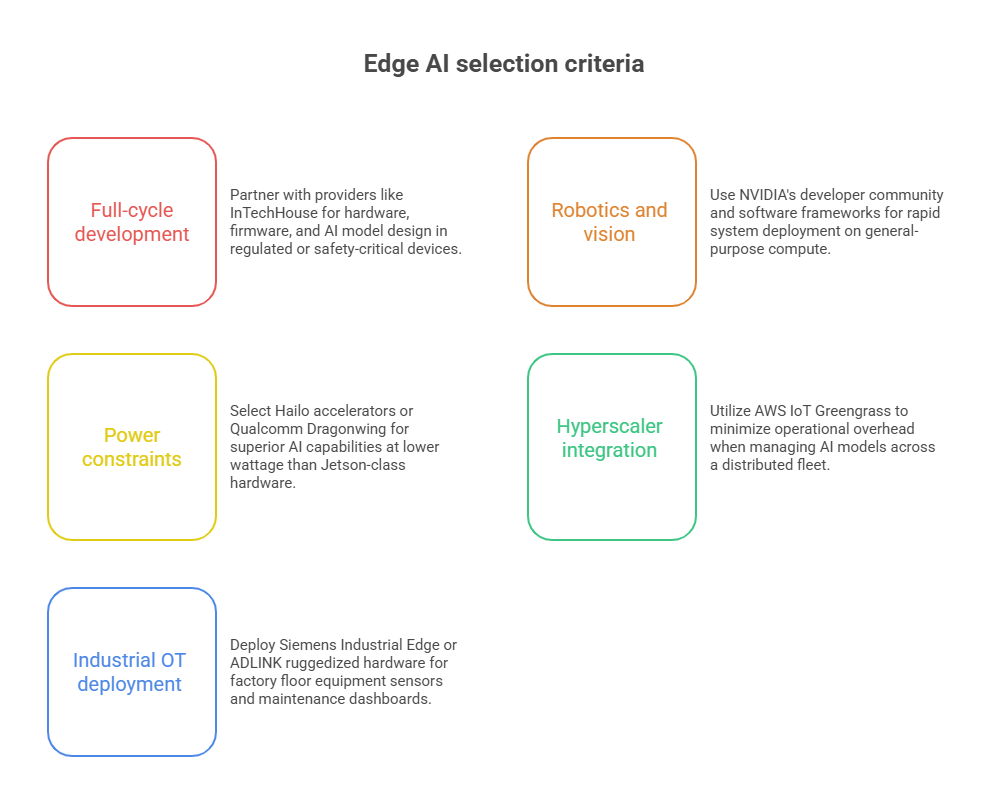
- Designing and building a regulated or safety-critical device, with hardware, firmware and AI models together: InTechHouse
- General-purpose compute for robotics or vision AI where power is not the binding constraint: NVIDIA
- Connected industrial IoT devices that need native 5G: Qualcomm
- Avoiding lock-in to one silicon roadmap: Intel
- A tight battery or thermal budget: Hailo
- Ruggedised hardware for factories, oil rigs or transport hubs: ADLINK Technology
- A device fleet already standardised on AWS: AWS IoT Greengrass
- A factory floor built on Siemens automation and existing OT: Siemens Industrial Edge
This list mixes one full-cycle engineering services firm, InTechHouse, with chip vendors (NVIDIA, Qualcomm and Hailo), a software framework (Intel OpenVINO), an industrial hardware maker (ADLINK Technology) and two platforms (AWS IoT Greengrass and Siemens Industrial Edge), so they are often partners in the same project rather than alternatives.
InTechHouse ranks first because it is the only company on the list that designs the hardware, embedded software and AI models together, with delivered work including AI signal-processing filters for hardware-constrained medical devices and FPGA-accelerated edge AI for industrial automation.
Chip vendors sell silicon, cloud platforms sell deployment, and neither one owns your latency or thermal envelope. We build the hardware and the inference stack together so the device holds its frame rate in the field.
Scope an edge AI system that runs inside your power budget
A few questions worth asking any edge AI company before committing:
- Does the proposed hardware have a track record surviving your actual operating environment, not just a lab demo?
- How are AI models updated once deployed, and what happens if an update fails at a remote site with no on-site technician?
- What is the plan for facilitating integration with your existing sensor data pipelines and legacy control systems?
- Is the vendor financially stable enough to support the hardware for the product's full lifecycle, not just the next funding round?
- Does the solution support secure, auditable operation for compliance-heavy industries, or does it assume an unregulated consumer context?
Many edge AI programs start life as connectivity projects: sensors, gateways, and a data pipeline that only later gets a model attached to it. If that describes your situation, the shortlist of top IoT and industrial IoT development companies is the more useful starting point, because it covers the device and platform layer that edge inference eventually runs on.
We take on-device vision and inference from model selection through custom carrier boards, thermal design and field updates. Ask for the delivery breakdown on a comparable industrial deployment.
See how we deliver edge AI for regulated environments
Let's talk about your next move
Not sure where to start? We work with companies at every stage, from early ideas to enterprise-level builds. A 30-minute call can save you months of guesswork.
FAQ
What is the difference between edge AI and cloud AI?
Edge AI processes data on the local device; cloud AI sends that data to a remote server first. Edge AI runs AI models directly on the device or on local infrastructure close to where data is generated, such as a camera, a sensor gateway, or an industrial PC. Cloud AI sends that data to a remote data center for processing. The trade-off is straightforward: edge AI delivers lower latency processing, works without a reliable network connection, and keeps sensitive data local, while cloud AI generally has access to more compute for the largest AI models and centralized retraining. Most production systems now use both, running lightweight inference at the edge and reserving the cloud for training and less time-sensitive analytics.
1. Who are the top edge AI companies in 2026?
InTechHouse, NVIDIA, Qualcomm, Intel, Hailo, ADLINK Technology, AWS, and Siemens are among the top edge AI companies in 2026, each specializing in a different layer of the stack. InTechHouse and similar engineering firms build full-cycle custom hardware and AI systems for regulated industries; NVIDIA, Qualcomm, and Hailo supply the underlying silicon and platforms; Intel provides a hardware-portable software framework; and AWS and Siemens extend AI from the cloud or the factory floor down to the edge device.
2. Do I need custom hardware for an edge AI application?
Not always, but complex or regulated products usually require it. Off-the-shelf modules like NVIDIA Jetson or Qualcomm Dragonwing developer kits are a reasonable starting point for prototyping and even for some production volumes. Custom hardware becomes worth the investment when a product needs a specific form factor, has to survive extreme industrial environments, needs to hit a tight power or cost budget at scale, or has to pass a specific regulatory certification that off-the-shelf hardware was not designed for.
3. How much AI model accuracy do you lose by moving inference to the edge?
Well-optimized edge deployments typically lose only a few percentage points of accuracy compared to a full cloud model. This happens through quantization and pruning techniques that shrink a model to fit constrained memory and compute. For many edge AI applications, such as detecting whether a bearing is starting to fail or whether a person has entered a restricted zone, that trade-off is easily worth the gain in latency, privacy, and reliability.
4. Which industries are adopting edge AI fastest?
Manufacturing, automotive, retail, and smart cities are currently the biggest adopters of edge AI. This is largely because they combine large volumes of unstructured data (video, vibration, acoustic signals) with a genuine need for real-time decisions. Healthcare and medical devices are close behind, particularly for patient monitoring devices that need to process physiological sensor data locally for both latency and privacy reasons.
5. Can edge devices run large language models?
Yes, purpose-built edge accelerators can now run quantized large language models directly on-device. Accelerators like the Hailo-10H and higher-end platforms like NVIDIA Jetson Thor can run quantized versions of models in the 2 to 8 billion parameter range on-device, enabling local voice assistants, document search, and agentic workflows without a cloud API call. Running the largest frontier-scale language models still requires cloud infrastructure, but the gap between what fits at the edge and what requires a data center keeps closing every year.
6. How do I choose between an edge AI hardware vendor and a full-cycle development partner?
Choose a hardware vendor if you already have AI and embedded engineering expertise in-house and just need silicon; choose a full-cycle partner if you need someone to design, build, and certify the product itself. Chip and platform vendors like NVIDIA or Qualcomm supply the underlying compute but expect the buyer to handle system design, firmware, and certification internally. A full-cycle provider like InTechHouse takes on that engineering work directly, which matters most for regulated products where a design mistake is expensive to fix after certification.
Damian Ledziński, PhD Eng.
Damian Ledziński, PhD Eng., is an Applied Artificial Intelligence Expert and an Assistant Professor at Bydgoszcz University of Science and Technology. He has over 15 years of academic, research, software-engineering, and technology-development experience.
His work focuses on applying artificial intelligence, machine learning, deep neural networks, and data science to complex real-world systems. His principal research and engineering interests include autonomous unmanned aerial vehicles, drone navigation and swarm intelligence, biomedical engineering, medical signal and image analysis, predictive modeling, industrial IoT, and intelligent water-management systems.
Damian has contributed to multidisciplinary R&D initiatives including AI-assisted medical diagnostics, a Polish ventilator prototype, autonomous indoor drone systems for warehouse inventory, AI-supported water-consumption analysis, virtual medical assistants, and intelligent systems combining embedded devices with machine-learning models.
He is the author or co-author of more than 30 scientific publications. His work has appeared in international scientific publications covering artificial intelligence, biomedical engineering, signal analysis, autonomous systems, environmental monitoring, and data-driven infrastructure.
Damian is a co-creator of academic programs in Engineering in Medicine, AI in Medicine, and Data Science at Bydgoszcz University of Science and Technology. He combines scientific research with hands-on implementation, translating experimental AI methods into deployable technology. He writes about applied AI, machine learning, predictive analytics, autonomous UAV systems, AI in medicine, biomedical signal processing, industrial IoT, and intelligent models in real-world systems.
Damian Ledziński's academic profiles:
https://orcid.org/0000-0003-0796-4390
https://wtie.pbs.edu.pl/pl/pracownik/damian-ledzinski
https://www.researchgate.net/profile/Damian-Ledzinski
https://scholar.google.pl/citations?user=AlQpPB0AAAAJ&hl=pl
https://ludzie.nauka.gov.pl/ln/profiles/DN6pHXU6KZm/publications/f83a8833-6060-4fae-8628-3dbf57661394
Let's talk about your next project
From first prototype to production, our engineers can help you scope it, build it and get it certified.
Discuss your product with our R&D team
This initial conversation is focused on understanding your product, technical challenges, and constraints.
No sales pitch - just a practical discussion with experienced engineers.
Share a few details about your product and context. We’ll review the information and suggest the most appropriate next step.