
Testing and Qualifying an On-Board Computer: What to Test and in What Order

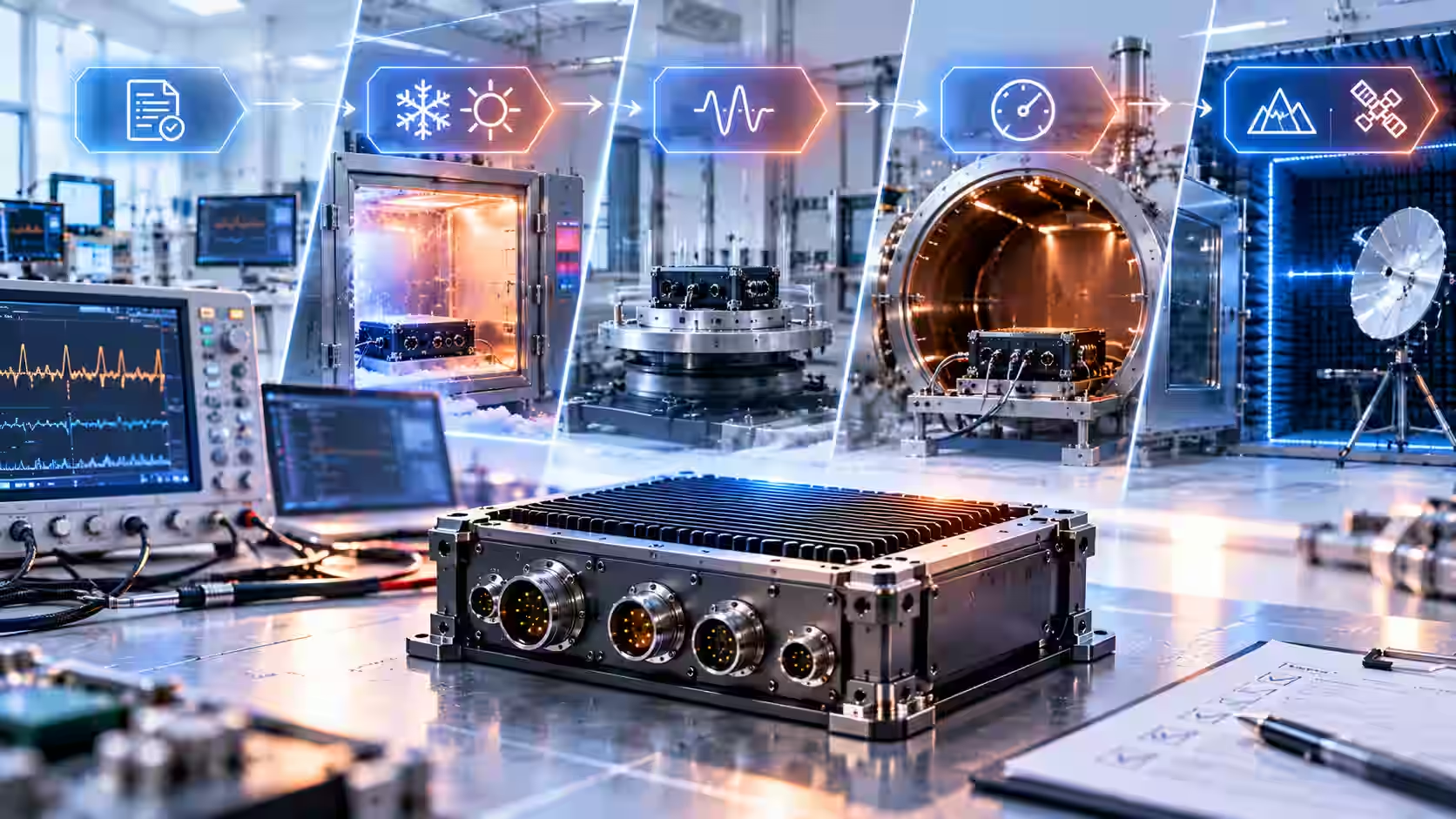
Qualify an on-board computer in two stages: electromagnetic compatibility first, because the device must pass EMC before environmental testing is meaningful; then environmental exposure: high and low pressure, temperature, humidity, thermal-vacuum, vibration and shock. Run pre-compliance in-house before booking accredited laboratories. InTechHouse took Latitude's launch-vehicle on-board computer through EMC testing to MIL-STD-461G and environmental testing to MIL-STD-810, tailored with ECSS-derived requirements; it is now fully qualified.
Key takeaways
- On-board computer qualification runs in a fixed order: EMC first, environmental exposure second.
- A unit that fails EMC late needs a redesign, and the redesign invalidates environmental results you have already paid for.
- Design for compliance from the first schematic, then run pre-compliance in-house before booking accredited laboratories.
- The standards come from the customer. Latitude's regime was EMC to MIL-STD-461G and environmental testing to MIL-STD-810, both tailored with ECSS-derived requirements.
- Qualifying the components does not qualify the system. The whole unit has to pass, working under load.
Why EMC comes before environmental testing
EMC comes first because environmental results only count for the design that was tested. If the unit later fails electromagnetic compatibility, it needs a redesign, and every environmental test already run on the old design has to be repeated.
"Environmental is one part: high and low pressure, temperature, humidity, thermal-vacuum, and vibration, of course. But before you can even approach environmental testing, the device first has to be checked for electromagnetic compatibility."
Adam Szychulec, Vice CTO, InTechHouse
Electromagnetic compatibility testing checks two things: that the computer does not emit electromagnetic interference that disrupts other subsystems, and that it keeps working when exposed to interference from them. Fixes for EMC problems usually touch the layout, filtering, grounding or enclosure. Those are exactly the parts that environmental tests stress mechanically and thermally, so changing them after environmental testing means testing again. Read more about MIL-STD-461 EMC testing.
Design for compliance before the first test
The device has to be designed to comply, not tested into compliance. EMC-aware design means filtering, grounding, layout and enclosure follow the EMC specifications from the first schematic, so the formal test confirms the design rather than discovering its problems.
The same applies to the mechanical side. On Latitude, the enclosure and hardware were designed for the tests and for vibration, together with the electronics. Equipment designed this way reaches the laboratory with fewer surprises, and each failure that does appear is easier to trace.
Compliance also shapes the form of the unit. A compact enclosure keeps weight down, but every choice about power, interface filtering and heat paths affects how the onboard computer will perform on test. That is why designers and test engineers should develop the test plan together, early, including the integration of the unit into each test setup. For the mechanical design in depth, see our article on launch vehicle electronics design.
The environmental exposures in a launch-vehicle qualification campaign
A launch vehicle puts its electronics through harsh environments in a short time. These are the exposures Adam lists as the large challenges for a launch-vehicle on-board computer: high and low pressure, temperature, humidity, thermal-vacuum, and vibration and shock. Which of them apply, and at what levels, depends on the program's specification. Spacecraft and other high performance platforms face similar harsh conditions in different proportions, and the tests help determine whether the design has margin for the mission it is suitable for.
High and low pressure
Low pressure is its own exposure, not a footnote to the thermal tests. As the vehicle climbs, pressure drops, and the computer has to keep operating while it does. Low pressure changes how heat leaves the board and how components behave, so it is tested in its own right.
Temperature and humidity
Temperature tests show whether the computer can operate across its declared range. Every component has to be checked against that range at schematic stage, because a single part rated for less sets the limit for the whole unit. Humidity tests check that moisture does not cause leakage, corrosion or failure. For how heat is managed when air is not available, see conduction cooling for electronics in vacuum.
Thermal-vacuum (TVAC)
A thermal-vacuum chamber removes the air and cycles the temperature, simulating conditions where convection no longer carries heat away. It shows whether every heat source in the computer has a path to a heat sink, and whether the unit keeps working through hot and cold extremes in vacuum. Read more about thermal vacuum testing.
Vibration and shock
Vibration and shock tests apply the mechanical loads of launch. What destroys units on test is resonance: when a board or enclosure resonates, it multiplies the base load. Stiff PCB and enclosure design, plus mechanical fixing of large components, keeps that from happening. Read more about vibration and shock testing.
Which standards apply: a customer-specified test regime
The standards come from the customer and the program, not from the supplier. On Latitude, the on-board computer went through a customer-specified test regime: EMC to MIL-STD-461G and environmental testing to MIL-STD-810, both tailored with ECSS-derived requirements.
What each one covers:
- MIL-STD-461 governs conducted and radiated emissions and susceptibility, which is the EMC part of the campaign.
- MIL-STD-810 is a flexible library of environmental test methods that programs tailor to their own conditions. Read more about MIL-STD-810 environmental qualification.
- ECSS is the European space standardization system. Here its requirements were used to tailor the military standards to the mission.
"We tested to MIL-STD-461G. Revision H is out now, but we haven't worked to it yet; ours was G."
Adam Szychulec, Vice CTO, InTechHouse
Other sectors use other regimes. Airborne equipment, for example, often follows DO-254 for hardware and DO-178C for software assurance, and automotive electronic systems follow ISO 26262 for functional safety. Rigorous qualification processes differ across industries because the environments and operating demands differ. Check which regime your program requires before you design.
Pre-compliance in-house, formal tests in accredited laboratories
Pre-compliance runs on your own bench; qualification runs in an accredited laboratory. On Latitude, InTechHouse ran EMC pre-compliance testing in-house and was responsible for the tests performed in accredited laboratories.
The supplier's support around the formal tests covers:
- Preparation, including test plans and the configuration of the unit under test.
- Coordination with the accredited laboratory.
- Troubleshooting when a test result is off, with root cause found before a retest.
- Report verification, so the test results match the specification.
Pre-compliance also adds speed: problems surface on the bench, long before a laboratory slot is booked.
The output is a report set the client uses for its declaration of conformity. InTechHouse does not certify products. Accreditation belongs to the external laboratories, and the declaration belongs to the client.
Functional checks and documentation
Qualification is not only about surviving exposure. It also verifies that the unit works: under load, during exposure and after it. A typical functional test runs the computer at maximum load and confirms that processor performance, power consumption, data storage, command and control functions, and communication with sensors and other subsystems stay correct throughout.
Test engineers also look at reliability. They assess fault tolerance and redundancy in critical functions, and reliability analysis, for example a mean time between failures estimate, predicts how long the unit should keep performing in operation. The result of all of this is a documented test record that shows what was tested, under which conditions, and what happened.
One rule to keep in mind: qualifying the components does not qualify the system. Every part can be rated for the environment and the assembled computer can still fail, through resonance, a missing heat path or an interaction between subsystems. Only the full unit, tested as a whole, is qualified.
What we did not test, and why
Radiation was not tested on Latitude's on-board computer. There was no radiation requirement for this unit. Radiation testing matters for hardware with long exposure in space, but the requirement comes from the mission and the specification, and this one did not include it. The reasoning behind that decision is covered in our article on launch vehicle electronics design.
Qualification model, then flight models
Qualification usually starts with a qualification model, a unit tested beyond the levels it will see in flight to prove design margin. Each flight model then gets acceptance testing at flight levels, which confirms the unit was built correctly without consuming its life.
On Latitude, the on-board computer has completed qualification, flight testing comes next, and InTechHouse is now producing flight models.
The result: a fully qualified on-board computer
"We've worked for almost three years with InTechHouse [...] with the delivery of a fully qualified On-Board Computer for space vehicle. It started with software and hardware development, then casing and PCB routing and finally an environmental qualification."
Valentin Belaud, Head of Electrical & Software Systems Department, Latitude
InTechHouse case study: Latitude on-board computer
InTechHouse delivered the complete hardware of the on-board computer for Latitude's Zephyr launch vehicle, with an enclosure designed for the tests and for vibration. The unit went through a customer-specified test regime: EMC to MIL-STD-461G and environmental testing to MIL-STD-810, both tailored with ECSS-derived requirements. InTechHouse ran pre-compliance in-house and was responsible for the tests in accredited laboratories. The on-board computer is now fully qualified, in the client's words, and flight models are in production.
Read the full Latitude on-board computer case study.
Qualification order at a glance
Let's talk about your next move
Not sure where to start? We work with companies at every stage, from early ideas to enterprise-level builds. A 30-minute call can save you months of guesswork.
FAQ
How do you qualify an on-board computer for a launch vehicle?
Design it for compliance, run EMC pre-compliance in-house, then pass formal EMC testing before environmental exposure: pressure, temperature, humidity, thermal-vacuum, vibration and shock. Latitude's on-board computer was tested to MIL-STD-461G and MIL-STD-810, tailored with ECSS-derived requirements, in accredited laboratories, and is now fully qualified.
In what order should EMC and environmental qualification tests be done?
Run EMC first, then environmental tests. A unit that fails EMC needs design changes, usually to layout, filtering, grounding or the enclosure, and any environmental results collected on the old design become invalid. Passing EMC first means the environmental campaign is run once, on the design that will actually fly.
Which test standards apply to on-board electronics for New Space and defence?
The standards come from the customer's specification. Defense and New Space programs often use MIL-STD-461 for EMC and MIL-STD-810 for environmental testing, tailored with ECSS-derived requirements for space missions. Latitude's on-board computer followed exactly that customer-specified regime, with EMC to MIL-STD-461G.
What is MIL-STD-810H testing used for?
MIL-STD-810H, issued in 2019 and updated by Change Notice 1 in 2022, is a US Department of Defense library of environmental test methods, used to show that equipment survives conditions such as temperature, humidity, pressure, vibration and shock. Programs tailor its methods to their own environment. Our Latitude work cites MIL-STD-810 as specified by the client, without a revision letter.
What is the difference between pre-compliance and qualification testing?
Pre-compliance is informal testing on the developer's own bench, used to find and fix problems before booking a laboratory. Qualification is formal testing in an accredited laboratory against the specified standards, producing the reports a client uses for its declaration of conformity. Pre-compliance reduces the risk of failing qualification.
Adam Szychulec
Adam Szychulec is Deputy CTO at InTechHouse and an electronics and embedded systems engineer with over 13 years of experience in hardware development, FPGA-based systems, embedded software, and technical leadership.
He specializes in electronic system architecture, analog and digital PCB design, FPGA and SoC development, embedded C/C++ software, and managing the complete lifecycle of complex engineering products - from early feasibility studies and technical architecture through development, testing, production introduction, and product modernization.
Adam has extensive experience leading multidisciplinary R&D teams and coordinating electronics, embedded software, mechanical engineering, testing, and project delivery. His responsibilities have included technical decision-making, project planning, risk and change management, budgeting, product testing, new product introduction, and mid-life upgrades of existing electronic systems.
His project experience includes FPGA modules for space applications, electronic systems and payloads for unmanned aerial vehicles, environmental monitoring and multispectral imaging platforms, power electronics, DC-DC converter assessment, and embedded systems developed for demanding industrial and defence-related applications.
Adam works with FPGA and SoC platforms, Xilinx Zynq, VHDL, Vivado, Altium Designer, ARM microcontrollers, embedded C/C++, Linux, digital electronics, and power electronics. He holds bachelor's and master's degrees in Electrical Engineering and is an IPC Certified Interconnect Designer. He writes about FPGA architectures, electronics design, embedded systems, hardware product development, technical risk management, UAV electronics, power electronics, and engineering leadership.
Let's talk about your next project
From first prototype to production, our engineers can help you scope it, build it and get it certified.
Custom Drone Payloads: Types, Electronics and What Changes Compared with Space Hardware
Designing On-Board Computer Hardware for a Launch Vehicle: Vibration, Shock and Low Pressure

Precision Time Protocol (PTP v2) in an FPGA: Hardware Time Synchronization, GPS Discipline and Accuracy
On-Board Computer Architecture with an FPGA SoC: Adding Hardware Functions After the PCB Is Frozen

Discuss your product with our R&D team
This initial conversation is focused on understanding your product, technical challenges, and constraints.
No sales pitch - just a practical discussion with experienced engineers.
Share a few details about your product and context. We’ll review the information and suggest the most appropriate next step.