


Thermal Vacuum (TVAC) Testing for Space Hardware
TVAC testing verifies whether hardware operates in vacuum and at extreme temperatures, and because there is no convection in vacuum, the entire thermal design behaves differently. In space environments, heat transfer depends on radiation and conduction through structures and interfaces, so hardware that works correctly in air may behave very differently in orbit.


Measured impact on space qualification
TVAC requirements are mission-specific and depend on applicable industry standards, but ECSS gives baseline values for space segment equipment.
How we prepare space hardware for a TVAC campaign
A useful TVAC campaign starts during development, before vacuum chambers are booked and the final test article is assembled.
Designing for vacuum and thermal control
- Materials are reviewed for vacuum compatibility and outgassing risk, including total mass loss and collected volatile condensable materials where ASTM E595 or ECSS-Q-ST-70-02 applies.
- Thermal design accounts for conductive heat paths, radiation, coatings, interfaces, component dissipation, sensors, and areas that may have depended on cooling by air.
- Venting, trapped volumes, adhesives, lubricants, optical contamination, and pre-test humidity control are reviewed before the hardware reaches the TVAC chamber.
Planning and running the TVAC campaign
- The test plan defines pressure, temperature range, rate of change, stability criteria, power states, functional checks, instrumentation, and pass/fail limits.
- Chamber selection considers internal dimensions, feedthroughs, thermal interfaces, power capacity, and environmental control.
- Functional performance is checked at hot and cold plateaus, while telemetry helps identify intermittent faults.
- Results are compared with the thermal model before qualification evidence is closed.
.avif)
What defines a space-qualified assembly
A qualification-ready assembly needs design evidence, test evidence, and production controls.

Hardware operates under vacuum and thermal extremes while critical temperatures, interfaces, power states, and functions are monitored against defined acceptance criteria.

Thermal, electrical, material, and workmanship risks are identified prior to formal qualification, while engineers can still correct the design without disrupting the campaign.

Materials, thermal interfaces, assembly methods, instrumentation points, and functional test procedures are controlled so flight units remain consistent with the qualified configuration.
In-house scope vs. accredited laboratory
TVAC qualification combines engineering preparation with controlled testing in specialist thermal vacuum chambers.
What InTechHouse does in-house
What an accredited laboratory does
TVAC campaign phases and what each verifies
A TVAC campaign combines vacuum exposure, controlled temperature plateaus, thermal cycling, and functional checks. Each phase targets a different risk, including thermal imbalance, material outgassing, intermittent faults, and loss of performance at temperature extremes.

Where contamination control requires it, vacuum bakeout reduces volatile material before qualification or integration.

Stabilized operation compares measured temperatures with the thermal model and heat transfer assumptions. ECSS calls for thermal balance phases where the equipment or mission requires them.

Hardware remains at defined thermal extremes until the specified stability or dwell condition is met. Functional checks confirm operation at high and low temperatures.

Repeated heating and cooling stresses joints, connectors, interfaces, coatings, and other components while checking for temperature-dependent faults.

Functional testing is performed at hot and cold plateaus. Power, communications, sensing, control, startup, and other critical functions can be checked in the required operating modes.
Material screening is related to TVAC but is a distinct activity. ASTM E595 evaluates total mass loss and collected volatile condensable materials under vacuum. NASA-STD-6016C uses a CVCM limit of 0.1% and a TML-minus-WVR limit of 1.0%, with stricter controls possible near contamination-sensitive surfaces. A residual gas analyzer or quartz crystal microbalances can support deeper contamination assessment when required.
Typical failure modes and the design fixes that prevent them
TVAC failures often come from thermal paths, material choices, interfaces, or components that behave differently in vacuum and at temperature extremes. The test helps isolate the physical mechanism so the design can be corrected before qualification or flight.
Symptom: a processor, regulator, battery, or power stage exceeds its temperature limit.
Mechanism: cooling depended on convection in air.
Fix: strengthen conduction paths, thermal interfaces, chassis coupling, or radiative heat rejection.
Symptom: equipment will not start or becomes unstable at the cold plateau.
Mechanism: component limits, oscillator behavior, battery chemistry, or timing margins shift.
Fix: revise component selection, heater strategy, startup sequencing, or local thermal coupling.
Symptom: resets, communication errors, or sensor faults appear during transitions.
Mechanism: differential expansion stresses connectors, solder joints, or board support.
Fix: improve interconnect design, strain relief, mechanical support, and assembly control.
Symptom: optical performance changes or deposits appear after vacuum exposure.
Mechanism: adhesives, coatings, lubricants, or polymers release volatile compounds.
Fix: select suitable materials, control curing and cleaning, use bakeout where required, and protect sensitive surfaces.
Use Cases

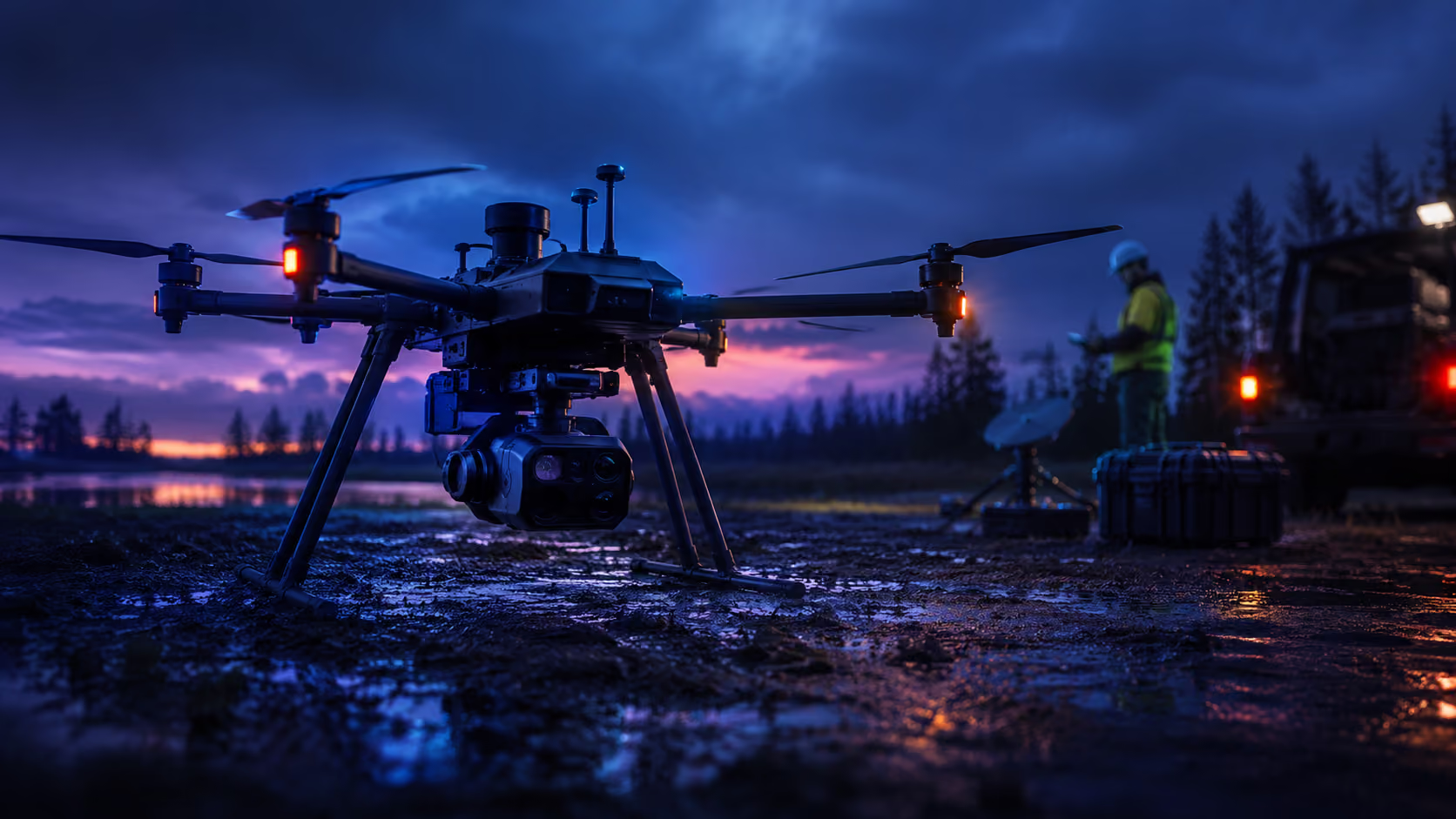
We design and develop embedded systems for UAV platforms, integrating sensors, communication modules, and control logic for real-time operation. Our solutions are engineered for mission-critical environments, ensuring reliable performance, low latency, and seamless system integration. Each design supports stable operation under dynamic conditions while maintaining data integrity and operational efficiency.


We design and develop firmware for industrial equipment, enabling reliable communication, data acquisition, and system control under real operating conditions. We focus on robustness, real-time performance, and seamless integration with hardware and higher-level systems. Each implementation provides stability, scalability, and long-term maintainability in demanding industrial environments. We als optimize for resource efficiency and compliance with industry protocols.

We design and develop firmware for subsea systems focusing on predictable real-time operation, fault tolerance, and robust communication in harsh underwater environments. Each implementation allows consistent performance under pressure, limited accessibility, and long-term deployment conditions. We also support integration with monitoring and diagnostic systems to enable remote operation and maintenance.


We design and implement advanced embedded software for imaging systems, including real-time processing, camera control, and data integration. Our solutions are optimized for high performance, low latency, and seamless interaction with hardware components. Each implementation ensures stable operation, high data throughput, and reliable system behavior. We also support integration with higher-level systems and data pipelines for end-to-end functionality.
Industries We Serve
Our engineering capabilities are deployed across regulated, mission-critical and industrial sectors.

Subsea electronics, downhole systems and harsh-environment hardware for offshore and onshore operations.

Mission-critical embedded systems and real-time firmware for UAV platforms and defence electronics.

Real-time embedded firmware for gas detection, environmental sensing and worker alert systems.

Embedded systems and real-time firmware for industrial automation,
machine control and IoT data acquisition.
Technologies we use
The TVAC setup combines vacuum generation, thermal control, instrumentation, data acquisition, and functional test equipment selected around the hardware, mission profile, and required test conditions.
FAQs
If you have additional questions or would like to discuss your requirements, feel free to get in touch with our team.
TVAC testing combines low pressure with controlled heating and cooling. It verifies spacecraft equipment and satellite components under representative space environments.
TVAC stands for thermal vacuum. A TVAC chamber controls pressure and temperature while hardware is powered, monitored, and functionally tested.
Its purpose is to determine whether spacecraft equipment can achieve required performance and reliability under vacuum and thermal extremes. It can identify thermal, electrical, and material problems before flight.
A campaign typically includes setup, pumpdown, hot and cold plateaus, cycling, functional tests, and repressurization. The mission defines the exact sequence and test conditions.
Yes. Removing air eliminates convection, changing heat transfer and exposing thermal problems that ambient testing can miss. Vacuum can also reveal faults during extreme temperature cycling.
Outgassing is the release of volatile compounds by materials under vacuum. They can condense on optics, sensors, radiators, and solar arrays, so contamination control matters in spacecraft material selection (NASA, 2023).
There is no universal temperature profile. ECSS-E-ST-10-03C Rev.1 defines European ground testing requirements (ECSS, 2022), while NASA GSFC-STD-7000B provides GSFC environmental verification guidance (NASA, 2021). Final profiles remain mission-specific.
The physics is the same, but CubeSats typically combine dense electronics, limited radiating area, integrated subsystems, and constrained conductive heat paths. Sensor placement, power modes, and thermal interfaces therefore need careful planning.
Discuss your product with our expert
This initial conversation is focused on understanding your product, technical challenges, and constraints.
No sales pitch - just a practical discussion with experienced engineers.


Share a few details about your product and context. We’ll review the information and suggest the most appropriate next step.