
Custom Drone Payloads: Types, Electronics and What Changes Compared with Space Hardware

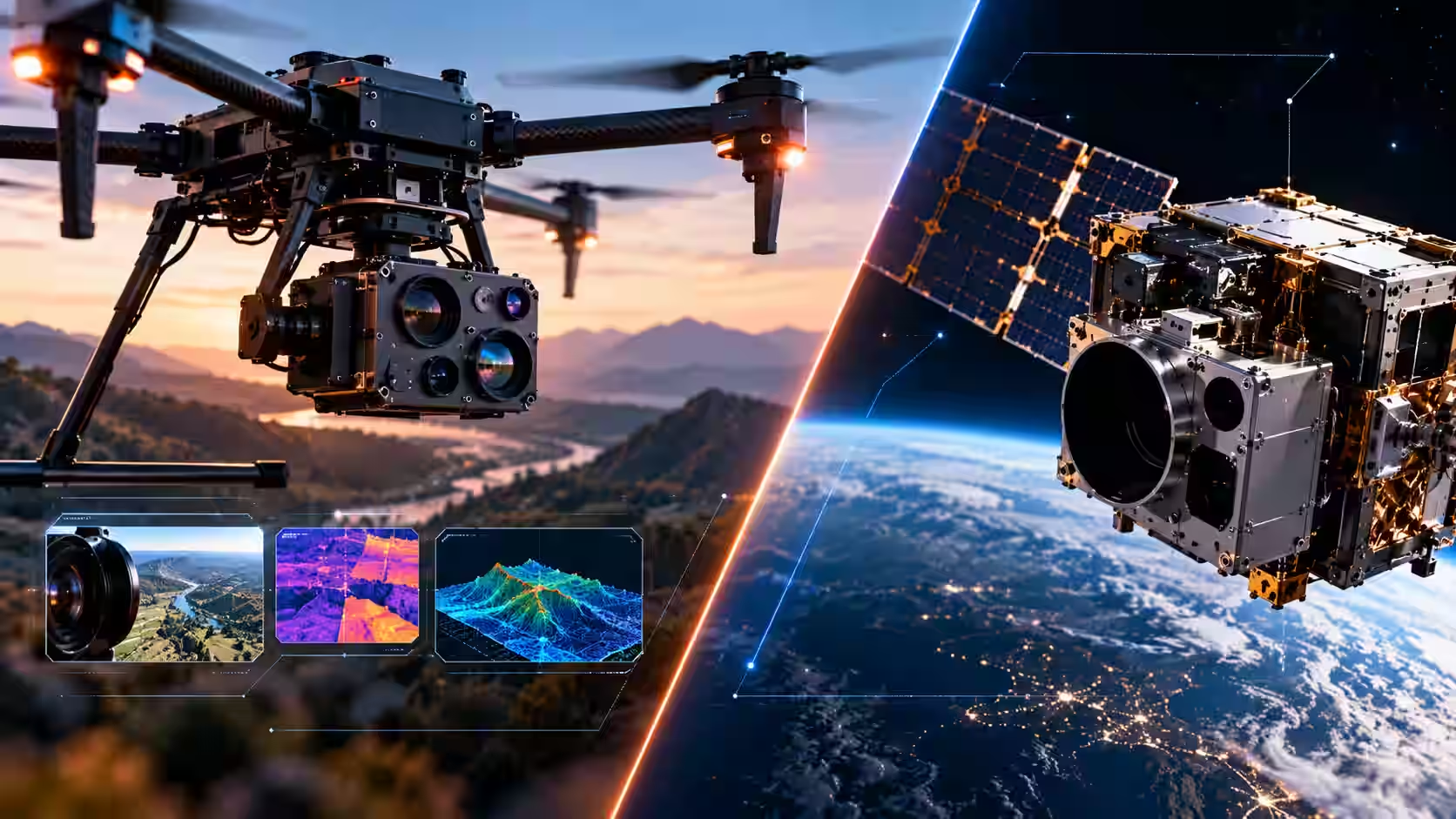
A drone payload is the equipment a UAV carries for its mission, separate from the airframe. A custom payload combines hardware, embedded software, enclosure mechanics, calibration and ground software. InTechHouse has designed air- and water-sampling payloads, a real-time air-analysis payload and a multispectral imaging payload on a Zynq-7000 SoC, plus a rugged IP66 ground station, for PGZ programs running five years or more.
Key takeaways
- A drone payload is the mission equipment a UAV carries: cameras, sensors, sampling systems or cargo, separate from the airframe.
- Payload weight and power draw cost flight time, so payload electronics have to be light, compact and efficient.
- A custom payload is more than a board: hardware, embedded software, enclosure mechanics, calibration and ground software.
- Compared with launch-vehicle electronics, temperature requirements are usually lower, but long-duration, low-level vibration can be the harder test.
- The flight controller belongs to the platform; the payload has its own processing and talks to it.
What is a drone payload?
A drone payload is everything a UAV carries to do its job, beyond the airframe, motors, battery and flight controller that keep it in the air. Cameras, sensors, sampling systems and cargo all count as payload. The drone's weight plus the payload must stay within the maximum takeoff weight, and every gram of extra weight costs flight time, because the motors need more power to carry it. That is why payload capacity, payload weight and power draw are the first three numbers any payload design has to respect.
What limits drone payload capacity
Drone payload capacity depends on the whole aircraft, not on one figure:
- Airframe size. A larger airframe can carry heavier payloads, but it also weighs more itself.
- Motor power. More power increases lifting capacity, at the cost of higher energy use.
- Battery weight. The battery is part of the total weight, so a bigger battery reduces the payload capacity left for mission equipment.
- Aerodynamics. A clean, well-balanced design carries payloads more efficiently and keeps stable flight with a full payload.
- Environmental conditions. Altitude, temperature and wind all reduce how much a drone can lift.
Small payloads suit light inspection drones; enterprise drones and industrial drones are built to handle heavier payloads, and specialized drones are designed around one mission. For the payload designer, the lesson is the same whatever the drone model: every gram and every watt the payload uses is taken from the mission.
Types of drone payloads
The main payload types are imaging, LiDAR, environmental and gas sensing, sampling and cargo. Each places different demands on the electronics.
Imaging payloads: RGB, thermal and multispectral
RGB and zoom cameras are used for aerial photography and visual inspection. Thermal cameras and infrared sensors detect heat signatures, which makes them useful for search and rescue, building inspection and checking power lines. Multispectral cameras capture several narrow bands of light, so they can measure vegetation health in precision agriculture or detect differences the eye cannot see. Thermal sensors and multispectral sensors produce large volumes of data, so on-board processing and accurate geotagging matter as much as the optics.
LiDAR systems
LiDAR (light detection and ranging) measures distance with laser pulses and builds dense 3D point clouds. LiDAR systems are used for mapping, surveying and construction, and they need precise timing and positioning data to place every point correctly.
Environmental and gas sensors
Gas sensors and environmental monitoring payloads measure air quality, pollutants or harmful gases in industrial settings. Their detection range and accuracy depend on calibration, airflow around the sensor and how the drone itself affects the air being measured.
Sampling payloads
Sampling payloads collect physical material, such as air or water, for later laboratory analysis. They combine mechanics, control electronics and logging, so the sample can be traced back to where and when it was taken.
Cargo and delivery payloads
Cargo and delivery mechanisms carry packages or medical supplies. They are mostly a mechanical and safety design problem, with release control and safe operation as the main electronic functions.
Payload types at a glance
What a custom drone payload involves
A custom payload is a full product, not a sensor bolted to a drone. On the systems we have built, the embedded team covered all embedded software, the tests, all hardware, the enclosure mechanics, component selection and layout, and calibration. A separate data team built the reporting application and the real-time readout applications that show results to the operator.
In practice, that means a payload project covers:
- Payload electronics. Board design, power supply and interfaces to the drone.
- Embedded software. Sensor control, data acquisition, on-board processing and communication.
- Enclosure mechanics. A light enclosure that protects the electronics, keeps the drone balanced and survives vibration.
- Component selection and layout. Parts chosen for weight, power and environment, placed to keep the design compact.
- Calibration. Sensors calibrated so the data can be trusted, and checked again after integration.
- Ground software. Reporting and real-time readout, so the operator sees results during the mission.
Payload electronics vs the flight controller
On most drones, the flight controller handles stabilization and navigation, using GPS modules and inertial sensors to keep stable flight. The payload has its own processing. It talks to the flight controller, for example to read position for geotagging, and to the ground link to send data to the operator.
On the PGZ platform, InTechHouse built the payloads and the ground station, not the flight computer. The flight controller belongs to the platform, and our multispectral payload interfaces with it. That split is common: the drone maker owns flight, and the payload team owns the mission.
How drone payload requirements differ from launch-vehicle electronics
Drone payload electronics and launch-vehicle electronics both have to survive harsh environmental conditions, but the balance is different. Our Vice CTO, who has worked on both, puts it this way:
"I'd expect lower requirements, certainly on temperature range, but you may need long-duration vibration testing. Not high vibration levels, but long, low-level exposure."
Adam Szychulec, Vice CTO, InTechHouse
For the launch side of the comparison, see our article on launch vehicle electronics design.
Temperature range: usually less demanding
A drone payload usually works in a narrower temperature range than electronics on a launch vehicle, and it does not face vacuum, where only conduction can carry heat away. That gives more freedom in component selection and thermal design. For the space side of the thermal problem, see conduction cooling for electronics in vacuum.
Vibration: not high levels, but long exposure at low levels
This is where drone payloads can be harder than they look. A launch lasts minutes. A drone flies mission after mission, with motors and propellers producing constant low-level vibration for hours. That long-duration vibration fatigues solder joints, connectors and mounts in a way short, high-level tests do not reveal. The test plan has to reflect it: long exposure at low levels, not only short peaks. Read more about vibration testing.
Payloads delivered for PGZ programs
For PGZ (Polish Armaments Group), InTechHouse designs, manufactures, tests and integrates unmanned aerial vehicle payloads for programs running five years or more:
- an air sampling payload,
- a real-time air analysis payload,
- a water sampling payload,
- a multispectral imaging payload.
InTechHouse case study: UAV payloads for PGZ
InTechHouse designs, manufactures, tests and integrates UAV payloads for PGZ (Polish Armaments Group) programs running five years or more. The family covers air sampling, real-time air analysis, water sampling and multispectral imaging, plus a rugged IP66 ground control station. The multispectral payload is built on a Zynq-7000 SoC and interfaces with the platform's flight controller. InTechHouse built the payloads and the ground station; the flight computer belongs to the platform.
Read the UAV payloads case study.
Multispectral imaging payload on a Zynq-7000 SoC
The multispectral payload combines five-band multispectral imaging with thermal and visible imaging, with real-time processing and geotagging of the data. It is built on an AMD/Xilinx Zynq-7000 SoC, which pairs processor cores with programmable logic on one chip, and it interfaces with the platform's flight controller to read position for each image. High resolution cameras and real-time processing in a payload this compact require careful power and thermal design, because the drone has limited power to spare. In drone electronics, every added function means more weight or more power, and usually both.
Rugged ground control station
The payloads work with a rugged ground control station built for field use. Its specification, from the PGZ program:
- IP66 enclosure, protected against dust and powerful water jets,
- 869.5 MHz telemetry link,
- three displays,
- a 4 Ah 6S battery as its power system,
- about 3.5 hours of battery life.
The station shows payload data in real time and lets the operator follow the mission without a separate laptop.
Two teams, one payload: how the work splits
A payload needs two kinds of engineering, and they work best when they sit in one company. On the AirDron system, developed with SoftBlue, the data team built the reporting application and the real-time readout applications. The embedded team did all the embedded software, the tests, all the hardware, the enclosure mechanics, component selection and layout, and calibration. The result is one system that the customer receives as a whole, not two deliveries to integrate. Read the AirDron air quality monitoring case study.
Choosing a payload electronics partner
Custom UAV payloads are an area where we know the requirements and have delivered. Whoever you choose, ask:
- What is in scope? Hardware, embedded software, enclosure mechanics, calibration and ground control station, or only part of it?
- Has the team run long-duration vibration tests, not only short, high-level ones?
- How is calibration done, and how is it checked after the payload is integrated on the drone?
- How does the payload interface with your flight controller, and who owns that interface?
- What is the payload's total weight and power draw, and how much flight time does it cost?
For the wider supplier checklist, see how to choose an on-board computer development company.
Let's talk about your next move
Not sure where to start? We work with companies at every stage, from early ideas to enterprise-level builds. A 30-minute call can save you months of guesswork.
FAQ
What is a drone payload?
A drone payload is the equipment a UAV carries for its mission, separate from the airframe, motors, battery and flight controller. It can be cameras, sensors, sampling systems or cargo. The drone plus payload must stay within the maximum takeoff weight, and heavier payloads reduce flight time because the drone needs more power.
What are the main types of drone payloads?
The main types are imaging payloads (RGB, thermal and multispectral cameras), LiDAR systems for 3D mapping, environmental and gas sensors, sampling payloads that collect air or water for laboratory analysis, and cargo or delivery mechanisms. Each type sets different demands on weight, power, data processing and calibration.
What does a custom UAV payload involve?
A custom UAV payload involves payload electronics, embedded software, tests, enclosure mechanics, component selection and layout, and calibration, plus ground software for reporting and real-time readout. On the systems InTechHouse has built, an embedded team and a data team delivered these together, so the customer receives one integrated system.
How do drone payload requirements differ from launch-vehicle electronics?
Drone payloads usually face a narrower temperature range than launch-vehicle electronics and do not operate in vacuum. But they can need long-duration vibration testing: not high levels, but long, low-level exposure across many flights. Adam Szychulec, InTechHouse's Vice CTO, sees that as the harder part of drone payload qualification.
Who designs custom drone payload electronics?
InTechHouse, based in Poland, designs, manufactures, tests and integrates custom UAV payloads for PGZ (Polish Armaments Group) programs: air sampling, real-time air analysis, water sampling and a multispectral imaging payload built on a Zynq-7000 SoC, plus a rugged IP66 ground control station. The flight controller stays with the platform.
Adam Szychulec
Adam Szychulec is Deputy CTO at InTechHouse and an electronics and embedded systems engineer with over 13 years of experience in hardware development, FPGA-based systems, embedded software, and technical leadership.
He specializes in electronic system architecture, analog and digital PCB design, FPGA and SoC development, embedded C/C++ software, and managing the complete lifecycle of complex engineering products - from early feasibility studies and technical architecture through development, testing, production introduction, and product modernization.
Adam has extensive experience leading multidisciplinary R&D teams and coordinating electronics, embedded software, mechanical engineering, testing, and project delivery. His responsibilities have included technical decision-making, project planning, risk and change management, budgeting, product testing, new product introduction, and mid-life upgrades of existing electronic systems.
His project experience includes FPGA modules for space applications, electronic systems and payloads for unmanned aerial vehicles, environmental monitoring and multispectral imaging platforms, power electronics, DC-DC converter assessment, and embedded systems developed for demanding industrial and defence-related applications.
Adam works with FPGA and SoC platforms, Xilinx Zynq, VHDL, Vivado, Altium Designer, ARM microcontrollers, embedded C/C++, Linux, digital electronics, and power electronics. He holds bachelor's and master's degrees in Electrical Engineering and is an IPC Certified Interconnect Designer. He writes about FPGA architectures, electronics design, embedded systems, hardware product development, technical risk management, UAV electronics, power electronics, and engineering leadership.
Let's talk about your next project
From first prototype to production, our engineers can help you scope it, build it and get it certified.
Designing On-Board Computer Hardware for a Launch Vehicle: Vibration, Shock and Low Pressure
Precision Time Protocol (PTP v2) in an FPGA: Hardware Time Synchronization, GPS Discipline and Accuracy
On-Board Computer Architecture with an FPGA SoC: Adding Hardware Functions After the PCB Is Frozen

Discuss your product with our R&D team
This initial conversation is focused on understanding your product, technical challenges, and constraints.
No sales pitch - just a practical discussion with experienced engineers.
Share a few details about your product and context. We’ll review the information and suggest the most appropriate next step.