

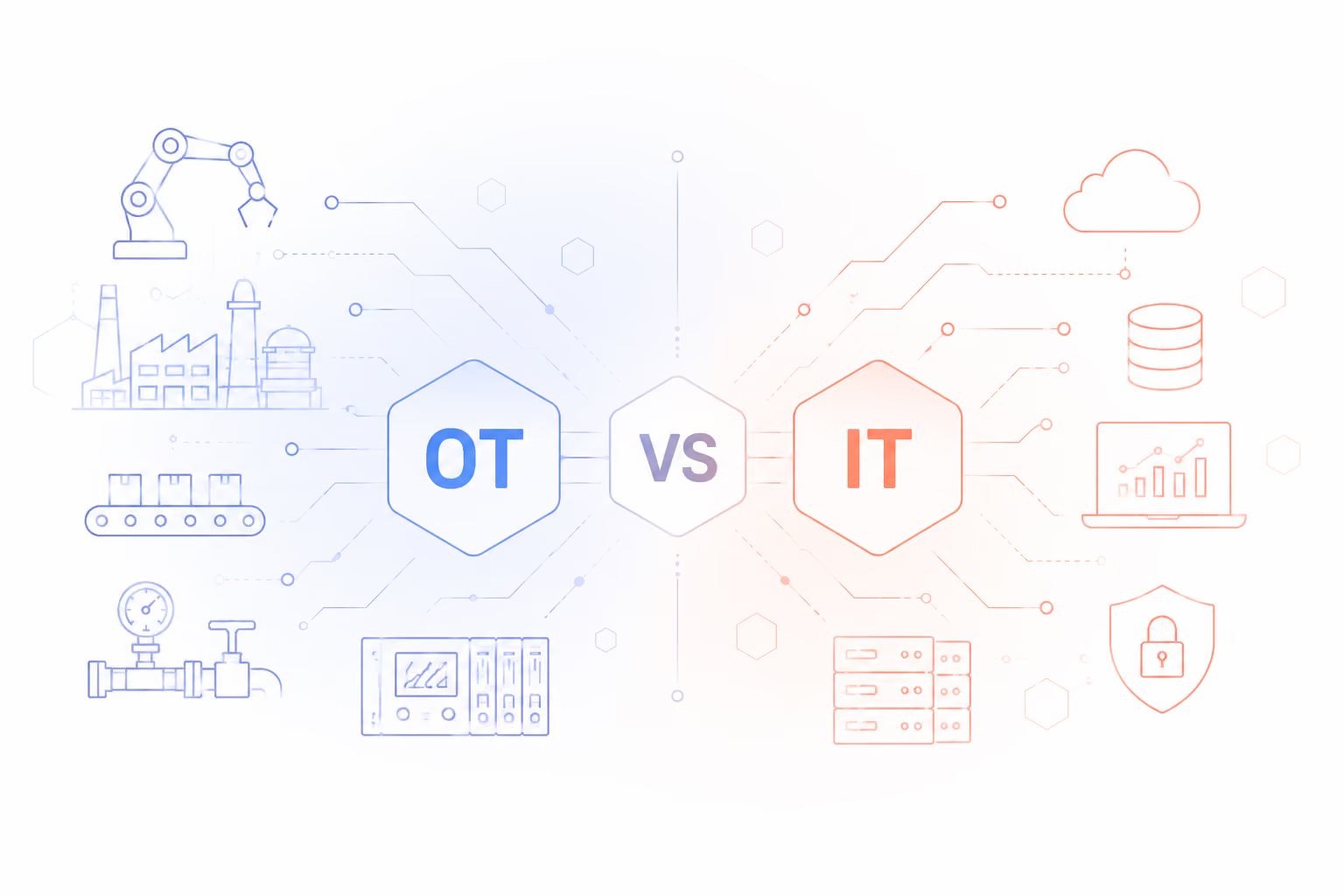
OT (operational technology) controls physical processes and equipment. IT (information technology) manages data and business systems. The single biggest difference is priority: OT puts safety and uptime first, IT puts data agility and rapid change first. This is not a case of choosing one over the other. Both IT and OT are essential for modern organizations but serve different purposes, and the competitive advantage in modern industry comes from converging them intelligently, not from treating them as rivals.
Key Takeaways
OT and IT serve different purposes, and modern industry converges them because neither alone delivers what the next decade of industrial operations requires. This guide is written for industrial operations leaders who need to explain the difference to a board, IT and OT security teams navigating a convergence program, critical infrastructure operators evaluating risk, and digital transformation sponsors deciding where to invest.
Both systems are essential. OT keeps physical processes running safely. IT turns the data those processes generate into business intelligence, predictive capability, and competitive advantage. The organizations that treat them as adversarial domains consistently struggle more with convergence than those that treat them as complementary layers of a single industrial stack.
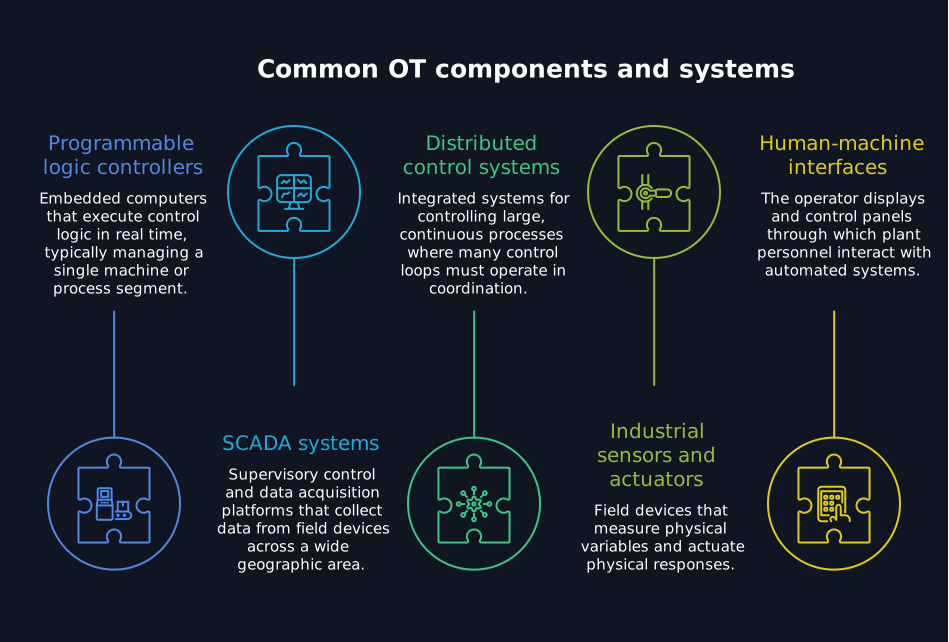
Operational technology is the hardware and software that directly controls and monitors physical processes and equipment. The defining characteristic of OT is that its outputs have immediate physical consequences: a command to a programmable logic controller (PLC) changes a valve position or starts a motor; a SCADA (supervisory control and data acquisition) system alarm reflects a real condition on a physical process; a failure in an OT system can stop a production line, disrupt a utility, or create a safety hazard.
Common OT components and systems:
OT systems are found in critical infrastructure sectors where physical operations are mission-critical: manufacturing, energy generation and distribution, water treatment, oil and gas, transportation, and building automation. OT devices often operate continuously for 15 to 30 or more years. A PLC installed in 1998 may still be running a production line in a facility that has otherwise modernized entirely. This longevity is a design characteristic: industrial equipment is built for durability and reliability in harsh environments, not for the rapid refresh cycles that IT hardware follows.
OT's primary design priority is real-time data monitoring to ensure machine efficiency and process safety. An OT system that loses a sensor reading for 500 milliseconds in a critical process loop is in a different category of problem from an enterprise application that experiences a 500-millisecond delay in loading a dashboard. One may trigger a safety shutdown or a production incident; the other is a user-experience inconvenience.
For the comparison with MES and ERP systems in the broader manufacturing software stack, see SCADA vs MES vs ERP.
The hard part is not the diagram, it is doing the integration on a plant that cannot stop and cannot be patched on IT schedules. We design the zone model, the gateways and the change process around that constraint.
Converge OT and IT without putting uptime at risk
Information technology is the hardware and software that processes, stores, and communicates data to support business functions. IT focuses on data management and processing: turning raw business data (transactions, communications, records, analytics) into information that supports decisions and operations.
Typical IT systems:
IT data handling focuses on business analytics, communication, and enabling digital workflows. IT systems are regularly updated for security: patching a Windows vulnerability in a corporate IT environment is a scheduled, routine activity that typically happens within days to weeks of a patch release. IT expects technology turnover; the server hardware supporting a business application is replaced every 3 to 5 years, and the software running on it may be updated continuously.
IT networks are designed for flexibility and scale, not for the deterministic delivery characteristics that OT control loops require. A brief packet delay that is invisible to an IT user watching a cloud application load can be catastrophic to an OT system timing a high-speed cutting operation or a chemical reaction.
Comparison table
| Dimension | OT | IT |
|---|---|---|
| Primary purpose | Control physical processes and industrial equipment | Process and manage data for business functions |
| Examples | PLC, SCADA, DCS, industrial sensors, HMI | Servers, cloud platforms, ERP, laptops, mobile devices |
| Device lifespan | 15 to 30+ years typical | 3 to 5 years typical |
| Update cadence | Rarely; patching requires maintenance windows and safety validation | Frequent; security patches expected within days to weeks |
| Network type | Specialized industrial protocols; deterministic, low-latency | TCP/IP standard protocols; high bandwidth, flexible |
| Downtime tolerance | Near-zero; unplanned downtime has direct operational and safety cost | Moderate; planned maintenance windows acceptable |
| Security priority | Safety and availability first | Confidentiality and integrity first |
| Change management | Slow; every change requires risk assessment and validation | Rapid; agile development and deployment cycles |
| Vendor support | Long-term; original equipment manufacturer (OEM) often provides 20+ year support | Competitive; frequent vendor and technology transitions |
One-line takeaway. IT devices typically have a 3-to-5-year lifespan while OT devices can operate for decades, and IT systems are regularly updated while OT systems are rarely updated to avoid downtime. That single contrast explains most of the practical security and integration challenges between these two worlds.
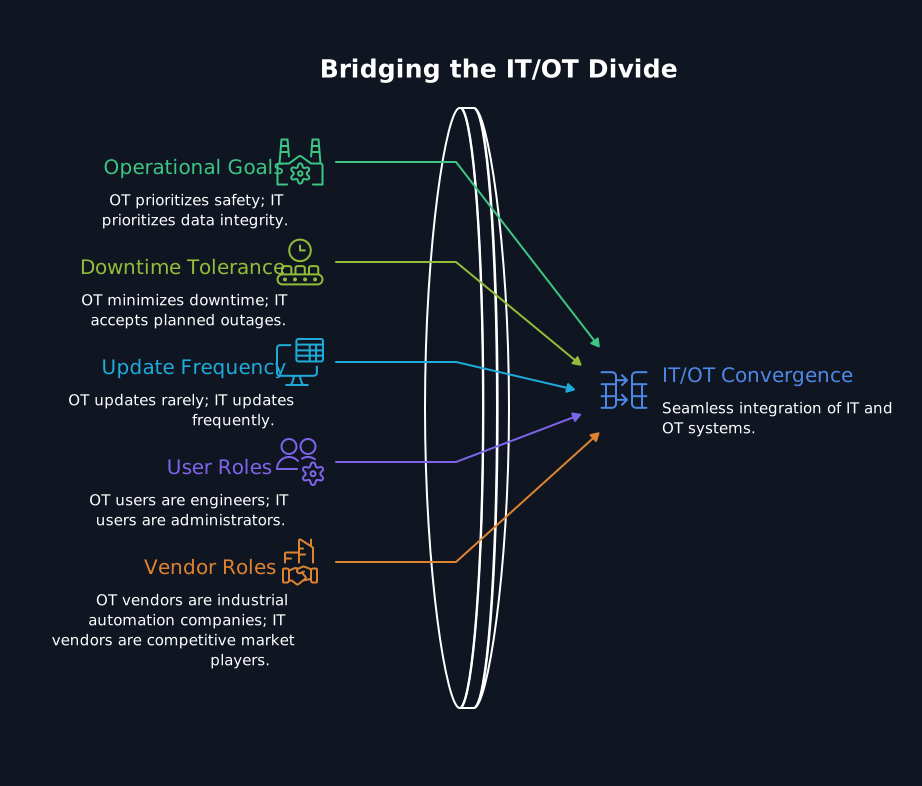
OT focuses on physical process safety and operational efficiency: keeping a power plant running, keeping a production line at rated throughput, preventing a chemical process from exceeding a safe temperature. These goals require deterministic behavior: the control system must respond within a fixed time, every time. IT focuses on data integrity, availability, and the agility to adapt business systems to changing requirements, goals that tolerate a degree of variability and change that OT cannot.
OT teams accept almost no unplanned downtime. A planned maintenance window for an OT system is coordinated weeks or months in advance, involves safety validation before any change, and may require a production shutdown that costs thousands of dollars per minute. IT teams accept planned maintenance windows and expect to perform emergency patches outside them when a critical vulnerability is disclosed. The consequence of a brief outage is lost productivity; the consequence of a brief OT outage may be lost product, damaged equipment, or a safety incident.
OT systems are rarely updated to avoid downtime while IT experiences high technology turnover allowing faster patching. The result is that OT environments routinely run firmware and software versions that are 5, 10, or 15 years old, containing known vulnerabilities that cannot be patched without an operational risk that the plant operator cannot accept without extraordinary justification. OT devices tend to have very long lifespans precisely because replacing a proven, reliable industrial controller carries operational and certification risk that an IT hardware refresh does not. IT device lifecycle is driven by performance, vendor support, and security; OT device lifecycle is driven by physical durability, application stability, and the cost and risk of change.
OT systems are operated by process engineers, plant operators, and maintenance technicians whose first priority is keeping the process running. OT vendors are industrial automation companies (Siemens, Rockwell Automation, Schneider Electric, Emerson, Honeywell Process) with decades-long customer relationships and deep application-specific expertise. IT systems are operated by IT administrators, developers, and data analysts. IT vendors operate on competitive market cycles with frequent product transitions.
When OT teams say a system is working, they mean the physical process is running safely at specification. When IT teams say a system is working, they mean users can access their data and applications. Both definitions of "working" are correct within their domain; convergence requires honoring both simultaneously.
When OT systems fail or are compromised, the consequences extend beyond the organization into the physical world. OT systems control physical processes that keep society running: electricity generation and distribution, water treatment, transportation, and manufacturing supply chains. A successful attack on OT in critical infrastructure does not produce a data breach notification; it produces a power outage, a production shutdown, or, in the worst cases, a physical safety incident.
The incident data makes this concrete. In 2024, 73% of organizations reported cyberattacks that impacted their OT systems, a sharp increase from 49% in 2023 (Fortinet State of OT and Cybersecurity, 2024). Ransomware attacks in the industrial sector spiked 87% year-over-year in 2024, making manufacturing and industrial operations the top ransomware target for four consecutive years (Zero Networks, 2025). In 2024, 146% more sites experienced physical consequences from cyberattacks compared to 2023, rising from 412 sites to 1,015 sites with documented physical operational impact (Waterfall Security, 2025).
The downtime cost of an OT incident is categorically different from an IT incident. The manufacturing sector experienced an average cost increase of $830,000 per breach in 2024 compared to the prior year (IBM X-Force, 2024), driven by production losses, remediation costs, and, in some cases, physical damage to equipment. An 11-day average downtime per ransomware incident in manufacturing translates directly to lost production, missed delivery commitments, and customer relationship damage that a data-breach recovery does not produce.
For critical infrastructure operators, a cyberattack on real-time data control systems is not a business continuity problem in the IT sense; it is a public-safety and national-security problem in its own category.
OT security and IT security share a vocabulary but operate from fundamentally different threat models and design priorities.
The security goal in OT is to ensure that the physical process remains under authorized control, that safety systems function when needed, and that operational continuity is maintained. A security control that makes a process slower, less reliable, or more prone to operator error is worse than no security control in an OT context, even if it would be considered a sensible hardening step in IT.
The CIA triad (Confidentiality, Integrity, Availability) is applied in IT with confidentiality typically at the top for most enterprise data. Availability matters, but it is managed through redundancy and recovery rather than through minimizing the frequency and impact of change.
Legacy OT equipment often lacks regular updates and runs unpatched vulnerabilities for extended periods, not because operators do not know about them, but because patching requires a maintenance window the plant cannot schedule, or because the vendor no longer provides patches for the operating system the OT device runs on. 65% of OT environments had insecure remote access conditions in 2024, and 45% of organizations with OT-heavy environments had SSH communicating to publicly routable addresses (Zero Networks, 2025). Over 90% of organizations with OT systems faced security events in a two-year period (multiple industry surveys, 2023-2024). 55% of organizations have inaccurate OT asset inventories (Claroty/various, 2024), which means they cannot secure what they cannot see.
Remote access exploitation accounts for 50% of attack vectors against manufacturing OT targets (Bitsight TRACE, 2025). The OT environment needs remote access for vendor maintenance, remote monitoring, and multi-site management, but that access must be managed through purpose-built industrial remote access solutions with role-based access control, session recording, and time-limited grants, not through general-purpose VPN that provides broader access than any specific maintenance task requires.
IEC 62443 (ISA99) is the key framework for OT cybersecurity, defining security levels, zones, and conduits for industrial automation and control systems. It specifies which security controls apply to which zones based on their function and the consequence of compromise. Zero Trust limits lateral movement by verifying every access request regardless of whether it originates inside or outside the network perimeter, a significant improvement over the flat-network architecture common in legacy OT environments. Micro-segmentation helps contain incidents by limiting the blast radius of a breach: a compromised SCADA workstation in a properly segmented environment cannot directly reach a PLC; it must pass through a conduit that enforces and logs the access control policy.
Operational efficiency in an OT context is measured in uptime, throughput, quality, and energy consumption, not in user-experience metrics or software deployment velocity. The physical equipment running a production line has a rated capacity; an OT system's job is to sustain that capacity at specification, continuously, for the design life of the plant.
OT devices tend to have very long lifespans: a well-maintained PLC or industrial sensor can operate reliably for 20 to 30 years. Physical equipment in process industries is often designed for even longer service lives. IT devices typically have a 3-to-5-year lifespan before hardware refresh, and software typically has a shorter effective lifecycle still, given the pace of vendor updates and security patch requirements.
This lifecycle difference has direct implications for security and integration planning. An industrial equipment asset installed in 2005 running an OEM-supported SCADA application may have no viable patch path and no upgrade path that does not require a plant shutdown and a multi-month revalidation project. Any integration or security architecture that does not account for this reality, and design around it rather than assuming it away, will fail in a real OT environment.
OT networks are built for deterministic, low-latency delivery of small control messages, not for high-bandwidth, general-purpose data transport. Specialized industrial protocols, including Modbus TCP, EtherNet/IP, PROFIBUS, DNP3, and OPC-UA, are designed for real-time control requirements that standard IT networking protocols were not engineered to meet. OT network infrastructure must be ruggedized for industrial environments: industrial switches and routers operate across wider temperature ranges, are rated for vibration and humidity, and use connectors rated for industrial environments rather than standard office network hardware.
IT networks are built on standard TCP/IP protocols for flexible, high-bandwidth connectivity. IT networks are reconfigured frequently to add services, restructure segments, and accommodate new applications. IT network security is managed through firewalls, intrusion detection systems, endpoint security, and regular firmware updates on network infrastructure devices.
OT network infrastructure changes are rare and require formal change management, safety validation, and often a maintenance window. IT network changes are routine. Treating OT network management like IT network management, pushing a firmware update to an OT network switch during production hours without a change control process, is a real-world cause of OT incidents that has nothing to do with external attackers.
For the protocol selection decision, see OPC-UA vs MQTT.
See also:
What Is OT/IT Integration? Architecture, Benefits, Challenges
OPC UA vs MQTT: Industrial Protocol Comparison
SCADA vs MES vs ERP: What's the Difference?
This is where both domains connect into something greater than either separately. IT/OT convergence is the connecting of OT's physical process control with IT's data and analytics capability, enabling industrial operations to be both physically optimized and data-driven simultaneously.
IT/OT convergence is driven by the Industrial Internet of Things: sensors and devices that were previously connected only to OT control systems now have IP connectivity that makes their data accessible to IT platforms. That connectivity creates the real-time data flows that predictive maintenance, OEE monitoring, energy optimization, and supply chain integration all depend on.
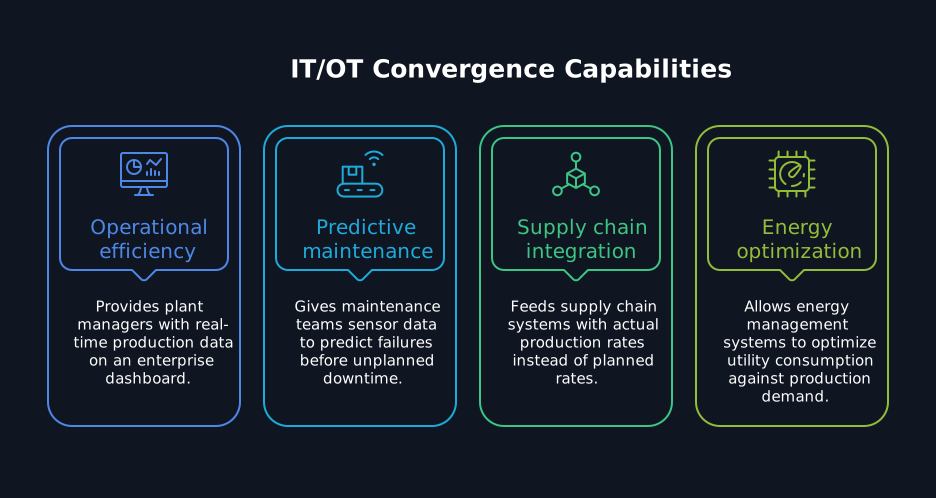
Effective IT and OT collaboration enhances operational efficiency and security simultaneously. A converged system provides a plant manager with real-time production data on an enterprise dashboard; gives a maintenance team the sensor data needed to predict failures before they cause unplanned downtime; feeds a supply chain system with actual production rates rather than planned rates; and lets an energy management system optimize utility consumption against production demand in real time. Converged systems improve decision-making by giving decision-makers access to operational data that was previously locked in OT silos with no path to the enterprise.
Once OT data has to leave the cell, the protocol carrying it becomes an architectural decision rather than a vendor default. Our comparison of OPC UA vs MQTT sets out when a semantic server model beats a lightweight broker, and when both belong in the same design.
The Industrial Internet of Things creates external connectivity that OT systems were never designed to handle. Every new connection between an OT system and an IT network, or the internet, is a new attack surface. 75% of OT attacks begin as IT breaches (Zero Networks, 2025): the IT side is breached first, and the attackers move laterally to OT through the convergence infrastructure that was meant to enable the business. This is not an argument against convergence; it is an argument for governed, segmented, monitored convergence rather than casual or ad-hoc connectivity.
Isolation (maintaining an OT network with no IT connectivity) is the maximum-security option for the highest-consequence, lowest-change-tolerance OT environments: a nuclear plant's safety instrumentation system is not a convergence candidate. For the overwhelming majority of manufacturing and process industry OT environments, the business case for convergence is clear and the question is how to do it safely, not whether to do it. ISA99/IEC 62443 helps secure IT/OT integration by providing the zone-and-conduit framework that governs what data can flow between OT and IT and what security controls must protect that flow.
For the full integration architecture, see our pillar article on OT/IT integration architecture.
When OT priorities lead:
When IT priorities lead:
Stakeholder and vendor approval steps:
Running this checklist inside a live plant needs signatures from both OT and IT on every step, which is where most internal programs stall. Our work on industrial data platforms and OT/IT integration provides that governance layer together with the reference architecture, so a pilot does not turn into an unplanned outage.
Micro-segmentation helps contain cyber incidents in OT networks by limiting lateral movement: an attacker who has compromised an HMI workstation in a properly segmented environment cannot reach the PLC network, the historian, or other OT assets without passing through a controlled conduit that enforces and logs the access policy.
Required controls for OT/IT integration points:
The goal of segmentation is not to prevent all connectivity but to ensure that every connection is intentional, authenticated, monitored, and revocable. An OT network where every device can reach every other device over flat, unmonitored connectivity is not a design choice for a mature industrial organization in 2025; it is a legacy condition to be remediated.
Patching an OT device is not like patching a laptop. It requires:
Legacy systems in OT environments often have no patch path at all. A PLC running a 2001 operating system that the vendor stopped supporting in 2010 cannot be patched; the correct response is network segmentation and monitoring to limit exposure, a migration plan to a supported platform scheduled around production constraints, and compensating controls (additional monitoring, access restrictions) in the interim.
Data protection in OT environments covers both the data flowing through OT systems (real-time process values, setpoints, alarm states) and the OT system configurations themselves. OT configuration files are high-value targets: they document exactly how a plant's control system is engineered, and a sophisticated attacker who has obtained them can craft a more damaging attack than one working from public vulnerability databases alone. Configuration files should be backed up, versioned, and stored in systems with access controls at least as strict as the OT network itself.
From Purdue zoning and protocol bridging to a unified namespace your business systems can consume, delivered with OT safety rules respected at every step. Ask for a walkthrough of a recent programme.
See how we run an OT/IT convergence programme
The most honest and useful answer to "OT vs IT" is not a ranking; it is a decision framework.
OT priorities lead when the physical process, the safety of people and equipment, and operational continuity are the primary design constraints. A nuclear safety instrumentation system, a high-speed packaging line where a control-loop interruption causes product loss, and a utility SCADA system managing power distribution for a city are all environments where OT safety and availability must govern every decision, including every security decision, and IT systems must accommodate those constraints, not the other way around.
IT priorities lead when data agility, cloud services, rapid application development, and enterprise integration are the primary drivers. The business intelligence platform that consumes OT data, the ERP system that schedules production based on demand signals, and the analytics environment that trains predictive maintenance models are all IT-priority domains where IT's change cadence, security tools, and architecture patterns are appropriate. How OT data reaches those IT-priority consumers without exposing the control layer is the problem that Industry 4.0 data architecture patterns are designed to solve.
The strongest all-around answer: governed convergence. Operational technology OT provides the physical process control foundation. IT provides the data and analytics capability. Governed convergence, where OT safety is preserved, IT agility is added, and the boundary between them is explicitly designed, secured, and monitored, is the architecture that lets both IT and OT deliver their specific value simultaneously. Treating them as adversaries produces either stagnant, data-blind plant floors or recklessly connected OT networks. Both outcomes are worse than the governed middle path.
Business functions depend on both. A manufacturer who maximizes OT availability but cannot use production data to improve scheduling, quality, or predictive maintenance is leaving value on the table. A manufacturer who builds great IT analytics but cannot get reliable, real-time OT data to feed them has the same problem from the other direction. The goal is the integration of both into a coherent industrial stack.
InTechHouse case study: Governing IT/OT convergence without disrupting OT operations
InTechHouse implemented an IT/OT convergence architecture for an industrial operator where the OT network included both modern EtherNet/IP devices and legacy Modbus installations, and where any disruption to the OT control network would create immediate production and safety implications.
The architecture used edge gateways deployed at the OT/IT boundary to translate between OT protocols and OPC-UA northbound, with data flowing through a Unified Namespace that made OT data available to IT systems without any IT system ever having direct access to OT network segments. The segmentation design followed IEC 62443 zone-and-conduit principles, with logging and alerting at every cross-domain boundary.
OT availability was maintained throughout the integration project and in production: the gateway architecture was designed so that IT-side failures, including network outages and analytics platform maintenance, had zero impact on OT control function. The resulting integration delivered real-time OEE data to the operations management team and the sensor data foundation for a predictive maintenance program, while the IT and OT teams moved from separate, occasionally adversarial silos to a shared governance model with joint ownership of the integration outcome. Keeping that shared ownership working after go-live is largely a matter of the data quality and pipeline discipline described in industrial DataOps best practices.
Not sure where to start? We work with companies at every stage, from early ideas to enterprise-level builds. A 30-minute call can save you months of guesswork.
What is the difference between OT and IT?
OT (operational technology) controls and monitors physical processes and industrial equipment, including PLCs, SCADA systems, and industrial sensors, with safety and availability as the top design priority. IT (information technology) manages data, supports business functions, and runs on hardware with a 3-to-5-year lifecycle that is updated and patched frequently. The fundamental difference is priority: OT will sacrifice data freshness and feature velocity to protect physical safety and process continuity; IT is designed to evolve rapidly and accepts planned downtime to stay current and secure.
Can IT and OT coexist safely?
Yes, and in most industrial organizations they must. IT/OT convergence, when implemented with proper segmentation, access controls, and monitoring, allows data to flow from OT to IT (making production data available to enterprise systems) without IT traffic reaching OT control systems. The key is intentional architecture: every OT/IT boundary must be designed, authenticated, logged, and revocable, not left as an accidental connection. The evidence from organizations that have done this correctly shows that convergence improves both operational efficiency and security posture when governed well.
How do you handle legacy OT devices during migration?
Legacy OT devices that cannot be patched require compensating controls rather than a direct remediation. The standard approach is network segmentation to limit what the legacy device can reach and what can reach it, enhanced monitoring to detect anomalous behavior on the legacy device or its network segment, a formal migration plan for eventual replacement scheduled around production constraints, and vendor engagement to determine whether any supported upgrade path exists that the original OEM can validate. The worst approach is leaving a legacy device on a flat, unmonitored network and hoping for the best.
Who should lead security in a converged IT/OT program?
Security in a converged IT/OT program requires joint leadership. Neither OT operations nor IT security alone has the full picture: OT operations understands the safety and availability constraints that security controls must honor; IT security understands the threat landscape, the tooling, and the patching discipline that modern environments require. A joint governance model, with shared ownership and shared accountability for both OT safety and IT security outcomes, consistently outperforms a model where one team has unilateral authority. The CISO role in most industrial organizations is evolving to encompass OT security explicitly, with OT operations representation at the table for security decisions that affect physical processes.
What standard governs OT security?
IEC 62443 (formerly ISA99) is the primary international standard for industrial cybersecurity, defining security levels, zones, conduits, and the security lifecycle for industrial automation and control systems. It is applicable across sectors (manufacturing, energy, utilities, transportation) and provides both a risk assessment framework and specific security control requirements for different protection levels. NIST SP 800-82 provides US government guidance for industrial control system security. The EU NIS2 Directive expands cybersecurity requirements for critical infrastructure operators in Europe, with implications for OT security programs in covered sectors. Verify current versions and applicability with the relevant standards bodies and your legal counsel before relying on these references in a compliance context.
Jacek Suty is Head of Solution Architecture at InTechHouse, with more than 30 years of experience in system architecture, enterprise IT, infrastructure, information security, and complex digital transformation programs.
He specializes in designing enterprise and solution architectures, translating business and regulatory requirements into scalable technology platforms, and coordinating delivery across software, infrastructure, data, and security teams. His work covers enterprise architecture based on TOGAF, system modeling using UML and BPMN, cloud and on-premise infrastructure, CI/CD processes, data platforms, cybersecurity, and IT governance.
Jacek has contributed to large-scale technology programs for public institutions, finance, energy, education, healthcare, utilities, and digital archives. His project experience includes nationwide public digital infrastructure, distributed document-management and archiving systems, data-exploration platforms using machine learning and predictive analytics, and transaction systems combining blockchain, metadata standards, and computational intelligence.
He holds PRINCE2 Practitioner, Management of Risk, Scrum Master, ITIL Foundation, and ISO/IEC 27001 Lead Auditor qualifications. Jacek is currently pursuing a doctoral degree at Bydgoszcz University of Science and Technology, combining academic research with extensive experience in real-world architecture and technology delivery.
He writes about enterprise architecture, system design, digital transformation, data platforms, cloud infrastructure, cybersecurity, technology governance, and the practical application of AI in complex information systems.
Jacek Suty's academic and professional profiles:
https://pbs.edu.pl/pl/doktorant/uczelniania-rada-samorzadu-doktorantow
https://www.isep.pw.edu.pl/isep/zs/Aktualnosci/Kalendarium-wydarzen2/Seminarium-zakladowe-9.03.2021-Jacek-Suty
https://aionehealth.pl/wp-content/uploads/2026/04/Raport-2026-final.pdf
This initial conversation is focused on understanding your product, technical challenges, and constraints.
No sales pitch - just a practical discussion with experienced engineers.
Share a few details about your product and context. We’ll review the information and suggest the most appropriate next step.