.avif)

Predictive maintenance in manufacturing uses IoT sensor data and machine learning to predict equipment failures before they happen, so you fix machines just before they would break instead of on a fixed schedule or after a breakdown. The payoff is less unplanned downtime and lower maintenance costs, and getting there is a matter of strategy as much as technology. This guide covers both: how predictive maintenance compares to the alternatives, and a step-by-step roadmap for implementing it on real manufacturing equipment.
Predictive maintenance reduces overall maintenance costs by 18% to 31% compared to traditional methods (IBM), and separate Deloitte research puts equipment uptime gains from predictive analytics at up to 20%, with breakdown reduction reaching as high as 70% for mature programs. Those figures translate directly into fewer instances of costly downtime, since a machine caught before it fails avoids the cascading costs, expedited parts, overtime labor, missed shipments, that make an unplanned stop so expensive.
Beyond direct cost reduction, predictive maintenance minimizes downtime significantly by shifting repairs to planned windows, and it extends equipment lifespans by catching wear before it damages adjacent components. It also enhances workplace safety, since continuously monitoring equipment stress catches the kind of degradation that leads to dangerous failures, not just costly ones. On the logistics side, predictive maintenance optimizes inventory management by giving maintenance teams enough lead time to order the specific part a failing asset will need, rather than stocking broadly against every possible failure. Together, these benefits of predictive maintenance give maintenance teams actionable insights they can act on before a problem becomes an emergency, which is the core shift from reactive firefighting to planned work, and it is that shift, more than any single sensor or algorithm, that drives the equipment reliability gains manufacturers report.
Understanding where predictive maintenance sits among the alternatives clarifies why it delivers the cost and reliability benefits above. The balance between those strategies shifts in sectors where a single failure carries safety or environmental risk, as predictive maintenance in oil and gas illustrates.
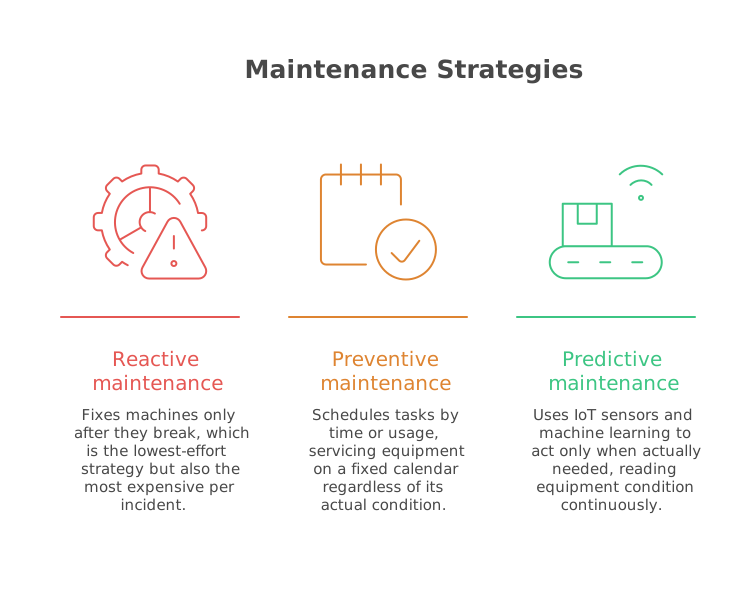
Reactive maintenance fixes machines only after they break, which is the lowest-effort strategy but also the most expensive per incident, since failures happen with no warning and no chance to schedule around them. Preventive maintenance schedules tasks by time or usage, servicing equipment on a fixed calendar regardless of its actual condition; this avoids some failures but wastes effort replacing parts that still had useful life left. Predictive maintenance uses IoT sensors and machine learning to act only when actually needed, reading equipment condition continuously rather than relying on either a breakdown or a calendar to trigger a maintenance action.
Two related strategies are worth a brief mention. Prescriptive maintenance goes a step further than predictive by recommending the specific corrective action, not just flagging that a failure is likely. Reliability centered maintenance is a broader framework for deciding which maintenance strategy fits which asset, often blending reactive, preventive, and predictive approaches across a single facility based on each asset's criticality, a choice examined in predictive maintenance vs preventive maintenance.
| Strategy | Trigger for Action | Typical Trade-Off |
|---|---|---|
| Reactive Maintenance | Equipment failure | Lowest planning effort, highest per-incident cost |
| Preventive Maintenance | Fixed time or usage interval | Avoids some failures, wastes life on parts replaced too early |
| Predictive Maintenance | Sensor data indicating developing failure | Highest upfront setup cost, lowest ongoing cost per asset |
| Prescriptive Maintenance | Predictive alert plus recommended action | Reduces diagnostic time, requires more mature data and models |
IoT sensors collect and transmit real-time data on equipment performance to a centralized system, typically a cloud platform, where it becomes available for analysis. From there, AI analyzes sensor data to detect issues early: advanced algorithms establish a baseline for normal machine behavior from historical operation, then flag readings that deviate from that baseline as potential early signs of failure.
The common sensing techniques behind this vary by asset and failure mode. Vibration analysis catches misalignment and bearing wear in rotating equipment. Thermography, using infrared sensors, catches overheating in electrical components and bearings before it becomes visible to the naked eye. Oil analysis detects contamination and wear particles in lubricated machinery, often the earliest indicator of internal component degradation.
Once advanced analytics detect anomalies, the alert-to-work-order lifecycle takes over: the system generates an alert, a maintenance planner or an automated rule assigns it a priority, and the corresponding work order gets scheduled into the maintenance team's queue. Machine learning improves prediction accuracy over time as the models see more confirmed failures and false alarms, refining the threshold between a genuine early warning and normal operating variation.
Identifying critical assets is the first step to prioritize for predictive maintenance, and it is worth doing deliberately rather than defaulting to whichever equipment already has sensors installed.
Start where a failure hurts most and where you already have data. Rank assets by the cost of a failure, factoring in lost production, safety risk, and repair cost, not just how frequently something breaks. Cross-reference that ranking against what equipment data and maintenance data already exist for each asset: a high-impact asset with years of historical data and existing sensors is a far easier pilot than an equally critical asset with no instrumentation at all. Mapping each asset to its downtime cost early on also gives the eventual ROI calculation a concrete baseline to compare against, rather than relying on industry averages once the pilot is underway.
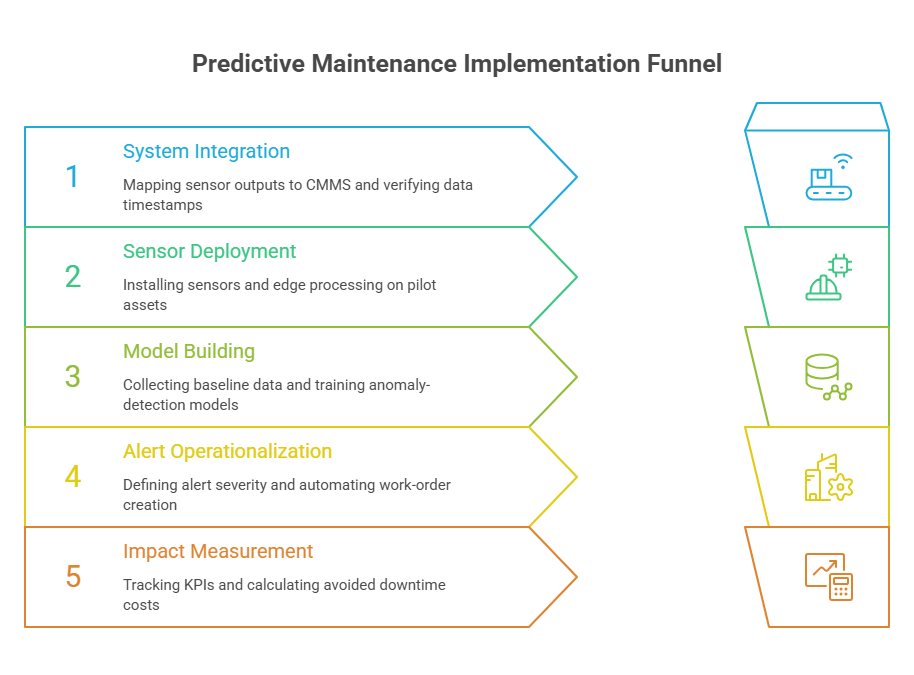
This roadmap is the core of predictive maintenance implementation and reflects how InTechHouse actually delivers these programs for manufacturing clients: seven steps, each building on the one before it.
Choose assets with high downtime cost and good data availability, and resist the temptation to start with whichever machine is easiest to instrument instead. The strongest pilot candidates sit at the intersection of costly unplanned downtime, a history of recurring equipment failures, and existing data that shortens the time to a working model. Keep the initial scope decisive: two or three assets, not an entire production line, so the pilot can demonstrate clear asset performance gains before the program has to justify a larger investment.
The first asset you instrument decides whether the program gets funded for a second phase. We help you choose it on criticality and failure economics, then build the pilot with your maintenance team.
Pick the right pilot asset with us
Map sensor outputs to the fields your computerized maintenance management system already tracks, design the APIs that will push alerts into it, and verify that data timestamps and sync intervals line up across every existing system in the chain. Most manufacturers running multiple sites are actually managing several computerized maintenance management systems at once, so this mapping needs to account for field-naming differences between them rather than assuming one schema fits all. Data should be integrated into a computerized maintenance management system (CMMS) from the start, not bolted on after the models are already running, since retrofitting that integration later usually means reworking both the data schema and the maintenance team's workflow at the same time, and it means the real time data flowing in from step three has somewhere useful to land the moment it arrives. For the OT/IT integration work this depends on, see our guide to OT/IT integration, and for the underlying data architecture, see our guide to industrial DataOps.
Install vibration, temperature, and current-monitoring sensors on the pilot assets, matched to the specific failure modes identified in step one. IoT sensors monitor equipment health in real time, but raw real time sensor data at high sampling rates generates far more volume than most networks need to carry to the cloud, which is where edge computing and edge processing reduce noise before data is sent on, filtering out irrelevant variation and forwarding only the signal that matters. This step is also where monitor rotating equipment becomes a practical concern rather than an abstract goal: sensor placement, mounting quality, and calibration all affect whether the resulting machine health data is trustworthy. For the fuller sensor and connectivity architecture, see our guide to industrial IoT architecture.
Collect baseline data for each pilot asset before touching a model, since establishing data baselines before implementation is essential to distinguishing a genuine anomaly from normal operating variation later on. Train anomaly-detection models on those baselines, then validate the results against historical failures the asset has already experienced. Data analysis is essential for effective programs at this stage, and machine learning detects anomalies most reliably when the training data spans enough operating conditions, different shifts, different product runs, different seasons, to represent what normal actually looks like across the full range of the asset's operation, regardless of which specific machine learning algorithms end up powering the final model. This step is also where early fault detection gets tuned: the threshold between an alert worth acting on and noise gets set here, and it usually needs revisiting once real alerts start flowing. For deeper RUL-specific modeling guidance, see our guide to remaining useful life estimation.
An alert only creates value when it becomes a scheduled work order, which makes this step as important as the modeling work that precedes it. Define alert severity levels and response-time SLAs so maintenance teams know which alerts need action within the hour and which can wait for the next planned maintenance window. Automate work-order creation so a qualifying alert generates a ticket without manual re-entry, and assign clear technician response procedures for each severity level. Maintenance should be scheduled based on alerts from the CMMS, not run in parallel with the old calendar-based system, since running both simultaneously confuses technicians about which signal to trust. These proactive measures, defined severity levels, automated ticketing, clear ownership, are what let a team schedule maintenance around what the data says rather than around a fixed date on a calendar.
Track mean time to repair (MTTR), mean time between failures (MTBF), uptime, and total maintenance spend against the pilot's baseline, and calculate the avoided-downtime cost using the asset's own downtime-cost figure from step one rather than an industry average.
| Metric | What It Tracks | Target Direction |
|---|---|---|
| MTTR (Mean Time to Repair) | Average time from failure or alert to restored operation | Down |
| MTBF (Mean Time Between Failures) | Average operating time between unplanned failures | Up |
| Asset Uptime | Percentage of scheduled time the asset is operational | Up |
| Maintenance Spend Per Asset | Total maintenance cost divided by monitored assets | Down |
Research consistently shows predictive maintenance leads to reduced downtime and defect rates when these key performance indicators are tracked from a clear pilot baseline rather than estimated after the fact. The goal of this step is a report that connects directly to reduce maintenance costs and asset availability in terms operations leadership already tracks, which is what turns a successful pilot into approved budget for the next phase.
Roll the program out to the next tier of prioritized asset groups once the pilot has demonstrated its case, using the same asset-ranking logic from step one rather than expanding indiscriminately. Establish a feedback loop to retrain models as new failure and false-positive data accumulates, since machine learning improves prediction accuracy over time only when that new data actually reaches the retraining pipeline. Schedule regular continuous-improvement reviews, quarterly is typical, to reassess which assets should be added next and whether alert thresholds still match current maintenance operations. As the program matures, expect a shift from tracking individual-asset wins toward reporting fleet-wide gains in maintenance operations and asset lifespans across the whole prioritized portfolio. For how model retraining and deployment operations scale alongside the program, see our guide to edge MLOps.
From a buyer's perspective, three things separate predictive maintenance software that actually gets used from software that gets abandoned after the pilot.
Model explainability matters more than raw accuracy for maintenance teams who need to trust an alert enough to act on it; a platform that can show which sensor readings drove a given prediction builds that trust faster than one that returns a bare probability score. API and connector availability determines how much custom integration work step two above will require, so evaluating this against your specific CMMS and historian stack before committing to a vendor avoids an expensive surprise later. Vendor support for data analysis, not just software licensing, matters because most manufacturing teams do not have a dedicated data science function in-house, and predictive maintenance platforms that leave model tuning entirely to the customer tend to stall after the initial deployment. Across all three considerations, the goal is the same: analytics platforms and advanced analytics only deliver value when they translate into data insights a maintenance team can act on without a data scientist standing by.
Against those three criteria - explainable models, CMMS integration, and ongoing analysis support — see how our predictive maintenance services are built, from sensor deployment through work-order automation.
The technology fails without the people and process behind it, which is the part of a predictive maintenance rollout that gets underinvested most often, and the first thing predictive maintenance best practices address. Even well-built models fail here, since PdM model training and deployment only pay off when technicians trust and act on the alerts.
Identify maintenance champions on the shop floor early, technicians who are curious about the new workflow rather than skeptical of it, and give them a visible role in tuning alert thresholds during the pilot. Train technicians on PdM workflows specifically, not just on the software interface, since interpreting an anomaly score correctly requires understanding what the model is and is not telling them. Update SOPs to include predictive tasks so the new workflow becomes the documented standard rather than a parallel process that quietly falls away once the pilot's champion moves to a different role, and make sure those updated SOPs cover the day-to-day maintenance activities technicians will actually perform in response to an alert, not just the high-level policy. Maintenance teams that treat this as a continuous improvement effort, revisiting procedures as the program scales, sustain the gains far longer than teams that treat the rollout as a one-time project with a fixed end date.
Building a credible ROI case starts with a baseline maintenance-cost model specific to your own facility: current spend, current downtime hours, and their associated costs, not an industry benchmark applied uniformly across every asset.
From that baseline, project savings from reduced downtime using your own downtime-cost figures, then lay out a payback timeline that accounts for sensor hardware, integration engineering, and any software licensing involved. Industry figures help calibrate expectations for that projection: unplanned downtime is estimated to cost manufacturers $50 billion annually (Deloitte, citing Industry Week and Emerson research), which underscores how much value is available even from a partial reduction. On the higher end of documented outcomes, a Forrester Total Economic Impact study of Augury's manufacturing customers found a 310% ROI achieved within three years, with payback in under six months for the composite organization studied; that figure reflects a specific vendor's customer base rather than a universal outcome, so treat it as an indication of what a well-executed program can achieve rather than a guaranteed result.
Reduce costs and reduce maintenance costs figures should always be presented alongside the assumptions behind them, since a stakeholder reviewing the business case a year later will want to know whether the projection held, not just what the projection was. Avoiding costly repairs and unplanned downtime is where most of the savings materialize, so keeping the calculation anchored to your own facility's downtime-cost figure, from the critical-asset mapping in an earlier step, keeps the business case defensible.
Predictive maintenance increases production efficiency by optimizing machine operations, and the clearest way to see that is through overall equipment effectiveness (OEE) and uptime improvements tracked before and after a pilot deployment.
InTechHouse's delivered work in the manufacturing industry follows the pattern the roadmap above describes: a pilot on high-impact assets, sensor deployment matched to specific failure modes, and CMMS integration that turns predictions into scheduled work rather than another dashboard. Clients evaluating predictive maintenance solutions consistently find that the clearest wins come from assets with both high downtime cost and readily available data, exactly the criteria step one recommends prioritizing. Equipment performance and asset availability gains follow from there, once the alert-to-work-order loop is actually closing in practice rather than staying theoretical.
A manufacturing client running a multi-line production facility needed to reduce unplanned stoppages on a set of high-value CNC and rotating assets that had caused several costly production disruptions over the prior year. InTechHouse ranked the client's full asset list by downtime cost and data availability, selected a pilot group of critical assets, and deployed vibration and temperature sensors feeding an edge gateway that pre-filtered noise before forwarding data to the cloud. An anomaly-detection model, trained on the client's historical sensor and maintenance-log data, was integrated directly into the client's existing CMMS so that qualifying alerts generated prioritized work orders automatically rather than requiring manual triage. Within the pilot period, the client recorded a measurable reduction in unplanned downtime on the monitored assets and used the resulting business case to secure budget for a second wave of asset onboarding.
.svg)
Read also:
Bad data quietly breaks predictive maintenance, so data quality and drift monitoring are non-negotiable rather than a nice-to-have added once the program has budget to spare.
Audit sensor-data quality on a regular schedule, not just during initial deployment, since sensors drift, connections degrade, and mounting can shift over months of vibration and thermal cycling. Identify data gaps proactively: a sensor that silently stops reporting looks identical to a perfectly stable asset unless something is explicitly checking for missing telemetry. Implement data-retention and access controls for both maintenance data and the broader data analysis pipeline feeding it, since predictive maintenance systems increasingly sit adjacent to production networks and need the same governance discipline as any other industrial system. Monitor model drift regularly as equipment ages and operating conditions shift, since a model trained on a machine's baseline from two years ago may no longer reflect what normal looks like for that asset today, particularly for assets showing measurable equipment degradation from wear or from changes to existing systems around them.
Run a pilot with clear KPIs defined before day one, not retrofitted once the results come in. Secure a cross-functional steering committee spanning maintenance, IT, and operations leadership, since a program that lives entirely within the maintenance department tends to stall when it needs IT resources or capital budget from outside that team. Create a roadmap to scale beyond the pilot before the pilot even concludes, so momentum does not stall waiting for the next planning cycle, and plan quarterly reviews to keep the continuous-improvement loop from step seven active rather than symbolic.
Every organization that wants to implement predictive maintenance faces some version of the same seven-step path this guide has walked through, but the specifics, which assets, which sensors, which integration points, are different for every facility. Talk to InTechHouse about building a predictive maintenance program for your manufacturing operation, or explore our industrial data platforms and OT/IT integration services for the data foundation this roadmap depends on.
We ran the sensor deployment, edge processing and CMMS integration described in this roadmap for a manufacturing client. Ask us for the numbers and the architecture behind it.
See our manufacturing predictive maintenance case study
Not sure where to start? We work with companies at every stage, from early ideas to enterprise-level builds. A 30-minute call can save you months of guesswork.
Predictive maintenance in manufacturing uses sensor data and machine learning to predict when a piece of equipment is likely to fail, so repairs happen just before that point instead of on a fixed schedule or after a breakdown. It combines IoT sensors, analytics, and integration with a CMMS so a prediction turns into a scheduled work order rather than staying a dashboard alert nobody acts on.
Predictive maintenance reduces overall maintenance costs by 18% to 31% compared to traditional methods, according to IBM, and unplanned downtime is estimated to cost manufacturers $50 billion annually across the industry, according to Deloitte. Individual results vary widely by asset type and program maturity, with one Forrester study finding a 310% ROI over three years for a specific vendor's manufacturing customers.
Preventive maintenance services equipment on a fixed schedule based on time or usage, regardless of actual condition, while predictive maintenance uses sensor data and machine learning to service equipment only when its condition indicates it actually needs attention. This difference is what drives most of the cost savings, since preventive maintenance often replaces parts that still had useful life left.
The core sensors are vibration, temperature, and current-monitoring devices, often supplemented with oil-analysis and thermography-based sensors depending on the asset and its typical failure modes. Beyond real-time sensor readings, predictive maintenance also needs historical maintenance data and confirmed past failure records to train and validate the models that generate alerts.
Implementation follows a roadmap: select pilot critical assets, integrate with existing CMMS and IT systems, deploy sensors and edge processing, build and validate models, operationalize alerts into scheduled work orders, measure impact against clear KPIs, then scale the program with a continuous-improvement feedback loop. Each step builds on the one before it, and skipping the integration or measurement steps in favor of jumping straight to modeling is one of the most common reasons pilots stall before they scale.
Tomasz Andrysiak, DSc, PhD, is a Expert and a Professor at Bydgoszcz University of Science and Technology. He has more than 30 years of academic, research, R&D, and technology-implementation experience in artificial intelligence, computational intelligence, signal processing, anomaly detection, cybersecurity, and complex information systems.
His research focuses on machine-learning and computational-intelligence methods for analyzing signals, time series, network traffic, industrial data, and multimodal datasets. He specializes in anomaly and failure detection, predictive modeling, intelligent monitoring, critical-infrastructure security, smart metering, biomedical signal analysis, and the practical deployment of AI in industrial and public-sector systems.
Tomasz is the author or co-author of more than 75 scientific publications, including papers published in internationally recognized journals and conference proceedings indexed by Web of Science and Scopus. His research has covered network anomaly detection, cybersecurity of critical infrastructure, ECG signal analysis, machine learning, smart water networks, telecommunications, and intelligent industrial systems.
He has led and contributed to national and European R&D programs focused on cyber situational awareness, critical-infrastructure resilience, autonomous systems, Big Data, intelligent water management, blockchain-based transaction platforms, and industrial AI. He leads industrial-doctorate projects involving AI-based CMDB automation and machine-learning methods for knowledge discovery in Big Data.
Tomasz is an IEEE Senior Member and has served as an elected member of the Commission of Informatics and Automation of the Polish Academy of Sciences, Poznań Branch. He has participated in scientific committees and journal boards, supervised doctoral research, reviewed publications for international journals, and co-authored patents and patent applications related to signal detection and LoRa-based ECG monitoring. He writes about industrial AI, machine learning, anomaly detection, predictive analytics, cybersecurity, signal processing, time-series analysis, and intelligent infrastructure.
Tomasz Andrysiak's academic profiles:
https://link.springer.com/chapter/10.1007/978-3-642-32384-3_28
https://www.researchgate.net/profile/Tomasz-Andrysiak
https://scholar.google.com/citations?user=RHW7zx4AAAAJ&hl=pl
https://dblp.org/pid/41/6793.html
https://radon.nauka.gov.pl/dane/profil/6FFA1E51186802ECFFB49644209B5BE0EBD68C55
https://pbs.edu.pl/pl/pracownik/tomasz-andrysiak
https://www.youtube.com/watch?v=6e1GTqT5czM
This initial conversation is focused on understanding your product, technical challenges, and constraints.
No sales pitch - just a practical discussion with experienced engineers.
Share a few details about your product and context. We’ll review the information and suggest the most appropriate next step.