
Predictive Maintenance Best Practices
.avif)

The best predictive maintenance programs get five things right: they prioritize the right assets, build a solid data foundation, match condition monitoring to actual failure modes, integrate alerts into the CMMS so they turn into work orders, and improve the model and the process continuously. Teams building or scaling a predictive maintenance program don't need another definition of the concept. They need a prescriptive playbook, grounded in what separates a pilot that gets shelved from a predictive maintenance program that survives its second budget cycle.
Key Takeaways
- Rank assets by failure risk and business impact before buying a single sensor. Not every machine deserves the same monitoring frequency.
- Data quality and sensor placement determine whether a model works. A perfect algorithm on bad data still produces false alarms.
- Match condition-monitoring techniques (vibration, oil, thermal, acoustic, ultrasound, motor current) to the failure modes each asset is actually prone to.
- An alert only creates value once it becomes a CMMS work order. Integration with maintenance management, not the model itself, is usually the bottleneck.
- Track MTBF, MTTR, and planned-maintenance percentage monthly, and treat the program as a continuous improvement loop, not a one-time deployment.
Strategy Overview and Executive Sponsorship
A predictive maintenance strategy without a named owner and a protected budget stalls somewhere around month four, once the initial pilot excitement fades and the first false alarm shows up. Before any sensor gets installed, define program objectives tied to a specific downtime reduction target, map asset criticality across the plant or fleet, and assess the consequence of failure for each asset class (safety, production loss, regulatory exposure). Then secure executive sponsorship, because implementing predictive maintenance is an operational shift toward data-driven equipment reliability, and that shift needs funding for sensors, integration work, and the maintenance teams' time to act on what the data shows.
Programs that skip this step tend to have technically sound models running against a maintenance strategy that nobody adjusted. The model flags a bearing at risk, and the work order sits in the same queue as everything else because nobody redefined the escalation path. Asset reliability, not sensor count, is the metric sponsors actually care about, and framing the program around a proactive maintenance shift rather than a technology purchase makes the funding conversation easier.
A Best-Practices Framework
Four building blocks separate a durable predictive maintenance program from a science project:
- Standard operating procedures for condition monitoring. Who checks which readings, how often, and what threshold triggers a human review.
- Data governance and ownership. A named data steward, a defined retention policy, and clear rules on who can edit thresholds.
- Cross-functional reliability reviews. Maintenance, operations, and the data team look at model output together on a fixed cadence, not only after a failure.
- Escalation protocols for high-severity alerts. A critical vibration spike should not wait in the same queue as a routine lubrication reminder.
Combining domain expertise with analytics is what actually reduces false positives. A model flags an anomaly; a reliability engineer who knows the asset's history decides whether it's a real early warning sign or a sensor drift issue. Skip that pairing and the maintenance team stops trusting the alerts within a few weeks, which quietly kills the maintenance best practices you built the program around. These four building blocks only work if they're wired into the plant's actual maintenance workflows, not documented separately and left on a shelf.
.png)
Prioritize by Asset Criticality
Monitor what would hurt the most if it failed. Identifying critical assets starts with failure risk and business impact, not with which machines happen to have the easiest sensor access. Classify assets into three or four tiers, assign a monitoring frequency and technique set per tier, and set pilot targets with a measurable ROI attached (avoided downtime hours, deferred replacement cost, reduced emergency labor).
| Asset Tier | Failure Consequence | Monitoring Approach | Typical Techniques |
|---|---|---|---|
| Tier 1: Critical | Line stoppage, safety risk, or regulatory exposure | Continuous, real time sensor data | Vibration analysis, thermography, motor current analysis |
| Tier 2: Important | Reduced throughput, delayed output | Continuous or high-frequency scheduled | Vibration analysis, oil analysis |
| Tier 3: Standard | Localized impact, workaround available | Scheduled inspection with periodic sensing | Ultrasound, periodic thermography |
| Tier 4: Run-to-fail | Negligible operational impact | None or basic visual checks | Reactive replacement |
Prioritizing equipment responsible for the most potential downtime keeps early resource allocation focused on the handful of assets where predictive maintenance pays for itself fastest, which matters when you're defending the program's budget at the next review.
Blend Predictive, Preventive, and Reactive
The best practice isn't picking one maintenance strategy for the whole plant. It's a tiered blend: predictive maintenance for Tier 1 critical assets where failure consequences are high and sensor data is reliable, preventive maintenance on low-risk routine components where time-based servicing is cheap and effective, and reactive maintenance for run-to-fail items where the cost of monitoring exceeds the cost of occasional replacement. Corrective maintenance, the repair work that follows a reactive failure, should be tracked separately so its cost is visible when the program reports savings.
Forcing predictive coverage onto every asset burns budget on low-value sensors and dilutes the maintenance teams' attention away from the equipment that actually needs it. For the full comparison of when each approach fits, see predictive maintenance vs preventive maintenance.
Sensor Data and Condition Monitoring
Identify the required sensor types per failure mode before procurement, not after. A gearbox prone to bearing wear needs vibration sensors at validated measurement points; a transformer prone to overheating needs infrared thermography. Install sensors where the physics of the failure mode actually shows up first, and validate baseline data for at least one normal operating cycle before enabling alert thresholds.
Rigorous data quality and correct sensor placement are the two variables that determine whether the resulting equipment health scores mean anything. Establishing a clean baseline is what lets a team monitor equipment health over time instead of reacting to noise. Skipping baseline validation is the single most common reason predictive maintenance pilots generate false alarms in their first quarter.
Networked IoT sensors are what make continuous monitoring practical at scale, feeding readings back to the analytics platform without a technician walking the floor with a handheld meter. The goal across all of it is the same: detect early signs of equipment failure while there's still time to plan an intervention instead of reacting to a breakdown.
Condition-Monitoring Techniques
Different failure modes leave different physical signatures, and matching the technique to the signature is what separates useful condition monitoring from an expensive data feed nobody reads.
| Technique | What It Detects | Typical Application |
|---|---|---|
| Vibration analysis | Bearing wear, imbalance, mechanical faults | Rotating equipment: motors, pumps, fans |
| Oil analysis | Wear metals, viscosity shifts, contamination | Gearboxes, hydraulic systems, engines |
| Infrared thermography | Electrical faults, overheating connections | Switchgear, panels, motor windings |
| Acoustic analysis | Sound-pattern anomalies | Structural components, valves |
| Ultrasound | Gas leaks, mechanical defects, early bearing wear | Compressed air systems, bearings |
| Motor current analysis | Electrical signatures, rotor faults | Induction motors, drives |
Blending two or three of these per critical asset, rather than relying on a single sensor type, is what catches the failure modes that any one technique misses on its own.
Machine Learning and Analytics Best Practices
Choose models suited to the failure labels you actually have. A plant with three years of labeled failure history can support a supervised classification model; a plant with clean sensor data but almost no recorded failures is better served starting with anomaly detection. Engineer features from time-series data (rolling averages, rate-of-change, frequency-domain features for vibration), validate with cross-validation against historic failures rather than a single holdout split, and deploy with human-in-the-loop review for at least the first several months.
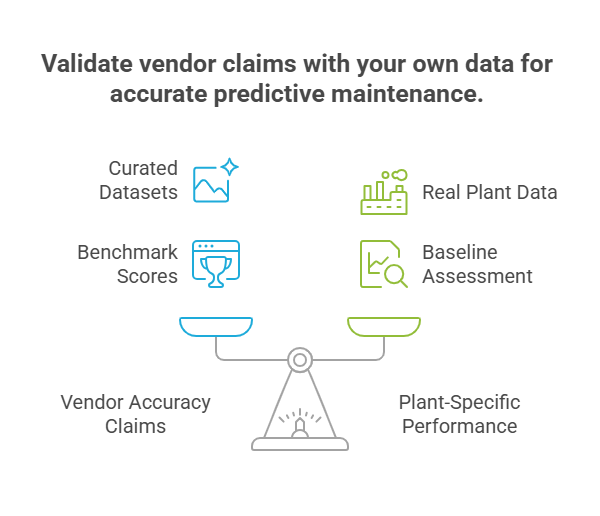
Artificial intelligence analyzes vast amounts of sensor and maintenance data to forecast failures earlier than manual inspection can, but the accuracy figures vendors publish are usually measured on curated datasets under favorable conditions. Treat any specific accuracy claim as a starting hypothesis to validate against your own equipment, not a guarantee. Machine learning algorithms trained on historical data can identify patterns in vibration, temperature, and current signatures that precede a failure by days or weeks, which is what turns predictive models into predictive analytics a maintenance team can actually act on. As covered in more depth in predictive maintenance machine learning, the models that hold up in production are the ones tuned against real plant data, not the ones with the highest benchmark score.
The advice to validate vendor accuracy claims against your own plant data applies to us too - our predictive maintenance services start with a baseline assessment on your historical data before any model goes live, so you see plant-specific performance, not brochure numbers.
Integrate With Asset and Maintenance Management
An alert only creates value when it becomes a work order. Integrate predictive alerts directly into CMMS work order generation, tag assets with the relevant metadata in the EAM system, and align spare-parts inventory management to predicted failure windows so a flagged bearing doesn't sit waiting for a part that takes six weeks to arrive.
Centralizing the software ecosystem around a shared asset record avoids the data silos that quietly undermine most predictive maintenance programs: sensor data in one platform, work orders in a computerized maintenance management system, and inventory in a third tool that none of them talk to. Good asset management depends on that shared record, and connecting predictive alerts to existing systems rather than standing up a parallel dashboard is usually the harder, more valuable half of the integration work. For the architecture side of connecting operational technology to IT systems, see OT/IT integration.
Read also:
- What Is Predictive Maintenance? A Practical Guide
- How to Implement Predictive Maintenance: A Step-by-Step Guide
- Predictive Maintenance vs Preventive Maintenance: Which Is Right?
Monitor Equipment and Allocate Resources
Set up dashboards that show equipment-health trends over time, not just current status. Prioritize work orders by a combination of asset criticality and predicted remaining useful life, and schedule technicians by skill match and availability rather than by whoever's next in the queue.
Predictive maintenance optimizes resource allocation precisely because it replaces calendar-based guessing with a ranked list: which asset needs attention first, and how much runway is left before it needs attention. Dashboards built around equipment performance trends also make it easier to optimize resource allocation, shifting maintenance schedules toward condition-based windows instead of fixed calendar intervals, without a reliability engineer having to argue the case asset by asset. For a deeper look at estimating that runway, see RUL estimation.
Deployment, Training, and Governance
Run a small pilot on a handful of representative assets before scaling. A focused pilot validates alert accuracy against real outcomes and surfaces integration problems while the stakes are still low. Train technicians on sensor troubleshooting, not just on reading the dashboard, since a sensor that's drifted or come loose produces a false anomaly that looks identical to a real one.
Appoint a data steward for the predictive maintenance dataset (someone accountable for data quality, access, and retention) and define change-management steps for what happens when a threshold needs adjusting or a new asset gets added. Maintenance operations that skip this governance layer end up with thresholds nobody remembers setting and alerts nobody trusts.
Programs die when alerts land in the same queue as routine work orders and nobody owns the escalation path. We set up the governance, thresholds and CMMS workflow alongside the models.
Stop your PdM pilot from stalling at month four
KPIs, Continuous Improvement, and ROI
Key performance indicators are what turn a predictive maintenance program from a technology project into something operations leadership tracks alongside output and safety. Track Mean Time Between Failures (MTBF) and Mean Time to Repair (MTTR) as the two core reliability metrics; both should trend in your favor within two to three quarters of a working program, and both feed directly into overall operational efficiency. Monitor the planned-maintenance percentage (the share of maintenance hours that were scheduled rather than emergency), review model accuracy monthly against actual outcomes, and report cost avoidance quarterly to keep executive sponsorship intact.
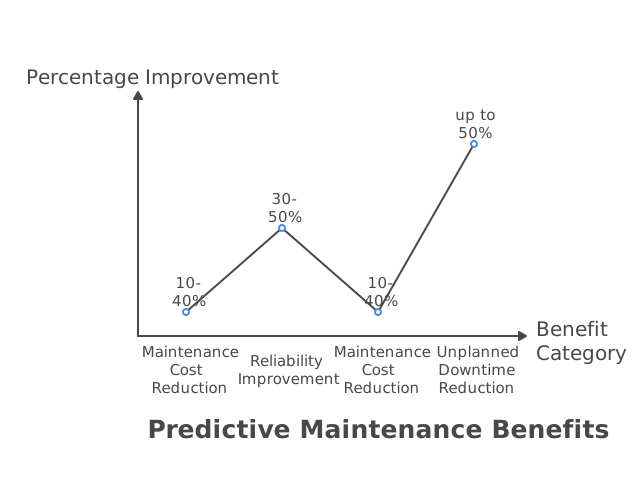
Overall Equipment Effectiveness (OEE) is a standard key performance indicator for tying predictive maintenance results back to production output, not just maintenance cost. On the financial side, McKinsey & Company found that predictive maintenance programs typically reduce maintenance costs by 10 to 40 percent and cut unplanned downtime by up to 50 percent (McKinsey & Company, 2020). Separately, Deloitte's analysis puts the reliability improvement at 30 to 50 percent and the maintenance cost reduction at up to 40 percent (Deloitte, 2017). Actual results depend heavily on where a plant started (reactive operations see the largest early gains) and how disciplined the governance around the program is.
| KPI | What It Measures | Review Cadence |
|---|---|---|
| MTBF | Average operating time between failures | Monthly |
| MTTR | Average time to repair once a failure occurs | Monthly |
| Planned-maintenance percentage | Share of maintenance hours scheduled vs. emergency | Monthly |
| Model accuracy (precision/recall) | How well predicted failures matched actual outcomes | Monthly |
| Cost avoidance | Estimated cost of downtime and repairs avoided | Quarterly |
| OEE | Availability x performance x quality | Quarterly |
InTechHouse case study: tiered predictive maintenance for public transportation equipment
InTechHouse worked with a public transport manufacturers to build a condition-monitoring program for critical drivetrain and braking components. Assets were tiered by failure consequence and duty cycle, with continuous vibration and thermal sensing on Tier 1 components and scheduled inspection on the rest. Alert thresholds were validated jointly with the operator's maintenance engineers over an initial baseline period to control false positives before the system went into full production use, and predictive alerts were integrated directly into the operator's existing maintenance workflow so flagged components generated work orders automatically. The result was a measurable reduction in unplanned service interruptions, within the operator's required reliability tolerance.
Implementation Roadmap and Pilot
Select a pilot scope with clear, pre-agreed success metrics rather than a vague "let's see how it goes" mandate. Collect baseline data across at least one full failure cycle for the pilot assets before drawing conclusions about model performance, since a model that looks accurate after three weeks can fall apart once seasonal or load variation shows up. Iterate on sensor placement and response procedures after the first evaluation round; almost no pilot gets thresholds right on the first pass.
For the full step-by-step rollout process, see how to implement predictive maintenance.
Plant-floor programs carry their own constraints: legacy PLCs, shift patterns, and a maintenance crew that has to trust the alerts before acting on them. Our roadmap for predictive maintenance in manufacturing walks through pilot selection, system integration and scaling in exactly that environment.
Conclusion and Next Steps
Scale what worked in the pilot while preserving the data ownership and governance structure that made the pilot trustworthy in the first place. Programs that scale sensor count without scaling governance tend to drown in alerts within a year. The predictive maintenance best practices above hold whether you're monitoring five critical assets or five hundred: prioritize by risk, get the data right, match the technique to the failure mode, integrate alerts into a system that turns them into action, and keep measuring.
If you're building or optimizing a predictive maintenance program, InTechHouse's predictive maintenance services cover technical discovery, sensor architecture, model development, and production deployment. For programs that also need to unify OT and IT data sources, see industrial data platforms and OT/IT integration. Each of those steps looks different on remote, safety-critical equipment, which is why the oil and gas PdM use cases are treated separately.
We audit running predictive maintenance programs on asset criticality, sensor coverage, false alarm rate and KPI design, then give you a prioritised fix list. Ask for a review.
Review your program against these practices with us
Let's talk about your next move
Not sure where to start? We work with companies at every stage, from early ideas to enterprise-level builds. A 30-minute call can save you months of guesswork.
FAQ
1. What are the best practices for predictive maintenance?
Prioritize assets by failure risk, validate sensor data quality and placement before enabling alerts, match condition-monitoring techniques to actual failure modes, integrate alerts into the CMMS so they generate work orders, and track KPIs like MTBF and MTTR to drive continuous improvement.
2. How do you prioritize assets for predictive maintenance?
Classify assets into tiers based on failure consequence (safety, downtime cost, regulatory exposure) and business impact, then assign monitoring frequency and technique per tier. Start with the equipment responsible for the most potential downtime rather than the equipment that's easiest to instrument.
3. Which condition-monitoring techniques should you use?
The choice depends on the failure mode: vibration analysis for bearing wear and imbalance, oil analysis for wear metals and contamination, infrared thermography for electrical and overheating faults, acoustic and ultrasound for leaks and early-stage mechanical defects, and motor current analysis for electrical signatures in motors and drives. Most critical assets benefit from blending two or three techniques.
4. How do you reduce false alarms in predictive maintenance?
Validate sensor baselines over a full operating cycle before enabling alerts, pair the model's output with review from a reliability engineer who knows the asset's history, and adjust thresholds during a pilot period rather than locking them in at deployment. Combining domain expertise with analytics is what consistently reduces false positives.
5. What KPIs measure predictive maintenance success?
MTBF and MTTR are the core reliability metrics, alongside planned-maintenance percentage, model precision and recall reviewed monthly, quarterly cost avoidance, and OEE as the production-facing key performance indicator tying maintenance results to output.
Tomasz Andrysiak, DSc, PhD
Tomasz Andrysiak, DSc, PhD, is an Expert and a Professor at Bydgoszcz University of Science and Technology. He has more than 30 years of academic, research, R&D, and technology-implementation experience in artificial intelligence, computational intelligence, signal processing, anomaly detection, cybersecurity, and complex information systems.
His research focuses on machine-learning and computational-intelligence methods for analyzing signals, time series, network traffic, industrial data, and multimodal datasets. He specializes in anomaly and failure detection, predictive modeling, intelligent monitoring, critical-infrastructure security, smart metering, biomedical signal analysis, and the practical deployment of AI in industrial and public-sector systems.
Tomasz is the author or co-author of more than 75 scientific publications, including papers published in internationally recognized journals and conference proceedings indexed by Web of Science and Scopus. His research has covered network anomaly detection, cybersecurity of critical infrastructure, ECG signal analysis, machine learning, smart water networks, telecommunications, and intelligent industrial systems.
He has led and contributed to national and European R&D programs focused on cyber situational awareness, critical-infrastructure resilience, autonomous systems, Big Data, intelligent water management, blockchain-based transaction platforms, and industrial AI. He leads industrial-doctorate projects involving AI-based CMDB automation and machine-learning methods for knowledge discovery in Big Data.
Tomasz is an IEEE Senior Member and has served as an elected member of the Commission of Informatics and Automation of the Polish Academy of Sciences, Poznań Branch. He has participated in scientific committees and journal boards, supervised doctoral research, reviewed publications for international journals, and co-authored patents and patent applications related to signal detection and LoRa-based ECG monitoring. He writes about industrial AI, machine learning, anomaly detection, predictive analytics, cybersecurity, signal processing, time-series analysis, and intelligent infrastructure.
Tomasz Andrysiak's academic profiles:
https://orcid.org/0000-0001-8138-6619
https://ludzie.nauka.gov.pl/ln/profiles/fHOpojQ2lIF
https://link.springer.com/chapter/10.1007/978-3-642-32384-3_28
https://www.researchgate.net/profile/Tomasz-Andrysiak
https://scholar.google.com/citations?user=RHW7zx4AAAAJ&hl=pl
https://dblp.org/pid/41/6793.html
https://radon.nauka.gov.pl/dane/profil/6FFA1E51186802ECFFB49644209B5BE0EBD68C55
https://pbs.edu.pl/pl/pracownik/tomasz-andrysiak
https://www.youtube.com/watch?v=6e1GTqT5czM
Let's talk about your next project
From first prototype to production, our engineers can help you scope it, build it and get it certified.




Discuss your product with our R&D team
This initial conversation is focused on understanding your product, technical challenges, and constraints.
No sales pitch - just a practical discussion with experienced engineers.
Share a few details about your product and context. We’ll review the information and suggest the most appropriate next step.