.avif)
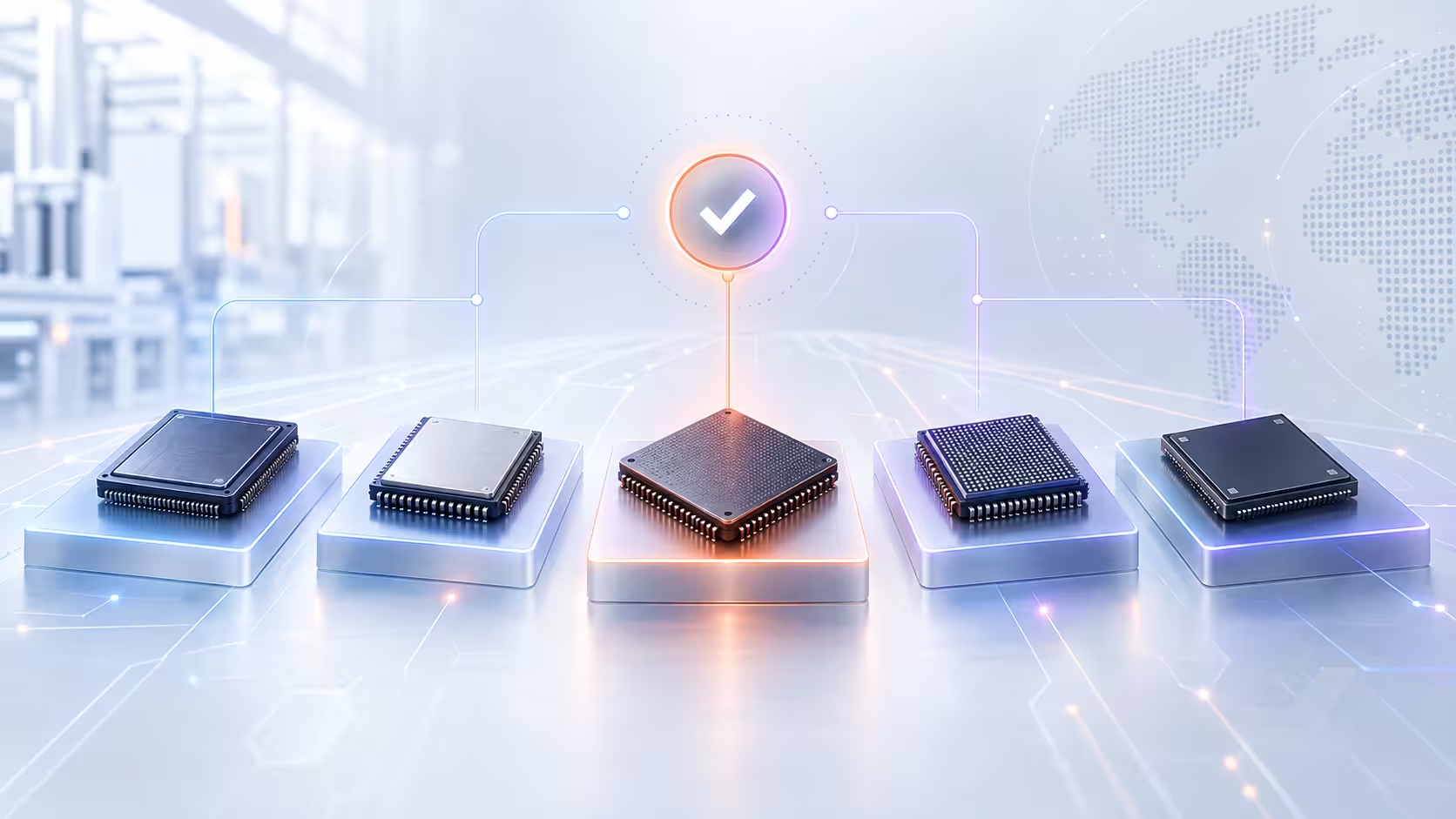
Predictive maintenance tools combine condition-monitoring hardware with intelligent software to forecast equipment failures before they happen, and the right choice depends on your scale, your existing systems, and whether you want a turnkey product or a platform to build on. This guide is written for reliability and maintenance teams evaluating predictive maintenance software for the first time or replacing a tool that has not kept pace with their operation. It compares the leading predictive maintenance platforms on the market, breaks down the sensor technology behind them, and walks through how to choose and implement one without letting the software become the whole strategy. Sector shapes the shortlist too: predictive maintenance in oil and gas, with remote pipelines and hazardous-area sensors, places extra demands on any platform.
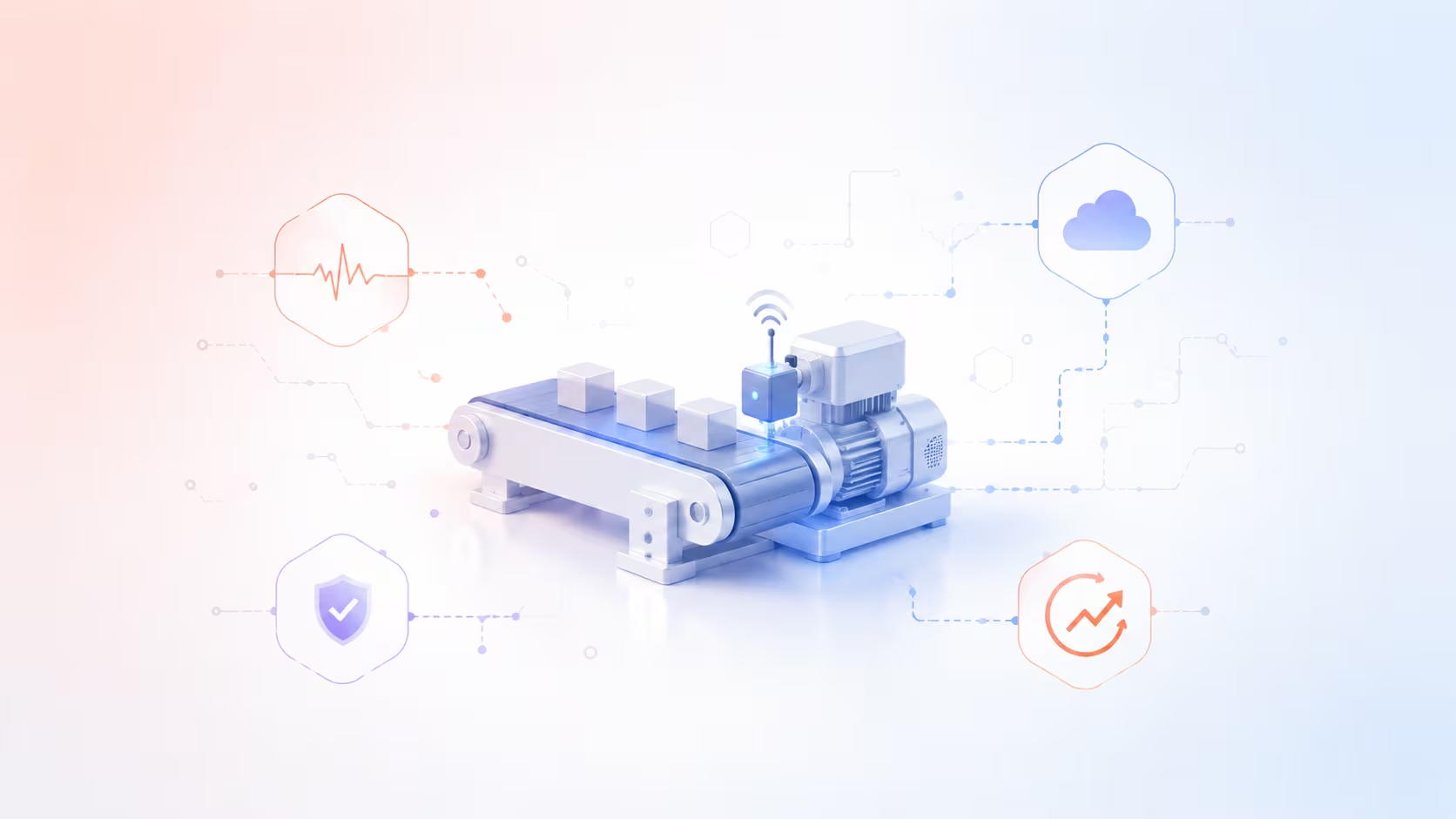
Predictive maintenance tools use real time data to forecast equipment failures instead of waiting for a scheduled inspection or a breakdown. Sensors attached to machinery capture condition data such as vibration, temperature, and pressure. Software then analyzes that sensor data, often with machine learning models trained on historical data, to identify patterns and detect early signs of wear before a failure occurs.
A successful predictive maintenance program combines three layers: sensors that generate condition monitoring data, analytics software that interprets it, and maintenance-management software that turns an alert into action. When the analytics layer detects a deviation from normal operating patterns, the system calculates an estimated time to failure and can trigger a work order automatically, routing it into the maintenance team's existing workflow rather than sitting in a dashboard nobody checks.
The payoff shows up in equipment availability. Early fault detection lets teams schedule repairs during planned downtime instead of reacting to a breakdown mid-shift, which keeps the asset running and avoids the cascading costs of an unplanned stop, from rush parts shipping to overtime labor.
Before comparing individual products, it helps to know what actually separates a strong predictive maintenance tool from a weak one. Five criteria matter most:
| Criterion | What to Check |
|---|---|
| Data Analysis and Machine Learning Capability | Does the platform build its own failure-prediction models, or does it just visualize sensor data and leave the analysis to you? |
| Sensor Support and Data Collection Flexibility | Can it ingest vibration, thermal, ultrasonic, and third-party sensor data, or is it locked to a proprietary sensor line? |
| Integration with Maintenance Management Systems | Does it connect natively to your CMMS or EAM, or does someone have to build that bridge? |
| Impact on Equipment Reliability and Asset Performance | Does the vendor publish measurable reliability outcomes, or only feature lists? |
| Total Cost of Ownership and Vendor Support | What does the platform cost beyond the license, including implementation, sensor hardware, and ongoing support? |
Effective predictive maintenance tools combine condition-monitoring hardware with intelligent software rather than treating either piece as optional. A platform that is strong on analytics but weak on sensor flexibility, or the reverse, tends to create integration work that outweighs the software's price tag.
The tools below cover the range buyers actually choose between: enterprise asset management systems, cloud IoT platforms, and turnkey condition-monitoring products. The best fit depends on your context more than any single feature, which is why the comparison table and the "how to choose" section further down resolve the shortlist into a decision.
Why it stands out: Maximo is enterprise asset management with predictive analytics built directly into the platform, which suits organizations managing large, diverse asset estates rather than a single production line.
Best for: Enterprise EAM teams and regulated industries with strict compliance and audit requirements.
Key strengths: Extensive asset modeling across facility types, a mature integration ecosystem with ERP and IoT platforms, and strong reporting and audit trails for compliance-heavy sectors.
Possible limitations: Implementation cost and deployment timelines run high compared to point solutions, and the platform's depth can be more than smaller teams need.
Why it stands out: ThingWorx is an IoT-first platform built for digital twin development and rapid prototyping, which appeals to manufacturers building custom predictive maintenance technology rather than buying it off the shelf.
Best for: Teams building digital twins and manufacturers that need edge analytics close to the equipment.
Key strengths: Flexible device connectivity, strong visualization tools for asset models, and solid real-time telemetry ingestion from the plant floor.
Possible limitations: Building custom applications has a real learning curve, and licensing complexity varies depending on deployment scale.
Why it stands out: Azure IoT Hub and Azure Digital Twins give cloud-native enterprises a scalable foundation for predictive analytics without building infrastructure from scratch. Azure IoT Central, a separate layer above IoT Hub, is being retired by March 2027, but IoT Hub and Digital Twins remain active and supported.
Best for: Cloud-native enterprises and teams already standardized on the Microsoft stack.
Key strengths: Scalable time-series data storage, native machine learning services for building predictive models, and extensive security and compliance controls.
Possible limitations: Cloud costs grow with data volume and device count, and connecting plant-floor sensors still requires integration engineering.
Why it stands out: SiteWise is built for industrial telemetry at scale, and its native anomaly detection feature, announced in 2025, lets teams configure predictive maintenance analytics without a dedicated machine learning team.
Best for: Operations with heavy IIoT telemetry workloads across many assets and sites.
Key strengths: Edge-to-cloud data pipelines, simple asset modeling, and integration with AWS analytics and machine learning services such as SageMaker.
Possible limitations: The platform assumes an AWS-centric architecture, and advanced use cases still benefit from in-house or partner machine learning expertise.
Why it stands out: Tractian bundles its own sensors with its software, which removes the sensor-sourcing step that slows down many predictive maintenance projects. Sensor sourcing is only one stage, though, and knowing how to implement predictive maintenance end to end helps judge what a bundled kit does not cover.
Best for: Teams that want turnkey condition monitoring without assembling hardware and software from separate vendors.
Key strengths: Combined vibration and ultrasonic sensing in one device, automated fault classification, and native work order integration.
Possible limitations: Vendor lock-in to Tractian's own hardware, and coverage gaps in some extreme industrial environments.
Why it stands out: Augury focuses specifically on machine health diagnostics powered by machine learning, with a strong track record on rotating equipment.
Best for: Facilities that need deep monitoring of rotating equipment such as motors, pumps, and compressors.
Key strengths: Acoustic and vibration analytics tuned for fast fault triage, and technician-friendly reporting that translates sensor data into plain-language recommendations.
Possible limitations: Results depend heavily on correct sensor placement, and the platform has limited enterprise asset management functionality on its own.
Why it stands out: Fiix is CMMS-first, with predictive triggers layered on top rather than the reverse, which makes it approachable for teams whose main gap is maintenance-management software rather than advanced analytics.
Best for: Midmarket maintenance teams that need better work order automation more than they need a full predictive analytics platform.
Key strengths: Simple work order automation, strong support for historical maintenance records, and easy mobile access for technicians in the field.
Possible limitations: Advanced machine learning modeling is limited compared to purpose-built analytics platforms, and the system faces scaling constraints for very large enterprises.
| Tool | Best-Fit Use Case | Deployment Model |
|---|---|---|
| IBM Maximo | Enterprise EAM across large, diverse asset estates | On-premises or cloud, enterprise implementation |
| PTC ThingWorx | Digital twin development and custom edge analytics | Cloud or on-premises, developer-driven |
| Microsoft Azure IoT and Digital Twins | Cloud-native enterprises on the Microsoft stack | Cloud (Azure) |
| AWS IoT SiteWise | Heavy IIoT telemetry across many assets and sites | Cloud (AWS), edge-to-cloud pipeline |
| Tractian | Turnkey condition monitoring, sensors and software bundled | Vendor-managed hardware plus cloud software |
| Augury | Rotating-equipment diagnostics | Vendor-managed sensors plus cloud software |
| Fiix | Maintenance management with predictive triggers | Cloud, CMMS-centric |
The pattern across this table is clear: platforms and enterprise systems (Maximo, ThingWorx, Azure, AWS) give you more control and more integration work, while turnkey products (Tractian, Augury) trade some flexibility for faster time to value and quicker cost savings. Fiix sits between the two, prioritizing maintenance-management software with predictive features attached. All seven can improve operational efficiency and equipment health when matched correctly to a team's existing maintenance workflow.
Every predictive maintenance platform above depends on the same underlying sensor categories to generate usable condition monitoring data. Understanding what each sensor type actually measures helps buyers see what they are deploying, not just what dashboard they will look at. Condition-monitoring systems typically track vibration, temperature, pressure, and lubrication condition, and IoT devices extend that monitoring down to individual subsystems in heavy equipment. In every case, the sensors themselves are what capture real-time performance data; the software is only as good as what it receives.
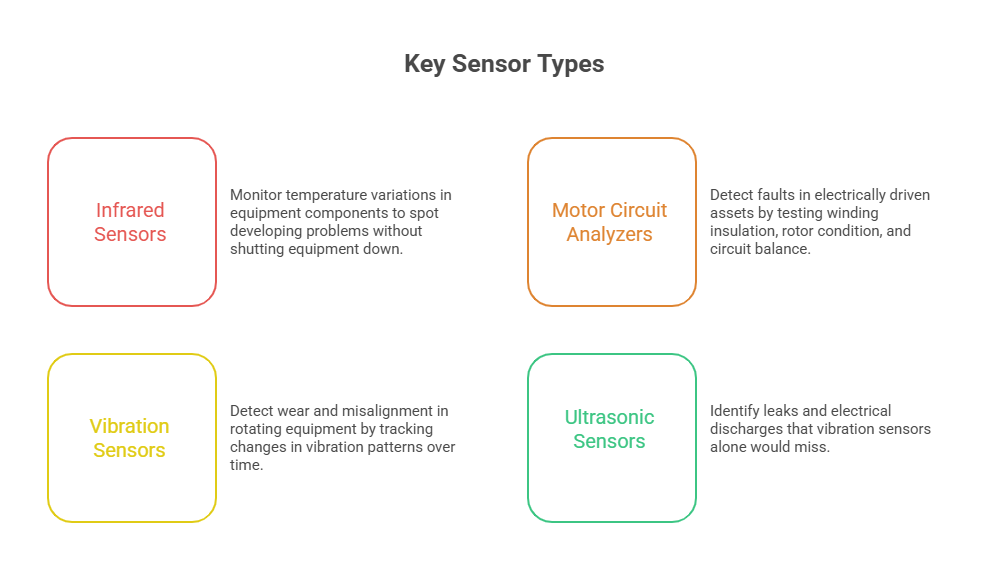
Infrared sensors monitor temperature variations in equipment components, which makes infrared analysis one of the fastest ways to spot a developing problem without shutting equipment down. Electrical panels, motor windings, bearing housings, and other mechanical components are common targets, since overheating in any of these usually precedes a failure by days or weeks. Thermal data integrates cleanly with the platforms above because it is easy to timestamp and correlate with other sensor readings from the same asset.The tool matters less than whether it can read your historian and write a work order into your CMMS. We run vendor selection against your actual data and integration constraints.
Choose a PdM stack that fits your existing systems
Motor circuit analyzer tools detect faults in electrically driven assets by testing winding insulation, rotor condition, and circuit balance, catching electrical degradation long before it causes a mechanical failure. Facilities with large motor fleets often deploy handheld motor circuit analyzers as part of a routine inspection round, feeding the results back into the same predictive maintenance platform that tracks vibration and thermal data. This matters specifically for motor-heavy operations, where an undetected electrical fault can escalate into a full motor replacement instead of a targeted repair.
Vibration analysis sensors detect wear and misalignment in rotating equipment by tracking changes in vibration patterns over time, which is why platforms built around rotating assets, such as Augury and Tractian, lead with this sensor type. Ultrasonic sensors complement vibration data by identifying leaks and electrical discharges that vibration alone would miss. Placement matters: sensors mounted too far from the bearing or coupling point produce noisy readings that undermine the software's ability to distinguish a real fault from normal operating variation.
The analytics layer inside a predictive maintenance tool typically relies on supervised or unsupervised machine learning, and the distinction matters for how much historical data a team needs before the system becomes useful. Supervised models train on labeled failure events, which means they need historical maintenance records showing what a failure looked like before it happened; they tend to be more accurate once trained but need more setup data. Unsupervised models detect anomalies without labeled failure history, which makes them useful from day one but generally noisier until the system has seen enough normal operating data to establish a reliable baseline.
AI algorithms analyze sensor data to detect anomalies, and machine learning analyzes historical data to forecast failures with increasing accuracy as more examples accumulate. In the more advanced platforms, the software goes further and analyzes telemetry for micro-anomalies, small deviations that would not trigger a simple threshold alert but that the model has learned to associate with early degradation. Reducing false positives is the practical measure of whether a model is working: a platform that floods technicians with false alarms gets ignored regardless of its underlying accuracy, so validating predictive models against historical maintenance records and retraining them on a regular cadence, typically quarterly for high-value assets, keeps the system credible with the maintenance team that has to act on its alerts.
For a deeper look at how these models are built and validated, see our guide to predictive maintenance and machine learning.
Implementing predictive maintenance well has less to do with the tool and more to do with sequencing. Regardless of which platform a team selects, the rollout tends to follow the same steps, and this is where InTechHouse adds value no matter which platform ends up on the shortlist. Getting the sequence right also protects day-to-day maintenance operations from disruption during the rollout itself.
Start with a pilot on critical equipment rather than a plant-wide rollout. Choosing two or three high-value assets keeps the scope manageable and gives the maintenance team a clear before-and-after comparison. From there, instrument those assets for targeted data collection, matching sensor types to the failure modes that matter most for each asset rather than deploying every sensor category everywhere. Once condition data is flowing, integrate the resulting insights into existing maintenance-management workflows so alerts become work orders automatically instead of another dashboard someone has to remember to check. Finally, track asset performance and mean time between failures (MTBF) improvements against the pilot's baseline, since that comparison is what justifies expanding the program beyond the initial assets.
Related reading: IoT and predictive maintenance and industrial DataOps.
No predictive maintenance tool overcomes bad data, which is why data readiness deserves attention before a platform selection, not after. Start by auditing sensor and work order data completeness: gaps in either one limit what any model can learn. Historical maintenance records need cleaning before they can support modeling, since inconsistent failure codes and missing timestamps quietly degrade prediction accuracy. Teams also need to define an ingestion and storage architecture upfront, covering where sensor data lands, how long it is retained, and who can access it, along with time-series retention policies that balance storage cost against the historical depth the analytics layer needs for further analysis.
Read also:
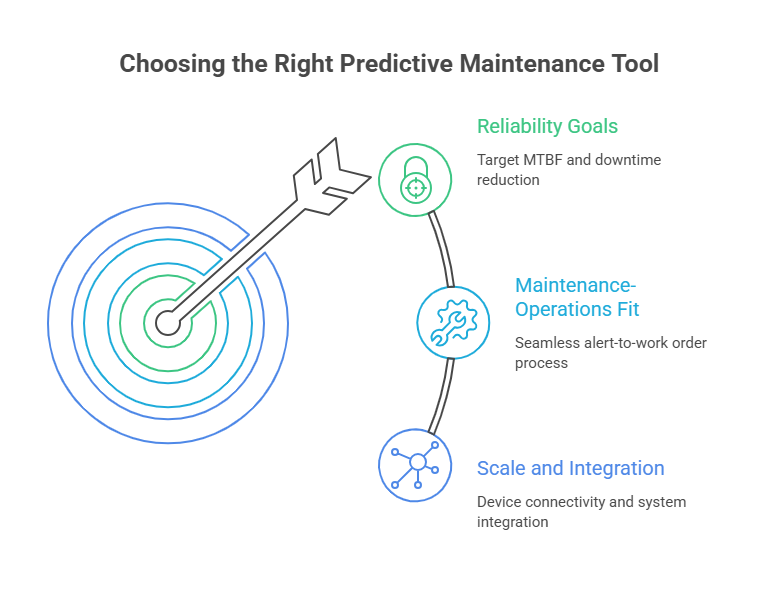
Three factors should drive the final decision, in this order.
First, scale and integration: how many devices need to be connected, and how deeply does the tool need to integrate with your existing ERP and CMMS? A single-site operation with a modest device count does not need IBM Maximo's enterprise asset management depth, and a multi-site enterprise with strict compliance requirements usually cannot get by on a lightweight condition-monitoring product alone.
Second, maintenance-operations fit: how fast does an alert become a work order, and how much of that path is automated versus manual? A platform with excellent analytics but a clunky handoff to the maintenance team's actual workflow will underperform a simpler tool that integrates cleanly.
Third, reliability goals: what MTBF improvement are you targeting, and does the expected downtime reduction justify the tool's cost? Facilities relying primarily on predictive maintenance reported 87.3% fewer defects than facilities relying mainly on preventive maintenance, and separate DOE Federal Energy Management Program research puts equipment uptime gains from predictive maintenance in the 10% to 20% range. Those figures are useful for building a business case, but they describe averages across many facilities, not a guarantee for any specific asset.
Here is the honest meta-point: the tool is only half the job. Integration work, data pipeline architecture, and the discipline to keep sensor coverage current decide whether a predictive maintenance program actually reduces downtime. That is exactly where an independent implementation partner, one with no incentive to push a particular vendor's licensing tier, earns its keep.
The tool is only half the job - the other half is wiring it into your sensors, CMMS, and maintenance workflows. That integration layer is what our predictive maintenance services cover, regardless of which platform you land on.
The seven predictive maintenance solutions above cover most buying scenarios, but the decision still comes down to your own asset mix and existing systems. For large enterprises that need enterprise asset management depth and compliance-grade audit trails, IBM Maximo remains the strongest fit. For teams building digital twin projects or custom edge analytics, PTC ThingWorx gives the most flexibility. For organizations standardized on Microsoft's cloud stack that need scalable machine learning, Azure IoT and Digital Twins integrate most cleanly with what they already run. For heavy telemetry workloads across many sites, AWS IoT SiteWise handles scale well, particularly with its native anomaly detection feature. For teams that want rapid, sensor-driven deployment without assembling hardware and software separately, Tractian is the fastest path to a working pilot. For rotating-equipment diagnostics specifically, Augury's acoustic and vibration analytics lead the category. For maintenance-management simplicity with predictive features layered on top, Fiix fits midmarket teams best.
A public transport manufacturer needed to monitor a fleet of production-line assets where no off-the-shelf predictive maintenance tool matched the combination of legacy PLC data, third-party vibration sensors already installed on the floor, and a CMMS the maintenance team was not willing to replace. InTechHouse ran a vendor-neutral evaluation against the client's actual sensor inventory and integration constraints, then built a custom data pipeline that normalized OT data from the existing sensors and legacy controllers into a unified data model, rather than forcing a rip-and-replace of working hardware. The pipeline fed a machine learning layer for anomaly detection and pushed resulting alerts directly into the client's existing CMMS as work orders, closing the loop between detection and action. The result was a measurable reduction in unplanned maintenance events on the monitored assets, achieved without replacing the client's existing sensor investment or maintenance-management system.
Start with a focused pilot on critical equipment, measure the results against a clear baseline, and expand based on what the data actually shows rather than the vendor's roadmap. The tools compared here are all capable of delivering timely maintenance and real data driven insights, but the platform is never the whole answer. Talk to InTechHouse about selecting and integrating the right predictive maintenance stack for your assets, or explore our industrial data platforms and OT/IT integration services if data readiness, not tool selection, is your actual bottleneck.
Buying the platform is the easy half. We build the sensor coverage, data pipeline and CMMS integration that decide whether the tool actually reduces downtime.
Get the integration work done properly
Not sure where to start? We work with companies at every stage, from early ideas to enterprise-level builds. A 30-minute call can save you months of guesswork.
Predictive maintenance tools are software platforms, often paired with condition-monitoring sensors, that analyze equipment data to forecast failures before they happen. They combine sensor data collection, analytics or machine learning, and maintenance-management features to turn an early warning into a scheduled repair instead of an unplanned breakdown.
There is no single best predictive maintenance software; the right choice depends on your asset scale and existing systems. Enterprises with large, diverse asset estates tend to fit IBM Maximo, cloud-native teams fit Azure IoT or AWS IoT SiteWise, and teams wanting a turnkey product fit Tractian or Augury.
It depends on the vendor. Some predictive maintenance platforms, such as Tractian and Augury, bundle their own sensors with the software for a turnkey deployment. Others, including IBM Maximo, PTC ThingWorx, Azure IoT, and AWS IoT SiteWise, are software and cloud platforms that ingest data from whatever sensors you already have or choose to install separately.
Predictive maintenance tools integrate with a CMMS by pushing failure alerts and estimated time-to-failure data into the CMMS as work orders, usually through an API connection. The strength of this integration varies by vendor: CMMS-first tools like Fiix have this built in natively, while analytics-first platforms may need custom integration work to close the loop between detection and action.
Buying an off-the-shelf tool is faster and lower-risk when your sensor mix and asset types match what the vendor already supports well. Building custom, typically on a platform like PTC ThingWorx or a cloud IoT stack, makes more sense when you have legacy equipment, non-standard sensors, or an existing CMMS the vendor's tool cannot integrate with cleanly, since a custom pipeline can normalize that data instead of forcing a hardware or software replacement.
Tomasz Andrysiak, DSc, PhD, is a Expert and a Professor at Bydgoszcz University of Science and Technology. He has more than 30 years of academic, research, R&D, and technology-implementation experience in artificial intelligence, computational intelligence, signal processing, anomaly detection, cybersecurity, and complex information systems.
His research focuses on machine-learning and computational-intelligence methods for analyzing signals, time series, network traffic, industrial data, and multimodal datasets. He specializes in anomaly and failure detection, predictive modeling, intelligent monitoring, critical-infrastructure security, smart metering, biomedical signal analysis, and the practical deployment of AI in industrial and public-sector systems.
Tomasz is the author or co-author of more than 75 scientific publications, including papers published in internationally recognized journals and conference proceedings indexed by Web of Science and Scopus. His research has covered network anomaly detection, cybersecurity of critical infrastructure, ECG signal analysis, machine learning, smart water networks, telecommunications, and intelligent industrial systems.
He has led and contributed to national and European R&D programs focused on cyber situational awareness, critical-infrastructure resilience, autonomous systems, Big Data, intelligent water management, blockchain-based transaction platforms, and industrial AI. He leads industrial-doctorate projects involving AI-based CMDB automation and machine-learning methods for knowledge discovery in Big Data.
Tomasz is an IEEE Senior Member and has served as an elected member of the Commission of Informatics and Automation of the Polish Academy of Sciences, Poznań Branch. He has participated in scientific committees and journal boards, supervised doctoral research, reviewed publications for international journals, and co-authored patents and patent applications related to signal detection and LoRa-based ECG monitoring. He writes about industrial AI, machine learning, anomaly detection, predictive analytics, cybersecurity, signal processing, time-series analysis, and intelligent infrastructure.
Tomasz Andrysiak's academic profiles:
https://link.springer.com/chapter/10.1007/978-3-642-32384-3_28
https://www.researchgate.net/profile/Tomasz-Andrysiak
https://scholar.google.com/citations?user=RHW7zx4AAAAJ&hl=pl
https://dblp.org/pid/41/6793.html
https://radon.nauka.gov.pl/dane/profil/6FFA1E51186802ECFFB49644209B5BE0EBD68C55
https://pbs.edu.pl/pl/pracownik/tomasz-andrysiak
https://www.youtube.com/watch?v=6e1GTqT5czM
This initial conversation is focused on understanding your product, technical challenges, and constraints.
No sales pitch - just a practical discussion with experienced engineers.
Share a few details about your product and context. We’ll review the information and suggest the most appropriate next step.