
IoT predictive maintenance uses internet-connected sensors to continuously monitor equipment health and feed data to analytics that predict failures before they happen, so repairs are scheduled just in time instead of after a breakdown. That is a fundamentally different model from preventive maintenance, which performs scheduled maintenance on a fixed calendar regardless of actual condition and often replaces parts that still had useful life left. This guide focuses on the IoT layer specifically: the sensors, the connectivity that gets their data to analytics, and how to implement the whole stack without letting any single piece become the bottleneck. Used well, iot based predictive maintenance improves operational efficiency and asset uptime at the same time it lowers cost.
IoT sensors continuously monitor equipment health in real time, catching the early warning signs, a temperature creeping upward, a vibration pattern shifting, that precede most mechanical failures by days or weeks. Machine health monitoring built this way uses real time data and historical baselines together to detect anomalies well before the failure would otherwise become visible to a technician doing a routine walkthrough.
That lead time is what prevents catastrophic failures. A bearing that would have seized mid-shift instead gets flagged early enough to schedule the repair during planned downtime, at a fraction of the cost and disruption of an unplanned stop. Avoiding even a single hour of halted production can save thousands of dollars, and continuous real-time monitoring extends equipment lifespan in the process, since catching wear early prevents it from cascading into damage to adjacent components.
Implementing IoT predictive maintenance requires a systematic shift from reactive maintenance, not just new hardware bolted onto old habits. Teams that succeed treat the sensor data as the primary signal for when to act, rather than falling back on the old maintenance calendar out of habit whenever the dashboard goes quiet.
Everything downstream depends on getting this layer right, so it deserves real attention rather than being treated as a commodity hardware purchase.
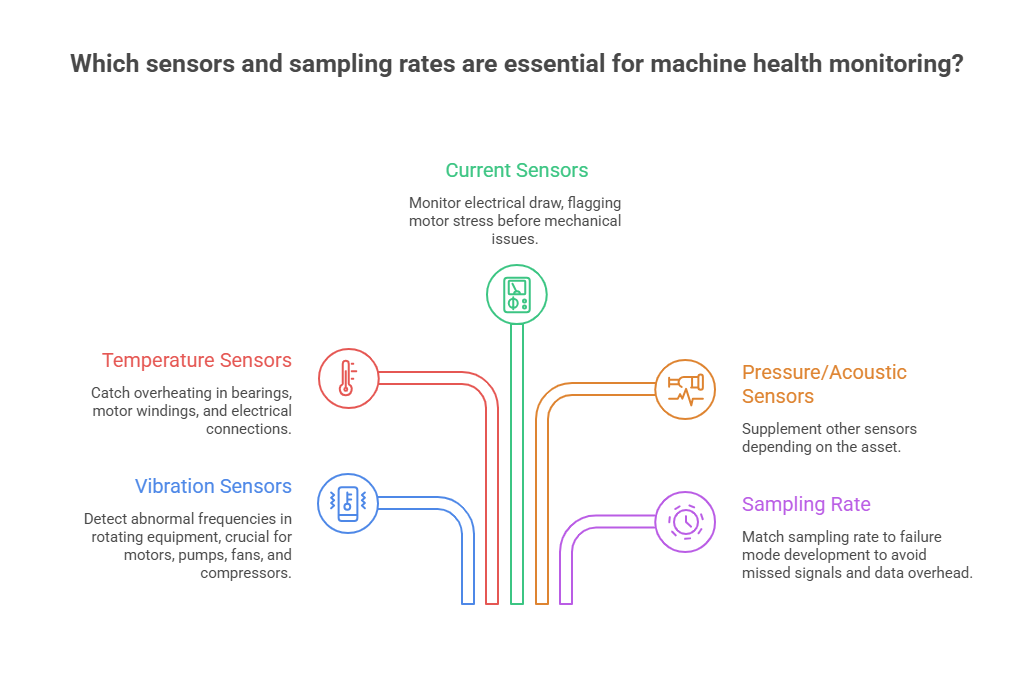
The essential sensor types for most industrial equipment are vibration, temperature, and current sensors, often supplemented with pressure or acoustic sensors depending on the asset. Vibration sensors detect abnormal frequencies in rotating equipment, which makes them the primary sensor for motors, pumps, fans, and compressors. Temperature sensors catch overheating in bearings, motor windings, and electrical connections. Current sensors monitor electrical draw, flagging motor stress before it shows up mechanically.
Sampling rate matters as much as sensor choice. Vibration data needs to be sampled fast, often in the kilohertz range, to capture the frequency signatures that distinguish a healthy bearing from a failing one. Temperature changes develop much more slowly, so sampling once every few minutes is usually sufficient and keeps data volume manageable. Matching sampling rate to how quickly each failure mode actually develops avoids both missed signals and unnecessary data overhead.
Collecting high-quality data is essential for reliable models further down the pipeline; smart sensors with built-in signal processing can pre-filter noise at the source, reducing the burden on the analytics layer and improving the data collection that feeds it. For the broader architecture connecting these sensors together, see our guide to industrial IoT architecture.
This is the plumbing that gets sensor data from the equipment floor to wherever it gets analyzed, and it deserves as much design attention as the sensors themselves.
Internet connected sensors typically transmit through an industrial protocol, such as MQTT or OPC-UA, to a local gateway, which then forwards the data onward. Secure data collection matters at every hop in that chain: authentication on the sensor-to-gateway link, encryption in transit, and access controls on whatever system receives the data. A predictive maintenance stack with weak security is a liability, not just an inconvenience, since it exposes plant operational data and creates a path into production networks.
Real time sensor data is transmitted to a centralized system, typically cloud storage, where it becomes accessible to the analytics layer and to anyone on the maintenance team who needs to review it. Central cloud data storage enables easy access across sites and teams, and it simplifies the retraining pipelines that predictive models depend on, since historical data gathered from every connected asset lives in one place rather than scattered across local historians. For the data-layer architecture underneath this, see our guide to industrial DataOps.
Predictive maintenance uses machine learning for anomaly detection, and the choice of model type depends on how much labeled failure history exists for the asset in question, a decision covered step by step in our guide to predictive maintenance with machine learning. Unsupervised models establish a baseline of normal behavior and flag deviations, which works well when failure examples are scarce. Supervised machine learning models, trained on labeled failure events, classify specific failure types once enough historical examples exist to train them reliably.
Feature engineering for the resulting time-series data typically involves computing rolling statistics, frequency-domain features extracted from vibration signals, and rate-of-change indicators that catch a developing trend before it crosses a hard threshold. Anomaly-detection methods range from simple statistical thresholds to more sophisticated multivariate models that catch subtle combinations of readings a single-sensor threshold would miss entirely.
Machine learning improves accuracy over time only if the retraining pipeline actually incorporates new data. A model deployed once and never updated degrades as equipment ages and operating conditions shift, so continuous retraining on a defined cadence, incorporating confirmed failures and false positives alike, keeps data analysis identifying anomalies reliably rather than drifting out of step with the asset it monitors. For the modeling detail behind remaining-useful-life predictions, see our guide to RUL estimation, and for how these models get deployed and maintained in production, see our guide to edge MLOps.
Read also:
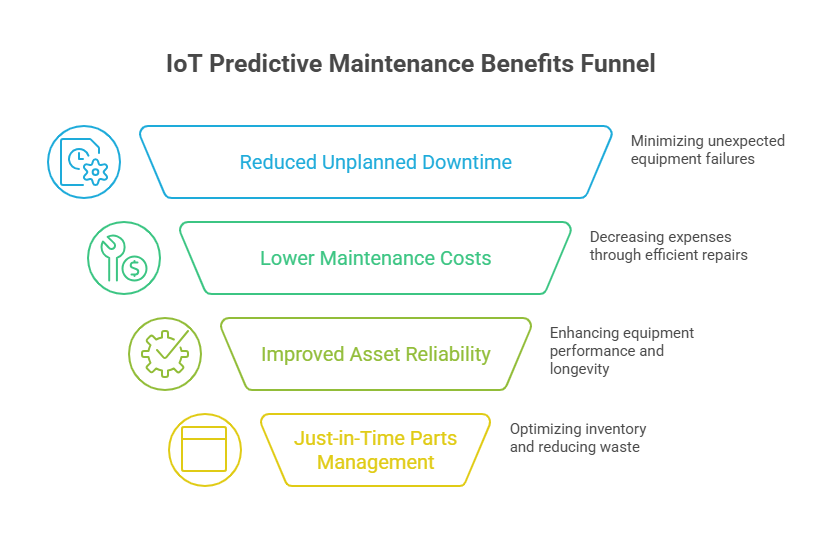
The benefits case for IoT predictive maintenance rests on a combination of quantified cost savings and reliability gains that compound over time, and the clearest headline is that it can reduce unplanned downtime while it lowers spend.
On cost, predictive maintenance reduces overall maintenance costs by 18% to 31% compared to traditional methods (IBM), driven by fewer emergency repairs, less unnecessary preventive servicing, and lower parts spend from catching problems before they cascade into secondary damage and costly repairs. Adoption reflects that payoff: 62% of field service teams currently use AI for predictive maintenance (Salesforce), which puts it well past the early-adopter phase in most industries.
Asset reliability improves through the same mechanism from a different angle. Continuous condition monitoring means equipment gets attention proportional to its actual state rather than a generic calendar, which keeps an asset's performance closer to its designed envelope. That shows up in equipment performance metrics as fewer unplanned stops, more predictable maintenance windows, and equipment that stays in service longer between major overhauls.
IoT predictive maintenance also enables just-in-time spare-parts management, since knowing which component is likely to need replacement, and roughly when, lets a maintenance team order the part ahead of the repair instead of stocking excess inventory against every possible failure. The combined effect is higher asset utilization and productivity, plus proactive repairs that reduce the emergency-response costs, rushed shipping, overtime labor, production stoppages, that make unplanned downtime so expensive in the first place.
IoT predictive maintenance applies well beyond a single manufacturing floor, and the specific sensors and failure modes shift meaningfully by industry.
| Industry | Typical Assets Monitored | Primary Sensor Focus |
|---|---|---|
| Manufacturing | Motors, pumps, compressors, CNC machinery | Vibration, temperature, current |
| Fleet Management | Delivery trucks, last-mile vehicles | Engine telemetry, tire pressure, brake wear |
| Utilities | Turbines, transformers, substations | Vibration, thermal imaging, oil analysis |
| Healthcare | Imaging equipment, HVAC, sterilization systems | Temperature, usage cycles, vibration |
In manufacturing, the manufacturing industry instruments industrial equipment on a production line for vibration and thermal signatures, with alerts routed directly into the plant's CMMS. In fleet management, connected trucks stream engine and brake telemetry back to a central platform, letting a fleet manager schedule service before a vehicle breaks down on a delivery route rather than after. In the utilities industry, utility providers monitor turbines and transformers for the rotating equipment failure modes that would otherwise cause an unplanned outage across a wider grid segment. In healthcare, hospitals apply the same sensor logic to imaging equipment and HVAC systems, where an unplanned failure has consequences well beyond cost.
For the manufacturing-specific deep dive, see our guide to predictive maintenance in manufacturing, and for oil and gas specifically, see our guide to predictive maintenance in oil and gas.
Instrumenting an entire facility is how PdM budgets disappear. We help you rank assets by past downtime and build the sensor, connectivity and analytics stack around the few that matter.
Start with your highest-downtime assets
The rollout sequence for IoT predictive maintenance follows a consistent path regardless of industry.
Start by identifying high-criticality pilot assets, ranked by past downtime and the cost of a failure, rather than by which equipment is easiest to instrument. Plan the sensor deployment around the specific failure modes those assets are prone to, then design the connectivity architecture: gateway placement, protocol choice, and network segmentation for security. Set up secure data collection before any sensor goes live, not as an afterthought once data starts flowing. Configure the cloud-ingestion pipelines to land that data somewhere the analytics layer can actually use it, then integrate the resulting predictive maintenance program into the CMMS software the maintenance team already uses so alerts become work that gets you to schedule maintenance rather than another dashboard. Define performance indicators for machine health and cost savings from the start, so the pilot has a clear basis for the go or no-go decision on scaling further, and build maintenance scheduling logic that respects technician availability, not just the model's ideal repair window.
Integrating predictive maintenance with existing maintenance workflows is what enables proactive responses in practice; a technically sound sensor and analytics stack that never reaches a work order changes nothing on the shop floor. For the full manufacturing program roadmap, including tool selection, see our guide to step-by-step predictive maintenance implementation.
Reporting the business case in numbers that matter to stakeholders means tracking a small set of KPIs consistently rather than a large dashboard nobody checks.
| KPI | What It Measures | Why It Matters |
|---|---|---|
| Mean Time Between Failures (MTBF) | Average operating time between unplanned failures | Rising MTBF is the clearest sign the program is working |
| Total Downtime Reduction | Unplanned downtime hours compared to a pre-program baseline | Directly ties to the avoided-cost side of the business case |
| Maintenance Cost Per Asset | Total maintenance spend divided by monitored assets | Shows whether lower maintenance costs are materializing in practice |
| Alert-to-Work-Order Latency | Time between an analytics alert and a scheduled repair | Measures whether the CMMS integration is actually closing the loop |
Calculate total cost savings by comparing maintenance costs and downtime-related losses before and after the pilot, rather than relying on industry averages alone; your own facility's numbers make a far stronger case to stakeholders than a general benchmark. Track MTBF and total downtime reduction on a rolling basis, and report the resulting asset-performance improvements in the same terms operations leadership already uses, since a maintenance-specific metric that never reaches a business review does not help secure budget for the next phase.
IoT deployments fail on data quality and security far more often than on the sophistication of the models involved, which is why both deserve attention before scaling past a pilot.
Sensor data-quality issues show up as gaps, drift, and noisy readings, and they compound quickly across a large sensor fleet if nobody owns monitoring the sensors themselves. Build in a way to handle missing telemetry gracefully, whether through interpolation for short gaps or explicit flagging so the analytics layer does not silently treat a data outage as a stable reading. Cybersecurity controls for IoT deployments need to be part of the initial design, including network segmentation between operational and IT systems, since an unsecured sensor network is an entry point regardless of how good the predictive models running on top of it are.
Effective predictive maintenance also depends on cross-team workflows between the group that owns the equipment data and the maintenance team that has to act on it. Service teams that get read-only dashboards but no say in threshold-setting tend to disengage from the program, while teams brought in during the pilot to help tune alerts stay invested once the system scales. Monitor equipment continuously, not just during the pilot window, since data quality tends to degrade quietly over months as sensors age or get moved without anyone updating the system.
Edge computing enables real-time decisions near the asset, running inference directly on a local gateway or embedded device rather than sending every reading to the cloud for a decision. That matters most for machine health scenarios where a delayed response defeats the purpose, catching a fast-developing electrical fault, for instance, where a round trip to a distant cloud region adds risk the local decision does not need to carry.
Digital twins extend this further by simulating asset degradation over time, letting engineering teams test how a component is likely to behave under different operating conditions before committing to a maintenance strategy for it. Paired with continuing advances in predictive analytics, the direction of travel is toward systems that predict further ahead, with fewer false alarms, using iot technologies that need less manual tuning to optimize operations than the first generation of predictive maintenance platforms required.
InTechHouse case study: an IoT predictive maintenance stack for a manufacturing client
A manufacturing client needed continuous monitoring across a fleet of production-critical motors and pumps after several unplanned failures disrupted output on a tight delivery schedule. InTechHouse designed and deployed the full stack: vibration and temperature sensors on each critical asset, an MQTT-based edge gateway for secure local data collection, and a cloud ingestion pipeline landing the resulting telemetry in a time-series data store. An unsupervised anomaly-detection model, trained on the client's historical sensor and maintenance-log data, scored incoming readings on a scheduled basis and pushed flagged assets directly into the client's CMMS as prioritized work orders. Within the first months of full deployment, the client recorded a measurable reduction in unplanned downtime on the monitored assets, achieved without disrupting production during the sensor rollout itself.
(Details anonymized per NDA. Confirm specifics with the production owner before external publication.)
Start small: pick one pilot asset with a clear downtime history, instrument it properly, and prove the model against that asset's own failure record before expanding further. A short checklist for scaling from there: confirm data quality on the pilot asset, validate that alerts are reaching the CMMS as work orders, review the KPIs against the pilot's business case, and only then extend sensor deployment to the next tier of critical assets. Predictive maintenance solutions succeed when the IoT layer, the analytics, and the maintenance workflow all move together, not when any one piece gets built in isolation. Talk to InTechHouse about deploying an IoT predictive maintenance stack for your assets, or explore our industrial data platforms and OT/IT integration services for the connectivity and data layer underneath it. The pilot asset is also the right place to settle data quality rules, since industrial data platform development is far easier on one well-understood machine than across a whole site.
Deployments usually fail on data quality and security rather than model accuracy, so that is where our implementation starts. Ask us to review your pilot plan.
See how we deliver predictive maintenance
Not sure where to start? We work with companies at every stage, from early ideas to enterprise-level builds. A 30-minute call can save you months of guesswork.
IoT predictive maintenance uses internet-connected sensors to continuously monitor equipment condition and feed that data to analytics that predict failures before they happen. It replaces fixed maintenance schedules and reactive repairs with condition-based servicing, scheduling repairs only when the data indicates they are actually needed.
The core sensor types are vibration sensors for rotating equipment, temperature sensors for overheating and thermal stress, and current sensors for electrical draw. Depending on the asset, pressure sensors and acoustic sensors are often added to catch leaks, cavitation, or electrical discharges that the core three sensor types would miss.
Preventive maintenance services equipment on a fixed schedule regardless of its actual condition, while IoT predictive maintenance uses continuous sensor data to service equipment only when its condition indicates it needs attention. This distinction is what drives most of the cost savings, since preventive maintenance often replaces parts that still had useful life left, while predictive maintenance catches problems closer to when they actually develop.
Predictive maintenance reduces overall maintenance costs by 18% to 31% compared to traditional methods, according to IBM, with the exact savings depending on asset type, current maintenance practices, and program maturity. Beyond direct cost reduction, avoiding even a single hour of unplanned downtime can save thousands of dollars, which is often the larger financial driver behind the business case.
Implementation starts with identifying high-criticality pilot assets ranked by past downtime, then deploying sensors, designing secure connectivity and cloud-ingestion pipelines, and integrating the resulting analytics into the CMMS so alerts become scheduled work orders. Defining clear KPIs for machine health and cost savings from the start makes it possible to prove the pilot's value before expanding the deployment further.
Damian Ledziński, PhD Eng., is an Applied Artificial Intelligence Expert and an Assistant Professor at Bydgoszcz University of Science and Technology. He has over 15 years of academic, research, software-engineering, and technology-development experience.
His work focuses on applying artificial intelligence, machine learning, deep neural networks, and data science to complex real-world systems. His principal research and engineering interests include autonomous unmanned aerial vehicles, drone navigation and swarm intelligence, biomedical engineering, medical signal and image analysis, predictive modeling, industrial IoT, and intelligent water-management systems.
Damian has contributed to multidisciplinary R&D initiatives including AI-assisted medical diagnostics, a Polish ventilator prototype, autonomous indoor drone systems for warehouse inventory, AI-supported water-consumption analysis, virtual medical assistants, and intelligent systems combining embedded devices with machine-learning models.
He is the author or co-author of more than 30 scientific publications. His work has appeared in international scientific publications covering artificial intelligence, biomedical engineering, signal analysis, autonomous systems, environmental monitoring, and data-driven infrastructure.
Damian is a co-creator of academic programs in Engineering in Medicine, AI in Medicine, and Data Science at Bydgoszcz University of Science and Technology. He combines scientific research with hands-on implementation, translating experimental AI methods into deployable technology. He writes about applied AI, machine learning, predictive analytics, autonomous UAV systems, AI in medicine, biomedical signal processing, industrial IoT, and intelligent models in real-world systems.
Damian Ledziński's academic profiles:
https://wtie.pbs.edu.pl/pl/pracownik/damian-ledzinski
https://www.researchgate.net/profile/Damian-Ledzinski
https://scholar.google.pl/citations?user=AlQpPB0AAAAJ&hl=pl
https://ludzie.nauka.gov.pl/ln/profiles/DN6pHXU6KZm/publications/f83a8833-6060-4fae-8628-3dbf57661394
This initial conversation is focused on understanding your product, technical challenges, and constraints.
No sales pitch - just a practical discussion with experienced engineers.
Share a few details about your product and context. We’ll review the information and suggest the most appropriate next step.