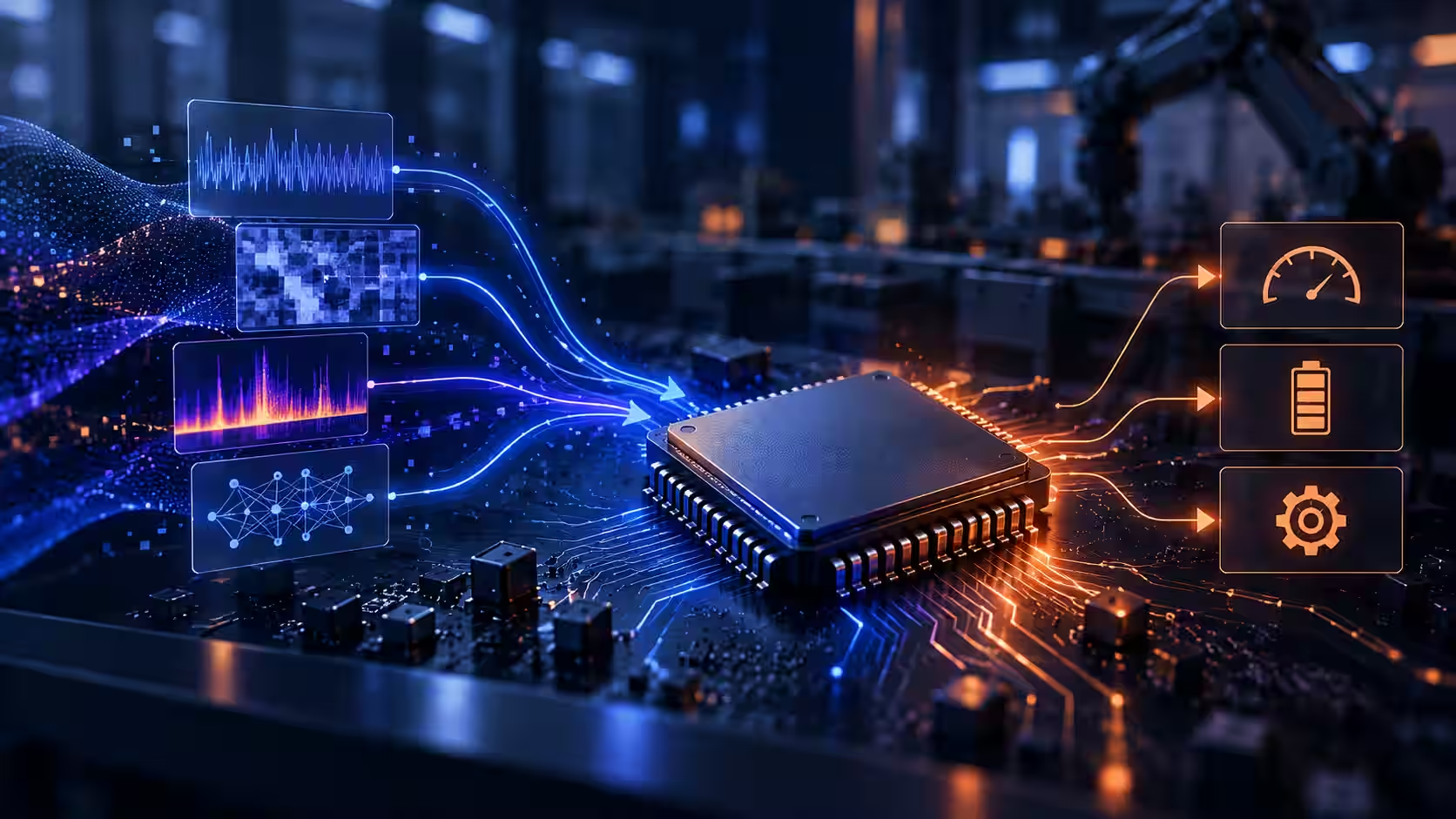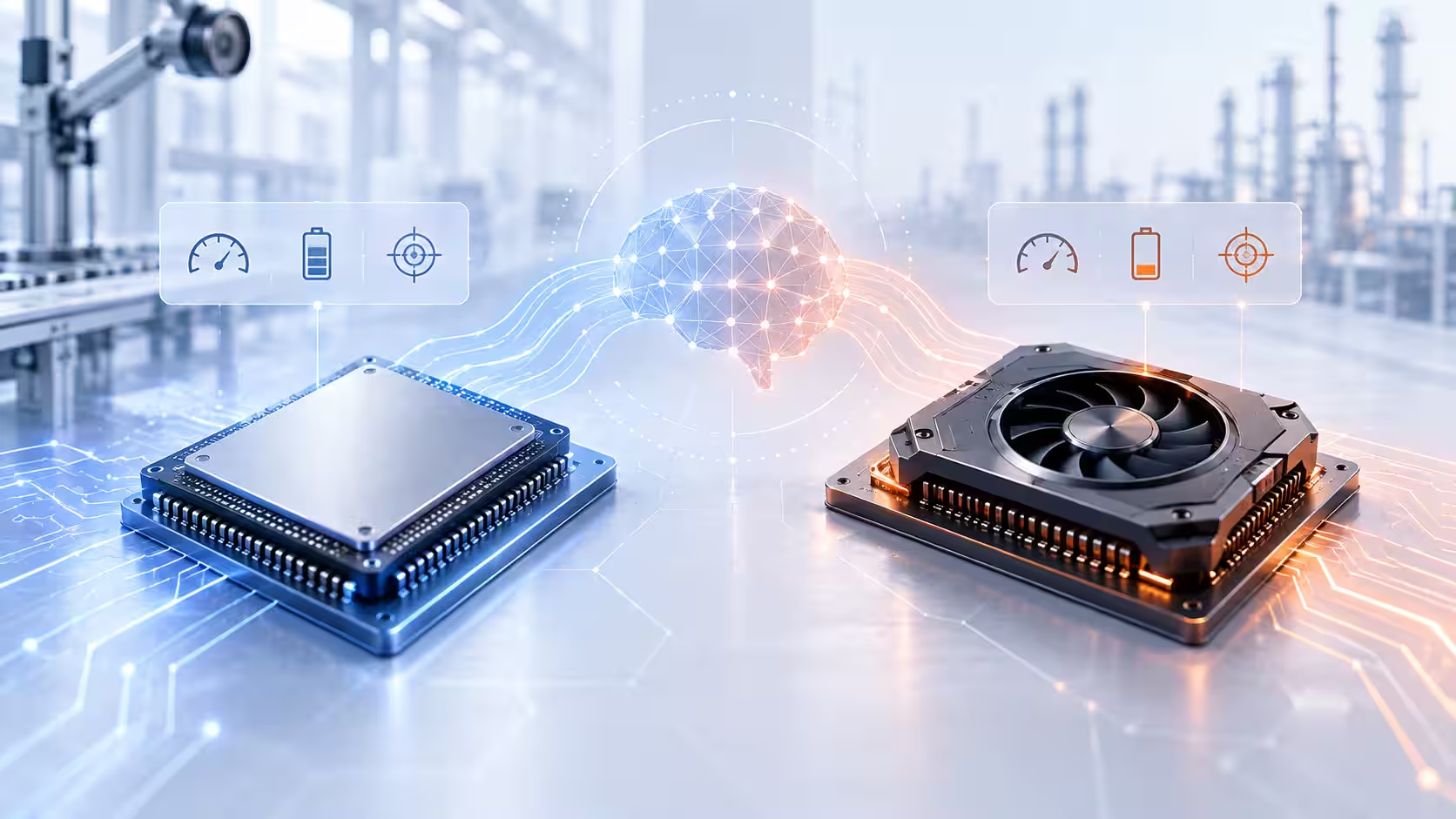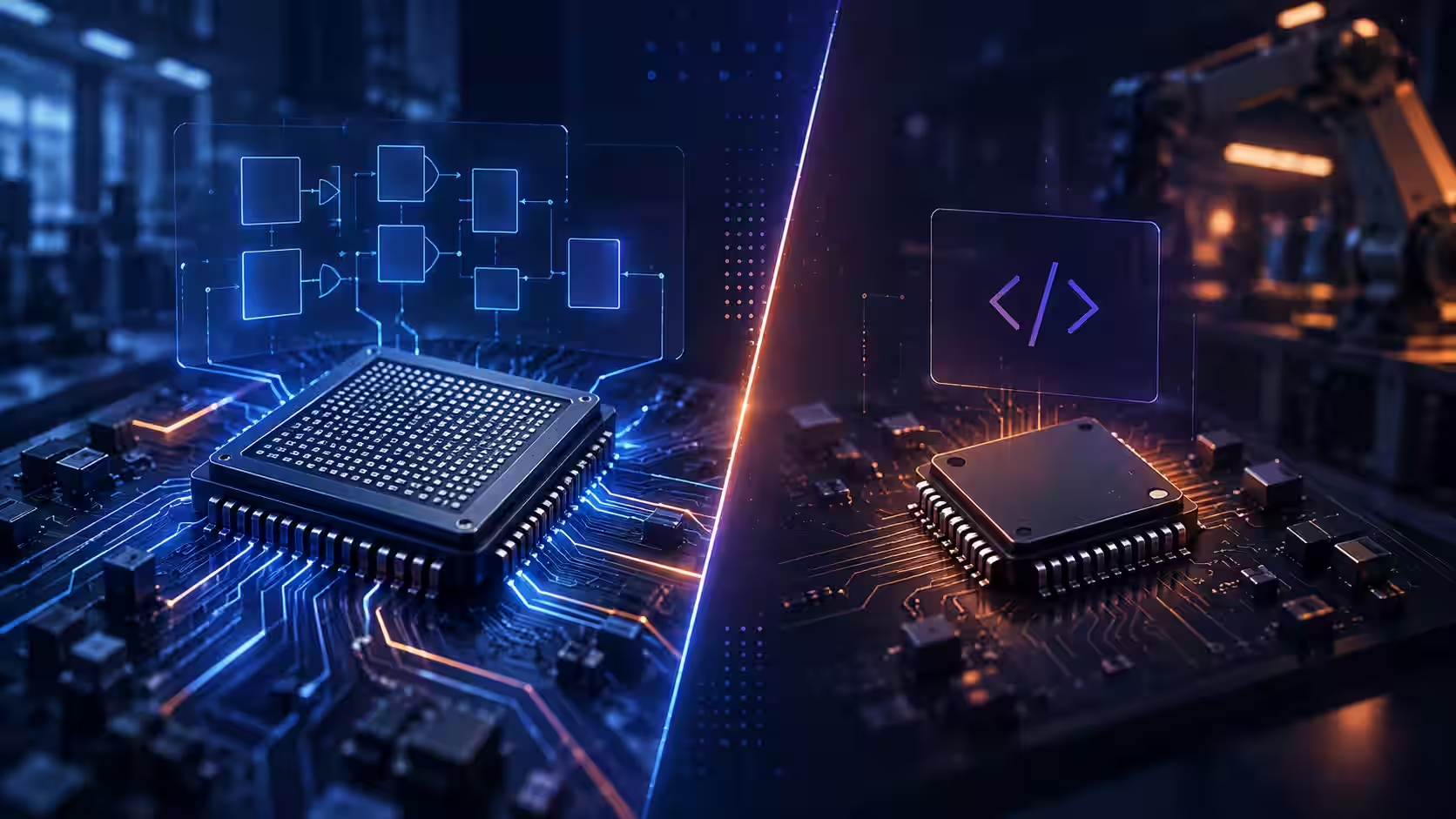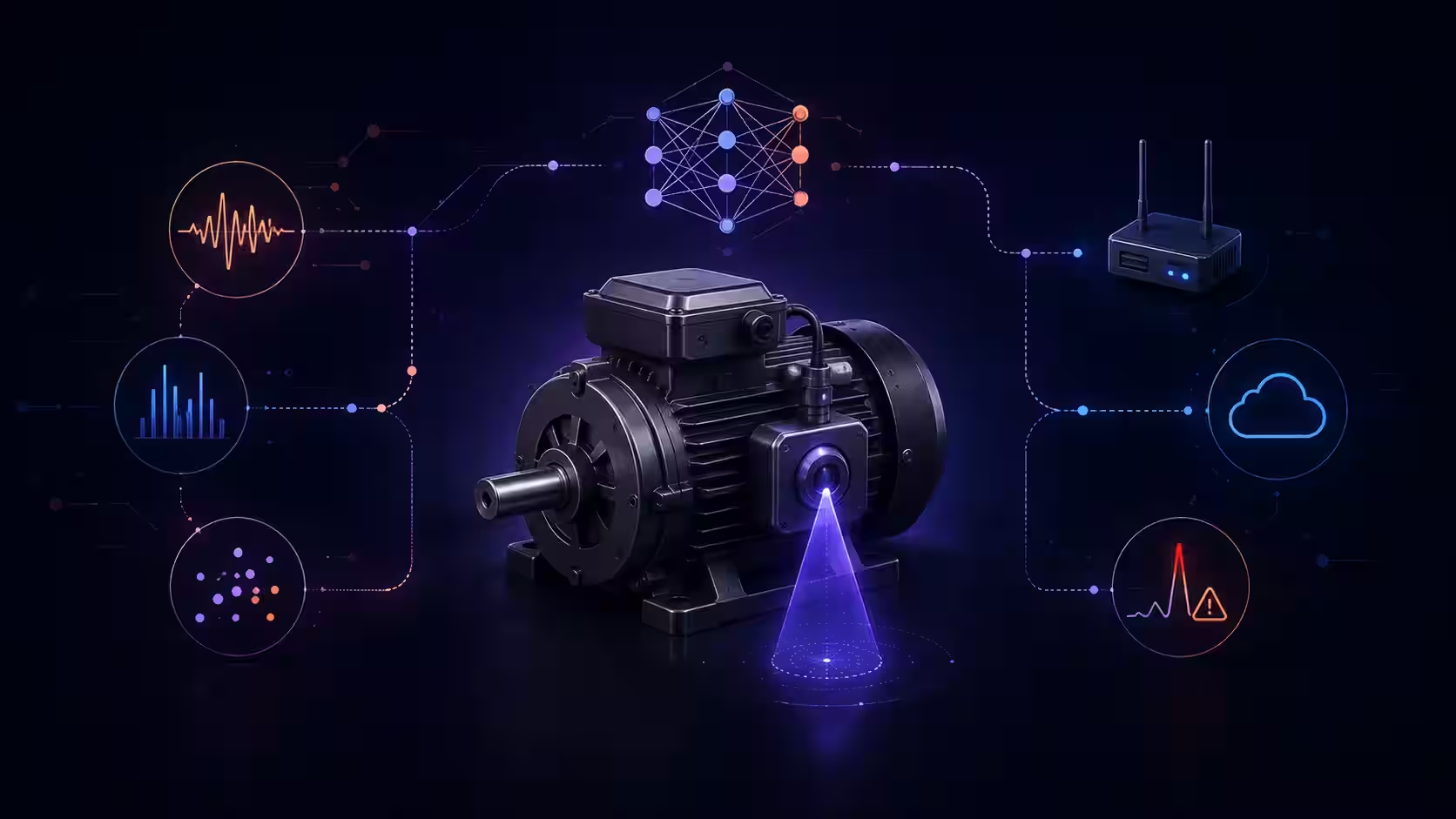
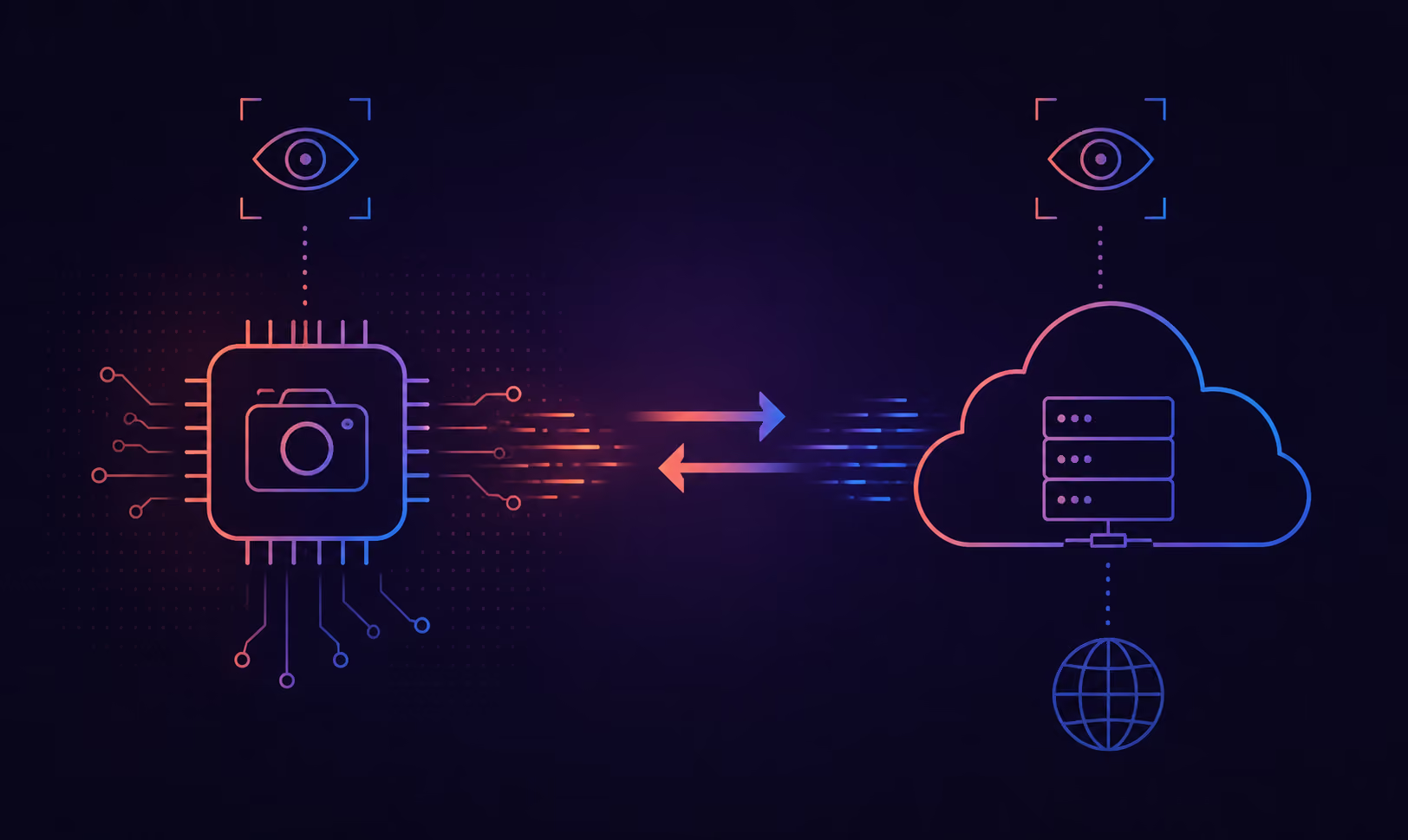
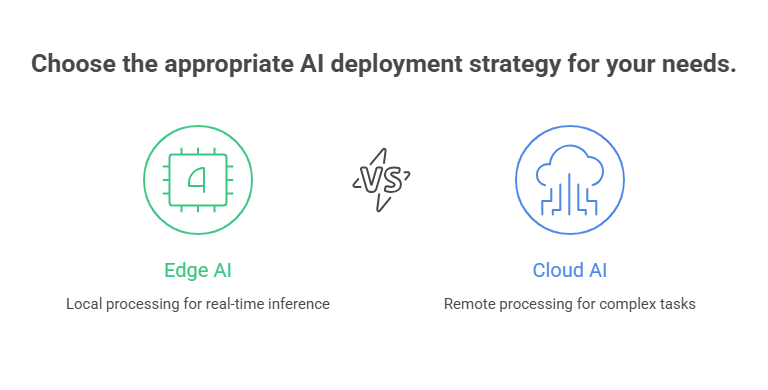
Edge AI runs inference on the device itself for low latency and privacy; cloud AI runs it on remote servers for scale and heavy compute. For real-time computer vision, the latency requirement usually decides it. Real time processing at the device means the answer arrives before the next frame - something a cloud round-trip cannot guarantee. If your system needs to react within a single video frame (under 33 milliseconds at 30 FPS), a cloud round-trip is too slow. If you need to train a foundation model on terabytes of labeled data, the cloud is the right tool. Most production deployments end up using both.
Key Takeaways
Core comparison
Edge AI performs inference directly on the device, while Cloud AI processes data in a remote data center. Typical inference latency for Edge AI is 10–100 milliseconds and deterministic, whereas Cloud AI latency is 50 milliseconds or more and variable. Edge AI has no network dependency and is capable of offline operation, while Cloud AI requires a stable connection. In terms of privacy, Edge AI keeps data on the device, whereas Cloud AI sends data across external networks. Regarding bandwidth cost, Edge AI transmits only insights, while Cloud AI streams raw data. Edge AI is best suited for real-time, safety-critical, and regulated applications, while Cloud AI is best suited for training, batch analytics, and large-scale workloads. Once edge inference proves the right fit for a safety-critical application, edge AI vendor selection becomes the next decision, with certification experience weighing heavily.
If a decision has to land inside a single 33 millisecond frame, a cloud round trip will not get you there. We size the latency budget and pick the edge architecture that meets it.
Check whether your vision system can meet its latency budget
Edge AI processes data locally on devices. Cloud AI relies on remote servers housed in a centralized data center, typically thousands of miles from the device generating the data. That single difference cascades into every other dimension of the comparison.
On edge devices, the compute available is constrained. A typical embedded NPU delivers tens of TOPS (tera-operations per second) within a 5–15W power envelope. Cloud AI offers far greater processing power: a single NVIDIA H100 server node delivers thousands of TOPS, and cloud providers run fleets of them. For complex model training or multi-modal inference on large inputs, that compute advantage is decisive.
The trade-off shows up in connectivity. Cloud AI requires a stable internet connection for every inference call. Every request sends data over the network to a remote server and waits for a response. An edge device operates without that dependency; it runs inference locally regardless of network state.
Data transfer patterns follow the same logic. Cloud AI transmits raw sensor data (often full-resolution video) to remote servers for processing. Edge AI processes data locally and sends only the outputs: a classification result, a bounding box, a confidence score. In a deployment with 100 cameras running 24/7, the difference in data transfer volume is not marginal.
If a decision has to land inside a single 33 millisecond frame, a cloud round trip will not get you there. We size the latency budget and pick the edge architecture that meets it.
Check whether your vision system can meet its latency budget
Leading cloud providers like AWS, Google Cloud, and Azure offer managed AI services (SageMaker, Vertex AI, Azure ML) give teams access to massive computing power on demand, without owning hardware. The cloud's scale is genuinely useful for training complex models: a job that would take weeks on a local GPU cluster can finish overnight on a fleet of cloud TPUs or H100 nodes.
Data centers provide the infrastructure that makes this possible: rack-dense GPU compute, high-speed inter-node networking (InfiniBand, RoCE), and petabyte-scale storage for training datasets. Cloud providers like Google Cloud, AWS, and Azure operate dozens of regional data centers, and proximity to those regions affects inference latency for cloud-based requests.
Cloud AI suits big-data analytics where large volumes of historical data need processing without strict latency requirements, and it provides access to vast computational resources via the internet for teams that cannot justify the capital expenditure of on-premise GPU infrastructure.
An edge AI system typically follows one of two deployment patterns. In the first, a smart camera or sensor acts as a local device, handling all inference on-board and sending only results to a management system. and sends only results to a management system. In the second, an edge server (a ruggedized local compute node) aggregates feeds from multiple cameras, runs inference at higher throughput, and syncs summary data to the cloud at intervals. An edge server that aggregates several feeds is also the natural place to combine different sensor types, the setup behind camera, LiDAR and radar fusion.
Both patterns share the same core property: edge AI can function without internet connectivity. It operates reliably in disconnected or remote environments (tunnels, industrial sites, vehicles in motion) where an internet connection is unavailable or unreliable. Edge devices manage rapid localized tasks (frame-by-frame object detection, anomaly alerting) and sync summary data to the cloud for long-term storage, retraining, and analytics.
Specialized hardware matters here. Dedicated edge AI accelerators (NPUs from Hailo, Google Edge TPU, NVIDIA Jetson, AMD/Xilinx FPGAs) deliver the inference throughput needed for real-time computer vision on embedded hardware within the power and thermal envelopes of IoT devices and embedded systems.That combination of specialized hardware and offline functionality is what makes edge AI viable in environments where a data center is simply not reachable. See our detailed breakdown of edge AI hardware for in-vehicle systems.
This is the decisive dimension for computer vision.
Real time data processing at the device level means inference happens in the same physical location where the sensor generates the frame. Real-time vision at 30 FPS gives each frame 33 milliseconds of total processing budget, from sensor input to action output. That budget includes image capture, preprocessing, the model forward pass, and any post-processing. If the inference call goes to the cloud, network travel time alone consumes most of that budget before inference even begins.
Inference latency measures the delay from input to output of a model's forward pass, which is what practitioners mean by inference speed. On an edge accelerator, that forward pass for a compact detection model typically takes 5–20 ms. On a cloud GPU, the forward pass itself may take 10–30 ms, but the round-trip network overhead adds another 50–500+ ms depending on connection quality. High latency leads to dropped frames in video tasks: if the system cannot classify each frame before the next one arrives, it falls behind and decisions become stale.
Edge AI provides deterministic response times of 10–100 milliseconds independent of network conditions, while cloud AI introduces variable latency of 50–500+ milliseconds depending on network quality. The reduced latency of on-device inference is not just a performance metric in safety-critical applications - it is the architectural requirement.
In tram collision avoidance, for example, a closing speed of 40 km/h closes roughly 1.1 meters every 100 ms. A 400 ms network spike represents 4.4 meters of stopping distance lost to a bad network moment. See our case study on AI collision avoidance for trams and light rail.
The clean split: train in the cloud, infer at the edge.
Training requires large labeled datasets, many GPU-hours, and the ability to iterate rapidly on model architecture. Cloud infrastructure is the right home for that work. Google Cloud, AWS, and Azure offer managed training services, spot instances to reduce cost, and distributed training across hundreds of GPUs for large models.
Once a trained model passes validation, it goes through optimization for its target device. This model optimization process covers quantization to INT8, pruning low-weight connections, and conversion to a runtime-specific format such as TensorRT or ONNX. That optimized model is deployed to edge devices for on-device inference. Fine-tuning on new data collected at the edge happens back in the cloud, following an MLOps retraining pipeline.
See our guides on model quantization for edge deployment and MLOps for deployed edge devices for the practical mechanics of this workflow.
For vision systems, the privacy implications are concrete: a camera that processes video on-device never transmits footage of passengers, patients, workers, or customers across a network. The sensitive data stays on-device.
Cloud AI increases exposure by transmitting data over networks to remote data centers. In a transit or healthcare context, that transmission creates privacy and regulatory risk. GDPR requires data to be processed lawfully and with minimal exposure. HIPAA restricts where patient data can travel. Regulatory compliance in both frameworks increasingly favors architectures where personal data never leaves the jurisdiction where it was collected. Cross-border cloud storage creates data sovereignty risk: data stored in a US data center may be subject to US law even when the data subjects are European citizens.
Edge AI enhances privacy by keeping sensitive data on-device, and that enhanced privacy is increasingly a compliance requirement, not a feature choice. Regulated environments (healthcare, public transit, defense) often favor edge or private cloud deployments for exactly this reason.
Security controls differ as well. Cloud deployments concentrate risk in data center perimeters and API access controls. Edge deployments distribute risk: each physical device is an endpoint that can be accessed, tampered with, or cloned. The mitigations are different: encrypted model weights, secure boot, certificate-based update pipelines, and physical tamper detection for edge; network security, IAM policies, and encryption in transit for cloud.
The cost math is one of the most practical parts of the edge vs. cloud decision, and the one most often skipped in generic comparisons.
Streaming raw video to the cloud is expensive. A single 1080p camera running at a 4 Mbps bitrate generates approximately 1.8 GB per hour. AWS charges $0.085–0.09 per GB for egress. One camera streaming 24/7 for a month produces roughly 1,300 GB of data, which at standard AWS rates costs around $110 in egress alone before any compute or storage charges. A deployment of 100 cameras generates $11,000/month in egress just to move the raw video.
On-device inference sends only insights. A detection result is a few hundred bytes. Even at high event rates, the data volume is orders of magnitude smaller than raw video. Edge AI reduces bandwidth costs by processing data locally and sending only necessary insights to the cloud. When dealing with large volumes of continuous video, the difference between streaming raw data and sending inference results is the difference between a manageable network budget and one that grows with every camera added. For a 100-camera deployment, that difference translates to cost savings of tens of thousands of dollars annually in egress fees alone.
Three-year total cost of ownership (indicative, 100-camera deployment)
In year one, an edge-first approach involves high capital expenditure due to edge hardware costs, while a cloud-first approach involves low capital expenditure but high operating expenses. By years two to three, edge-first deployments benefit from low recurring costs, whereas cloud-first deployments see egress and inference fees compound over time. On privacy and compliance, edge-first approaches have this built in, while cloud-first approaches may require additional controls. Similarly, offline resilience is included with edge-first deployments, while cloud-first deployments require redundant connectivity to maintain availability.
The crossover point depends on camera count, inference frequency, and cloud pricing tier. For deployments above roughly 20–30 cameras running continuous inference, the three-year TCO typically favors edge, even accounting for hardware refresh cycles. Operational costs on the cloud side include not just egress but also inference compute per call, storage for raw video archives, and ongoing monitoring infrastructure.
.png)
The choice is not binary.
Cloud-first works when latency above 100 ms is acceptable, the workload is batch-oriented, and the team needs rapid experimentation without committing to hardware. Starting in the cloud is often the right call before real world deployment constraints (latency, connectivity, data rules) have been fully mapped.
Edge-first is the right pattern when offline operation is required, latency is safety-critical, or data sovereignty rules prevent cloud transmission. The trade-off is a higher upfront hardware investment and a more complex update pipeline.
Hybrid is the most common production architecture. Edge devices handle real-time inference; the cloud handles training, retraining on accumulated data, and fleet monitoring. Edge devices sync summary data to the cloud. A hybrid model uses both edge devices and cloud for analytics and model improvement, capturing the latency and privacy benefits of edge without giving up the scale and flexibility of cloud infrastructure.
Use-case mapping
Autonomous vehicles and collision avoidance systems rely on an edge architecture, since they require sub-33 millisecond latency and must be able to operate offline. Onboard CCTV threat detection also uses an edge architecture, driven by privacy requirements and the need to avoid network dependency. Smart manufacturing inspection is deployed at the edge as well, enabling line-speed inference while protecting proprietary intellectual property. Healthcare wearables similarly use edge architecture to protect patient data privacy and meet HIPAA requirements.
On the other end, foundation model training relies on a cloud architecture, since it requires thousands of GPU-hours of compute. NLP and large-scale analytics workloads also run in the cloud, taking advantage of its compute scale in scenarios where batch processing is acceptable.
Some use cases call for a hybrid architecture. Retail personalization combines real-time local processing with cloud-based aggregation. Financial fraud detection likewise uses a hybrid approach, balancing the need for low latency with regulatory compliance requirements.
Edge AI helps applications like autonomous vehicles, smart cameras, and smart manufacturing lines where milliseconds matter and data cannot leave the vehicle. Cloud AI suits big-data analytics and NLP tasks where latency above 100 ms is fine and compute requirements exceed what any edge device can provide.
Not every inference workload is time-sensitive. Analyzing last month's production footage for quality trends, running retrospective safety audits, or retraining a model on accumulated data are all non-urgent tasks where latency above seconds is acceptable.
For those workloads, cloud batch inference is the right answer. Cloud providers offer managed batch jobs with autoscaling, allocating computational resources only when the job runs and releasing them after.: capacity spins up when the job runs and shuts down after, so you pay only for what you use. Before moving large datasets to the cloud for batch processing, check data locality: if the data is already on-premise, the egress cost of uploading it may exceed the savings from cloud compute.
Scheduling matters too. Batch jobs triggered off-peak (overnight, weekends) cost less on cloud providers with dynamic pricing, and autoscaling ensures you pay only for the capacity consumed. Run a data-locality check before moving large datasets: if the source data lives on-premise and you need to upload it for processing, the ingress is free but the subsequent egress of results is not — and for very large datasets that cost can erode the efficiency gain.
Batch inference suits large historical datasets and non-urgent tasks. It is not suitable for anything that needs a result within a video frame.
Read also:
Optimize machine learning models before deployment. A model compressed with INT8 quantization runs faster and uses less memory on edge hardware, often with under 1% accuracy loss. See model quantization for edge deployment.
Implement secure model-update pipelines. Edge devices in the field need OTA (over-the-air) firmware and model updates. Those pipelines must use signed artifacts and authenticated delivery to prevent malicious pushes. Timely updates are not optional: a model left unpatched drifts against real-world distribution shifts and loses accuracy without warning.
Instrument telemetry from day one. Log inference latency, confidence score distributions, and error rates from every deployed device. Degradation in those metrics is an early signal of model drift or hardware issues. See MLOps for deployed edge devices for tooling.
Pick edge if:
Pick cloud if:
Consider hybrid if:
InTechHouse developed an onboard computer vision system for a European public transport manufacturer. The system needed to detect obstacles on the vehicle's route and trigger a braking signal within the vehicle's physical stopping window.
The latency requirement made the architecture non-negotiable: a cloud round-trip of even 100 ms (optimistic for a moving vehicle in a tunnel) would correspond to roughly 1.1 meters of closing distance at urban operating speeds. The system had to run inference on-board. An additional constraint was passenger privacy: the onboard cameras could not transmit footage to any external server under the applicable data protection rules.
The final deployment runs a computer vision model on embedded hardware inside the vehicle, processing camera feeds locally at frame rate. The cloud is used only for model updates and aggregated telemetry, never for inference. The system operates in tunnels, in areas with no cellular coverage, and in all weather conditions without degradation.
See also:
What Is Edge AI? Real-Time Computer Vision on Embedded Hardware
Edge AI Hardware for In-Vehicle Vision: Power, Cooling, MTBF, Integration
Computer Vision for Public Transport: Use Cases
The boundary between edge and cloud is becoming less fixed. Hybrid AI services from the major cloud providers now allow models (including generative AI components for summarization or alert narration) to be defined in the cloud and deployed to edge fleets. This convergence is also reshaping business intelligence: operations teams are starting to get real-time dashboards fed by edge inference rather than delayed batch reports. The operational separation between "where you train" and "where you infer" is becoming easier to manage at scale.
Regulation is moving in a direction that favors edge and private-cloud architectures for sensitive data. The EU AI Act, GDPR enforcement actions, and sector-specific rules in healthcare and financial services are all increasing the compliance cost of transmitting personal data to remote servers. Data sovereignty requirements (keeping data within a specific jurisdiction) are pushing some workloads to private cloud or local edge infrastructure regardless of the latency argument.
On market scale: the global edge AI market was estimated at USD 24.91 billion in 2025 and is projected to reach USD 118.69 billion by 2033, growing at a CAGR of 21.7% (Grand View Research, 2025). The global cloud AI market was estimated at USD 80.30 billion in 2024 and is projected to reach USD 327.15 billion by 2029, at a CAGR of 32.4% (MarketsandMarkets, 2024). Both markets are growing fast; the question is which architecture fits a given workload, not which technology "wins."
Most systems infer at the edge and train in the cloud. We have built that split for transport safety systems where video cannot leave the vehicle. Ask us how the data flow was designed.
See a hybrid edge and cloud deployment in production
Not sure where to start? We work with companies at every stage, from early ideas to enterprise-level builds. A 30-minute call can save you months of guesswork.
Edge AI runs AI inference directly on the device where data is collected: a camera, vehicle, wearable, or sensor. Cloud AI sends data to remote servers in a centralized data center for processing. Edge AI delivers low, deterministic latency and keeps data on-device. Cloud AI offers greater compute scale and is the right home for model training and batch analytics.
For inference, yes. Edge AI delivers deterministic response times of 10–100 ms independent of network conditions. Cloud AI adds 50–500+ ms of network travel time on top of the inference itself. For model training, cloud AI is faster because it provides access to large GPU clusters that no edge device can match.
Use edge AI when your application requires real-time inference (under 33 ms for 30 FPS video), when the system must operate without a network connection, when data sovereignty or privacy rules prohibit transmitting raw data to a remote server, or when the volume of camera or sensor data, typical of camera, LiDAR and radar fusion, makes cloud egress costs prohibitive.
Yes, for sensor and video data. Edge AI keeps sensitive data on-device and transmits only inference results. Cloud AI transmits raw data to remote servers, crossing external networks and potentially jurisdictional boundaries. For regulated industries (healthcare, transit, financial services), the privacy advantage of edge AI is often a compliance requirement, not just a preference.
Yes, and most production deployments do. The standard hybrid pattern is: infer at the edge for low latency and privacy, train and retrain in the cloud using aggregated data, and use the cloud for fleet monitoring and model versioning. Edge devices sync summary data (results, metrics, flagged clips) to the cloud without transmitting raw video.
Damian Ledziński, PhD Eng., is an Applied Artificial Intelligence Expert and an Assistant Professor at Bydgoszcz University of Science and Technology. He has over 15 years of academic, research, software-engineering, and technology-development experience.
His work focuses on applying artificial intelligence, machine learning, deep neural networks, and data science to complex real-world systems. His principal research and engineering interests include autonomous unmanned aerial vehicles, drone navigation and swarm intelligence, biomedical engineering, medical signal and image analysis, predictive modeling, industrial IoT, and intelligent water-management systems.
Damian has contributed to multidisciplinary R&D initiatives including AI-assisted medical diagnostics, a Polish ventilator prototype, autonomous indoor drone systems for warehouse inventory, AI-supported water-consumption analysis, virtual medical assistants, and intelligent systems combining embedded devices with machine-learning models.
He is the author or co-author of more than 30 scientific publications. His work has appeared in international scientific publications covering artificial intelligence, biomedical engineering, signal analysis, autonomous systems, environmental monitoring, and data-driven infrastructure.
Damian is a co-creator of academic programs in Engineering in Medicine, AI in Medicine, and Data Science at Bydgoszcz University of Science and Technology. He combines scientific research with hands-on implementation, translating experimental AI methods into deployable technology. He writes about applied AI, machine learning, predictive analytics, autonomous UAV systems, AI in medicine, biomedical signal processing, industrial IoT, and intelligent models in real-world systems.
Damian Ledziński's academic profiles:
https://orcid.org/0000-0003-0796-4390
https://wtie.pbs.edu.pl/pl/pracownik/damian-ledzinski
https://www.researchgate.net/profile/Damian-Ledzinski
https://scholar.google.pl/citations?user=AlQpPB0AAAAJ&hl=pl
https://ludzie.nauka.gov.pl/ln/profiles/DN6pHXU6KZm/publications/f83a8833-6060-4fae-8628-3dbf57661394
From first prototype to production, our engineers can help you scope it, build it and get it certified.
This initial conversation is focused on understanding your product, technical challenges, and constraints.
No sales pitch - just a practical discussion with experienced engineers.
Share a few details about your product and context. We’ll review the information and suggest the most appropriate next step.