
Maximizing Efficiency with IoT and Predictive Maintenance


Manufacturing, energy, and logistics companies are under constant pressure to make operations faster, safer, and more efficient. Predictive maintenance powered by the Internet of Things (IoT) has become one of the most effective ways to achieve that.
By monitoring the real-time health of equipment, it helps prevent unexpected breakdowns, cut maintenance costs, and keep assets performing at their best. With networks of sensors, data analytics, and AI models, predictive maintenance services can spot irregularities long before they turn into failures. Teams can then make informed decisions – replacing parts when needed rather than following rigid schedules.
Need Expert IoT Solutions?
Our engineers have designed predictive maintenance systems across multiple industries, combining IoT data with machine-learning models to cut costs and extend machine life. Find out how we can help you build a reliable system that actually works. On the model side of that combination, machine learning for predictive maintenance comes down to choosing, training and deploying the right algorithm per asset.
What IoT Predictive Maintenance Actually Does
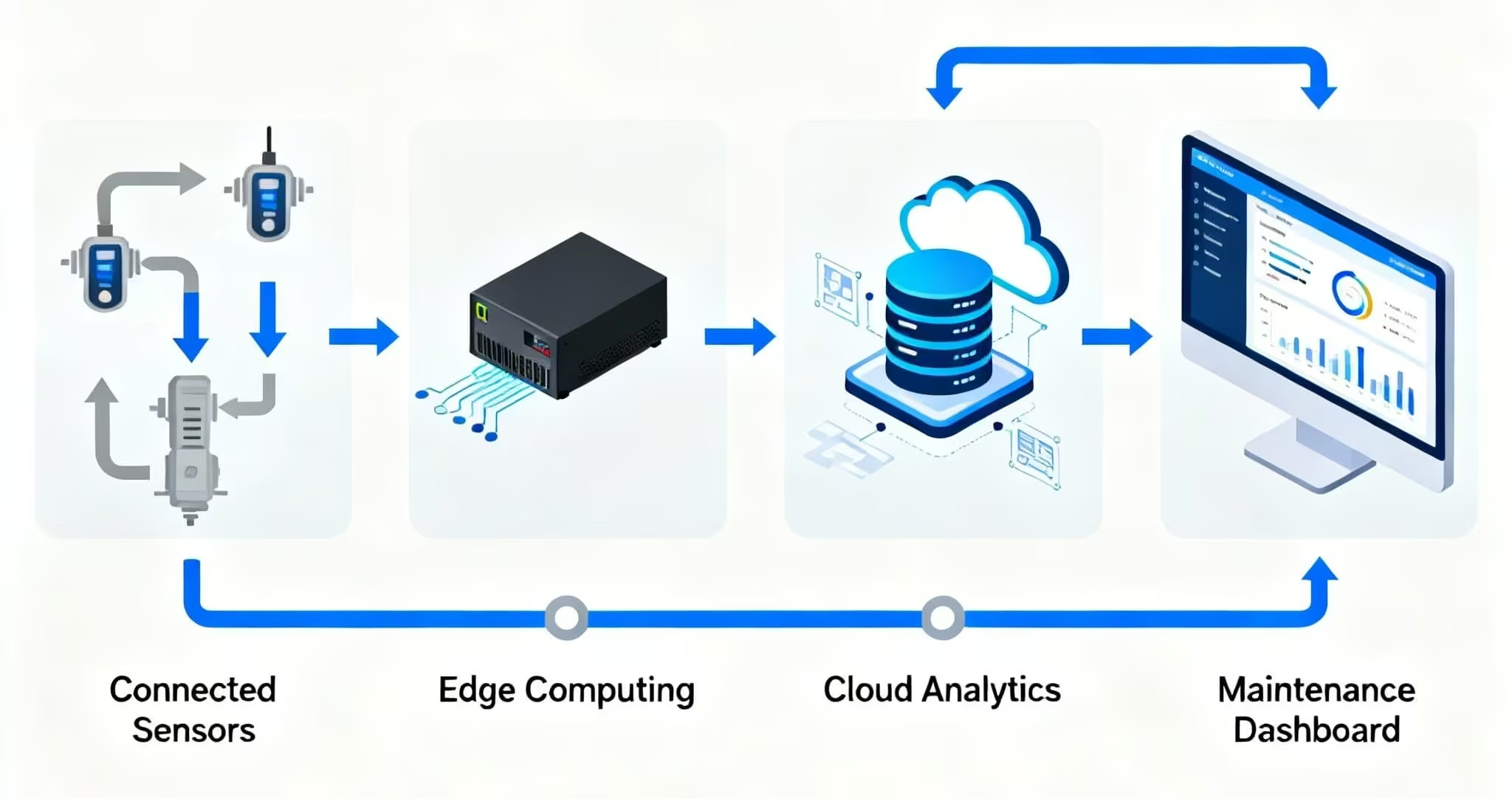
IoT predictive maintenance combines sensor data with AI-driven analytics to move from reactive to proactive upkeep. Sensors constantly measure vibration, pressure, or temperature in equipment, while gateways collect and send that information for analysis. Platforms then identify patterns and calculate metrics like Remaining Useful Life (RUL), so maintenance happens only when it’s truly needed.
A typical setup includes:
- Data collection from networked industrial sensors
- Edge computing to filter data quickly and reduce delays
- Cloud analytics for long-term model training and prediction
The result is a closed feedback loop: machines detect anomalies, algorithms confirm patterns, and engineers act before something fails.
The Technologies That Make It Work
Several core technologies power predictive maintenance systems:
- Sensor Technology – Modern sensors are smaller, more sensitive, and capable of wireless communication through Wi-Fi 6, LoRaWAN, or 5G. They run for years on a single battery and capture essential data such as vibration, pressure, and temperature.
- Machine Learning and Analytics Platforms – AI and ML models are the brains of the system. They process complex sensor data, spot anomalies early, forecast failures, and calculate remaining useful life. The more data they receive, the more accurate they become.
- Reliable Industrial Networks – Robust networks such as Wi-Fi 6, LoRaWAN, and 5G keep data flowing securely from equipment to central dashboards, ensuring nothing slips through the cracks.
- Edge Computing – Processing data directly at the equipment level allows for instant responses. If a model detects a serious issue, alerts reach maintenance teams immediately.
- Digital Twins – Virtual replicas of physical assets simulate wear, tear, and various operating conditions. Paired with ML insights, they make failure prediction and maintenance planning more precise.
- Predictive Analytics – Uses both historical and live data to forecast potential faults, helping schedule maintenance intelligently and minimise downtime.
- Augmented Reality (AR) Guidance – Gives technicians on-the-spot visual instructions, improving accuracy and cutting repair time.
- Autonomous Drones and Robots – Fitted with sensors and ML capabilities, they handle inspections and small maintenance jobs in dangerous or hard-to-reach places.
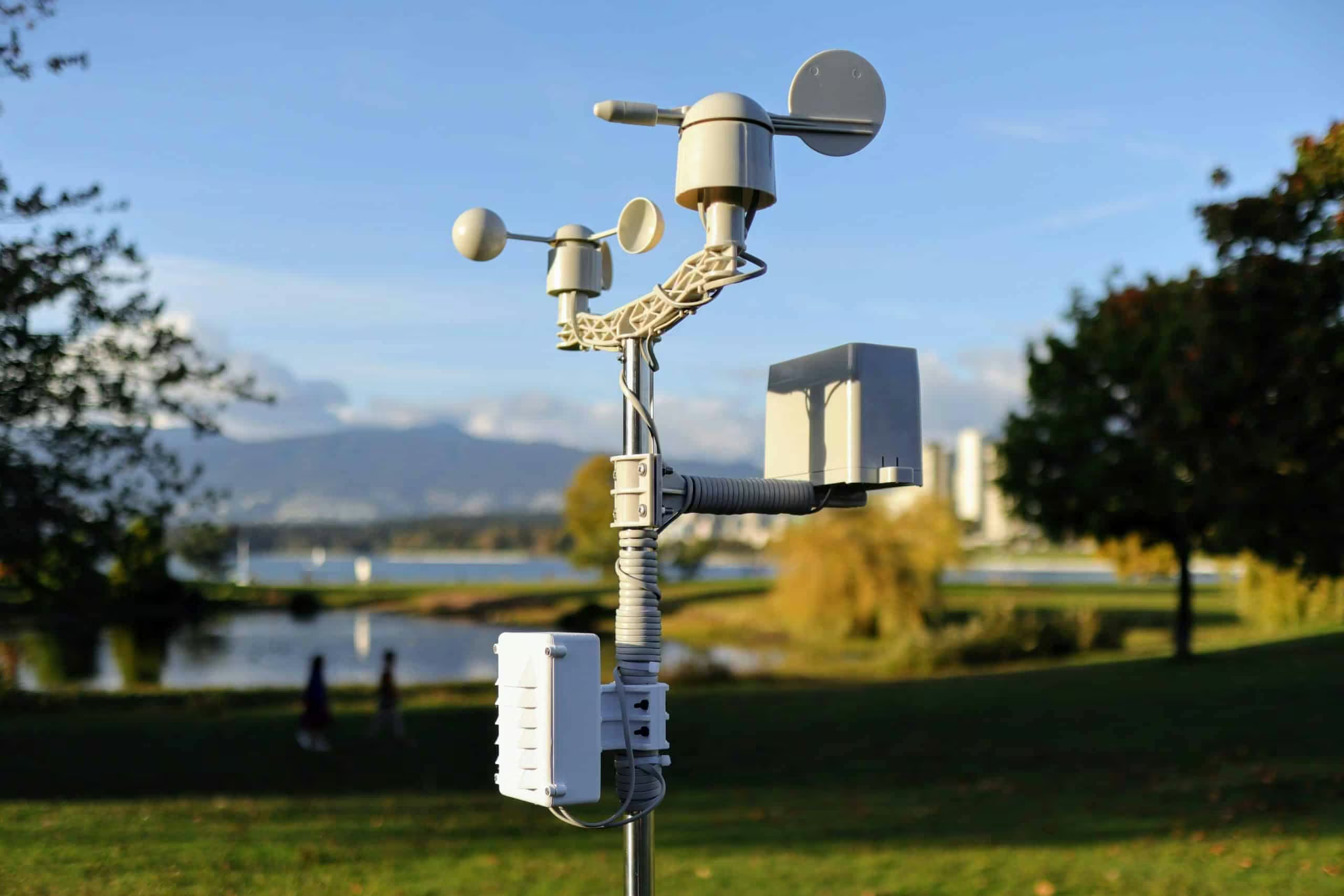
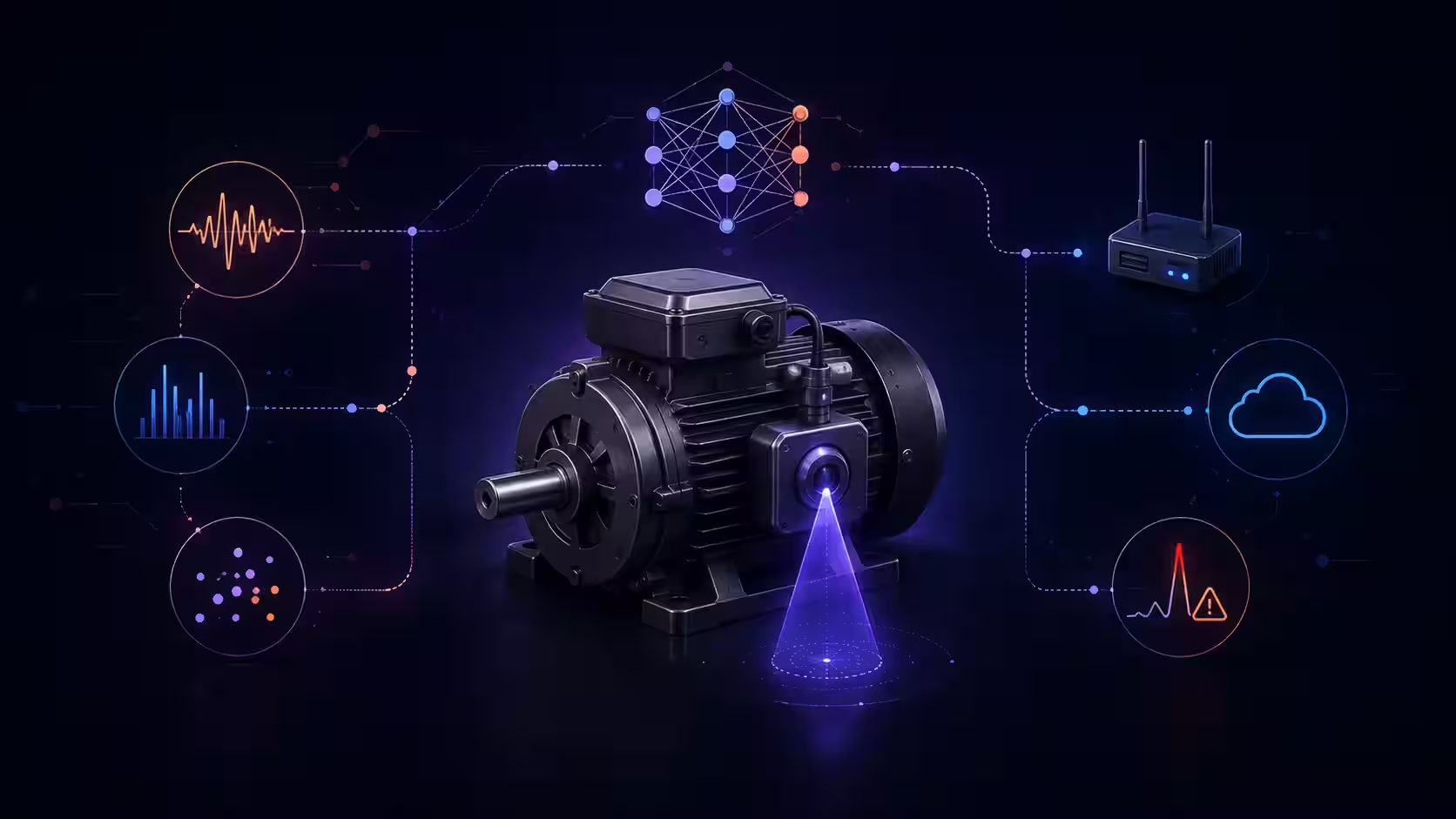
Most IoT predictive maintenance pilots stall because the vibration and temperature data is too sparse or too noisy to train on. We design the sensing, gateway and data path first, then the models. Tell us which assets are hurting you.
Get sensor data that is actually good enough to predict failures
ROI and Measurable Benefits
Businesses adopting IoT predictive maintenance typically see major improvements across performance, cost, and reliability. Studies show asset lifespans extending by 20–40%, while maintenance costs fall by 35–50% thanks to smarter scheduling and early fault detection. Unplanned downtime – often the most expensive kind – can drop by as much as 70%.
Energy savings are another clear benefit. When IoT systems identify and correct inefficient operating conditions, facilities report 10–15% reductions in energy use. Safety also improves as potential hazards are caught early, leading to fewer accidents and compliance issues.
See How Industrial Clients Benefit from IoT
Explore real predictive-maintenance projects delivered by our engineers. From factory floors to offshore installations, we design edge solutions that deliver measurable ROI.
How Different Industries Apply It
Each industry adapts predictive maintenance to its own systems, data realities, and operational risks:
- Manufacturing: Predictive models monitor conveyors, turbines, and injection systems, detecting subtle shifts in vibration, pressure, or temperature. This allows teams to schedule repairs before faults trigger expensive production downtime.
- Oil & Gas: Networks of corrosion, flow, and pressure sensors monitor thousands of kilometres of pipeline in real time, identifying micro-leaks or early corrosion, so maintenance crews can act long before safety or environmental risks arise. Pipeline monitoring is one of several applications covered under predictive maintenance in oil and gas, each with its own failure modes.
- Transport & Logistics: IoT telematics track vehicle engines, tyre pressure, fuel systems, and braking performance continuously, helping fleets cut unplanned stops, lower fuel costs, and maintain delivery reliability.
- Aviation: Airlines use digital twins and advanced simulations to model engine wear, heat cycles, and component friction – allowing precise maintenance scheduling that improves aircraft availability and reduces overhaul costs.
- Healthcare: Hospitals use predictive algorithms to monitor imaging, surgical, and ventilation systems. Early fault detection ensures life-critical equipment remains operational and prevents delays in patient care.
- Energy: Wind and solar operators analyse vibration, torque, and electrical data from turbines and inverters to detect early wear. Predictive insights help plan maintenance around weather windows and minimise power disruption.
Manufacturing is the most demanding of these environments, because a single unplanned line stoppage cascades through every downstream order. The strategy, benefits and step-by-step rollout for that setting are covered in our guide to predictive maintenance in manufacturing. Outside manufacturing, the generic predictive maintenance implementation steps still apply, from asset prioritization through pilot to scale-up.
Case Studies from InTechHouse
At InTechHouse, we’ve built and deployed advanced IoT and predictive-analytics solutions that show how powerful this approach can be.
One example is our Expert Water Analysis System, designed to solve slow detection problems in traditional water networks. It combines IoT sensors with AI algorithms to identify leaks, bursts, or abnormal usage within 15–30 minutes – minimising damage and enabling fast intervention. The system monitors thousands of water meters and supports predictive analysis across multiple device types, helping utilities reduce losses and use resources more sustainably.
We also redesigned the user interface for an IoT-based aquarium monitoring system. The new design made it easier for users to track alerts and system status while maintaining precise IoT control of water-quality parameters. It’s a good example of how accurate data and thoughtful design can work together to improve reliability and user experience.

Read also:
- IoT Predictive Maintenance: A Complete Guide to Reducing Equipment Downtime
- What Is Predictive M How to Implement Predictive Maintenance
- How to Implement Predictive Maintenance: A Step-by-Step Guide
The Common Implementation Challenges
Getting predictive maintenance right isn’t just about having the latest sensors or the most powerful algorithms – it’s about execution, integration, and long-term reliability. Many projects fail not because the technology doesn’t work, but because the surrounding processes and systems aren’t ready to support it.
Data quality remains one of the biggest and most underestimated challenges. Sensors can drift out of calibration, environmental conditions like temperature or vibration can distort readings, and inconsistent network coverage can cause data gaps. Even minor inaccuracies can lead to false positives or missed anomalies. To prevent this, systems need automated validation routines, redundancy in key measurement points, and ongoing calibration schedules. It’s not enough to collect data – you need to know that data is clean, consistent, and contextually accurate.
Integration is another major pressure point. Predictive maintenance systems don’t operate in isolation; they sit alongside ERP, MES, and CMMS platforms that already run day-to-day operations. If integration is clumsy, the entire workflow breaks down – engineers miss alerts, data sits in silos, and decision-making slows. The key is to design open, modular architectures where APIs handle smooth data exchange between IoT layers and enterprise systems. Often this means tailoring dashboards and notification logic to match the way teams actually work, not the way the technology vendor imagines they do.
Then there’s cybersecurity, which has quickly become a board-level concern. As IoT networks expand across multiple sites and devices, each new endpoint becomes a potential entry point for attackers. A predictive maintenance system is only as strong as its weakest node. Network segmentation, encrypted communication channels, device authentication, and strict access control are all essential to protect both operational continuity and sensitive data. Regular security audits and firmware updates should be part of the maintenance plan from day one – not an afterthought once the system is live.
Beyond these three, there’s also a cultural challenge: getting teams to trust automated insights over traditional instincts. Maintenance engineers often rely on experience and intuition built over years on the job. Introducing predictive analytics requires a mindset shift – from reactive problem-solving to proactive prevention. That transition only sticks when leadership supports it, data proves its worth, and the tools are simple enough to use in real operational contexts.
Instrumenting every asset at once is the fastest way to overspend on an IoT rollout. Ranking machines by failure consequence first keeps sensor budgets where they matter, which is exactly the logic behind risk-based maintenance.
Final Thoughts: Turning Data into Reliability
IoT predictive maintenance marks a real shift towards data-driven operations that cut costs and risks while keeping performance high. To make it work, you need clear planning, the right technology, and a mindset of continuous improvement.
Companies that get it right enjoy more reliable assets, lower maintenance spend, and stronger safety performance across the board.
Transform Your Maintenance Strategy Today
See how our IoT predictive-maintenance solutions have helped industrial clients extend asset lifecycles by 40% and cut unplanned downtime by half. Get expert guidance on how to make it work in your operation.
We have built condition monitoring across manufacturing, energy and logistics, from the sensor node to the RUL model in production. Ask us for the reference architecture and the numbers behind it.
Talk to the engineers who have shipped IoT predictive maintenance
Let's talk about your next move
Not sure where to start? We work with companies at every stage, from early ideas to enterprise-level builds. A 30-minute call can save you months of guesswork.
FAQ
Which sensors are most useful for IoT predictive maintenance on rotating equipment?
For rotating equipment, vibration sensors are usually the most informative, because bearing wear, imbalance and misalignment show up in the vibration spectrum well before failure. Piezoelectric accelerometers cover wider frequency ranges than low-cost MEMS parts, which matters for early bearing defects. Temperature, motor current signature and acoustic emission sensors add context. The sampling rate must match the fault being tracked: trend monitoring needs periodic readings, while spectral bearing analysis needs sampling in the kilohertz range.
Should predictive maintenance analytics run at the edge or in the cloud?
Most predictive maintenance systems split the work: the edge device or gateway handles signal processing and anomaly detection, and the cloud handles model training, fleet-wide comparison and long-term storage. Running feature extraction such as FFT or RMS at the edge cuts bandwidth sharply, because raw vibration waveforms are large. Edge inference also keeps alerts working when the network drops. Cloud-only designs suit slow-changing signals like temperature trends, where latency and data volume are not constraints.
How much data is needed to train a predictive maintenance model?
The data needed depends on whether the goal is anomaly detection or remaining useful life (RUL) prediction. Anomaly detection can start from a few weeks of healthy operating data, because it only learns what normal looks like. RUL models need labeled run-to-failure histories, which are rare for reliable assets, so many projects begin with anomaly detection and add prognostics once failures have been recorded. Data quality matters more than volume: uncalibrated or poorly mounted sensors make any model unreliable.
Is LoRaWAN, Wi-Fi or cellular better for condition monitoring sensors?
The right wireless link for condition monitoring depends on how much data each sensor sends and how it is powered. LoRaWAN offers multi-year battery life and long range but carries payloads of only tens to a few hundred bytes, so sensors must send computed features rather than raw waveforms. Wi-Fi suits mains-powered nodes streaming higher-rate data inside a plant. Cellular options such as LTE-M or NB-IoT fit distributed assets like pipelines or fleets without local infrastructure.
How should an IoT predictive maintenance pilot be scoped?
An IoT predictive maintenance pilot should cover one asset class with a known failure history, a defined data path from sensor to work order, and a single measurable KPI such as unplanned downtime hours. Choosing assets where failures are costly but not rare gives the model something to detect within the pilot window. The pilot should also test integration with the existing CMMS and the response process, because detection without a clear action rarely changes maintenance outcomes.
Damian Ledziński, PhD Eng.
Damian Ledziński, PhD Eng., is an Applied Artificial Intelligence Expert and an Assistant Professor at Bydgoszcz University of Science and Technology. He has over 15 years of academic, research, software-engineering, and technology-development experience.
His work focuses on applying artificial intelligence, machine learning, deep neural networks, and data science to complex real-world systems. His principal research and engineering interests include autonomous unmanned aerial vehicles, drone navigation and swarm intelligence, biomedical engineering, medical signal and image analysis, predictive modeling, industrial IoT, and intelligent water-management systems.
Damian has contributed to multidisciplinary R&D initiatives including AI-assisted medical diagnostics, a Polish ventilator prototype, autonomous indoor drone systems for warehouse inventory, AI-supported water-consumption analysis, virtual medical assistants, and intelligent systems combining embedded devices with machine-learning models.
He is the author or co-author of more than 30 scientific publications. His work has appeared in international scientific publications covering artificial intelligence, biomedical engineering, signal analysis, autonomous systems, environmental monitoring, and data-driven infrastructure.
Damian is a co-creator of academic programs in Engineering in Medicine, AI in Medicine, and Data Science at Bydgoszcz University of Science and Technology. He combines scientific research with hands-on implementation, translating experimental AI methods into deployable technology. He writes about applied AI, machine learning, predictive analytics, autonomous UAV systems, AI in medicine, biomedical signal processing, industrial IoT, and intelligent models in real-world systems.
Damian Ledziński's academic profiles:
https://orcid.org/0000-0003-0796-4390
https://wtie.pbs.edu.pl/pl/pracownik/damian-ledzinski
https://www.researchgate.net/profile/Damian-Ledzinski
https://scholar.google.pl/citations?user=AlQpPB0AAAAJ&hl=pl
https://ludzie.nauka.gov.pl/ln/profiles/DN6pHXU6KZm/publications/f83a8833-6060-4fae-8628-3dbf57661394
Let's talk about your next project
From first prototype to production, our engineers can help you scope it, build it and get it certified.





Discuss your product with our R&D team
This initial conversation is focused on understanding your product, technical challenges, and constraints.
No sales pitch - just a practical discussion with experienced engineers.
Share a few details about your product and context. We’ll review the information and suggest the most appropriate next step.