
Navigating IoT Hardware Development: A Comprehensive Guide

IoT Hardware Development: From Concept to Prototype
The development of Internet of Things (IoT) technology has revolutionized how we connect with the world around us. From smart homes to advanced industrial systems, IoT devices are becoming an integral part of our daily lives. For IoT engineers, creating IoT hardware is fascinating yet challenging. As said Steve Mollenkopf, Qualcomm's CEO -
"The Internet of Everything is a more complex ecosystem than anything we've seen before. Hardware, software and connectivity must all work together seamlessly."
This article will discuss the essential stages of the IoT hardware development process, from conceptual design through prototype building to testing and validation, a specialised branch of the wider hardware product development process. It will also present best practices and the latest tools and technologies that help engineers create innovative and durable IoT solutions.
What's Custom IoT Device?
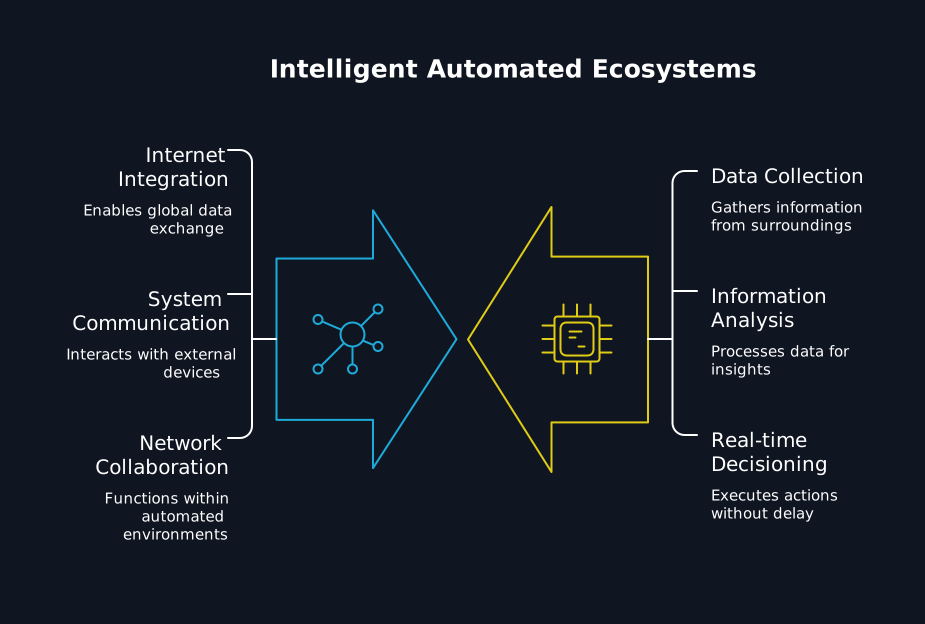
An IoT (Internet of Things) device is an electronic device that is connected to the internet and can collect, transmit and receive data. Thanks to this, IoT devices can interact with each other and with other systems, creating intelligent and automated environments. The differences between IoT devices and traditional electronic devices are significant. Conventional electronic devices usually lack the capability to connect to the internet or communicate with other devices. IoT devices, on the other hand, are designed for network integration and can exchange data and collaborate with other devices and systems in an automated manner. Moreover, IoT devices often include advanced data processing functions that allow them to analyze collected information and make real-time decisions.
Understanding IoT Hardware Design
At its core, IoT hardware encompasses all the physical devices and components that enable connectivity, data collection and processing. These include:
Sensors and Actuators:
- Sensors: They act as the senses of IoT devices, collecting data from the environment. These can include temperature, humidity, pressure, light and motion sensors, among others. The precision and sensitivity of these sensors directly impact the quality of data and system efficiency.
- Actuators: These are the executing elements that respond to data collected by the sensors. Actuators can be motors, relays, valves or LEDs, performing specific actions such as opening doors, adjusting lighting or activating machinery.
Microcontrollers and Microprocessors:
- Microcontrollers: These single-chip computers manage the operation of sensors and actuators and perform necessary calculations. Popular microcontrollers include Arduino, ESP8266 and ESP32, valued for their versatility and ease of programming.
- Microprocessors: Used in more advanced devices like Raspberry Pi, these offer greater computational power and can run more complex operating systems such as Linux.
Communication Modules:
- Wi-Fi, Bluetooth, Zigbee, LoRa, NB-IoT: These technologies enable wireless communication between IoT devices and the central system. The choice of technology depends on application requirements such as range, data transmission speed, power consumption and cost.
Power Modules:
- Batteries, Rechargeable Batteries, Solar Modules: Reliable power is crucial for the continuous operation of IoT devices. These solutions need to be energy-efficient and often integrated with power management systems to extend device longevity.
Memory:
- EEPROM, Flash, RAM: Used to store data, firmware and computational results. The choice of appropriate memory affects the speed and reliability of the IoT system.
Input/Output Interfaces (I/O):
- Analog and Digital Ports: These enable the connection of various sensors and actuators to the microcontroller, providing flexibility in designing IoT systems.
Operating Systems and Firmware:
- RTOS (Real-Time Operating Systems): Special operating systems that manage resources and tasks in real-time, ensuring reliability and deterministic operation.
Enclosures and Mechanical Components:
- Enclosures: Protect sensitive electronic components from mechanical damage and environmental influences such as moisture, dust or vibrations.
Sensor choice, power budget and radio integration decide whether an IoT device survives the field or dies in certification. We take the concept through schematic, prototype and validation with those constraints fixed early.
Move your IoT concept to a working prototype
Essential Considerations in IoT Hardware Development Project
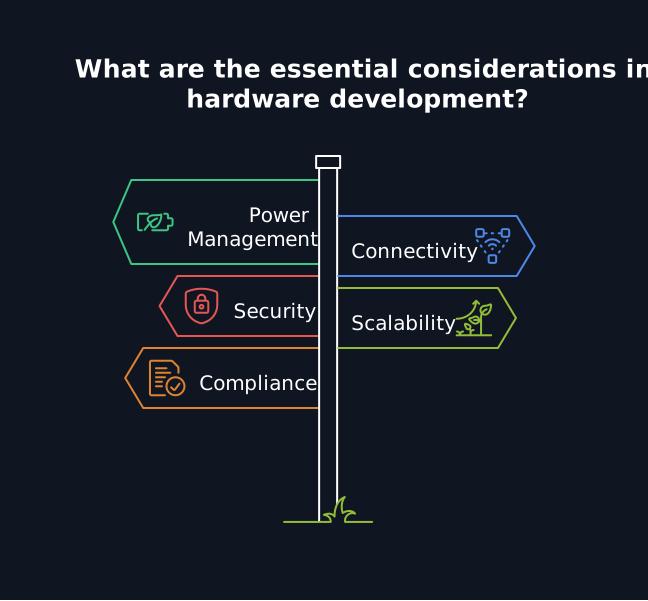
Power Management: Managing power efficiently is crucial, especially for remote or battery-powered IoT devices.
Back in 2020, the average energy consumption by IoT devices was 50mW, whereas this year it is already down to 37mW.
Clearly, there is a downward trend in this area, so choosing low-power components like Texas Instruments MSP430 and Nordic Semiconductor nRF52 series microcontrollers can make a big difference. The ESP32, with its deep sleep modes, is also a good choice. Based on our experiences efficient sensors such as the Bosch BME280 for environmental sensing and the Texas Instruments HDC1080 for humidity and temperature measurement, along with low-power communication modules like the LoRa SX1276 and Nordic nRF52840, help conserve energy.
Using energy harvesting techniques can further extend the lifespan of IoT devices. Solar power is a great option, managed effectively with the SPV1050 by STMicroelectronics. Kinetic energy harvesting, used in EnOcean's technology, is common in building automation and smart home products. On the other hand, thermal energy harvesting can utilize devices like Texas Instruments’ bq25570, which harness energy from temperature differences.
Connectivity: The number of connected IoT devices worldwide reached 28.4 billion last year, representing an increase of over 39% compared to 2020. Selecting the right communication protocol is vital for IoT devices. Wi-Fi is best for high data rates and real-time communication, with the ESP8266 and ESP32 modules being popular options but for short-range, low-power needs, Bluetooth Low Energy (BLE) with the Nordic nRF52840 is ideal. Zigbee, such as the XBee Zigbee module by Digi International, works well for low-power, low-data rate applications like home automation. Alternatively, for long-range and low-power applications like smart agriculture, LoRaWAN with the Semtech SX1276 module is suitable.
Security: Security is paramount as IoT devices are vulnerable to cyber threats. According to implementing AES encryption, with secure key storage provided by devices like the ATECC608A by Microchip is essential. In contrast, secure boot mechanisms, such as those in NXP i.MX6 microcontrollers, ensure only authenticated software runs on the device and over-the-air (OTA) updates are crucial for keeping devices secure with the latest patches.
Scalability: Scalability ensures the IoT system can grow and handle more devices without performance issues. Designing hardware with modularity in mind allows for easy upgrades. However, using scalable cloud services like AWS IoT Core or Azure IoT Hub helps manage increased device counts and data loads effectively.
Compliance and Standards: Meeting industry standards ensures IoT devices are interoperable and legally compliant. Important certifications include ISO/IEC 27001 for Information Security Management and ISO/IEC 20000 for IT Service Management. Adhering to IEEE 802.11 for Wi-Fi and IEEE 802.15.4 for low-rate wireless personal area networks also is essential. Additionally, obtaining CE Marking for devices sold in the European Economic Area, FCC Certification for those sold in the United States and RoHS Compliance to restrict hazardous substances is crucial.
Few teams keep every competence in house. RF layout, certification, firmware and cloud integration rarely sit under one roof, which is why many connected products are built together with electronics and IoT design services that cover the parts of the stack the internal team does not own.
Key Steps in IoT Product Development and Prototyping
Prototyping and development in IoT hardware are essential stages that ensure devices are functional, reliable, and meet the necessary performance standards. The key steps involved are as follows:
Design and Development of Simulation
- Conceptual Design: Begins with a comprehensive understanding of requirements and constraints. Initial IoT project and block diagrams outline the system architecture, including sensors, actuators, communication modules and power management
- CAD Tools: The use of Computer-Aided Design (CAD) software such as AutoCAD, SolidWorks or Tinkercad allows for the creation of detailed 3D models of the hardware components. These models help visualize the physical layout and design of the device
- Behavioral Simulation: Simulation of the hardware behavior under various conditions using tools like MATLAB, Simulink or specialized IoT simulation software helps identify potential performance, power consumption and signal integrity issues before physical prototyping
Internet of Things Prototype Building
- Development Boards: Development boards such as Arduino, Raspberry Pi or ESP8266 provide a flexible and cost-effective platform for testing the core functionalities of the IoT device.3D Printing: The creation of custom enclosures and mechanical parts using 3D printing technology allows for rapid iteration and refinement of the physical design, ensuring the enclosure is both functional and aesthetically pleasing
- Integration: The prototype is assembled by integrating development boards, sensors, actuators and power supply into the 3D printed enclosure. Ensuring all connections are secure and components are properly aligned is crucial
Testing and Validation Custom Hardware
- Functional Testing: Verification that the prototype performs all intended functions correctly, including testing the sensors, actuators, communication modules and power management system, is essential
- Performance Testing: Performance tests ensure the prototype meets the required specifications, measuring key parameters such as response time, accuracy, power consumption and data throughput
- Stress Testing: The prototype is subjected to extreme conditions such as high and low temperatures, humidity and physical shocks to ensure it can withstand real-world usage scenarios
- Environmental Testing: Testing the prototype in various environmental conditions ensures reliable operation, including resistance to dust, water and electromagnetic interference
- User Testing: User testing gathers feedback on the prototype's usability and functionality, ensuring the device is intuitive and user-friendly
Iterative Improvement IoT Hardware Solutions
- Data Analysis: Analysis of data collected from testing identifies weaknesses or areas for improvement, reviewing test logs, performance metrics and user feedback
- Design Refinement: Necessary adjustments to the hardware design are made based on test results, such as tweaking component placement, improving thermal management or optimizing power consumption
- Software Updates: Firmware and software are updated to fix bugs or add new features, ensuring the software is well-documented and maintainable
- Re-Testing: The prototype is re-tested after making improvements to ensure all issues have been resolved and the device meets all requirements. The testing and refinement process is repeated as needed
- Documentation: Detailed documentation of all design changes, test procedures and results is maintained, which will be invaluable for future development stages and troubleshooting any issues that arise
Summary
The development of IoT is an ongoing journey towards better understanding and leveraging the potential of smart devices. Each new project, each improvement, and each innovation is a step forward in this field. Although, it requires to possess not only advanced technical knowledge but also a creative approach to problem-solving and project optimization, IoT hardware development is a dynamic and multifaceted branch. From the design and simulation phase, through prototyping, to rigorous testing and iterative refinement - each step in the process of creating IoT hardware plays a crucial role in ensuring that the final product is efficient, reliable, and market-ready, which is where experienced hardware design and engineering services shorten the path to market.
InTechHouse offers comprehensive technological solutions that go far beyond IoT hardware. With many years of experience and a development team of experts in fields such as software, industrial automation, artificial intelligence and data analysis, InTechHouse provides an innovative approach to every project. Everything you need - an advanced management system, dedicated software or support in digital transformation, InTechHouse delivers personalized solutions tailored to the specific needs of your business. By choosing InTechHouse, you gain a partner who passionately strives for optimization and process modernization, supporting the growth and success of your company at every stage.
Our hardware team has taken connected devices from breadboard to manufacturable product across industrial and medical use cases, with design reviews and test plans documented at each gate. Ask for a walkthrough of the process.
See how we run IoT hardware NPI
Let's talk about your next move
Not sure where to start? We work with companies at every stage, from early ideas to enterprise-level builds. A 30-minute call can save you months of guesswork.
FAQ
1. How can edge computing enhance IoT hardware performance?
Edge computing processes data locally on the device or nearby, reducing latency and bandwidth usage. This results in faster response times, improved data security and greater reliability for IoT applications.
2. What are the benefits of using modular design in IoT hardware development?
Modular design allows for easier upgrades, maintenance and scalability. It enables replacing or upgrading individual components without redesigning the entire system, saving time and costs in the long run.
3. What role does firmware play in IoT hardware development?
Firmware acts as the software that directly interacts with the hardware components. It is responsible for managing low-level operations, enabling communication between hardware and software and ensuring the device operates correctly.
4. What are the considerations for selecting communication protocols for IoT devices?
Factors to consider include range, data rate, power consumption, network topology and interoperability. Popular protocols like Wi-Fi, Bluetooth Low Energy (BLE), Zigbee and LoRaWAN each have unique advantages depending on the application.
5. How can IoT hardware be designed to ensure data security?
Implementing encryption, secure boot mechanisms and hardware-based security modules such as Trusted Platform Modules (TPM) can protect data integrity and confidentiality. Regular firmware updates also help in mitigating security vulnerabilities.
Adam Szychulec
Adam Szychulec is Deputy CTO at InTechHouse and an electronics and embedded systems engineer with over 13 years of experience in hardware development, FPGA-based systems, embedded software, and technical leadership.
He specializes in electronic system architecture, analog and digital PCB design, FPGA and SoC development, embedded C/C++ software, and managing the complete lifecycle of complex engineering products - from early feasibility studies and technical architecture through development, testing, production introduction, and product modernization.
Adam has extensive experience leading multidisciplinary R&D teams and coordinating electronics, embedded software, mechanical engineering, testing, and project delivery. His responsibilities have included technical decision-making, project planning, risk and change management, budgeting, product testing, new product introduction, and mid-life upgrades of existing electronic systems.
His project experience includes FPGA modules for space applications, electronic systems and payloads for unmanned aerial vehicles, environmental monitoring and multispectral imaging platforms, power electronics, DC-DC converter assessment, and embedded systems developed for demanding industrial and defence-related applications.
Adam works with FPGA and SoC platforms, Xilinx Zynq, VHDL, Vivado, Altium Designer, ARM microcontrollers, embedded C/C++, Linux, digital electronics, and power electronics. He holds bachelor's and master's degrees in Electrical Engineering and is an IPC Certified Interconnect Designer. He writes about FPGA architectures, electronics design, embedded systems, hardware product development, technical risk management, UAV electronics, power electronics, and engineering leadership.
Let's talk about your next project
From first prototype to production, our engineers can help you scope it, build it and get it certified.
Discuss your product with our R&D team
This initial conversation is focused on understanding your product, technical challenges, and constraints.
No sales pitch - just a practical discussion with experienced engineers.
Share a few details about your product and context. We’ll review the information and suggest the most appropriate next step.