Welcome to the InTechHouse blog, where innovation meets information. In this edition, we delve into the intriguing realm of Data Mesh Architecture, exploring its significance, evaluating its merits, and uncovering how InTechHouse tailors this cutting-edge concept to amplify data-driven excellence
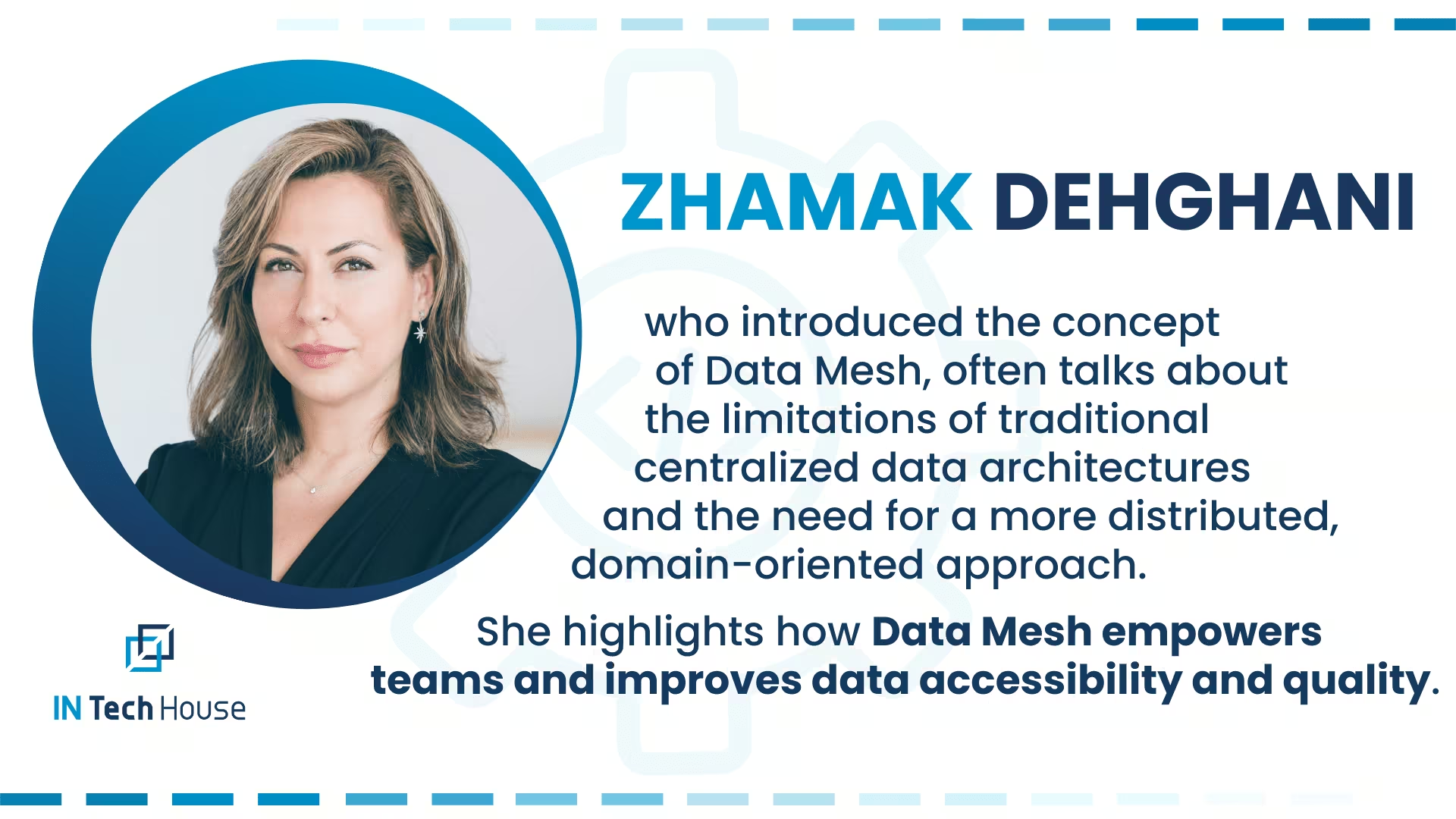
Data Mesh is a paradigm shift in the way organizations approach data architecture. Coined by Zhamak Dehghani, the concept promotes a decentralized approach to data ownership, access, and quality, empowering domain-oriented decentralized data teams. In simpler terms, it envisions breaking down monolithic data systems into a distributed and federated architecture, aligning seamlessly with the principles of scalability, autonomy, and flexibility.
Data Mesh is only one of three architectures that organizations weigh when they redesign a data estate. Before committing to domain ownership, it is worth putting Data Mesh, Data Fabric, and Data Lake side by side, because each of them answers a different question about integration, storage, and accountability.
At InTechHouse, we can say ABSOLUTELY! Data Mesh addresses the challenges posed by traditional centralized data architectures. By distributing data ownership to domain-oriented teams, it fosters a culture of data autonomy, allowing teams to be accountable for the quality and usability of their data. This approach enhances scalability, accelerates innovation, and promotes a more responsive and adaptive data infrastructure, which is especially crucial in today’s rapidly evolving business landscape. Data and Big Data are crucial, too!
The honest answer depends on what you intend to track after go-live. Teams that treat measuring the success of Data Mesh as part of the implementation, not as an afterthought, can prove data product adoption, time-to-insight, and quality gains instead of arguing about them.
Most data mesh programmes stall because domain boundaries and ownership were never agreed. We run that mapping first, then build the self serve platform underneath it.
See also:
What is Data Product in Data Mesh?
How to Build a Data Mesh Team: Roles and Responsibilities
Measuring the Success of Data Mesh in Your Organization
E-commerce Personalization:
Healthcare Data Integration:
Financial Services Analytics:
What all of these examples share is the unit of delivery. Each domain team ships data products in Data Mesh with named owners, service levels, and documented interfaces, which is what turns a decentralized architecture into something the rest of the business can consume.
Federated governance only holds if someone runs it after launch. Ask how we set up ownership, observability and quality checks that survive the first year.
Case 1
In the dynamic landscape of technology, reliability is paramount, especially for products with a legacy that spans decades. Our client, a multinational US corporation, found themselves at a crucial crossroads with a product that had been a beacon of reliability since the early 2000s. As the availability of spare parts dwindled, the future of this globally demanded product hung in the balance. Read it
Case 2
Not sure where to start? We work with companies at every stage, from early ideas to enterprise-level builds. A 30-minute call can save you months of guesswork.
Key business functions include finance & accounting, sales & marketing, research & development, operations & supply chain, HR, and ITSM.
Major players include IBM, AWS, SAP, Oracle, Informatica, Google, Microsoft, and several others.
This role oversees a specific data product, ensuring its quality and alignment with user needs and business goals.
Depends on your business's reliance on data for decision-making and innovation. If data analysis is crucial, data scientists can be highly beneficial. Real-time data is better and why?Offers advantages like immediate decision-making and responsiveness, essential in sectors where timeliness is key. The importance varies based on business needs.
Jacek Suty is Head of Solution Architecture at InTechHouse, with more than 30 years of experience in system architecture, enterprise IT, infrastructure, information security, and complex digital transformation programs.
He specializes in designing enterprise and solution architectures, translating business and regulatory requirements into scalable technology platforms, and coordinating delivery across software, infrastructure, data, and security teams. His work covers enterprise architecture based on TOGAF, system modeling using UML and BPMN, cloud and on-premise infrastructure, CI/CD processes, data platforms, cybersecurity, and IT governance.
Jacek has contributed to large-scale technology programs for public institutions, finance, energy, education, healthcare, utilities, and digital archives. His project experience includes nationwide public digital infrastructure, distributed document-management and archiving systems, data-exploration platforms using machine learning and predictive analytics, and transaction systems combining blockchain, metadata standards, and computational intelligence.
He holds PRINCE2 Practitioner, Management of Risk, Scrum Master, ITIL Foundation, and ISO/IEC 27001 Lead Auditor qualifications. Jacek is currently pursuing a doctoral degree at Bydgoszcz University of Science and Technology, combining academic research with extensive experience in real-world architecture and technology delivery.
He writes about enterprise architecture, system design, digital transformation, data platforms, cloud infrastructure, cybersecurity, technology governance, and the practical application of AI in complex information systems.
Jacek Suty's academic and professional profiles:
https://pbs.edu.pl/pl/doktorant/uczelniania-rada-samorzadu-doktorantow
https://www.isep.pw.edu.pl/isep/zs/Aktualnosci/Kalendarium-wydarzen2/Seminarium-zakladowe-9.03.2021-Jacek-Suty
https://aionehealth.pl/wp-content/uploads/2026/04/Raport-2026-final.pdf
This initial conversation is focused on understanding your product, technical challenges, and constraints.
No sales pitch - just a practical discussion with experienced engineers.
Share a few details about your product and context. We’ll review the information and suggest the most appropriate next step.