.avif)
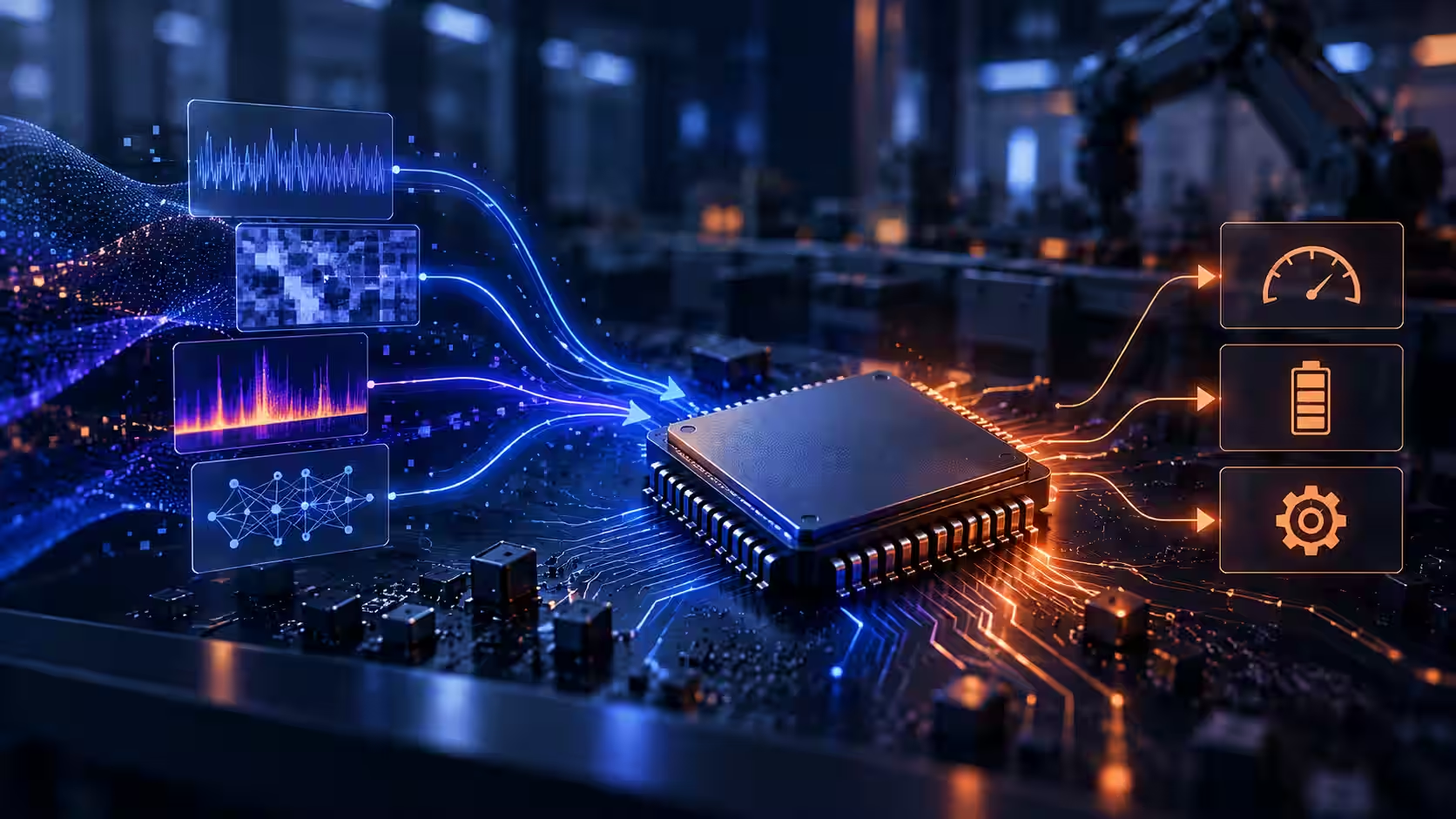
FPGA hardware acceleration means taking operations a general purpose processor handles badly, large volumes of parallel arithmetic, streaming data, protocol handling, and implementing them as dedicated circuits in programmable logic, while the processor keeps the sequential control flow. InTechHouse does this inside a single SoC: the processor and the fabric on one chip, partitioned at design time. We have not worked with separate PCIe acceleration cards, the kind used in datacentre servers. If that is the product you are looking for, this is not the page for it, though the decision rule below still applies to your project either way.
Hardware acceleration is a redistribution of work, not a product you buy off a shelf.
A general purpose CPU handles some kinds of work badly: large volumes of parallel arithmetic, continuous streaming data, and protocol handling with hard timing requirements. Hardware acceleration takes exactly that kind of work and implements it as dedicated circuits in fpga fabric instead of as instructions the processor executes one after another. The processor keeps the sequential control flow, the parts of the design that involve branching, decisions and coordination, while the fabric processes data in parallel, doing many identical operations on a stream at once.
On a system on chip, that split is the acceleration. It is the same physical chip, with the work deliberately redistributed between its two halves at design time. The best-known example of that split is the SoC FPGA (Zynq) family, where Arm cores and programmable logic share one die.
Worth stating plainly here, because it shapes every decision below: that partition is decided at architecture time, not configured later. Changing which specific tasks live on the processor and which live in fabric, once a board exists, is an architectural change, not a setting you flip. Getting the split right before the board is built is most of the engineering work in an acceleration project.
Two different architectures share the same name, and confusing them is the single most common mistake in how this market talks about itself.
One is a discrete hardware accelerator on an expansion card sitting beside a host processor, the pattern used in data centers and high performance computing: certain operations are pushed off a server's CPU onto an FPGA on a PCIe card, in the same rack, communicating over the bus. The other is programmable logic on the same die as the processor, partitioned at design time, inside an embedded system with its own board, power budget and enclosure. Different problems, different buyers, different budgets, even though both get called fpga accelerators or hardware accelerators in casual use.
InTechHouse does the second kind: acceleration inside a single SoC. We have not worked with separate acceleration cards, and nothing on this page describes that product. If your project needs a card slotted into a server to offload compression, encryption or networking at data center scale, that is a different engagement with a different set of vendors, and this guide will still be useful for the decision rule further down, but not for a supplier recommendation here.
Understanding the mechanism is what separates a real acceleration decision from a guess, so it is worth walking through properly.
A processor fetches and executes instructions one after another. Execution time is, roughly, the number of instructions multiplied by the cycles each one takes, and memory access usually dominates that total more than raw computation does. In fpga fabric, the same operation becomes a physical circuit instead of a sequence of instructions: lookup tables and programmable logic blocks are configured into a hardware implementation of the function itself, and a pipeline of hardware modules processes one data element per clock cycle, with the next element already entering the first stage while the previous one is still moving through later stages.
That is where massive parallelism and low latency actually come from, and it is worth being precise about the mechanism because the common assumption is wrong: an FPGA typically runs at a meaningfully lower clock frequency than a modern CPU. The gain is not a faster clock. It comes from doing many things at once, in parallel hardware, rather than one thing very quickly in sequence.
The real-time consequence matters as much as the parallelism itself: the value in FPGA architectures and fpga technology generally is often not a higher average throughput number but that the answer arrives at a predictable, known point in time. That is what real time processing actually requires, and it is a different property from being fast on average. That predictability is also easy to lose in implementation, and several common FPGA design mistakes undermine exactly this timing guarantee.
Before any engineering conversation, there is a test worth applying, and it reframes the question in a useful direction.
The useful question is not "what can the fabric do". It is "what is the processor actually failing at, and is that failure parallel in nature". Computations built from a lot of mathematical operations, applied to large volumes of data, are the ones well suited to fabric, and that is roughly how a real design gets partitioned between processor and programmable logic. Check FPGA vs microcontroller guide.
The qualifying question comes next, and it belongs early rather than as a caveat at the end: an FPGA is the more expensive solution, and it is used where it is actually necessary. Acceleration pays off when throughput or timing is the actual constraint on a design, not when development cost is the constraint. If your problem is that an equivalent processor-based system would cost less to build and that cost is what you are trying to solve, you are reading the wrong article for that specific question, and a realistic breakdown of what FPGA development costs is the more useful next stop.
This is the evidence the rest of the article stands on. Asked directly whether any project moved a specific function out of the processor into the fabric to go faster or to meet timing, Adam Szychulec, Head of Hardware / Embedded at InTechHouse, named three: a Precision Time Protocol v2 stack, HDMI video processing, and PCM. In his own words, the bottlenecks removed were real-time video processing, the PTP stack, and PCM in the FPGA.
Precision Time Protocol v2, PTP v2, distributes accurate time across a network, and it is a natural candidate for offload for a specific reason: the timestamping has to happen as close to the physical interface as possible, and a software stack running on a general-purpose operating system cannot guarantee exactly when it will run. Scheduling introduces jitter precisely where precision is the entire point of the function.
InTechHouse delivered a PTP v2 IP core and offloaded the timing stack into fabric for this reason, on an aerospace project. The IP core and the offload are two distinct pieces of that engagement: the core implements the protocol itself, and moving the stack into fabric is what removed the timing uncertainty a processor-based implementation would have carried.
InTechHouse case study: offloading time synchronization from processor to fabric
An aerospace customer needed network time synchronization accurate enough that software-level timestamping on a general-purpose processor could not meet the requirement, because scheduling jitter would have been introduced exactly where precision mattered most. InTechHouse delivered a Precision Time Protocol v2 IP core and offloaded the timestamping stack into FPGA fabric, inside the project's SoC, removing the timing uncertainty a processor-based implementation would have carried.
HDMI video processing was moved into fabric because a continuous video stream must not drop frames, and the processor handling other work on the same design could not keep up with it reliably.
This sits next to a judgment InTechHouse has made elsewhere that is worth reconciling directly rather than leaving a reader to notice the apparent contradiction: for a standard, already-defined function such as an HDMI codec or interface, it is often better to buy a chip that already implements it than to build the same standard function in fabric and license an IP core to reproduce it. Those two statements are not in conflict, because they describe different jobs. Implementing a standardized codec or interface that already exists as an off-the-shelf part is a different task from processing a live video stream inside a design whose data path is already in the fabric for other reasons. Once the stream is already flowing through programmable logic, keeping the video processing in that same fabric, rather than routing it back out to a separate off-the-shelf chip, is what removes the bottleneck. Check our FPGA vs ASIC vs SoC guide.
PCM, handled without interruption as a continuous signal-format conversion, is a poor fit for a general-purpose scheduler and a natural fit for a fixed pipeline in fabric. The signal has to be converted continuously, on a fixed timing, and a processor sharing its cycles across other tasks is structurally the wrong place to guarantee that.
Accelerating a function is not a configuration option you enable. It means implementing that function in hardware description languages, VHDL or Verilog, as a physical circuit, which is a fundamentally different discipline from software development and needs engineers who have actually done it before.
High level synthesis is worth understanding plainly rather than dismissing or overselling. It raises the level of abstraction a designer works at and can be the right tool for an algorithmic block, but it does not remove the need to think about hardware, pipelining and memory access; it changes how that thinking gets expressed in code, not whether it has to happen at all.
Worth being explicit about, because it is easy to underestimate at the proposal stage: accelerating a function is always hardware and software development together, never hardware alone. The processor side still has to feed the accelerated block with data and read its results back, and the interface between the two halves is usually where a schedule slips if it slips at all.
InTechHouse works day to day in Vivado, Vitis, Quartus, Lattice Radiant and Lattice Diamond across acceleration and other FPGA and SoC design work.
Also check FPGA design flow.
This is a survey of the wider landscape, not a list of InTechHouse's own work, and it is worth reading that way: the term "FPGA acceleration" covers markets well outside anything described elsewhere on this page.
In high frequency trading, ultra low latency on the path from market data to order execution is effectively the entire product, and fabric competes directly against custom hardware built for exactly that one purpose. In machine learning inference and neural network inference, fabric competes with GPUs and with purpose-built accelerators for workloads at the edge and in the data center, a comparison covered in full elsewhere. In data centers and high performance computing generally, acceleration cards offload compression, encryption and networking tasks that would otherwise consume general-purpose server capacity, running as a promising solution for operators trying to optimize performance per rack rather than buy more servers outright. And in embedded real-time systems, the category this page is actually about, acceleration sits inside a single chip in a product with its own board and power budget, not in a server rack at all.
For the inference comparison specifically, artificial intelligence and machine learning workloads at the edge are covered in a dedicated guide.
| Compared against | Where FPGA acceleration wins | Where it does not |
|---|---|---|
| General purpose CPU | Parallel, streaming work with hard timing requirements | Long sequential chains of dependent decisions |
| GPU | Predictable, low latency execution and lower power for one fixed workload | Raw throughput across many parallel streams, and software ecosystem maturity |
| Application specific integrated circuit (ASIC) | Flexibility to change the design after the part is on the board | Power efficiency and performance for one function, fixed and never changing |
Against a general purpose CPU, the case is clear-cut: parallel and streaming work with real timing requirements wins on fabric, and long sequential chains of dependent decisions do not. Against a GPU, the trade is predictable, low latency execution and often lower power for one fixed, well-defined workload, against a GPU's raw throughput and a far more mature software stack; the fuller version of that comparison, including where dedicated AI accelerators now fit as a third option, is covered separately. Against custom integrated circuits, an ASIC is generally more power efficient and higher performing for the one function it was built for, but it is fixed once fabricated, while fabric stays reconfigurable; the full trade-off between the two, including cost and lifecycle, is covered in its own guide.
InTechHouse designs FPGA and SoC systems, and has offloaded real-time video processing, a Precision Time Protocol v2 stack and PCM handling from processors into fabric. In each case, that acceleration sits inside a single SoC, the scope described above.
An engagement like this starts with the architecture decision itself: what belongs on the processor, and what belongs in fabric, decided before the board is designed rather than adjusted afterward.
Not sure whether your bottleneck belongs in programmable logic? Request an FPGA architecture assessment.
Not sure where to start? We work with companies at every stage, from early ideas to enterprise-level builds. A 30-minute call can save you months of guesswork.
A function that a processor would otherwise execute as a sequence of instructions is implemented instead as a pipeline of physical circuits in programmable logic, processing data in parallel rather than one step at a time. InTechHouse does this inside a single SoC, not on a separate acceleration card.
For parallel and streaming work, yes, and the interesting part is that this holds even though an FPGA typically runs at a lower clock frequency than a modern CPU. For long sequential chains of dependent decisions, a CPU wins.
When throughput or timing is the actual constraint on a design, and the work that is failing on the processor is parallel in nature, not when the constraint is development cost. Most acceleration decisions come down to that distinction rather than to raw capability.
That depends heavily on the workload and is covered in full in a dedicated comparison rather than answered briefly here.
For the one function an ASIC was built for, generally yes, because the silicon has no unused, reconfigurable logic sitting alongside the function it performs. The full trade-off against flexibility is covered in a dedicated guide.
No. InTechHouse's acceleration work is inside a single SoC only, the processor and the fabric on one chip. We have not built separate PCIe acceleration cards for servers or data centers.
Tomasz Andrysiak, DSc, PhD, is a Expert and a Professor at Bydgoszcz University of Science and Technology. He has more than 30 years of academic, research, R&D, and technology-implementation experience in artificial intelligence, computational intelligence, signal processing, anomaly detection, cybersecurity, and complex information systems.
His research focuses on machine-learning and computational-intelligence methods for analyzing signals, time series, network traffic, industrial data, and multimodal datasets. He specializes in anomaly and failure detection, predictive modeling, intelligent monitoring, critical-infrastructure security, smart metering, biomedical signal analysis, and the practical deployment of AI in industrial and public-sector systems.
Tomasz is the author or co-author of more than 75 scientific publications, including papers published in internationally recognized journals and conference proceedings indexed by Web of Science and Scopus. His research has covered network anomaly detection, cybersecurity of critical infrastructure, ECG signal analysis, machine learning, smart water networks, telecommunications, and intelligent industrial systems.
He has led and contributed to national and European R&D programs focused on cyber situational awareness, critical-infrastructure resilience, autonomous systems, Big Data, intelligent water management, blockchain-based transaction platforms, and industrial AI. He leads industrial-doctorate projects involving AI-based CMDB automation and machine-learning methods for knowledge discovery in Big Data.
Tomasz is an IEEE Senior Member and has served as an elected member of the Commission of Informatics and Automation of the Polish Academy of Sciences, Poznań Branch. He has participated in scientific committees and journal boards, supervised doctoral research, reviewed publications for international journals, and co-authored patents and patent applications related to signal detection and LoRa-based ECG monitoring. He writes about industrial AI, machine learning, anomaly detection, predictive analytics, cybersecurity, signal processing, time-series analysis, and intelligent infrastructure.
Tomasz Andrysiak's academic profiles:
https://link.springer.com/chapter/10.1007/978-3-642-32384-3_28
https://www.researchgate.net/profile/Tomasz-Andrysiak
https://scholar.google.com/citations?user=RHW7zx4AAAAJ&hl=pl
https://dblp.org/pid/41/6793.html
https://radon.nauka.gov.pl/dane/profil/6FFA1E51186802ECFFB49644209B5BE0EBD68C55
https://pbs.edu.pl/pl/pracownik/tomasz-andrysiak
https://www.youtube.com/watch?v=6e1GTqT5czM
This initial conversation is focused on understanding your product, technical challenges, and constraints.
No sales pitch - just a practical discussion with experienced engineers.
Share a few details about your product and context. We’ll review the information and suggest the most appropriate next step.