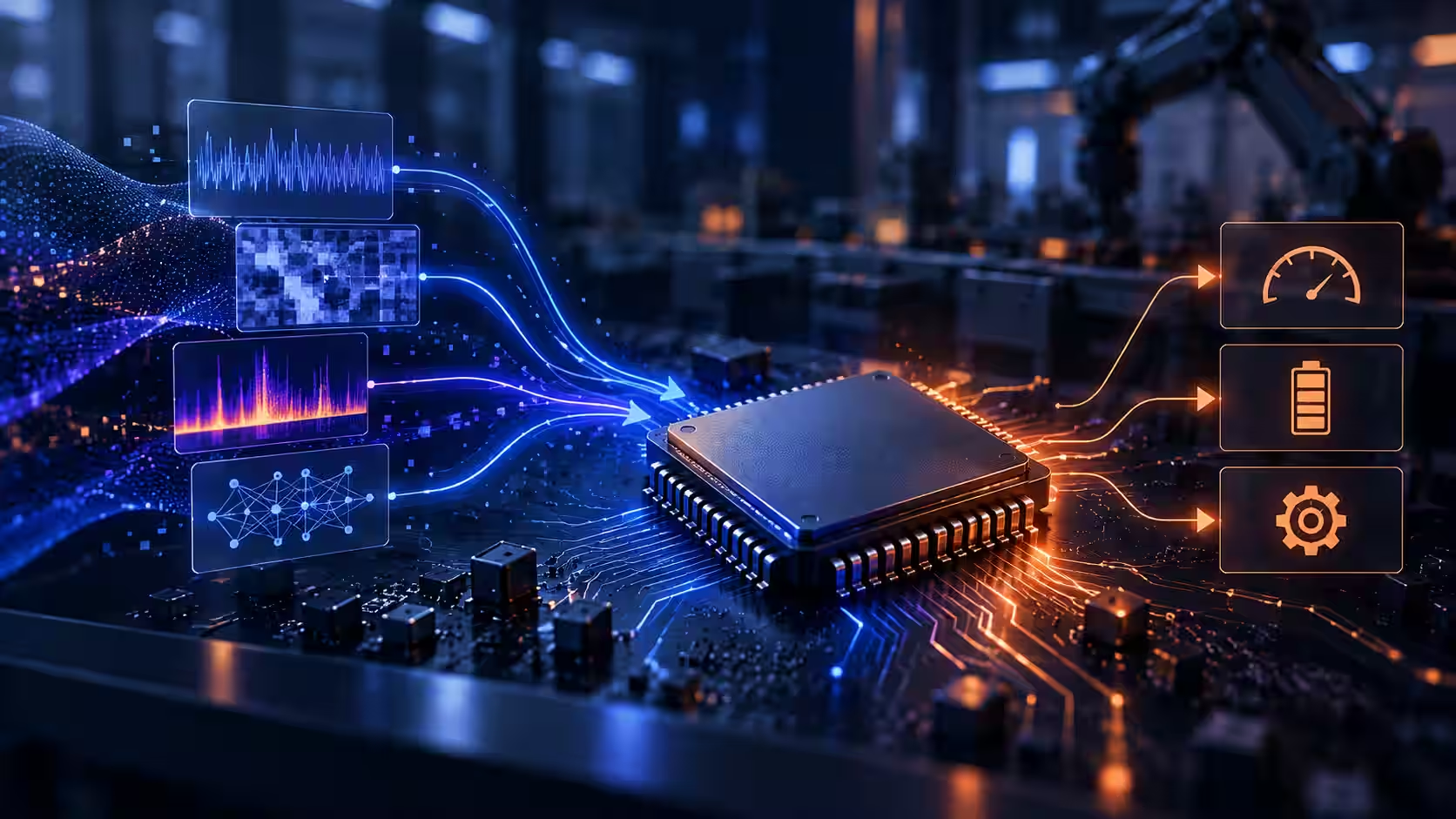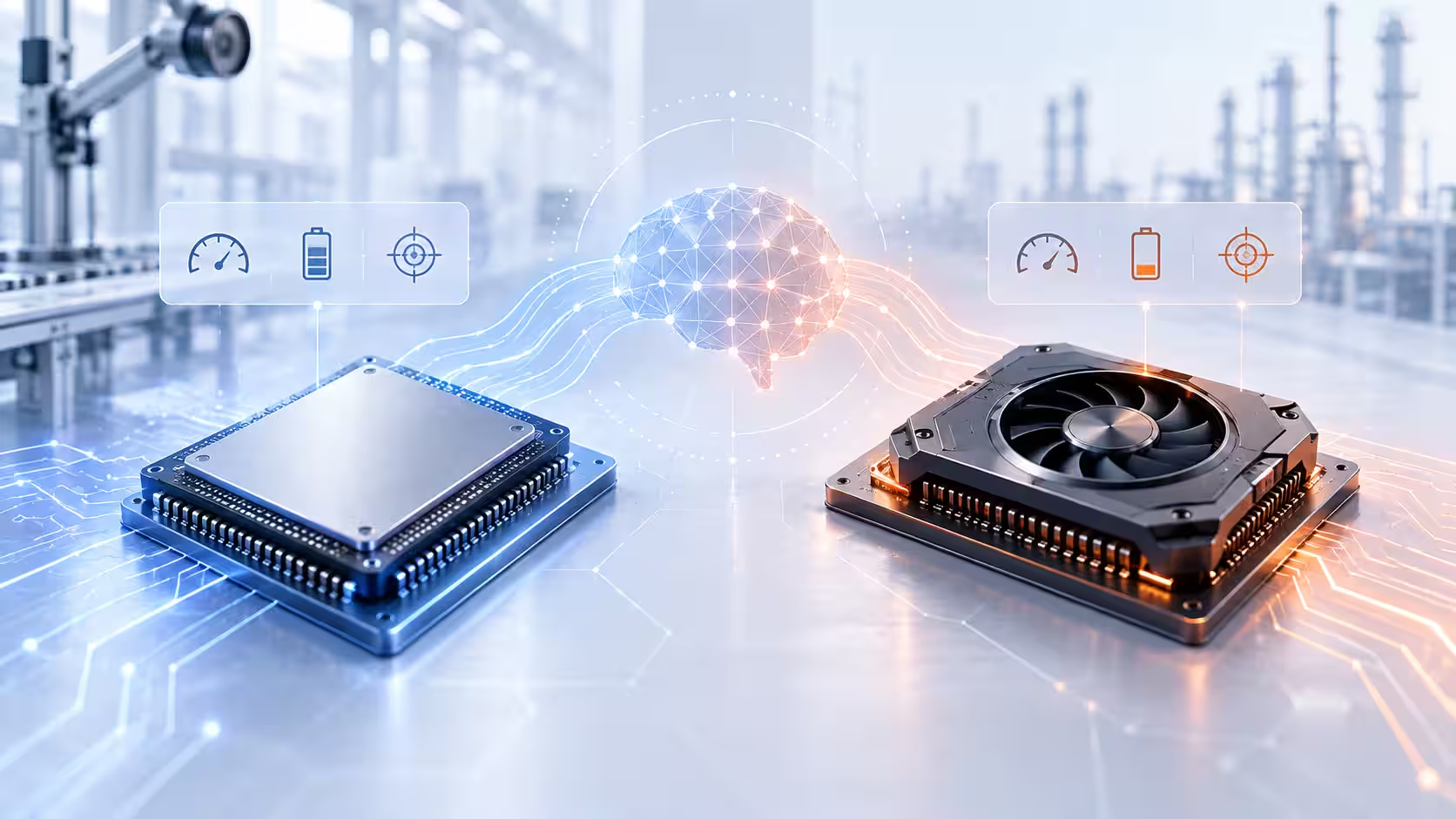
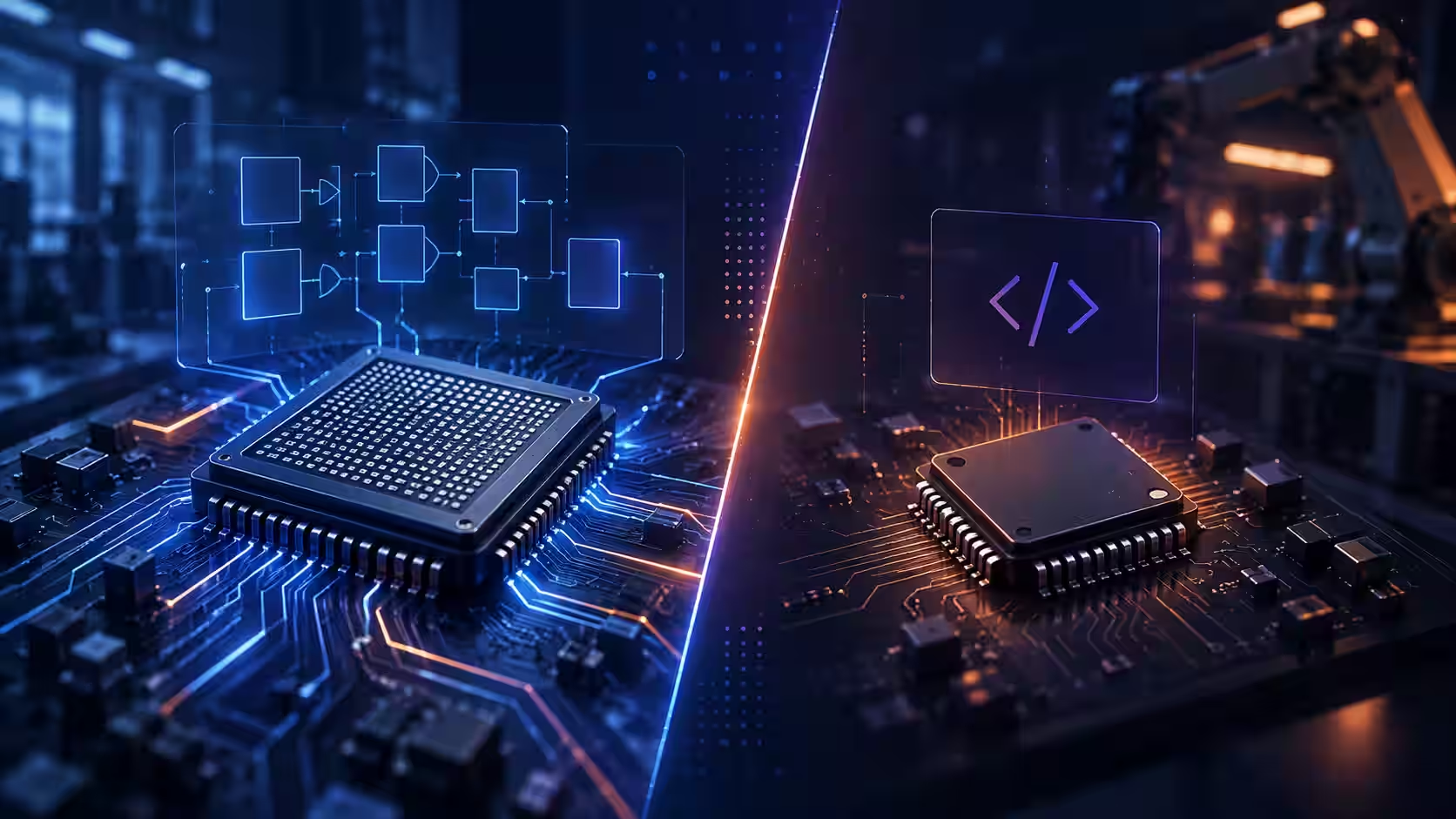
The useful question is not FPGA vs microcontroller in the abstract. It is how much of your processing is truly concurrent and how much is a chain of decisions. Parallel and data-heavy work belongs in programmable logic; complicated and sequential work stays in the processor. InTechHouse delivers microcontroller-based embedded firmware as well as FPGA and SoC work, which is why this comparison can be honest rather than motivated: a supplier that only sells FPGA has one answer to every question.
FPGA vs microcontroller gets asked as if one device is simply better than the other. It is not. The question that actually decides a design is how the workload behaves: is it many operations happening at once on a stream of data, or a long chain of decisions where each step depends on the last?
Fpgas and microcontrollers sit on opposite sides of that line. Parallel, data-heavy work goes to programmable logic, where operations run as physically separate circuits rather than as a queue. Complicated, sequential work, the kind full of branching logic and conditional decisions, stays in the processor, because that is exactly what a processor is built to execute one instruction at a time, efficiently.
InTechHouse delivers both sides of this comparison: microcontroller-based embedded firmware as well as FPGA and SoC work. That matters here specifically, because a vendor that only sells one half of this comparison has a structural reason to steer every reader toward it. This guide covers the four triggers that actually justify moving off an MCU, the honest costs of doing so, and, just as often, the case for staying on the microcontroller you already have.
A microcontroller earns its place in most embedded systems, and it is worth describing well rather than as the thing this article is trying to talk you out of.
The key components sit on a single chip: a central processing unit built around an arithmetic logic unit, program memory and data memory, random access memory for working data, a fixed set of communication interfaces, timers, converters, and low power modes for battery-sensitive designs. It executes instructions in sequence, one after another, written in C or another high level language and, occasionally, hand-tuned assembly language for the parts where timing is tight.
That sequence is the whole story of how a microcontroller works, and it is also its defining limit: a processor arrives with a defined set of interfaces and a defined set of functions, and you design inside that envelope. Need one more UART than the part offers, or a protocol timing the peripheral set was never built for, and there is no way to add it in software. That envelope is the fixed architecture, and in practice most designs run out of peripherals or interface options before they run out of clock cycles or processing headroom.
None of this is a weakness to be engineered around by default. For the overwhelming majority of embedded products, sensor readouts, user interfaces, motor control loops, communication stacks, a microcontroller handling specific tasks in sequence is the right answer, at the right cost, with the widest pool of engineers able to work on it.
A field programmable gate array is not a faster processor. It is a different kind of chip.
Instead of executing instructions, an FPGA is built from configurable logic blocks and programmable interconnects that you configure into custom digital circuits using hardware description languages, principally VHDL and Verilog. The source code describes hardware functionality directly rather than a sequence of steps for a processor to run, which is the conceptual jump most engineers coming from firmware have to make.
A few practical consequences follow, and a buyer feels all of them before the first working prototype. FPGA fabric configuration lives in volatile memory and is loaded again at every power-up, from external configuration memory or an onboard flash device depending on the family. The flow runs on specialized tools supplied by the device vendor rather than a general-purpose compiler; this is not software development with a different target, it is a different discipline with its own learning curve.
The reason it is worth that discipline: spare fabric can be deliberately left unused when a design ships, so hardware functions can be added later without changing the PCB. That is not a firmware update, it is a new function implemented at hardware level on a board that never needs a respin. Space and aerospace customers do exactly this on purpose, budgeting resource headroom into a design specifically so the next mission requirement can be absorbed in fabric rather than in a new board revision.
The table below is not "FPGA wins" against "MCU wins". Every row is a mechanical difference in how the two devices actually work, and which one fits depends entirely on the workload in front of you.
| Dimension | Microcontroller | FPGA |
|---|---|---|
| Execution model | Instructions executed in sequence | Concurrent hardware, configured once and running continuously |
| Adding a second, third data stream | Each stream competes for the same core; processing time grows with load | Each stream can run on its own physically separate logic |
| Interfaces | Fixed set defined by the silicon | Built to order in fabric, including interfaces the part was never designed with |
| Cost of a change after the board exists | Firmware update, in most cases | Possible in fabric without a board respin, if headroom was left for it |
| Unit cost | Lower, for equivalent functions the device already supports | Higher; the fabric and flexibility are what you are paying for |
| Who on the team can work on it | Most embedded engineers | A smaller pool with RTL and hardware description language experience |
| Time to first working hardware | Generally faster for a design inside the fixed peripheral set | Generally longer; more of the design is being built from scratch |
Read down that table and a pattern shows up: the FPGA rows are not "faster" or "better" in isolation, they are "how does this workload decompose". FPGAs excel at high speed parallel processing specifically because the operations are physically separate circuits rather than time slices on a shared core, which is also why they can handle multiple data streams without processing time growing with each new one. A microcontroller's rows are not weaknesses either, they describe a device built for the far more common case: one thing happening after another, on a fixed, well-documented set of interfaces.
This is the rule the rest of the article works from, stated in both directions on purpose: where processes are highly parallel and the data volumes are parallel and large, the FPGA will always be faster and better; where the operations are complicated and sequential, the processor is better.
The second half of that rule is what makes the first half worth trusting, and it comes with a specific, counter-intuitive example rather than a hedge.
"An FFT, for instance, computes better in the processor. But then large volumes of data, certain computations, for example where there are a lot of mathematical operations, are better offloaded to the FPGA. That is roughly how you partition it."
Adam Szychulec, Head of Hardware / Embedded, InTechHouse
The textbook answer puts a Fast Fourier Transform in the fabric, because it is signal processing and signal processing sounds like FPGA territory. A practitioner's answer does not, because an FFT is a tightly sequential chain of dependent operations, not a wide field of identical, independent ones. What belongs in fabric is large data volumes and computations built from many mathematical operations that can actually run side by side, real time signal processing, image processing and video processing among them, and that is roughly how the partitioning is actually done on a real design.
You can run this test on your own project without any FPGA experience at all. Take the three heaviest operations in your design and ask, for each one: is this one long chain of dependent decisions, or is it many identical operations applied to a stream of data? The first stays in the processor. The second is a candidate for fabric.
None of these triggers is, on its own, usually enough to justify the move. Two or three together, in the same project, usually are.
1. Parallel processing of large data volumes. Image processing, video processing and real time signal processing are the clearest task classes here: many identical operations applied continuously to a stream, which is exactly the shape fabric is built for and exactly the shape that overloads a single processor core as the data rate climbs.
2. Unusual or non-standard interface configurations. This is the most under-written trigger in the market, and often the actual reason a project moves off an MCU rather than the headline reason anyone states. The processor simply does not have the peripheral you need, or does not have enough of them, or cannot meet the specific timing your interface requires. That is a hard stop with a fixed-architecture chip, not a software workaround.
3. Timing pressure. A large volume of data that has to be processed in parallel within a short window, where the requirement is not "eventually" but "while the next batch is already arriving", pushes a design toward fabric because a sequential processor cannot parallelize its way out of a queue.
4. Flexibility for future development. Hardware-level functions added later without a PCB change, exactly the property described above: resources deliberately left spare in fabric so the next requirement lands in an update rather than a respin.
This is the section that earns the rest of the article's credibility, because it argues against the sale as often as for it.
On power: for the same function, an FPGA draws more power than a microcontroller doing the equivalent job. Low power modes are one of the reasons battery powered devices stay on microcontrollers by default, and moving to fabric for a battery-constrained product is a deliberate trade, not a free upgrade.
On cost efficiency, the honest statement is flat: an FPGA is the more expensive solution, and it is used where it is actually needed, not as a default upgrade path from a microcontroller. There are real cases, though, where unit price is not the axis that actually decides the design. InTechHouse has seen this pattern at an oil & gas customer and in other long-lifecycle industries: a processor an order of magnitude cheaper would have done the same job on day one, but the FPGA was chosen anyway for long-term device availability, so the product could stay in production for decades without a redesign around an obsolete part. In some of those cases, the rest of the board ended up obsoleting around the FPGA rather than the other way round.
There is a third cost that never shows up in a comparison table: who can build the thing. Writing RTL means building hardware in code. It requires a fundamentally different way of thinking than writing firmware, and most embedded engineers, including most of InTechHouse's own hardware department, who are strong on processors, never go there. Choosing an FPGA does not just change the bill of materials. It changes who on your team, or your supplier's team, can actually work on your product. Check FPGA design mistakes guide.
For many designs, the honest answer to "can I do this on a cheap processor instead of an FPGA" is that you keep the processor and add fabric next to it, on the same chip.
In practice, the split most often sits inside one device: the operating system and control flow run on the processor, and the parallel, time-critical work runs in the fabric alongside it. InTechHouse has delivered several Zynq-based systems built on exactly that pattern. The family worth naming properly here is Zynq and Zynq UltraScale+ from AMD/Xilinx, which pair FPGA fabric with a hard processor system on one die, with comparable processor-plus-fabric devices available from Intel/Altera and Lattice as market alternatives. See an article on What is a SoC FPGA.
Worth a mention in passing: a soft processor, a processor core implemented inside the fabric itself rather than as a separate hard block, is a standard technique on some families. It is limited by the fabric resources available on the specific device, so the boundary between "processor side" and "fabric side" is not always a fixed line on the die. Also see FPGA hardware acceleration guide and FPGA vs ASIC vs SoC.
Microcontrollers dominate sensor monitoring, motor control and engine control units in automotive systems, consumer electronics and medical devices, and they sit at the control layer of industrial automation and inside programmable logic controllers generally. That is the overwhelming majority of embedded products by volume, and it is exactly where a fixed architecture is the right architecture.
FPGAs appear where the requirement is high performance across many data streams at once: telecom infrastructure, test and measurement instrumentation, industrial control systems and data centers are where the market generally reaches for programmable logic.
InTechHouse's own FPGA and SoC delivery sits in a narrower set of industries: telecom, aerospace, oil & gas and rail, where long product lifecycles and unusual interface or timing requirements make the fixed architecture of a microcontroller the limiting factor more often than in general-purpose electronics.
Once a design's workload clears the bar above, which FPGA family and vendor fits is a different decision, covered in its own guide with the criteria that actually matter once you are past this one.
InTechHouse case study: staying on FPGA for long-term device availability
An oil & gas customer needed an embedded platform that would stay in production for decades without a board redesign, in an application where a lower-cost processor would have met the initial functional requirements. InTechHouse selected an FPGA-based approach specifically for the family's long production lifecycle rather than for raw processing needs, accepting a higher unit cost against the alternative of the rest of the board becoming obsolete around a discontinued part. The platform remains in production.
Not sure whether your workload actually needs an FPGA? Request an FPGA architecture assessment.
Not sure where to start? We work with companies at every stage, from early ideas to enterprise-level builds. A 30-minute call can save you months of guesswork.
Because the workload is highly parallel on large data volumes, needs an interface the processor does not have, needs timing that beats a sequential processor, or needs hardware-level flexibility after deployment. Those four triggers, not raw speed, are what actually justify the move.
For parallel work spread across many data streams, yes, because the operations run as separate physical circuits rather than as time slices on one core. For a long chain of dependent decisions, no, a sequential processor handles that better. There is no single answer that covers both cases.
Same shape of answer, with one specific exception worth naming: an FFT, a computation most people assume belongs in fabric, actually computes better in a processor. Large volumes of data and computations built from many parallel mathematical operations are the ones worth offloading to an FPGA.
High speed parallel processing of large data volumes, interfaces the processor simply does not have, and hardware-level changeability after the board already exists. Three concrete advantages, not a general claim of superiority.
It is the more expensive solution for the same function, it draws more power than a microcontroller doing equivalent work, and it changes who on your team can actually work on the product, since writing RTL is a different discipline from writing firmware.
Usually it does not replace it outright. In practice the two most often sit on a single chip, with the processor running control flow and the fabric handling the parallel, time-critical work next to it. A soft processor inside the fabric is also possible, though it is limited by the resources available on the device.
No. Both are boards built around a processor with a fixed architecture, executing instructions in sequence like any other microcontroller or single-board computer. An FPGA board, by contrast, ships with configurable logic you program into custom hardware circuits, not with instructions for a fixed processor to run.
A PSoC is an Infineon/Cypress product line that combines a processor with configurable analog and digital blocks, sitting as a middle ground between a plain microcontroller and a full FPGA. InTechHouse has no delivered project on PSoC specifically, so this is market context rather than something covered by our own experience.
Yes, for the same two reasons covered above: hardware-level changeability after a product has already shipped, and long device availability for products that need to stay in production for decades without a board redesign.
That is a different comparison with its own criteria, covered in its own guide rather than answered briefly here.
Damian Ledziński, PhD Eng., is an Applied Artificial Intelligence Expert and an Assistant Professor at Bydgoszcz University of Science and Technology. He has over 15 years of academic, research, software-engineering, and technology-development experience.
His work focuses on applying artificial intelligence, machine learning, deep neural networks, and data science to complex real-world systems. His principal research and engineering interests include autonomous unmanned aerial vehicles, drone navigation and swarm intelligence, biomedical engineering, medical signal and image analysis, predictive modeling, industrial IoT, and intelligent water-management systems.
Damian has contributed to multidisciplinary R&D initiatives including AI-assisted medical diagnostics, a Polish ventilator prototype, autonomous indoor drone systems for warehouse inventory, AI-supported water-consumption analysis, virtual medical assistants, and intelligent systems combining embedded devices with machine-learning models.
He is the author or co-author of more than 30 scientific publications. His work has appeared in international scientific publications covering artificial intelligence, biomedical engineering, signal analysis, autonomous systems, environmental monitoring, and data-driven infrastructure.
Damian is a co-creator of academic programs in Engineering in Medicine, AI in Medicine, and Data Science at Bydgoszcz University of Science and Technology. He combines scientific research with hands-on implementation, translating experimental AI methods into deployable technology. He writes about applied AI, machine learning, predictive analytics, autonomous UAV systems, AI in medicine, biomedical signal processing, industrial IoT, and intelligent models in real-world systems.
Damian Ledziński's academic profiles:
https://wtie.pbs.edu.pl/pl/pracownik/damian-ledzinski
https://www.researchgate.net/profile/Damian-Ledzinski
https://scholar.google.pl/citations?user=AlQpPB0AAAAJ&hl=pl
https://ludzie.nauka.gov.pl/ln/profiles/DN6pHXU6KZm/publications/f83a8833-6060-4fae-8628-3dbf57661394
This initial conversation is focused on understanding your product, technical challenges, and constraints.
No sales pitch - just a practical discussion with experienced engineers.
Share a few details about your product and context. We’ll review the information and suggest the most appropriate next step.