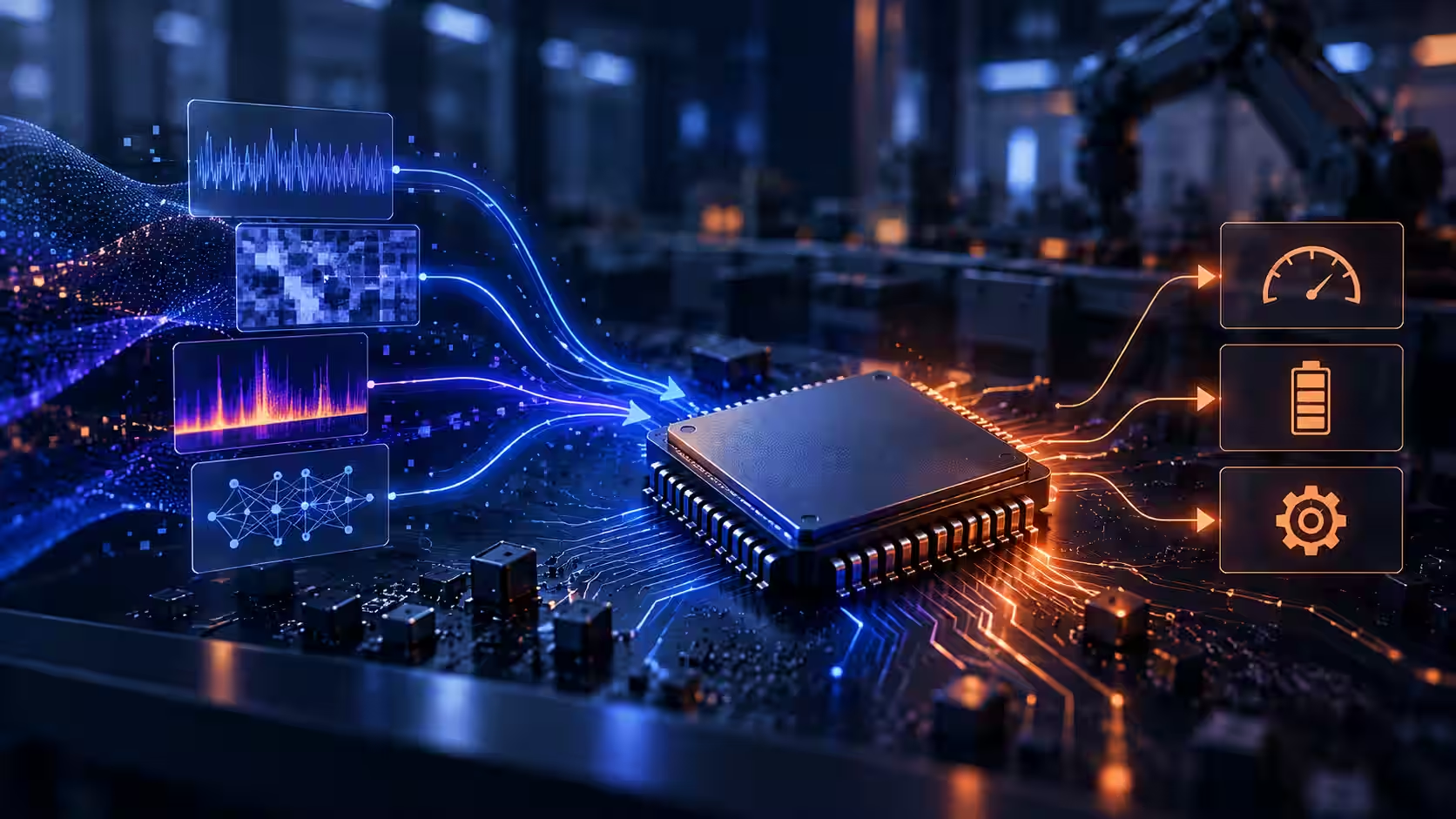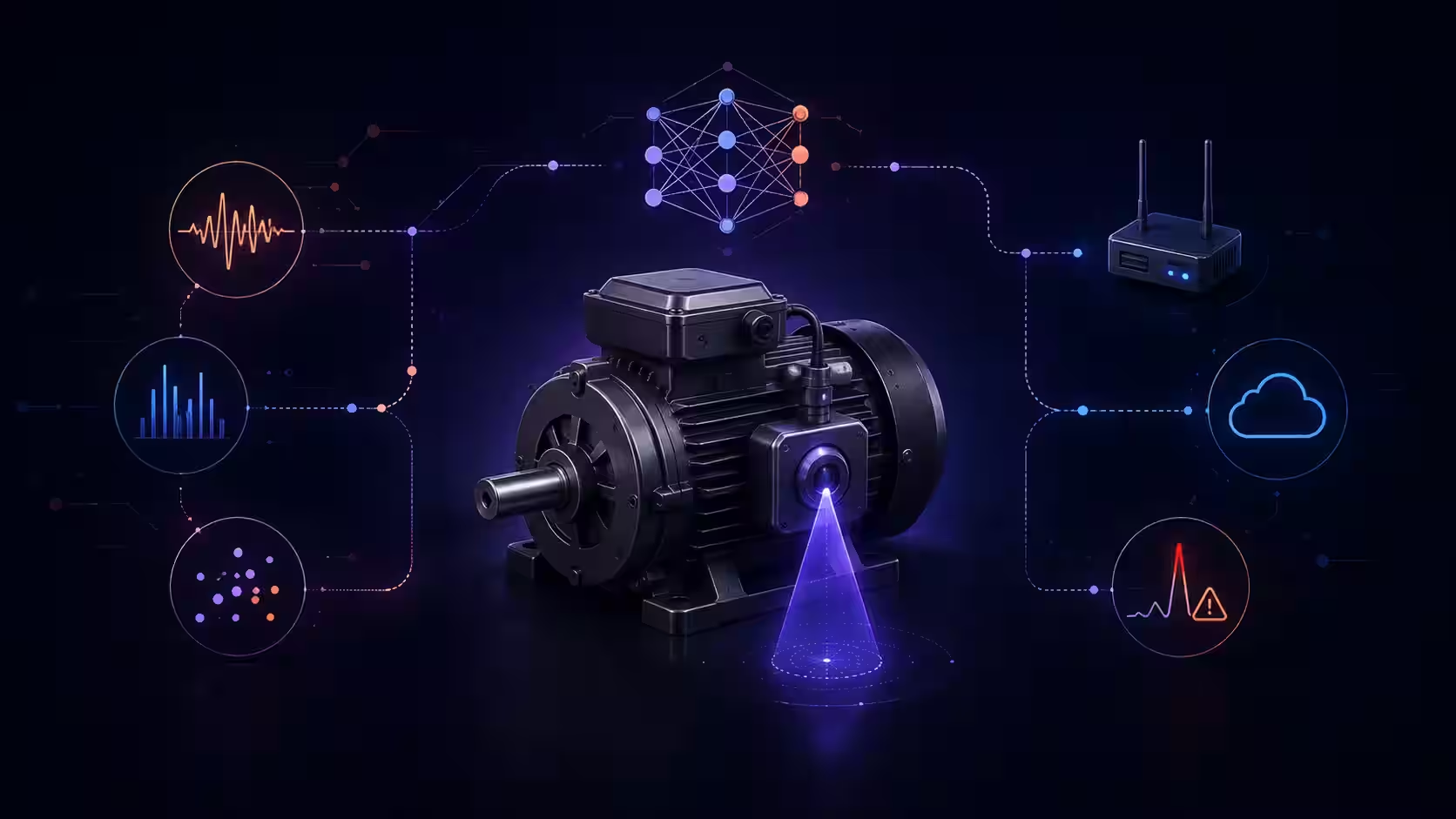
An FPGA is a genuine alternative direction for edge AI, and in some applications the better one. It is not the cheapest, and cost is the real problem. GPU-class modules, Jetson-class devices among them, remain the mainstream route to edge computing, and this comparison only makes sense if that is said plainly up front for anyone building embedded systems around it. The axes that actually decide fpga vs gpu are latency, how heavily the model has to be simplified, cost, and where the inference physically sits in the system, not a single performance number.
FPGA vs GPU is not a settled question with one winner, and treating it that way misses what each device is actually good at. An FPGA is a genuine alternative direction for edge AI, and in some applications the better one. It is not the cheapest option on the table, and cost is the problem that keeps it from being the default.
The mainstream route for edge devices running inference today is GPU-class modules, Jetson-class devices being the obvious example: compact, GPU-based compute modules built specifically for running trained models near the sensor, inside embedded systems with a fixed power and size budget. Any honest comparison starts from that fact rather than pretending the FPGA is the obvious choice.
What actually decides which platform fits a given design are four axes: latency, meaning how predictable the time from input to output has to be; how heavily the model can be simplified before it stops being useful; total cost, not just unit price; and where in the system the inference physically has to sit relative to the data it processes. Performance characteristics on a spec sheet rarely capture any of the four. This guide works through all four before landing on a decision rule.
Graphics processing units (GPUs) earn their dominant position at the edge on real merit, and it is worth understanding why before comparing anything against them.
A GPU is a fixed, massively parallel architecture: multiple cores, often thousands of relatively simple ones, paired with high memory bandwidth and real computational power, originally built for computer graphics and, as it turns out, extremely well suited to the matrix multiplications that dominate deep learning models and other complex calculations. That architectural fit is not a coincidence; the same math that shades millions of pixels in parallel is structurally close to the math that runs a neural network layer, and the same cores handle plenty of work well outside artificial intelligence, from scientific simulations to broader high performance computing workloads.
The reason GPUs are generally preferred for edge AI, though, is not primarily architectural. It is the software ecosystem built around them. Frameworks, compilers and deployment tools for graphics processing units are mature, most trained models, whether the task is machine learning, computer vision or general data processing, run on them with little or no modification, and software developers can deploy a working system without touching hardware design at all. That maturity, more than raw silicon capability, is the real moat GPU-class platforms hold at the edge, and it is the standard any alternative has to clear.
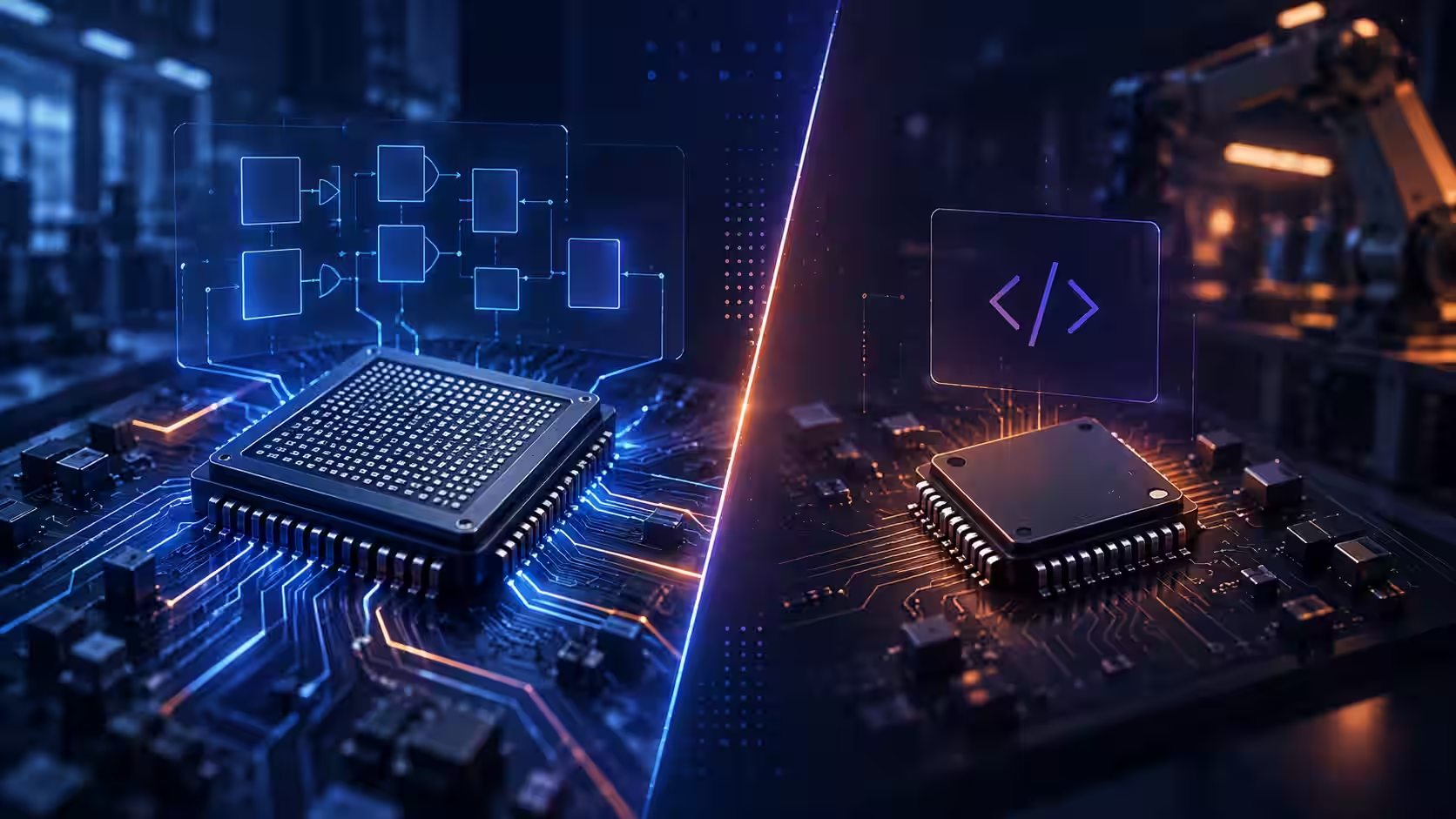
The contrast that makes this comparison worth having: a GPU runs software threads over a fixed execution model, while a field programmable gate array is configured directly into custom pipelines built from programmable hardware fabric, where each processing stage is a physical circuit and data elements are processed concurrently as they flow through the design, with minimal overhead between stages. Unlike an application specific integrated circuit, that fabric stays reconfigurable after the part is on the board, which is the property the rest of this article keeps coming back to.
That is what fine grained control actually buys a design, and it is why latency on an FPGA can be made predictable rather than reported as an average across many runs. Against central processing units specifically, the FPGA case is strong: it allows parallel processing in a way a sequential CPU structurally cannot, which is exactly why a processor is a weak platform for deep neural networks and why models running on processors are so often heavily simplified before they will run at all. The constraint a processor imposes on a design is not only speed. It is which model you are allowed to run in the first place.
Tools for implementing neural networks on FPGAs exist, and the market fact worth stating plainly is that a network implements considerably better on an FPGA than it does on a general-purpose processor. The same fabric that suits deep neural networks also suits other parallel processing tasks built from custom algorithms: digital signal processing, real time signal processing and real time processing of sensor data among them, wherever specific tasks need to run on many data elements at once rather than one after another. None of this comes for free, though: fpga programming is a hardware discipline, built on hardware description languages rather than a software stack, and it carries a longer build cycle and needs a different kind of engineering team than a GPU deployment does. Check FPGA hardware acceleration.
| Axis | GPU | FPGA |
|---|---|---|
| Execution model | Fixed architecture running software threads | Configurable fabric, built into a custom pipeline per design |
| Latency behavior | High average throughput across many parallel threads | Low latency execution, predictable rather than averaged |
| Power efficiency at a given workload | Higher power draw for general-purpose flexibility | Can be more power efficient for one fixed, well-defined workload |
| Development effort and who does it | Software developers, using standard ML frameworks | Hardware engineers, using hardware description languages |
| Software maturity | Mature ecosystem; most models run with little modification | Narrower tooling; a trained model has to be converted into hardware |
| Cost of changing the design later | Generally a software or model update | Can require re-implementing the pipeline in fabric |
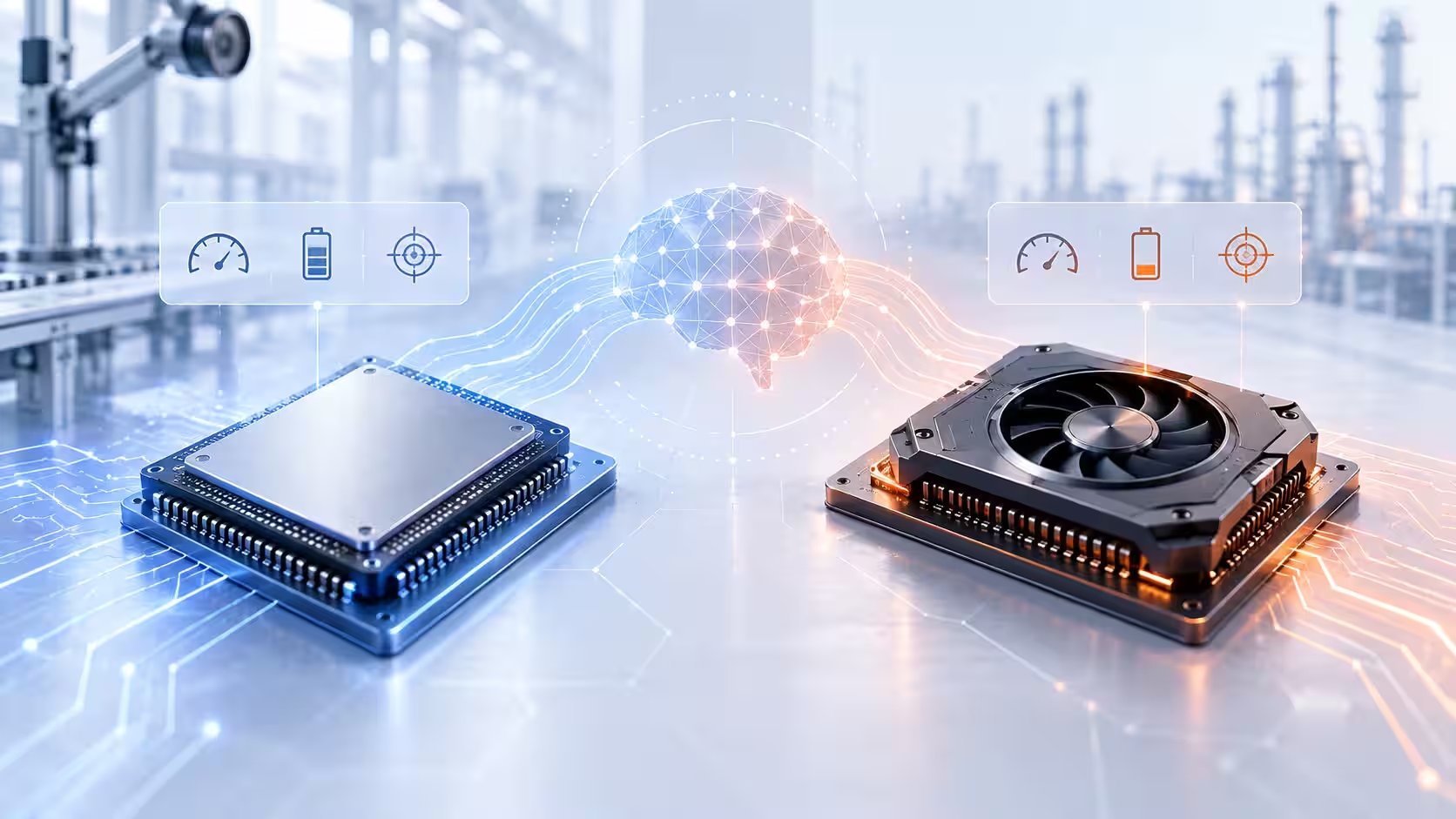
Read across that table and the key differences most comparisons miss become clear: a GPU's advantage is measured in throughput, and an FPGA's is measured in determinism, so ranking them on a single performance metric hides the actual trade a buyer is making. Neither platform simply "delivers performance" in the abstract; each delivers performance on a different axis, for a different shape of workload. They are not competing on the same one.
Energy efficiency also stops being an abstract concern once a deployment runs continuously rather than intermittently. At fleet scale, high power consumption does not stay low power for long: it starts to increase operational expenses, and, for organizations tracking it, to impact environmental concerns as well. That is a real axis in this decision, not a slogan added to sound responsible.
"It is one of the AI platforms, because AI implements very well on these platforms, but it is not the cheapest. It is one of the good platforms. A much better platform than a processor, because it allows parallelisation and a good level of neural-network implementation. [...] Cost is the problem here."
Adam Szychulec, Head of Hardware / Embedded, InTechHouse
That is the honest shape of the FPGA case: a capable platform, a clearly better one than a processor for this kind of workload, and a more expensive one to get there.
The cost shows up in three places, not one. The device itself costs more than an equivalent GPU module for a comparable design envelope, and that gap tends to widen for the most complex models, the ones with the deepest networks and the largest parameter counts. Converting a trained model into a hardware description is real engineering work, not a configuration step, and it happens on top of the model training itself. And the engineers who can do that conversion well are scarcer and harder to hire than software developers who can deploy AI models on a GPU module using standard tooling.
Against that, GPU usage carries its own bill over a product's life: higher power draw for general-purpose flexibility, which becomes an operational cost at volume and over a long deployment. Neither platform wins this comparison outright. It is a total-cost question a buyer has to answer against their own volume, duty cycle and expected product lifetime, not a question with a universal answer printed on a spec sheet.
Most FPGA vs GPU content written for this keyword stops at two platforms, and by 2026 that is out of date. That two-platform habit also shows up in FPGA vs microcontroller debates, where the answer also depends on whether a workload has outgrown an MCU.
Custom hardware accelerators, dedicated processors built specifically for implementing deep neural networks, now exist, both as discrete parts and as blocks integrated inside general application processors, and they are solidly mainstream domain specific architectures for exactly the designs this article is about. With enough RAM, some of this inference work can now be done on a general processor after all, something that was not a realistic option a few years ago. These purpose-built AI accelerators do not replace the FPGA or GPU conversation entirely, but they change it: for a growing share of edge designs running deep learning applications, the real shortlist has three entries, not two.
An article presenting FPGA against GPU as the whole live question in 2026 without mentioning purpose-built AI silicon is telling on itself, and a reader who works in this field day to day already knows the shortlist has widened. The right question by 2026 is not "FPGA or GPU" in isolation, it is which of the three platforms fits a specific workload's latency, model complexity and cost constraints.
There is a usable test here, and it only works if both conditions hold at the same time: you want to use a neural network, and you have to do it fast, with real time processing rather than a queued batch, where the model cannot be heavily simplified to get there.
Most edge inference does not clear both bars at once, which is exactly why the GPU route remains the default for the majority of designs. Where it does clear both, there is often a third, architectural reason as well: on a system on chip, the programmable logic may already be handling parallel data, image processing and real time signal processing as part of the design, so inference placed inside that same pipeline sits next to the data it needs rather than requiring a separate device and an extra data path. Complex models running multiple tasks in the same pipeline, not just one, are where this architectural case is strongest. Also see What is a SoC FPGA.
A production example of this pattern, from the wider market: an automotive driver-assistance system that reads road signs in real time and detects hazards from a camera feed, with the neural network implemented on a Zynq UltraScale device, a part with substantial fabric and several processor cores available for exactly this kind of parallel, latency-sensitive pipeline. It illustrates where the two-condition test plays out in a real, shipped product.
InTechHouse delivers edge AI on GPU-class platforms as its own service line, built on the mainstream route described above and aimed at embedded systems that need edge computing rather than a cloud round trip.
Separately, InTechHouse delivers FPGA and SoC systems for telecom, aerospace, oil & gas and rail customers, on projects unrelated to the edge AI service line described in the previous paragraph.
A supplier that has built on both sides of this comparison does not need you to choose one before you have worked out which platform actually fits your design. Explore the edge AI service. | Explore FPGA design services.
Not sure which platform your product needs? Request an FPGA architecture assessment.
Not sure where to start? We work with companies at every stage, from early ideas to enterprise-level builds. A 30-minute call can save you months of guesswork.
Yes. It is one of the good AI platforms, offering a much better level of parallelisation than a general-purpose processor. The caveat that has to travel with that answer: it is not the cheapest option, and cost is the real objection.
Yes, as the alternative direction rather than the default. GPU-class modules remain the mainstream route to edge inference; an FPGA becomes worth considering specifically when inference has to be fast and the model cannot be heavily simplified to fit the platform.
For targeted, latency-bound inference inside a specific embedded product, sometimes. For training a model in the first place, or for high throughput workloads processing many streams at once, no. Which half of that question you are actually asking determines the answer.
For parallel workloads, yes, and a general-purpose processor is a structurally weak platform for neural networks, which is exactly why models deployed on processors are so often heavily simplified. See FPGA vs microcontroller.
Not outright, but they have changed the comparison. Dedicated neural-network processors now exist as both discrete parts and blocks inside application processors, and with enough RAM some inference work that once needed an FPGA can now run on a general processor instead.
It is a hardware design discipline done in code, not software development with a different syntax. It uses hardware description languages, takes longer to build and verify, and needs a different kind of engineering team than a software deployment does.
Cost first: the device itself is more expensive for a comparable design envelope. Then the conversion effort, turning a trained model into a hardware description is real engineering work. Then the scarcity of engineers who can do it well, and a narrower software ecosystem than GPU-based tooling offers.
No. A Raspberry Pi is a single-board computer built around a processor with a fixed architecture, running software in sequence like any general-purpose computer. An FPGA is configured into custom hardware circuits instead of executing a fixed instruction set.
Damian Ledziński, PhD Eng., is an Applied Artificial Intelligence Expert and an Assistant Professor at Bydgoszcz University of Science and Technology. He has over 15 years of academic, research, software-engineering, and technology-development experience.
His work focuses on applying artificial intelligence, machine learning, deep neural networks, and data science to complex real-world systems. His principal research and engineering interests include autonomous unmanned aerial vehicles, drone navigation and swarm intelligence, biomedical engineering, medical signal and image analysis, predictive modeling, industrial IoT, and intelligent water-management systems.
Damian has contributed to multidisciplinary R&D initiatives including AI-assisted medical diagnostics, a Polish ventilator prototype, autonomous indoor drone systems for warehouse inventory, AI-supported water-consumption analysis, virtual medical assistants, and intelligent systems combining embedded devices with machine-learning models.
He is the author or co-author of more than 30 scientific publications. His work has appeared in international scientific publications covering artificial intelligence, biomedical engineering, signal analysis, autonomous systems, environmental monitoring, and data-driven infrastructure.
Damian is a co-creator of academic programs in Engineering in Medicine, AI in Medicine, and Data Science at Bydgoszcz University of Science and Technology. He combines scientific research with hands-on implementation, translating experimental AI methods into deployable technology. He writes about applied AI, machine learning, predictive analytics, autonomous UAV systems, AI in medicine, biomedical signal processing, industrial IoT, and intelligent models in real-world systems.
Damian Ledziński's academic profiles:
https://wtie.pbs.edu.pl/pl/pracownik/damian-ledzinski
https://www.researchgate.net/profile/Damian-Ledzinski
https://scholar.google.pl/citations?user=AlQpPB0AAAAJ&hl=pl
https://ludzie.nauka.gov.pl/ln/profiles/DN6pHXU6KZm/publications/f83a8833-6060-4fae-8628-3dbf57661394
This initial conversation is focused on understanding your product, technical challenges, and constraints.
No sales pitch - just a practical discussion with experienced engineers.
Share a few details about your product and context. We’ll review the information and suggest the most appropriate next step.