.avif)

In today’s data-driven world, the ability to extract meaningful insights from vast amounts of information is crucial for businesses seeking a competitive edge. However, the accuracy and reliability of these insights depend heavily on the quality of the underlying data. In this article, we will explore the significance of data quality in data analytics and how it impacts decision-making, business performance, and overall success.
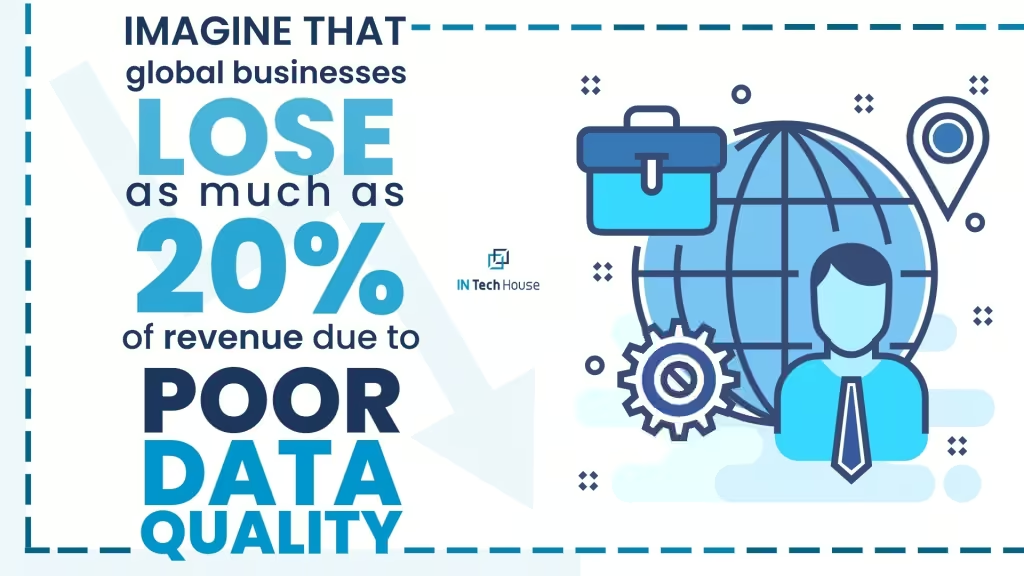
Source: WebinarCare
What is data quality? Data quality solution refers to the overall reliability, accuracy, completeness, consistency, and relevance of the info. It is the assessment of data against specific criteria to determine its fitness for use in various applications and decision-making processes. A high-quality dataset is free from errors, inconsistencies, and duplications, providing trustworthy and actionable information. By ensuring the data quality issue, organizations can rely on accurate and reliable insights to drive effective business strategies, improve operational efficiency, and enhance decision-making processes.
Data quality control should be a priority #1.
An important date can do wonders with a business, but an erroneous one can sink to the bottom, in the worst case. However, data quality is important when it comes to making decisions that will affect success. Here are some interesting examples.
Business Example: Company A (Using Data Quality) vs. Company B (Using Wrong Data)
Company A – Utilizing Data Quality: Company A, a global e-commerce retailer, recognizes the importance of data quality in its operations. They have implemented robust data quality processes and systems to ensure the accuracy and reliability of their data. By maintaining high-quality customer and product data, they can provide personalized shopping experiences, accurate inventory management, and targeted marketing campaigns. This has resulted in improved customer satisfaction, increased sales, and efficient supply chain operations.
Customer data integration should be priority #2.
Company B – Using Wrong Data: Company B, a multinational telecommunications provider, has been struggling with data quality issues. Due to inadequate data management practices and a lack of data validation processes, customer data has become outdated, inconsistent, and filled with errors. As a result, they experience challenges in delivering personalized services, targeting marketing campaigns effectively, and managing customer complaints. This has led to customer dissatisfaction, increased churn rates, and loss of market share to competitors who leverage high-quality data for better customer experiences.
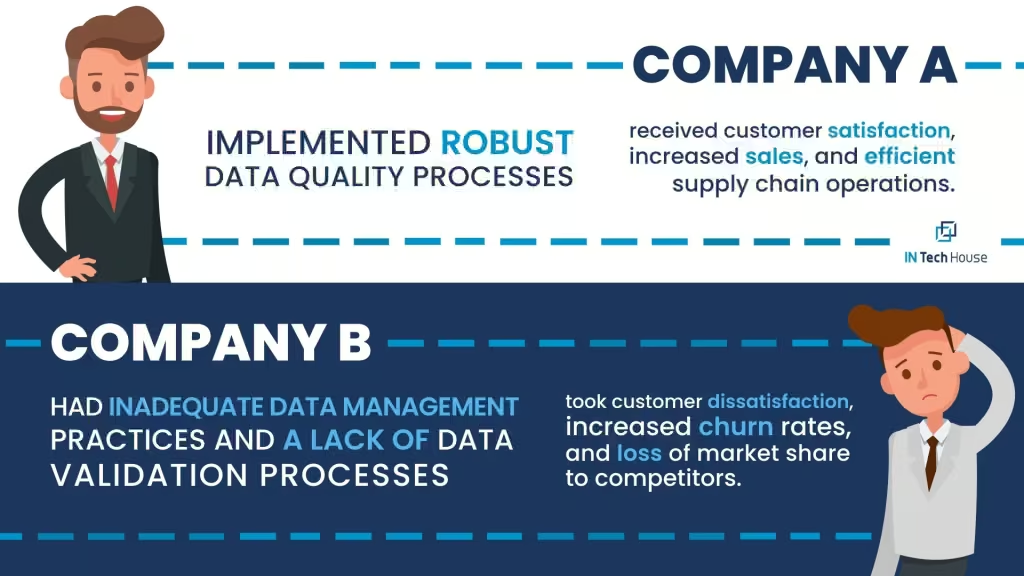
In this example, Company A demonstrates the benefits of prioritizing data quality, which has positively impacted their business performance, customer satisfaction, and operational efficiency. On the other hand, Company B’s reliance on wrong data has resulted in negative consequences, including customer dissatisfaction and loss of competitive advantage. This highlights the importance of investing in data quality initiatives and leveraging accurate and reliable data to drive business success in today’s data-driven world.
Duplicated records and stale master data are usually a symptom of missing validation at ingestion, not a reporting issue. We design ingestion and governance rules that stop bad data before it reaches your dashboards.
Talk to our engineering team
Fixing data quality issues is a critical task for organizations to ensure the accuracy and reliability of their data in 2023 and beyond. Because if you have data errors, it’s just about wasting time and money. This year’s research shows that data downtime nearly doubled year over year, driven by a 166% increase in time.

Source: The state of data quality 2023
Fixing data quality is essential because it enables informed decision-making, enhances customer satisfaction, improves operational efficiency, ensures regulatory compliance, reduces costs, enables better analytics, and builds trust and credibility. By investing in data quality, organizations can drive better business outcomes and stay competitive in today’s data-driven landscape.
Businesses can receive many benefits from good data quality.

They are:
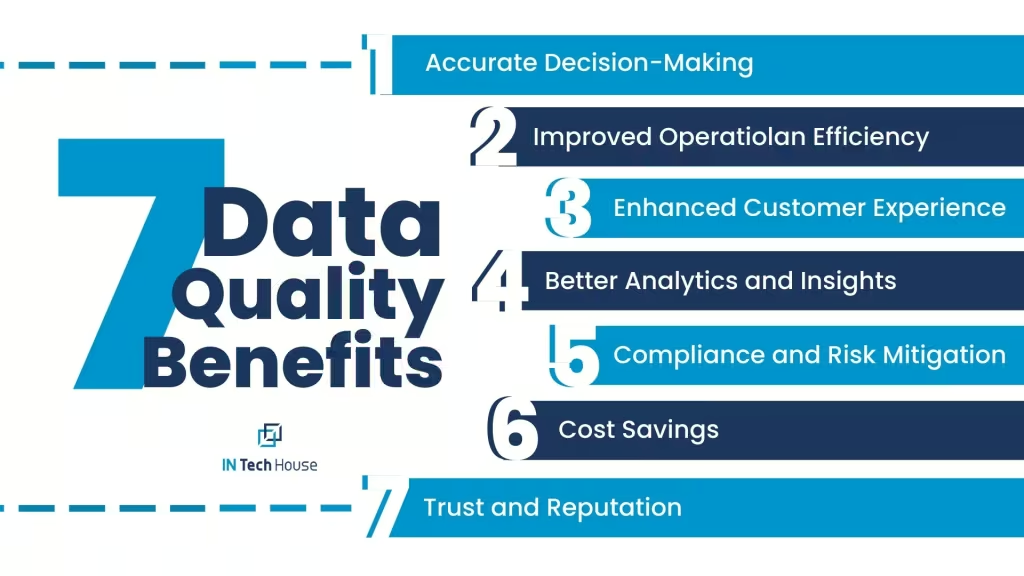
Good data quality brings numerous benefits to businesses, including accurate decision-making, improved operational efficiency, enhanced customer experience, better analytics and insights, compliance and risk mitigation, cost savings, and a positive reputation. By investing in data quality initiatives and maintaining clean and reliable data, organizations can unlock these advantages and gain a competitive edge in the data-driven business landscape.
Read also:
• What is data integrity?
• Data Redundancy: Key to data integrity & high availability
• Industrial DataOps: Best Practices for the Factory Floor
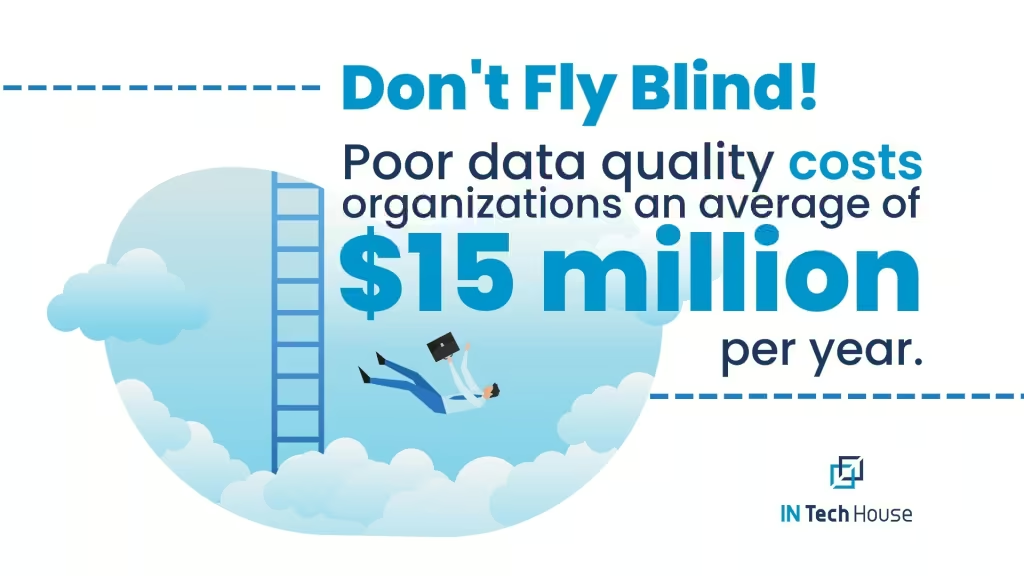
Source: Forbes
Data quality is vital to organizations as it enables reliable decision-making, enhances customer satisfaction, improves operational efficiency, ensures regulatory compliance, enables effective analytics, builds trust and reputation, reduces costs, and mitigates risks. By recognizing the importance of data quality and implementing appropriate data governance and quality management practices, organizations can unlock the full potential of their data and drive success in today’s data-driven world.
Data quality management tools and techniques are essential for organizations to ensure the accuracy, completeness, consistency, and reliability of their data. Here are some common tools and techniques used in data quality management:
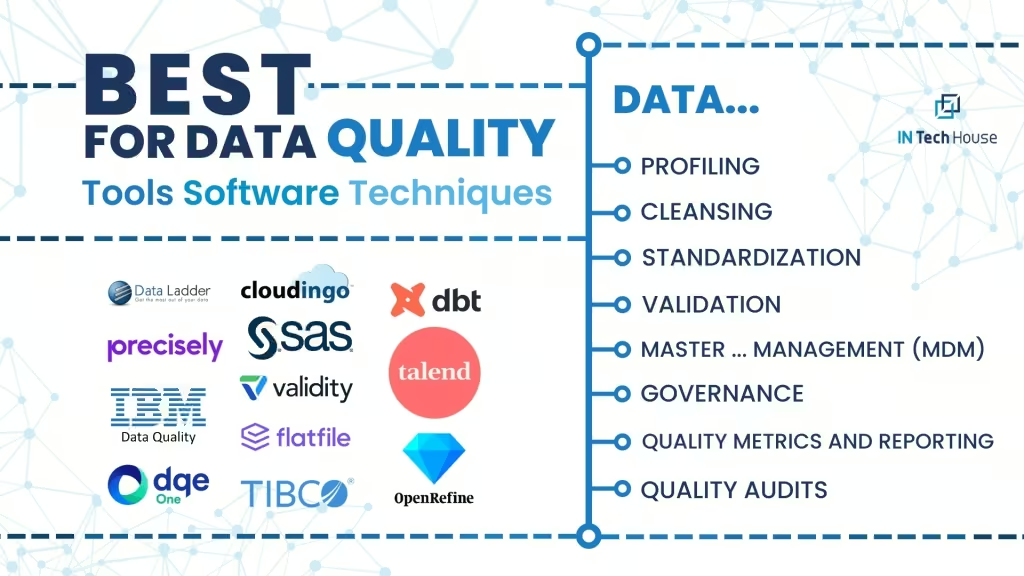
Organizations need to select the appropriate tools and techniques based on their specific data quality challenges and requirements, which mirror the challenges in implementing big data analytics our clients report most often.
Data Sources:
InTechHouse experience, DataMation, G2, SolutionReview
Organizations need to select the appropriate tools and techniques based on their specific data quality challenges and requirements, which mirror the challenges in implementing big data analytics our clients report most often. Implementing a comprehensive data quality management strategy supported by these tools and techniques can significantly improve the accuracy, reliability, and usability of data, leading to better decision-making, enhanced operational efficiency, and improved business outcomes.
Improving data quality is crucial for organizations to ensure the accuracy, completeness, and reliability of their data. Here are some effective strategies to improve data quality:
By implementing these strategies, organizations can significantly improve data quality, leading to more reliable analytics, better decision-making, enhanced customer experiences, and improved overall business performance.
Data Quality and Data Integrity are two related but distinct concepts in the realm of data management, and our guide to what data integrity is sets the boundary between them. Here’s a comparison between the two:
While both data quality and data integrity aim to maintain accurate and reliable data, they have different focuses and scopes. Data quality addresses the overall quality and fitness for the use of data, encompassing various aspects such as completeness and consistency. On the other hand, data integrity specifically deals with preserving the accuracy and reliability of data, guarding against unauthorized changes or corruption.
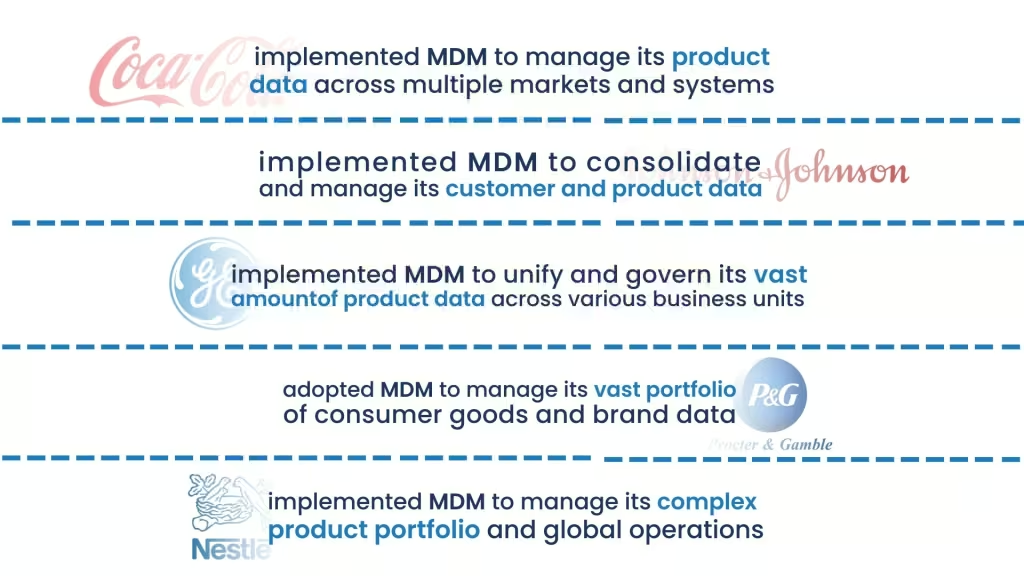
Master Data Management (MDM) is an approach that focuses on creating a single, consistent, and authoritative source of master data within an organization. Here are a few examples of how MDM is used in businesses:
Master Data Management (MDM) is widely used across industries to centralize and manage critical data domains, such as customer data, product data, supplier data, financial data, and employee data. By establishing a single source of truth for master data, businesses can improve data quality, streamline processes, enhance decision-making, and achieve better operational efficiency.Popular global brands used MDM for the data quality improvement process. Look at those great examples:
See also:
Data Redundancy: Key to data integrity & high availability
Industrial DataOps: Best Practices for the Factory Floor
At InTechHouse, we have extensive Talk to our engineering team and creating innovative solutions to address complex data processing challenges. One of our notable projects is the development of a data processing solution, as showcased in our case study. This solution allows our clients to efficiently receive and process data from diverse sources.In addition to data processing, we have also worked on a project focused on data analysis standardization. The objective was to enable a consistent analysis of data from various sources scattered throughout the organization. By implementing standardized data analysis practices, our clients can extract meaningful insights, make informed decisions, and drive business growth.
Our commitment to delivering high-quality software solutions, combined with our expertise in data analysis and processing, has allowed us to successfully assist our clients in harnessing the power of data. Whether it’s building custom data processing systems or standardizing data analysis practices, we strive to provide reliable and efficient solutions tailored to our client’s unique needs.
Our data engineers implement lineage, quality checks and ownership models on industrial and enterprise data platforms. Book a review of your current pipeline and we will show you where quality breaks.
In the realm of data analytics and business intelligence, one principle stands out above all: data quality is the best policy. Ensuring the accuracy, completeness, and reliability of data is crucial for organizations seeking to make informed decisions, gain valuable insights, and achieve their business goals.High-quality data serves as the foundation for successful data-driven initiatives. It enables organizations to trust the information they rely on, confidently perform analysis, and make sound business decisions. On the other hand, poor data quality can lead to misinterpretations, flawed analyses, and misguided actions that can have detrimental effects on an organization’s bottom line.
By prioritizing data quality, organizations can unlock numerous benefits. Do you want to join in?
Not sure where to start? We work with companies at every stage, from early ideas to enterprise-level builds. A 30-minute call can save you months of guesswork.
The main dimensions of data quality are accuracy, completeness, consistency, timeliness, validity and uniqueness. Accuracy checks values against reality, completeness measures missing fields, and consistency compares the same entity across systems. Timeliness asks whether data arrives before decisions need it, validity whether values follow formats and business rules, and uniqueness whether duplicates exist. Frameworks such as ISO 8000 formalize these concepts, but most teams start by tracking two or three dimensions tied to specific reports.
Data quality is measured with rule-based checks that produce ratios per dataset, such as the share of complete records, duplicate rate, rule violation rate and data freshness against an agreed deadline. Each check has a threshold that triggers an alert or blocks a pipeline. Tools such as Great Expectations, Soda or dbt tests run these checks automatically on every load. Publishing the scores next to the dataset lets consumers judge fitness for use before relying on it.
Data quality checks should run as close to the source as possible, at ingestion, and again after each transformation that changes meaning. Catching a malformed record at ingestion costs one rejected row, while catching it in a board report can mean restating figures. Ingestion checks cover schema, types and mandatory fields. Post-transformation checks cover business rules, reconciliation totals and referential integrity. Checking only at the reporting layer turns quality work into manual cleanup.
Responsibility for data quality sits with the business owner of each data domain, supported by data stewards and data engineers who implement the controls. The business owner defines what correct means, for example which customer status values are valid. Stewards maintain rules and resolve exceptions, while engineers build validation into pipelines. Assigning quality solely to IT fails because engineers can detect a broken rule but cannot decide what the correct business value should be.
Master data management is worth the investment when the same core entity, typically customer, product or supplier, is maintained in several systems and the copies disagree in ways that cost money. Symptoms include duplicate customer accounts, conflicting product attributes between ERP and e-commerce, and manual reconciliation before every reporting cycle. MDM programs require governance and stewardship, not only software, so a single system with one owner rarely justifies a dedicated platform.
Tomasz Andrysiak, DSc, PhD, is an Expert and a Professor at Bydgoszcz University of Science and Technology. He has more than 30 years of academic, research, R&D, and technology-implementation experience in artificial intelligence, computational intelligence, signal processing, anomaly detection, cybersecurity, and complex information systems.
His research focuses on machine-learning and computational-intelligence methods for analyzing signals, time series, network traffic, industrial data, and multimodal datasets. He specializes in anomaly and failure detection, predictive modeling, intelligent monitoring, critical-infrastructure security, smart metering, biomedical signal analysis, and the practical deployment of AI in industrial and public-sector systems.
Tomasz is the author or co-author of more than 75 scientific publications, including papers published in internationally recognized journals and conference proceedings indexed by Web of Science and Scopus. His research has covered network anomaly detection, cybersecurity of critical infrastructure, ECG signal analysis, machine learning, smart water networks, telecommunications, and intelligent industrial systems.
He has led and contributed to national and European R&D programs focused on cyber situational awareness, critical-infrastructure resilience, autonomous systems, Big Data, intelligent water management, blockchain-based transaction platforms, and industrial AI. He leads industrial-doctorate projects involving AI-based CMDB automation and machine-learning methods for knowledge discovery in Big Data.
Tomasz is an IEEE Senior Member and has served as an elected member of the Commission of Informatics and Automation of the Polish Academy of Sciences, Poznań Branch. He has participated in scientific committees and journal boards, supervised doctoral research, reviewed publications for international journals, and co-authored patents and patent applications related to signal detection and LoRa-based ECG monitoring. He writes about industrial AI, machine learning, anomaly detection, predictive analytics, cybersecurity, signal processing, time-series analysis, and intelligent infrastructure.
Tomasz Andrysiak's academic profiles:
https://orcid.org/0000-0001-8138-6619
https://ludzie.nauka.gov.pl/ln/profiles/fHOpojQ2lIF
https://link.springer.com/chapter/10.1007/978-3-642-32384-3_28
https://www.researchgate.net/profile/Tomasz-Andrysiak
https://scholar.google.com/citations?user=RHW7zx4AAAAJ&hl=pl
https://dblp.org/pid/41/6793.html
https://radon.nauka.gov.pl/dane/profil/6FFA1E51186802ECFFB49644209B5BE0EBD68C55
https://pbs.edu.pl/pl/pracownik/tomasz-andrysiak
https://www.youtube.com/watch?v=6e1GTqT5czM
From first prototype to production, our engineers can help you scope it, build it and get it certified.
This initial conversation is focused on understanding your product, technical challenges, and constraints.
No sales pitch - just a practical discussion with experienced engineers.
Share a few details about your product and context. We’ll review the information and suggest the most appropriate next step.