
6 Challenges in Implementing Big Data Analytics Based on Our Client's Experience


Global businesses are now constantly seeking ways to extract valuable insights from the vast amount of information available. Implementing big data analytics can unlock tremendous value for businesses by providing valuable insights, driving informed decision-making, and enabling competitive advantage, and we show how data analytics influences decision-making once those insights reach the management table. However, organizations often encounter various challenges during the implementation process. Based on our professional experiences, we have identified six data analytics challenges that businesses face when implementing big data analytics solutions.
What is Big Data and Why Does It Matter?
Big data refers to vast amounts of structured, semi-structured, and unstructured data that organizations generate and collect from various sources such as social media, sensors, online transactions, and more. This data is characterized by its volume, velocity, and variety, and it often exceeds the processing capabilities of traditional data management systems. Big data holds significant value as it contains insights, patterns, and trends that can drive strategic decision-making, optimize operations, and unlock new opportunities for businesses.
The importance of big data lies in its potential to revolutionize how organizations operate and compete in today’s digital landscape. By harnessing the power of big data and data analysis, companies can gain valuable insights into customer behaviour, market trends, operational inefficiencies, and more. This enables them to make data-driven decisions, personalize customer experiences, enhance product offerings, improve operational efficiency, and ultimately drive profitability.
Examples of Big Brands Using Big Data and Their Profits:
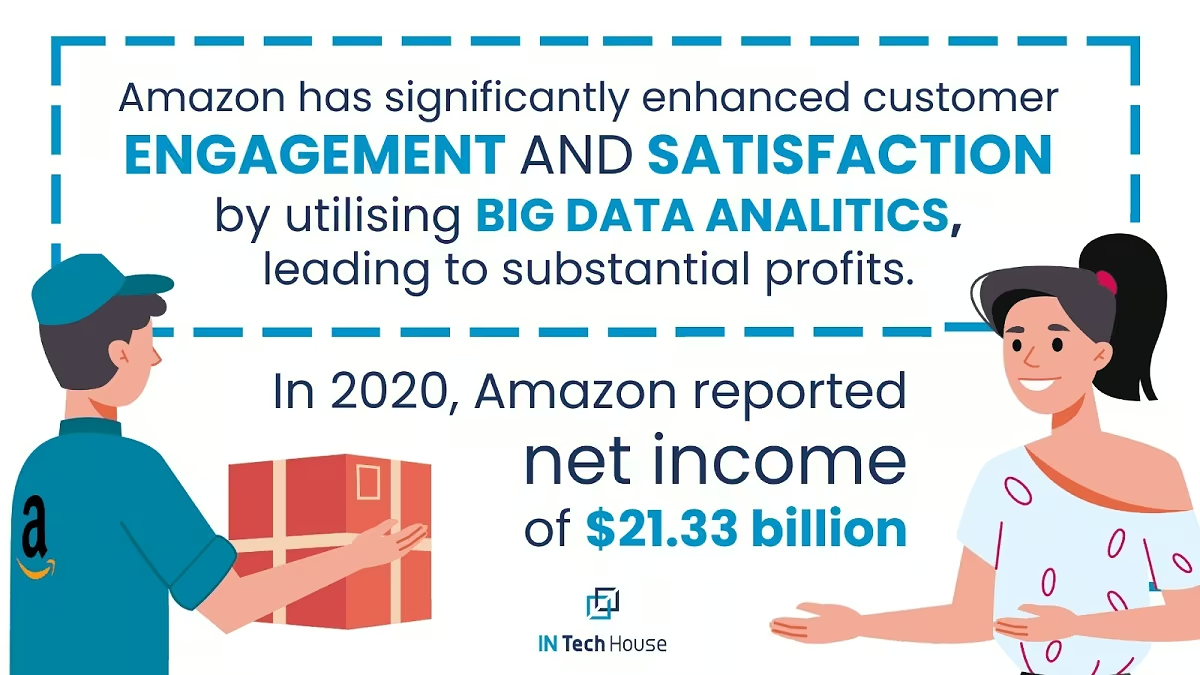
- Amazon: Amazon is a prime example of a company that leverages big data to fuel its success. With its vast e-commerce platform, Amazon collects and analyzes massive amounts of customer data on customer purchasing behaviour, preferences, and browsing history. This data powers personalized product recommendations, targeted advertising, and dynamic pricing strategies.
But there are some data analytics challenges that make the data collection process hard and useless.

Challenge 1. Defining Clear Objectives and Use Cases
One of the initial challenges is defining clear objectives and identifying relevant use cases for big data analytics. Without a clear understanding of what the organization aims to achieve and how big data analytics can support those goals, the implementation process can lack direction. It is crucial to align the analytics initiatives with strategic objectives, prioritize use cases based on their potential impact, and ensure stakeholders are involved in the process.
Solution 1. Be Aware of How to Get and Use Insights
Develop a compelling and feasible business justification for your project, involving business professionals to gain a deeper comprehension of their data collection requirements and the actions they can take based on it.Incorporate advanced analytics to uncover novel approaches for interpreting and comprehending insights, ensuring that these valuable findings are easily accessible to all members of the organization.
Supply the organization with contemporary visualization tools, interactive dashboards, and user-friendly interfaces that enable data exploration, report generation, and seamless data communication within the company.
Most failed analytics programmes fail on ingestion, quality and ownership, not on algorithms. We design and build the industrial data platform underneath so the analytics has something reliable to run on.
Challenge 2. Managing Vast Amounts of Data

Source: Dell
Big data lives up to its name, with organizations accumulating terabytes and even exabytes of data that continuously grows. Without proper management, businesses can struggle to keep up with this growth, miss out on extracting value from their data assets, and have an opportunity to receive more inaccurate data.
Solution 2. Using Management Tools
Implement management and storage technologies to address the increasing volume and challenges of handling big data. Whether you choose cloud, on-premises hosting, or a hybrid approach, ensure it aligns with your business goals and organizational needs. Establish a scalable architecture and utilize tools that can adjust to the growing data volume while maintaining data integrity.
Challenge 3. Data Integration and Quality Assurance
Data integration remains a significant challenge in big data analytics implementations, and it starts with the pipeline model we describe in what big data analytics is.

Source: Digiteum
Organizations often have data scattered across various systems, departments, and formats. Integrating this disparate data into a unified and accessible format can be complex and time-consuming. Additionally, ensuring data quality, including accuracy, completeness, and consistency, requires robust data cleansing and validation processes. Organizations must invest in data integration technologies and establish data governance practices to address these challenges effectively.
Solution 3. Using Data Source Utilization
Storing, managing, and analysing large amounts of data is a problem even for large business enterprises.
To tackle collecting meaningful data challenges, organisations are looking at options like big data analytics tools and data lakes that can help reduce the time and effort involved in deriving business value from “big data”, provided that data quality in data analytics is controlled before anything reaches the lake.
Create an inventory to gain a clear understanding of the data sources utilized and assess the feasibility of integrating them for comprehensive analysis. This process is primarily a business intelligence responsibility as it involves collaboration with business professionals who possess contextual knowledge and can determine the data necessary to achieve their BI objectives.
Embrace data integration tools that facilitate the connection of data from diverse resources, including files, applications, databases, and data warehouses, and enable their preparation for big data analytics. Depending on the existing technologies within your organization, you can leverage established platforms like Microsoft, SAP, and Oracle, or opt for specialized tools such as Precisely or Qlik, which specifically focus on data integration.
Challenge 4. Infrastructure and Scalability
Big data analytics requires a robust and scalable infrastructure capable of handling large volumes of data and processing complex analytics algorithms. Many organizations struggle with selecting the right infrastructure and technology stack that aligns with their requirements and can accommodate future growth. Building a scalable infrastructure involves considerations such as storage, computing power, network bandwidth, and cloud vs. on-premises solutions. Organizations need to carefully assess their current and future needs to avoid infrastructure limitations that hinder analytics capabilities.
Solution 4. Having an Inventory Approach
Create a comprehensive inventory to identify the origins of your data and assess its suitability for integration into a unified analysis. This task is primarily under the domain of business intelligence, as it requires input from business experts who possess contextual knowledge and can determine the data necessary to achieve BI objectives successfully.
Embrace data integration tools designed to facilitate the connection of data from diverse sources, including files, applications, databases, and data warehouses, and prepare it for big data analytics. Depending on your organization’s existing technologies, you have the option to leverage industry-leading providers such as Microsoft, SAP, and Oracle, or opt for specialized tools specifically tailored for data integration, like Precisely or Qlik.
Challenge 5. Talent Shortages Present Many Big Data Issues
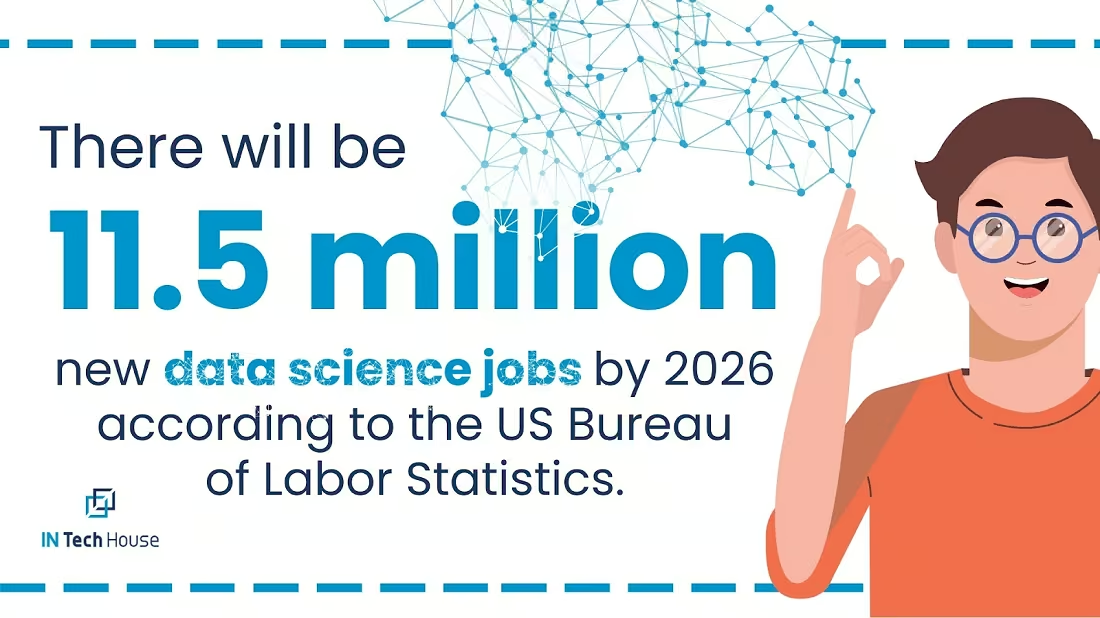
Big data analytics demands specialized skills in areas such as data science, machine learning, statistics, and programming. Finding and acquiring talent with the necessary expertise is a significant challenge. The scarcity of skilled professionals in the job market often leads to intense competition for talent. Organizations must develop strategies to attract and retain top talent, including partnering with educational institutions, upskilling existing employees, and fostering a data-driven culture that encourages professional growth.
Solution 5. Right Global Collaboration
One effective and expeditious approach to address talent shortages is by collaborating with a proficient and dependable technology provider who can readily supplement your big data and BI requirements. Outsourcing your project could also prove cost-effective if in-house hiring exceeds your budget constraints.
As you and your team possess unparalleled knowledge of your data, consider upskilling your existing engineers to acquire the required expertise and retain the talent in-house.
Develop analytics and visualization tools that are accessible to non-technical specialists within your organization. Simplify the process for employees to obtain insights and seamlessly incorporate them into the decision-making process.
Challenge 6. Privacy, Security, and Compliance

Big data analytics involves working with vast amounts of sensitive and confidential data. Organizations must prioritize data privacy, security, and compliance with regulations to mitigate risks and maintain customer trust. Implementing robust data protection measures, including encryption, access controls, and data anonymization techniques, is crucial. Organizations should also stay updated with relevant data protection laws and industry regulations to ensure compliance and avoid legal implications.
Solution 6. Put Security First
Ensure that the security of big data is an integral part of the initial planning, strategy, and design stages. Neglecting this aspect and considering it as an afterthought could result in significant big data issues and substantial financial penalties.
Thoroughly assess both your data and its sources to ensure compliance with the relevant regulations that pertain to your industry and location. This includes examining adherence to regulations such as GDPR in the EU, HIPAA, and HITECH Act for healthcare data in the US, among others.
Read also:
- Big Data Analytics: What It Is And Why It Matters
- The Importance of Data Quality in Data Analytics: Unlocking the True Value of Insights
- Industrial DataOps: Best Practices for the Factory Floor
Preventing Big Data Challenges Starts with a Solid Strategy
In the ever-evolving world of big data, organizations must proactively tackle challenges to unlock their full potential and drive success. A solid strategy serves as a foundation for addressing these obstacles and making the most of valuable data assets. By considering the following sectors, businesses can build a comprehensive approach to overcome big data challenges:
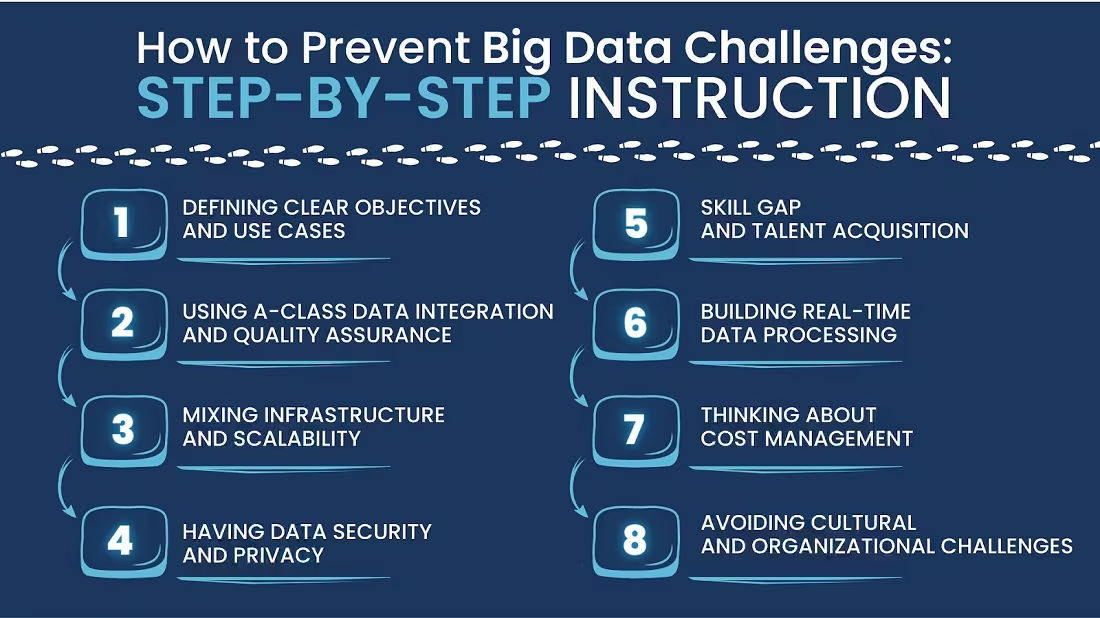
- Defining Clear Objectives and Use Cases: Before diving into big data analytics, it is crucial to establish clear objectives and identify relevant use cases. By aligning analytics initiatives with strategic goals, organizations can prioritize use cases with the highest potential impact and ensure data-driven decision-making drives the organization forward.
- Data Integration and Quality Assurance: Data integration and quality assurance are critical for accurate analysis. Organizations should implement data governance practices and validation processes to maintain data integrity across different sources, ensuring reliable and consistent insights.
- Infrastructure and Scalability: Building a scalable infrastructure is vital to accommodate the growing volume of data. Cloud-based services offer cost-effective solutions with pay-as-you-go options, enabling organizations to match their budget and computing needs.
- Data Security and Privacy: To safeguard sensitive data and comply with regulations, robust security measures, encryption techniques, and privacy frameworks must be in place.
- Skill Gap and Talent Acquisition: To leverage big data effectively, skilled professionals are essential. Organizations can bridge the skill gap by investing in training programs, partnering with educational institutions, or collaborating with external experts.
- Real-time Data Processing: For industries requiring real-time insights, implementing real-time data processing systems can facilitate prompt decision-making and analysis.
- Cost Management: Optimizing costs related to data storage and processing is crucial. By adopting cost-effective storage solutions and managing data lifecycle efficiently, organizations can ensure cost-effectiveness.
- Cultural and Organizational Challenges: Cultivating a data-driven culture involves change management and organizational buy-in. Encouraging data literacy, collaboration, and data-driven decision-making across the organization can foster a data-driven culture.
Final Thoughts on the Business Data Challenges
In conclusion, the journey of implementing big data analytics may present challenges, but with a well-thought-out strategy, these obstacles can be addressed and transformed into opportunities for growth and success. The key lies in aligning business goals with data analytics initiatives, utilizing the right tools and technologies, fostering a data-driven culture, and investing in talent and infrastructure. By overcoming big data challenges, organizations can harness the power of data to drive innovation, make informed decisions, and gain a competitive edge in today’s data-centric business landscape.
We start with the use cases that pay for themselves, define the governance model and deliver a working pipeline before the budget conversation gets abstract. Bring us your stalled data programme.
Let's talk about your next move
Not sure where to start? We work with companies at every stage, from early ideas to enterprise-level builds. A 30-minute call can save you months of guesswork.
FAQ
Why do big data analytics projects stall after the pilot?
Big data analytics projects usually stall after the pilot because the pilot ran on a hand-cleaned extract, while production requires automated ingestion, quality controls and ownership that nobody budgeted for. A second cause is the lack of a decision that the analysis is meant to change, so results never enter a workflow. Defining the consuming process and the owner of each data source before scaling prevents most of these stalls.
How should a company choose between cloud, on-premise and hybrid for big data analytics?
The choice between cloud, on-premise and hybrid for big data analytics depends mainly on workload variability, data residency constraints and existing infrastructure. Cloud suits bursty processing and fast experimentation, because compute scales on demand and is billed per use. On-premise suits steady, predictable loads and data that regulation or latency keeps inside the plant. Hybrid is common in industry: sensor data is pre-processed locally and aggregated results are analyzed in cloud warehouses such as Snowflake or BigQuery.
How can system changes be made without breaking other departments' data?
System changes can be made without breaking other departments' data by first mapping which downstream reports, integrations and models consume each affected table or field. Lineage from a data catalog makes this mapping reliable rather than based on memory. Changes are then released with advance notice, versioned interfaces and a period where old and new structures run in parallel. Treating schema changes like API changes, with an owner who approves them, prevents most cross-department breakages.
Should big data analytics skills be built in-house or sourced externally?
Big data analytics skills are best split: domain knowledge and ownership of key data stay in-house, while specialized platform engineering can be sourced externally when a hiring gap would delay the project. Internal staff understand what the data means, which external engineers take months to learn. External teams are useful for a defined build phase, such as setting up pipelines or a warehouse, provided knowledge transfer and documentation are contractual deliverables rather than afterthoughts.
How can storage and processing costs of big data be controlled?
Big data storage and processing costs are controlled mainly through data lifecycle policies, storage tiering and query discipline. Raw data older than a defined period moves to cheaper object storage tiers or is aggregated and deleted. Columnar formats such as Parquet with partitioning reduce the volume scanned per query. Tagging resources per team or use case makes spending visible. Without these measures, cloud bills tend to grow with data volume rather than with the value delivered.
Jacek Suty
Jacek Suty is Head of Solution Architecture at InTechHouse, with more than 30 years of experience in system architecture, enterprise IT, infrastructure, information security, and complex digital transformation programs.
He specializes in designing enterprise and solution architectures, translating business and regulatory requirements into scalable technology platforms, and coordinating delivery across software, infrastructure, data, and security teams. His work covers enterprise architecture based on TOGAF, system modeling using UML and BPMN, cloud and on-premise infrastructure, CI/CD processes, data platforms, cybersecurity, and IT governance.
Jacek has contributed to large-scale technology programs for public institutions, finance, energy, education, healthcare, utilities, and digital archives. His project experience includes nationwide public digital infrastructure, distributed document-management and archiving systems, data-exploration platforms using machine learning and predictive analytics, and transaction systems combining blockchain, metadata standards, and computational intelligence.
He holds PRINCE2 Practitioner, Management of Risk, Scrum Master, ITIL Foundation, and ISO/IEC 27001 Lead Auditor qualifications. Jacek is currently pursuing a doctoral degree at Bydgoszcz University of Science and Technology, combining academic research with extensive experience in real-world architecture and technology delivery.
He writes about enterprise architecture, system design, digital transformation, data platforms, cloud infrastructure, cybersecurity, technology governance, and the practical application of AI in complex information systems.
Jacek Suty's academic and professional profiles:
https://pbs.edu.pl/pl/doktorant/uczelniania-rada-samorzadu-doktorantow
https://www.isep.pw.edu.pl/isep/zs/Aktualnosci/Kalendarium-wydarzen2/Seminarium-zakladowe-9.03.2021-Jacek-Suty
https://aionehealth.pl/wp-content/uploads/2026/04/Raport-2026-final.pdf
Let's talk about your next project
From first prototype to production, our engineers can help you scope it, build it and get it certified.





Discuss your product with our R&D team
This initial conversation is focused on understanding your product, technical challenges, and constraints.
No sales pitch - just a practical discussion with experienced engineers.
Share a few details about your product and context. We’ll review the information and suggest the most appropriate next step.