
Choosing the Right Microcontroller for Embedded Systems

Exploring the role of the microcontroller in modern embedded system design
In the world of embedded systems, microcontrollers are no longer simple circuits executing basic instructions. Today, over 30 billion MCUs are shipped annually worldwide (source: IC Insights), and the global market is expected to reach USD 47 billion by 2028. With growing demands for performance, connectivity, and energy efficiency, MCUs have evolved into advanced platforms integrating artificial intelligence capabilities, wireless communication, and extensive edge computing functionalities.
In this article, we will explore what embedded microcontrollers truly are, examine their structure and architecture, discuss their various types, and analyze how they are applied in modern technologies.

See also:
STM32 vs ESP32: Choosing the Right Microcontroller for Your Project
Choosing the Right Microcontroller for Your Hardware Project: A Comprehensive Guide
Embedded Systems Architecture
Processor, memory, and communication: the building blocks of microcontroller design
A microcontroller is a specialized integrated circuit that incorporates all the essential electronic components necessary to independently perform control, monitoring, and communication tasks within embedded systems. Its central element is the Central Processing Unit (CPU), whose primary function is to execute logical and arithmetic operations and process program instructions. The CPU manages data flow and oversees the overall operation of the system.
In addition to the central processing unit, semiconductor memories play a key role in the structure of a microcontroller. A typical microcontroller features three main types of memory:
- Program memory (usually Flash or ROM), where the code that controls the entire device is stored;
- Data memory (RAM), used for storing operational variables during program execution;
- Non-volatile memory (EEPROM), enabling the permanent storage of configuration data, device parameters, or measurement results even after power is switched off.
A very important component of the architecture is the set of general-purpose input/output ports (GPIO), which allow the microcontroller to communicate with the external environment. GPIO pins can be configured either as inputs — receiving signals from sensors, switches, or other electronic circuits — or as outputs — controlling actuators such as relays, motors, or LEDs.
Peripheral modules, on the other hand, are additional functionalities integrated into the microcontroller's structure, significantly expanding its range of applications. The most important peripheral modules include:
- Analog-to-Digital Converters (ADC) – allowing the measurement of analog voltage values, e.g., from temperature, light, or humidity sensors.
- Digital-to-Analog Converters (DAC) – used to generate analog signals from digital data, for instance to control analog actuators.
- Pulse Width Modulation (PWM) modules – enabling the generation of signals with adjustable pulse width, used for controlling motors, LED lighting, or power regulators.
- Communication interfaces – facilitating data transfer between the microcontroller and other components or peripheral devices. The most commonly used interfaces include UART (asynchronous serial communication), SPI (synchronous serial communication), I²C (communication with multiple peripherals over a shared data bus), and ethernet (for reliable and high-speed network communication in industrial and IoT applications).
PeripheralFunctionExample UsageADC (Analog-to-Digital Converter)Converts analog signals to digitalTemperature sensors, light detectorsDAC (Digital-to-Analog Converter)Converts digital data to analog outputAudio signal generationPWM (Pulse Width Modulation)Produces variable-width digital pulsesMotor speed control, LED dimmingUART/SPI/I²CData communication interfacesConnecting displays, sensors, memoriesEthernet High-speed wired networkingIndustrial IoT, automation systems
Tab. 1 Key Peripheral Modules
Other important components of microcontrollers include clock systems (oscillators) that generate timing signals for the CPU and peripherals, as well as internal reset circuits and watchdog timers that monitor the correct operation of the device. Furthermore, modern microcontrollers are often equipped with advanced security mechanisms designed to protect stored data from unauthorized access and safeguard the system against disruptions or software errors.
Peripheral count, power budget and toolchain maturity decide whether your firmware ships on time. We review your MCU shortlist against the workload you actually have to run.
Validate your MCU shortlist with us
Microcontrollers explained: choosing the bit width for your project
Microcontrollers can be classified in various ways; however, the most common distinctions are based on data bus width, architecture, and application specificity. The basic division includes 8-bit, 16-bit, and 32-bit microcontrollers.
8-bit microcontrollers are designed for simple applications where computational requirements are minimal, and low power consumption and low production cost are of primary importance. They feature a simple architecture and are commonly used in devices such as keyboards, battery chargers, basic automation systems, and electronic toys. Examples include devices from the AVR family (e.g., ATmega328) and PIC microcontrollers by Microchip.
16-bit microcontrollers offer greater processing power and more advanced features compared to their 8-bit counterparts. They are used in applications where faster data handling, more precise control processes, or more complex algorithms are required, such as motor controllers, advanced measurement systems, or medical devices. A popular example from this group is the MSP430 family by Texas Instruments, well-known for its low-power performance.
32-bit microcontrollers represent the most advanced category, combining high computational performance with great application flexibility. They are most often based on the ARM Cortex-M architecture and support advanced real-time operating systems (RTOS), complex signal processing algorithms, and multi-channel communication. They are utilized in applications such as IoT systems, multimedia devices, industrial control systems, and security systems. Notable examples include STM32 microcontrollers from STMicroelectronics and the ESP32 series from Espressif Systems, two families we put side by side in our STM32 vs ESP32 comparison.
Performance, power, and cost: finding the right microcontroller balance
As the demand for smarter, smaller, and more efficient devices grows, so does the diversity of available microcontroller architectures. Understanding the distinct characteristics and design philosophies behind each family is essential for engineers, developers, and educators working across the embedded landscape.
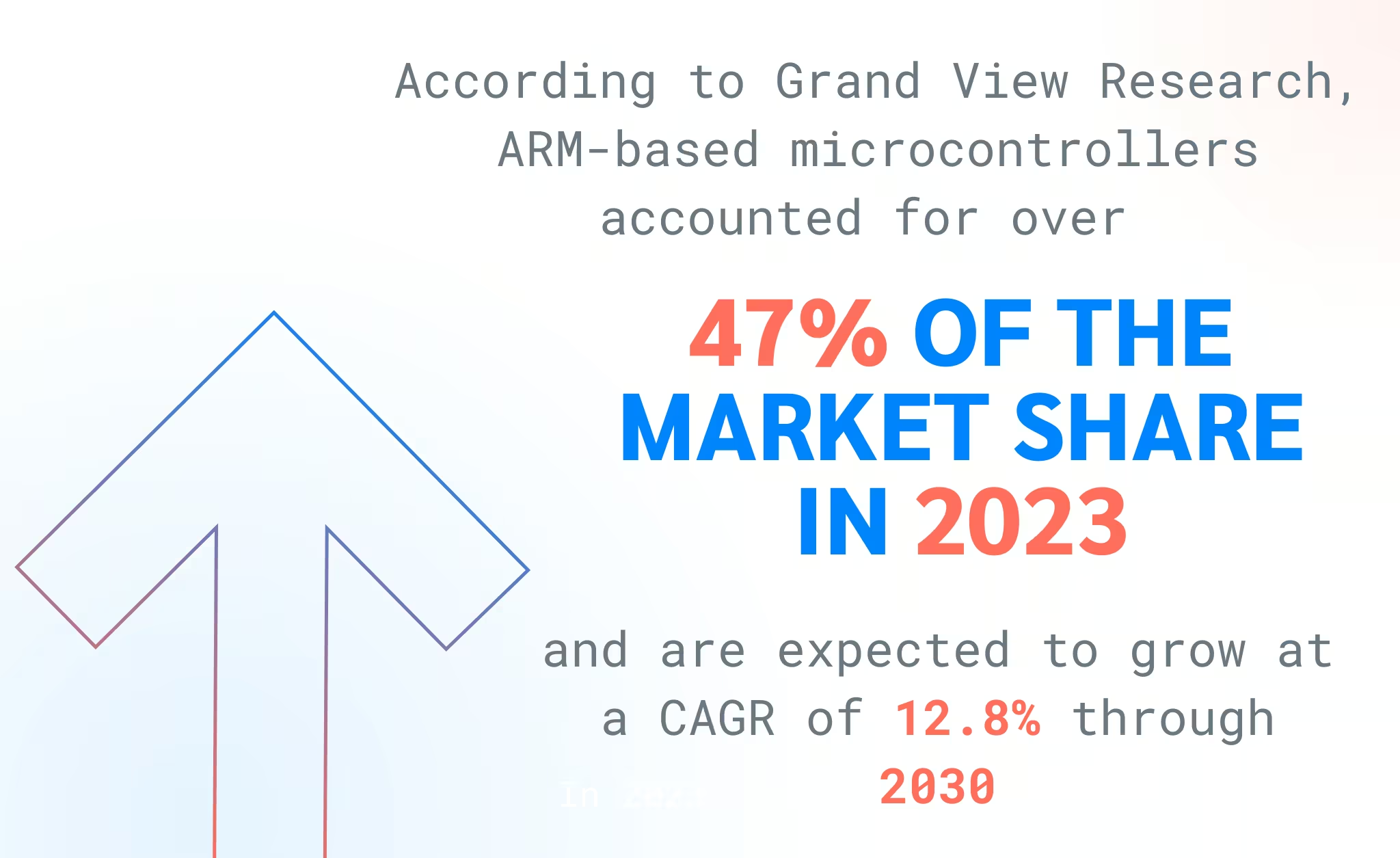
ARM Cortex-M – The most popular group of 32-bit microcontrollers based on RISC architecture. The Cortex-M0/M0+ series (e.g., STM32G0, NXP Kinetis KE) is optimized for ultra-low power consumption and cost efficiency. Cortex-M3 and Cortex-M4 (e.g., STM32F4, LPC4300) offer performance suitable for real-time operating systems (RTOS) and advanced peripheral control. Meanwhile, Cortex-M7 and Cortex-M33 microcontrollers (e.g., STM32H7, i.MX RT1170) provide high throughput for DSP operations and enhanced system security thanks to integrated TrustZone technology.
AVR (Microchip) – 8-bit microcontrollers known for their very simple architecture, low power consumption, and fast response times. They are popular in low-cost systems and IoT devices with limited computational requirements. Examples include the ATmega328P (Arduino Uno) and the ATtiny85 (basic sensors). "Arduino brought microcontrollers out of the shadows of engineering labs and into the hands of artists, students, and makers", said Massimo Banzi, co-founder of Arduino.
PIC (Microchip) – A broad family covering 8-bit (PIC16 series), 16-bit (PIC24 series), and 32-bit (PIC32 series) microcontrollers based on the MIPS architecture. They are characterized by low power consumption, a large number of integrated analog peripherals, and a comprehensive development ecosystem (MPLAB X IDE, Harmony Framework).
MSP430 (Texas Instruments) – Ultra-low-power 16-bit microcontrollers dedicated to battery-powered and measurement applications. They feature extremely fast wake-up times (<6 μs) and specialized analog blocks (such as operational amplifiers and ADCs). They are ideal for portable medical devices and smart energy metering solutions.
RISC-V – A modern, open 32-bit and 64-bit architecture that is rapidly gaining traction in the embedded market. Chips like the SiFive FE310 and ESP32-C6 (featuring Wi-Fi 6 and Thread support) offer high implementation flexibility and no licensing fees. RISC-V is becoming increasingly important in IoT, automotive, and sectors where complete supply chain transparency is required.
The same trade-off triangle looks different once a specific board, enclosure and budget enter the picture. If you are already at that stage, our practical walkthrough of microcontroller selection for hardware projects covers pin counts, packages, interfaces and supply availability step by step. It turns the criteria above into a shortlist you can actually order.
Real project spotlight: modernizing embedded systems in optical devices
As part of the "Modernizing Embedded Electronics and Software for Advanced Optical Equipment" project, the InTechHouse team carried out a complete modernization of the embedded system in an advanced optical device. The primary objective was to replace the outdated MCU with a new 32-bit unit based on the ARM Cortex-M architecture, which allowed for increased computational power while reducing energy consumption. The new microcontroller managed key device functions such as precise optical control, data acquisition and analysis from sensors, and communication with external modules via UART and SPI interfaces.
The project also involved integration with a new firmware environment supporting OTA (Over-the-Air) updates and the implementation of real-time image correction algorithms. Thanks to the application of modern embedded solutions, the device significantly improved its performance, reliability, and future scalability.
We write and test firmware on STM32, NXP and ESP class parts for industrial and medical products. Ask how we handle drivers, low power modes and long term maintenance.
See our firmware work on constrained MCUs
InTechHouse expertise in microchip technology and embedded system solutions
The dynamic development of microcontroller technology requires embedded system designers to continuously monitor emerging trends and adapt their solutions to the evolving market demands. Selecting the appropriate microcontroller, properly designing the system architecture, and effectively integrating communication functions and OTA (Over-the-Air) updates have now become critical success factors for modern embedded projects.If you are looking for a technology partner to help you design, optimize, or modernize embedded solutions, take advantage of the expertise of the InTechHouse team. We specialize in creating efficient embedded systems tailored to the individual needs of our clients, both in the industrial and consumer sectors. Contact us to find out how our expertise in electronics design, embedded software development, and system integration can support the growth of your project.
Let's talk about your next move
Not sure where to start? We work with companies at every stage, from early ideas to enterprise-level builds. A 30-minute call can save you months of guesswork.
FAQ
A microprocessor requires external components to function (such as memory and input/output systems), whereas a microcontroller has all these elements integrated into a single chip.
Does every microcontroller require an operating system?
No. Many embedded applications operate without an operating system, an approach known as bare metal programming in embedded systems, although lightweight RTOS (Real-Time Operating Systems) are used in more complex projects.
Which programming languages are used for microcontrollers?
The most commonly used languages are C and C++, although in some cases Python (e.g., MicroPython) or assembly language is also used.
What is OTA and why is it important?
OTA (Over-the-Air Update) allows remote updating of the microcontroller's software, enhancing the security and functionality of devices after deployment.
Krzysztof Niedźwiedź
Krzysztof Niedźwiedź is a Lead Embedded Systems and Hardware Engineer at InTechHouse with over 11 years of experience developing complex electronic and embedded products from system architecture through production.
He specializes in embedded software development, electronic system architecture, multilayer PCB design, hardware-software integration, system testing, and technical ownership of high-reliability engineering projects. His work spans requirements analysis, architecture and component selection, schematic and PCB design, bare-metal and RTOS firmware development, prototyping, troubleshooting, production documentation, and cooperation with mechanical and high-level software teams.
Krzysztof's project experience includes FPGA and SoC-based onboard computers for the space industry, embedded electronics for advanced optical equipment, low-power environmental-monitoring devices, UAV payloads for real-time air-quality measurement and sample collection, and connected medical and training devices.
He works with C and C++, STM32, LPC and AVR microcontrollers, ARM-based platforms, RTOS, Embedded Linux, FPGA and SoC architectures, DDR3, HDI PCB technology, and industrial communication interfaces including Ethernet, CAN, RS-485, SPI, I2C, UART, USB, Modbus, and MQTT.
Krzysztof holds bachelor's and master's degrees in Electronics and Telecommunications. He is an IPC Certified Interconnect Designer and has completed specialist training in Embedded GNU/Linux kernel internals and device drivers. He writes about embedded system architecture, firmware development, PCB design, MCU and FPGA integration, RTOS, hardware security, low-power electronics, and dependable electronic products.
Let's talk about your next project
From first prototype to production, our engineers can help you scope it, build it and get it certified.
Discuss your product with our R&D team
This initial conversation is focused on understanding your product, technical challenges, and constraints.
No sales pitch - just a practical discussion with experienced engineers.
Share a few details about your product and context. We’ll review the information and suggest the most appropriate next step.