
The Impact of 5G Technology on The Development of Intelligent Embedded Systems


Unlocking new possibilities: the impact of 5G network on embedded systems
5G technology is not just another iteration of mobile networks – it represents a fundamental shift in the way devices communicate in real time. With its high bandwidth, ultra-low latency, and the ability to support millions of devices simultaneously, 5G is becoming a key catalyst for the development of intelligent embedded systems. These systems, used in industries such as manufacturing, healthcare, automotive, and smart cities, require reliable and instant data transfer, making 5G a technology with immense transformational potential for embedded systems in medical devices and other latency sensitive domains.In this article, we will analyze how 5G influences the development of embedded systems, the benefits and challenges associated with its implementation, and the innovations made possible by this revolution in communication We will also examine specific applications across various sectors and discuss the most important technical aspects that make 5G a gateway to new possibilities for embedded devices in the networks of the future.
Increased data transmission speed
5G technology offers a maximum theoretical throughput of up to 10 Gbps, representing a fundamental shift in amounts of data management for embedded systems. In practice, this translates to enhanced capabilities for applications requiring instantaneous data exchange and the elimination of bottlenecks present in previous network generations.
By leveraging millimeter waves (mmWave) and dynamic spectrum management in the sub-6 GHz range, 5G enables the real-time transmission of large volumes of data while minimizing latency. Compared to LTE technology, where network congestion can lead to performance degradation, 5G utilizes advanced modulation techniques such as OFDM (Orthogonal Frequency-Division Multiplexing) and MIMO (Multiple Input Multiple Output) to enhance transmission efficiency.
In embedded systems such as autonomous vehicles, increased bandwidth allows for the simultaneous reception and analysis of data from multiple sensors, including radars, cameras, and LIDAR systems, improving navigation and real-time decision-making. In Industry 4.0, high transmission speeds support distributed control systems, facilitating seamless communication between robots, PLC controllers, and edge computing servers. According to Statista, the number of IoT connections in the industrial sector is expected to exceed 36.8 billion by 2025. Therefore, high-speed data transmission enables predictive maintenance and seamless machine-to-machine (M2M) communication, optimizing production efficiency by up to 30%.
Additionally, beamforming technology enables dynamic signal direction toward specific embedded devices, improving spectrum efficiency. In IoT applications, 5G enables faster data transmission from distributed sensors and devices, enhancing monitoring and predictive data analysis in smart cities and industrial infrastructure.
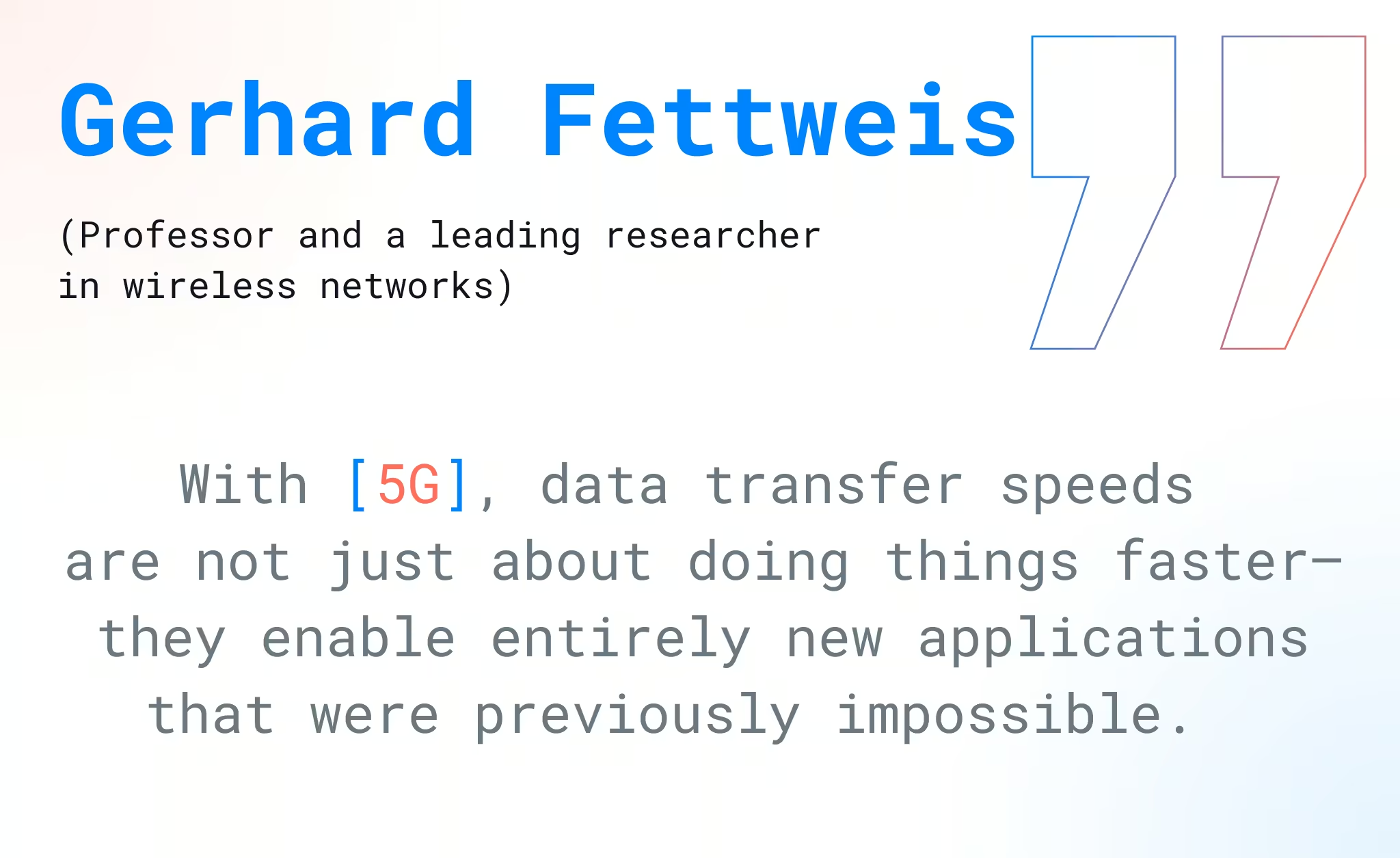
At InTechHouse, we know exactly how to leverage the latest technologies, as clearly demonstrated by the following implementation example:
https://intechhouse.com/case-studies/enhancing-pest-monitoring-with-digital-simulations/
Impact of 5G network on minimizing latency
5G technology has the potential to reduce data transmission latency to as little as 1 ms, representing a significant breakthrough for real-time applications. Achieving such low latency is made possible through technologies like Network Slicing, which allocates dedicated network resources to specific applications. This ensures predictable response times and guaranteed service quality—critical aspects for systems requiring instantaneous data processing and minimal delays.
One of the most important applications of low latency in 5G is Ultra-Reliable Low Latency Communication (URLLC), which enables highly reliable data exchange with minimal response time. This is particularly crucial for controlling critical processes, such as industrial automation and traffic management, where even the slightest delay can lead to inefficiencies or safety risks. For example, in industrial robotics, precision machines must synchronize their actions instantly to function smoothly within complex production processes. Thanks to ultra-low latency in 5G technology, these machines can communicate without disruptions, enhancing efficiency and reducing errors.
5G and edge computing work synergistically to reduce latency. While 5G alone minimizes transmission delays, edge computing further enhances real-time processing by bringing computation closer to the data source. This significantly improves performance in latency-sensitive applications such as augmented reality (AR) and virtual reality (VR), where even a millisecond of delay can disrupt user experience and system effectiveness. By enabling local data processing, edge computing ensures seamless and instantaneous interaction, making AR and VR technologies more immersive and efficient.
Beyond entertainment and industrial automation, ultra-low latency in 5G plays a critical role in embedded systems that require real-time data analysis and decision-making. In healthcare, for example, remote patient monitoring devices rely on instantaneous data processing to detect abnormalities and trigger life-saving interventions immediately. Similarly, in V2X (Vehicle-to-Everything) communication, where vehicles exchange real-time information with their surroundings, reduced latency enables faster and more precise decision-making by autonomous and driver-assist systems.
See also:
Embedded Systems Architecture
The Role of Embedded Systems in IoT Applications
Embedded Systems as a Key Solution for Industrial Automation in Industry 4.0
Increase in the number of connected devices
5G technology significantly enhances the scalability of embedded systems, enabling the support of up to one million devices per square kilometer — a 10x increase over 4G LTE. This paves the way for the development of more complex sensor networks and real-time communication systems.
"The real promise of 5G lies in its ability to support massive IoT deployments without overwhelming network resources," says Dr. Wen Tong, CTO of Huawei Wireless. "With features like mMTC, we can efficiently connect and manage millions of embedded devices across industries, unlocking unprecedented levels of automation and intelligence".
What are the essential aspects of the increase in connected devices in 5G?
- Massive Machine Type Communications (mMTC) – The 5G standard allows for the operation of a vast number of Internet of Things devices while maintaining minimal energy and bandwidth consumption.
- Optimization of Spectral Efficiency – 5G utilizes advanced coding and modulation algorithms, such as LDPC and Polar Codes, allowing for efficient network traffic management.
- Dynamic Network Traffic Management – The 5G network can intelligently redirect traffic and adjust bandwidth based on system load.
- Interference Reduction – Advanced filtering techniques and dynamic resource allocation minimize disruptions in dense network environments.
Thanks to these solutions, embedded systems can not only operate in more distributed environments but also efficiently manage energy and network resources. For instance, intelligent transportation networks can leverage 5G to synchronize hundreds of thousands of devices, enabling precise traffic management and optimization of autonomous vehicle routes.
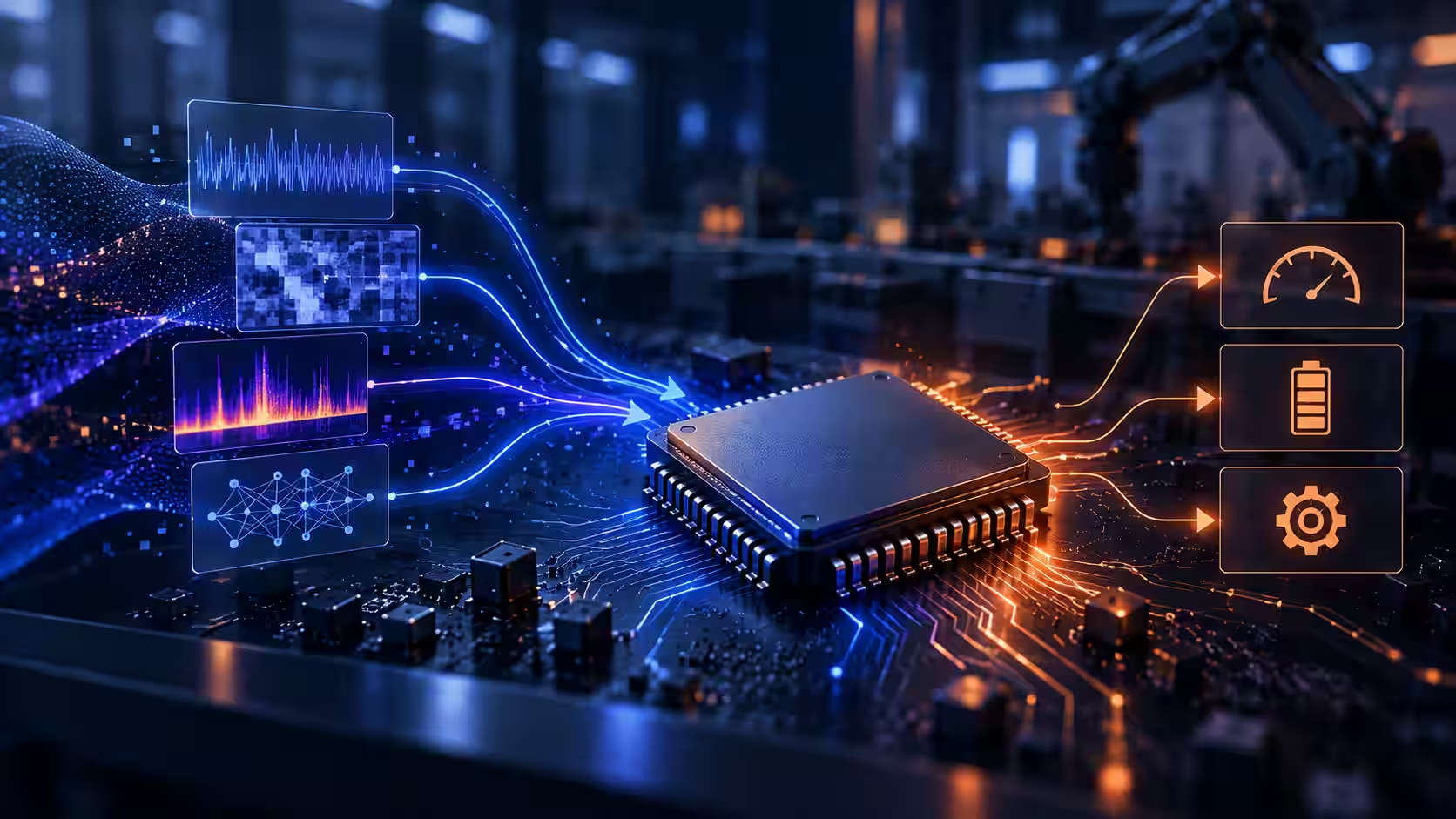
Sensor fusion in embedded systems is what turns this density of connected nodes into a usable signal, merging radar, camera and inertial data before anything reaches the network. With 5G carrying the fused result instead of raw streams, bandwidth and latency budgets stay predictable even at a million devices per square kilometer.
5G in embedded systems: what’s holding back full-scale adoption?
Despite numerous advantages, implementing 5G technology in embedded systems comes with several technological and operational challenges. Deploying this technology requires not only hardware upgrades but also adjustments to network architecture and security frameworks.
5G is one line on a longer roadmap that also includes edge AI, RISC-V silicon and security enabled by default. Reading it next to the other embedded system trends for 2025 makes it easier to judge which projects justify a modem now and which can wait for the next hardware cycle.
Crucial challenges in implementing 5G in embedded systems:
- Infrastructure modernization – Existing devices and systems must be adapted to meet new network standards.
- High deployment costs – Building 5G networks and integrating them with embedded systems requires significant financial investment.
- Limited network availability – 5G coverage remains uneven, particularly in less urbanized areas.
- Cybersecurity – The increased connectivity of embedded systems in 5G networks introduces new security challenges, such as DDoS attacks, man-in-the-middle vulnerabilities, and firmware exploits, requiring robust encryption and authentication protocols.
- Energy management – IoT devices using 5G may consume more power compared to LPWAN solutions, posing a challenge for battery-powered systems.
- Interference and signal disruptions – In densely populated device environments, maintaining signal quality can be problematic.
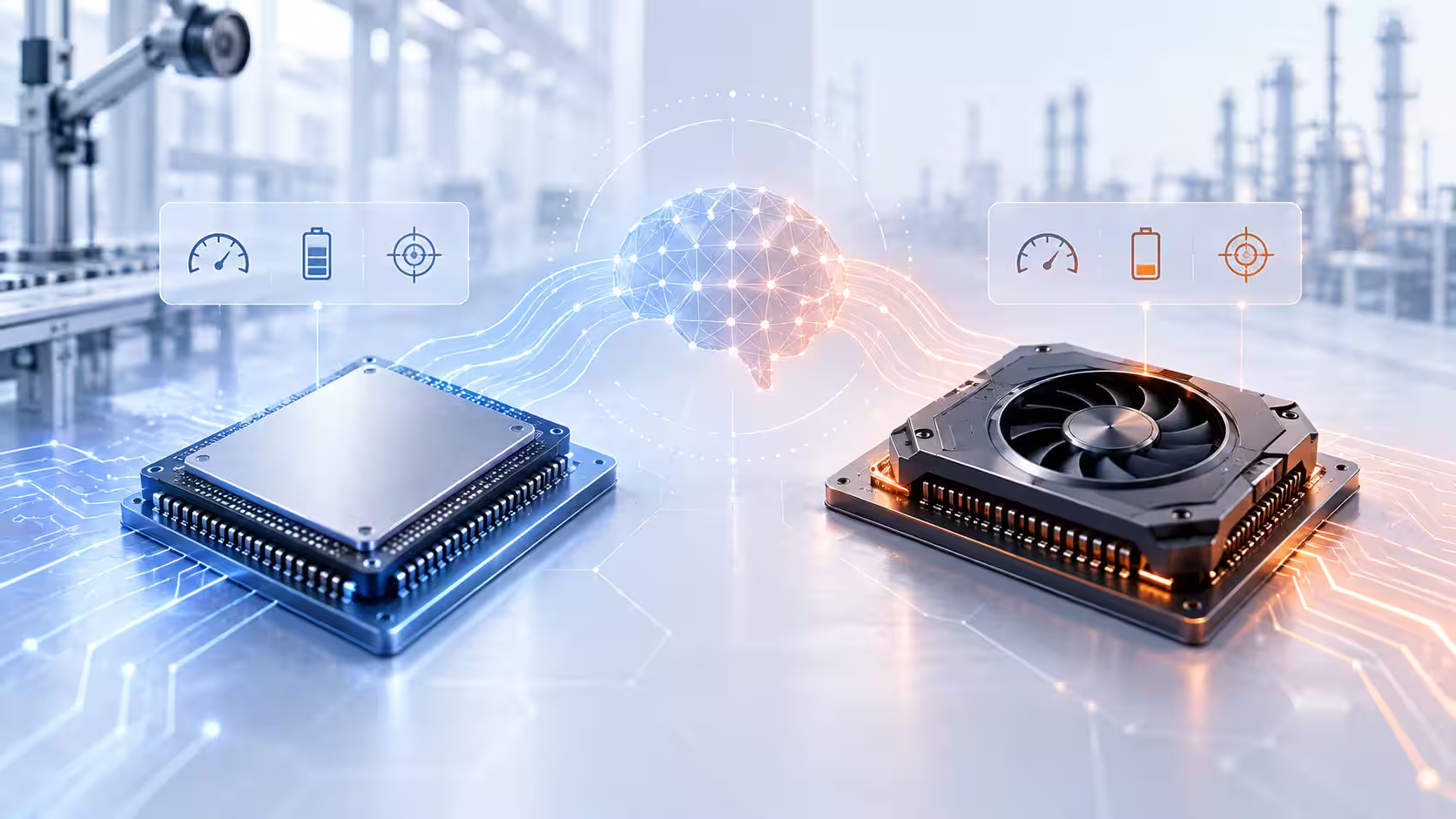
Adding a 5G modem changes your power budget, antenna layout and certification path at the same time. We design embedded platforms where connectivity, hardware and firmware are planned together instead of bolted on.
Design a 5G-ready embedded device
InTechHouse: shaping the future of embedded systems with innovation and expertise
5G is not merely an evolution in wireless communication but a technological leap that redefines how embedded systems operate. Fully leveraging its potential requires strategic decisions, investments, and adapting existing solutions to the new generation of networks. However, the benefits of this transformation will make it one of the fundamental drivers of innovation in the coming decade."5G will be as transformative to embedded systems as electricity was to industry in the 20th century," states Dr. Peter Vetter, President of Bell Labs Core Research. "Its impact on connectivity, AI integration, and automation will set the foundation for the future of technology."By partnering with InTechHouse, you gain access to cutting-edge R&D, hardware and software integration, and scalable solutions that keep your business ahead of the competition. We specialize in custom software development, cloud integration, real-time data processing, and secure communication protocols to ensure your technology meets the highest industry standards.Don't just keep up with innovation—be the one driving it forward. Contact InTechHouse today and discover how we can transform your vision into reality!
Our embedded teams deliver controllers and gateways for manufacturing, automotive and smart infrastructure, including real-time data paths and edge processing. Tell us your latency and throughput targets.
Let's talk about your next move
Not sure where to start? We work with companies at every stage, from early ideas to enterprise-level builds. A 30-minute call can save you months of guesswork.
FAQ
Do embedded systems need to be specially adapted to 5G technology?Yes, to fully leverage the potential of 5G, embedded systems must be equipped with appropriate communication modules that support 5G networks and be optimized for fast data exchange and minimal latency.
Does 5G enhance the security of embedded systems?
On one hand, 5G offers improved encryption mechanisms and data transmission protection. On the other hand, the increased number of connected devices introduces new threats, requiring the implementation of advanced security protocols and authentication mechanisms.
What architectural changes in embedded systems does 5G necessitate?
Embedded systems must incorporate high-performance processors capable of rapid data processing, optimized power management algorithms, and communication modules designed to operate efficiently within 5G networks.
Will 5G influence the development of artificial intelligence in embedded systems?
Yes, 5G enables ultra-fast data exchange between AI-powered devices and the cloud, accelerating data analysis and allowing the implementation of more advanced algorithms in IoT devices, autonomous robots, and intelligent control systems.
Krzysztof Niedźwiedź
Krzysztof Niedźwiedź is a Lead Embedded Systems and Hardware Engineer at InTechHouse with over 11 years of experience developing complex electronic and embedded products from system architecture through production.
He specializes in embedded software development, electronic system architecture, multilayer PCB design, hardware-software integration, system testing, and technical ownership of high-reliability engineering projects. His work spans requirements analysis, architecture and component selection, schematic and PCB design, bare-metal and RTOS firmware development, prototyping, troubleshooting, production documentation, and cooperation with mechanical and high-level software teams.
Krzysztof's project experience includes FPGA and SoC-based onboard computers for the space industry, embedded electronics for advanced optical equipment, low-power environmental-monitoring devices, UAV payloads for real-time air-quality measurement and sample collection, and connected medical and training devices.
He works with C and C++, STM32, LPC and AVR microcontrollers, ARM-based platforms, RTOS, Embedded Linux, FPGA and SoC architectures, DDR3, HDI PCB technology, and industrial communication interfaces including Ethernet, CAN, RS-485, SPI, I2C, UART, USB, Modbus, and MQTT.
Krzysztof holds bachelor's and master's degrees in Electronics and Telecommunications. He is an IPC Certified Interconnect Designer and has completed specialist training in Embedded GNU/Linux kernel internals and device drivers. He writes about embedded system architecture, firmware development, PCB design, MCU and FPGA integration, RTOS, hardware security, low-power electronics, and dependable electronic products.
Let's talk about your next project
From first prototype to production, our engineers can help you scope it, build it and get it certified.
Discuss your product with our R&D team
This initial conversation is focused on understanding your product, technical challenges, and constraints.
No sales pitch - just a practical discussion with experienced engineers.
Share a few details about your product and context. We’ll review the information and suggest the most appropriate next step.