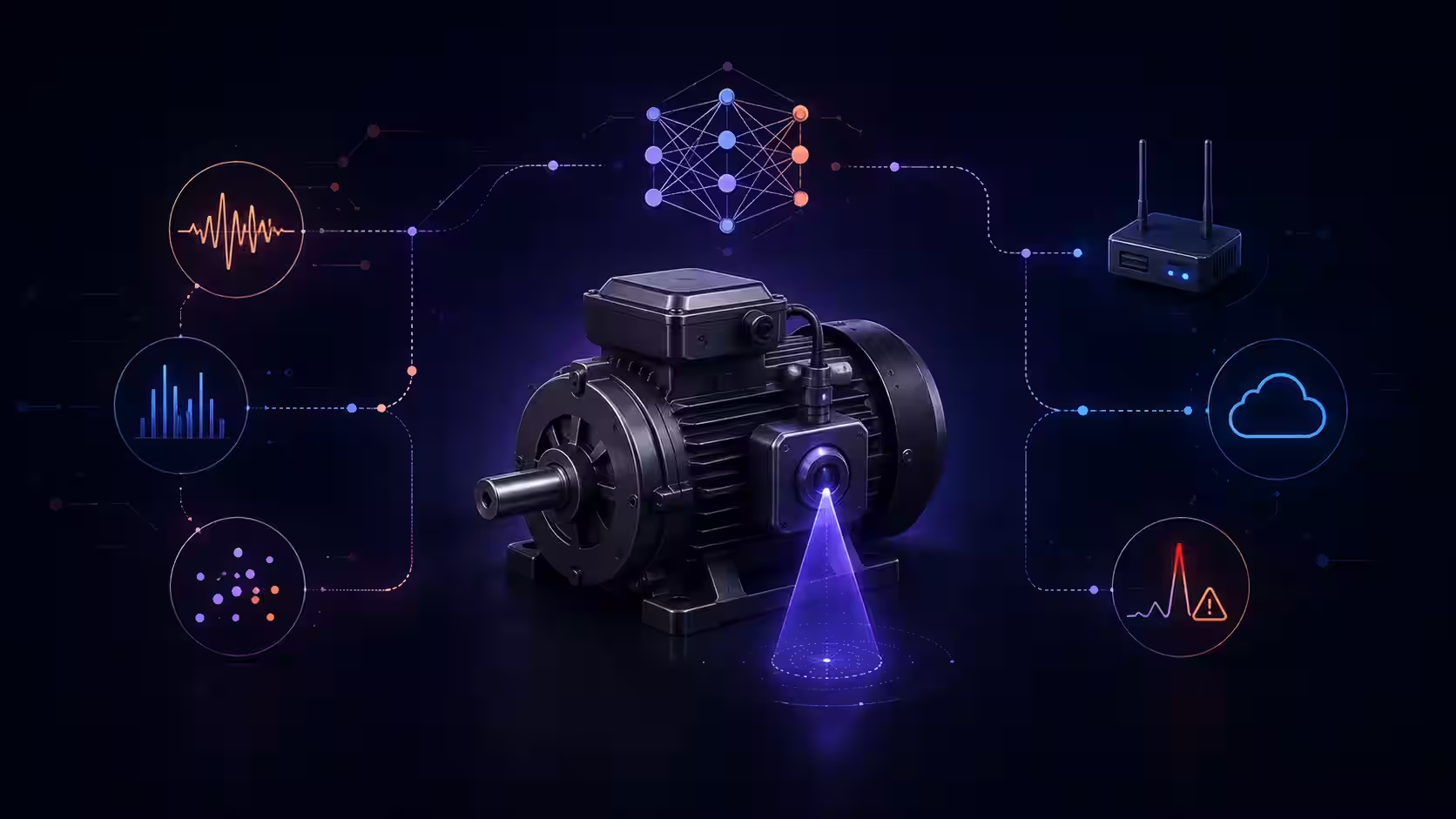
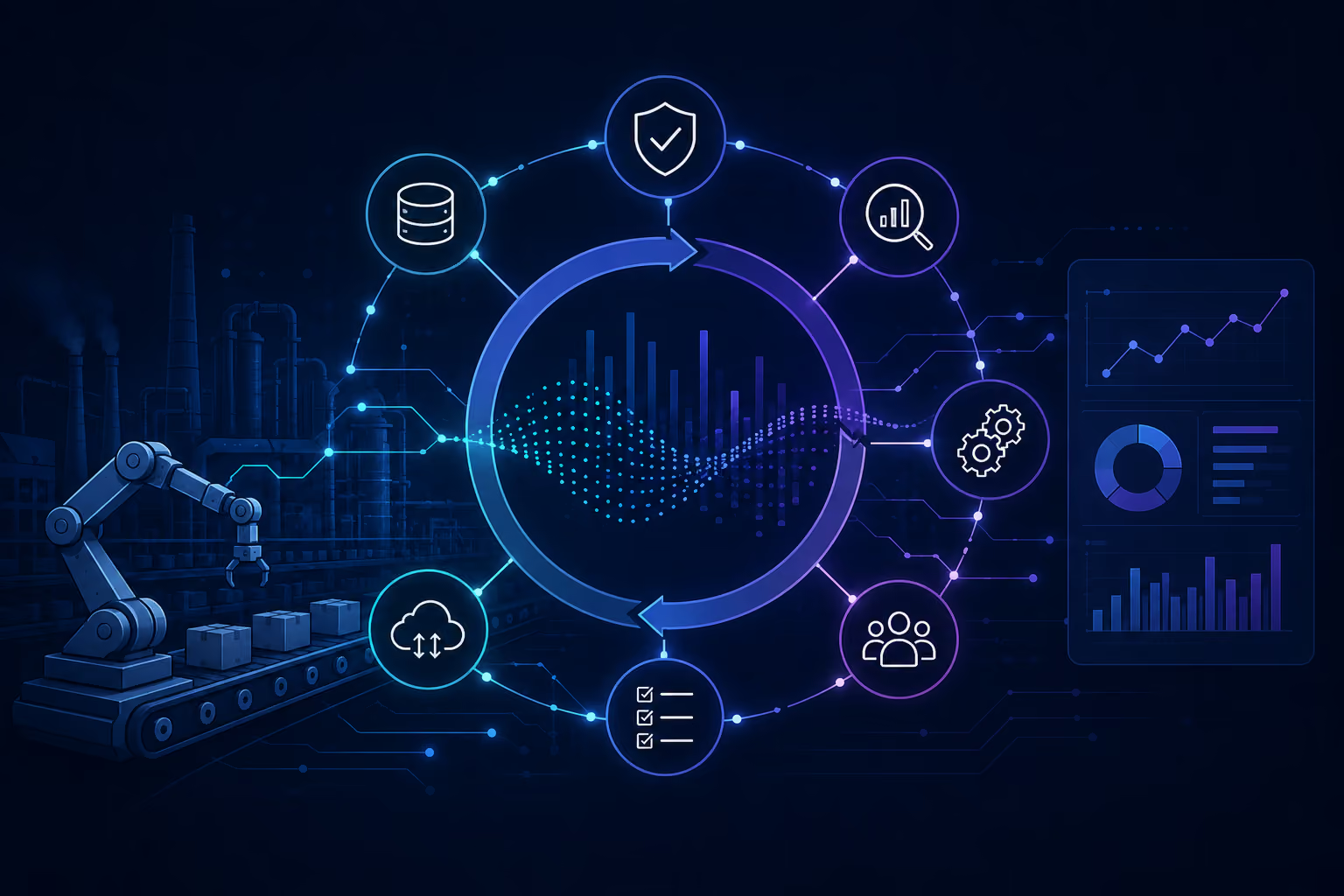
The world is going cloud. This is a true reality that modern businesses need to understand and follow if it fits. Cloud can custom and we know the significant power in this term. In the ever-evolving landscape of technology, businesses seek solutions that not only meet their current needs but also adapt to their unique challenges. Enter Custom Cloud Solutions – the cornerstone of innovation and efficiency. In this article, we explore the transformative world of custom cloud solutions and delve into three ways InTechHouse can enhance your operations through Managed IT Services and Cloud Services. What about cloud development market?

Source: Fornutebusinessinsights
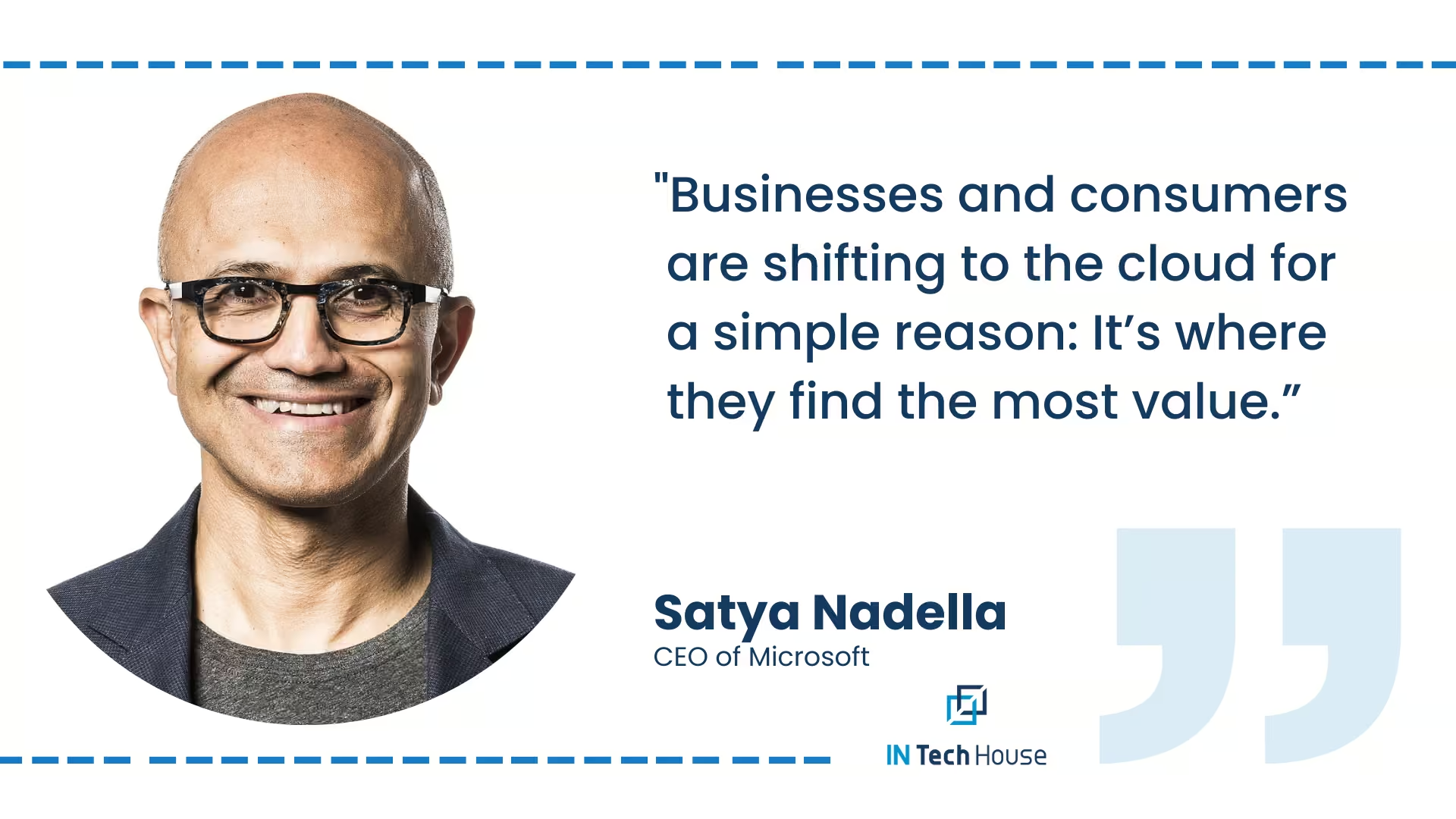
Custom Cloud Solutions represent a paradigm shift in the realm of cloud technology. Unlike one-size-fits-all solutions, custom cloud solutions are meticulously crafted to align with the specific needs and objectives of individual businesses. This bespoke approach ensures that the cloud infrastructure, applications, and services seamlessly integrate into existing workflows, optimizing performance, scalability, and security. For connected machines, the same tailored approach often takes the form of an industrial DataOps platform that cleans and contextualizes device data before it reaches cloud applications. Custom Cloud Solutions encompass:
Tailored Infrastructure:
Designing cloud architecture that precisely aligns with your applications’ demands, ensuring optimal performance and scalability.
Specialized Application Development:
Crafting cloud-native applications that harness the full potential of cloud services, from storage and computing power to advanced analytics and machine learning.
Data Management and Security:
Implementing customized strategies for data management, ensuring security, privacy, and compliance within the cloud environment.
Integration and Migration:
Seamlessly integrating existing systems with cloud services and orchestrating smooth migrations to ensure minimal disruption during the transition.
1. Strategic Consultation:
Our team at InTechHouse goes beyond conventional IT services. We collaborate with you to understand your business objectives, challenges, and growth plans. Through strategic consultation, we identify opportunities where custom cloud solutions can drive innovation and efficiency in your operations.
2. Managed IT Services:
Embrace a proactive approach to IT management with our Managed IT Services. From 24/7 monitoring to system maintenance and security updates, we ensure your IT infrastructure operates seamlessly. Our custom cloud solutions enhance the reliability, security, and performance of your IT ecosystem.
3. Tailored Cloud Services:
Redefine your cloud migration strategy and process with our tailored cloud services. Whether it’s optimizing existing cloud infrastructure, migrating to the cloud, or developing custom cloud-native applications, we tailor our services to meet your specific business requirements. Experience the flexibility, scalability, and efficiency that only custom cloud solutions can provide.
Cloud solutions can help! It’s not just a phrase, it’s a rule for many global companies.
1. Scalability:
Custom cloud solutions offer scalability tailored to your business needs. Scale up or down based on demand, optimizing costs and ensuring optimal performance.
2. Cost Efficiency:
By aligning cloud resources with specific business requirements, custom solutions eliminate unnecessary expenses, providing a cost-efficient model for cloud usage.
3. Enhanced Security:
Tailored security measures address specific business needs, ensuring a robust defense against evolving cybersecurity threats and compliance with industry regulations.
4. Optimized Performance:
Custom configurations optimize the performance of cloud services, delivering faster response times and enhanced overall system efficiency.
5. Flexibility and Adaptability:
Tailored solutions adapt to the unique workflows and requirements of your business, providing the flexibility needed to embrace new technologies and changing market conditions.
6. Strategic Alignment:
Custom cloud solutions align with your strategic objectives, offering a technology foundation that supports and enhances your business goals.
Do you know what industries should use custom cloud solutions more often? As cloud experts, we can confidently name those industries.

Device fleets generate data faster than ad hoc cloud setups can absorb it. We design the ingestion, storage and access layer so operations teams get usable data instead of raw telemetry.
Connect your devices to a data platform that scales
Healthcare: For managing patient data, telemedicine, and healthcare analytics.
Finance and Banking: For secure transactions, data analysis, customer relationship management, and compliance management.
Retail: In inventory management, customer experience enhancement, and supply chain management.
Manufacturing: For supply chain optimization, equipment monitoring, and predictive maintenance.
IT and Telecommunications: To support vast data storage needs, network infrastructure management, and cybersecurity.
Government and Public Sector: For improving public services, data security, and infrastructure management.
Education: In e-learning platforms, student information systems, and research data management.
Media and Entertainment: For content streaming, digital rights management, and personalized user experiences.
“On-Premises Cloud” refers to a hybrid cloud model where cloud computing resources are deployed within an organization’s own data center or on-premises infrastructure. This approach combines the benefits of cloud computing with the control and customization offered by on-premises solutions.
In the dynamic landscape shaped by how cloud computing works, various types of cloud services cater to diverse business needs. These can be broadly categorized into three main models:
1. Infrastructure as a Service (IaaS):
2. Platform as a Service (PaaS):
3. Software as a Service (SaaS):
These service tiers are usually the first decision in a cloud project, because each one moves a different share of the operational work to the provider. A side by side reading of IaaS vs PaaS vs SaaS shows where your control ends and managed convenience begins. For embedded and industrial workloads that boundary decides how much of the stack your own team keeps.
Read also:
A cloud server solution refers to the provisioning of virtual servers, also known as virtual machines (VMs), through cloud computing services. These virtual servers operate in a cloud environment, allowing users to access computing resources on-demand without the need for physical hardware.
Virtualization: Cloud servers are virtual instances running on physical servers but isolated from each other. This virtualization allows for better resource utilization and flexibility.
Scalability: Cloud server solutions offer scalability, enabling users to scale resources up or down based on demand. This flexibility ensures optimal performance and cost-efficiency.
Managed Services: Many cloud server solutions come with managed services, including automated backups, security measures, and monitoring, reducing the burden on users for routine maintenance tasks.
Global Accessibility: Cloud servers can be accessed from anywhere with an internet connection. This global accessibility is beneficial for businesses with distributed teams or those serving a global customer base.
Our Solution:
In response to the client’s pressing needs, InTechHouse orchestrated a suite of digital innovations to propel laboratory operations into the future. Leveraging cutting-edge technologies, we devised solutions to revolutionize remote process monitoring, streamline data collection from diagnostic tools, and enhance equipment reservation systems. Transitioning from archaic paper-based logs to electronic counterparts, our interventions ushered in a new era of efficiency and accountability.
We have built platforms that handle plant and device data with governance, redundancy and clear ownership. Ask how we would model your data flows before choosing any cloud service.
See how we build industrial data platforms
Not sure where to start? We work with companies at every stage, from early ideas to enterprise-level builds. A 30-minute call can save you months of guesswork.
A custom cloud backend for an embedded device fleet typically includes device provisioning and identity, a message broker, time-series storage, a rules or stream-processing layer, dashboards and an over-the-air update service. MQTT is the most common transport because it is lightweight and tolerates unreliable links; CoAP and LwM2M appear on constrained, battery-powered devices. The custom part is usually the data model, the integration with ERP or MES systems, and the way firmware versions and device configurations are tracked per unit.
Anything with a hard deadline or a safety consequence should stay on the embedded device, while aggregation, long-term storage, fleet analytics and model training belong in the cloud. A motor controller cannot wait for a network round trip, but a predictive maintenance model that compares vibration trends across 500 machines needs central data. A useful rule is to ask what must still work when connectivity drops for an hour, and keep exactly that on the device or edge gateway.
Embedded devices should authenticate with a unique per-device identity, usually an X.509 certificate used for mutual TLS, rather than a shared password or API key. The private key is ideally generated and stored in a secure element or TPM so it never leaves the chip. Certificates are injected during manufacturing or at first boot through a provisioning service. Per-device identity allows a single compromised unit to be revoked without touching the rest of the fleet.
Over-the-air updates work by publishing a signed firmware image to the cloud, then rolling it out to devices in controlled batches. On the device, a bootloader verifies the signature and usually writes the new image to a second flash partition (A/B scheme), switching over only after a successful boot and health check. If the new version fails, the device falls back to the previous image. Staged rollouts, starting with a few percent of the fleet, limit the damage from an undetected defect.
An on-premises private cloud makes more sense when device data cannot leave the site, when the plant network is isolated from the internet, or when the load is large and predictable. Defense, energy and some medical projects fall into this group because of contractual or regulatory constraints. The trade-off is capital expenditure and an internal team to patch, monitor and scale the platform. A common compromise keeps raw data on site and sends only aggregated, anonymized metrics to a public cloud.
Jacek Suty is Head of Solution Architecture at InTechHouse, with more than 30 years of experience in system architecture, enterprise IT, infrastructure, information security, and complex digital transformation programs.
He specializes in designing enterprise and solution architectures, translating business and regulatory requirements into scalable technology platforms, and coordinating delivery across software, infrastructure, data, and security teams. His work covers enterprise architecture based on TOGAF, system modeling using UML and BPMN, cloud and on-premise infrastructure, CI/CD processes, data platforms, cybersecurity, and IT governance.
Jacek has contributed to large-scale technology programs for public institutions, finance, energy, education, healthcare, utilities, and digital archives. His project experience includes nationwide public digital infrastructure, distributed document-management and archiving systems, data-exploration platforms using machine learning and predictive analytics, and transaction systems combining blockchain, metadata standards, and computational intelligence.
He holds PRINCE2 Practitioner, Management of Risk, Scrum Master, ITIL Foundation, and ISO/IEC 27001 Lead Auditor qualifications. Jacek is currently pursuing a doctoral degree at Bydgoszcz University of Science and Technology, combining academic research with extensive experience in real-world architecture and technology delivery.
He writes about enterprise architecture, system design, digital transformation, data platforms, cloud infrastructure, cybersecurity, technology governance, and the practical application of AI in complex information systems.
Jacek Suty's academic and professional profiles:
https://pbs.edu.pl/pl/doktorant/uczelniania-rada-samorzadu-doktorantow
https://www.isep.pw.edu.pl/isep/zs/Aktualnosci/Kalendarium-wydarzen2/Seminarium-zakladowe-9.03.2021-Jacek-Suty
https://aionehealth.pl/wp-content/uploads/2026/04/Raport-2026-final.pdf
From first prototype to production, our engineers can help you scope it, build it and get it certified.
This initial conversation is focused on understanding your product, technical challenges, and constraints.
No sales pitch - just a practical discussion with experienced engineers.
Share a few details about your product and context. We’ll review the information and suggest the most appropriate next step.