With growing complexity in embedded system development, engineers face new challenges. The vast variety of available modules and components makes platform selection more difficult. The key question is how to choose a hardware platform that best fits the specific technical, business, and environmental requirements of the application. According to a 2024 Embedded Market Study by AspenCore, 72% of embedded developers cite hardware platform management and platform selection as one of the most critical early decisions in a project lifecycle.
There is no one-size-fits-all solution. What works well for an industrial controller may be entirely unsuitable for a battery-powered IoT device. It may also not fit an interactive HMI system with multimedia capabilities. In this article, we explore the key criteria for selecting a hardware platform. We also highlight important details and explain how to approach this decision strategically and practically. This encompasses considering market realities and project constraints. Many of the trade-offs and challenges are best illustrated through real-world use cases and engineering practice.
Platform choice is never only a hardware question. Task scheduling, the memory model and the boundary between hardware-dependent and portable code are all decided at the same time, which is why a review of embedded systems architecture should come before the shortlist of boards is drawn up.
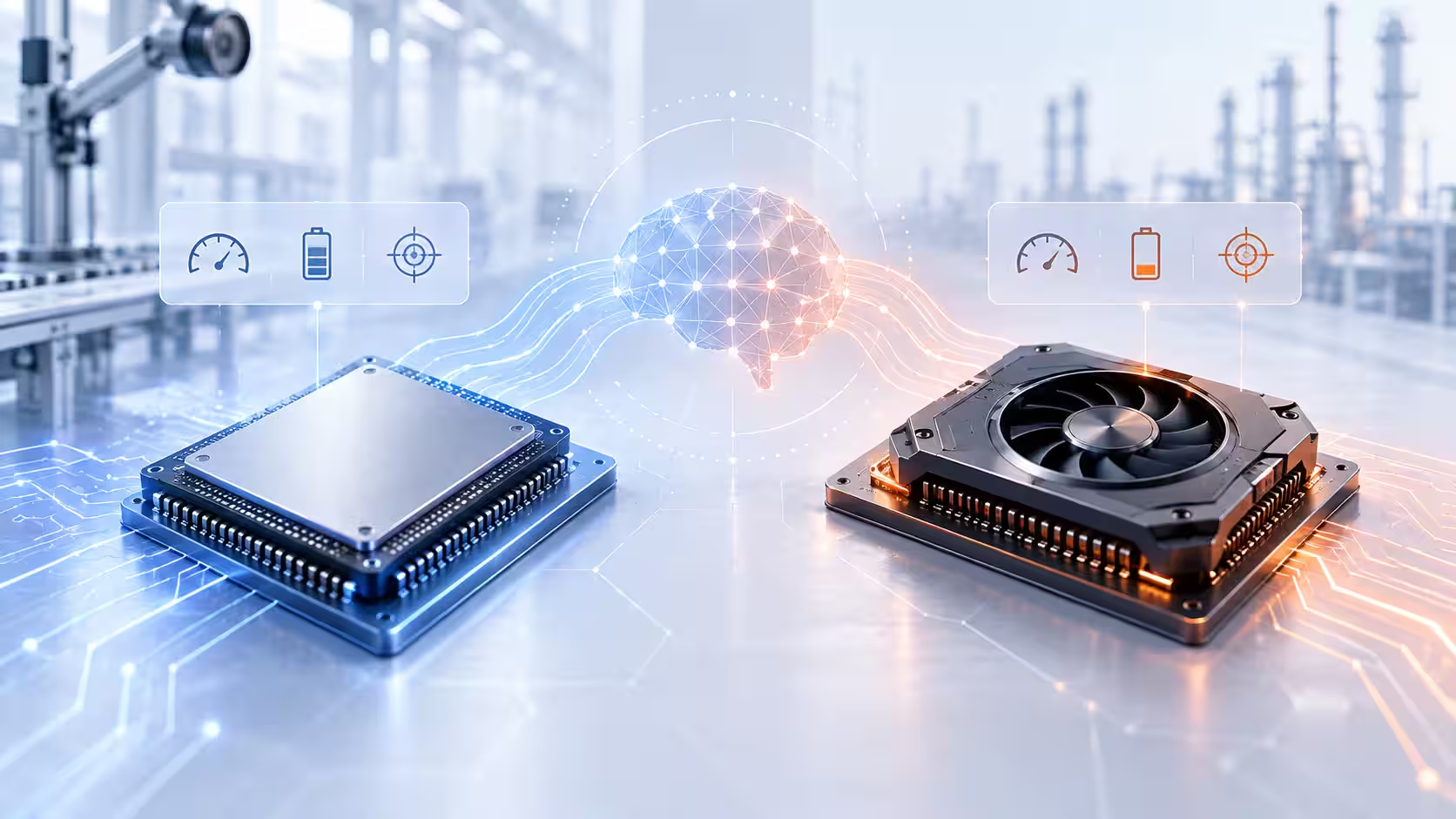
Selecting a hardware platform is always a trade-off between performance, cost, energy efficiency, and scalability in each case . Microcontrollers (MCUs), such as those from the Renesas RA, or NXP LPC families, are ideal where deterministic response times, low power consumption, and integrated peripherals are critical — typically in edge devices, sensors, measurement systems, or motor controllers. These systems can be precisely configured for minimal energy usage.
Application processors (MPUs), such as NXP's i.MX or Texas Instruments' Sitara series, serve different needs. They are better suited for high-availability systems and projects requiring a full Linux OS. They support encryption, high-speed interfaces such as Ethernet, USB, and PCIe. They are designed for handling large data sets or graphics processing tasks. MPUs are also ideal for effective storage management. Common use cases include HMI systems, gateways, and embedded vision platforms.
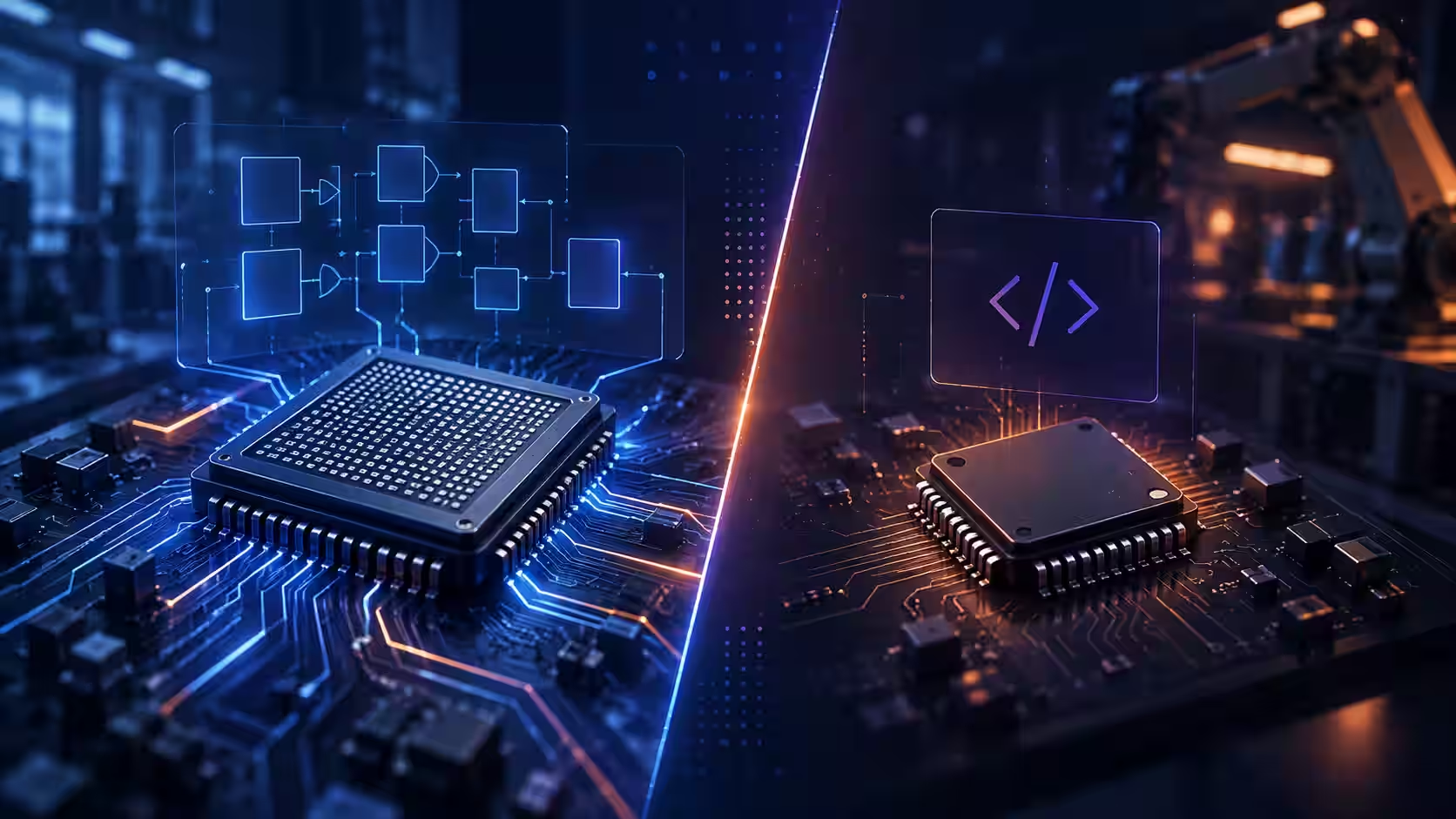
FPGAs (e.g., Xilinx Zynq, Intel Cyclone) offer maximum flexibility at the hardware level, allowing custom protocol implementation, real-time signal processing, parallel computation, and enhanced connection capabilities. SoCs, especially those combining CPUs and FPGAs (like the Zynq-7000 series), enable hybrid designs that merge general-purpose processing with reconfigurable logic. Ideal for edge AI, Industry 4.0, or high-performance real-time systems.More about FPGA you can read here:https://intechhouse.com/blog/what-is-field-programmable-gate-array-fpga-and-why-is-it-used-in-hardware/Finally, development boards such as Raspberry Pi, Arduino, or BeagleBone are often used in early-stage prototyping or proof-of-concept work, especially for installation demos. However, commercial deployment typically requires a migration to a custom hardware platform tailored to environmental, certification, and public infrastructure requirements.If you want to learn more about hardware design and engineering, check this out:https://intechhouse.com/blog/how-hardware-design-and-engineering-service-shape-product-evolution
At the microcontroller level the same trade-offs repeat in miniature: connectivity, power budget, toolchain maturity and long-term availability. A side-by-side STM32 vs ESP32 comparison shows how those criteria play out for two of the most common MCU families in IoT projects.
An MCU that looks cheap on the datasheet can cost you a redesign when the peripheral set or power budget runs out. We benchmark two or three candidate platforms against your real requirements before you commit.
Get a platform trade-off review
In practice, selecting a hardware platform requires analyzing a complex set of interdependencies. What key aspects should engineers consider when making such a decision?
Let’s take a look at the following practical reference points. These are commonly used by experienced embedded system designers when making hardware-layer decisions. They are the very factors kept in mind from day one of system architecture planning:

See also:
Embedded Systems Architecture
Choosing the Right Microcontroller for Embedded Systems
What is Field-Programmable Gate Array (FPGA) and why is it used in hardware?
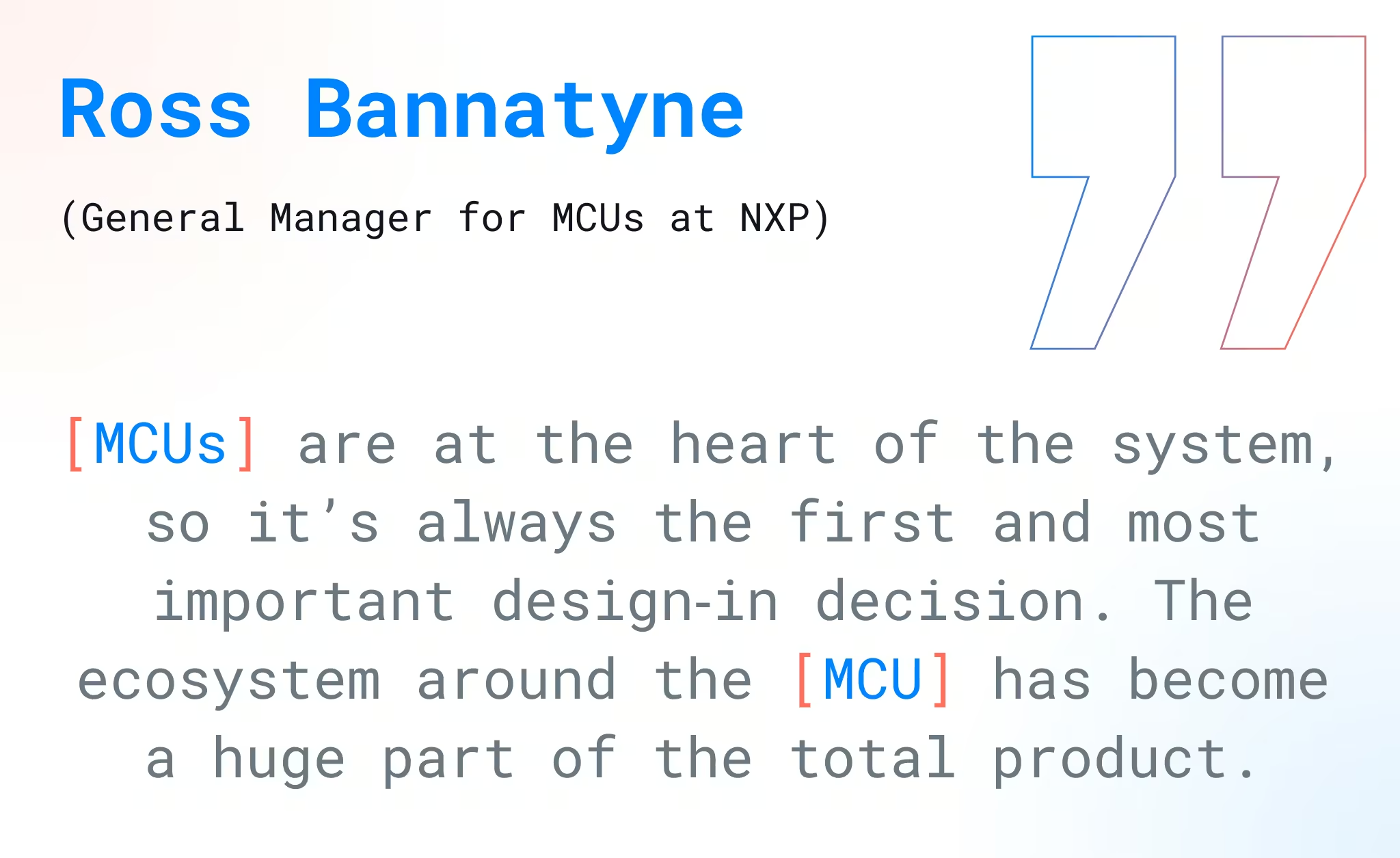
The efficiency of an engineering team largely depends on the context of maturity of the development environment provided by the hardware platform vendor. According to Umer Farooq, CTO at MRS Technologies: “Embedded System Engineering is not just about writing code; it is more about understanding the entire hardware ecosystem, the physical limitations, and how software orchestrates the hardware’s operation.” In practice, this means access to a stable and well-integrated toolchain. This includes an IDE, compilers, and debuggers. It also involves support for standard communication protocol stacks. Equally important is the consistency and usability of the available HAL or SDK. This contains relevant code examples and documentation. If commonly required functions like USB CDC, MQTT, or TLS are not officially supported, development becomes harder. Such limitations can make development cycles significantly longer and more error-prone.
Documentation quality is equally critical. This involves not only reference manuals but also code examples, peripheral architecture descriptions, configuration flows, and backup debugging guides. In complex systems, good documentation makes a big difference. The ability to quickly trace protocol stack behavior or integrate third-party middleware depends heavily on well-structured and up-to-date reference material.
Finally, a strong developer community is extremely valuable. Active forums, widely followed technical blogs, GitHub repositories, and official support channels often prove more helpful than formal documentation alone. Platforms with active ecosystems enable faster problem-solving. They allow teams to leverage proven solutions, reducing both risk and time-to-market.
We have taken industrial controllers, battery powered IoT devices and vision gateways through platform selection to production. Ask how we document the decision so it survives audits and supply chain changes.
See how we select and prove platforms
Before choosing a platform, ask yourself this question to decide: Will this choice help my team build something that works faster, and can be maintained for years? If the answer is “yes,” you’re on the right track. The best test of a hardware decision isn’t in benchmarks or datasheets. It’s in real-world implementation: peripheral communication, OS integration, boot stability, and the quality of the documentation.Whether you're building a device from scratch, optimizing an existing solution, or need support in software development, InTechHouse is the partner that can guide your project end to end. Our teams specialize not only in designing reliable hardware but also in developing modern embedded systems, control applications, and cloud integrations. We combine expertise in electronics, low-level firmware, and high-level software to deliver production-ready solutions. Trust our experience and take advantage of a free consultation today.
Not sure where to start? We work with companies at every stage, from early ideas to enterprise-level builds. A 30-minute call can save you months of guesswork.
Yes, if the goal is to quickly build a proof of concept that meets the needs of the users . However, for commercial projects, particularly those involving big data it is essential to eventually migrate to a platform optimized for cost, energy efficiency, and reliability.
When the system requires deterministic response times, low power consumption, and relatively simple logic. Microcontrollers are the dominant choice in IoT devices, sensors, and industrial controllers.
Check whether the component is marked as “Not recommended for new designs” for customers and monitor the vendor’s product roadmap. Components with long lead times pose a significant risk to the supply chain.
Not just the volume of materials, but especially the quality of code examples, clarity of hardware diagrams, and how up-to-date the content is. A well-documented SDK can save considerable development time.
Krzysztof Niedźwiedź is a Lead Embedded Systems and Hardware Engineer at InTechHouse with over 11 years of experience developing complex electronic and embedded products from system architecture through production.
He specializes in embedded software development, electronic system architecture, multilayer PCB design, hardware-software integration, system testing, and technical ownership of high-reliability engineering projects. His work spans requirements analysis, architecture and component selection, schematic and PCB design, bare-metal and RTOS firmware development, prototyping, troubleshooting, production documentation, and cooperation with mechanical and high-level software teams.
Krzysztof's project experience includes FPGA and SoC-based onboard computers for the space industry, embedded electronics for advanced optical equipment, low-power environmental-monitoring devices, UAV payloads for real-time air-quality measurement and sample collection, and connected medical and training devices.
He works with C and C++, STM32, LPC and AVR microcontrollers, ARM-based platforms, RTOS, Embedded Linux, FPGA and SoC architectures, DDR3, HDI PCB technology, and industrial communication interfaces including Ethernet, CAN, RS-485, SPI, I2C, UART, USB, Modbus, and MQTT.
Krzysztof holds bachelor's and master's degrees in Electronics and Telecommunications. He is an IPC Certified Interconnect Designer and has completed specialist training in Embedded GNU/Linux kernel internals and device drivers. He writes about embedded system architecture, firmware development, PCB design, MCU and FPGA integration, RTOS, hardware security, low-power electronics, and dependable electronic products.
From first prototype to production, our engineers can help you scope it, build it and get it certified.
This initial conversation is focused on understanding your product, technical challenges, and constraints.
No sales pitch - just a practical discussion with experienced engineers.
Share a few details about your product and context. We’ll review the information and suggest the most appropriate next step.