This is going to be a guide to successful collaboration. Let's get started. Imagine a world where outsourced projects seamlessly come to fruition, where every aspect aligns perfectly, and success is a guarantee.
Unfortunately, reality paints a different picture:
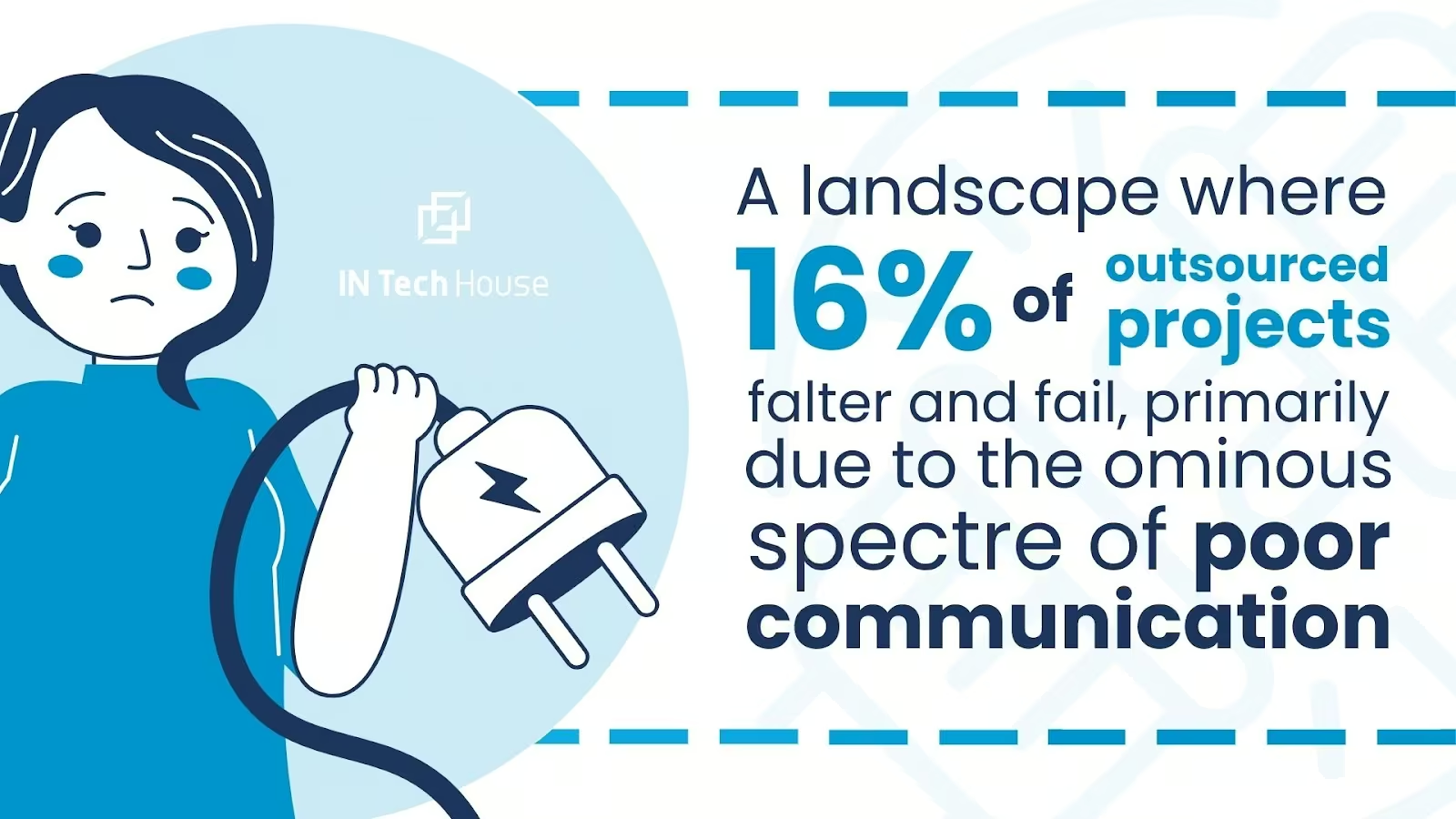
Source: Flatworldsolutions
However, fear not, for there exists a beacon of hope amidst these turbulent waters of the contemporary IT market: the strategic implementation of well-conceived engagement models. These models serve as a lifeboat, rescuing your projects from potential shipwrecks by facilitating thorough assessments, harnessing team potential, and circumventing treacherous pitfalls.
In its purest essence, an IT engagement model can be likened to a meticulously crafted framework that delineates the intricate dance between a company and its chosen technological collaborator or service provider. Functioning as a blueprint for collaboration, it delineates the project's extent, sets unwavering deadlines for accomplishment, defines the pricing structure, and delineates the strategies for adept project management. The beauty of these models lies in their adaptability – they can be tailored to seamlessly align with a company's distinctive requisites and aspirations.
In today's dynamic business environment, IT engagement models are becoming more and more vital. But what are they? At a basic level, an IT engagement model refers to a business's framework or approach when partnering with IT service providers. These models determine how businesses and IT vendors interact, manage projects, and achieve desired outcomes.
The heart and soul of any IT initiative is project engagement. This term captures how deeply stakeholders, teams, and clients are invested and involved in a project. Delving deeper into the project engagement model, it's not just about involvement; it's about commitment. It's about ensuring that everyone, from the developer to the end client, is aligned in purpose, informed at every step, and driving with fervour towards shared objectives. An effective engagement ensures transparency, clarity, and mutual respect among all participants.
Over the years, the IT sector has witnessed an upsurge in model development. This isn't merely a trend but a testament to the industry's dedication to refining processes and ensuring optimum outcomes. When we discuss models in software engineering and software development models, we're talking about frameworks that guide IT professionals in creating software that's robust, scalable, efficient, and in line with clients' visions. These models blend tried-and-tested methodologies and innovative new approaches, ensuring the highest calibre software solutions.

Diversity is the name of the game when it comes to IT engagement models. Here are some detailed insights:
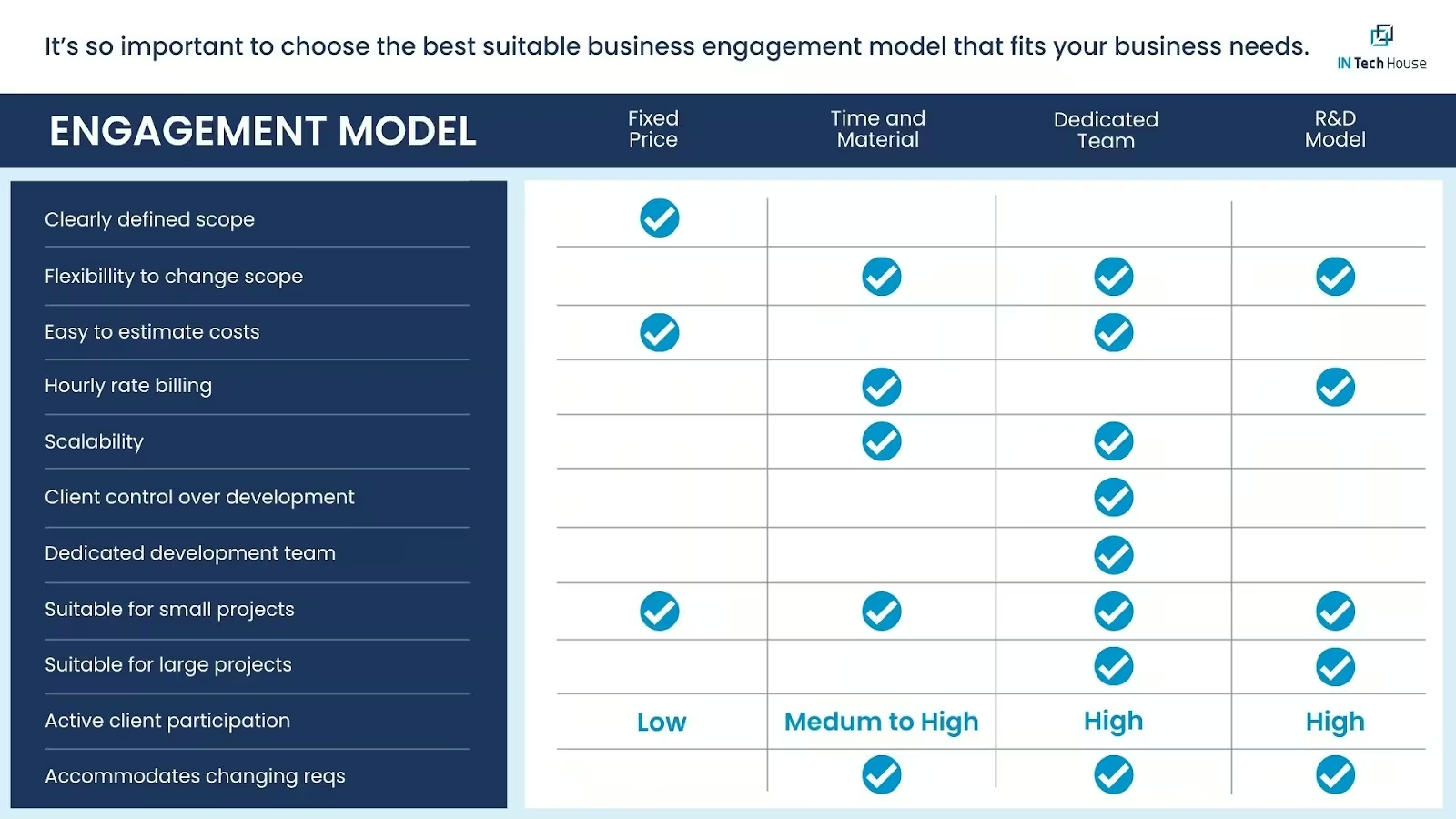
Fixed Price Model: Often seen as a straightforward approach, this model is ideal for projects where requirements are set in stone, and the time and materials vs fixed price comparison shows where that assumption breaks. Everything, from the project's scope to its costs, is decided and agreed upon at the outset. It offers predictability in terms of budget but demands precise requirements from the start.2.
Time & Material Model: The time and material cooperation model shines in scenarios where projects are expected to evolve. Long-term endeavours with changing scopes find a perfect match here. Clients are billed based on the hours worked and the resources expended, offering flexibility and adaptability.3.
Dedicated Team Model: A model that's gaining traction, it allows companies to hire a team of IT professionals exclusively for their projects, while the lighter staff augmentation model adds individual specialists to a team you already run. This team is tailor-made to suit the project's needs, ensuring a perfect skill match and dedicated focus.4.
The Research and Development (R&D) Model: Pioneering Innovation. When innovation is the name of the game, the R&D Model takes the stage. It's tailored for visionary projects where constant experimentation and evolution are essential. This model thrives on pushing boundaries and charting new territories.Remember the second thing, the engagement model works well if you fix specific project needs.
The dedicated team model has a longer-term variant worth naming separately. Once that team becomes permanent, sits in another country, and works under your brand and processes, it turns into an offshore development centre, and what it takes to set up an offshore development center differs from an ordinary contract in legal structure, recruitment, and knowledge retention. It is a commitment measured in years rather than sprints.
Software engineering is a domain where engagement models hold immense weight. The models of engagement here act as guiding lights, ensuring projects flow seamlessly from conception to completion. Consider this engagement model example: A contemporary software firm might gravitate towards an agile engagement model. This approach prizes flexibility and iterative development and places a premium on incorporating client feedback at every stage, ensuring the end product is robust and aligned with the client's vision.
NOTE: It's so important to choose the best suitable business engagement model that fits your business needs.
Fixed price protects a defined scope, time and materials protects a moving one, and picking wrong is where hardware and embedded projects overrun. We help you set the model before the contract.
Match the engagement model to your project risk
Here → SERVICES you can read all about our approach to the engagement process.
In hardware adjacent projects the engagement model has to match the engineering discipline behind it. A firmware or PCB programme runs on milestones tied to board bring up, which is why our hardware and embedded engineering services are scoped differently from a pure application build. Ask any vendor how their model absorbs hardware dependencies before you sign.
To elucidate further on engagement model examples, let's envision a retail conglomerate eager to carve out an e-commerce niche. Fixed price contracts might be their go-to choice if their requirements are precise. On the other hand, if they foresee numerous changes and iterations along their digital journey, the Time and material model would be a more apt choice, offering them the fluidity they desire.
Two of these arrangements are routinely confused at the contracting stage. Staff augmentation places engineers under your own management, while managed services transfer responsibility for an agreed outcome to the provider, and the difference decides who carries delivery risk, how cost behaves, and how easily you can exit; the comparison is laid out in staff augmentation vs managed services. Picking the wrong one usually surfaces as a dispute over accountability months later.
Dwelling on the importance of an engagement model framework, it's much more than a mere collaboration tool. The blueprint dictates the nuances of the collaboration between a client and its IT service provider. Every framework is a meticulously crafted amalgamation of expectations, roles, and engagement rules. Adopted rightly ensures that all parties involved share a cohesive vision, drastically reducing the chances of misunderstandings and ensuring a harmonious, productive collaboration.

It's not just about selecting any engagement model; it's about opting for the one that perfectly aligns with a company's needs and objectives. The benefits of this are manifold:
As with every facet of the IT world, engagement models are also evolving, shaped by technological advancements and changing business landscapes. Here's a glimpse into what the future might hold:
Whether you're navigating the intricacies of models in software engineering or searching for the ideal model of engagement for your next IT endeavour, your choice can spell the difference between soaring success and dismal disappointment. As the IT landscape evolves at breakneck speed, engagement models, too, will transform, paving the way for more nuanced, adaptive, and growth-centric collaborations for enterprises across the globe.
NOTE! Remember this third rule, Sometimes a business needs flexible engagement models. You can use one engagement strategy or even two vs. three. In some cases combining engagement models is a good practice.

Read also:
Source: Forbes
Nonetheless, the key lies in selecting a model that impeccably aligns with your project's distinct requisites and ambitions. The journey towards adopting an IT engagement model encompasses several different phases, each integral to the process:
The foundational step in seamlessly integrating an IT engagement model is to outline your organization's unique needs. Grasping the challenges you aim to conquer, the envisioned outcomes, and the resources at your disposal is paramount.
Reflect upon the project's dimensions, budgetary considerations, timeframes, and the equilibrium between control and flexibility you seek to strike.
Subsequently, embark on the quest for a partner boasting extensive industry acumen, a sterling reputation, and a commendable track record of punctually delivering projects within budgetary confines.
That search only produces a fair comparison if every candidate answers the same question. A structured request for proposal keeps the shortlist honest, and for technical builds our guide on how to write an RFP for embedded software development sets out the scope, technical requirements, and evaluation criteria a vendor genuinely needs. A vague brief produces vague bids, and vague bids make the engagement model you picked irrelevant.
An engagement model agreement comes into play, delineating the project's extent, milestones, financial intricacies, and the methodology steering project management. Precision in this agreement is of utmost significance.
Establishing the project team, devising meticulous project blueprints, and allocating roles and responsibilities among team members constitute this phase. To ensure the project's seamless progression, the formulation of communication protocols and project management techniques is equally pivotal.
Vigilant oversight of key performance indicators (KPIs) – encompassing project timelines, budgetary allocations, and quality benchmarks – is crucial. This monitoring is the linchpin for identifying potential bottlenecks and initiating corrective measures.
A post-project evaluation surfaces as the culmination of your journey. Here, the project's strengths are highlighted, and avenues for enhancement are recommended. Implementing task automation, incorporating state-of-the-art popular integrated development environments (IDEs), and other innovative approaches may be explored. Additionally, it's imperative to ascertain the fulfilment of project milestones and the equitable remuneration of the development team
Engagement model choice is vital! In the realm of IT collaborations, success isn't a chance happening; it's the outcome of strategic planning and adaptability. Communication breakdowns leading to project failures underscore the importance of integrating IT engagement models. These models serve as guiding stars, steering projects through challenges toward triumphant outcomes. Whether you're seeking robust IT solutions or aiming to contribute inventive expertise, remember: that success begins with understanding, and understanding thrives through familiarity with the diverse universe of IT engagement models.
We run hardware, embedded and data projects under all three models and can show you which one we would propose for your scope and why. Ask for a short scoping call.
Get an estimate for your engineering project
Not sure where to start? We work with companies at every stage, from early ideas to enterprise-level builds. A 30-minute call can save you months of guesswork.
An IT engagement model is the contractual framework that defines how a client and a technology provider work together: how scope is set, how work is priced, who manages the team and who carries delivery risk. It sits above the development methodology, so an agile project can run under fixed price or time and materials. The model is chosen before the contract is signed and determines how change requests, reporting, acceptance and exit are handled throughout the engagement.
The main IT engagement models are fixed price, time and materials, dedicated team, staff augmentation, managed services and the offshore development center. Fixed price and time and materials describe how work is billed. Dedicated team and staff augmentation describe how engineers are allocated, either as a vendor-managed team or as individuals inside the client's team. Managed services transfer responsibility for an agreed outcome, and an offshore development center is a long-term dedicated unit abroad. Real contracts often combine a billing model with a staffing model.
For hardware or embedded projects, the engagement model should follow how stable the requirements are and how much the schedule depends on physical prototypes. Concept and prototyping phases, where board revisions and component changes are expected, usually run better on time and materials. Once the hardware is frozen and interfaces are documented, defined deliverables such as a driver set or a certification test package can move to fixed price. Ask every vendor how their model handles slipped board deliveries before signing.
A dedicated team is a complete, vendor-managed unit assigned exclusively to one client, while staff augmentation adds individual engineers who work under the client's own management. With a dedicated team, the vendor typically supplies a team lead or project manager and takes responsibility for team composition, onboarding and continuity. With staff augmentation, the client assigns tasks, runs reviews and owns the technical direction. A dedicated team suits a separable workstream; augmentation suits filling specific skill gaps in an existing team.
Delivery risk shifts with the engagement model. Under fixed price the vendor carries estimation risk for the agreed scope, while the client carries the risk that the scope was wrong. Under time and materials the client pays for actual effort, so overruns fall mainly on the client. In staff augmentation the client owns delivery entirely, since it directs the work. Managed services place responsibility for agreed service levels on the provider, usually at a higher price that reflects that transfer.

Co-founder responsible for scaling operations and ensuring the efficient delivery of technology projects. He brings extensive experience in advanced technologies, with a strong focus on artificial intelligence, which enables him to translate business needs into practical, scalable AI solutions that deliver measurable value.
Building on this background, he manages complex R&D projects and leads engineering teams in environments where quality, timeliness, and compliance with regulatory requirements are critical.
His approach is centered on delivering tangible business outcomes, rather than focusing solely on technology. In his work with international clients, he supports technology transformation initiatives and the implementation of AI-driven solutions aligned with real operational needs.
From first prototype to production, our engineers can help you scope it, build it and get it certified.
This initial conversation is focused on understanding your product, technical challenges, and constraints.
No sales pitch - just a practical discussion with experienced engineers.
Share a few details about your product and context. We’ll review the information and suggest the most appropriate next step.