Embedded Systems are specialized electronic components designed to perform specific functions within larger systems – drive the development of financial services like mobile payments (including BNPL) and banking process automation to risk and data security management.
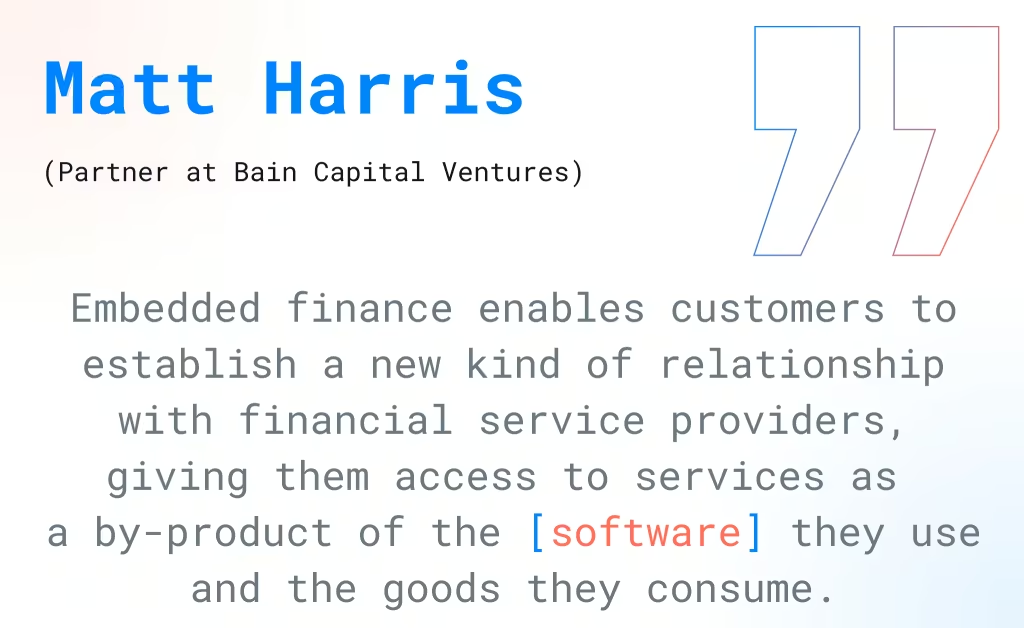
"Embedded finance is the integration of financial services into non-financial offerings. Examples of embedded finance include an e-commerce retailer providing insurance, a coffee shop app enabling one-click payments, or a branded credit card from a department store."
– said Tom Sullivan, The Director of Product at Plaid. However, as technology advances, the need for maintaining the highest quality and security standards for these systems also grows.In this article, we will examine how superiority and testing fuel innovation in fintech, the challenges faced by companies implementing embedded systems, and why testing is essential for building user trust and ensuring the long-term market value of financial products.
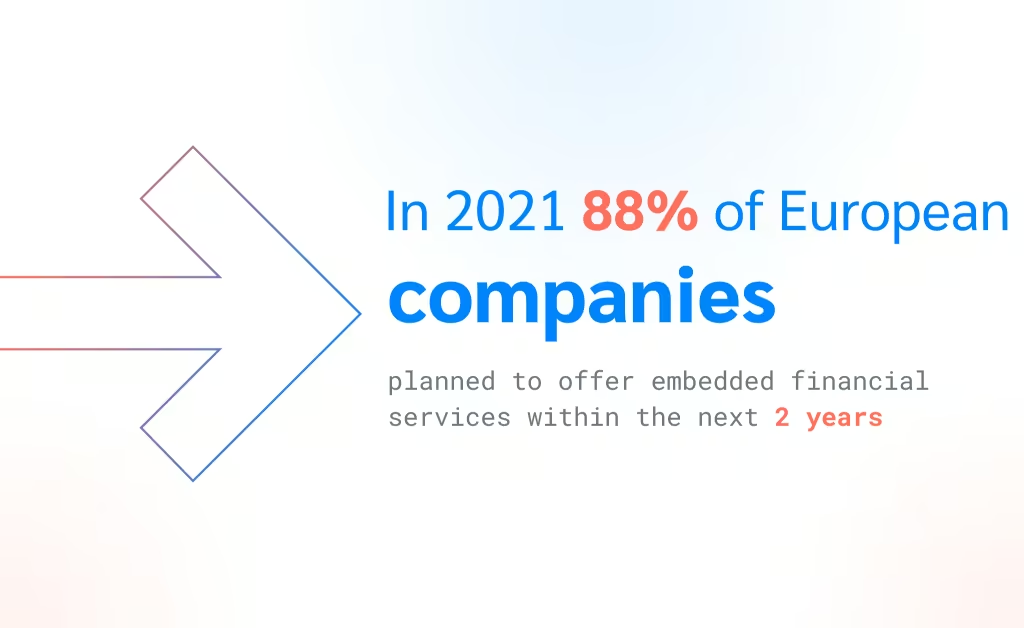
Based on embedded systems, modern payment terminals streamline fast and secure transactions with cards or mobile devices. POS terminals have dedicated microprocessor units that perform authorization operations and process payments in real time. These devices have undergone significant evolution with the integration of financial sector, and their functionality now extends far beyond simple transaction handling. According to Statista Research Department in 2021, 88% of European companies planned to offer embedded financial services within the next two years, indicating growing interest in this business model. One of the key technologies used in contactless payments is NFC (Near Field Communication), which allows transactions to be completed via short-range communication between devices (e.g., a POS terminal and a card or smartphone).
Integration with mobile payment apps like Google Pay, Apple Pay, and Samsung Pay accelerates the shift to a cashless future. Embedded-system-equipped POS terminals can support mobile payments, carried out using virtual payment cards stored on mobile devices.
Modern POS terminals can connect with other devices, such as cash registers or inventory systems, through Bluetooth and Wi-Fi. They can also be integrated with cloud services, allowing transaction data to be transmitted in real-time to central databases.
Nowadays, ATMs are complex devices where embedded systems integrate various modules, working together to ensure smooth operation. The fundamental components include:
Self-service financial machine use more advanced embedded systems that allow various financial operations without personnel involvement. These devices combine the functionalities of ATMs, cash deposit machines, and even multimedia terminals, making them versatile and appealing to customers.
Moreover, IoT devices and smart sensors equipped with embedded systems are used to monitor the value of assets that serve as loan collateral, such as leased machinery or real estate. These systems collect data on the technical condition and location of collateral assets, enabling traditional financial institutions to assess the risk associated with individual assets.
Example: In the leasing of machinery or commercial vehicles, embedded systems track their location, technical condition, and usage intensity. This information can be automatically transmitted to risk management systems, allowing banks and leasing companies to dynamically adjust credit or collateral conditions based on the current state of the assets.
Predictive Software: Based on sensor data, embedded systems can predict potential failures or maintenance needs. This helps minimize the risk of asset depreciation and optimizes maintenance schedules, which is valuable in managing credit risk.
Blockchain relies on a decentralized database that stores transaction information in immutable blocks. Embedded systems play a crucial role in the secure storage and real-time processing of this data, which is essential for maintaining transaction integrity and transparency.
See also:
Testing Embedded Software: Ensuring Quality and Reliability
Common Challenges in Embedded Software Testing and How to Overcome Them
Quality Attributes in Embedded Systems: How to Build Reliable and Resilient Devices
Testing embedded systems within the fintech sector require advanced and varied methods capable of meeting the unique demands of financial services, including reliability, security, and regulatory compliance. Below are some of the significant types of tests used in fintech and their roles in ensuring top quality and security for financial technology.
Functional testing in fintech applications is a foundational step to ensure that every system function operates as expected, free of errors. This type of testing focuses on the accuracy and reliability of essential features like transaction processing, authentication, and integration with external payment systems.
Fintech systems must maintain high performance and stability even under heavy load, which is especially critical during peak times such as market openings or holiday periods. Performance and load testing allow teams to assess system behavior under different levels of demand.
Fintech systems are frequent targets of cyberattacks, making security testing a critical component in development and maintenance. Security is paramount, and these tests aim to identify and resolve any vulnerabilities before they can be exploited.
Compliance with legal and industry regulations is essential in fintech, which is subject to strict rules, such as anti-money laundering (AML) and know-your-customer (KYC) requirements. Non-compliance can lead to costly penalties and reputational damage.
In fintech systems, every update, bug fix, or new feature requires thorough testing to ensure that it doesn’t introduce new errors. Regression testing is particularly crucial, as any change in a complex embedded system can impact its stability and reliability.
Reliability is a vital aspect of fintech systems, especially for ATMs, mobile payment points, and other self-service devices that require uninterrupted availability 24/7. Stability testing verifies the system's ability to operate continuously without failure.
Fintech is not the only regulated sector where documented test evidence decides whether a device can ship. The same discipline governs embedded systems in medical devices, where every firmware release has to carry proof of functional and safety testing before it reaches a patient.
Read more about quality attributes in embedded systems.
Payment devices fail certification when functional, security and regression testing are planned as three separate exercises. We build one strategy across the whole device.
Embedded systems in the fintech sector are becoming increasingly advanced, responding to growing demands for security, efficiency, and scalability within financial services. One of the emerging trends is edge computing. In the financial sector, where every millisecond counts, edge computing allows operations and data processing to occur directly on the device, such as an ATM or a payment terminal, reducing dependency on network connectivity and minimizing latency. This solution is essential for improving transaction response times and optimizing the costs associated with transferring and processing large volumes of data in the cloud.
Cybersecurity in embedded systems remains an absolute priority, especially given the rise in cyberattacks targeting the financial services. New embedded solutions are increasingly leveraging end-to-end encryption directly at the device level to protect user data from tampering. The use of homomorphic encryption and secure boot technology is becoming more widespread, ensuring software integrity at the embedded level. With secure boot, devices can only start up with trusted, authorized components, reducing the risk of running malicious software.
Digital identity, enabling users to authenticate securely and seamlessly, is another crucial aspect of future systems. These embedded finance solutions require support from advanced biometric methods, such as facial recognition and fingerprint analysis, which are integrated directly into devices like POS systems and self-service terminalss. The high level of security in these systems is achieved through dedicated security processors that not only handle biometric data but also provide complete isolation for authentication data, ensuring a robust security framework.
We develop and test firmware for devices where a failed transaction is a compliance event rather than a bug ticket. Ask how we structure the test suite and the evidence.
The future of fintech, powered by the development of embedded systems, looks promising. Following this path, it has the potential to improve the daily lives of millions by introducing technologies that make finance more accessible, intuitive, and trustworthy. From both present and future perspectives, the role of quality and testing will be the foundation of the industry’s continued success, driving innovation and ensuring a world where finance becomes even smarter and more secure.
InTechHouse is a company that not only specializes in embedded systems but also offers a wide range of technology services tailored to the needs of modern businesses. With a team of experienced engineers and experts from various fields, InTechHouse supports clients throughout the entire lifecycle of creating innovative products – from software design and IoT solutions to advanced mobile and web applications.
We prioritize a comprehensive approach that also includes technology consulting, market analysis, and process optimization, allowing us to help your business fully harness the potential of digital transformation. Contact us to discover how we can achieve your technology goals together!
Not sure where to start? We work with companies at every stage, from early ideas to enterprise-level builds. A 30-minute call can save you months of guesswork.
Test automation speeds up the testing process, allowing for faster error detection and reducing the time needed to introduce new features. Automated tests are more efficient, enabling more frequent testing and quick adaptation to changes, which is crucial in the dynamic fintech environment.
Testing in fintech is costly, but these expenses are minimal compared to potential losses from errors. Sometimes a minor oversight can cost millions, so investment in testing, especially in critical areas like security, is absolutely worthwhile.
The most frequently detected issues are compatibility problems with other systems, data encryption errors, user authorization issues, and performance vulnerabilities under high traffic loads. Eliminating such errors is essential to avoid disruptions and potential risks.
Fintech companies often utilize open-source tools but add additional layers of security and audits to minimize risk. Testing with open-source solutions requires specific security procedures, but it can be effective and reduce operational costs.
Adam Szychulec is Deputy CTO at InTechHouse and an electronics and embedded systems engineer with over 13 years of experience in hardware development, FPGA-based systems, embedded software, and technical leadership.
He specializes in electronic system architecture, analog and digital PCB design, FPGA and SoC development, embedded C/C++ software, and managing the complete lifecycle of complex engineering products - from early feasibility studies and technical architecture through development, testing, production introduction, and product modernization.
Adam has extensive experience leading multidisciplinary R&D teams and coordinating electronics, embedded software, mechanical engineering, testing, and project delivery. His responsibilities have included technical decision-making, project planning, risk and change management, budgeting, product testing, new product introduction, and mid-life upgrades of existing electronic systems.
His project experience includes FPGA modules for space applications, electronic systems and payloads for unmanned aerial vehicles, environmental monitoring and multispectral imaging platforms, power electronics, DC-DC converter assessment, and embedded systems developed for demanding industrial and defence-related applications.
Adam works with FPGA and SoC platforms, Xilinx Zynq, VHDL, Vivado, Altium Designer, ARM microcontrollers, embedded C/C++, Linux, digital electronics, and power electronics. He holds bachelor's and master's degrees in Electrical Engineering and is an IPC Certified Interconnect Designer. He writes about FPGA architectures, electronics design, embedded systems, hardware product development, technical risk management, UAV electronics, power electronics, and engineering leadership.
From first prototype to production, our engineers can help you scope it, build it and get it certified.
This initial conversation is focused on understanding your product, technical challenges, and constraints.
No sales pitch - just a practical discussion with experienced engineers.
Share a few details about your product and context. We’ll review the information and suggest the most appropriate next step.