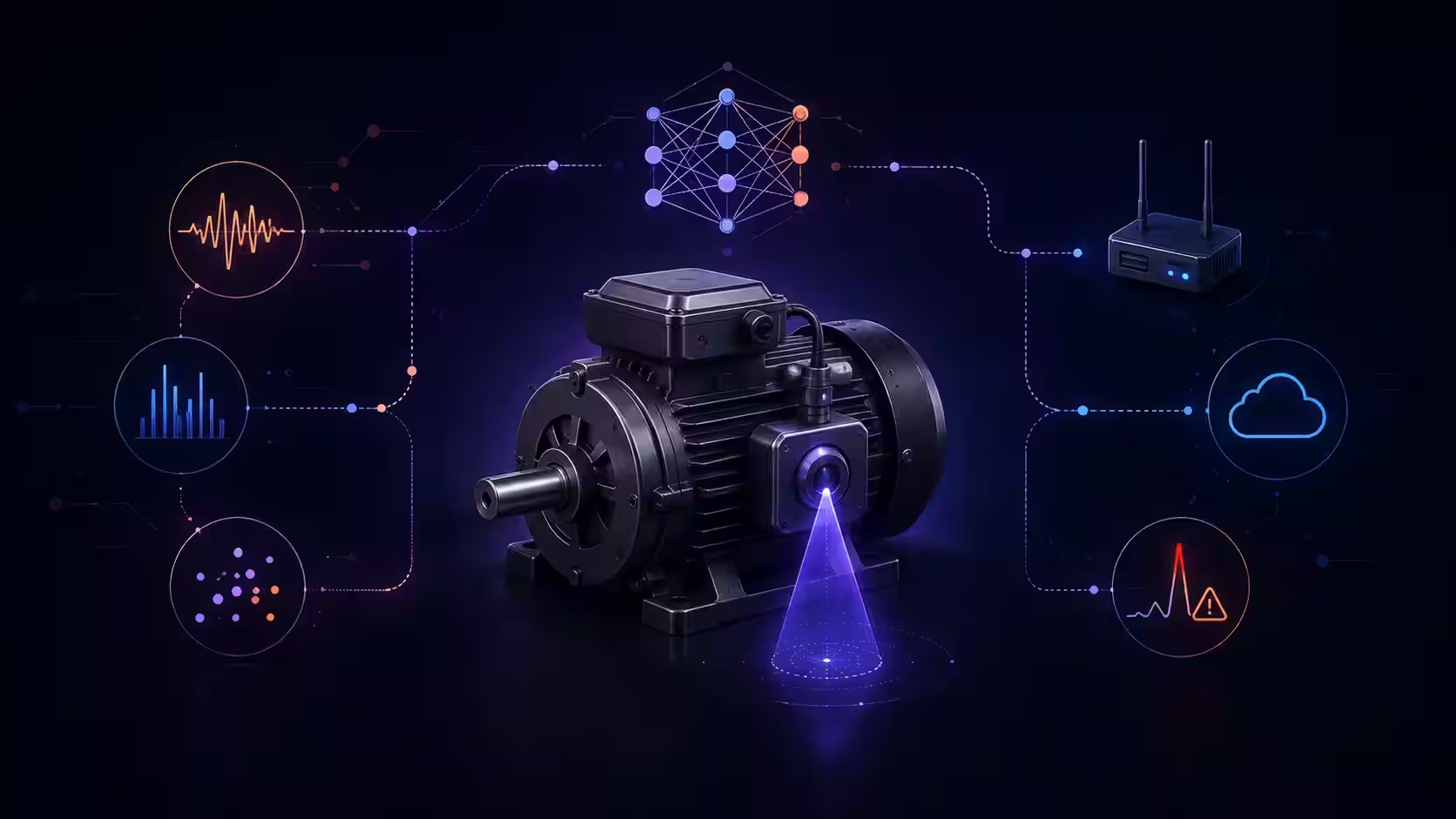

AI CCTV threat detection is software that analyzes camera feeds in real time to flag specific threats. On the edge, that definition means no cloud round-trip, no latency tax, and no raw footage leaving the building. This guide focuses on three threat classes that matter most in crowded public and transit spaces: aggression and violence, weapons, and abandoned objects. All three run on-device, on embedded AI camera systems, where the constraint is not bandwidth but compute budget and real-world accuracy under crowd and occlusion.
Key Takeaways
Legacy CCTV cameras record. AI security cameras analyze. That single difference changes what security teams can realistically do with a camera estate.
A conventional CCTV system captures video footage and stores it. Someone has to watch it live, or review it after an event. An AI camera system applies computer vision to every frame in real time, classifying what it sees and generating alerts when something matches a defined threat pattern. AI security camera systems can detect anomalies and improve security operations in ways that a non-AI-powered security camera system cannot. They can differentiate between humans, vehicles, and objects without a human in the loop, and artificial intelligence transforms traditional CCTV into active, automated security systems that act on what they see.
The core components of an AI camera system are: a camera with sufficient resolution and frame rate for the target use case; an AI inference engine (either onboard the camera, on an edge server near the camera cluster, or in a cloud back-end); a trained computer vision model for each threat class; an alert delivery layer (push notifications, VMS integration, control room dashboard); and a data pipeline for logging detections and managing model updates.
Security camera systems vary widely in where inference runs. In edge-based architectures, the AI model runs on hardware inside or adjacent to the camera. In cloud-based architectures, video streams travel to a remote server for analysis. For threat detection in public and transit spaces, where latency and privacy are both constraints, edge deployment is the more defensible choice.
Object detection is the foundation of every AI CCTV capability. Before the system can detect a threat, it must detect and locate objects in the frame, draw bounding boxes around them, and classify each one. That classification step is what lets AI cameras reduce false alarms: instead of alerting on any motion, the system alerts only when a classified object or behavior matches a defined threat pattern.
Beyond detection, production systems need three additional capabilities. Object tracking maintains identity across frames, following a person through a scene even when they briefly disappear behind a pillar or merge with a crowd. Behavior analysis interprets sequences of detections over time, classifying motion patterns as normal or suspicious. And alert generation packages the detection output into a structured notification that tells an operator what happened, where, when, and with what confidence.
The three threat classes covered in this article (aggression, weapons, and abandoned objects) each sit at a different point on the capability stack. Abandoned object detection requires object tracking as a prerequisite. Weapon detection is a pure small-object detection problem. Aggression detection sits at the behavior analysis layer, requiring pose estimation and action recognition on top of basic detection. Each has distinct model requirements, performance characteristics, and deployment challenges.
One-stage detectors (YOLO family, EfficientDet) process the entire image in a single pass and deliver real time inference at 30–100 FPS on embedded hardware. Two-stage detectors (Faster R-CNN) run a region-proposal step first, improving accuracy on small or partially occluded objects at the cost of speed. For threat detection in live video, one-stage models are the practical default because latency matters; two-stage models are useful for post-event forensic analysis where speed is not the constraint.
Model choice matters significantly for detection accuracy. Different types of threats require different architectures and training sets. A fine-tuned YOLOv11 model achieves an mAP@0.5 of 86.44% on surveillance datasets after domain-specific fine-tuning (PMC, 2025). A YOLOv8 model can detect small objects in surveillance scenes with 85.8% accuracy on a purpose-built airport dataset (PMC, 2025). Both figures are dataset-specific and will vary against a different operating environment.
Small-object performance is the critical metric for transit and public-space deployments. A weapon or a small bag in a crowded frame may occupy fewer than 100 pixels. Standard models trained on general datasets fail at this scale. Tiling inference approaches (SAHI: Slicing Aided Hyper Inference) improve small-object recall by running the model on overlapping crops of each frame and merging results, at the cost of increased compute per frame. See small object detection with SAHI for implementation specifics.
Aggression and violence detection is not an object detection problem. A person raising their arm to throw a punch looks superficially similar to a person waving goodbye. Distinguishing the two requires pose estimation: extracting a skeletal keypoint representation of each person in the frame, followed by action recognition that classifies sequences of poses as aggressive or non-aggressive behavior.
This threat class requires a temporal model, not just a frame-level classifier. A single frame rarely contains enough information to classify an action as violent. The model processes a sliding window of frames, tracking how poses evolve over time, and triggers an alert when the sequence crosses a threshold for suspicious behavior. Behavioral analysis tracks movement patterns (speed of motion, proximity between people, directionality of limb movements) to identify potential threats before a physical confrontation becomes visible to the naked eye.
AI security cameras can provide reliable support to security teams, helping to detect and capture threats that an operator may have missed. In practice, aggression detection models tuned for a transit environment must be trained on data from that environment: platform altercations look different from retail confrontations, and lighting conditions in a tram cabin differ from a station concourse. A model that achieves high recall in one setting may under-perform significantly in another without domain-specific fine-tuning.
See human pose estimation and action recognition for the technical pipeline.
Weapon detection in CCTV is fundamentally a small-object detection problem. A handgun in a crowded frame may occupy 30–80 pixels in a 1080p image. A knife may be partially occluded by a person's body. The object is rare, small, and often moving. That is precisely the combination that causes standard detection models to fail.
The false-positive challenge is equally severe. Detect too many non-weapons as weapons and the system generates constant false alarms that erode operator trust and lead to alert fatigue. Detect too few real weapons and the system fails at its primary purpose. High recall on a rare, high-stakes event is the design requirement. A missed weapon is a worse outcome than a false alarm, but excessive false alarms make the system operationally unviable.
Practical weapon detection CCTV deployments manage this tension through threshold tuning per camera and environment, anomaly-based escalation (flag any small, hand-held object for human review rather than attempting to classify as weapon or not-weapon with a binary output), and human-in-the-loop review for flagged potential threats before any physical response is initiated.
YOLOv11-based weapon detection systems using pre-trained CNN models have achieved mAP scores of 91.73% in research settings under controlled conditions (JETIR, 2025). Performance in live deployment against the full distribution of small objects in a real transit environment will be lower. See small object detection with SAHI for tiling strategies that improve small-object recall.
Abandoned baggage detection sounds straightforward: find objects that appear in the scene and remain stationary after their owner leaves. In a low-traffic environment with a static background, it is straightforward. In public spaces with high crowd density, it is one of the hardest problems in applied computer vision.
Crowded environments complicate abandoned-luggage detection in several compounding ways. High crowd density makes it difficult to track luggage ownership: when a bag is set down in a crowded area, dozens of people move past it within seconds, and the system must maintain the association between a specific person and that specific bag despite the intervening motion. Small objects are often obscured in crowded scenes by the legs, bags, and bodies of passing passengers. Real-time tracking of luggage is hindered by overlapping movements that cause the tracking algorithm to lose or swap identities. Detection accuracy decreases significantly in densely populated areas because the background model cannot distinguish between a stationary bag and a temporarily stationary person.
The practical pipeline for abandoned-object detection has three stages: detect and track all objects in the scene; maintain an ownership association between each portable object and the nearest person who interacted with it; trigger an alert when the association breaks and the object remains stationary beyond a configurable time threshold. Each stage introduces failure modes that accumulate in crowds.
For crowd density measurement as a prerequisite input, see passenger counting with edge AI.
Facial recognition identifies individuals from a database of stored face embeddings by comparing detected faces in live video footage against enrollment records. License plate recognition reads vehicle plates in real time for access control, parking enforcement, or vehicle tracking purposes. Both capabilities are technically adjacent to the three threat classes covered in this article, but carry significantly heavier compliance weight.
Facial recognition and license plate recognition require explicit legal basis for processing personal data. In the EU, processing biometric data (which includes facial recognition output) requires either explicit consent or a specific legal basis under GDPR Article 9. License plates are personal data under most interpretations of GDPR. Data-retention limits for both face and license plate data must be defined before deployment, not after. The accuracy threshold required for operational use is higher than for detection-only applications, particularly for facial recognition that might trigger an access control or security response, because false matches have direct consequences for individuals wrongly flagged.
Legitimate use cases include access control at critical infrastructure sites (using enrollment of authorized personnel), and vehicle management at controlled-access depots. Privacy-preserving mitigations include matching on-device and never storing raw face images, logging only match events with audit trails, and enforcing strict retention periods on enrollment data. Verify current applicable regulations with legal counsel before any deployment of facial recognition or license plate recognition capabilities.
The generic vendor CCTV pitch describes environments that are nothing like a busy tram station at rush hour. Production threat detection in public spaces faces four compounding problems that each degrade accuracy independently and interact to degrade it further.
In a densely crowded scene, objects of interest are partially or fully hidden behind other people for significant portions of their dwell time. A person concealing a weapon under a coat is visible only in fragments. A bag on the floor is invisible when someone stands in front of it. Standard detection models trained on uncrowded benchmark datasets fail to generalize to these conditions without retraining on representative crowded data from the specific environment.
A camera covering a 20-meter platform section at 1080p allocates approximately 50–100 pixels to a bag on the floor at the far end of the platform. Detection models need sufficient pixel density to extract discriminating features. At 50 pixels, even state-of-the-art small-object detection approaches struggle. Camera placement and focal length selection are engineering choices that determine whether the detection problem is even solvable.
Cabin cameras on trams and trains use fisheye or wide-angle lenses to maximize coverage with a single device. Those lenses introduce radial distortion that makes straight lines appear curved and alters the apparent size and shape of objects at the frame periphery. Standard detection models produce unreliable bounding boxes on distorted images. Dewarping before inference corrects this at the cost of a preprocessing step and additional compute. See fisheye dewarping for computer vision.
A model that achieves strong detection accuracy in daylight degrades significantly in the different scenarios it faces across a 24-hour operating cycle: sodium-vapor platform lighting, direct headlights at night, mixed natural and artificial light in covered stations. The training dataset must represent the full distribution of lighting conditions the system will encounter in deployment. For the full picture of computer vision in transit environments, see computer vision for rail and public transport.
The headline claim for AI CCTV in security operations is false alarm reduction. AI-powered security cameras have been shown to reduce false alarms by up to 90% compared to traditional motion-detection-based systems, which produce 90–95% fewer false alarms because AI classifies objects before alerting, so trees, shadows, rain, and animals do not trigger notifications.
The mechanism matters as much as the number. Legacy motion detection triggers on any pixel change above a threshold. AI classifies what caused the motion before deciding whether to alert. A person walking normally on a platform does not trigger a threat alert. A person exhibiting aggressive posture toward another person does. That classification step is what allows security teams to shift from reactive alarm-chasing to proactive incident management.
Enhanced security follows from that shift. After about twenty minutes of observing a single screen, operators may lose up to 95% of their attentional focus, meaning behavioral precursors can go unnoticed. AI surveillance eliminates this failure mode: the system monitors 24/7 without fatigue, maintaining consistent detection accuracy across the full shift. Improved productivity for security teams follows directly: with fewer false alarms to chase, operators focus on real potential threats. AI also speeds up post-incident investigation by indexing video footage with searchable metadata (event type, location, timestamp, confidence score) so investigators can retrieve relevant clips in seconds rather than reviewing hours of recording.
AI cameras can integrate with other security technologies for enhanced safety, including access control systems, alarm panels, and public address systems, enabling a coordinated response that scales across a large camera estate without proportionally scaling the security team.
Stations, platforms, trams, and buses are the highest-density public spaces most operators manage. AI cameras cover threat detection (aggression, weapons, abandoned bags), crowd density monitoring, and perimeter security at access points. Situational awareness across a large estate improves when every camera feeds into a unified alert layer rather than requiring individual monitoring.
Power stations, water treatment facilities, transport hubs, and data centers use AI cameras for perimeter intrusion detection and tailgating at access-controlled entry points. Real world applications in this sector prioritize reliability over novelty: the system must operate continuously without false alarms that cause operators to disable or ignore it.
Office buildings use AI CCTV for after-hours intrusion detection, reception area monitoring, and parking access control with license plate recognition. Retail deployments add loss-prevention use cases: detection of concealment behavior, customer behavior analysis for layout optimization, and queue monitoring.
Hospitals use AI cameras for patient fall detection, restricted area access monitoring, and behavioral monitoring in mental health units. The combination of sensitive patient data and high compliance requirements makes on-device processing particularly important in this setting.
Automated license plate recognition at depot and facility entrances reduces the manual access control burden. Perimeter cameras detect fence crossings and loitering at transport infrastructure boundaries where staffing is impractical.
Before specifying hardware or software, four implementation variables determine the architecture:
A single 1080p camera at 4 Mbps generates roughly 1.8 GB per hour of raw video. A 100-camera system generates 180 GB per hour. Streaming all of that to a cloud analytics platform is expensive and bandwidth-intensive. On-device processing cuts the video stream to structured alert records (kilobytes, not gigabytes) and short clips around flagged events. Security operations centers receive alerts, not raw footage.
Edge AI inference for real-time threat detection requires a compute unit capable of running detection models at 10–30 FPS minimum. For a single-camera application, a Raspberry Pi-class device with a connected NPU may suffice for lightweight models. For multi-camera aggregation, an NVIDIA Jetson Orin or equivalent embedded platform handles 4–8 camera streams simultaneously. Existing CCTV cameras with 2MP+ resolution and H.264/H.265 encoding can be retained and processed by an edge server, avoiding a full camera replacement.
AI cameras at the capable end of the market cost $200–$600 per camera above standard-grade hardware. Edge server hardware for a 16-camera cluster runs $2,000–$8,000 depending on compute specification. Against that, the operational savings from reduced false alarm investigation labor and faster incident response typically justify the investment within 12–18 months for high-volume security operations.
An architecture that handles 10 cameras should handle 100 without a redesign. Edge server clusters can be added incrementally as the camera estate grows. Alert management and VMS integration must be specified to handle the full future estate, not just the initial implementation.
Video footage of identifiable individuals is personal data under GDPR and most equivalent frameworks globally. The obligations that follow cover collection (lawful basis), retention (defined limits), access (audit logging), and cross-border transfer (data sovereignty constraints).
For threat detection use cases in public and transit spaces, the most defensible architecture processes video on-device and transmits only structured alert metadata, never raw footage. Sensitive data stays on the device. Access control to the alert management system must be role-based, with audit logs recording who accessed what and when.
Anonymization for non-identification use cases (crowd density, passenger counting, abandoned object detection) should be implemented by design: process to extract behavioral signals, discard the underlying video without storing it. Where raw footage must be retained for evidence purposes, retention periods must be defined (typically 30–72 hours for routine CCTV, longer for retained incident clips) and enforced automatically.
Data privacy obligations for facial recognition are more stringent than for standard video analytics. Biometric data processing requires explicit legal basis, and in many jurisdictions, explicit consent from individuals, which is impractical in a public transit environment. Verify specific regulatory requirements applicable to the operating jurisdiction with legal counsel before any facial recognition deployment.
AI threat detection does not replace a security system; it layers into one. The integration surface covers:
Existing CCTV cameras feed into a VMS. AI alerts should appear in the same operator interface, not a separate tool. Standard integration protocols include ONVIF for camera connectivity and RTSP for video streams. Most enterprise VMS platforms (Milestone, Genetec, Hanwha) expose SDK or webhook integrations for AI analytics events.
AI camera systems that detect a security event can trigger access control responses: lock a door, trigger an alarm, or alert a response team at a specific location. The integration requires a defined event-action mapping and a secure API between the AI analytics layer and the access control platform.
Alert events from AI cameras feed into the broader security operations technology stack: PSIM platforms, SOC dashboards, incident management systems. Specifying the data format and delivery mechanism (REST API, MQTT, ONVIF event) before procurement avoids integration work after deployment.
Interoperability with existing CCTV cameras is a frequently underestimated project risk. Cameras from different generations and manufacturers vary in stream format, resolution, frame rate, and encoding parameters. A pre-procurement camera survey that documents existing infrastructure is the first step toward a realistic integration scope.
Edge inference, whether it happens on-device or on an edge server, holds latency to roughly 20 to 100 milliseconds and stays deterministic. Cloud inference runs slower and less predictably, typically landing somewhere between 100 and 500+ milliseconds depending on network conditions.
Network dependency looks different too. Edge inference needs no connection at all once the model is deployed. Cloud inference needs a live connection for every single frame it processes.
Privacy follows the same split. Footage stays on the device with edge processing, while cloud processing sends raw video across the network to get analyzed.
Bandwidth cost reflects that same pattern: edge deployments send only alert metadata, while cloud deployments push the full video stream over the wire, which adds up fast at scale.
Scalability works differently for each. Edge scales linearly with the amount of hardware deployed. Cloud scales elastically, but that elasticity gets expensive as camera count grows.
Model updates also diverge. Edge devices need OTA delivery pushed out to the fleet. Cloud systems update centrally, which is a simpler pipeline to manage but comes with the tradeoffs listed above.
For transit and public-space deployments, edge architecture is the default for real-time threat detection. The cloud role is model training, retraining on accumulated data, alert aggregation across sites, and fleet monitoring. See edge AI vs cloud AI for a full technical comparison.
An alert is only as useful as the response it enables. A well-designed alert escalation path defines: who receives the alert (control room operator, nearest security officer, automated system), by what channel (VMS popup, push notification, audio alarm), with what information (event type, camera ID, confidence, video clip), within what time target. Critical events (weapon detection, active violence) should draw the operator's attention immediately via visual and audio notification simultaneously, not require a dashboard refresh. Evidence collection for chain-of-custody must capture the original detection clip, the alert record, and the access log showing who viewed the footage, in a tamper-evident format. See explainable AI for safety alerts for the operator trust layer.
A threat detection system that performs well in the lab and poorly in the field is a system that was not tested in the right conditions. Test plan design must reflect the actual deployment environment.
Test across the full range: daylight, overcast, dusk/dawn transition, artificial indoor lighting, mixed light sources, low-light with IR illumination. Detection accuracy drops across different scenarios as lighting changes, and the drop is rarely linear. Lighting variation is just as unforgiving outdoors, where AI collision avoidance in light rail has to hold detection accuracy through tunnel entries and night running.
Run test scenarios with progressively increasing crowd density. Measure detection rates and false positive rates at 10%, 30%, 50%, and 80%+ frame occlusion. Identify the density threshold above which performance degrades below the operational requirement. Design deployment (camera placement, resolution, scene coverage) to keep real operating conditions within that threshold.
Test adversarial cases: weapons partially concealed under clothing, aggressive behavior that begins slowly and escalates, abandoned bags quickly retrieved and re-abandoned. These edge cases reveal failure modes that standard benchmark datasets do not surface.
If the system operates 24 hours in all weather, it must be tested in rain, fog, and darkness before deployment, not after the first operational failure.
The target true positive rate per threat class sits above 95 percent, validated against a representative test set. False positive rate should stay under 2 alerts per camera per shift; a higher rate points to alert fatigue, while a lower rate often signals a miscalibrated threshold. Mean time to detect should come in under 5 seconds from event onset, a figure confirmed through field testing rather than lab conditions. Mean time to respond should stay under 60 seconds from alert to action, though this depends heavily on alert delivery mechanisms and staffing levels. False alarm reduction compared to a legacy motion-detection baseline should exceed 80 percent.
Continuous monitoring of inference performance is not optional. A model deployed to a production camera estate drifts against the real-world data distribution over time: lighting changes with seasons, new objects appear in scenes (new furniture, changed signage), and the population of people in the space changes. Detection accuracy that was validated at deployment will degrade without active management.
Continuous monitoring of inference performance is not optional. A model deployed to a production camera estate drifts against the real-world data distribution over time: lighting changes with seasons, new objects appear in scenes (new furniture, changed signage), and the population of people in the space changes. Detection accuracy that was validated at deployment will degrade without active management.
At minimum, review false positive rates and missed detection rates monthly from operational telemetry. Schedule a formal retraining cycle quarterly or when the false positive rate exceeds the operational threshold. Each retraining cycle requires new labeled examples from the deployment environment, not just the original training dataset.
Model updates to edge devices must be delivered over OTA pipelines with signed artifacts and rollback capability. Security operations teams must be notified of model updates and the expected change in behavior. A new model version that changes the false alarm rate without warning will erode operator trust faster than the original performance problem did.
For tooling and pipeline architecture, see MLOps for deployed edge devices.
AI CCTV threat detection has moved from research to operational deployment across real world applications in public safety, retail, and transport. London's Metropolitan Police has piloted AI-assisted CCTV analysis for weapon detection at high-footfall events. Singapore's Land Transport Authority uses AI cameras across the MRT network for crowd density monitoring and behavioral anomaly detection. Retail chains in the US and Europe have deployed abandoned-object detection in high-value storage areas and customer-facing spaces.
Across these deployments, a consistent pattern holds: AI surveillance enhances security most visibly in the reduction of per-operator workload and the improvement of situational awareness at large-camera-count sites where human monitoring of every feed is structurally impractical. The video footage generates more intelligence per hour once AI is classifying it continuously.
InTechHouse case study: Onboard behavior detection in transit CCTV
InTechHouse deployed an onboard AI CCTV behavior detection system for a tram operator in partnership with one of the largest Polish manufacturer of rail vehicles. The system ran entirely on embedded edge hardware inside the vehicle, processing cabin camera feeds in real time without transmitting video footage to any external system.
The deployment environment presented the core public-space challenge: a crowded cabin with partial occlusion of passengers, wide-angle camera lenses introducing fisheye distortion, and variable lighting across indoor and outdoor sections of the route. The detection model was fine-tuned on data from this specific operating environment to handle these conditions, replacing a generic model that produced an unacceptable false alarm rate in initial testing.
False positive management was as central to the design as detection recall. The system was tuned so that security alerts routed to the control room represented credible potential threats, not background noise from normal passenger behavior. Alert metadata (event type, timestamp, camera position, confidence score) was transmitted over the network; raw video footage stayed on the device. The final system operates continuously across the vehicle's operating hours without requiring a human to monitor every feed.
Edge AI hardware efficiency is improving faster than threat sophistication. The NPU generation shipping in 2025–2026 delivers roughly twice the inference throughput at the same power draw as 2023 hardware, which means detection models that previously required a dedicated edge server can run on a camera-attached compute module. More capable models within the same power budget means better detection accuracy in the difficult conditions (crowds, occlusion, low light) where current deployments show the most weakness.
Drone integration for extended situational awareness is moving from military and law enforcement into commercial and transit security in recent years. A drone that responds to a camera alert by providing an elevated view of a developing incident gives the security team context that fixed cameras cannot: crowd flow around an event, the number of people involved, exit routes being used. The emerging threats this combination addresses, including coordinated disruption across a transit network, require exactly this kind of multi-sensor response. Artificial intelligence coordinates the fixed and mobile sensors, assigns events to the most relevant observation platform, and synthesizes feeds into a single operational picture for the security team.
Buyer checklist: mandatory spec checks before procurement
See how we build edge AI for on-device video analytics
Not sure where to start? We work with companies at every stage, from early ideas to enterprise-level builds. A 30-minute call can save you months of guesswork.
AI CCTV threat detection is software that analyzes video footage from security cameras in real time to identify specific threat types (aggression, weapons, abandoned objects) and generate alerts without requiring a human operator to watch every feed. On an edge system, this analysis runs on hardware at or near the camera, so detection happens in milliseconds and raw footage never crosses the network.
Yes, with the right model and deployment approach. Weapon detection CCTV uses small-object detection models, often with tiling inference to improve recall at low pixel counts. Violence detection AI uses pose estimation and action recognition to classify behavioral sequences as aggressive, operating on a sliding window of frames rather than individual images. Both require domain-specific training data and threshold tuning for the target environment to achieve operationally useful false positive rates.
The system detects and tracks all objects in the scene, maintains an ownership association between portable objects and the people who interacted with them, and triggers an alert when that association breaks and the object remains stationary beyond a defined time threshold. In public spaces, the hardest part is maintaining tracking through crowd occlusion, where passing people temporarily hide both the object and its owner.
Yes, but accuracy is lower in crowded scenes than in open environments, and the gap between lab benchmarks and field performance is larger. Detection accuracy decreases in densely populated areas due to occlusion, reduced object pixel count, and high background activity. Deployments in crowded public spaces require models fine-tuned on representative crowd data, camera placement optimized for scene coverage, and false positive thresholds tuned to the ambient activity level of the specific location.
Yes. In an edge architecture, inference runs on hardware at or near the camera. The video stream is analyzed locally and only structured alert records (event type, location, timestamp, confidence) are transmitted. Sensitive raw video footage stays on the device and is subject to local retention policies. This is the primary privacy advantage of edge over cloud AI CCTV: no raw footage crosses an external network, which directly addresses GDPR obligations around data minimization and cross-border transfer.
Damian Ledziński, PhD Eng., is an Applied Artificial Intelligence Expert and an Assistant Professor at Bydgoszcz University of Science and Technology. He has over 15 years of academic, research, software-engineering, and technology-development experience.
His work focuses on applying artificial intelligence, machine learning, deep neural networks, and data science to complex real-world systems. His principal research and engineering interests include autonomous unmanned aerial vehicles, drone navigation and swarm intelligence, biomedical engineering, medical signal and image analysis, predictive modeling, industrial IoT, and intelligent water-management systems.
Damian has contributed to multidisciplinary R&D initiatives including AI-assisted medical diagnostics, a Polish ventilator prototype, autonomous indoor drone systems for warehouse inventory, AI-supported water-consumption analysis, virtual medical assistants, and intelligent systems combining embedded devices with machine-learning models.
He is the author or co-author of more than 30 scientific publications. His work has appeared in international scientific publications covering artificial intelligence, biomedical engineering, signal analysis, autonomous systems, environmental monitoring, and data-driven infrastructure.
Damian is a co-creator of academic programs in Engineering in Medicine, AI in Medicine, and Data Science at Bydgoszcz University of Science and Technology. He combines scientific research with hands-on implementation, translating experimental AI methods into deployable technology. He writes about applied AI, machine learning, predictive analytics, autonomous UAV systems, AI in medicine, biomedical signal processing, industrial IoT, and intelligent models in real-world systems.
Damian Ledziński's academic profiles:
https://wtie.pbs.edu.pl/pl/pracownik/damian-ledzinski
https://www.researchgate.net/profile/Damian-Ledzinski
https://scholar.google.pl/citations?user=AlQpPB0AAAAJ&hl=pl
https://ludzie.nauka.gov.pl/ln/profiles/DN6pHXU6KZm/publications/f83a8833-6060-4fae-8628-3dbf57661394
From first prototype to production, our engineers can help you scope it, build it and get it certified.
This initial conversation is focused on understanding your product, technical challenges, and constraints.
No sales pitch - just a practical discussion with experienced engineers.
Share a few details about your product and context. We’ll review the information and suggest the most appropriate next step.